
Category: Fieldcraft
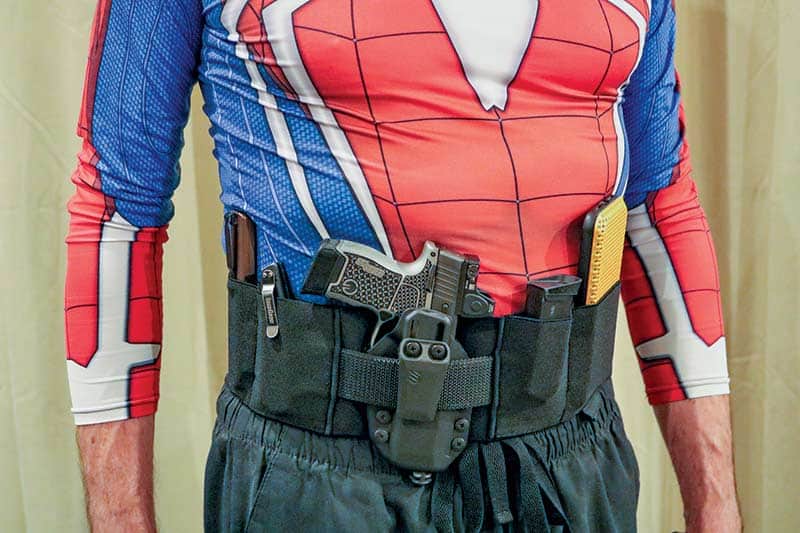
Note how all this rides above the belt. Any shirt will conceal it all.
If you found yourself in the suck, what sort of defensive weapon would you like to have handy? I’m thinking maybe an HK 416 or perhaps an M249 Para SAW with a truckload of ammo. While we’re dreaming, let’s make it a platoon of M1A2 SEP Abrams tanks and Close Air Support stacked up to the International Space Station. However, none of that stuff is terribly practical. It’s tough to conceal an M1 tank underneath a pair of shorts and a T-shirt while out with your best girl on a date.
Reality is that the best defensive firearm is the one you actually have on you. I’d much sooner have a Ruger 22/45 in my hand than that HK416 locked up in a gun box someplace. That’s why figuring out how you’re going to carry your gun is at least as important as the details of the gun itself.
I work in a busy medical clinic, so my daily uniform is basically pajamas. While that’s not THE reason I do what I do, that is indeed A reason I do what I do. Surgical scrubs are the next best thing to being naked, but they’re not necessarily the most efficient foundation for concealed carry.
I’ve tried quite literally everything. Pocket carry, ankle holsters, appendix carry and IWB rigs on a good stiff belt — all have their strengths and weaknesses. The rub is if something is uncomfortable or inefficient, you just won’t use it. The road to Hades is paved with fancy holsters that looked good on the website but rode like a wad of barbed wire stuffed down your Speedos. The Blackhawk Stache N.A.C.H.O. is legitimately different.
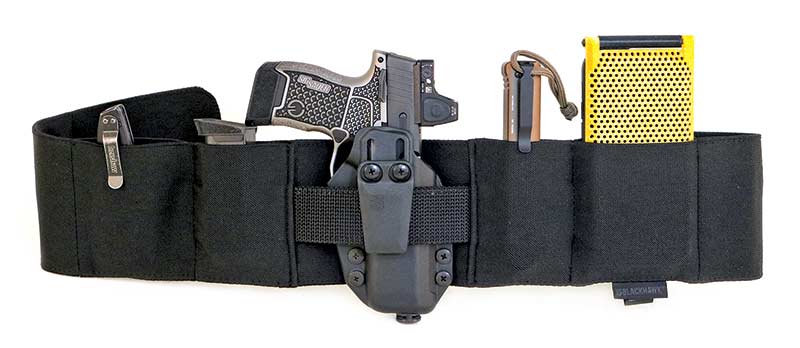
The Stache N.A.C.H.O. is like the Bat Belt. Everything you might reasonably
need while out and about rides comfortably in its generous pockets.
Tactical Details
N.A.C.H.O. stands for Non-Conventional Adaptive Carry Holster Option. That acronym seems a wee bit contrived, but the rig it describes is indisputably elegant. The Stache N.A.C.H.O. is a belly band. It comes in five different sizes to suit most any particular body habitus.
The N.A.C.H.O. is formed from wide, heavy-duty, double-ply 4″ elastic. A generous 3D mesh backer cushions the load and helps the rig breathe in hot climes. The edges are intentionally rounded to prevent chafing. Two integral 3″ pockets accommodate spare magazines or a flashlight. Another pair of 3.5″ pockets will carry your wallet and cell phone. No kidding, it’s like the Bat Belt. Just slap this rascal on, and you’re carrying all the sundry gear you might need to stay connected, supported, and safe while you’re out where the Wild Things roam.
The Stache N.A.C.H.O. includes a length of rigid 1.5″ double-layer scuba webbing to accept your favorite IWB holster. The system is really designed for weapons like the GLOCK 19 or smaller. The adaptive bit means the rig can be configured for appendix, hip, behind-the-hip, or mid-torso carry. I used mine with my SIG SAUER P365XL micro-carry gun.
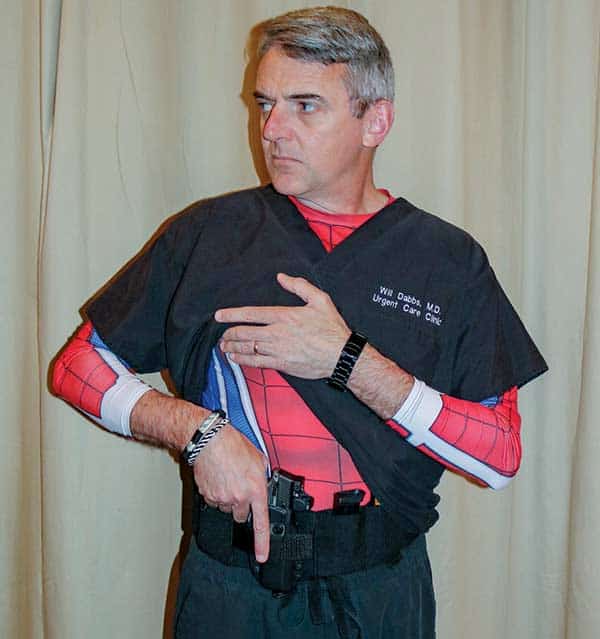
The draw is a bit higher with the Stache N.A.C.H.O. than might be the
case with a conventional belt, but it is easy to master.
Practical Tactical
In case you hadn’t noticed, people these days don’t dress quite like they did back when we were kids. The Stache N.A.C.H.O. is perfect for those times you’re not wearing jeans, 5.11s, or anything that doesn’t lend itself to a proper belt. Sweat pants, yoga pants, shorts and a T-shirt, skirts, dresses, kilts, or most any other sort of truly comfortable attire nicely complement the Stache N.A.C.H.O. This thing is just perfect underneath a pair of untucked surgical scrubs.
For starters, the Stache N.A.C.H.O. really is comfortable. The wide 4″ elastic spreads the weight of your gear out so it doesn’t eat into your anatomy. Pressure always equals force divided by surface area. That’s not just a good idea; that’s the law.
Your weapon is as positively retained as the holster you choose. You can customize your rig to your particular proclivities and circumstances. The Blackhawk Stache IWB base holster is a seamless fit. Even tricked out with my P365XL, smartphone, flashlight, knife and spare magazine, the whole rig still feels more comfortable than my old belt packing just the gun.
My draw was just as fast as with my previous conventional rig. I tried the orientation behind-the-hip, which is my custom, and in the front, both over my appendix as well as covering my belly button. If you can imagine it, the Stache N.A.C.H.O. will put your gun there. I found it fit best riding a bit higher than a typical belt. This changes the draw somewhat, but that’s the reason we train.
So, if you feel less is better when it comes to clothing and the only thing standing between you and that killer loincloth are those antiquated indecent exposure laws, then this is your minimalist concealed carry solution.
- Assume nothing.
- Never go against your gut.
- Everyone is potentially under opposition control.
- Do not look back; you are never completely alone.
- Go with the flow, blend in.
- Vary your pattern and stay within your cover.
- Lull them into a sense of complacency.
- Do not harass the opposition.
- Pick the time and place for action.
- Keep your options open.

I glanced at my buzzing phone between crises at work. There was a kid with an ear infection screaming in Room 2, and the elderly man with chest pain in 3 was very likely having a heart attack. The lady in 4 was sobbing hysterically. Her husband of three decades had moved out the night before, and she had no place else to turn. It was, in short, a fairly typical day at the office.
The message read, “Can I borrow a .22 rifle to chase squirrels? My old hunting buddy and I got access to a nice piece of woods, and we’d like to go walk around a bit. Dad.”
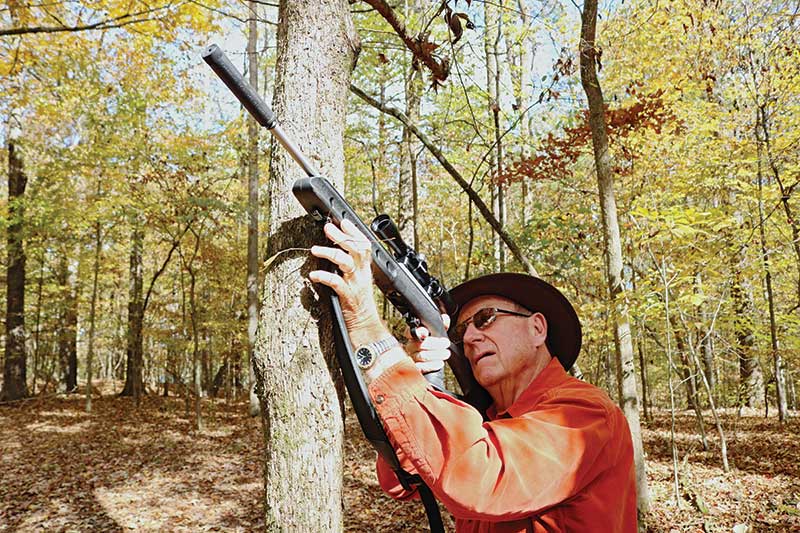
Everybody has a father. I am blessed with a dad.
Role Model, Inspiration, Hero
My father is an indispensable part of my success today. He and mom sacrificed when I was a kid and loved me even when I was unlovely. He lived the example of the Southern Christian gentleman and showed me what it meant to be a man. I never once heard him curse. If everybody had a dad like mine the planet would be a much more peaceful, respectful and productive place.
Dad was a football star in college and even earned a spread in Sports Illustrated. I take after my mom and apparently didn’t inherit any of that. He could have handily beat up everybody else’s dad. However, short of protecting his family I could not imagine anything provoking him to violence.
He and I split the cost of my first Daisy BB gun when I was 7. He gave me my first .22 rifle and 12-gauge shotgun. He taught me the basics of rifle marksmanship and wing shooting as well as how to talk to turkeys.
By the time I left for college, 13 wild turkeys had fallen to my Browning Auto-5 while hunting at his side. Christmas and Thanksgiving dinners were seldom without one. The musty sweet smell of the Army-issue field jacket he wore on hunting trips when I was a kid is burned indelibly into my memory. He would undoubtedly push back at the characterization, but if I took a clean piece of paper and designed the perfect dad he would look like mine.
Dad already has a splendid .22 rifle—a gorgeous Winchester 63 with a tubular magazine in the stock he got for Christmas when he was a kid. The gun shot straight enough for my mom to use it to clip sprigs of mistletoe out of towering Mississippi Delta oak trees for use as Christmas decorations back in the day. A closely held family secret was my mom was always the best shot in the family.
I borrowed his rifle for an article a couple of years ago, and, oddly, it never found its way back home. Dad could have just admonished me to give him his gun back. Instead, he just asked to scrounge one of mine. That’s the kind of guy he is.
After a literal lifetime spent squeezing triggers for fun and money I have tasted both the good stuff and the bad. However, this time was special. Here was my excuse to build my dad the ultimate Information Age counter-squirrel rifle.
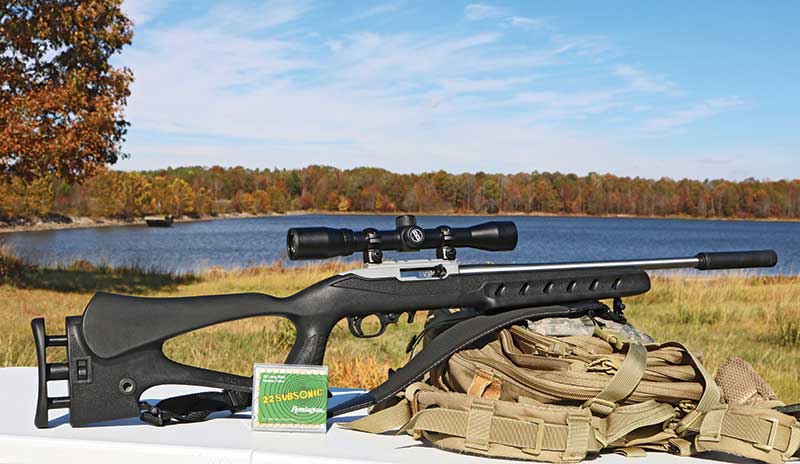
A sound suppressed Ruger 10/22 rifle is the ideal Information Age counter-squirrel weapon. The stainless steel
construction combined with the indestructible carbon fiber stock from Archangel make the gun essentially weatherproof.
Foundation
Naturally the chassis is a Ruger 10/22. This classic, simple, ubiquitous self-loading .22 rifle is reliable and customizable unlike anything else on the market. It is also surprisingly inexpensive. Ruger makes so many of them mass production keeps the costs down. Spare parts and aftermarket cool-guy stuff are everywhere. In my dad’s competent hands, the Ruger 10/22 would be pure death to tree-dwelling rodents.
Standard Ruger 10/22 stocks are not bad, but this is for my dad. I want it to be perfect, so I looked to Archangel. Archangel produces a bewildering array of indestructible carbon fiber aftermarket stocks for an equally bewildering array of disparate weapons. For the old standby 10/22, their options run the gamut. They can transform your humble 10/22 into the spitting image of a German HK G36 combat rifle or set you up with a heavy target stock sporting multiple adjustments.
As this rifle was to be toted operationally in the field I opted for the midrange version. This stock incorporates a handy thumbwheel adjustment for length of pull yet remains sufficiently lightweight for easy carry. The stock free floats the barrel for accuracy, is festooned with sling sockets, and also includes a handy carrying compartment for a few spare .22 rounds or some emergency M&M’s.
I mounted glass on the top without a fuss. Neither Dad nor I have quite the visual acuity we once did, and a proper optical sight sure makes it easier to drop rounds on target. All Ruger 10/22 rifles come equipped with a sturdy sight rail, and the receivers are drilled and tapped from the factory.
Magazines range from standard helical feed 10-rounders up to 50-round drums with banana mags of various capacities liberally interspersed. New 10/22 rifles come standard with extended magazine release levers. Modern 10/22 fire control groups and barrel bands are polymer, but you will not wear out these components.
In a timeless tribute to the innate toxicity of testosterone, my dad and his best friend, both well into their 70’s, were recently hanging out at their hunting camp when an armadillo had the poor grace to make an unscheduled appearance. Dad produced his Ruger .22 Magnum revolver and, 6 rounds later, both my dad and his buddy were well and truly deafened. The armadillo, naturally, escaped unscathed. After some vigorous admonishment by his physician son, Dad now keeps a pair of muffs in his pickup truck.
A lifetime’s exposure to gunfire and chainsaws has already taken a toll on Dad’s hearing. You only get so much, and every time you are exposed to excessive noise you lose a little. It is imperative you safeguard every bit of it.
Hearing protection can be tough to manage when in the field hunting, particularly when there are multiple hunters involved. Sound suppressors are the obvious answer. Regrettably, however, civilian ownership requires the same onerous paperwork and $200 transfer tax fully automatic machineguns and grenade launchers might.
Sound suppressors should really be sold over the counter in blister packs at your local Shop-n-Grab. In America you are statistically at greater risk of succumbing to a shark attack or toothpick injury than a criminal assault with a suppressed weapon. (No kidding. I looked it up.) The only place Bad Guys use sound suppressors is on the screen at your local movie theater. However, there is a way to optimize this labyrinthine process.
If you transfer a sound suppressor to yourself as an individual then no one else may legally possess the item. However, if you form a trust it is possible to include more than one person as trustees. Details are available online, and the process is not particularly difficult or expensive. As such, I created a trust for both Dad and me allowing us to share legal possession of a .22 caliber can. The processing time takes about forever, but the resulting convenience makes the wait worthwhile.

The AATS1022 stock from Archangel sports an easily adjustable length of pull to accommodate different shooters.
The stock is functional and lightweight for optimal use in the field.
Practical Tactical
The resulting optimized squirrel rifle will easily keep its rounds within a tennis ball out to 50 meters or more in Dad’s capable hands. He used his Winchester 63 to drop swamp rabbits on the run when I was a kid. Dad’s the one who taught me to shoot, after all.
When stoked with subsonic ammo Dad’s squirrel gun is easy on the ears and even allows multiple shots at the same rat. With the can in place the bullet may agitate the squirrel, but the source of the shot is all but impossible to ascertain. The rifle is lightweight enough to tote long distances, and the Archangel stock allows the gun to be adjusted to fit your particular anatomy. While not just dirt cheap, this rig still remains within the means of most American shooters.
Solutions
There is indeed a great deal wrong with our nation today. Among our many resplendent social ills, one of our greatest shortcomings is how few American men these days are signing up to be good old-fashioned dads. The job is grueling and the pay sucks, but the unfiltered adoration from a job well done makes up for the suffering.
Dad invested his life in me. As a result, I understood the value of hard work, discipline, good citizenship, and character in a world rapidly becoming bereft of same. Everybody has a father. Lamentably, fewer modern Americans have a real dad. Dad, enjoy your new rifle. The tree rats won’t stand a chance.
Archangel
43 North 48th Avenue
Phoenix, AZ 85043
(800) 438-2547
https://promagindustries.com/archangel/
Sturm, Ruger & Co.
411 Sunapee Street
Newport, NH 03773
(336) 949-5200
https://www.ruger.com/
Categories
“Funniest” negligent discharge ever
Categories
How To Use A Speedloader

There are few places on earth more enchanting than the isles of Hawaii. Most people think of Hawaii in terms of beautiful, well-groomed resorts, turquoise water, extravagant gift shops and Shave Ice. Not me. I think of Hawaii in terms of hunting abundant game through almost-impenetrable jungle, sheer cliffs plunging to the sea, guava fruit hanging ripe along steep mountain trails and kaleidoscope schools of fish just out of reach of my three-prong spear. And Shave Ice.
Hawaii is a relatively unknown sportsman’s paradise. Truth be known, there is more hunting opportunity to be found along the jungles and cliffs of the islands than in most of the mainland states.
DIY in Hawaii
In my opinion, the finest opportunities for the do-it-yourself hunter in Hawaii are found in backcountry settings, meaning you’ll have to hike to access them. Most of the islands offer public lands that anyone can hunt. Those lands are often surrounded by private property, but there are usually trailheads that offer access. An experienced mountain hunter can rapidly get into good hunting, but don’t make the mistake of expecting the hunting to be easy.
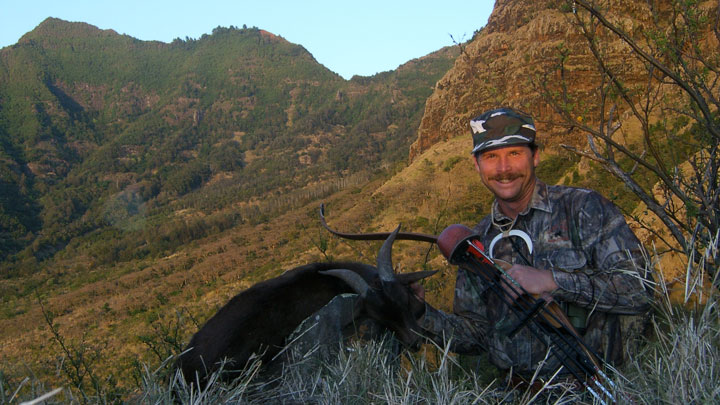
My first hunt on the islands was a fast-and-light excursion into the cliffs after wild goats. I stuffed a sleeping bag, some water and my takedown recurve bow into my pack, and climbed through the cactus and thornbush on the dry side of the island toward the base of a cliff.
I had only 24 hours to hunt. A thousand feet above the sea I found goats, stalked the band for several hours and finally placed an arrow through a young billy. I watched him tip over dead, but his last kick sent him sliding over a cliff. Fortunately, I was able to find my way down to him and got some photos as the sun set across the sea far below. I quartered the goat out, hung the meat in a tree and slept the night on the mountain before packing out to the trailhead, 22 hours after I’d headed up. It was awesome.
Seasons and Species
None of the big-game species found on the islands are indigenous. They have no natural predators, and some of the species proliferate so effectively they become problematic to the island habitat. As a result, seasons are long and limits incredibly generous. Huntable species vary from one island to another. If I’m not mistaken, pigs and goats can be hunted on almost all the islands, with mouflon sheep, axis, whitetail and Colombian blacktail deer huntable on select islands. Often the limit is one or two animals of each species per day. While you shouldn’t expect to fill those limits due to tough terrain, smart wildlife and dense vegetation, it’s still awesome to go hunting with “tags” in your pocket for multiple deer, goats and hogs every day. (No tags are needed in most areas, though you must have a license.)
Season dates are usually long, lasting months on end. Often there are several days (usually, but not always, Tuesday through Thursday) that are closed to hunting every week. Rules and regulations can be extensive and confusing, and vary from island to island and unit to unit, so be sure you study them well.
Hunting and Fishing Licenses
Obtaining a hunting license in Hawaii is not difficult, but you must plan ahead. Your stateside Hunter’s Education certificate is valid in Hawaii, but must be approved before you can buy a license. This can take three weeks or more. Paperwork and details are available online, but don’t fail to submit it at least a month prior to your trip. Island time is pretty awesome unless you’re waiting on something important like a hunting license. Have your approval letter in hand well before your trip, then you can walk into any game office and purchase your license on the spot. If you’ll be bowhunting, you may need an extra certificate. Everything should cost you right around $100. As of my last visit, no fishing license was required to fish from the beach with rod or spear, but be sure and check the regulations for the island you’re on.

Checking In
Each hunting area on the islands features a check-in station. These vary from a simple kiosk, where you open a lid and sign in, to more elaborate stations offering maps, information and sign-in portals. In my experience, the local hunters take this process seriously, which inspires me to take it seriously, as well. After your hunt, you’re required to sign out and report any game harvested.
Rifle or Bow
One of my toughest dilemmas when planning a hunt to Hawaii is whether to hunt with bow or rifle. A bow requires no paperwork or permitting, while using a rifle requires you to undergo a significant permitting process, including being fingerprinted and registering the rifle at the police station within five days of arrival. You must have an address where the rifle will be kept, and it’s supposed to stay at that address unless at the range or hunting.
Another thought-provoking element that should influence your decision is the fact that many of the good local hunters consider 40 yards to be a rather long shot at either deer or hogs. Most are closer due to the dense jungle vegetation, somewhat equalizing the effective range of bow and rifle.
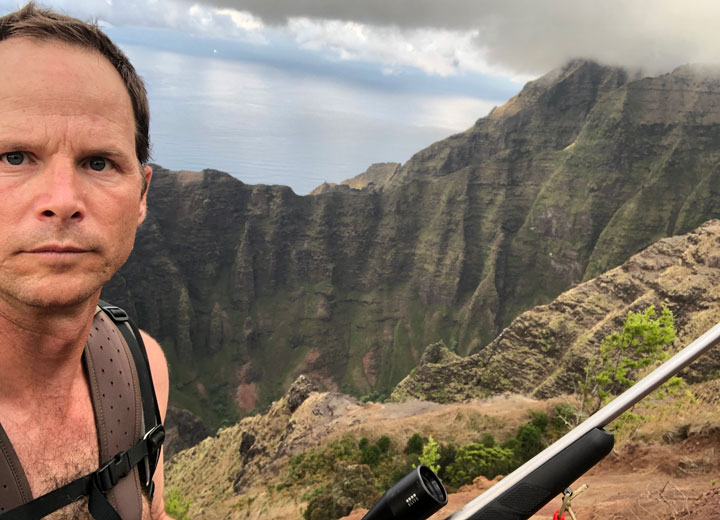
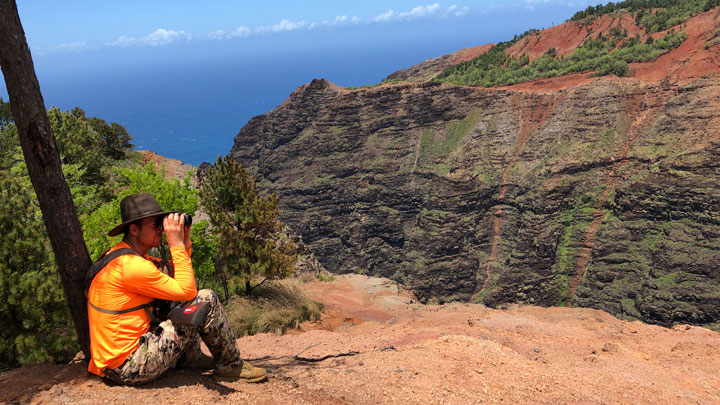
That said, on a recent hunt to the islands, I passed up shots at five deer at distances greater than 250 yards. They were across a canyon, and while I was confident I could harvest them cleanly, I was not confident I could cross the canyon and recover them. Deer on that particular island are plentiful, but extremely hard to find and harvest—indeed they seem to be the Holy Grail of game there. I left my perch on the ridge exuberant at just seeing a deer, let alone five—the knowledge that I could have killed them was icing on the cake. I just needed to find a way across that canyon.
Most, if not all of the islands have archery-only units offering better access and more liberal hunting dates. It is my opinion that, all things considered, you’re usually better off hunting Hawaii with a bow than a rifle. You’ll simply experience more and better opportunity.
Respect the Locals
There is a strong hunting tradition among the islanders, and in my opinion, it’s important to recognize and respect that. After all, those folks live and hunt there, often depending on the hunting for meat and recreation. You’re the visitor, so try to find ways and places to hunt that don’t intrude. It’s the ethical thing to do, and it may keep you out of a confrontation that’s not likely to end in your favor.

Ropes, Crampons and Taking the Shot
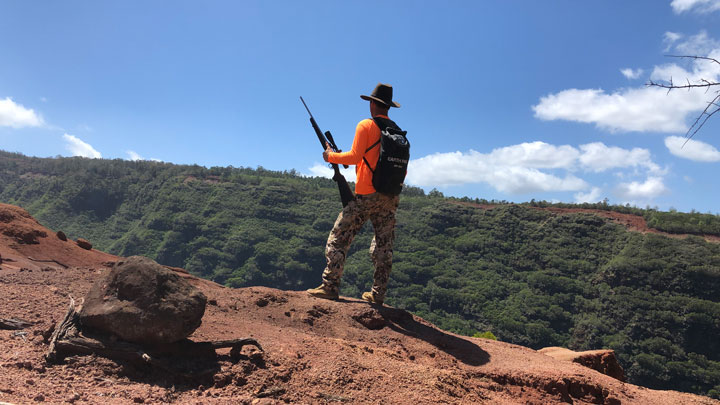
On my last trip (the same one where I passed up the five deer), I hunted my way down a giant ridge that hung above the sea like some primeval monster. I was looking for goats, and I found them. Several big billy goats strutted around, checking females and hunting breakfast in the sunshine of a beautiful Hawaiian morning. They were within easy range of my rifle and I spent hours shadowing them, watching my crosshairs on their ribs. The problem was, the cliffs they were living in were steep enough to scare an eagle, and there was no way I could access a goat had I shot one.
Some Hawaiian goat territory is not so steep and dangerous, but much of it is. You’ve got to be careful, especially when hunting solo, as I was. Next time I climb the ancient volcanic ridges of the islands hunting goat, I plan to have a set of strap-on crampons for my shoes, and several hundred feet of climbing rope. That way, if I shoot a goat, I’ll have the right tools with which to recover it.
The terrain on the islands—especially when hunting goats—can be extreme. Be prepared to pass up shots at animals you can’t ethically and safely recover. There will be some, even when you have crampons and climbing ropes. A goat or a deer is not worth risking a fall to your death, even in the most enchanting place on earth.
Coolers and Meat Care
One of the biggest challenges to hunting on the islands is keeping your meat safe after the harvest. Humidity and heat are a constant challenge. I use a YETI cooler full of ice, and bury my meat in the ice as soon as I get it to the truck. The YETI is super tough and keeps the meat and ice cold for a good long time.
Fishing the Reefs
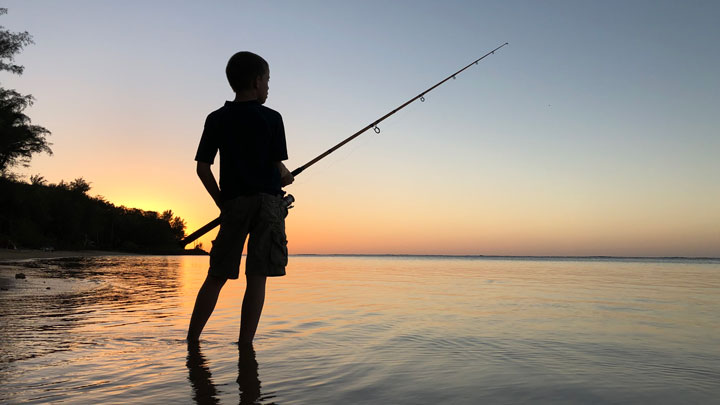
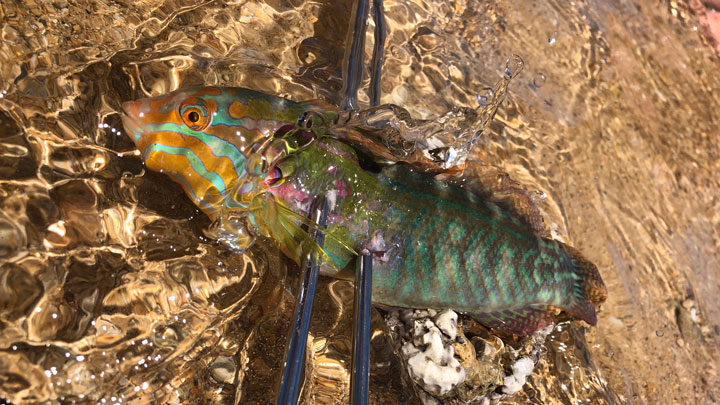
Thousands of colorful and tasty fish cruise inside the reefs that ring the islands. You can catch them with a little piece of raw shrimp on a hook cast into a channel or pocket in the reef, or spear them while snorkeling with a traditional three-prong Hawaiian spear. The locals set giant poles rigged with big hooks cast far out into the channels, with a bell to wake them if a big fish or shark strikes during the night. Fishing from the shore does not require a license, and you can pick up a basic rod and reel or a three-prong spear for $50 at the local Ace Hardware store. There are minimum-length requirements for the fish you’re allowed to spear, so study the regs before you snorkel into the blue yonder with your three-prong. Fish look bigger underwater than they actually are, so make sure they’re big enough before loosing your spear.

“Relax, This Ain’t the Mainland”
It’s one of my favorite sayings on the islands. Life and attitude are different there; being on time is not real critical, drivers are very courteous (even in heavy traffic) and people are not as tense and stressed. I love the feeling.
Being able to hike and eat guava fruit and thimbleberries picked fresh along the mountain trail is pretty awesome, too. Hunting through dense jungle, stalking along towering green cliffs draped with waterfalls and listening to the surf as the sun sets over the sea all combine to make the islands one of my favorite places on earth to hunt.
And of course, there are the sandy beaches, the snorkeling, surfing and the Shave Ice. Always the Shave Ice.