
Categories

Ginny is a lovely, hardworking senior citizen who of late has found herself having to leave work, late at night, and return to her home in a part of town that has seen a big uptick in crime recently. She knows as well as the rest of us that, as a senior citizen, she’s part of a growing population that’s also facing a growing threat. Older folks are among the most vulnerable demographics for unlawful attacks and assault, unfortunately. So when Ginny took a realistic look at her situation, she decided to ask a friend from church if he could help her learn how to shoot. That person, as I’m sure you can guess, was me.
Let me say up front that I make no claims as a professional trainer in firearms. The very best way to learn is to seek out professional training. That said, I have introduced more than two dozen people to shooting during the last 40-plus years, including such diverse backgrounds as my mother—who once was vehemently anti-gun—to youngsters and fellas in my own age group. Once that interest is stimulated, the motivated student would be wise to seek professional training.
Ginny knew that I was a “gun guy” from having read some of my articles, but she also worried that maybe I wouldn’t want to help her. She knew that I’ve made no secret that I prefer large, heavy bullets—specifically the .44 Special and .45 ACP—as the preferred rounds for self-defense. “All I have is a .22,” she said. ““I’m not sure you would want to teach me.”
I was pleased to let her know that wasn’t the case at all. For starters, a .22 is a great place to begin for someone interested in learning self-defense shooting and gun handling. What’s more, the fact of the matter is simple: The best gun to have when a gunfight or violent confrontation breaks out is the one you have on you at the time of the incident. A pair of .22 LR bullets delivered to the proper place at the right time beats a slew of other rounds sprayed in the general vicinity of the bad guy.
When I first started working with Ginny, I did so with two base assumptions. First, that shooting should be fun, or at least enjoyable. Second, that I didn’t want to turn a shooting lesson or session into an endurance event. Let the student determine his or her limitations. A lesson that is fun and enjoyable whets the student’s appetite to learn more and makes it easier to teach them. And while I remain steadfast in my own preference for large, heavy bullets to defend one’s self, if such rounds are painful for the student to employ, they are far more likely to give it up. Just because a person cannot physically handle a major caliber doesn’t mean they have no right to be able to defend themselves to the best of their ability.
My senior student started slow, and that was by my design. Her first shots from her SIG Mosquito were at 3 yards at a regular bullseye. The purpose here is to gain familiarity with the gun and get grounded in the basics of sight alignment and trigger control. Not surprisingly, her groups were very good from the get-go. Getting good groups early on instills confidence and makes the student eager to go to the next level. That session lasted about an hour.
A couple of weeks later we had another lesson. I started her again at 3 yards—this time on a “Bad Guy” target from Birchwood Casey—to make sure she hadn’t forgot anything. She hadn’t. I moved the target back to 5 yards and started working on presentation from the low ready position. Too, I started her to shoot the target’s eyes as a point of aim. She progressed splendidly, and then I made a mistake.
An eager student and not afraid to try anything new, I started showing her and then letting her shoot some close-up drills—arm’s length, one-handed shots at the eyes and speed rocks to the groin. The session ran a bit more than an hour and a half. The next day she messaged me that her hands were cramping up and she was a bit sore. My bad. As we get older—and I know this first hand—we don’t have the endurance we had when we were younger. I was so eager to show her some of the stuff we would spend more time learning that I over-extended the session. Each shooting session should be long enough to get one or two points across and no more.
By her third lesson my student started learning drawing and presentation from the holster. A good friend of mine, Rob Leahy of Simply Rugged Holsters out of Prescott, Arizona, provided her with one of his Cattleman holsters and a magazine pouch. Like anyone new to shooting, my student started slow and developed speed as her familiarity with the pistol and holster became greater.
Eventually her comfort with the pistol and shooting increased to the point where she began to look at other, more powerful alternatives to her .22 LR Mosquito. She asked me about all the hoopla over a 1911 pistol—what was it; why do some like and others not, etc. I let her try my Kimber Custom Shop Rimfire—a 1911-style pistol chambered in .22 LR—and her reaction after the first shot was, “Oh, this is very nice!” She also tried out an S&W Model 60 I have with target wadcutters and found it pleasant to shoot as well. I believe that in the not-to-distant future there will be a centerfire in her holster. Too, I pity anyone stupid enough to attack this quiet grandmotherly lady. She may not be a candidate for a law enforcement SWAT team, but anyone who messes with her is likely to find himself in a world of hurt.
The secret to successfully starting anyone to shooting is to make it an enjoyable experience. Start them slowly, and only progress to a new skill level once the previous one is mastered. Keep in mind that seniors—like most very young shooters—may have strength issues that prevent them from operating some handguns. It may be too much for some of them to rack a centerfire pistol’s slide, or to pull through a double-action revolver’s trigger. Let them determine the level they can comfortably achieve success. Like I said, a pair of .22 LR hollowpoints with proper shot placement beats a magazine full of 9mm or .45-caliber bullets around the periphery.
10 Rules for Teaching New Senior Shooters

Even experienced shooters like NRA Publications Senior Firearm Inventory Manager Larry Quandahl—a senior whose career includes service in the U.S.M.C., a Double Distinguished competitor rating and numerous NRA instructor credentials—can benefit from aids to marksmanship such as the Skinner Sights Express aperture unit seen here on a vintage Marlin 336 in .30-30 Win.
In his January 2020 article, “The Aging Defender,” then-Managing Editor Kelly Young did an admirable job in chronicling his interview with doctor of physical therapy Joseph Logar—who is also national manager of the NRA’s Adaptive Shooting Program—about the effects of aging on today’s shooters. And while Young’s article should be required reading for every NRA member, I had some issues with it—primarily that it was the article I had wanted to write ever since my personal odometer passed the 65-year mark more than a few birthdays ago.
But Kelly beat me to the draw, editorially speaking, and, to make matters worse, there was the irony of his surname. However, in the spirit of full disclosure, Young readily admitted to being “… a few years shy of 40” at the time. I, on the other hand, have spent more than 40 years (and counting) in a gun-writing career that has taken me from the deserts of Arizona to the jungles of Africa. In the process, I have encountered countless .22 rimfires, muzzleloaders, handguns, rifles and shotguns, from both the hunting and collecting perspectives. Consequently, I feel I am eminently qualified to write about the challenges of being a senior-citizen shooter. So, as an addendum to Young’s article, here are a few other age-related tidbits that I have personally discovered and that will hopefully be of benefit to some of our more “seasoned” NRA members.
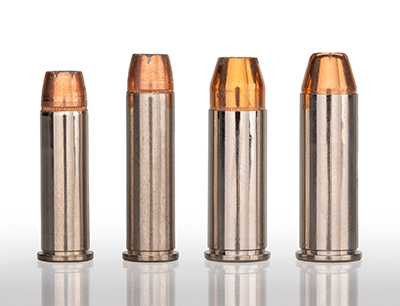
One thing I’ve noticed over the years is that as we get older, we become more sensitive to recoil. Not to be confused with flinching, it is simply a matter of our internal framework becoming a bit more fragile, or, as my friend the late radio announcer and “Laugh In” television personality Gary Owens used to say, “I find I’m not healing as fast as I used to.” Gary still shot his nickel-plated Smith & Wesson .41 Mag. for relaxation at the range, but he began doing it with reduced handloads. By that same token, I now primarily stoke my Model 29s with .44 Spl. rather than .44 Mag. ammunition—same gun, but less jarring on the hands and bones. I do, however, still occasionally put a cylinder’s worth of full-house magnums through the Smiths just to remind myself why I don’t do it all the time.
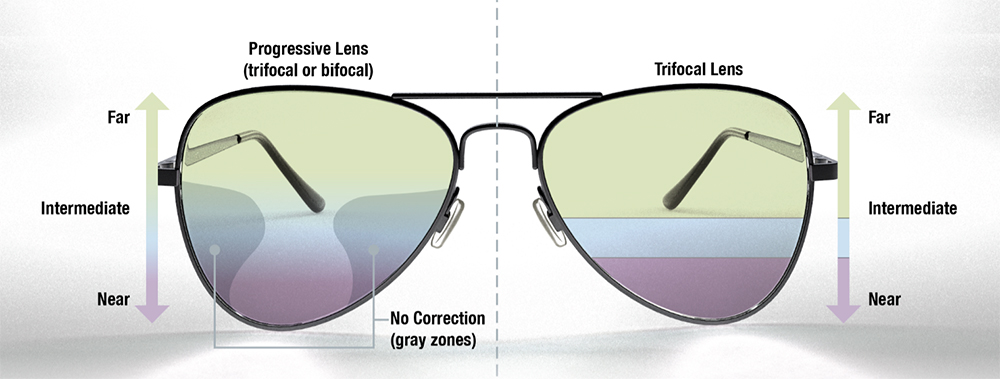
When I learned I had to have cataract surgery in both eyes and discussed the various options for the lens implants with my ophthalmologist (you can get bifocal implants or specific fixed-vision lenses), I opted for the strongest long-distance prescription I could get for both eyes. Being nearsighted and knowing I would still need glasses to correct my intermediate and close-up vision, I chose progressive trifocal glasses. The bottom portion of the lens is for reading, writing, adjusting gun sights, etc., the center portion is for working on my computer and the top portion of the lens is glass with no prescription at all, because my cataract lenses give me excellent distant vision.
And, for Christmas, my wife gave me a folding, pocket-size magnifying glass for gun shows to make up for my lost pre-cataract ability to read serial numbers and to see minute stampings without my glasses. I’ve been using this pocket-size magnifier now more than I care to admit, but in the interim, I carried a pair of reading glasses—the type you can buy at the drug store in magnification ratings that normally run from 1.50 to 3, and that are great for close-up scrutinizing but not for distance. I suspect they would work well for those who are as “close-up vision-impaired” as I am, although the miniature magnifying glass is a lot less intrusive and, for me, easier to carry around.
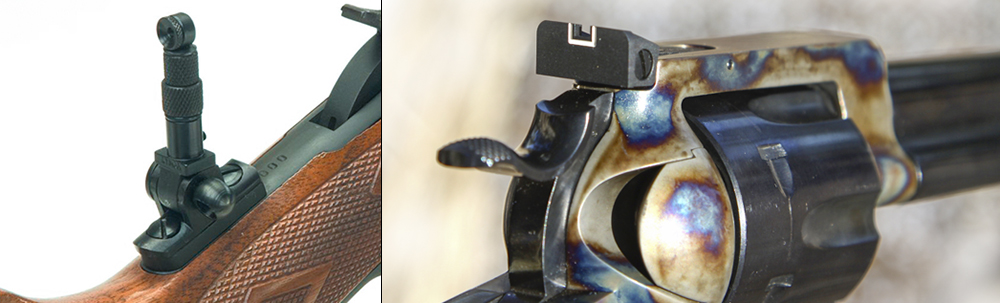
While on the subject of eyesight, the single-action revolvers that I am fond of shooting do not lend themselves to bulky high-visibility aftermarket sights. A good example is my Ruger New Model Blackhawk Bisley. Blackhawks, in general, are notable for their all-black rear sights and their equally all-black front sights, which are incredibly difficult for my aging eyes to properly line up. So, when I had my New Model Blackhawk Bisley customized with Turnbull casehardening (turnbullrestoration.com) and a tuned-up action by Andy Horvath [(440) 458-4369], I also replaced the factory’s micro-click rear sight with Hamilton Bowen’s Ruger Rough Country Rear Sight (bowenclassicarms.com). Although Bowen makes other variations for Ruger and Smith & Wesson revolvers, I found his easy-to-see Rough Country Rear Sight with a square, white-outline notch to be the easiest for me to see. I also had Horvath inlet a brass bar on the front sight ramp for a perfect pairing with the Bowen sight. The only problem is I can’t blame my “frequent fliers” on the gun anymore.
In addition, I have always been partial to open sights on a rifle, but as we get older, those open sights tend to become an exercise in frustration, as that rear sight sometimes blurs into obscurity. That is why you see many vintage Kentucky rifles that have had the original dovetails for their rear sights moved forward—farther from the shooter’s eye—so that the aging shooter could still make out enough of the rear sight notch to properly align it with the front sight. Moreover, until the use of scopes became widespread, peep or aperture sights were the best “quick fix” to accurize a rifle. In his 1961 book, “The Complete Book Of Rifles And Shotguns,” Jack O’Connor wrote, “It has been my experience that a big peep is the fastest of all sights—much faster than the open sight and a bit faster than a low-power scope.” Even in today’s world of electronic reticles and lasers, peep sights retain their century-plus reputation for accuracy. Outfitting a non-collectable rifle with a large peep, or even a ghost-ring rear sight, makes sense. But even some collectable rifles can have their original peep sights adapted by slightly enlarging the rear sight aperture hole so that they are easier for older eyes to peer through. I still hunt with my 1940s-era Winchester Model 71 but always unscrew the factory’s peep sight disk beforehand, leaving a larger hole where the sight screwed into the base; thus, I have an easier-to-see “ghost-ring” through which to sight. Additionally, Lyman (lymanproducts.com) still catalogs its original No. 2 tang sight for Winchester, Marlin and even some Uberti replica lever-actions.
In addition to our eyesight, hearing is also something that begins diminishing as we get older, and most elderly shooters have already lost a fair percentage of their ability to hear. When I began shooting back in the late 1950s and early ’60s, no one was overly concerned about hearing protection, whether it was target shooting on my high school ROTC rifle team or zeroing-in my Winchester 94 carbine at the original Ben Avery Shooting Range outside of Phoenix, Ariz. That ringing in my ears was just an annoying inconvenience, and, besides, it seemed to eventually go away, even though, unknown to me at the time, irreparable damage was being done.
I eventually began stuffing tissue in my ears, but wadded-up Kleenex offers precious little in the way of hearing protection. Nowadays we know better, and muffs or earplugs are de rigueur, no matter how old—or young—the shooter may be. However, for us older folks, earplugs are not enough. In order to protect what little hearing I have left—especially after a rather traumatic middle-ear operation that required a tungsten insert to restore the hearing in my left ear a few years ago—I now use both ear plugs and ear muffs. This not only offers double the protection, but the muffs shield the entire circumference surrounding the ear from magnum-level decibels—something that ear plugs alone can’t do.
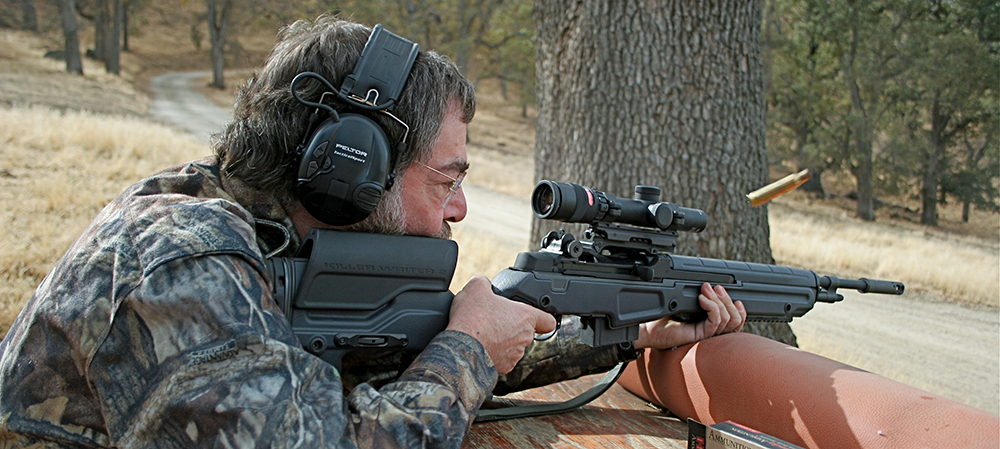
This might be a good place to mention that upgrading shooting equipment can be beneficial to us senior shooters who never throw anything away. For example, I had been using my Peltor Sport Tactical 100 Electronic ear muffs ever since 2007, but because of the tremendous advances made in technology during the past few years, I recently upgraded to Peltor’s newer Sport Tactical 500 Electronic model, which offers 26 decibels (dBs) of hearing protection (compared to 20 dBs of my older model) and dramatically enhances audio, while more effectively blocking out high-decibel sounds like gunshots. In fact, with the Tactical 500, I can hear the range master’s commands even more distinctly than I can with my unaided ear. In addition, this model has Bluetooth wireless technology that syncs to mobile devices and can even be used to make and receive phone calls through the headset, a benefit I have yet to fully embrace; I really wanted the Tactical 500 for its higher decibel rating to protect what little hearing I have left. Peltor also makes a Sport Tactical 300 model that delivers 24-dB hearing protection but without Bluetooth capabilities.
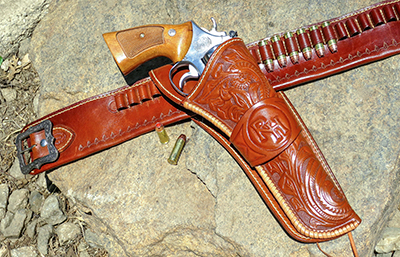
As Dr. Logar points out in Young’s article, muscle tone is another aspect that diminishes as we get older. I remember my late friend, singing cowboy star and NRA Life member Roy Rogers, once telling me that his sixguns seemed to be getting heavier each year. Today, in addition to daily walks, I use an adjustable hand-strength exerciser, along with a hand dumbbell on a regular basis to maintain my muscle tone. Admittedly, these are low-impact exercises, but they enable me to still shoulder and shoot a 9-lb., 8-oz., rifle offhand.
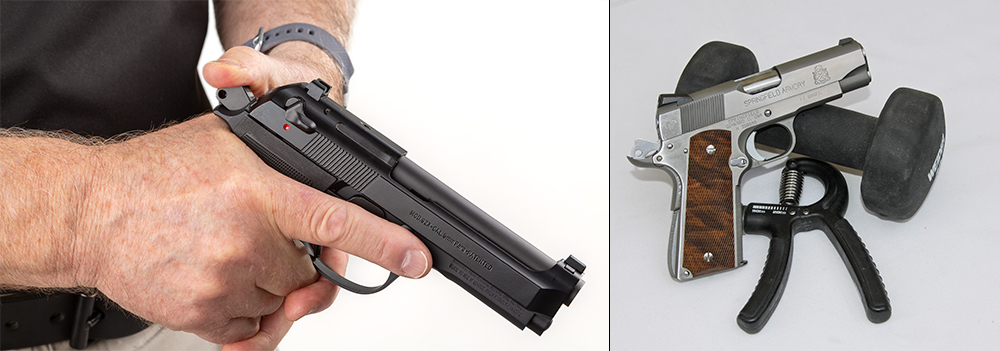
And for those who have trouble racking the slide on a Government Model 1911, I have found that by cocking the hammer first, the slide goes back much easier, as it is not pushing against the hammer’s mainspring. In the same way, my Beretta M9 has a very practical slide design for easier racking, at least for me; those “ears” on either side of the slide make it much easier to grasp and rack. Plus, with most exposed-hammer, DA/SA semi-automatics like the Beretta M9 and 92 variations, you don’t have to struggle to get off that first double-action shot. Keeping your finger off the trigger, cock the hammer first for an easier-to-pull, single-action first shot.
And finally, when I had a pinched nerve in my right shoulder a few years ago, my primary care doctor (who is also an NRA member) suggested that I should consider using a cross-draw holster—as that cross-body motion did not cause my shoulder any pain. Thankfully, my pinched nerve eventually went away, and in the process, I ended up with a couple of new cross-draw holsters—both thanks to my doctor.
To be sure, as we reach that “vintage” stage in life, some of us start requiring a little more maintenance, and yes, perhaps a few new parts, just like the guns we shoot.

Yeah don’t worry at all about ricochets! Grumpy

Quite possibly, for the very first time, all three Gun Cranks agree on something — open carry is stupid! In this episode, the Gun Cranks share various reasons and examples to back up their claim. Do you agree or disagree?

There are a lot of ways to defend your family at home. Several of them work well. There are also a lot of ways to get into trouble in the middle of a confusing situation with a gun in your hand. We want to learn from other people’s experience rather than from our own failures. That explains why a self-defense plan is so valuable. We want to do the best we can so that luck is less of a factor in our family’s safety.
Let me give you a counter example. I’ve heard people say they will figure out what to do when the time c0mes. I have a problem with that since we come up with some terrible ideas in the middle of the night. I’m pretty sure that I can improvise with the worst of them.
My plans are simple. We plan to lock our doors because we don’t want to wake up in the middle of the night with a bad guy standing in our bedroom. Locking our doors does a number of good things for us. For one, the robber often moves on to try another home if our doors are locked. That is a win right there. The second advantage of locking our doors is that the bad guy makes a lot of noise as he is kicking down our door or smashing one of our windows. That wakes us up and gives us some warning. Now, we and the bad guy are locked in a race to see who does the best job in a limited amount of time. If we thought about it, we’d know what to do when glass breaks. Our hands and feet would know what to do even if our head is still trying to wake up.
In our case, we no longer have kids in the home so this is what our home defense plan looks like.
As I implied, our doors are locked at night. We are also armed most of the time when we’re out of bed. At night, we store our firearms in bedside safes on each side of the bed. A flashlight and phone is also on each bedside table. That is the hardware side of a plan, but the human side of a plan is far more important. What should we do if we hear glass breaking in the middle of the night?
The easiest way to tell if someone has actually walked through their safety plan with their family is to ask them what they plan to say to their partner when they hear glass break. Unless the words fall out of their mouth then they don’t have a plan. We kept it simple.
“We have an intruder. Get up.”
That seemed a good compromise between information and time. Sure, we’d like to fully describe what we think we heard and what we saw. All that takes time that we might not have.
We chose to lock the bedroom door and turn on the lights. We also want to get on the phone and call 911. You have to do one thing at a time, particularly when you are still waking up. Some couples have planned who does which job. That can be particularly important if you have children in your home.
Given that it takes time to wake up and move, we figured the first person to stand up with a gun in their hand should go lock the bedroom door and turn on the lights. The other partner grabs their phone and their gun, and then moves behind the bed. We are worried about immediately stopping a threat until the door is locked and both of us are behind the bed and armed. Until then, we each have a gun in our hand and our attention on the door. Unless we hear an unexpected noise from inside our house, our guns stay pointed at the floor until both of us are behind the bed.
Should we shout a warning? We plan to. Again, we chose to keep it simple.
“We’re armed. We called the cops. Get out.”
Both of us now either have our guns in our hands pointed at the door or the gun is laying on the bed right in front of us as one of us calls 911. If you’ve practiced this then you know that guns are heavy and police are slow. If we don’t hear any more noise from outside our door then we will probably set our guns down on the bed before the police arrive.
Getting the police at your home is a good step but it also raises the next concern. What do you do once the police arrive?
We want the officers to walk around our house and look for obvious signs of entry. If they find an open door or broken window, then the police clear our home before we leave our bedroom.
If the outside doors are locked and the windows are intact, then we have to open the bedroom door and go meet the police. There probably isn’t an intruder in our home, but we did hear something so we’ll move slowly. We’re not going to clear every room and we are definitely not going to approach our doors with a gun in our hand. We rehearsed getting to our door step at a time.
Our hands are full. One person has a flashlight and a gun. The other person has a gun and a phone. The person with the light leads the way.
We have to leave our bedroom and scan the area with our flashlight. Slowly move to turn on light switches, and look all around your home. It is easy to move faster than you can look. You see new areas with every step and you want to make sure you are not walking into trouble. Keep your distance from corners.
The person with a phone is still in contact with 911. They’ve told the police that you are both armed. They are following the person with the light and they want to be close enough to help their partner. You also want to be far enough away that you have time to see and react to an attacker before the attacker can reach you. It makes sense to tell the person in front of you to slow down if they get too far ahead.
Now we are one corner away from the door where we will meet the police. I do not want the police near the door until I scan the area and am sure it is safe. I’m going to look around the corner and make sure the entryway is clear. The gun is not pointed around the corner because I do not have a target that needs to be shot. I’m going to put my gun and light on the ground if I don’t see a stranger in my home. Then, and only then, will I open the door and meet the police with my hands open and high.
When the officers are at the doorway I’ll ask my partner who is looking at me from behind the last corner to put down their gun and their phone. With the police there, we quickly search our home to make sure it is safe.
That is the simplest scenario. What if you hear someone in your house as the police arrive? What if you see someone in your house as you move toward the front door?
What fits my situation might not fit yours. Why not walk through your plan with your partner tonight. I bet your plan will change as you do.