Categories
All About Guns Fieldcraft

Cooper’s Color Code | You’re Doing it Wrong by Aaron Haskins

Col. Cooper's Color Code is frequently misinterpreted and taken to be a "Situational Awareness" mnemonic; this is fundamentally incorrect.

Col. Cooper’s Color Code (the “Cooper Color Code”) — you’re very likely doing it wrong. There’s a possibility this article will slaughter a few sacred cows. It is certain to cause some ass pain. That’s okay, though. What we want to do, more than anything else is to get engaged professionals talking whether they agree with the author’s contention or not. Know why? Because discussion, disagreement, and civil discourse are where learning occurs.

If you’re going to teach Cooper’s Colors, don’t teach it as advocating a mythical and unattainable concept of situational awareness. Teach it as the man intended: mental preparation for the decision to press the trigger.

Situational Awareness & Your Mind: Rethinking Cooper’s Color Code

At some point in the 1970s, Jeff Cooper created what is often called the Color Code. When he originally thought it up, and as he taught it, his purpose was to describe a shooter’s “…capacity…to cross the psychological barrier that inhibits [the] ability to take deadly action,” i.e., his or her mental preparation to press the trigger on a live target.[1]

The “situational awareness” interpretation of the Color Code is fundamentally flawed.

Cooper’s Color Code: Mistranslated and Misunderstood

In Cooper’s original intent, one could scale from Condition White, in which one is completely unprepared for combat, to Condition Red, in which one is psychologically committed to combat, regardless of whether the fight has actually begun or not. Essentially, he recognized many people must mentally gear up for violence, and his code traced that progression to help the mental switch.

That is not, however, how Cooper’s Colors are generally used in the modern firearms training world.

Instead, they have been reinterpreted as shorthand to describe an individual’s “situational awareness.”  Per this interpretation, the one most commonly cited in blogs and articles across the firearms community, an individual in Condition White is relaxed and unaware of what is happening around them. In Condition Yellow they’re in a state of “relaxed awareness”—not specifically paying attention to anything, but generally aware of what’s going on around them. In Condition Orange, they’re focused and specifically paying attention to something they’ve identified as a potential threat. And in Condition Red they’ve identified a threat and are completely focused on it, ready to respond to anything it does. It’s a simple, easy-to-remember system.

Unfortunately, whereas Cooper’s original Color Code is an effective tool to help ramp up to a mental state suited for combat, the “situational awareness” version so commonly used today is essentially useless and misleading. It fundamentally misunderstands how the brain scans for and responds to threats, and thus can harm shooters by leading them astray during training and development of their situational awareness skills.

The deliberate mind is lazy and cannot multitask.

Cognition and Reaction | the Duality of Grey Matter

Cognitive psychologists and decision scientists often model the brain as operating on two related but very different systems.[2] In this dual-system model of cognition, System 1 may be thought of as the “automatic” mind and System 2 as the “deliberate” mind. The automatic mind runs the vast majority of what you do. It multitasks and makes decisions very quickly without you ever consciously thinking about them. The deliberate mind, on the other hand, only deals with one thing at a time, and does so much more slowly than the automatic mind. This distinction is critical to understanding decision making because each system does so via different processes.

The deliberate mind uses what is sometimes called “analytical” decision making, in which it assesses the situation and evaluates multiple options to choose the best one.[3] The automatic mind, however, uses intuitive decision making, in which it only evaluates a single choice based on the available information, assesses its suitability by running a mental simulation, and either implements it or discards it (in which case it begins assessing the next potential choice). We all like to think we’re primarily analytical, assessing all our options and making the best possible choices.  But the truth is we aren’t. The deliberate mind is lazy—it takes extra blood flow to the brain to make analytical decisions. And, more importantly, it literally can only focus on one thing at a time.  The deliberate mind cannot multitask—when it tries to do so, it just shifts attention from task to task to task and does none of them well. So it shifts as much work as possible to the automatic brain.

To see how this works, think about when you first learned to drive a car. The first time you sat behind the wheel, you were trying to pay attention to everything: your hands on the wheel, the speedometer, your side and rear-view mirrors, the road in front of you, your blind spots, all the vehicles and pedestrians and obstacles around you, etc. And you weren’t doing any of it well. That’s because when you first learn a task, your deliberate mind is in charge, and its efforts to do everything at once lead you it doing everything badly. But the automatic mind learns through repetition. So you practiced, and after a few times driving, you began to relax. You kept your eyes primarily on the road in front of you, occasionally automatically scanning your mirrors and blind spots to update your picture of the situation around you, but then returning to the road. You learned to talk to passengers and listen to the radio without pulling your attention away from the road and becoming a danger to yourself or others. This is because as you learned, your deliberate brain began passing tasks off to your automatic brain, freeing itself up to pay attention to other things, like that audiobook you’ve been listening to for the past six hours, or the beautiful scenery along the highway.

This lack of paying deliberate attention to everything all the time doesn’t mean you’ve lost your ability to react to danger. To understand why let’s look at how the automatic mind processes information and makes decisions.

Never be in Condition White” is an effectively meaningless phrase.

Your Script: Recognition-Primed Decision Making


Information about the world around us reaches our brain through our five senses, and the brain then must process and decide based on this data.[4] Because the automatic mind is always on and always processing, it responds to this information first, and only activates the deliberate mind if it deems it necessary. It does so by a process that intuition researcher Gary Klein calls Recognition-Primed Decision Making, or pattern recognition. Essentially, the brain has a massive repertoire of stored patterns, and the automatic mind compares the information it receives from the senses to this pattern library.  The brain also has a store of heuristics (which Klein calls “action scripts”)—simple automatic algorithms of decision-making designed to lead to “good enough” results in most situations, if not the best possible outcome for any specific case.[5]

When the automatic mind matches the information it’s receiving from the senses to one of the patterns stored in its library, it applies an appropriate heuristic. This is what’s commonly called intuition or a “gut feeling.” Generally, the automatic brain does not weigh its options. Rather, it picks a good fit choice, imagines the outcome, and if it doesn’t identify a problem, it executes. Only if its mental simulation reveals a potential problem does it discard the initial heuristic and move on to the next choice. This is intuitive decision making in a nutshell. It happens very rapidly, often completely unconsciously, and most of the time achieve very good results.

The deliberate mind doesn’t even enter the decision-making process unless the automatic mind first notes a problem. My colleagues and I informally refer to this as the “risk monitor,” the process by which the automatic mind, in the process of matching sensory information to stored patterns, identifies either a known risk pattern or an unknown situation and triggers the deliberate mind to begin focusing on the problem and analyzing its potential courses of action. Of course, the automatic mind operates much faster than the deliberate mind, so it is often applying the appropriate action script (heuristic) even as the deliberate mind begins assessing the situation. To illustrate this, let’s return to our driving example.

You’re now an experienced driver, and on the highway, you’re comfortable letting your automatic mind deal with the task of actually driving and the myriad sub-tasks that actually involves. And you’re most likely comfortably driving 5-10 miles per hour over the speed limit. But the instant you recognize the shape of a potential police car up ahead by the side of the road, what happens? If you’re like most people, your attention shifts from wherever it was before and you begin focusing on the car to see if it is, in fact, the police—because your automatic mind matched that pattern of information to the known risk of a potential speeding ticket. And yet, while you’re assessing and deciding the best course of action, your foot probably shifted from the gas to the brakes, because while the slow deliberate mind is still spinning up and figuring out what to do, the fast automatic mind already applied the appropriate action script to ensure you’re under the speed limit and reduce the risk of a ticket, just in case it’s a cop. Beyond that, the deliberate mind takes control and decides whether to maintain your (new) current speed, slow down even more, or what.

“So that’s interesting and all,” you may be thinking to yourself,[6] “but how is it relevant to self-defense?” It’s fairly simple: knowing how the brain processes information and makes decisions means we now know the key to effective threat identification and taking the appropriate immediate action. Such action, whether it’s ducking for cover, drawing and firing, running away, or any other response lies in the automatic mind. That’s the part of your mind that is always active, always scanning, always comparing what it sees to known patterns to identify the appropriate response.

So, much loved as they are in the firearms community, what this means is that the situational awareness interpretation of Cooper’s Colors can only describe the deliberate mind’s level of attention to a given potential problem. But given that the deliberate mind can only pay attention to one thing at a time, and takes significant energy to focus, the adage (and occasional admonishment) to “Never be in Condition White” is effectively meaningless.

We’re almost always in “Condition White,” because the deliberate mind is busy focusing on the task at hand and not scanning for threats

It is all but impossible to actively scan for threats while talking on the phone or finding a debit card in a wallet at the ATM, or doing any of the thousands of tasks our deliberate minds must focus on throughout the day. Trying to do both at once just makes us ineffective at both, just as trying to pay attention to everything makes us bad drivers. To expect otherwise is unrealistic and potentially dangerous.

Training should focus on the ability to capture relevant information, identify potential threats, and respond heuristically.

Condition Fight

Instead of this unhelpful misinterpretation of Cooper’s Colors, then, I suggest that we in the firearms and self-defense community begin moving away from a useless “constant vigilance” philosophy and focus instead on training shooters to let the automatic mind shoulder the burden of identifying and responding to threats.

We don’t respond properly to threats when:

a) we don’t perceive the relevant information because our sensors are directed elsewhere;

b) our brains don’t interpret that information correctly to alert us to the threat; or

c) our brains don’t immediately know the appropriate action script or heuristic with which to respond to an identified threat.

This is what “Condition Yellow” is really talking about.

Thus, training should focus both on building habits that increase the likelihood of the sensors capturing relevant information, and then on building known patterns and action scripts in the automatic mind to correctly identify and respond to potential threats. The former is as simple as ensuring we aren’t walking around staring at our phones with headphones in, oblivious to the world around us. We need to ensure our sensors can capture the relevant information around us, which is what “Condition Yellow” is really talking about.

Without the next steps, without making sure the mind can put the pieces together and respond appropriately, looking and listening does nothing for us. And that aspect is much more difficult, and generally overlooked by those talking about “mindset” and “awareness.” Violent encounters often occur much too quickly for the deliberate mind ever to react and make conscious decisions, so we must set ourselves up for success by training our automatic minds to spot threats and apply the appropriate heuristic for that situation.

What does that look like? Well, as mentioned, the automatic mind learns through repetition and practice. Taking a class on indicators of violent intent is great, but it does absolutely nothing to build those patterns into the automatic mind’s library of stored threat patterns. Repetitive scenario training and simulations are probably your best bet for safe and effective training (which is no more a new concept than is stress inoculation). It’s time-consuming and resource-intensive, but the military uses such training to great effect to make threat identification and response almost instinctive. When a Soldier hears an explosion in a combat zone, the hundreds or thousands of similar times he or she’s been through that scenario in training means he or she’s unlikely to freeze in indecision. The automatic mind already knows what to do: take cover, identify the source, and continue as the situation dictates.

Athletes, law enforcement officers, pilots, and many others working in fields that require the ability to instantly react to changing circumstances at a rate much faster than the deliberate brain can respond all use variations of scenario practice and repetition to build that automaticity. It works, and it works well.

Action scripts must be built before-hand.

Cooper’s Color Code: Codify It

If you don’t have the time and resources for high-quality resource training, there are other options. The goal is just to build the patterns and responses into the automatic mind, which can be done visually. After you’ve taken that class on threat indicators, watch lots of videos of violent attacks (which can be found on YouTube) and practice spotting those indicators in real situations.

See if you can figure out who and where and how the attack will happen before it does. Then reinforce that with visualization: run through mental scenarios where you see and respond to specific indicators as appropriate. Build those action scripts, and attach them to sensory patterns, so you’re not having to stop and think your way through every decision when action and reaction are being measured against each other when every tenth of a second counts.

This is critical:

If you’ve never even imagined doing something, you cannot do it.

The brain has no mental simulation to judge against during its intuitive decision-making process. With the exceptions of basic instinctive heuristics like fight/flight/freeze, an action script will literally not even appear as an option to your automatic mind unless you build it beforehand. Visualization implants the script in the brain, and repeated visualization means the automatic mind is more likely to draw upon it as a first or second choice option when it identifies the associated sensory pattern. If you can’t do scenario practice, you must do visualization practice.

The instant you stop to think is the instant you’ve lost.

As You See So Shall You Compete

These same principles can be applied to competitive shooting, as well as defensive situations.

Many high-level competitors visualize each stage before running it. All they’re doing is prepping the automatic mind, so their deliberate mind is free to focus on deliberate decisions in response to potential unexpected and changing conditions. The time saved in decision making, by ensuring the automatic mind already knows which targets to shoot and in what order, adds up over the course of a stage and a match. New competitors hesitate because they don’t have the sensory patterns and action scripts mastered that allow them to flow through a course. Experienced competitors just execute.

Many top-level competitors, in any form of competition from shooting to martial arts to ball sports, will tell you that the instant you stop to think is the instant you’ve lost. Whether you’re playing for a title, or prize money, or the higher stakes of life and death, the mechanics of decision making remain the same. But to take advantage of them, you have to do more than give lip service to a vague concept like “situational awareness” or “vigilance.” You have to set yourself up for success by training your automatic mind.

Col. Cooper himself fought gains the ineffective (incorrect) reinterpretation of his Code.

Cooper’s Color Code Correct

An interesting note: this mental preparation of the automatic mind before the fight kicks off is pretty much exactly what Cooper intended with his original version of the Color Code. He focused on the psychological difficulty of the decision to kill, but the principles of decision making apply exactly as I’ve described. Col. Cooper spent decades combatting the ineffective reinterpretation of his Code so commonly heard today, because “constant vigilance” just doesn’t work. If you’re going to teach Cooper’s Colors, don’t teach it as advocating a mythical and unattainable concept of situational awareness. Teach it as the man intended: mental preparation for the decision to press the trigger. A tool to set your automatic mind up for success.


Cooper's Color Code for situation awareness and threat awareness has been distorted and misunderstood over the years.

Acknowledgements: A number of firearms, martial arts, and self-defense industry professionals and other subject matter experts reviewed this article for clarity and accuracy prior to publication. In no particular order, the author would especially like to thank Claude Werner (The Tactical Professor), Jon Hauptman (PHLster), Morgan Atwood (BFE Labs), James Quigg (Fight IQ), Benn Coren (Environmental Testing & Inspection), Keith Finch (GAT Marketing), Brandon Foat (Minnesota Sword Club), Rob Reed, Stephen Bell, and Will Morgan, among others, for their input and feedback during the writing and editing process.

[1] Jeff Cooper, “Commentaries,” Vol. 12, No. 5.

[2] This model is discussed in many books and articles, including works by Sloman (1996), Stanovich (1999), and Hogarth (2001), but is most well-known from Daniel Kahneman’s book, “Thinking, Fast and Slow” (2011).  The now-standard “System 1 and System 2” terminology itself originated in Stanovich and West (2000), but for clarity’s sake I have chosen to use the informal terminology of “automatic mind” and “deliberate mind” to refer to the exact same System 1 and System 2, respectively.  This model of cognition has been widely applied in fields ranging from social psychology to behavioral economics.

[3] Well, sometimes.  The deliberate mind sometimes uses the same intuitive decision-making process as the automatic mind, too.  It’s a bit weird and confusing, but it’s also not terribly relevant to our purposes here.

[4] A disclaimer: I am not a cognitive neuroscientist, neurologist, or neurophysiologist.  While it is my understanding that there *is* neuroscientific evidence to back up this model of cognition, from Paul Glimcher and others in the cross-disciplinary field of neuroeconomics, I will leave that examination to subject matter experts and constrain my comments to my own areas of expertise.  Therefore, I will not attempt to describe the specific mechanisms in the nervous system by which information reaches the brain and the various parts of the brain itself that sort through this information and make decisions, and will comment only on how this is applied in terms of cognitive psychology and applied decision science.

[5] These heuristics are built up through experience, by trial and error and practice over one’s lifetime.  Some basic heuristics even appear to be hardwired into our brains through evolutionary processes, such as fight/flight/freeze responses to potential danger.
Categories
Fieldcraft

What We Plan For Sheriff Jim reminds us that wishing and hopeful thinking should not be part of your self-defense plan. by SHERIFF JIM WILSON

Sheriff Jim Wilson

There is a saying among those who hunt dangerous game that we don’t plan for when everything goes right, we plan for when everything goes wrong. Thus, we carry guns of suitable and substantial caliber. And, we generally hunt with a guide, or partner, similarly armed just to throw some of the advantage in our own direction. The hunter can easily become the hunted when dealing with the likes of cape buffalo, Kodiak bear or elephant, just to name three of the tough ones.

The armed citizen should be able to easily identify with that statement, too. Of course, the hunter at least knows that he is going hunting, while the armed citizen may become a target without ever knowing it. All the more reason to be ready when Murphy’s Law goes into effect.

For years, one of the largest of the American bears on the record books (a polar bear as I recall) was taken by a native trapper with a .22 rifle. Yet, I am pleased to report, this did not cause all of the would-be bear hunters to rush out and purchase .22 rifles.

By contrast, however, I see quite a number of armed citizens packing small, lightweight guns in very light calibers. Occasionally someone will inform us that more people have been killed by the .22 rimfire than any other caliber. The only problem is that our mission is to stop an attack as quickly as possible; death, should it occur, is only a byproduct of the need to protect ourselves from death or serious bodily injury. The fact that a bad guy dies later, even two or three days later, does nothing to cause an immediate cessation to violence.

If those popgun calibers were so effective we might see our police and military armed with them. One should plan for when everything goes wrong, therefore I’ll stick with a minimum of 9mm/.38 Special and suggest that you do the same unless you have some physical impairment that prohibits it.

Along these same lines, another thing that bothers me are those who choose to carry a pistol with an empty chamber. I will freely admit that, when everything goes right, one can draw, chamber a round and get off a shot in a surprisingly short time period. The problem is that it’s a criminal attack and things rarely go right when people are trying to kill you. The empty-chamber assumption relies on the belief that you’ll have time to chamber a round (you probably won’t) and that you will have the use of both of your hands (you might not). If semi-automatics with loaded chambers really make a person nervous, I suggest they get a good DA revolver.

The armed citizen who is serious about personal defense should take the time, periodically, to examine their choice of gear and defensive tactics. There is a big difference between planning for when everything goes right and dealing with the reality that everything has gone wrong. Which camp do you fall into?

Categories
All About Guns Fieldcraft

Peccary Quest: Where and How to Hunt Javelina by ARAM VON BENEDIKT

photo-1-2.jpg

The afternoon sun was settling westward behind a bank of disconsolate grey clouds, as I worked my way across a huge flat-topped mesa just north of Texas’s famous Big Bend country. A huge javelina boar showed briefly through the short-brush. Readying my handmade Osage self bow and stone-pointed arrow, I moved to intercept him. The hunting gods must have been pleased, for the big boar continued his swaggering path directly toward me. My bow was raised, my fingers tight on the string as he crossed behind some brush. Seven short yards were all that separated us when he emerged, broadside, beady-eye gleaming and razor-sharp cutters lifting his lip in a perpetual good-natured snarl. I dropped the string and watched my stone point bury behind his shoulder. It was the second-largest archery-killed Javelina in Texas that year.

Javelina grazing in brushlands

Life and Times of Javelina
Javelina (pronounced Hav-uh-leen-uh), or Collared Peccary, reside stateside only in Texas, southern New Mexico and Arizona. Hunting opportunities vary from state to state. Arizona offers the best access to good public-land hunting, but javelina numbers are not terribly high, and in many areas, tags must be applied for and drawn lottery style. Texas is in many ways the reverse—in certain areas of Texas, javelina numbers are super high, and it’s possible to see half a dozen troops in a winter morning’s hunt, with 30 to 40 javelina per band. Most of Texas is private land, however, so you’ll need permission from the owner to hunt just about anywhere, and good properties may require an access fee. Licenses are easy to obtain though, and every hunter is allowed two javies each year with the purchase of a regular Texas hunting license. I’m not familiar with hunting javelina in New Mexico, so I am not in a position to offer an opinion on hunting quality and opportunity there.

Stink Pigs—so called because of the strong musk emitted by a scent gland located atop their hindquarters—are really fun to hunt, especially with a bow. Their sense of smell is superb but their eyesight is pretty bad, so as long as you keep the wind in your face it’s relatively easy to close within 10 or 15 yards of a band of pigs. Their hearing is pretty good, too, but most of the time they make so much noise shuffling about, grubbing for food, smacking their lips and quarreling with each other they rarely hear you. Only pay real attention to being quiet if you’re stalking a lone pig or a herd bedded down for a siesta. If the herd is quiet, you’d better be, too.

Javie lips pulled back to reveal its cutters

Peccary Teeth
Peccary possess long cutters (or teeth) that protrude fang-like from both top and bottom jaws. These continuously rub against each other, creating razor-sharp edges. Javelinas are tough, courageous critters, very dangerous to dogs and even humans at times, due to their tendency to attack anything that bothers one of their own. When following a wounded javie be careful, and approach any shadowed thicket with caution. If your pig is still alive, you’ll likely hear it popping its teeth at you—a loud, rather intimidating sound—before you see it. Best to put another round (or arrow) into the pig at your first opportunity in this scenario.

Dogs can experience especial problems in confrontations of the javelina variety. A big courageous dog will likely be killed, because he’ll put up a fight and be cut to pieces by the herd. A little dog with more bluster than bite can get its owner in real trouble by picking a fight with a pig, then running to hide behind his owner’s legs when the pig’s buddies all show up with blood in their eyes.

In Texas, Javelinas are scored exactly like a bear or lion, by measuring the length and width of the cleaned skull, then adding the two measurements together for a final score. The biggest, oldest boars usually have worn or broken their cutters down short, so often the best skull mounts come from middle-aged boars that still possess long, impressive fangs. Live weight usually ranges from 35 to 55 pounds. The two biggest Texas boars I’ve weighed pushed the scales to 65 pounds. Females are usually more petite than boars, but still sport long cutters and make admirable shoulder, full-body or skull mounts. Indeed, unless you’re very experienced, it can be quite hard to tell male and female apart while hunting.

Hunter with a primitive bow glasses for javelina.

Hunting Javelinas
Finding javelinas is sometimes the toughest element to hunting them. If you’re new to an area, I suggest spending a day scouting for sign left by the little pigs before getting serious about hunting them. Look in dry washes and arroyos for little blunt tracks—somewhat reminiscent of deer tracks, just much shorter. Keep an eye out for chewed-up prickly pear cactus; javelina love to eat the pads, leaving bite-shaped chunks missing. The bite edges will be ragged and stringy, since stink pigs don’t have cleanly meshing front teeth. Look for water sources with sign around them, for though javelina don’t need to drink much when feeding on prickly pear, they prefer to stay hydrated, and will frequent seeps, water troughs and such. In hot or buggy weather you might find evidence of wallowing activity in muddy areas. Also, if there are corn feeders around (as are common in Texas), keep an eye on them. Stink pigs love corn, and will drive deer away and take possession of the area around a feeder.

Once you’ve located an area with plentiful Javelina sign, ready your bow or shoulder your rifle. It’s not super important to be hunting at the crack of dawn; javelinas are not very early risers, and are more likely to be moving once sunshine warms the area a little. Hunt your area from downwind so the pigs don’t scent you, and keep your own sniffer busy—many times I’ve smelled a herd of stink pigs before I’ve seen them. Keep your ears open, too; occasionally javelinas bark or huff at each other, the sound giving you another way to locate them.

Lone javelina stands in a well lit dry plain.

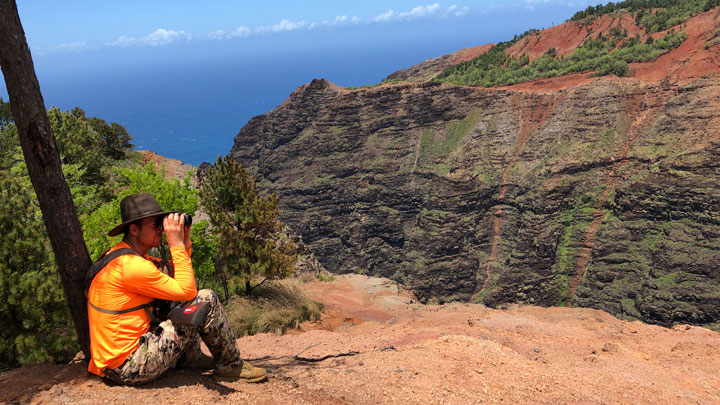
If there is a mesa, ridge, point or other vantage overlooking the area where you found javie sign, it’s a good tactic to sit atop the point and let your binocular do the walking. Be patient and spend plenty of time glassing; an entire herd of javelinas can be hidden in a tiny draw for a couple hours, and you’ll think there’s not a pig for miles. Then suddenly, they stroll out into the sunshine and it seems as though there are pigs everywhere. While sitting and glassing, you can listen, too—you might locate javelina by their sounds.

Once you’ve located a sounder of peccary, it’s time to make your move. Make sure you keep the wind in your favor and approach cautiously, but not too cautiously. Javies stay on the move most of the time, and if you take too long, they may have vacated the area before you arrive. Once you’re within 40 yards, you can slow down and stalk with care. If a pig spots you, just freeze and wait till it relaxes. Then resume your stalk.

Hunter poses with a downed javelina, draping his pistol over its back

Bullets and Broadheads for Peccary
Your regular deer-hunting rifle or handgun will work fine on javelina, just make sure you use a tough bullet. Stink pigs are dense and hard-boned, as you’ll see from the story below.

I almost simply wrote the same advice regarding archery gear—that the same gear you use on deer will work on pigs—but in good conscience, I can’t. From personal experience guiding peccary hunters in Texas, I believe they are tougher to kill than deer. In my opinion you need a really tough, cut-on-contact, one piece broadhead like a WoodsmanMontec G5 or similar. Here’s a true story to illustrate my point:

A friend who guided for me had never killed a peccary before, so we went out one evening to try to get him a pig. He was carrying an archery setup with which he had recently killed a huge bull elk, shooting expandable points. I told my buddy I had previously seen expandable heads fail on javelina, and suggested he use something else, but he was confident in his setup so we went hunting. His bow pulled 70 pounds of draw weight at 28 inches.

We soon located a troop of stink pigs, with one big boar sniffing around the females. The boar crossed in front of us, stopping broadside at 32 yards. My friend is a crack shot, but javies are pretty small and his arrow impacted about an inch and a half forward of the crease, with a sound like a baseball bat hitting a light pole. We tracked the boar over 450 yards up the side of a mesa before leaving him to live another day. The arrow had penetrated only an inch and a half beyond the broadhead ferrule, stopped cold by the peccaries scapula. It is my belief that a solid, cut-on-contact broadhead would have penetrated that scapula and double-lunged the pig. The moral of the story, of course, is that javelinas are small and very tough. Choose your gear and shots accordingly.

Hunter poses with his handbuilt primitive osage self-bow, behind a massive javie. The javies mouth is open, exposing its cutters, and the sun is setting in the background against the green and brown mesa.

Shot Placement
With a firearm and a tough bullet, you can down a peccary from any angle, but with archery gear the ideal shot angle is broadside, or slightly quartering away. The vitals are small, so take your time and make a careful shot. One helpful tip to remember is that javelinas can’t flex their neck very far to the side, so anytime they hear or see anything they must turn toward the source to investigate. This usually leaves you with a quartered-to angle. That’s fine with a firearm, but don’t risk it with a bow; wait for a better opportunity. Due to the same characteristic, it’s not helpful to make a sound to try to stop a moving pig for a shot—the animal will invariably stop quartered-on.

Hunter leans behind a javelina he has shot, dry mesa in the background

Following Up
Well-hit javies usually (though not always) tip over quickly. The same rules you’d use when hunting deer apply to any blood trail, except for one: if you believe that the pig is wounded and potentially alive, consider him dangerous. Exercise caution, and if possible, carry a hard-hitting firearm to use if he comes at you. A mad peccary is not likely to kill you, but he sure might leave some cool scars on your legs. Just be careful.

Processing Meat
There are two very important elements to keeping peccary meat tasty: keep it clean and cool it quick. When you approach your first stink pig, you’ll wonder how anyone could possibly eat something that smells like that. Get the skin off and away, exercising real care to keep the scent gland with its oily musk off the meat, and the carcass will look and smell fresh and tasty. Get the meat on ice in a cooler and you’re all set. Grind into breakfast sausage or chorizo, or slow-cook for a pulled-pork barbeque. Bon Appétit!

Categories
All About Guns Fieldcraft

Stay Aware by JIM WILSON

wilson2015_fs.jpg (8)

We spend too much of our time listening without actually hearing, and looking without actually seeing.

This past summer we pulled up to our travel trailer, after dark, and unloaded our two dogs. About the time they got out of the car, the dogs got really upset. They wouldn’t quit barking, they wouldn’t listen to me and they wouldn’t calm down. I figured they were just reacting to a coyote or some other critter in the pasture next to us. Finally, it dawned on me that I ought to find out what they were upset about, and started looking around with my flashlight. Luckily, I found and killed the Mojave rattlesnake before it bit any of us. Col. Cooper would have called me in Condition White, and he would have been right.

Awareness in our everyday lives gives us time to evaluate a situation and prepare to respond to it. Away from home, awareness often helps us spot a potentially bad situation while there is still time to go the other way. Heck, you might even spot the traffic cop while there is still time to slow down and avoid a speeding ticket.

Awareness should be part of the discussion in your family defensive plan. And, it really helps to have friends and family members encouraging each other to be conscious of what’s going on around them. A criminal attack is dangerous, but it should never be a complete surprise. Tune your senses—they are some of the best defensive weapons at your disposal.

Categories
All About Guns Fieldcraft

The Basics of Tactical Shotgun Training Getting good tactical shotgun training can overcome most of the limitations of using a shotgun for home defense. by KEVIN CREIGHTON

Tactical Shotgun Training

The debate rages on: What is best for home defense, a pistol, a rifle or a shotgun? There are definite advantages and disadvantages to each of these when it comes to keeping your home safe. A pistol is easy to carry and easy to move around inside your home, but it lacks the fight-ending punch of a long gun. A rifle, such as an AR-15, is very familiar to most American gun owners, but .223 or similar calibers quite often require more than one hit to stop the threat. A defensive shotgun or tactical shotgun brings a heavyweight hammer to the fight, but it has a low ammunition capacity compared to a standard capacity AR-15 rifle, with more recoil.

Despite these apparent limitations, however, the power of the shotgun is a quite compelling argument for using it to defend your home. Pistol drills like the Bill Drill and Failure to Stop Drill exist because we understand that a pistol is often not able to stop the fight with just one shot. The same is true for the AR-15. It’s very common to see trainers teach that three, four or even five rounds on-target as a normal response to a lethal threat. This means that a 30 round magazine in an AR-15 (which is usually loaded to 28 rounds in the field) suddenly becomes a firearm that can engage 5-7 targets before it needs to be reloaded. Coincidentally, this is the magazine capacity of the typical tactical shogun. All of sudden, the ammunition gap between a defensive shotgun and a rifle or a pistol is considerably smaller, and using a shotgun as a home defense gun starts to make a lot of sense.

Tactical Shotgun Training Shows You What Your Gun Can and Can’t Do

A good tactical shotgun training class can get even more out of your defensive shotgun, which is why I attended a recent Defensive Shotgun Instructor class taught by Tom Givens. Tom is a former Memphis police officer and a legend in the firearms training community. He is a firm believer in the power and efficacy of the defensive shotgun, and his class is a “must do” for anyone who wants to learn more about using a shotgun for home defense.

patterning a tactical shotgun

In this three day class, Givens taught us why a shotgun loaded with a good buckshot round is an absolute fight-stopper, if you understand what it can and can’t do. We first learned to pattern our specific gun with our defensive shotshell of choice to see how large the spread of pellets was at 5, 10, 15 or even 25 yards. Any pellet which doesn’t hit the intended target will fly downrange, with possibly disastrous results. Keeping all our hits on-target, no matter what gun you’re using, is an important part of marksmanship, and with a shotgun, that means knowing when the spread of your pellets exceeds the area of your target.

One of the biggest benefits of a good tactical shotgun training class is learning how to tame the recoil of a full-sized shotgun firing full-power buckshot loads. Givens teaches a “push-pull” method, where the hand that grips the fore-end of the shotgun pushes out towards the target while the other hand snugs the butt of the gun up against your shoulder. This creates a “loaded spring” effect and allows you to rapidly bring the sights of the gun back on target after each shot.

Make The Most Out Of Yourself And Your Gun

semi automatic tactical shotgun

The smaller magazine capacity of the defensive shotgun can be overcome by making sure you’re feeding fresh rounds into the magazine whenever possible, and just like other guns, there are two types of reloads, emergency and tactical. An emergency reload is when your gun runs completely out of ammunition and needs to get refilled right away, while a tactical reload is adding more rounds to your gun that is partially empty. An emergency reload with a shotgun means dropping a single shell into the chamber and closing the action, thus loading the gun. Shooting that round, or loading the rest of the magazine via a tactical reload will be dependent on your situation.

There was much more to this class than just those three concepts, as this wasn’t so much a class about shooting the shotgun as it was a class about how to teach other people how to use their shotguns in defense of life and limb. A shotgun can be an extremely effective home defense firearm but is definitely not “fire and forget.” Rather, it needs skill and expertise to be used to its fullest (and most devastating) effect, both of which can be acquired with good tactical shotgun training.

Categories
Fieldcraft

Take home food – Old School!

May be an image of 1 person and nature

Categories
All About Guns Fieldcraft

5 Dumb Hunting Mistakes I’ve Made by JAMES NASH

We do the wrong thing when we don’t know any better, but then thinking critically about how our decisions resulted in an undesirable outcome and making a plan for how to achieve a better outcome the next time is the map to improvement. Perhaps the only thing better than learning from your own mistakes is learning from someone else’s. Let’s get into five common mistakes that we aren’t going to make this year, and will all be better for it.

50lb draw weight and a 525gr arrow worked on this bull. This client shot much better than when his bow was set at a higher draw weight.

DON’T HIDE BEHIND TREES

We tend to think of the world the way we experience it as humans. That’s why we are hyper-focused on making sure animals don’t see us. I’m no different. I am careful to make sure I am using the best camouflage available, cover my face, and never cross a ridge on the skyline. As a young hunter, I was always seeking concealment behind the brush, rocks, trees, etc. I am thankful that I’ll never know how many critters got close to me without me ever seeing them because I can’t see through trees in the same way that I can’t be seen through trees.

Your camouflage works, let it do its job. El Sapo Guide Service

On a high desert peak in central Nevada, my good buddy Adam Hutchison and I spent a week hunting mule deer with a long bow. We had the basic pattern of the bucks nailed down after a few days. In the morning they’d graze on one side of the ridge until it got warm then bed down on the shady side until evening when they’d cross again to graze.

One evening we watched an ancient old 4×4 get out of his bed beneath a juniper tree and start working his way towards a pass in the ridge with a prominent game trail going through it. I stayed in place and watched through my spotting scope and Hutch scrambled off our knoll and positioned himself behind a short thick piñon pine that had been stunted by relentless Nevada winds. The tree itself might not have been more than 8’ tall but the trunk and limbs spread out to make an area that was around 15’ across.

The buck climbed along steadily into the pass as Hutch waited with an arrow knocked. I could see the wind pick up small puffs of dust as the buck walked, a wind blowing at the deer’s back, and just knew Hutch was going to get a shot. The old buck walked straight to pine, opposite where my buddy stood. They both waited there a long time, spread by no more than 6 yards. At the same time as Hutch took a step to walk around the tree counterclockwise, the buck did the same thing, also counterclockwise.

They mirrored each other as they walked around the tree, 180 degrees apart, both vaguely aware of the other but neither confident enough to make a bolder move. When the buck got to where Hutch had been standing and could smell his scent on the ground he bolted and we never saw him again.

Good camo breaks up your outline and blends into the background. If you stand in front of a tree, your camo will do its job and you’ll have excellent visibility of animals approaching and a full range of motion to draw a bow or shoulder a rifle. Try to pick locations where an animal will have to pass behind objects that will allow you the chance to move if you need to.

The extendable sun shield on the Sig Oscar 8 can be a lifesaver when you have to look towards the center of our solar system. I had just found a bear in a place I did not at all want to hike.

DON’T GLASS TOWARDS THE SUN

Spot and stalk hunting requires a lot of time spent glassing. When I scout an area, even more important to me than finding animals is finding good places to glass from. I want different glassing locations for different times of day, but above all I do not want to glass East in the morning or West in the evening. At first and last light, deer and elk will glow in the low angle sunlight and are very easy to spot if the sun is at your back. If it’s in your face it will flare out your lens and you’ll be fighting to tell trees from rocks.

During morning glassing sessions I like to take inventory of who is in the area and where they go to bed. Depending on the situation I can then make a mid-day move or be in a good position for the evening. During evening glassing sessions I tend to put myself much closer to the zone I am glassing so I can get into position and make a shot, especially if I am rifle hunting. With a bow, I tend to work towards situations where I will be shooting in the morning to give myself max daylight hours for blood trailing and getting meat hanging.

During an especially bad fire year, I hiked two days into the wilderness to get to a spot I just knew was going to hold deer. I made an especially difficult climb onto a glassing knoll that looked into a basin and settled in about 2 pm. The fires puffed up as they tend to in the afternoons and my basin grew hazy with smoke. I could still glass so I wasn’t bothered by it.

As the sun headed towards the horizon and the color of the light warmed, the smoke picked up that color and became impossible to glass through. My entire hunt depended upon being able to glass from this knob, and if I’d spent 30 seconds thinking about the light and air conditions during my two-day hike into that location I would’ve come up with a much better plan. As it was, I committed to the spot, and after three days of not being able to see, I hiked out empty-handed feeling dumb.

Whenever I glass, I set up the rifle first.

WAIT FOR THERMALS TO STABILIZE

When the ground is cooler than the air, it causes air to settle in a way that makes the wind begin blowing downhill. As the ground heats from solar gain in the morning and becomes warmer than the air, it causes lift that makes wind blow uphill. Animals base their movements, feeding locations, and when/where they bed on these diurnal wind conditions. However, there are transition times when the thermals are switching that you get periods of uphill wind followed by downhill followed by uphill again.

I’d been guiding a group of gentlemen from the East Coast on a backcountry elk hunt in the alpine for a week. We had seen and smelled elk but not many and weren’t able to get them to engage with calls and couldn’t navigate the steep country well enough to maneuver on them, so we headed to a different area that was short grass prairie interspersed with canyons, the north sides of which had timber. We glassed up a herd of around 70 elk with a great 6-point bull and watched them come off a south-facing ridge and settle into a north.

It was going to be an easy approach and I was fully confident we could challenge that bull into archery range. At 8:30 am I felt a puff of wind come uphill and grabbed the hunters and headed into the north. As soon as we got into the trees I could immediately feel the coolness and stopped. Then that dreaded feeling of cold sweat on the back of my neck made colder by a downhill thermal rippled through me and the scent carried on down into the trees and 70 head of elk got up at 150 yards and thundered off, ending our hunt. There was no rush, those elk were going to sleep in that north all day long.

We could’ve taken a nap and waited until 10 am for some really stable wind conditions and slipped into calling range and gotten that bull so mad he’d be willing to fight, but I rushed the thermals and blew it. Lesson learned.

Anyone can be a hero on their home range. Photo by Sean Powell

DON’T OVERSHOOT THE WIND

We seek comfort and efficiency naturally because those are survivable conditions. If you are anything like me, you enjoy going out to the range on days with pleasant weather. I can settle into a bench with my rifle on a bipod and shooting bag and hit targets at will. Even if the wind kicks up a little, I know my rifle range and can tell the difference between a 9mph wind and a 12 mph wind and I know how a three o’clock at the bench turns into a 5 0’clock at 500 yards. I know this because I’ve shot there a lot. The odds of getting to practice in the location you’ll be shooting in a hunting scenario are so low it’s not even worth talking about.

Here’s my point, the wind is doing something on the terrain you are hunting in that you don’t fully understand. Learning and reading wind takes a lot of trial and error. As the earth tilts on its axis during fall it causes massive shifts in weather patterns. The decreased daylight hours and even the change of color on foliage all play a role in fall weather. There is a much higher chance you are going to shoot through storm-driven winds which are also being influenced by diurnal terrain-driven thermal winds. Just because you could hit your target on your home rifle range at 600 yards every time in July doesn’t mean you can do it on the mountain. Take your maximum effective range in practice and reduce it for hunting.

Make yourself practice positional and hasty shots at the range. The bench is to ensure your rifle is zeroed, it’s not a great place to develop field shooting skills. Photo by Born and Raised Outdoors

I missed three consecutive shots, prone, with a shooting bag, on a target at 505 yards at the Sig Hunter Games in Wyoming this year. The wind was blowing between 10-15 mph at 6 o’clock from the shooting location, and around 20mph from 9 o’clock from 150-350 yards, and then who knows how fast at 7 o’clock from 350-500. Whiffed three times in a row. I shot the same target the day before with half that wind and went three for three. I don’t take 500-yard shots when hunting big game for this exact reason. I can’t guarantee a precise hit.

A full-size air rifle is a fantastic way to practice that doesn’t develop and make permanent bad habits. Photo by Sean Powell

DON’T SHOOT TOO MUCH BOW OR GUN

This has got to sound weird coming from me, and a younger version of myself would be rolling his eyes right now. Recoil is a real thing. If you don’t believe you are affected by recoil, the next time you go out to the range get in a contest with your buddy who shoots as well as you and see who can shoot a tighter group at 30 yards. You get to use your hunting rifle, and he gets to use a 22lr. I’ve played this game with guys who are much better shots than me and if I have the 22, I win. I have had a ton of clients show up with rifles that had too much recoil and they couldn’t shoot them well. Same thing with bows. The times I have turned down the draw weight for clients they have always shot better. Take the indoor archery shooters as an example, you know, the guys you see lined up in Vegas shooting half-inch dots over and over and over again from the 20-yard line. How many of them are drawing 80lbs? Zero. 70lbs? Zero

Do I shoot an 80lb bow? I used to. Right now I am pulling 70 and shooting better than I have in a decade. Will I shoot 80 again? Maybe, but only if I can shoot it well enough to satisfy my own accuracy requirements. I’d rather see a client shoot a smaller rifle well or a lighter draw weight bow more accurately than a heavy-hitting contraption that scares them into shooting poorly. Fun fact: If you turn your bow’s draw weight down and increase your arrow weight, you can get the same penetration you had before.

I’m not telling you to run out and buy a new gun. You can reduce recoil on the rifle you have by adding a suppressor, making the gun heavier by adding accessories, or by changing the stock or barrel, or adding a muzzle brake. I despise muzzle brakes and ask that clients do not bring them, but they are a relatively inexpensive way to reduce recoil. Just make damn sure that you and everyone around you are wearing good ear protection and don’t shoot it across the hood of a pickup. If you do decide to buy a new rifle, getting one with an adjustable stock will go a long way toward making the shooting experience more pleasant.

The best way to learn any of this is to not take my word for it and go out and make these mistakes yourself. Like the drill instructors enjoy saying, “pain retains.” The most efficient way? Well, that’s to let my mistakes be your lessons.

I’d love to learn from your hunting mistakes, so if you’ve ever made one, write it in the comment section at the bottom of this article. Let’s learn from each other and improve together.

Categories
All About Guns Fieldcraft

Massad Ayoob – How to answer the door at 3:00 AM – Critical Mas Episode 30

Categories
Fieldcraft

Massad Ayoob: The Pros and Cons of AIWB, IWB and OWB Concealed Carry Positions – Critical Mas

Categories
All About Guns Ammo Fieldcraft

Elephant Guns Point of View: .470 Nitro, .505 Gibbs, .450 Rigby, .375 H&H