Category: Fieldcraft
Off Duty Carry
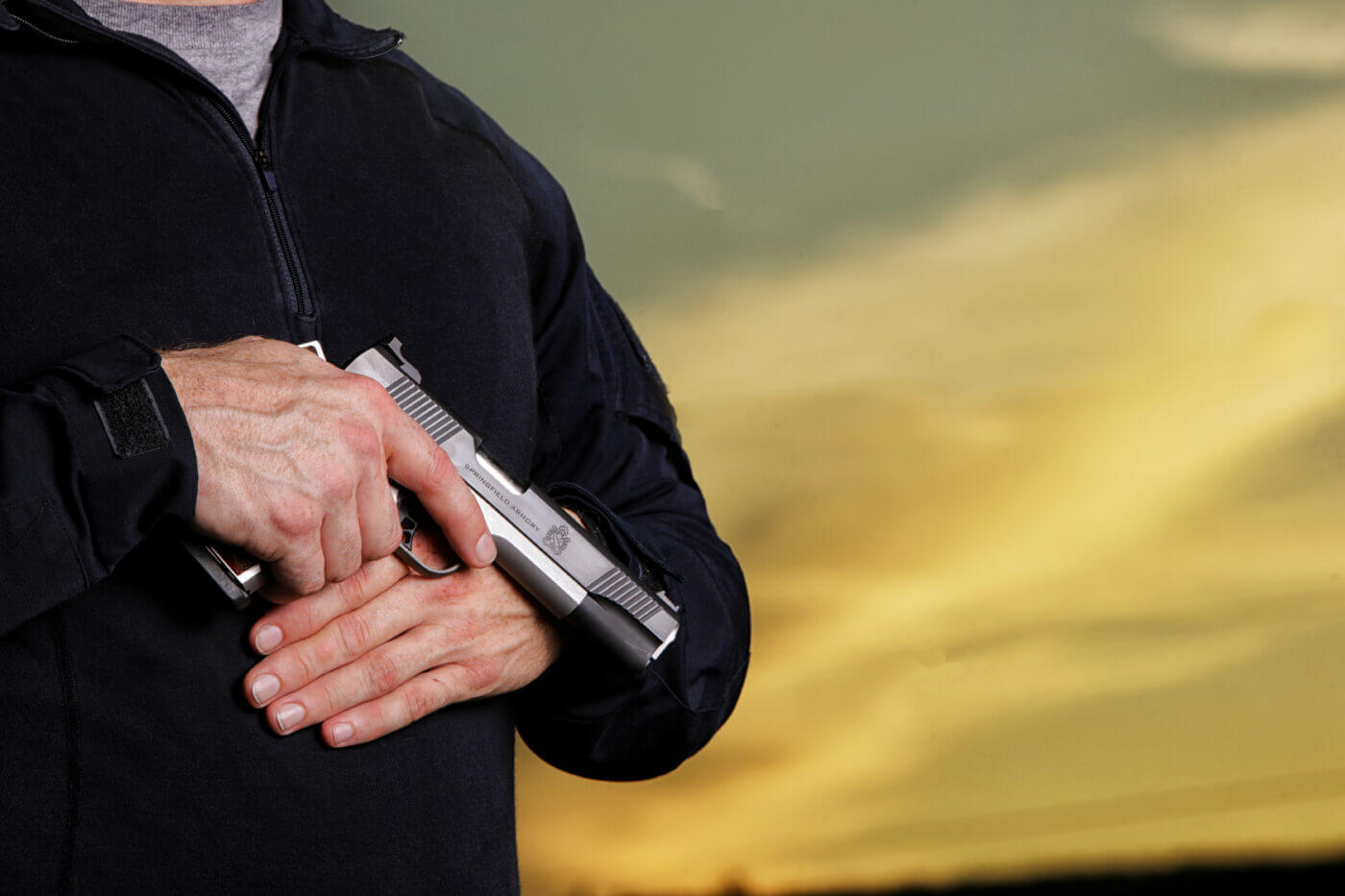
Traditionally, big handguns were for carrying openly and smaller handguns were for concealment because — well, duh — smaller things are easier to hide (and they’re also less weight and bulk to carry). However, the wise concealed carriers ask themselves, “Why exactly am I carrying a handgun in the first place?” The obvious answer is, “Because I might have to shoot something to stay alive.”

If the purpose of the gun is not only to shoot but to hit the target when it is desperately important to do so — and since we know that, as a general rule, larger handguns are easier to shoot fast and straight — we have a definite collision of needs here.
Which brings us to the question of how to comfortably and discreetly carry larger handguns concealed.
There may be other reasons. In law enforcement, the rookie cop is generally a relatively young adult, often with no firearms experience, now in an occupation where they realize they are expected to take action when violent felonies occur in their presence — even when they happen to be off-duty.

While more police officers are issued compact handguns for off-duty carry today than ever before, the majority of law enforcement agencies still issue only one handgun, normally a full-size service pistol. The entry level officer is at the low end of the pay scale, often with young children and substantial life expenses, and purchasing another firearm and the attendant accessories can be a significant financial burden.
Finding the Balance
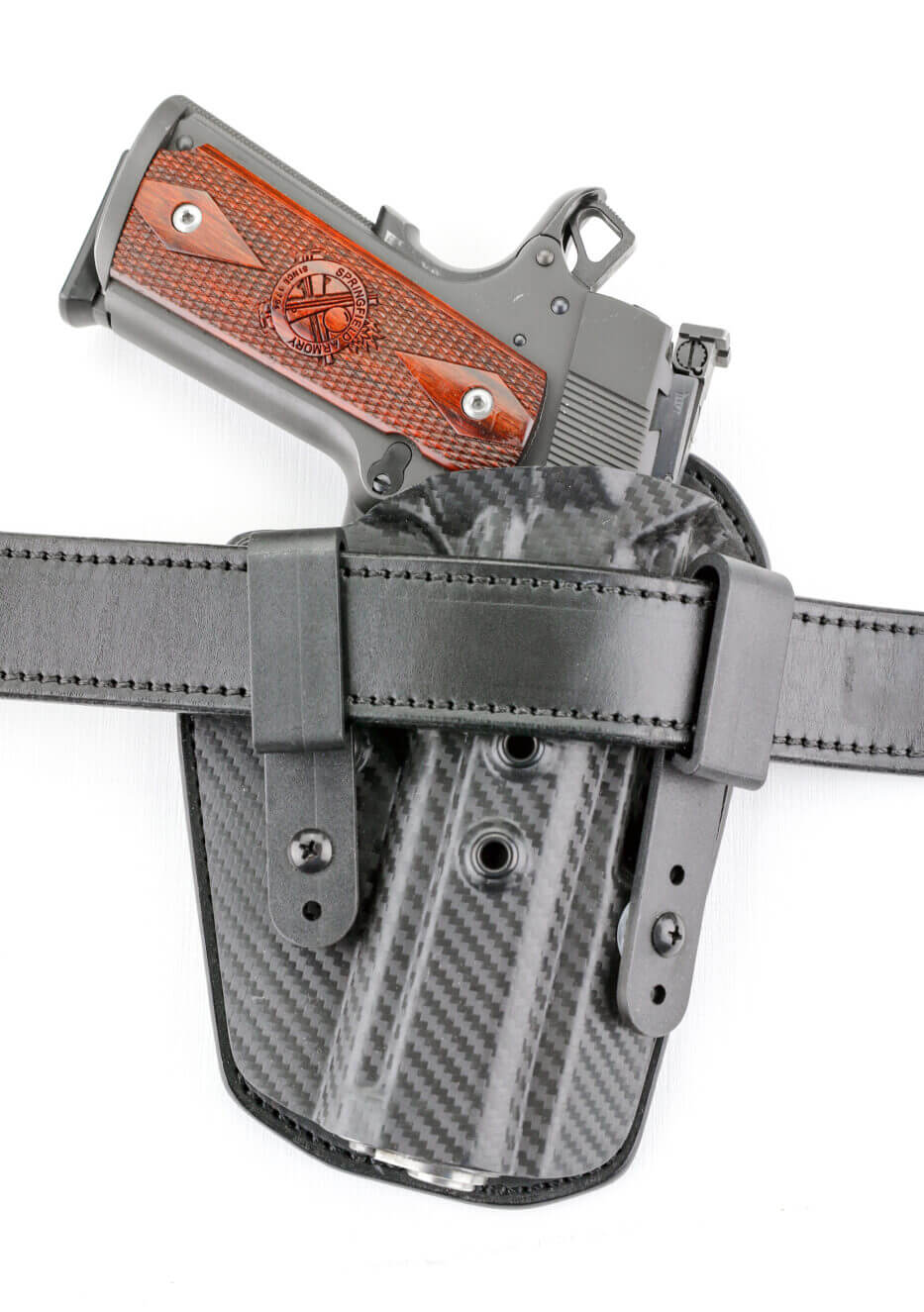
In the old days of the service revolver, young cops learned that buying an inside the waistband holster (IWB) allowed them to carry their four-inch barrel .38 or .357 Magnum concealed in ordinary clothing, and to be armed with the very same gun they were most familiar with through department training and qualification.

Let’s fast-forward to the concealed carry world of today. Even if you are at your peak earning years and you can afford a vast array of guns of all sizes and holsters of all types, you have to balance comfort with discreet concealment and, what we’ll call for lack of a better word, shootability.
If you shoot a helluva lot better with a bigger gun, perhaps one with an optical sight or even an attached flashlight, concessions are going to have to be made somewhere.

For decades, starting at a very young age before anyone pinned a badge on me, I carried a full-size 1911 .45 auto. I did so during a few decades as an active part-time cop whenever I was allowed by the agency to do so. There were periods when I had to carry a department issue double-action .45, full size, and of course did. For some of those years the mandated service weapon was a .357 Magnum revolver with four-inch barrel. In each case, I learned to carry and be comfortable with the department issue gun on my own time.
Here’s how.
Dressing Around the Gun
If I recall correctly, Detroit Police Lieutenant and gunfight winner Evan Marshall was the first expert to coin the term “dressing around the gun.” Your clothing was designed to fit you and make you look good. Now a couple of pounds of oddly shaped metal have been added. To dress around that requires changes in sizes and styles of clothing.

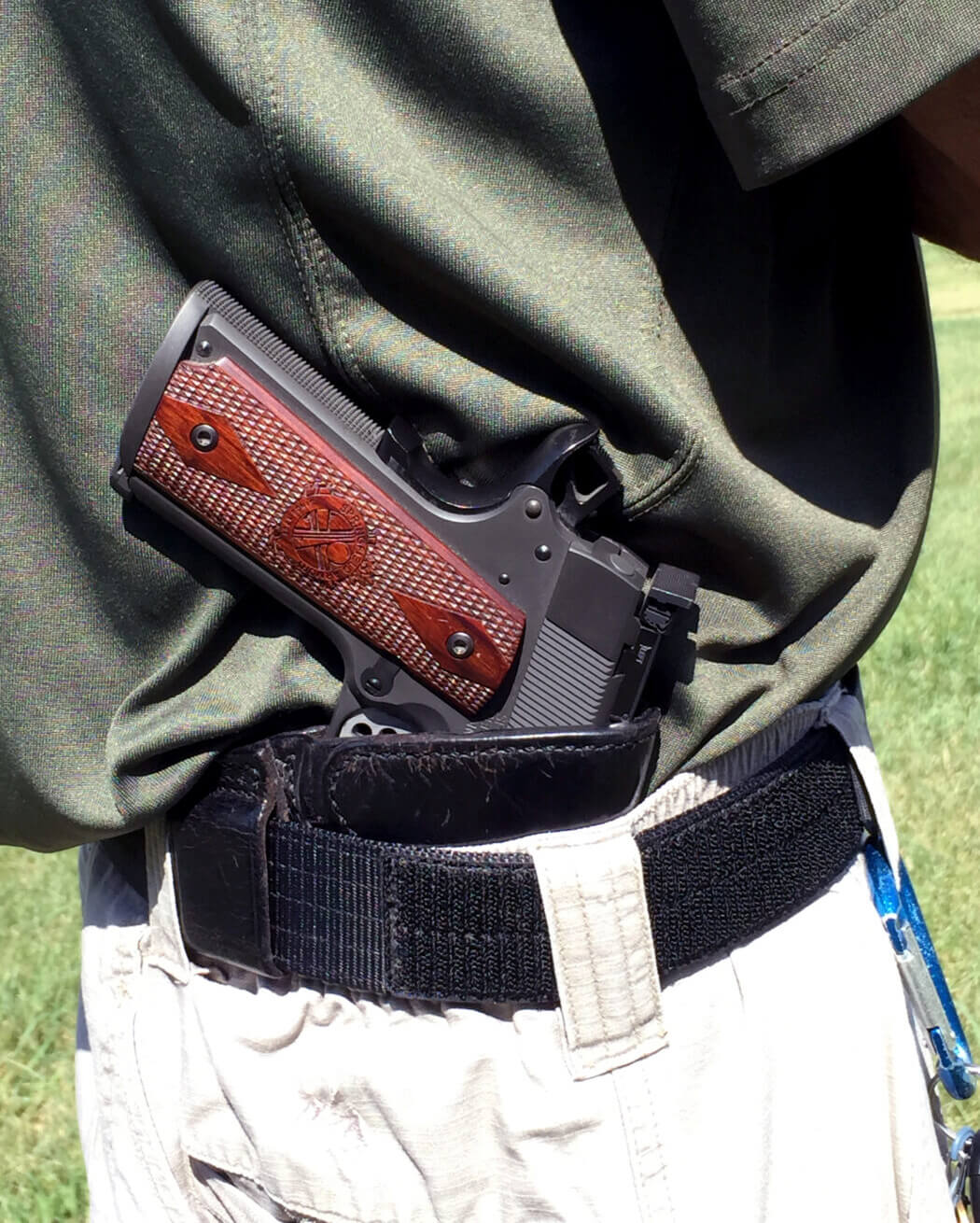
IWB means that a longer handgun is down inside your pants and you don’t need as long a lower hem on your concealing garment to cover it. There’s a price to pay, though: you bought your pants with a waistband to fit you, and for them now to fit you and the pistol — and probably a spare magazine — it will have to be larger. Figure two inches larger in the waistband dimension.
AIWB. If you want a full-length grip frame to accommodate a higher cartridge capacity magazine, you’ve increased the height of the gun, a measurement that encompasses the butt of the pistol to the top of the pistol. A modern optical sight will significantly increase that height.
This is one reason why appendix inside the waistband carry (AIWB) is now so popular: most people have a broader expanse across the front of their torso than their measurement from belly button to spine. The greater height of the fully equipped modern pistol is now better concealed — but a closed front concealing garment is now required. That means an untucked closed-front shirt, a hoodie, a pullover sweater, or something similar.

An excellent choice is the PHLster Enigma, an ingenious system that can hide a good-size pistol under a shirt.
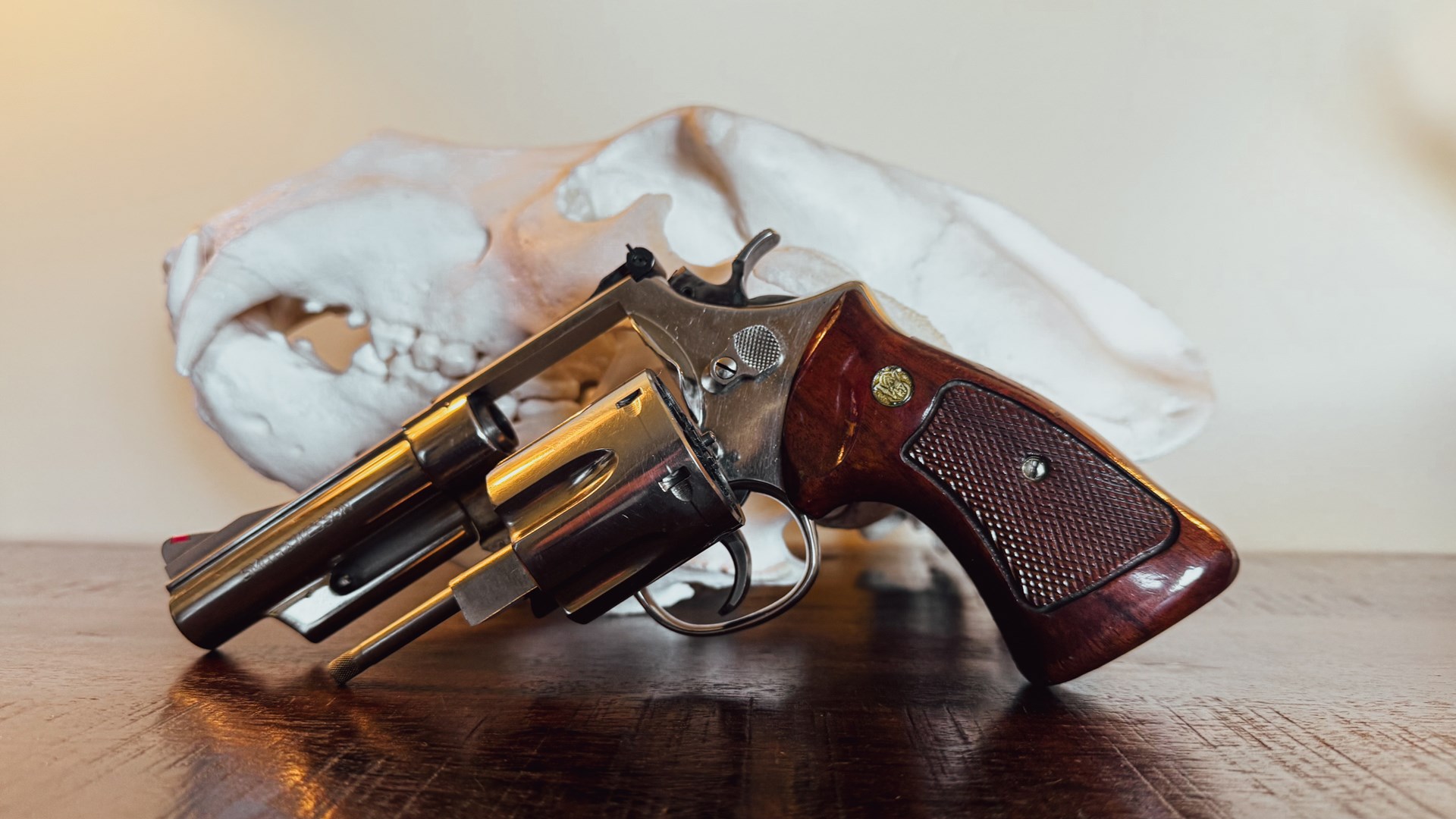
I’ve had occasion to carry a four-inch barrel .44 Magnum revolver. The big six-shooter concealed well in a Milt Sparks Summer Special inside the waistband holster, with a sport coat or un-tucked open front flannel shirt hiding it. Not the most comfortable carry, but certainly tolerable.
FBI tilt – butt a bit forward, muzzle canted to the rear — is a distinct concealment aid if you carry strong-side hip. It helps keep the butt inside the fabric drape coming down from the lats.
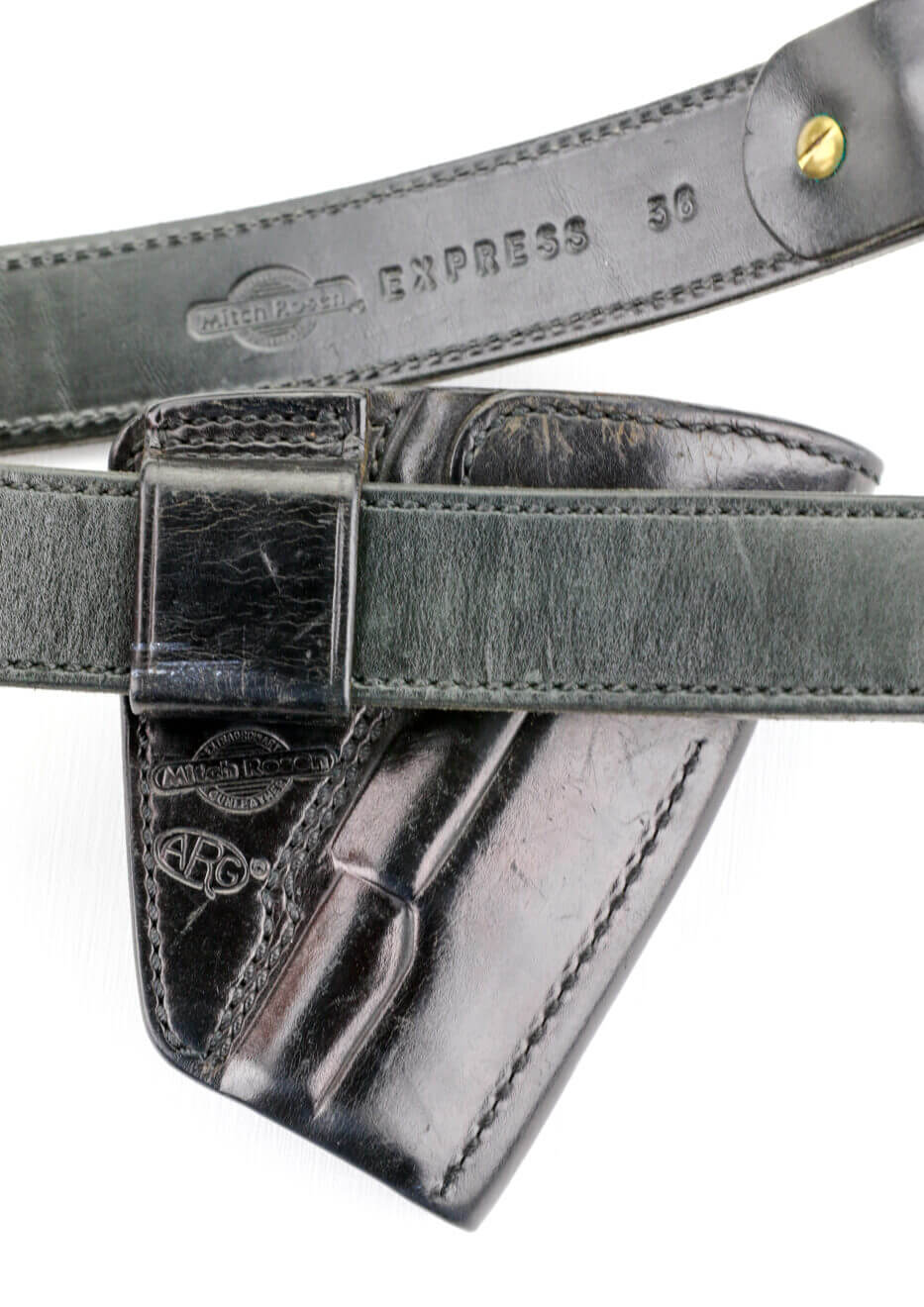
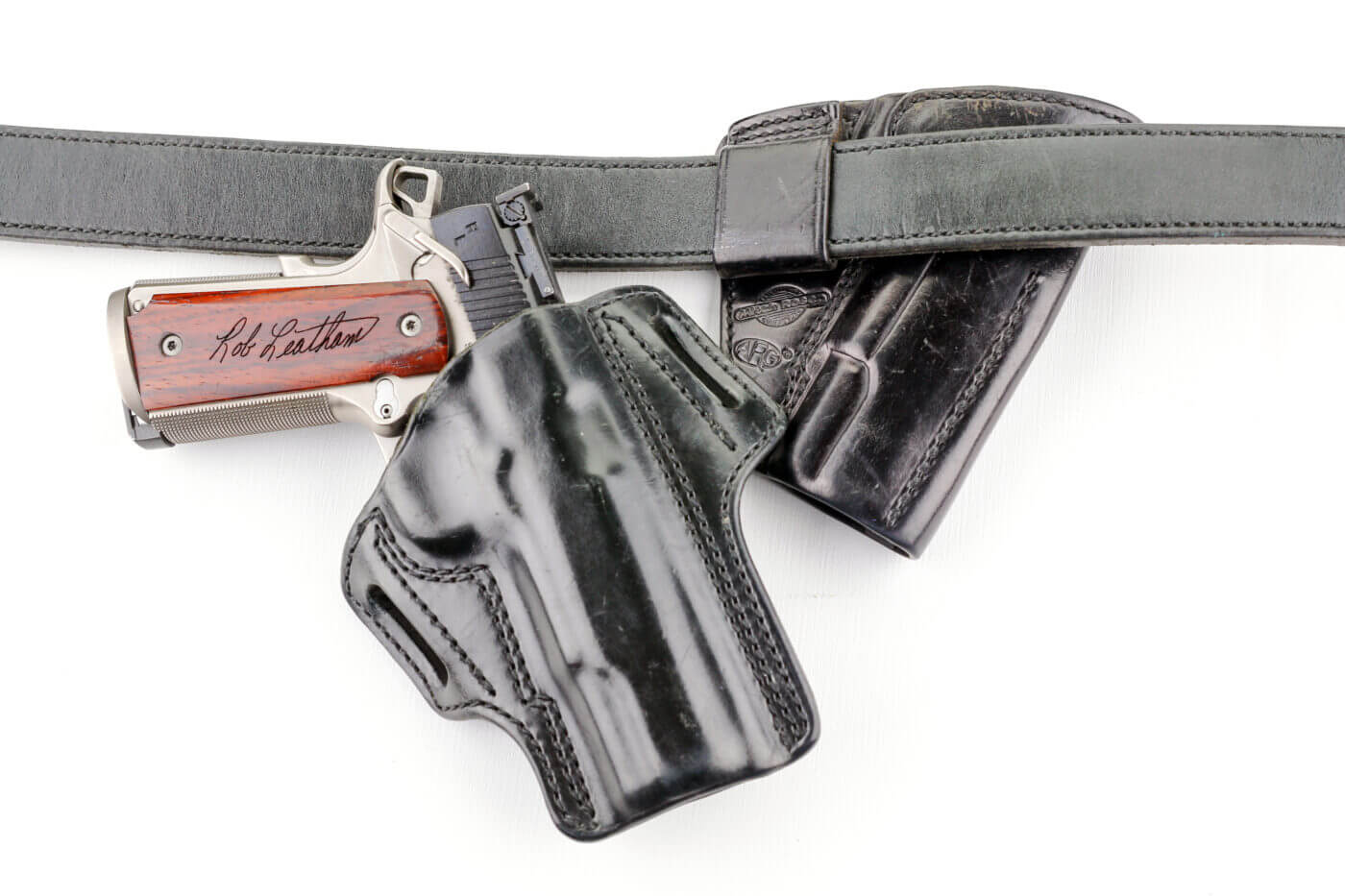
Pancakes aren’t just for breakfast. Back in the 1960’s, Roy Baker’s patented Pancake holster popularized belt loops fore and aft instead of level with the holstered pistol. It helps to pull the holstered gun’s silhouette tighter into the body for better concealment. One such loop, as on the classic Askins Avenger designed by Richard Nichols, is good; loops front and back work even better.
And for the Distaff Side
For the ladies reading this, there are separate concerns. The average female is smaller than the average male, and a four-inch barrel striker-fired 9mm her big brother considers “compact” becomes more like “huge” for her. Most of the handguns and most of the holsters were designed by and for men. Moreover, your typical female has higher and more prominent hips than a male the same height. A concealment hip holster that puts the gun’s butt in his kidney area will put the same gun up into her floating ribs.

Solution? Instead of awkwardly rocking the shoulders sideways to clear a long-barrel pistol, incorporate hip movement into the draw. If you’re right-handed, drop the hips down and left as you draw, down and right if you’re a southpaw. Now, instead of the draw being all lifting a big gun out of its scabbard, the draw becomes part that and part your lower body pulling the holster down and away from around the gun. It’s also less of a flag movement than the shoulder rock: you don’t want to “telegraph your punch” by allowing an assailant to see you drawing any sooner than he has to.
By the way, this technique also works for males who like a very high-riding hip holster.
General Tips
There are going to be fashion sacrifices. Skin-tight clothing and concealed handguns simply don’t play well together. To conceal a full-size handgun, you want the concealing garment (un-tucked polo shirt, jacket, whatever) to be about one size larger than perfect fit without the gun. That gives you enough fabric drape for better concealment. The Fashion Police will probably only give you a warning instead of dragging you into Fashion Court, but no one is likely to look at you and scream “OMG, they’ve got a gun!”

If you carry on the hip, don’t reach for high shelves in public with the hand on the holster side. That tends to pull up the concealing garment and reveal the pistol. Use the other arm. Bending over at the waist causes “printing” of holstered guns at hip or small of back, so pretend you’re a back patient and kneel or bend the knees to prevent the printing.
Conclusion
My old friend Clint Smith is one of the all-time great instructors in armed self-defense. He’s famous for saying, among other things, “The defensive handgun should be comforting, not necessarily comfortable.” He practices what he preaches. Every time I’ve been with him, he was carrying a full-size 1911 .45, a full-size Springfield Armory XD45, or a large frame big-bore revolver with a four-inch barrel. And, you know something? He never said the gun couldn’t be comfortable as well as comforting.
If a larger pistol gives you more confidence in your ability to hit your target rapidly under stress, and/or a greater power level that you find more reassuring, and/or a larger ammunition reservoir that you think you might need … well, that’s comforting.
Following the above advice, I’ve found that it can be comfortable, too.
Learn how to spot trouble long before it happens.
If you walk into any defensive-oriented training class, there will be a good chance you will hear the “Cooper Color Code” being mentioned. Created in the 1970’s by legendary firearms trainer Col. Jeff Cooper, it’s a way of describing your ability to react to what’s going on at any given moment.

The original version has four levels, each represented by a different color.
- White: Your mind is on vacation. You’re in your easy chair at home, reading a book and sipping a drink.
- Yellow: You are aware of your environment and that something might happen to you.
- Orange: There is something going on that requires your increased attention.
- Red: You’ve determined what the problem is, and it needs to be dealt with.
When I teach a class, I relate the Color Code to driving on a road. Condition White is clueless to your environment, like texting and driving. Don’t do that. Condition Yellow means you are occasionally checking your mirrors and keeping an eye on your speed. Orange means you are approaching something that might be a problem, like a tricky intersection or a tight corner. Red means some yahoo has blown through a stop sign and you’ve got to deal with it right now. Yikes.

The Color Code works well to describe our mindset as we go about our daily routine. It’s easy to relate to just about anybody, and describes how we need to change our response as things escalate.
However, one of the disadvantages of the Color Code is that it is an intuitive process. What triggers each step in the mindset is not specified; that is left up to the individual. Humans are pretty good at spotting trouble — that’s one of the reasons why we are at the top of the food chain. We know when things just “don’t feel right” and we prepare ourselves to deal with it.

This becomes a problem when we are forced to explain our actions to other people, such as an investigating officer or a district attorney. “I drew my pistol because the dude was acting weird” may have seemed perfectly reasonable at the time, but try explaining that to a jury and see what they think.
What we need is an iterative, process-based approach to spotting trouble and reacting to it when it happens. Enter the Marine Corps’ Combat Hunter program.
The Right Response
The Combat Hunter program was created in 2007 as a way to teach Marines how to spot an ambush before it happens.
Casualties were mounting from surprise attacks, and Gen. James Mattis (and others) directed the Corps to create a program to spot and possibly nullify an ambush before it happened. They wanted to win the “left of bang.”

“Bang” refers to the event that starts the ambush, be it an improvised explosive device going off or surprise assault by a group of irregular soldiers. Everything on the timeline to the left of that event is planning and preparation. Everything to the right is execution of those plans. We were winning the battle to the right of bang, what we needed was a way to win left of bang.
The Combat Hunter program was created to help solve this problem. It is, in essence, a two-step process:
- Establish a baseline of normal for your environment
- Look for changes from normal
Establishing a baseline of “normal” takes some time, but not as much as you might think. For example, I lived in Costa Rica for an extended amount of time, and it took me about three weeks to get the rhythm of the culture there, and that was before I could say more than a dozen words in Spanish.
After those three weeks went by, I had a good idea of what “normal” meant on the streets of San José, and could tell when something was not supposed to happen.

Just knowing that “something ain’t right” isn’t enough, though. We need to look for specific changes in our surroundings that signal that something is about to happen. The Combat Hunter program, as outlined in the book Left of Bang, demonstrates six things which can change and indicate that something bad is about to happen.
They are as follows:
- Proxemics: Where everybody is in relationship to everyone else. A young man breaking off from a group of other young men congregating on the other side of the street and walking towards you is a prime example of this, but so is someone who is standing unusually close or unusually away from you
- Iconography: Graffiti is a classic example of this, but it can also mean what clothes a person is wearing or similar ways we signal group affiliation to other people.
- Geographics: Where are you? My time in college taught me that hanging around outside of a seedy bar at night dramatically increases the chances of something bad happening to you versus, say, studying in the library.
- Kinesics: How are people moving? Touching your face, nervous glances or a “mad dog” fighting stare are usually indicators that something bad is about to happen.
- Biometrics: Nervous tics. Unusual sweating. You know it when you see it.
- Atmospherics: As they say in the movies, “I got a bad feeling about this.”
These are the six things that establish what “normal” behavior is like in any given environment. When three or more of those behaviors change, our behavior needs to change, or else we will suffer the consequences.
If three of these things are out of the ordinary, you need to act. What that action is will vary depending on the circumstances, but an action is required if you wish to avoid a negative outcome.
Near and Far
Up until now, I’ve been talking about how the Marines use these methods to spot trouble in far-off countries.
However, they are 100 percent applicable to our lives here in the U.S. The criminal we are most likely to face is a resource predator: We have something they want, and they are willing to use the threat of violence (or actual violence) in order to get it.
They will probably attack from ambush in order to get said resource, no matter if it is our wallet or our car or our very lives, so having a system that lets us look for specific things around us.
Better still, this process allows us to relate our thinking to others rather than just saying, “He was just acting strangely, so I drew my pistol.” Let’s walk through an example of what this might look like in real life.
It’s 10pm on a Saturday night and you have been tasked by your significant other to run to the local supermarket in order to buy a vital component for tomorrow’s meal.
Now before you say, “I would never do that sort of thing,” realize that if you haven’t done this already, you probably will do this or something similar at some point in your life. We can minimize the risks we take, but we can’t eliminate them altogether.

You pull up in your car in a reasonably safe parking spot, take a quick glance around the parking lot to make sure there is no violence currently in progress, then go into the store, make your purchases and walk out to your car.
As you exit the building, a young man breaks off from a group of other young men, ages 20-30 or so, who are hanging around a car about 15 yards off to your right. He walks purposefully towards you and is dressed primarily in green colors, along with his friends.
As he walks towards you, he points to you and says “Hey, buddy!”
Game on. Let’s establish what is going on here, and see if there is reason to act.
- Proxemics: The man in question left his group of friends and is on a mission to approach you. That’s weird.
- Iconography: There is a common color (green) among the people involved. Now it could be they are all on the same softball team and have stopped at this supermarket for a post-game libation, but that’s not how I would see things in this situation.
- Kinesics: Walking with purpose, pointing at you. Yep, check that box.
- Biometrics: Too far away to tell. Let’s give this one a pass.
- Geographics: You’re in a supermarket parking lot, late at night, on a weekend. Yeah, geographics are definitely in play here.
- Atmospherics: See above.
We’ve now established that there are five out of six things happening here which might indicate an ambush is about to happen. Welcome to Worst Case Scenario Town, Population: You.
What should you do in this situation? That is where your previous training and experience should kick in. If it were me, I would default to the “Ask, Tell, Make” method I learned in a Shivworks “Managing Unknown Contacts” class and ask the gentleman to hold up about 15 or so feet away from me.

If he persisted on approaching, I’d ask him again to stop there. If he kept coming, I’d scream “STOP!” and go to another option such as retreating back into the store, shining a bright flashlight at him (it is night after all) or possibly deploying pepper spray or another solution. Your response may vary.
Conclusion
As we can see, the beauty of Left Of Bang and the Combat Hunter program is that they allow us to see why we did something in a logical, process-driven manner rather than just rely on intuition.
It also allows us to hone those processes and live safer lives and improves our ability to relate our actions to others if there are any possible interactions with the American legal system. Left of Bang is available in electronic, paper and audio versions from all major booksellers.

Prioritizing four mandatory traits of a concealed carry handgun.
There are hundreds of pistols marketed as being suitable for concealed carry. Choosing one that might be the best option for you can seem daunting, but there’s a method you can employ that is very practical. It involves prioritizing the most important aspects of a concealed carry pistol, which include—in order of importance—carry and concealability, reliability, shootability and effectiveness.
This hierarchy might surprise many who believe effectiveness/ballistics should be most important, so let’s look at each aspect individually and some rules I think should apply.
Ease of Carry & Concealability
If you have a pistol for concealed carry that you find uncomfortable to carry or hard to conceal, you simply will not carry it—no matter how effective it might be. As they say, the first rule of participation in a gun fight is to have a gun.

For example, few would argue the effectiveness of a 10mm pistol, such as the 6-inch barreled Kodiak from Dan Wesson. After all, it can launch a 180-grain bullet to almost 1,300 fps with double the kinetic energy of the 9mm Luger. But it also weighs more than 50 ounces when fully loaded and is almost 10 inches long.

Rule 1: Find the size of pistol you can comfortably carry and easily conceal. Then, assemble your options accordingly.
Reliability
If you are required to shoot your concealed carry pistol to try to keep from becoming un-alive or seriously injured, it must work. It must work for the first shot, the second shot, and every shot thereafter. (I once responded to a shootout behind a bar early one morning and on the ground beside the dead guy was a pistol with a stove-pipe jam.)
Fortunately, most modern pistols from reputable manufacturers are very reliable, but you might discover that you do not interface with a certain pistol very well and that lack of a smooth interface can cause stoppages. You might also find out a specific pistol—no matter how trusted the model—has reliability issues.
Rule 2: Settle for no less than 100 percent reliability from your carry gun when shooting self-defense ammunition.
Shootability
You need to be able to hit what you’re shooting at. Yes, just pointing a pistol at, or shooting at, a bad guy might be enough to make them stop doing bad things. But if that does not work, you’re going to need the bullets you launch to find their mark. You might interface wonderfully well with a specific pistol, and it might never malfunction, but if you cannot hit what you’re shooting at—and you know you can shoot better—it’s not the pistol for you.

What you’re looking for is a pistol you can shoot fast and accurately, but it’s hard to give a performance threshold when it comes to shootability, because of the different skill levels of shooters. Consider using a common defensive handgun drill—something like the Forty-Five Drill—to evaluate your abilities with any handgun you’re considering carrying.
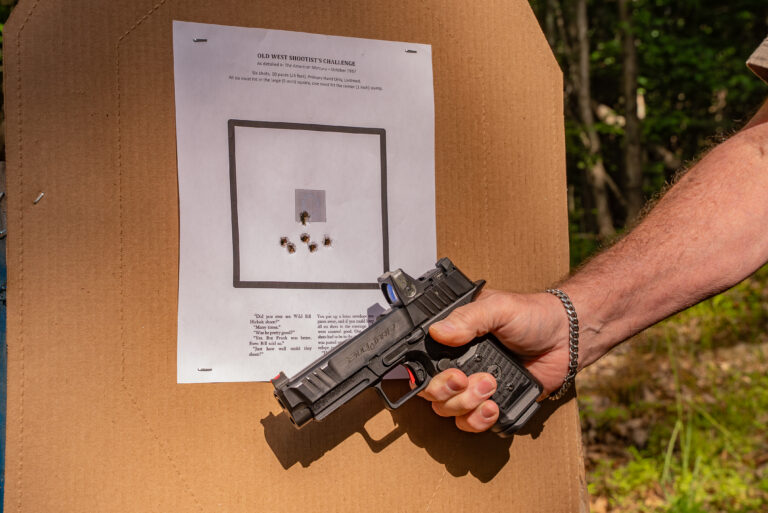
Rule 3: If, from 5 yards, you cannot put five shots into a 5-inch circle in 5 seconds with your chosen pistol, it might very well be the wrong handgun for you.
Effectiveness
This is the aspect of defensive handguns that often causes the most worry or disagreements, and it deals with the cartridge more than the pistol. Although, the pistol matters, too, because a particular cartridge might generate a recoil impulse that makes the pistol unshootable for you. The most carried self-defense pistol cartridges are the 9mm Luger, .40 S&W and .45 Auto. Less popular are smaller pistol cartridges like the .22 LR, the .25, .32 and .380 Auto, and the semi-recently introduced .30 Super Carry.

In attempting to answer the question of which cartridge is the most effective, the answer is really very simple: It’s the cartridge that’s capable of delivering the largest caliber bullet at the fastest velocity. However, between the three most popular cartridges, and even the .30 Super Carry, the distance between their effectiveness is not as broad as you might think. Given good shot placement, they will all work about the same.

Rule 4: Choose the largest caliber cartridge with the fastest velocity that you can comfortably manage and shoot well, in a pistol that you can carry and conceal reasonably easy.
Starting Your Search
When all these considerations are looked at in totality, the little itty-bitty guns are often avoided because they’re either hard to shoot or because they do not offer optimum effectiveness. Conversely, the big pistols are rarely chosen because they’re very hard to comfortably carry and conceal.
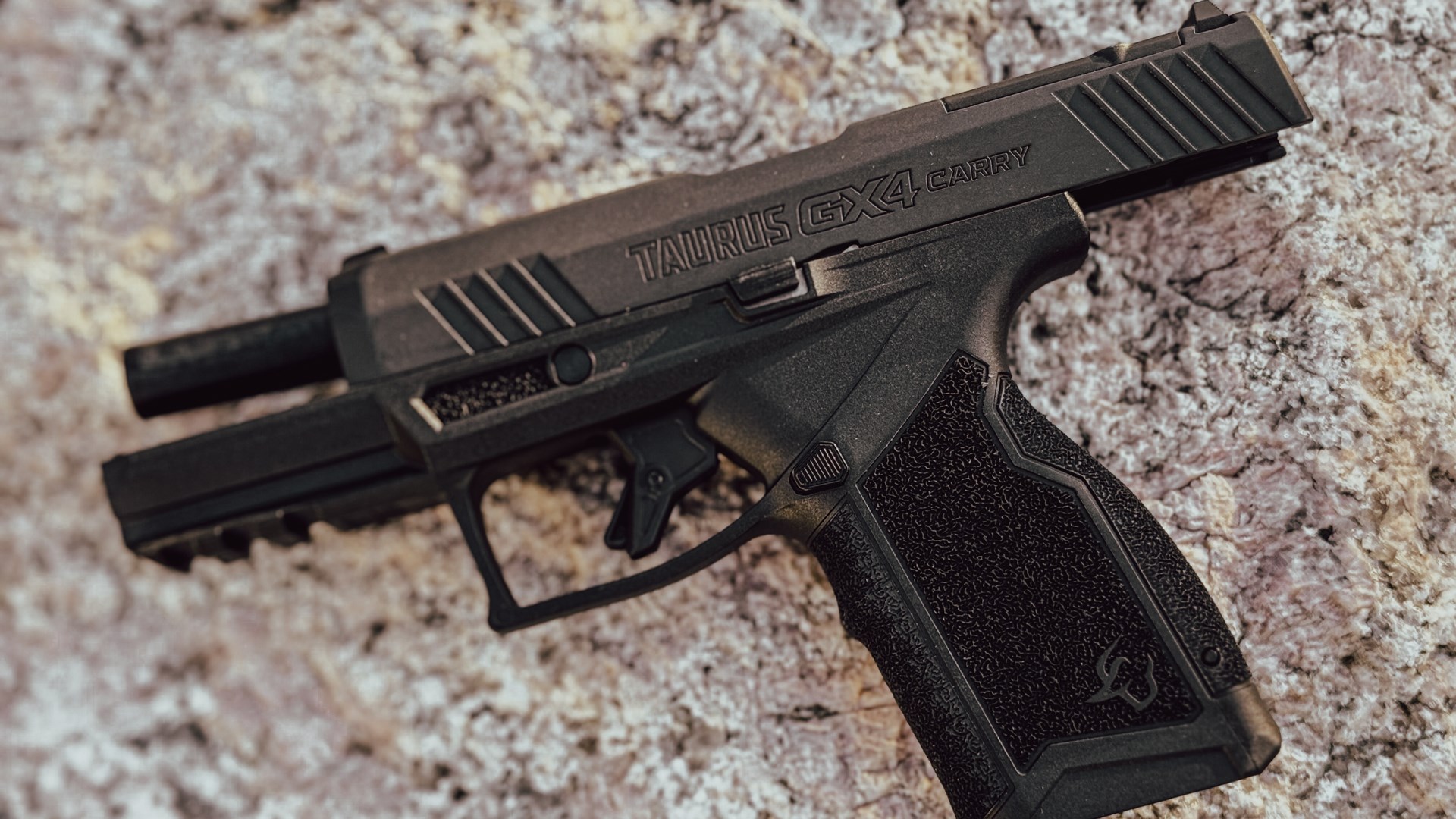
Today, handgun weight is a great classifying metric and the compact handguns—weighing between 24 and 32 ounces—in 9mm Luger have become the most popular. This is because for most people they offer the best balance of carry ease, shootability and effectiveness with 100 percent reliability.
This classification of pistols is where I would suggest most start their search. You might find that a compact pistol in 9mm Luger recoils a bit much for your shooting comfort. Your option then is to step up to a full-size pistol or drop down to a lesser cartridge. If you find a compact 9mm soft shooting, you could opt for a more powerful cartridge that might be more effective or for a sub-compact pistol that could be easier to carry and conceal.
Most shooters trade or upgrade their carry gun in the first few years because they’re either looking for something that fits them better or because they want a better quality or more powerful pistol. There’s nothing wrong with that.
As you learn and become a better shooter, you might go through multiple pistols before you find the one that’s just right for you. However, if you’re just beginning your search or are unhappy with your first purchase, consider these four aspects of a carry pistol and maybe try a compact 9mm, at least as a point of departure.
“Requiem for an Unsung Hero”
*Last week I was talking to my old friend Andy Stanford on the phone. For those of you new to the shooting game, Andy was a pioneering instructor in the 1990s and 2000s. He focused a lot of his classes on handgun skills and operating in a low light environment.
Back in the days before the internet was popular, Andy was well known in the field because he wrote books about subjects that most of us were trying to master. I still have the original first edition copies of Andy’s books from the now-defunct Paladin Press.
Andy’s most notable book was Fight at Night, the first book ever written about low light operations. His book Surgical Speed Shooting was also quite innovative for the time. 
In our conversation, I mentioned that I was planning on attending an upcoming private training class taught by Larry Mudgett. Larry spent 35 years with LAPD, During his tenure there, he radically improved the police department’s (and the SWAT Team’s) firearms training.
I’ve always found Andy to be both superbly intelligent and intellectually curious. He’s a bit of a contradiction in the knuckle-dragging world of atavistic firearms instructors. If you don’t know anything about him, I think this short article Andy Stanford: Former shooting instructor hits the high notes in the Ridgecrest, California Daily Independent characterizes a lot of his personality.
In our phone conversation, Andy told me about one of his friends whose accomplishments at Bakersfield, California PD rivaled those of Mr. Mudgett. In fact, Andy’s friend was once Larry Mudgett’s instructor. Unfortunately, this man, Mike Waidelich, passed away a few years ago.
In one of Cooper’s monthly Commentaries from 1995, he mentioned Mike in the following entry.
“Family member and Orange range master Mike Waidelich has now become a firm advocate of the Glock pistol. This has puzzled me because I consider that trigger action is the most significant single element in the precision efficiency of any firearm, and the trigger on the Glock is customarily so bad as to be practically unworkable.
But Mike does not agree. He explained to me that pistol engagements within the law enforcement establishment customarily occur at such short range that precise bullet placement is not important. He maintains that he can teach anybody to center a human adversary with the Glock trigger at any reasonable range – say 10 meters or less.
The other points that recommend the Glock to the police establishment are low cost and readily available modular parts. The Glock people will furnish you with spare parts immediately, where most other manufacturers hem and haw. These points are important. They are not enough to turn me into a Glockenspieler; but then, I am not a police range master.”
An appreciation for Glocks in the Gunsite world back in 1995 was considered heresy. I decided I liked Mike’s style. I liked it even more when I read his letter to the editor published by The Bakersfield Californian titled Don’t leave home without one back in 2012.
“In response to the May 2 letter “Consequences of NRA’s assault on gun laws”: I was a police officer for 30 years. I was assaulted several times during that time and had contact with many assault victims. All manner of weapons, knives, clubs, guns, and a bunch of other things were used.
I have been retired for about 14 years now and I still never leave the house without a gun. When you can assure me that I will never be attacked by anyone, armed or otherwise, I’ll leave my gun at home. Until then, you should hope that I, or someone like me, is around if you are ever the victim of an assault.
I hate violence. I hate it so much that I am willing to kill if necessary, to keep anyone from using it against me.”
Mike Waidelich
I fear that history may forget the genre-changing accomplishments that men like Andy Stanford and Mike Waidelich contributed. Andy wrote an obituary of sorts documenting Mike’s achievements. I am publishing it below with Andy’s permission to keep Mike’s ideas alive for eternity.
I think if modern day officers shot the same 10-round course Mike developed twice a month, our police hit rates would change in a dramatically favorable manner. We’ve known how to solve the problem of cops who can’t shoot for almost 50 years now. The problem is that most modern police firearms instructors don’t take enough interest in their craft to study the methods used by past innovators.
I hope Andy’s article provides you all with a little perspective and historical context that you might not have otherwise been exposed to. Enjoy. Thanks to Andy for allowing me to reprint his work.
-Greg
R.I.P. Mike Waidelich
Requiem for an Unsung Hero
Lyle Wyatt just called me with “bad tidings”: Mike Waidelich died today. I first met Mike in 1977 through the South West Pistol League, where he had won the B-class Championship the year before.
The last time I saw him was probably in the early 1990’s at the Soldier of Fortune 3-gun Match, where Waidelich was a longtime staff member. He had Hollywood good looks, and Lyle confirms my impression that Mike was a genuinely nice guy.
R.I.P. Mike Waidelich
Requiem for an Unsung Hero
Lyle Wyatt just called me with “bad tidings”: Mike Waidelich died today. I first met Mike in 1977 through the South West Pistol League, where he had won the B-class Championship the year before. The last time I saw him was probably in the early 1990’s at the Soldier of Fortune 3-gun Match, where Waidelich was a longtime staff member. He had Hollywood good looks, and Lyle confirms my impression that Mike was a genuinely nice guy.
Mike was born in 1942, and served in the U.S. Army Special Forces (he fought in the Dominican Republic in ’65, if I recall correctly). One of the first Gunsite instructors, Mike taught during the API 250 class attended by LAPD SWAT icons Larry Mudgett and John Helms. But his biggest claim to fame was the too-little-known story of his success as the Bakersfield P.D. Rangemaster. By some miracle, I spoke with him several times in the last month or so, and got the details.
Mike joined the BPD in 1967 when it was an agency of 50-ish sworn personnel (now several hundred). At that time patrol cops carried .38 revolvers in clamshell holsters. A year or so later they had eight on-duty shootings with zero police bullets hitting the suspects. The Chief asked Mike if he could solve this problem. Mike said “yes” but only if he could do it his way. A couple of hours explaining the particulars of “his way” and the job was his, 12 years total.
Pretty quickly the switch was made to 9mm Smith and Wesson Model 59 autopistols, and later, in the 1980s, to the 1911A1 Colt 45’s that Mike initially recommended (in Milt Sparks leather no less). Then, approximately ten years after that, the department switched again, to Glocks, first in .40 S&W, now 9mm. But the hardware is not generally the most important factor in a gunfight. It’s usually “the nut behind the bolt,” and that is where Mike made his bones.
The standard BPD course of fire (with Mike’s rationale) was as follows, all from the holster:
2 rounds in 1.5 seconds at 10 feet (“No one should be closer than that.”)
2 rounds in 2.0 seconds at 20 feet (“The length of a car.”)
2 reload 2 in 6.0 seconds (8.0 for revolvers) at 30 feet (“From the curb to the front door.”)
2 rounds in 3.5 seconds at 60 feet (“From the opposite curb to the front door.”)
The course was shot twice over each month (later, less frequently).
Mike told me the 10-point scoring zone on the silhouette target was, as best he could recall, a 7-inch circle, with the next zone (9 points) measuring 9×13 inches. A hit anywhere else on the silhouette scored 6 points. Departmental competitions were held as additional motivation for skills development. As for the rest of the system, I’ll let his words speak for themselves (from an 11 March 2021 email):
“I forgot to mention the somewhat unique method for scoring the basic drills. The time was flexible in that there were penalties for overtime. The penalties were 1 point per quarter second over the time allowed for the string. So, if you fired 2 in 1.5 seconds at 10 feet, you got zero penalties. At 1.6 seconds you lost 1 point. At 1.8 you lost 2 points, etc. I had shooters all over the place. One sergeant never made the time but never missed the 10 ring and his times were not long enough to disqualify him.
Others always made the time, but were all over the target. It was quite interesting to get them to balance the speed and accuracy appropriate for their abilities and I think it gave them a proper mind set for actual combat.
Of course shot timers didn’t come along until 1982 so initially the timing was done to tenths of a second with a stop watch. The course was administered with 6 shooters on the line and the RM would walk down the line and each shooter would shoot individually.
A run through all 4 stages for 6 shooters took less than 10 minutes so the first half hour of a 2-hour training session was basic drills, followed by additional drills covering and teaching specific skills and techniques.
Initially the standard was 80 out of 100 on either string out of 2 tries. If a shooter failed to shoot an 80 in his first 2 attempts he was sent to a side range to dry practice and then given a 3rd attempt. Those who failed 3 times were required to come back, but only once on department time.
If they failed again they were required to come back on their own time. If they couldn’t qualify during the course of the training period — monthly at first but it got longer as the department grew, finally to quarterly — they were assigned to the range for remedial training. Should they require remedial training in any two consecutive training cycles, their fitness for duty would be reevaluated.
In short, they could get fired, and nobody hit the street who wasn’t currently qualified. The training had teeth.”
How good were BPD officers? 85% hits when the national average was 15%. (Lyle says this number would be higher but for one outlier shooting in which an officer missed with his entire first magazine.) Anyone who has studied the matter knows how significant this is. Most cops can’t shoot well, and the few who can are usually self-motivated enthusiasts. Not one officer was killed in a gunfight when Mike was BPD rangemaster. A few anecdotes flesh out the tale:
The new regional FBI agents based in Bakersfield usually shot the BPD department qual for familiarization. Mike’s course of fire quickly humbled the mostly cocky G-men. (The Bureau actually used some of Mike’s written documentation as source material for their own efforts.)
Once, a visiting firearms instructor expressed skepticism when Mike described the BPD standards:
“You mean to tell me EVERY officer in your department passes this course?”
“Everyone from the Chief on down.”
“I’ll believe it when I see it!”
Mike got on the radio. “Dispatch, please send two officers to the range.” Shortly, two random BPD cops arrived, and both shot better than 90% scores, cold. “I can call two more but the results will be the same.”
In 2016 — long after Waidelich retired — Kern County law enforcement killed more people in the line of duty than any other county in the country, many much more populous. (Bakersfield is in west Kern County.) I believe this statistic is the result of three factors:
1) a relatively conservative political district where cops don’t automatically get fired for using their weapons,
2) a target rich environment full of gang bangers and oilfield roughnecks, and
3) the lasting influence of Mike Waidelich’s cutting-edge training.
That’s my story and I’m stickin’ to it.