Category: Dear Grumpy Advice on Teaching in Today’s Classroom

NEWS: Freedom Financing Act Would Protect Firearms Industry from Corporate Discrimination
As reported by Politico:
Sen. Kevin Cramer is introducing legislation, the Freedom Financing Act, designed to discourage big banks from cutting off the firearms industry, the latest response to moves by lenders such as Citigroup and Bank of America that have distanced themselves from the gun business.
The North Dakota Republican’s legislation would curb banks’ access to loans from the Federal Reserve’s discount window if they refused to serve legal firearms businesses for reasons outside of “traditional” underwriting.
The bill would also restrict payment card networks from declining to serve the industry because of political or reputational concerns.
“A small number of banks controlling most of the financial sector could effectively illegalize legal commerce by refusing to finance certain industries or process certain transactions,” Cramer said. “Look no further than pro-Second Amendment industries where such discrimination has already occurred. Big banks should not be the arbiters of constitutionality.”
Sen. John Kennedy, a Louisiana Republican who is co-sponsoring the bill, said the legislation would “ban big banks from refusing to do business with customers that may not share the same political values as the bank.”
Cramer and Kennedy are members of the Senate Banking Committee, where Chairman Mike Crapo (R-Idaho) has also made clear he has concerns about lenders cutting off the gun industry.
The Freedom Financing Act would exempt financial institutions with less than $10 billion in assets.
Sen. Kevin Cramer is introducing legislation, the Freedom Financing Act, designed to discourage big banks from cutting off the firearms industry, the latest response to moves by lenders such as Citigroup and Bank of America that have distanced themselves from the gun business.
The North Dakota Republican’s legislation would curb banks’ access to loans from the Federal Reserve’s discount window if they refused to serve legal firearms businesses for reasons outside of “traditional” underwriting.
The bill would also restrict payment card networks from declining to serve the industry because of political or reputational concerns.
“A small number of banks controlling most of the financial sector could effectively illegalize legal commerce by refusing to finance certain industries or process certain transactions,” Cramer said. “Look no further than pro-Second Amendment industries where such discrimination has already occurred. Big banks should not be the arbiters of constitutionality.”
Sen. John Kennedy, a Louisiana Republican who is co-sponsoring the bill, said the legislation would “ban big banks from refusing to do business with customers that may not share the same political values as the bank.”
Cramer and Kennedy are members of the Senate Banking Committee, where Chairman Mike Crapo (R-Idaho) has also made clear he has concerns about lenders cutting off the gun industry.
The Freedom Financing Act would exempt financial institutions with less than $10 billion in assets.

https://youtu.be/w-tz-9c-g4A
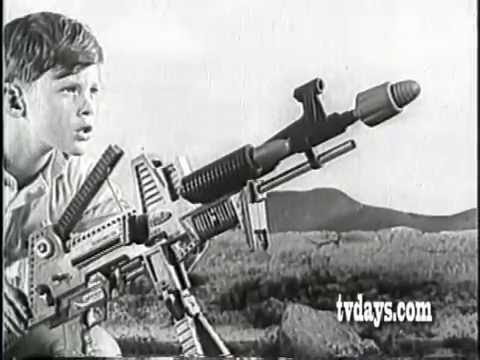
I still can not figure out WTF happened from then to now. Any ideas / solutions from my Fantastic readers out there?
Stuff like this just fascinates me! I just hope that you enjoy it also. If not then just look below, okay? Grumpy

Cody Shipman (right) and Hayden James (left) have been hunting together since they were children.
Warning: The following contains graphic images that might be disturbing to some readers.
When Cody Shipman, 24, and Hayden James, 15, set out to hunt Mallards one frosty January morning on the Snake River in Oregon, they expected the excursion to end like any other: with birds in the boat. But what should have been a successful hunt turned near-fatal after a simple mistake left Shipman with a gruesome wound that’s taken four surgeries to mend.
The brothers have been hunting together for years. Shipman started pursuing birds when he was 10 and big game when he was 12, and James started tagging along as soon as he could. Suffice it to say, this isn’t a story about green hunters making rookie mistakes.
“Definitely a freak accident,” Shipman told me. “We’ve both hunted from the time we were able to, and he’s my little brother, so we grew up hunting together on top of that. It’s not like we were new hunting partners. Just one of those things, freak accident. We were laughing one second, and things got real the next.”
The brothers and James’ father set out from their home in Emmett, Idaho, where Shipman works as a painter and James attends school. They launched their boat from the ramp in Ontario, Oregon, around 6 am, and soon they had located some Mallards, set up their decoys, and started shooting.
“We were only there about 20 minutes, and we’d already had four or five flocks of birds come in,” Shipman said. “Hayden lost his balance when he was shooting because we were in the muddy brush. He tipped over in the water, and we were laughing and having a good time.”
That’s when things took a turn for the worse.
“I was kind of twisted and off balanced, so I fell backward,” James recalls. “We were laughing, and he went to grab my gun first, and then he was going to help me up, and when he grabbed it that’s when it discharged and hit him in the shoulder. It was still in my hand – I was still holding it.”
At first, James said, he didn’t think he’d hit Shipman.
“I thought I’d shot off to the side more. But he was like, ‘Oh man, I think you’ve shot me.’ And I was like, ‘Are you serious?’”
It was true. The misfire from James’s 12 GA Beretta had taken a massive chunk out of Shipman’s shoulder, and with help a six-mile boat ride away, their situation wasn’t looking good.
James’s first worry was that his phone had gotten wet when his waders filled with water, but he soon fished it out, dry and functional, and called his father, who was with the boat. He then got on the phone with emergency dispatchers, who instructed him to apply pressure to the wound with something clean.
“But I didn’t have anything clean,” James said. So, he stripped off his jacket, sweater, and undershirt in sub-zero weather and used his undershirt to apply pressure to the wound.
As they waited for the boat to arrive, James said his brother stayed calm.
“He was doing good the whole time. Really calm, given the circumstances.”
Shipman said the injury hurt, of course, but the experience wasn’t as bad as he would have expected.
“To be honest, it wasn’t that bad,” Shipman recalls. “It may have been just from the shock. My fingers were tingly and my shoulder throbbed. It hurt, don’t get me wrong. But it wasn’t as bad as I thought it’d be.”
James continued to apply pressure as he sat next to his brother on the ride back to the boat ramp, where an ambulance was waiting to take Shipman to the hospital.
“I was just really shocked. I was freaking out,” James said. “I was crying on the boat ride back. It was scary.”
Doctors had to perform three surgeries to remove the bird shot and dead tissue from Shipman’s wound. The hunter lost two-thirds of his deltoid muscle, but the shot didn’t hit any arteries or bones. Shipman was still hooked up to a wound vac when GunsAmerica spoke to Shipman in February, and he was waiting until the wound had healed enough for doctors to perform a skin graft. He won’t be able to start physical therapy for several more weeks.
The shells were 3-inch magnums with steel 3 shot out of a full choke.


Shipman had some advice for hunters who want to avoid a similar situation.
“Always communicate,” Shipman said. “I’m sure I’m not the only person who has ever been shot this way. If I could think of one way to avoid it in that situation, it would be communication.
“You’re excited. Birds are coming in. Communicate and always watch where your barrel is pointed. That way they know their hand won’t be on the trigger. They can put it on safety first.”
James echoed his brother’s advice and added a piece of his own.
“Don’t ever get too comfortable with a shotgun,” he said. “Me and him have been hunting since I was 9. We go on a whole bunch of hunts together every year. I tell you one thing – I’ll never get too comfortable with a gun like that again.”
“We could have prevented that so many different ways. If I had just flipped my safety on. All that goes back to, I think, don’t get too comfortable.”
When asked whether he planned to hunt again after his recovery, Shipman didn’t hesitate.
“Absolutely.”

GunsAmerica reminds all shooters and hunters to memorize and follow the four safety rules:
1. Treat every firearm as if it were loaded.
2. Keep your finger outside of the trigger guard until you are ready to shoot.
3. Always keep the muzzle pointed in a safe direction.
4. Be sure of your target and be aware of what is beyond it.
____________________________________
This is what happens even to the Best of us. Usually when one is tired, bored, frustrated, having a dumb attack or some other things. The only things that can help prevent this is attention to detail and a lot of self discipline. Grumpy
| September 28, 2016
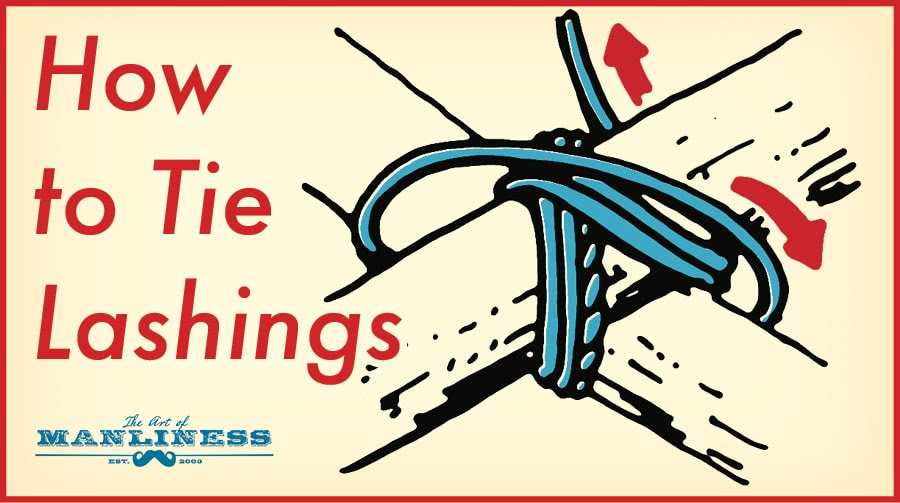
The number of ways a person can tie things together is more or less limitless, from the thousands and thousands of legitimate knotsand roping techniques used by sailors, hunters, and savvy outdoorsmen, to the countless impromptu tangles and knot nests crafted by those of us too impatient to learn anything more than a never-ending square knot.
But in that infinite fray of tying techniques, lashing is one of the most practical and easy to learn. At its basic, lashing is a method used to secure two things (often poles or pole-like items) together. A knowledge of lashing requires an understanding of two terms: wrapping and frapping. A wrap and a frap are two different techniques used when lashing. To wrap is to wind your binding material, usually rope, around your poles. To frap is to wind your binding material around itself, usually in-between your poles. Wrapping brings the poles together, while frapping generally tightens the lashing and helps prevent the poles from rotating in place. Before you start practicing your lashing skills, brush up on how to tie a clove hitch and a timber hitch, as they come in handy when beginning or ending your lashing.
Below you’ll find illustrated instructions on how to tie the 3 most useful lashings: square, diagonal, and shear.
Square Lashing
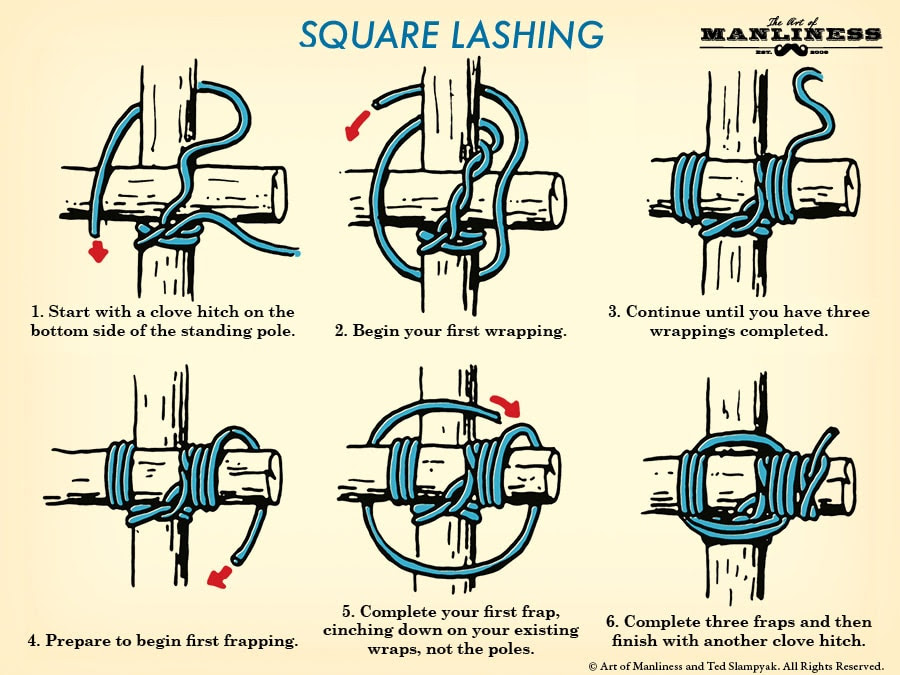
A square lashing is used to bind two things (often logs/poles) together at a right angle. It is important to note that it is used for items that will be used at a right angle to the ground as well. If poles are intended to be used diagonal to the ground, or diagonal to their load, then a diagonal lashing should be used.
Diagonal Lashing
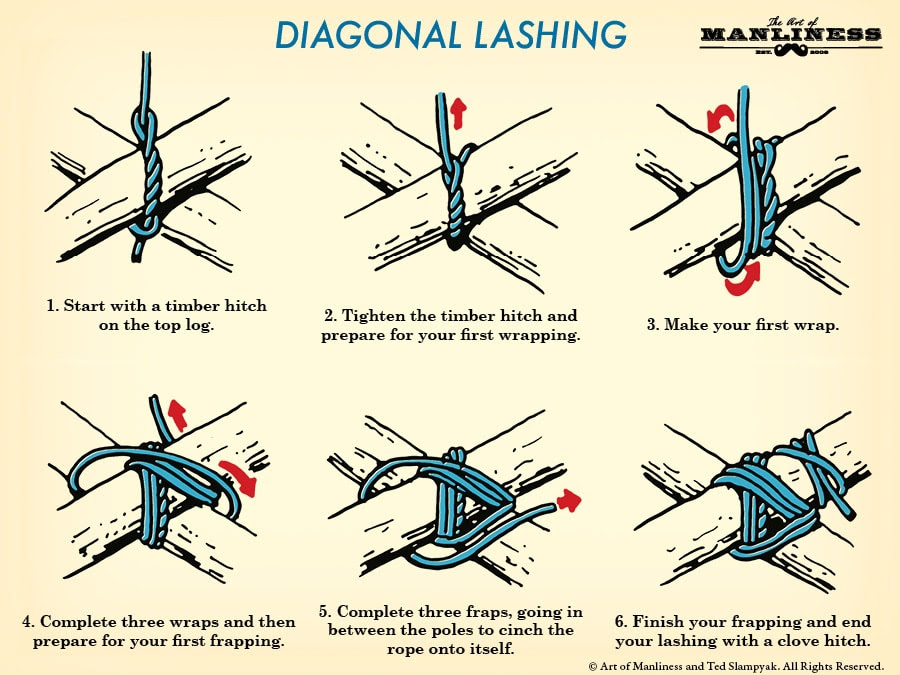
A diagonal lashing is used to bind two poles together diagonally and prevent racking, which is the term given when poles twist or rotate within their lashing. Like a square lashing, the poles do come together at right angles, but in a diagonal lashing the poles themselves are diagonal to the ground or the load which they are supporting, like the legs of a picnic table.
Shear Lashing
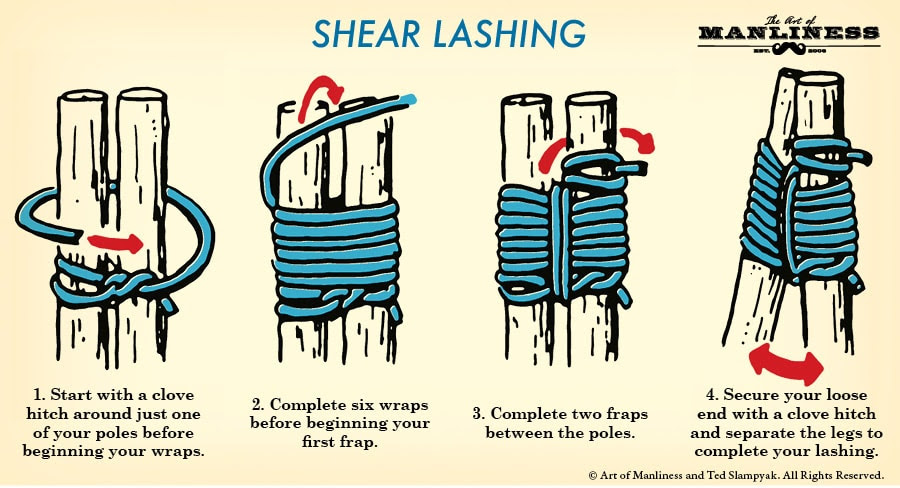
A shear lashing is used when you need to bind two poles at their tops so that they can ultimately support weight, like the legs of a sawhorse or the basic supports of an A-frame structure. When starting a shear lashing, begin with your poles parallel and adjacent to each other. After the lashing is completed, you can separate the legs to create the basic A-frame shape.
Like this illustrated guide? Then you’re going to love our book The Illustrated Art of Manliness! Pick up a copy on Amazon.
Illustrations by Ted Slampyak
California Saw Huge Increase in Gun Ownership Over Last Decade Despite Strict Gun Laws
Do you think if you tell people they can’t have something, then that’s what they want to have?
Despite some of the nation’s toughest laws, the number of gun owners in California has more than doubled over the past ten years, according to new data released Friday by the state Department of Justice.
The state of California maintains a one-of-a-kind database of known gun owners, the Armed and Prohibited Persons System (APPS). APPS combines data on firearm transactions from two different state sources, the Dealer Record of Sale (DROS) database which tracks all transfers made by gun dealers and the Automated Firearms System (AFS) which includes the subset of guns the state requires to be registered, to compile a list of all individuals who legally purchased or were transferred a firearm in California.
Operated continuously since 2006, the program’s goal is to identify and seize the weapons of individuals prohibited from owning a gun under state law.
And certainly, there are even more people who owned a gun before 2006 and still do.