Category: Cops
Categories
How Did Medieval Cities Catch Criminals?

Few things expose the hypocrisy of anti-gun activists and their allies more clearly than the recurring spectacle of so-called “violence interrupters” and their own violent tendencies. The story has become repetitive but worth reiterating because the pattern keeps “pattern-ing.” In theory, the idea of “credible voices within the community” (typically, “reformed” criminals with knowledge of local criminal networks) stepping in to squelch beefs and stop violence before it erupts is unobjectionable. But, like a lot of ideas in modern “gun violence” policy, the yawning gap between theory and real life is instructive.
Law-abiding gun owners are treated by gun control activists as nothing more than nascent criminals. They have to be vetted, surveilled, registered, and treated with ongoing suspicion, to the degree they are tolerated at all. Meanwhile, these same activists treat actual criminals victimizing others in their own communities as the inevitable byproducts of an unfair system who have to be understood, sympathized with, and repeatedly given the benefit of the doubt. In the case of “violence interrupters,” this extends to providing them with public money and free reign to associate with active lawbreakers. In either case, the gun control activists will insist it’s all for the “greater good.”
Yet it is increasingly difficult to sustain that delusion when so-called community “violence interrupters,” along with other high profile anti-gun activists, repeatedly find themselves accused of serious violent crimes, as we have previously reported on, including here and here.
Last week brought yet another case of a violent interrupter, this time out of Baltimore, charged with the very crimes he was supposed to be preventing. A worker with Safe Streets, a taxpayer funded community program that uses “violence interrupters” to hopefully intervene and prevent violent conflicts, was charged with attempted first-degree murder and several firearm violations after a shooting.
Baltimore Mayor Brandon Scott properly called the latest episode a disgrace but then erred in claiming the shooting was an isolated incident, “and should not be used to undermine the proven work that Safe Streets does each and every day.”
The problem is that these repeated incidents don’t just expose individual failures or isolated embarrassments but undermine the credibility of a larger movement that insists it has the solution: focus on eradicating firearms, instead of arresting and strictly punishing violent actors, and intervene in conflicts with criminals instead of police officers.
Far too often – as gun control groups lecture law-abiding gun owners about public safety, responsibility, and the “dangers” of firearm ownership – the silence is deafening when individuals they champion as community leaders on violence prevention are charged with serious violent offenses. Or worse, when their own champions fall from grace, it often becomes just another occasion to call for even more gun control. The Second Amendment community is not only entitled to question their judgment but also their motives. Proponents of these programs should be prepared to answer the growing list of examples that call their credibility into question.
Safe Streets is a program that receives millions of taxpayer money via city, state, and federal funds and has already been subject to formal investigations on misuse of the money, as well as possible gang infiltration. Credibility is earned through consistency and outcomes, not rhetoric. And nothing prevents a violent recidivist from preying upon innocent members of his own neighborhood like putting him in prison for an extended period of time.
Indeed, law-abiding armed citizens have contributed far more to supporting safe communities and preventing “gun violence” than pie-in-the-sky “interrupter” schemes. Research consistently shows hundreds of thousands to millions of defensive gun uses happen every year across America, usually without a shot being fired. So as a broader point for the state of Maryland, if public safety is truly priority, why does Maryland continue to prioritize gun control focusing on law-abiding citizens rather than focusing on violent offenders?
The community programs approach relies heavily on informal, unstructured intervention and personal influence rather than proven fundamentals of public safety. While the right mentorship can play a supporting role, it is not a substitute for policies that produce meaningful results through targeting violent criminals, repeat offenders, urban gang activity, and the small percentage of people responsible for a disproportionate share of serious violent crime.
For decades, NRA has argued that if policymakers are serious about improving safety, they must confront criminals rather than burdening law-abiding citizens. Communities deserve a better approach than programs that make a questionable, and sometimes dangerous, assumption that those closest to violence are in the best position to stop it.
And I used to think that the US Army had some real idiots. So I am just glad that I am not standing in front of their supervisor as of right now. As I am sure that they are one very happy camper having to deal with these clowns. Grumpy
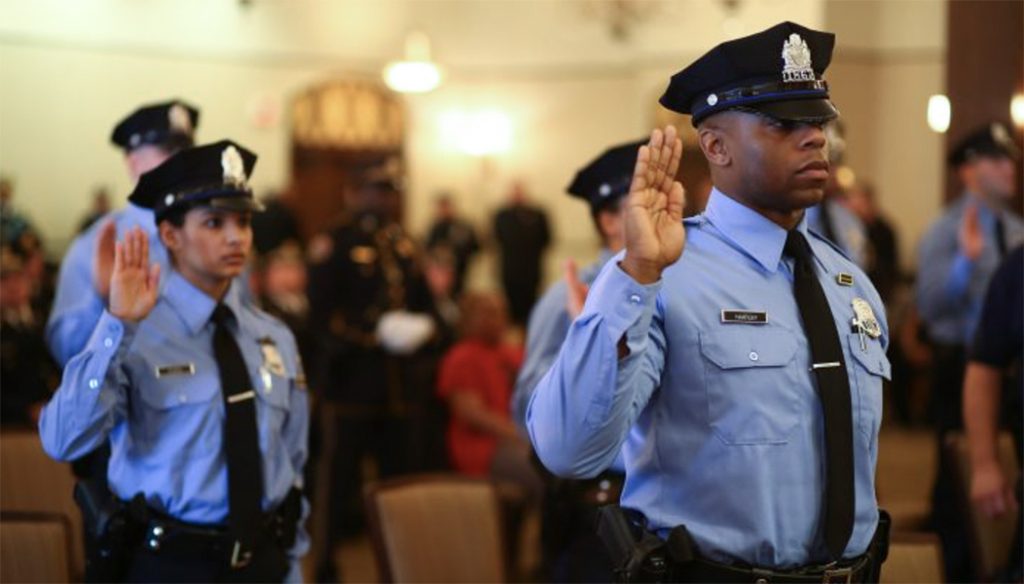
Today, the Justice Department opened an investigation to determine whether Philadelphia Police use a vague “good cause” standard to cancel permits to carry legal firearms.
The U.S. Constitution’s Second Amendment protects the civil right keep and bear legal firearms — including the right to legally carry firearms where allowed. The investigation focuses on the Philadelphia Police’s permitting system; the investigation does not support any armed obstruction of federal or local law enforcement.
“I have directed the Civil Rights Division, through our Second Amendment Section, to defend law-abiding citizens from local authorities who infringe the right to safely carry legal firearms,” said Assistant Attorney General Harmeet K. Dhillon of the Justice Department’s Civil Rights Division. “Law-abiding Americans, regardless of where they live, should not have to worry that their city will revoke their means of self-defense.”
It is a violation of the Second Amendment for government officials to use vague, personal discretion when determining whether to issue or revoke permits to carry firearms.
In 2008, the U.S. Supreme Court, in its landmark decision District of Columbia v. Heller, held that the Second Amendment protects the right of law-abiding citizens to possess weapons that are in common use for lawful purposes.
In 2022, the Supreme Court held, in another case, that permitting officials may not base licensing decisions merely on their personal discretion. Here, it is alleged that Philadelphia Police use just such a discretionary standard to improperly limit Second Amendment rights.
The Civil Rights Division’s Second Amendment Section enforces the Second Amendment. If you believe your right to keep and bear arms is being infringed, please submit a complaint through www.justice.gov/crt/second-amendment-section.

When Virginia State Police announced last week that it would resume enforcing the commonwealth’s universal background check requirement for private firearm sales — in direct defiance of a Lynchburg Circuit Court injunction that halted enforcement of the law — gun-rights groups didn’t wait around to see what would happen next. They went straight back to court.
On June 3, the court delivered exactly the response Virginia’s executive branch should have expected.
Judge F. Patrick Yeatts ruled that his statewide permanent injunction remains fully in effect and that Virginia law enforcement is expected to comply with that order. The ruling shut down Attorney General Jay Jones’s apparent theory that an executive branch officer can effectively dissolve a court injunction by deciding it no longer applies — and confirmed what gun-rights groups had been arguing since the State Police announcement: that the executive branch doesn’t get to unilaterally override court orders just because new legislation passes.
What just happened
As TTAG reported earlier this week, the dispute began when the Virginia Attorney General’s office informed the Virginia Citizens Defense League that Virginia State Police would resume universal background checks for private firearm sales — despite Judge Yeatts’s October 29, 2025, permanent injunction halting enforcement of that exact law.
Gun Owners of America and VCDL responded immediately with a contempt of court motion. The motion’s framing was unusually direct:
“It appears that the Commonwealth’s Executive Branch of government no longer has any respect for the rule of law. From the same Attorney General who brazenly sought to usurp his predecessor’s constitutional role before he even assumed office, Attorney General Jay Jones now informs this Court that its October 29, 2025, Final Order means nothing, and that Jones, as an executive branch officer and officer of the court, may unilaterally determine that a court’s order is no longer in effect.”
The court didn’t take long to agree.
The ruling
Judge Yeatts confirmed on June 3 that his permanent injunction remains fully in effect and that Virginia law enforcement is expected to comply. The court has called both parties back later this month for further proceedings in the ongoing case.
Within hours, Virginia State Police updated its website to reflect the court’s ruling. The page now states the agency is “in compliance with the injunction” and “currently cannot provide criminal history background checks for the private sale of firearms.”
That’s a quick reversal from the position Virginia State Police took last week. It’s also the correct one — the position the agency should have been taking all along, before the AG’s office decided that new legislation gave the executive branch authority to ignore court orders without going back to court first.
What this means
The ruling matters beyond the specific background check question because it confirms something fundamental about how court orders work in the American legal system. An injunction remains in effect until the issuing court dissolves it. Executive branch officers — including state attorneys general, governors, and law enforcement agencies — don’t get to decide on their own that an injunction no longer applies. If the state believes the injunction should be lifted because circumstances have changed (new legislation, new facts, whatever), the proper procedure is to return to the court and seek dissolution.
Virginia tried to skip that step. The court told them no.

Wine With Your Colt?
In Alice Springs, Australia, a group of 15 Aborigines is reported to have attacked and beaten three police officers. Their weapons were frozen kangaroo tails. By the time reinforcements arrived to make arrests, the suspects had eaten the evidence.
Note: Don’t try this with firearms, although a properly marinated Claro walnut stock might be pretty tasty. And those french-fried Franchis, well …
Pepperoni-Popper
Dale Tipton thinks he was only protecting his life in the most reasonable way possible. Pizza Hut says he violated company policy. For preventing a robbery — and possibly his own murder — the pizza deliveryman was fired.
Tipton pulled up to deliver a pizza in Hutchinson, Kan., and found three male suspects waiting to rob him. When one brandished a gun, Tipton jumped back into his car and sped away. A few seconds later, he realized he had driven into a dead end and was trapped unless he turned around and “ran the gauntlet” past the suspects.
Then Tipton remembered — he had been target shooting the day before, and his unloaded semiauto rifle was still in the car.
“I spun the vehicle around and pulled the rifle out from under the back seat and put it across my chest and made a big show of it. As soon as they saw it, they were trucking,” the delivery man recalled.
Having won the game of “Mine’s Bigger Than Yours,” Tipton drove away as the suspects burned shoe leather. He was more than a little disappointed to learn he had saved his life, the company’s cash and a big pepperoni pizza, but lost his job.
Pizza Hut forbids its drivers to carry weapons, and mandates that employees must cooperate with robbery suspects.
Local police pointed out that Tipton did absolutely nothing illegal.
A New Nickname Now
Police in Omaha, Neb., thought their burglary suspect was just another break-and-enter man with bad luck. They didn’t realize they were dealing with a true medical pioneer, a fearless experimenter on the cutting edge of surgical technique. Their suspect had successfully removed one of his testicles with a .45 ACP round.
At the scene of a store burglary, investigators found copious amounts of blood but no explanation of how the injury occurred. Shrugging, they collected samples for a blood match, drew up an affidavit to obtain a blood sample from a known local suspect, and went looking for him.
They didn’t have far to look, as they found him undergoing some rather sensitive surgery at a local hospital. It seems our villain was playing with a .45 auto he found at the scene. While practicing his “quick draw” technique pulling the pistol from his waistband, he unintentionally squeezed off a round which not-too-neatly carried away one of the family jewels.
A good blood sample, the loot, the gun, and the “jewel” were recovered.
Smelly Robbery
Cincinnati police had a pretty good description of a robbery suspect wanted for stickups in three local restaurants. The only comment from witnesses they couldn’t figure out was a description of the suspect’s weapon as a “really funny-looking derringer.” All seemed to feel it was a real gun, but there was definitely something strange about it.
With the arrest of Ivery Johnson, 28 the riddle was solved. He was carrying the “weapon” at the time of his arrest. It was a derringer shaped Avon perfume bottle.
Oops, Wrong Victim
Reginald Jordan of New Brunswick, New Jersey, was charged with committing a murder in the course of a robbery but it wasn’t the murder of his intended victim.
The 23-year-old would-be stickup man and two accomplices had mugged a young man for $150 and a gold chain when Jordan apparently decided to kill him anyway.
The robbery victim waited until the last split second, then ducked when Jordon fired. The shot hit one of Jordan’s cronies in the head, killing him. The other gangster fled, perhaps worried he might be next. Jordan may have problems recruiting new gang members in the future.
Six-Shooter Vs. Six-Pack
When a lone gunman burst into a convenience store in Seattle, he apparently thought all he had to do was fire a few shots into the cigarette machine to intimidate Mahomed, the night clerk. But Mahomed, remembering the TV jingle about how “Pepsi hits the spot,” gave it a new literal meaning. He opened up on the crook with hurled 12 oz. cans of Pepsi Cola.
The stunned robber, pelted with Pepsi staggered backward but then regained the offensive, firing another shot at Mahomed. Mahomed stood his ground and this time was joined by a friend in firing Pepsi cans at the shooter.
After another fusillade of gunfire Mahomed and his buddy had to seek cover and found themselves crouching behind a virtual arsenal: an entire stack of six-packs of Pepsi. They re-armed and continued firing away until the robber fled the store empty-handed.
With a badge and a carload of one-liter soft drinks, this guy could bring crime in Seattle to a crisp, refreshing standstill.
Banned Flag
Rick Sansoni seems like an American Handgunner kind of guy, though he’s not too popular with his neighbors. For over 20 years, he’s been celebrating national holidays by flying the American flag from the top of his condominium in San Rafael, Calif. But now that could cost him financial penalties, and ultimately perhaps, his home.
Rick recently received notice from the condo complex property manager that future display of the colors will cost him $50 for the first offense and up to $400 for a fourth violation. A letter from John Sirrine, the property manager, asked that Sansoni “… please be considerate of your neighbors and protect the value of your home: by not flying the red, white and blue. Sirrine was not available for further comment.
It is speculated that other residents exercised a fine print clause in their owners agreement to complain about Sansoni’s politically incorrect support of archaic American values.
Why, this display could even be construed as praise for (shudder!) patriotism! What if children should see it?
Mark Moritz hung up his satirical spurs to a collective sigh of relief from America’s gun writers whom he had lampooned in Friendly Fire for two long, painful years.
The 10 Ring is written by Commander Gilmore, a retired San Diego police officer who bases his humor, like Mark did, on actual occurrences. All the incidents described by the Commander are true.
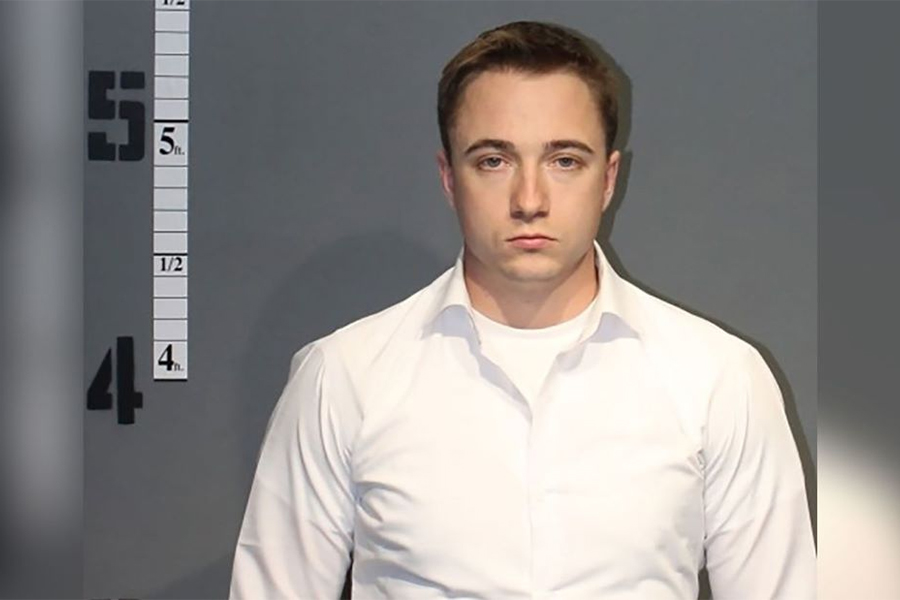
Patrick Tate Adamiak is starting his fourth year of a 20-year federal prison sentence, even though he broke no law and committed no crime. That sad fact leads almost every discussion about the 31-year-old who had no prior criminal history. The public’s attention has been rightfully focused on freeing him from his undeserved incarceration, not on the ATF agents who wrongfully put him in a prison cell for two decades.
As most of you know, Joe Biden’s ATF lied about what their confidential informant had purchased from Adamiak. They lied again to obtain a search warrant of Adamiak’s property. They found nothing illegal while executing their search warrant, so they lied yet again about the legal items they found in order to obtain a conviction.
These untruths, in my humble opinion, were made for three reasons: in order to stave off any claim that Adamiak’s civil rights were violated, to shield the ATF agents from how poorly they conducted the investigation, and to keep secret the fact that they simply can’t work a confidential informant.
The ATF’s lies were so profound they actually turned gun parts into machineguns. Their firearms “experts” even classified a toy as a machinegun—a toy! They misclassified two DEWAT RPGs as actual grenade launchers, which added 15 years to Adamiak’s sentence. An ATF expert even classified seven legal semi-auto handguns, which fire from an open bolt, as machineguns.
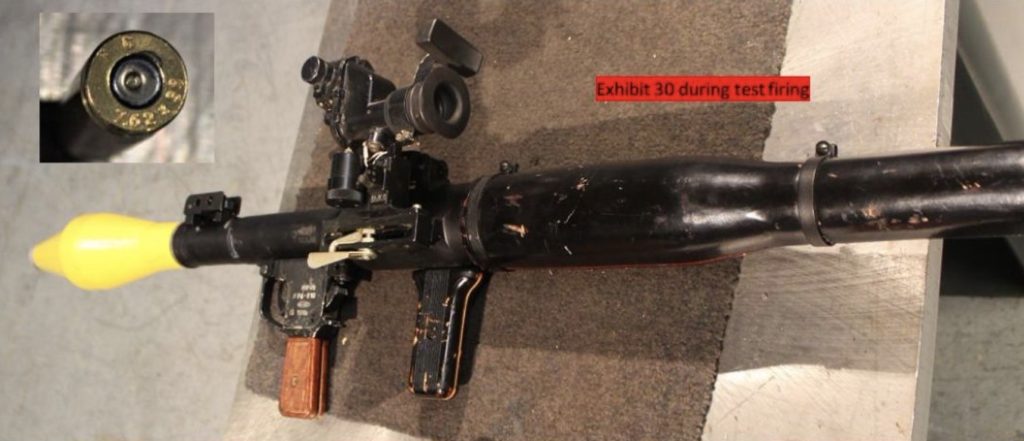
To be clear, this was a massively flawed investigation. It was fraudulent in more than a hundred different ways. And it was fraudulent from the very beginning.
This entire monstrosity started when the ATF sent a confidential informant to buy machineguns from Adamiak, who never sold any machineguns, of course. Adamiak never had any machineguns. Instead, Adamiak sold the informant barrel shrouds, which were even cut up into pieces.
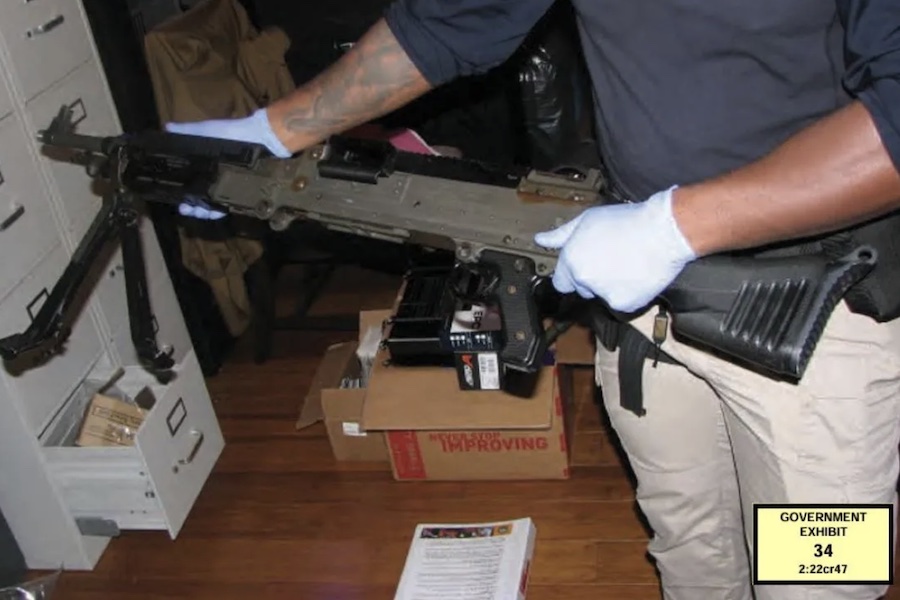
Barrel shrouds surround a machinegun barrel. They’re meant to keep a young soldier from burning their hands on a hot machinegun barrel. The weapon can fire full-auto with or without a shroud. They certainly aren’t vital parts. They definitely are not a “machinegun.”
Anyone who misclassifies cut up barrel shrouds as machineguns shouldn’t be working for the ATF, but that’s exactly what ATF Firearms Enforcement Officer Ronald K. Davis did. He put this deception into a report, which ATF Agent William S. Harston, Jr., quickly used as evidence to obtain a search warrant of Adamiak’s home. Hairston, the ATF’s lead case agent, even held up a toy during Adamiak’s trial, which of course was also classified as a machinegun.
“If they never lied about those shrouds, they never would have gotten a search warrant,” Adamiak said Wednesday.
During his trial, Adamiak’s defense team tried to argue that the barrel shrouds weren’t machineguns, so the search warrant was flawed, and the ATF’s entire investigation was based on lies…but the judge cut them right off.
Adamiak was calm when I asked about his years of mistreatment by the ATF. He pointed to what the new ATF director, Rob Cekada, recently said during a congressional hearing. He agrees with Cekada’s comments.
“There is ambiguity in the law, and I think it’s important for people to be able to follow the law, to understand to law, and when federal agents don’t understand the law themselves, that leaves all of us at risk, and there shouldn’t be any room there,” Cekada told Congressman Eli Crane, who chaired the hearing.
I asked Adamiak what he thinks should happen to the ATF staffers whose misdeeds got him arrested, which led to his 20-year sentence. “That’s a good question,” he said. “They should be immediately fired, and I think they should be investigated for perjury.”
If the ATF kicked down my door for no reason, seized all my guns for no reason, lied under oath and sent me to prison for two decades, I would want more—much more—than perjury charges.
I truly believe Adamiak will be released, hopefully soon. He has a hearing next month and his new legal team is incredible. The public has mailed hundreds of “Free Tate” letters to the White House and other recipients. There are also other machinations occurring almost daily that could also lead to his release. Unfortunately, nothing happening now will hold anyone accountable for the more than 1,500 days Adamiak has spent behind bars or the 5,840 days he has left to serve.
As a result, the ATF agents who were involved with the Adamiak investigation believe they got away with it. They committed a massive civil rights violation solely to ingratiate themselves with the Biden administration, and are all still gainfully employed. These agents go to work every day as if they did nothing wrong.
In a perfect world, once Adamiak is freed, these agents will be held accountable. The current ATF leadership doesn’t get to simply ignore this group of miscreants. They need to be made an example of, so that their extreme misconduct never happens again. Trust me, unless these ATF staffers are held accountable for their misdeeds it all will happen again, especially when there’s another Democrat at 1600 Pennsylvania Avenue.
What these agents did needs to be dissected. Those responsible need to be severely disciplined. It must not be overlooked by the current ATF leadership. The entire organization needs to look at this incident as it really is—a massive civil rights violation that merits penalties. No one who made a single decision about the case should ever receive another taxpayer dollar.
The U.S. Department of Justice and the ATF itself need to take a close, serious look at what they did to Patrick Tate Adamiak or it will happen again, especially when there’s another Dem calling the shots at 1600 Pennsylvania Avenue. Once was enough.
Bottom line: If the ATF doesn’t hold itself fully accountable, we need to ask whether we even need the ATF.