

Categories
California Some Sick Puppies! The Horror!

Los Angeles summed up

Categories
A Victory! All About Guns California Cops

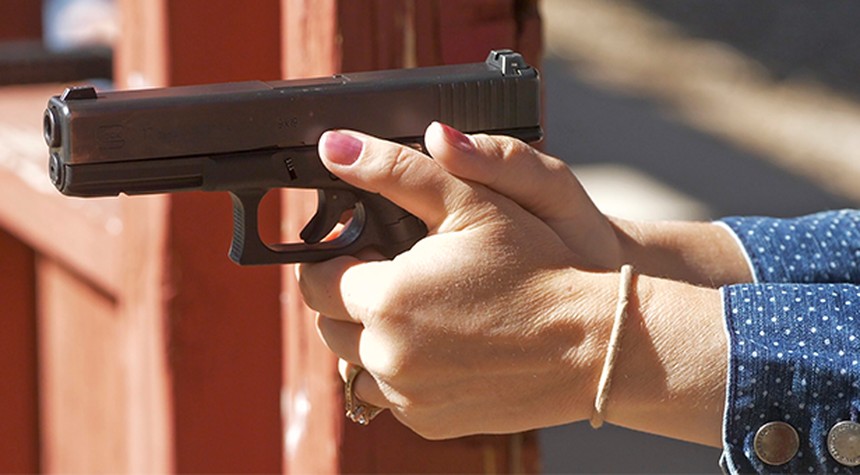
California woman shoots intruder day after getting her gun By Cam Edwards

AP Photo/ Rick Bowmer
Buying a gun in California isn’t a simple or fast process thanks to the numerous gun control measures that anti-gun politicians have put in place over the past few decades, but thankfully the state’s draconian restrictions on the right to keep and bear arms didn’t interfere with one woman’s ability to use a firearm to defend herself and her husband from a stranger who tried to come inside their home.

According to authorities, the woman in question had just picked up her pistol the day before, after waiting the 10 days required under California law between the time of purchase and when gun owners can actually take possession of their newly-bought firearm. Little did she realize that she would soon end up using the gun to fend off an attack on her husband in their own home.

A Patterson woman who had gotten a handgun just the previous day fatally shot a stranger who was grappling with her husband Saturday night at the door of their home, the Stanislaus County sheriff’s office said.

In a 911 call at 10:20 p.m., a resident of the Wilding Ranch subdivision on the city’s east edge reported that a neighbor had called and said she had just shot an intruder at her house.

When deputies arrived, they found a dead man near the home’s front entry. The residents — a 50-year-old woman and her 45-year-old husband — said that the apparently intoxicated stranger had tried to force his way into their home.

According to the sheriff’s report, as the husband fought with the intruder near the front door, his wife ran to the bedroom to get a revolver, which she said she had brought home on Friday. Returning to the entry, she fired all its rounds into the intruder.

According to authorities, 22-year old Angelo Santana tried to force entry into the home while he was “heavily intoxicated,” leading to him fighting with the 45-year old resident. Police say that, according to interviews with those who knew him, Santana had a history of alcohol abuse and would “regularly show-up unannounced trying to find friends and acquaintances of his in the same neighborhood.”

In a Facebook post, the Stanislaus County Sheriff’s Office announced that a preliminary investigation indicates the shooting was “strictly self-defense,” and while the investigation continues the details that the sheriff has released publicly appear to back up the woman’s claim that she was acting to protect her husband and herself from a combative stranger.

The house belonged to 50-year-old Yuhui Zheng and her husband, 45-year-old Yang Luan. The husband attempted to physically restrain Santana and was involved in a significant fight near the threshold of the front-door.
Luan sustained minimal physical injuries, to include abrasions and scratches to the back, while fighting with Santana and trying to defend his home. Yuhui Zheng retrieved a revolver from the upstairs bedroom, which she had acquired only one-day prior, and in self-defense of her husband, fired all rounds into Angelo Santana.
Santana wasn’t armed, but neither Zheng nor Luan knew that at the time. All they knew for sure is that a strange man was trying to get inside their home and began attacking Luan as he tried to keep the would-be intruder at bay. I’d say that they had a reasonable fear that the stranger was trying to do them harm, but we’ll have to wait and see what the D.A. in Stanislaus County decides to do with the case.
Categories
All About Guns Allies Anti Civil Rights ideas & "Friends" California Gun Fearing Wussies

BREAKING: Judge Issues Ruling to Save Magazine Owners from Confiscation

Judge Benitez Issues Ruling to Save Magazine Owners from Government 
Confiscation and Prosecution

On Monday, September 26, 2022, Judge Roger T. Benitez proved once again that he is ten steps ahead of the California government and its anti-gun leaders when he re-issued his ruling to protect “traditional” magazine owners from prosecution.

If you have been following the “merry-go-round” that has been the life of Duncan v Bonta (formerly Becerra), it’s entirely possible that you have been confused.

Let’s break this down:

Initially, the case of Duncan v Becerra (ban on 10+ round magazines which originated from legislation and an initiative) went before Federal District Court Judge Roger T. Benitez. He said that it violated the text, history and tradition of the Second Amendment using the test that Justice Scalia established in Heller v DC and was therefore unconstitutional. Knowing that the crazy 9th would use a different standard, Benitez ruled that it would still be unconstitutional regardless of what standard was used.

This opened what became known as “Freedom Week” where Californians legally purchased between one and two million magazines.

California threatened to appeal the ruling to the 9th Circuit Court of Appeals, so Judge Benitez issued an order staying his decision from going into effect until all legal proceedings were completed, thus preventing the California government from banning any “Freedom Week” magazines.

The 9th assigned the case to a 3-judge panel who agreed with Judge Benitez that the mag ban was unconstitutional.

Angered by this defeat, the State immediately asked for an 11-judge en banc panel who as expected, reversed the previous pro 2A decisions and sided with the State.

The pro-gun forces – which included Gun Owners of California – appealed to the Supreme Court of the United States (SCOTUS). SCOTUS kept the case alive pending their decision in NYSRPA v Bruen. Once the court declared that the only rule that lower courts can use to test Second Amendment challenges, that being text, as informed by history and tradition and nothing else, the court accepted the case (granted Certiorari which means it could be heard), then vacated the anti-2A decision of the 9th Circuit and remanded the case back to them, with the instructions to reconsider the case with the new one-step standard.

At this point, the 9th Circuit en banc panel could have reversed its decision and declared the mag ban unconstitutional. Of course, they did not. Instead, they returned the case to Judge Benitez who had already declared the law unconstitutional.

Is your head swimming by now?

In doing so, the 9th essentially “erased” Judge Benitez’ original decision and directed him to start from scratch.

Given this turn of events, we are confident the State of California had been preparing to begin the confiscation of magazines and enforcing the ban because forcing Benitez start from scratch meant that his original order that protected “Freedom Week” magazine buyers from prosecution was no longer in place.

As we’ve said time and time again, Judge Benitez doesn’t pussy-foot around; he was one step ahead of the gun mag grabbers, and re-issued his order protecting magazine owners from prosecution by the state.

Bottomline? We are free to own, possess and in many cases use our 10+ magazines (as long as they are not used on “California Compliant Semi-Autos”).

What happens next? The entire convoluted process is set to begin again, but with one huge difference: lower courts MUST follow the rules for deciding Second Amendment case as established by the Supreme Court in the Bruen decision.  This changes everything.  Both SCOTUS and Judge Benitez have come to the rescue, not only of citizens who abide by the law, but of the Constitution itself.

Get off the merry-go-round/rollercoaster of confusion and join Gun Owners of California;  we will keep you up-to-speed and continue to march ahead to fully restore, then defend and protect the Second Amendment. We will accept NO COMPROMISE!

Categories
California Well I thought it was funny!

I could actually believe this one!

Categories
All About Guns Anti Civil Rights ideas & "Friends" California Cops You have to be kidding, right!?!

Los Angeles County Creating ‘Buffer Zones,’ Demanding Gun Shops Keep Fingerprint Logs by S.H. BLANNELBERRY


The Los Angeles County Board of Supervisors is moving forward this week with plans to enact various gun control measures that will chill the 2A rights of law-abiding gun owners and place an undue burden on responsible gun dealers.

Among the ordinances included in the motion authored by Supervisor Janice Hahn are:

  • A ban on the sale of .50 caliber handguns and .50 caliber ammunition
  • The creation of “buffer zones” between gun stores and “sensitive areas” (schools, daycares, parks, etc.)
  • To make all Los Angeles County property a gun-free zone
  • Require gun stores to keep a fingerprint log, submit sales reports and inventory reports in real-time to the county board, install security cameras, limit minors’ access and provide gun owners with information about the local laws.
  • Deny sales to individuals on the federal government’s no-fly list

“When I was in Congress, we responded to horrific mass shootings with little more than moments of silence and thoughts and prayers,” said Supervisor Hahn in a press release.

“I will not sit idly by when there is action that we can take to save lives,” she continued. “These gun violence prevention measures are commonsense and are under our authority at the County level to implement.”

Attorneys will be drafting up the details for each ordinance over the next three months.  Once finished, the completed drafts will come before the board for a final vote.

Hahn told Fox11LA that these “common sense gun regulations” are “just one piece of the puzzle.”

“If we move forward with implementing these “four common-sense gun regulations”, I hope others in our county will follow suit,” Hahn said.

Categories
All About Guns Anti Civil Rights ideas & "Friends" California Some Sick Puppies!

Just another reason on why I am a born again Cynic!

Categories
California Cops

Women trainees of the LAPD practice firing their newly issued revolvers, 1948

Women trainees of the LAPD practice firing their newly issued revolvers, 1948 : r/TheWayWeWere


https://digitallibrary.usc.edu/asset-management/2A3BF11JQ4JN

Categories
All About Guns Anti Civil Rights ideas & "Friends" California

Politicians Terrified of Responsible Gun Owners – Not Violent Criminals BY L.A. PAREDES

GOC has been hammering the point for years that our singular best remedy to the anti-gun garbage is going to be in the courts.  Thankfully, the recent SCOTUS decision in NYSRPA v Bruen set the stage in elaborate fashion for what’s to come down the legal road.

Until that time, however, the Left has made no bones about it:  they are out to do whatever they can to make sure that lawful citizens are as far away from guns as possible.  While this may sound like some far-right conspiracy rant, it’s very true.  Forget the ridiculous mantra of “I support the Second Amendment, but…”  – forget the BS that all they want is “reasonable gun reform.” These are lies, lies and damn lies.  The Left does not trust us – nor do they want us to be able to protect ourselves.  Neither do they want us to protect our families, our homes or our businesses.  Their real intent has become abundantly clear, especially given their antipathy for law enforcement:  No guns.  Nowhere.

Senator Anthony Portantino is especially keen on the no guns anywhere philosophy.  His SB 918 was obviously introduced in angry response to the recent SCOTUS decision because it legally established California a “shall issue” state, and that’s not on the Left’s progressive menu.

Senator Portantino must be driven by something besides anger – it’s quite possible he’s literally terrified of people who have a CCW because his bill stipulates that there are about 2 places in the entire state where one can carry a concealed weapon outside of their own home.  He has likely trembled with fear when going out for dinner with fellow legislators after work.  He may wonder who’s in the next booth, legally carrying a gun?  Gasp!
And what about when he heads to Whole Foods to pick up some organic asparagus to go with his grilled chicken dinner?  Uh oh!  Who may have a concealed firearm while testing the cantaloupe in the produce section?

What if he’s on a picnic or an outdoor concert with his family at one of Napa’s lovely vineyards?  Yikes!  There might be someone snacking on some crackers and brie who might have a CCW! The trauma!

Portantino is clearly fearful of safe and responsible people being able to carry a concealed firearm, but doesn’t seem too preoccupied with the bad guys that are plaguing his very own Los Angeles County.  Is he one of the privileged who can hire private security like so many celebrities? According to World Protection Group CEO Kent Moyer, because crime continues to rise in California, more celebrities are starting to hire private security. In Hollywood alone, homicides have jumped an incredible 75%, yet LAPD arrests are down by 20%.  It’s no wonder people want some ability to protect themselves. Evidently though, elected officials like Portantino (and those who share his politics) don’t believe this should apply to the rest of us.

SB 918 is chock-full of highly subjective criteria – from who can be granted a CCW to who is even permitted to apply.  Those on even the most benign prescription medications need not apply.

When SB 918 gets a thumbs up from the Legislature and Governor in the next few weeks, it will be interesting to see who on the Left will be shocked to learn their armed security detail won’t be able to follow them into virtually any facility in the state.  (Check out the list below of prohibited areas for CCW holders – especially those that are bolded).   The limitations are so significant, a CCW will be deemed useless.

Remember, no lawsuit can be filed until the law becomes operative; if the final version of the bill has an urgency clause, it will go into effect as soon as the Governor signs it.  If the bill passes without the urgency, it would become effective January 1, 2023.

With far too many Californians making bad decisions by repeatedly electing anti-gun politicians, the courts have become our best recourse.  While it seems as if we may not be successful in the short term, GOC is in it for long game and ultimately, we will come out of the mess with some significant wins.  But it’s going to take some patience, hard work and yep – money.  Rest assured, GOC will be involved the legal challenges to this legislation – and other bills that undermine the Second Amendment.  Please support us in these efforts – the costs are great but the rewards will be greater.

Section 26230 is added to the Penal Code, to read:

(a) A person granted a license to carry a pistol, revolver, or other firearm capable of being concealed upon the person pursuant to Section 26150, 26155, or 26170 shall not carry a firearm on or into any of the following:

(1) A place prohibited by Section 626.9.

(2) A building, real property, or parking area under the control of a preschool or childcare facility, including a room or portion of a building under the control of a preschool or childcare facility. Nothing in this paragraph shall prevent the operator of a childcare facility in a family home from owning or possessing a firearm in the home if no child under child care at the home is present in the home or the firearm in the home is unloaded, stored in a locked container, and stored separately from ammunition when a child under child care at the home is present in the home so long as the childcare provider notifies clients that there is a firearm in the home.

(3) A building, parking area, or portion of a building under the control of an officer of the executive or legislative branch of the state government. government, except as allowed pursuant to paragraph (2) of subdivision (b) of Section 171c.

(4) A building designated for a court proceeding, including matters before a superior court, district court of appeal, or the California Supreme Court, parking area under the control of the owner or operator of that building, or a building or portion of a building under the control of the Supreme Court. Court, unless the person is a justice, judge, or commissioner of that court.

(5) A building, parking area, or portion of a building under the control of a unit of local government, unless the firearm is being carried for purposes of training pursuant to Section 26165.

(6) A building, real property, and parking area under the control of an adult or juvenile detention or correctional institution, prison, or jail.

(7) A building, real property, and parking area under the control of a public or private hospital or hospital affiliate, mental health facility, nursing home, medical office, urgent care facility, or other place at which medical services are customarily provided.

(8) A bus, train, or other form of transportation paid for in whole or in part with public funds, and a building, real property, or parking area under the control of a transportation authority supported in whole or in part with public funds.

(9) A building, real property, and parking area under the control of a vendor or an establishment where intoxicating liquor is sold for consumption on the premises.

(10) A public gathering or special event conducted on property open to the public that requires the issuance of a permit from a federal, state, or local government and sidewalk or street immediately adjacent to the public gathering or special event but is not more than 1,000 feet from the event or gathering, provided this prohibition shall not apply to a licensee who must walk through a public gathering in order to access their residence, place of business, or vehicle.

(11) A playground or public or private youth center, as defined in Section 626.95, and a street or sidewalk immediately adjacent to the playground or youth center.

(12) A park, athletic area, or athletic facility that is open to the public and a street or sidewalk immediately adjacent to those areas, provided this prohibition shall not apply to a licensee who must walk through such a place in order to access their residence, place of business, or vehicle.

(13) Real property under the control of the Department of Parks and Recreation or Department of Fish and Wildlife, except those areas designated for hunting pursuant to Section 5003.1 of the Public Resources Code, Section 4501 of Title 14 of the California Code of Regulations, or any other designated public hunting area, public shooting ground, or building where firearm possession is permitted by applicable law.

(14) Any area under the control of a public or private community college, college, or university, including, but not limited to, buildings, classrooms, laboratories, medical clinics, hospitals, artistic venues, athletic fields or venues, entertainment venues, officially recognized university-related organization properties, whether owned or leased, and any real property, including parking areas, sidewalks, and common areas.

(15) A building, real property, or parking area that is or would be used for gambling or gaming of any kind whatsoever, including, but not limited to, casinos, gambling establishments, gaming clubs, bingo operations, facilities licensed by the California Horse Racing Board, or a facility wherein banked or percentage games, any form of gambling device, or lotteries, other than the California State Lottery, are or will be played.

(16) A stadium, arena, or the real property or parking area under the control of a stadium, arena, or a collegiate or professional sporting or eSporting event.

(17) A building, real property, or parking area under the control of a public library.

(18) A building, real property, or parking area under the control of an airport or passenger vessel terminal, as those terms are defined in subdivision (a) of Section 171.5.

(19) A building, real property, or parking area under the control of an amusement park.

(20) A building, real property, or parking area under the control of a zoo or museum.

(21) A street, driveway, parking area, property, building, or facility, owned, leased, controlled, or used by a nuclear energy, storage, weapons, or development site or facility regulated by the federal Nuclear Regulatory Commission.

(22) A church, synagogue, mosque, or other place of worship, including in any parking area immediately adjacent thereto, unless the operator of the place of worship clearly and conspicuously posts a sign at the entrance of the building or on the premises indicating that license holders are permitted to carry firearms on the property. Signs shall be of a uniform design as prescribed by the Department of Justice and shall be at least four inches by six inches in size.

(23) A financial institution or parking area under the control of a financial institution.

(24) A police, sheriff, or highway patrol station or parking area under control of a law enforcement agency.

(25) A polling place, voting center, precinct, or other area or location where votes are being cast or cast ballots are being returned or counted, or the streets or sidewalks immediately adjacent to any of these places.

(26) Any other privately-owned commercial establishment that is open to the public, unless the operator of the establishment clearly and conspicuously posts a sign at the entrance of the building or on the premises indicating that license holders are permitted to carry firearms on the property. Signs shall be of a uniform design as prescribed by the Department of Justice and shall be at least four inches by six inches in size.

(27) Any other place or area prohibited by other provisions of state law.

Categories
California

Hopefully soon for me & THE BOSS!

Categories
California

Back in the Glory days of Los Angeles!

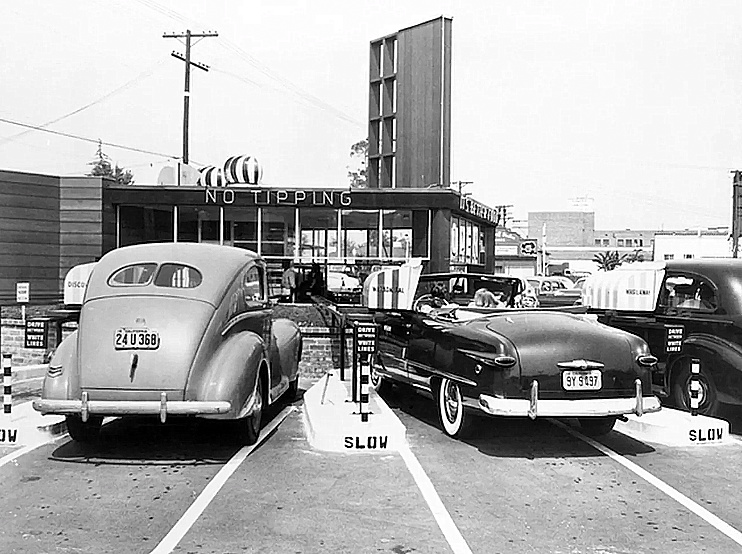
The Motormat drive-in in Los Angeles, 1948. The food tray was sent out on rails right to your car. The little awnings provided a shade for your food.

HISTORIC LOS ANGELES
The Track
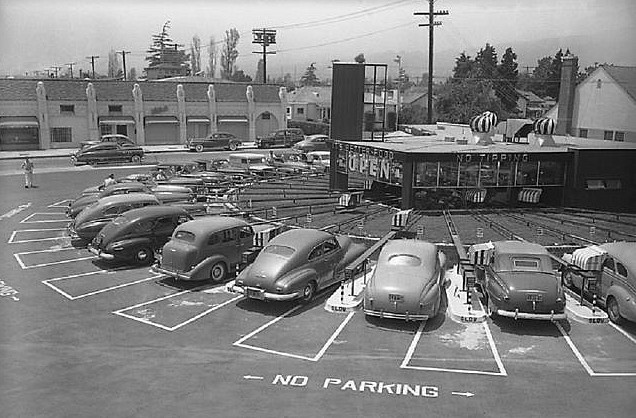
What could go wrong? One of the most intriguing L.A. architectural novelties we’ve ever seen was this take on the drive-in. It’s The Track, with “Motormat” technology, “Track” apparently a reference to racetrack—hence the striped service trolleys that were sent out to cars at 120 feet per minute, each unit named after a famous racehorse.
A theme, however, was not enough in the face of Rube Goldberg technology. You just know the crazy trolley system must have hit snags constantly, with burgers and fries and chicken wings and cokes flying all over the hoods of Hudsons and DeSotos…and yet at one time there seems to have been as many as three outlets in the Los Angeles area, for however long they lasted. Here’s a description of the operation from The American Drive-In, by Michael Karl Witzel:

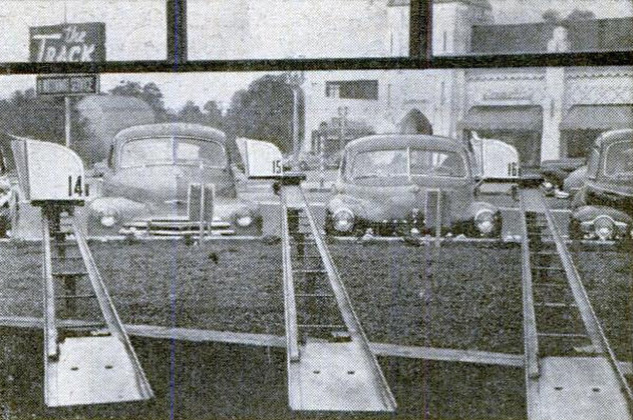
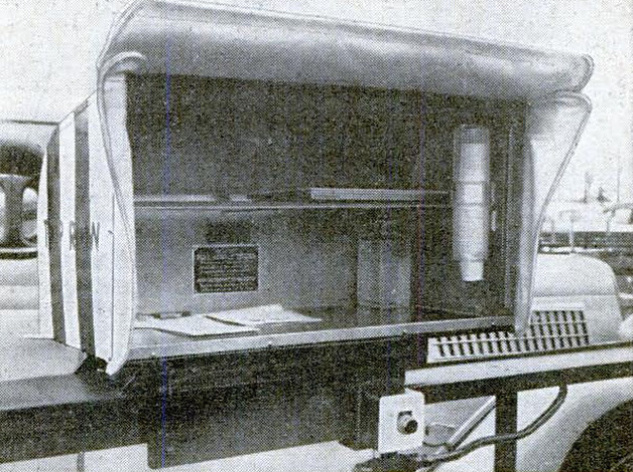
“Debuted in 1949, a Los Angeles innovation promised total elimination of carhops. At a new drive-in called “The Track,” it attracted customers from as far as Santa Monica with its unique type of service. Like a group of horses at a trough [there’s a gracious image], cars ringed around a central building, forming a circular pattern. Twenty semicircular parking spaces bridged a center kitchen by means of metal tracks. Food and condiments rode the rails within carrying…compartment[s] each powered by a small ½-horsepower motor…. The mechanical setup was reminiscent of the wackiest Rube Goldberg device. Positioned in a pre-determined [?] parking space, the diner rolled down the car window and was greeted by a stainless-steel bin that could be made flush with the door. Inside the box were plastic cups, a water bottle, menu, order pad, and change tray. It was large, too. Food for six people could be ferried back and forth on the elevated platforms. Patrons would jot down their orders and with the push of a button, the unit scooted a return to the kitchen…. When the empty bin arrived at the kitchen, an attendant put through the order and added up the bill. As hamburgers and other entrées were prepared, the rail box made its second journey to the automobile to collect the money. By the time it returned to the preparation area, the food was ready to go—loaded into the compartment along with condiments and the customer’s change. According to inventor Kenneth C. Purdy, the spoke-and-wheel-track arrangement sped service 20-25 percent.”

Well, needless to say, we wanted to know where this madcap drive-in was. There was a 1951 phone-book listing for a “The Track No 3” at 3816 Sepulveda Boulevard in Culver City, now the site of a Carl Jr’s, but current visual cues there don’t jive with the vintage shots seen here. So we squinted at the pics, especially the one at top, and decided that the sign on the Herman-Something real estate office must have said “Herman Shrager”—who, it turns out, dealt in cemetery real estate, as in plots.

Anyway, after more digging we found that Herman had an office at 8152 Beverly Boulevard…and eureka! It all fell into place. Across from Herman’s one-time haunt, at the northwest corner of Beverly and Kilkea Drive, the distinctive Welch’s Candy building still stands…and so across Kilkea from Welch’s would have been The Track, at 8123 Beverly.
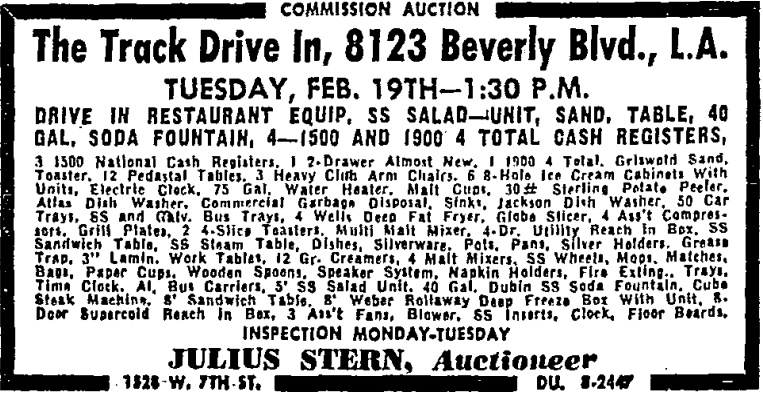
The mini-chain’s other locations may have survived longer, but with maintenance obviously a nightmare and profits hindered with what was clearly too much real estate given over to servicing too few cars, it was all over in a few years. Advertisements for an auction of the pieces of The Track appeared in the Times in February 1952.

The view from the kitchen, above. Below:
Assuming that the contraption made it out to his car,
the driver received his order in this box:

As seen in the Los Angeles Times on February 17, 1952
 Looking north today at Beverly Boulevard and Kilkea Drive

The Track
PLEASE ALSO SEE OUR COMPANION HISTORIES
FOR AN INTRODUCTION TO HISTORIC LOS ANGELES, CLICK HERE
What could go wrong? One of the most intriguing L.A. architectural novelties we’ve ever seen was this take on the drive-in. It’s The Track, with “Motormat” technology, “Track” apparently a reference to racetrack—hence the striped service trolleys that were sent out to cars at 120 feet per minute, each unit named after a famous racehorse. A theme, however, was not enough in the face of Rube Goldberg technology. You just know the crazy trolley system must have hit snags constantly, with burgers and fries and chicken wings and cokes flying all over the hoods of Hudsons and DeSotos…and yet at one time there seems to have been as many as three outlets in the Los Angeles area, for however long they lasted. Here’s a description of the operation from The American Drive-In, by Michael Karl Witzel:

“Debuted in 1949, a Los Angeles innovation promised total elimination of carhops. At a new drive-in called “The Track,” it attracted customers from as far as Santa Monica with its unique type of service. Like a group of horses at a trough [there’s a gracious image], cars ringed around a central building, forming a circular pattern. Twenty semicircular parking spaces bridged a center kitchen by means of metal tracks. Food and condiments rode the rails within carrying…compartment[s] each powered by a small ½-horsepower motor…. The mechanical setup was reminiscent of the wackiest Rube Goldberg device. Positioned in a pre-determined [?] parking space, the diner rolled down the car window and was greeted by a stainless-steel bin that could be made flush with the door. Inside the box were plastic cups, a water bottle, menu, order pad, and change tray. It was large, too. Food for six people could be ferried back and forth on the elevated platforms. Patrons would jot down their orders and with the push of a button, the unit scooted a return to the kitchen…. When the empty bin arrived at the kitchen, an attendant put through the order and added up the bill. As hamburgers and other entrées were prepared, the rail box made its second journey to the automobile to collect the money. By the time it returned to the preparation area, the food was ready to go—loaded into the compartment along with condiments and the customer’s change. According to inventor Kenneth C. Purdy, the spoke-and-wheel-track arrangement sped service 20-25 percent.”

Well, needless to say, we wanted to know where this madcap drive-in was. There was a 1951 phone-book listing for a “The Track No 3” at 3816 Sepulveda Boulevard in Culver City, now the site of a Carl Jr’s, but current visual cues there don’t jive with the vintage shots seen here. So we squinted at the pics, especially the one at top, and decided that the sign on the Herman-Something real estate office must have said “Herman Shrager”—who, it turns out, dealt in cemetery real estate, as in plots. Anyway, after more digging we found that Herman had an office at 8152 Beverly Boulevard…and eureka! It all fell into place. Across from Herman’s one-time haunt, at the northwest corner of Beverly and Kilkea Drive, the distinctive Welch’s Candy building still stands…and so across Kilkea from Welch’s would have been The Track, at 8123 Beverly. The mini-chain’s other locations may have survived longer, but with maintenance obviously a nightmare and profits hindered with what was clearly too much real estate given over to servicing too few cars, it was all over in a few years. Advertisements for an auction of the pieces of The Track appeared in the Times in February 1952.

The view from the kitchen, above. Below:
Assuming that the contraption made it out to his car,
the driver received his order in this box:

As seen in the Los Angeles Times on February 17, 1952
 Looking north today at Beverly Boulevard and Kilkea Drive