Category: Born again Cynic!
Categories
A lot of AI being shown
Categories
My Kind of a guy
Obituary for Robert Adolph Boehm

Robert Adolph Boehm, in accordance with his lifelong dedication to his own personal brand of decorum, muttered his last unintelligible and likely unnecessary curse on October 6, 2024, shortly before tripping backward over “some stupid mother****ing thing” and hitting his head on the floor.
Robert was born in Winters, TX, to the late Walter Boehm and Betty Smith on May 6, 1950, after which God immediately and thankfully broke the mold and attempted to cover up the evidence.
Raised Catholic, Robert managed to get his wife Dianne pregnant (three times) fast enough to just barely miss getting drafted into the Vietnam War by fathering Michelle, John, and Charlotte between 1967 and 1972. Much later, with Robert possibly concerned about the brewing conflict in Grenada, Charles was born in 1983.
This lack of military service was probably for the best, as when taking up shooting as a hobby in his later years, he managed to blow not one, but two holes in the dash of his own car on two separate occasions, which unfortunately did not even startle, let alone surprise, his dear wife Dianne, who was much accustomed to such happenings in his presence and may have actually been safer in the jungles of Vietnam the entire time.
While the world was in conflict elsewhere, Robert made due by learning to roof, maintain traffic signs with the City of Amarillo, and eventually becoming a semi-professional truck driver—not to be confused with a professional semi-truck driver.
With peace on the horizon, Robert’s attention somewhat counterintuitively drifted to weapons of war, spanning the historical and geographical spectrum from the atlatl of 19,000 BC France, to the sjambok of 1830s Africa, to the Mosin-Nagant M1891 of WWII-era Soviet Union.
So many examples of these mainstream hobbyist items litter his small Clarendon, Texas, apartment that one of them may very well have been the item referenced in his aforementioned eloquent final epitaph.
A man of many interests, Robert was not to be entranced by historical weapons alone, but also had a penchant for fashion, frequently seen about town wearing the latest trend in homemade leather moccasins, a wide collection of unconventional hats, and boldly mismatched shirts and pants.
Robert also kept a wide selection of harmonicas on hand—not to play personally, but to prompt his beloved dogs to howl continuously at odd hours of the night to entertain his many neighbors, and occasionally to give to his many, many, many grandchildren and great-grandchildren to play loudly during long road trips with their parents.
Earlier this year, in February, God finally showed mercy upon Dianne, getting her the hell out of there for some well-earned peace and quiet. Without Dianne to gleefully entertain, Robert shifted his creative focus to the entertainment of you, the fine townspeople of Clarendon, Texas. Over the last eight months, if you have not met Robert or seen his road show yet, you probably would have soon.
We have all done our best to enjoy/weather Robert’s antics up to this point, but he is God’s problem now.
Robert’s farewell tour will be held Monday, October 14th, at 10 a.m. at Memorial Park Funeral Home, 6969 E Interstate 40 Hwy, Amarillo, TX 79118. The family encourages you to dust off whatever outdated or inappropriate combination of clothing you have available to attend. A tip jar will be available in the front; flowers are also acceptable.
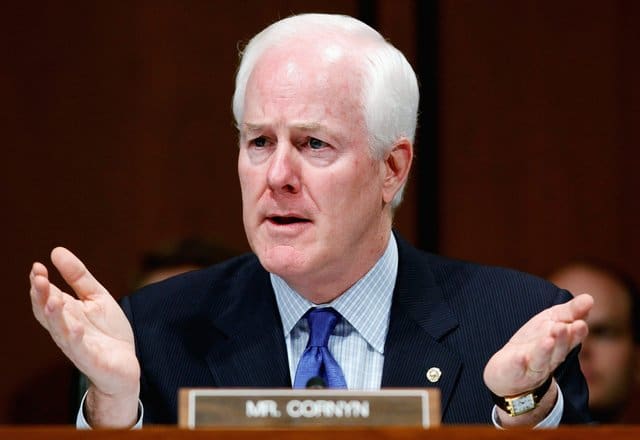 We told you back in 2022 how U.S. Sen. John Cornyn, R-Texas, worked with President Joe Biden and Democrats in the U.S. Senate to help pass the so-called Bipartisan Safer Communities Act (BSCA), which the Bureau of Alcohol, Tobacco, Firearms and Explosives (ATF) later utilized to issue several more Final Rules further restricting firearm ownership.
Now, in the midst of a reelection campaign that sees him running neck-and-neck with Texas Attorney General Ken Paxton, Cornyn is denying that he worked with the Democrats to help get the anti-gun measure passed.
According to a report at dallasexpress.com, the pro-gun rights group Texas Gun Rights recently posted on social media: “Speaking of shooting, remember when you teamed up with Biden to spearhead gun control legislation?” Cornyn’s reply was a simple, “No.”
Either Cornyn’s memory is failing him or he’s trying to hide the fact that he was instrumental in the passage of the measure back in 2022. In fact, that’s the point Blaze Media personality Sara Gonzalez was making when she asked on social media: “Is John Cornyn senile, a liar, or both?”
The denial also gave Texas AG Paxton a chance to take a shot at Cornyn, who he’s seeking to unseat in the U.S. Senate.
“My promise to voters of Texas is that I will never be thanked by Joe Biden for helping him pass gun control legislation,” Paxton posted on X. “I wish John Cornyn could make the same promise.”
In fact, Cornyn’s denial isn’t even plausible. There’s no doubt that he aided in the passage of the bill, even voting “yea” when the final vote on the measure was taken.
At the time, Cornyn should have known better than to help with the bill. Despite his claims that he “thought it was important to demonstrate the Senate could work,” the National Rifle Association publicly opposed the legislation, warning that its vague language gave anti-gun officials nebulous authorities that could be abused to target law-abiding gun owners and firearm-related businesses. That assertion, of course, turned out to be correct.
Cornyn’s denial of being involved with the legislation comes only three months after Texas Gun Rights penned a letter to President Trump in which it aired its grievances over what it believes to be Cornyn’s lack of support for the Second Amendment.
“Dear President Trump, We, the members and supporters of Texas Gun Rights, write to you as dedicated defenders of the Second Amendment,” the letter stated. “We urge you in the strongest terms not to endorse Senator John Cornyn in his bid for re-election to the U.S. Senate.”
An Emerson College Poll released August 15 showed a statistical tie among GOP primary voters, with 30% backing Cornyn, 29% supporting Paxton and 37% undecided.


This is the damage cause by an AR-15 chambered in 22LR.
Random people should not be able to buy weapons of mass destruction under the gun show loophole.

“A product demonstrator at the Las Vegas SHOT Show was speaking of a competitor’s product: ‘When their part was installed, the guns went civil service in under 1,000 rounds.’ After he used this term a few times, an audience member asked what he meant. The instructor replied with a smile: ‘The gun went civil service. That means it won’t work, and you can’t fire it’.” — Anonymous
“Andersen’s (?) Law of Survival for Low-Level Managers: “Never be right too often.” — Anonymous
“Blair’s (?) Observation: The best-laid plans of mice and men are about equal.”
A variation on a verse by Robert Burns in his poem, To a Mouse: “The best laid schemes o’ mice an’ men Gang aft a-gley.”
“Those who have given themselves the most concern about the happiness of peoples have made their neighbors very miserable.” — Anatole France, Nobel-Prize-winning French author (1844–1924)
“The angels take no interest in the sports of man, save archery.” — Persian saying
“Experience is not what happens to a man; it is what a man does with what happens to him.” — Aldous Huxley, English writer and philosopher (1894–1963)
“If you are guided by opinion polls, you are not practicing leadership—you are practicing followship.” — Margaret Thatcher, prime minister of the United Kingdom, known as “The Iron Lady” (1925– 2013)
“Just be thankful we’re not getting all the government we’re paying for.” — Will Rogers, American vaudeville performer, actor, columnist, humorist, and social commentator (1879–1935)
“Politics is supposed to be the second-oldest profession. I have come to realize that it bears a very close resemblance to the first.” — Ronald Reagan, 40th president of the US (1911–2004)
“When there is lack of honor in government, the morals of the whole people are poisoned.” — Herbert Hoover, American politician and engineer, 31st president of the US during the Great Depression (1874–1964)
“A society grows great when old men plant trees whose shade they know they shall never sit in.” — Greek proverb
“When liberty becomes license, some form of one‑man power is not far distant.” — Theodore Roosevelt, 26th president of the US, author, recipient of the Congressional Medal of Honor, and pioneering conservationist (1858–1919)
“Give the vote to the people who have no property, and they will sell them to the rich, who will be able to buy them.” — Gouverneur Morris, the author of the Preamble to the US Constitution and Founding Father (1752–1816)
“Scientifically, a raven has seventeen primary wing feathers, the big ones at the end of the wing. They are called pinion feathers. A crow has sixteen. So, the difference between a crow and a raven is only a matter of a pinion.” — Anonymous
“Whoever said you can’t buy happiness forgot about puppies.” — Gene Hill, American author and outdoors columnist (1928–1997)
“I’m all in favor of the democratic principle that ‘one idiot is as good as one genius,’ but I draw the line when someone takes the next step and concludes that ‘two idiots are better than one genius’.” — Leo Szilard, Hungarian-German-American physicist and inventor, holder of the patent on the nuclear fission reactor, collaborator with Albert Einstein (1898–1964)
Szilard was one of the five, Jewish-Hungarian scientists known as “The Martians.” Someone once remarked that the only explanation for five geniuses originating from the same small part of Hungary at the same time was that they were all really Martians and chose Hungary because the language was about as intelligible as Martian. I first read this anecdote in The Making of the Atomic Bomb by Richard Rhodes et al. Highly recommended.
“Wisdom is the right use of knowledge. To know is not to be wise. Many men know a great deal, and are all the greater fools for it.” — Charles Spurgeon
“Never argue with an idiot. They will drag you down to their level and beat you with experience.” — Mark Twain, American writer, humorist, entrepreneur, publisher, and lecturer (1835–1910)
“I cannot give you the formula for success, but I can give you the formula for failure, which is—try to please everybody.” — Herbert Bayard Swope, American editor and journalist (1882–1958)
“A recent traveler returning from Pakistan reports that there is no racial discrimination in that country—only a good deal of ethnic homicide.” — Jeff Cooper, Lt. Colonel of Marines and the father of modern practical shooting (1920–2006)
“Masculine republics give way to feminine democracies, and feminine democracies give way to tyranny.” — Aristotle, Greek philosopher and polymath (384–322 BC)
In a similar vein: “Democracy is when the indigent, and not the men of property, are the rulers.” — Aristotle
“A liberal is someone who feels a great debt to his fellow man, which debt he proposes to pay off with your money.” — G. Gordon Liddy, American lawyer, FBI agent, talk show host, actor, and convicted felon (1930–2021)
Liddy was the chief operative in the Nixon administration Watergate scandal that led to the resignation of President Nixon.
“What this country needs are more unemployed politicians.” — Edward Langley, British mathematician and author (1851–1933)
“The trouble with practical jokes is that very often they get elected.” — Will Rogers, American vaudeville performer, actor, columnist, humorist, and social commentator (1879–1935)
“Dreams will get you nowhere, a good kick in the pants will take you a long way.” — Baltasar Gracian
“There are more things on this planet with fangs, claws, poisons, and scales than there are things that are warm, fuzzy, and full of love. It’s a simple fact.” — Master at Arms James Albert Keating
“The problem with ‘post-modern’ society is there are too many people with nothing meaningful to do, building careers around controlling the lives of others and generally making social nuisances of themselves. They justify their meddling by discovering ‘social problems’ and getting the media to magnify them out of all proportion.” — Graham Strachan, attorney and author
“If the automobile had followed the same development as the computer, a Rolls-Royce would today cost $100, get a million miles per gallon, and explode once a year killing everyone inside.” — Robert X. Cringley, the pen name of technology journalist, Mark Stephens
“I do benefits for all religions. I would hate to blow the hereafter on a technicality.” — Bob Hope, British-American comedian, vaudevillian, actor, singer, dancer, and film star (1903–2003)
“I have noticed even people who claim everything is predestined, and that we can do nothing to change it, look before they cross the road.” — Stephen Hawking, English theoretical physicist and cosmologist (1942–2018)
“Under capitalism, man exploits man. Under communism, it’s the opposite.” — J.K. Galbraith, Canadian-born, American economist, diplomat, and public official (1908–2006)
“What is a communist? One who hath yearnings
For equal division of unequal earnings,
Idler or bungler, or both, he is willing,
To fork out his copper and pocket your shilling.”
— Ebenezer Elliott, English poet (1781–1849)