Categories
All About Guns Anti Civil Rights ideas & "Friends"

The 50 best(And Worst) States for Firearm Rights in the Unites States.

Top 5 – Best Gun-Friendly States

1. Arizona
2. Idaho
3. Alaska
4. Kansas
5. Oklahoma

Bottom 5 – Worst Gun-Friendly States

47. California
48. New Jersey
49. Massachusetts
50. Hawaii
51. New York

Each year we provide an update on firearms-related legislative activity and use each state’s laws and rules to create our Best States for Gun Owners rankings. Calling 2020 a “different year” would be a gross understatement. As COVID-19 swept the world and the nation, states suspended or adjourned their legislative sessions midstream. Thousands upon thousands of bills died on the vine as lawmakers vacated their respective state capitols. Some legislatures, including those in Texas, Montana, North Dakota and Wyoming, meet every other year and did not go into session in 2020 at all. The short version is, as a result of these events, very few changes in firearms laws occurred this year.

Due to this unusual set of circumstances, this year’s rankings will be a bit different than in years past. Where states made meaningful changes in law, we will outline those. Where states took no action that would change our scoring, we note that as well. As in previous years, we evaluate each state numerically in each of five categories: Right-To-Carry/CCW, access to “Black Rifles”, the states’ use-of-force laws i.e., Castle Doctrine, the prohibition of items regulated by the National Firearms Act (NFA) and a catchall Miscellaneous column.

States are awarded 0-10 points in each category and ranked according to their total number of points. In the case of a tie, which is common, we dig deeper into the “intangibles” category and rank states accordingly. Please note that while we have done our best to rank states as objectively as possible, reasonable minds disagree with our findings. No article of this length could capture every nuance of a state’s statutory and regulatory framework. Each year I receive comments from readers on individual states’ rankings and, in many cases, I learn something new from that feedback — please keep it coming.

Right-­to-­Carry/CCW

This category is evaluated using the criteria applied in our “Best States for CCW” rankings: standard for issuance, training requirements, cost, reciprocity and the extent of locations where licensees are prohibited from carrying. May-issue states that rarely issue permits are graded accordingly and can receive 1-6 points, depending on the standard review factors. Shall-issue states, states that require that a permit be issued as long as the applicant is qualified, are given 6-8 points.  States with legal permitless or “constitutional” carry are given 9 points, whereas states that both issue permits and allow citizens to carry without one are given a full 10-point score. States that issue permits and allow for permitless carry for residents only are given 9.5 points.  Open carry laws are considered under the miscellaneous column and can also be used as a tiebreaker.

Black Rifles

This category examines whether a state regulates or bans firearms based on their appearance. These laws often require registration of certain firearms and, in some states, ban ownership altogether. Our rankings reflect whether a state regulates any category of firearm by its features or limits magazine capacity.

NFA

The National Firearms Act (NFA) regulates the sale, transfer and possession of machine guns, suppressors (actually called “silencers” in the law), short-barreled rifles (SBR), short-barreled shotguns (SBS), Any Other Weapons (AOW), and Destructive Devices (DD).  This federal statute allows states to further restrict these items (we use the term “items” since suppressors are not firearms but are covered under the NFA) and some states ban their ownership altogether or piecemeal; we rank each state based on a sliding scale of regulations.  This has been an active category in recent years as states have moved to legalize the ownership and use of suppressors.

Castle Doctrine

The term “Castle Doctrine” has become shorthand for a state’s use-of-force laws.  Some states require citizens to retreat before the use of deadly force is authorized.  We rank states based on the right to use force both inside and outside of homes and businesses.  We award maximum points to states that allow the use of force wherever a person has a legal right to be and protect citizens from both criminal and civil liability if appropriate force is used.

Miscellaneous

This is the most subjective category in our survey but allows us some leeway to quantify the culture and environment in a given state. We use this category to track preemption statutes, laws and rules that fall outside of our other buckets as well as the availability of places to shoot. States with thriving competitive shooting communities are also recognized here and states with laws that allow for gun confiscation without due process, i.e., Red Flag laws, are penalized.

51. New York

No relevant outcomes in 2020. (2019 rank: 51)

50. Hawaii

Dozens of gun control bills were introduced in Hawaii this year but only two actually became law. A magazine ban and other bills failed to advance, but the Governor did sign legislation that will make the creation of home-made guns a felony. The other bill requires that gun owners give formal notice when permanently removing a firearm from the state, with financial penalties imposed for non-compliance. (2019 rank: 48)

49. Massachusetts

Gov. Baker closed gun shops as part of his executive powers related to the pandemic, but a Federal Court ruled that the state overstepped its authority and placed an undue burden on the Second Amendment. The court ordered that gun stores be allowed to reopen and the Governor subsequently opened shooting ranges by executive order. A small victory in an otherwise hostile environment for gun owners. (2019 rank: 50)

48. New Jersey

Governor Murphy shut down gun shops, shooting ranges and firearm transfers in March by executive order. Thanks to action by the Trump Administration and a lawsuit by the Association of New Jersey Rifle and Pistol Clubs (ANJRPC), transfers eventually resumed and outdoor shooting ranges reopened. An attempt by the Governor to exponentially raise the cost of pistol permits and firearm licenses failed when the measure was omitted by the legislature’s budget bill. (2019 rank: 49)

47. California

One of the most important Second Amendment cases in recent memory moved closer to resolution this year when a Federal Appellate Court struck down the state’s magazine ban in the Duncan V. Becerra case. The fight isn’t over yet, though, as the state’s Attorney General has petitioned for an en banc review by a panel of judges. The ban remains in place as the court considers the case. If the larger panel upholds the ruling, it will be a game-changer for gun owners, so stay tuned. (2019 rank: 47)

46. Washington D.C.

No relevant outcomes in 2020. (2019 rank: 46)

45. Connecticut

Unlike some of his neighboring Governors, Connecticut Gov. Ned Lamont declared firearm and ammunition retailers as “essential businesses” as part of his pandemic-related executive order.  A special session of the legislature is currently underway but, as of now, there are no indications that gun control bills will be pursued. (2019 rank: 45)

44. Maryland

2020 was a surprisingly good year for Maryland’s gun owners. Gov. Hogan kept gun stores open despite the state’s shutdown, and vetoed legislation that would have banned the private transfer of long guns. In July, the State Police announced that mandatory handgun training required to obtain a Handgun Qualification License can now take place online due to the pandemic. (2019 rank: 44)

43. Rhode Island

Numerous anti-gun bills, including “assault weapon” and magazine bans, were introduced in 2020, but the COVID-related shutdown prevented any of them from passage. Time will tell whether these issues will see new life in 2021. (2019 rank: 43)

42. Delaware

No relevant outcomes in 2020. (2019 rank: 42)

41. Illinois

Legislation that would ban private transfers and “reform” the state’s FOID (Firearms Owner Identification) system were been carried over from the 2019 session but did not pass. The Illinois Legislature can meet year-round, so the fight is never over. (2019 rank: 41)

40. Colorado

No relevant outcomes in 2020. (2019 rank: 40)

39. Minnesota

Bills that would ban private transfers and allow for firearm confiscation by law enforcement passed the Democratic-controlled Minnesota House in February but stalled in the Republican-led Senate. (2019 rank: 39)

38. Washington

Magazine bans and other gun control bills failed to make their way out of the Legislature, but three bills did pass. One of the bills, which was signed by Governor Inslee, prohibits carrying a firearm at a daycare center, regardless of whether the individual has a CPL (CCW) permit. Other bills that became law will create an Office of Firearm Violence Prevention and impose additional requirements related to court-ordered surrender of firearms. (2019 rank: 38)

37. Vermont

No relevant outcomes in 2020. (2019 rank: 37)

36. New Mexico

No relevant outcomes in 2020. (2019 rank: 36)

35. Nebraska

No relevant outcomes in 2020. (2019 rank: 34)

34. Iowa

Governor Reynolds signed legislation in June to protect Iowa’s shooting ranges from local ordinances designed to put them out of operation. Access to safe shooting facilities is key to ensuring the future of responsible gun ownership. The bill also preempts municipal governments from imposing their own restrictions on firearms ownership. This important move earns Iowa an additional point in the Miscellaneous category. (2019 rank: 35)

33. Virginia

All eyes were on Virginia this January after Democrats took majorities in both chambers of the Commonwealth’s General Assembly. What looked like certain victory for a semi-auto, magazine and suppressor ban took a sharp turn when a handful of Democrats voted against the measure during a Senate Judiciary Committee hearing. Still, the Governor achieved passage of at least some of the items on his gun control wish list. Legislation passed that weakens the state’s preemption laws and numerous municipalities are already acting to prevent firearm possession in public areas. Virginia’s old “one gun a month” law was reinstated, though those with carry permits are exempt. Private transfers were effectively eliminated and a Red Flag confiscation program has been created. Virginia is a shining example of how a single election cycle can drastically change the fate of gun owners in a given state. These actions costs Virginia points in the Miscellaneous category and look for efforts to pass more onerous legislation in 2021. (2019 rank: 31)

32. Oregon

Bills that would have gutted Oregon’s preemption law and imposed mandatory storage requirements on gun owners failed when the Republican members of the Legislature staged a walk-out, preventing the body from achieving the quorum necessary to pass the bills. Efforts to put semi-auto and magazine bans on the state’s November 2020 ballot failed, but the proponents will surely be back. (2019 rank: 33)

31. Pennsylvania

Since our last report, Pennsylvania Attorney General Josh Shaprio issued an Opinion declaring that partially-manufactured firearm components including so-called “80% receivers” qualify as firearms under state law, and should be regulated as such. A bill that would prevent the Governor from restricting firearm rights during an emergency has passed the House and currently awaits action in the state Senate after advancing from the Judiciary Committee in September. (2019 rank: 32)

30. Maine

No relevant outcomes in 2020. (2019 rank: 30)

29. South Dakota

Governor Noem signed important legislation protecting gun owners in March, just a day after its passage by the Legislature. This law prevents state and local government from restricting the rights of gun owners during emergencies and took effect immediately. Other bills were signed that increased opportunities for concealed carry, including legislation that specifies that a permit is not required when carrying a firearm on a motorcycle, snowmobile or off-road vehicle. (2019 rank: 29)

28. Michigan

No relevant outcomes in 2020. (2019 rank: 27)

27. North Carolina

Last year, the NC General Assembly passed legislation that would allow concealed carry permit holders to carry in places of worship. Governor Cooper vetoed the bill and the Assembly made an unsuccessful attempt to override that veto in July. All eyes were on North Carolina in the November election where gubernatorial, U.S. Senate and Assembly races all carried serious implications for gun owners. Despite huge advantages in fundraising by out-of-state groups, Democrats were unsuccessful in gaining majorities in the state’s two legislative chambers. (2019 rank: 26)

26. Nevada

No relevant outcomes in 2020. (2019 rank: 25)

25. Florida

The biggest news for gun owners in the Sunshine State came in June when the state Supreme Court removed a serious gun control proposal from the November ballot. The measure would have amended the state’s Constitution to prohibit possession of “assault weapons”. The state’s Attorney General challenged the proposal and the majority of the court agreed that the ballot summary was “misleading” and took it out of consideration for this election. (2019 rank: 24)

24. Louisiana

Governor Edwards proved that protecting the Second Amendment need not be a partisan issue when he signed four pro-gun bills in June. These bills allow permittees to carry in places of worship, protect the rights of gun owners in times of emergency and prevents municipalities from restricting firearm possession. (2019 rank: 28)

23. Ohio

No relevant outcomes in 2020. (2019 rank: 23)

22. South Carolina

No relevant outcomes in 2020. (2019 rank: 22)

21. Wisconsin

Nothing notable happened in Wisconsin’s Legislature in 2020 but the state’s Stand-Your-Ground law made national headlines in the context of the riots and shootings in Kenosha. (2019 rank: 21)

20. Indiana

Indiana continued to establish itself as a gun-friendly state this year as laws passed in 2019 went into effect. Those laws protect individuals from frivolous lawsuits related to self-defense encounters, and eliminate fees for concealed carry permits in the state. Additionally, the Governor declared that firearm and ammunition suppliers and retailers could remain open during the COVID-19 crisis. (2019 rank: 20)

19. Arkansas

No relevant outcomes in 2020. (2019 rank: 19)

18. Alabama

An effort to create a lifetime carry permit in the state failed when the Legislature adjourned Sine Die in May. This measure was opposed by the state’s sheriffs, many of whom derive revenue from the issuing of carry permits. The good news was that gun stores remained open during Gov. Ivey’s shutdown of the state. (2019 rank: 18)

17. New Hampshire

Governor Chris Sununu vetoed legislation in August that would have allowed for firearm confiscation without adequate due process protections. An attempt by the legislature to override that veto failed, closing the book on this issue for 2020. (2019 rank: 17)

16. Mississippi

No relevant outcomes in 2020. (2019 rank: 16)

15. West Virginia

Governor Justice signed legislation in March that strengthens the state’s firearm preemption statute, making the state even more friendly for gun owners. Attorney General Patrick Morrisey stood up for the Second Amendment once again when he advised Sheriffs that they may accept LCDW/Concealed Carry applications and renewals by mail. Though West Virginia is a permitless carry state, the LCDW is key when traveling to other jurisdictions and also satisfies the background check requirements for purchasing a firearm. I have long lampooned a WV law that prevented guns from being displayed in a store window — thanks to legislation sponsored by Delegate Brandon Steele, that law is off the books! (2019 rank: 15)

14. North Dakota

No relevant outcomes in 2020, the state’s legislature did not meet in 2020. (2019 rank: 14)

13. Tennessee

Tennesseans have sought permitless carry for years, but their efforts got a boost in 2020 when Gov. Lee endorsed the proposal. What looked like a sure thing in January fell victim to the COVID shutdown when the bill failed to advance before the legislature’s adjournment. Barring any unforeseen events, we should see passage of this bill in 2021. (2019 rank: 13)

12. Missouri

No relevant outcomes in 2020. (2019 rank: 12)

11.Georgia

No relevant outcomes in 2020. (2019 rank: 11)

10. Texas

No relevant outcomes in 2020. (2019 rank: 10)

9. Montana

No relevant outcomes in 2020. (2019 rank: 9)

8. Utah

No relevant outcomes in 2020. (2019 rank: 7)

7. Wyoming

No relevant outcomes in 2020. (2019 rank: 8)

6. Kentucky

No relevant outcomes in 2020. (2019 rank: 6)

5. Oklahoma

No relevant outcomes in 2020. (2019 rank: 5)

4. Kansas

An emergency powers bill designed to protect gun owners was passed during a Special Legislative Session, but the measure was vetoed by Gov. Kelly. Nonetheless, firearms-related businesses were exempt from the Governor’s COVID-19 shutdown order. (2019 rank: 4)

3. Alaska

No relevant outcomes in 2020. (2019 rank: 3)

2. Idaho

The big news for gun owners in Idaho this year was Governor Brad Little’s signature on a permitless carry bill in March. Permitless carry was already legal for Idaho residents, but this legislation extends the law to cover all U.S. Citizens over the age of 18 to carry, including in the cities. With this slight change in law, Idaho ties the number one state in terms of points. (2019 rank: 2)

1. Arizona

No relevant outcomes in 2020. Arizona remains number one on our list due to its thriving competitive shooting scene and firearms industry presence. (2019 rank: 1)

Categories
Anti Civil Rights ideas & "Friends" Cops

4 Cops for Every Congressman – But Pelosi Wants More The police defunders have a lot more cops than the taxpayers whose police they want to defund. by Daniel Greenfield,

Daniel Greenfield, a Shillman Journalism Fellow at the Freedom Center, is an investigative journalist and writer focusing on the radical Left and Islamic terrorism.

In “Surf City,” the Beach Boys sang that there were two girls for every boy. But in Swamp City, there are four cops for every Congressman.

That doesn’t refer to Washington D.C.’s already huge concentration of law enforcement and multiple overlapping police forces. Washington D.C. has the highest ratio of police to people of any major city in the country. There are 650 officers for every 100,000 residents in D.C. That’s 40% higher than any other major city in America including Chicago and Baltimore. It has a 58% higher police ratio than New York, more than double that of Boston, and triple that of L.A.

But that’s nothing compared to the private police force dedicated only to protecting Congress.

The Capitol Police, which has been in the spotlight since the Capitol Riot, has over 2,000 sworn officers. Pelosi’s private police force is the 19th largest police force in America.

It’s already larger than the police forces of Atlanta, Baltimore, Denver, and Milwaukee.

While Democrats advocated defunding the police, their private police force budget shot up from $375 million in 2016 to $460 million in 2020. And now it’s demanding even more money.

Speaker Pelosi claimed, “It’s going to take more money to protect the Capitol in a way that enables people to come here.”

How much money? Who knows.

Colonel Bowie managed to hold off the Mexican Army at the Alamo for over a week with a few hundred men, but the Capitol Police couldn’t keep Congress for an hour with a thousand.

Acting Chief Yogananda Pittman, told Congress that she needed funding for 212 new sworn officers and 111 dignitary protection agents. That’s a fancy name for the congressional version of secret service agents for “high-profile members of Congress.” Teams of four of these “agents” accompany their important charges. Since then, the number of agents has been increased and there are six dignitary agents protecting every single “high-profile member of Congress”.

(Some dignitary protection agents had even been deployed to protect the homes of “high-profile members of Congress” during the Capitol Riot and weren’t available to help during the fighting.)

That would take the Capitol Police up to at least 2,200 sworn officers. And with 535 elected officials in the House and Senate, that’s a ratio of 4 cops for every congressman and woman.

Meanwhile the high-profile members get a private security detail of 6 cops.

While the names of those high-profile members are not available for security reasons, these likely included senior leadership figures in both parties as well as high-profile politicians who attract a lot of threats. That would likely include some members of the Squad and other Democrat proponents of police defunding. Or defunding other people’s police anyway.

While Democrats have advocated for police defunding, their House and Senate majorities currently enjoy some of the densest possible ratio of police for them and their employees.

House members had 3,695 staffers (total 6,880 nationwide) and Senate members had 2,342 staffers (total 4,120 nationwide) working in their D.C. offices for a combined 6,037 people.

That’s up from 146 in 1891, and 304 in 1943, which is understandable since our government works much better now than when we won WW2.

Between members of Congress and their staffers (not to mention kits, cats, sacks, and wives), that’s over 6,500 people to be protected by 2,200 sworn officers. Or a cop per 3 employees.

Even Vatican City, with the highest police ratio in the world, is more modest than that.

The shopkeepers of Kenosha would have appreciated that kind of police ratio during the Black Lives Matter riots that robbed them of their livelihoods with the backing of the Democrats.

But it stands to reason that the big government elites of the political faction that embraced police defunding not only need their own private police force, but that while the people in the cities whose police forces they want to defund have to make do with 440 officers per 100,000 people in Chicago and 320 officers per 100,000 people Detroit, they enjoy a 1 officer per 3 people ratio.

Police defunding means no cops to answer the call in Seattle or Minneapolis, but 4 cops for every Democrat Congressman whose life is much more important than those of mere taxpayers.

Some might argue that Republicans also enjoy the benefit of a private police force. But that’s not how Speaker Pelosi sees things. According to Pelosi, Republicans are the enemy.

Speaker Pelosi insisted on “more security for members, when the enemy is within the House of Representatives, a threat that members are concerned about.” Who is this enemy within?

“We have members of Congress who want to bring guns on the floor and have threatened violence on other members of Congress,” Pelosi incited. If members have actually threatened violence against other members, why doesn’t she file charges? But Pelosi has admitted that she wants more cops to protect Democrat members of Congress from Republican Congressmen.

If the “enemy is within the House of Representatives”, then the only solution is to turn the Capitol Police into a Praetorian Guard to accompany Democrat police defunders everywhere. And then Republicans can create their own police force to protect them from the Democrats. If America is going to live out the last era of the Roman Empire, we might as well do it in style.

And since history has been cancelled on account of racism, Pelosi will be really surprised when Chief Yogananda Pittman threatens to replace her unless she ups the ‘donativum’ to the force.

Meanwhile the calls for more money and more personnel for the Capitol Police continue to grow.

D.C. is already the most overpoliced city in America. And yet somehow, no one could manage to cope with one day of riots. The Capitol Police, with 2,000 sworn officers, over 1,000 of whom were on duty, claimed that they couldn’t cope with the riot and needed the National Guard.

The D.C. police force, with 3,750 sworn officers, the Park Police, which was also on the scene, and the multitude of other law enforcement personnel and services, some you have heard of, like the FBI, and some which you may have not like the Supreme Court Police (yes, they exist), the D.C. Protective Services Division, and the Federal Protective Service, couldn’t help either.

Washington D.C. is the epicenter of law enforcement in the country. There are more law enforcement personnel in the imperial city than anywhere in the country. And there are more individual agencies, services, and sub-services with armed personnel than anyone can count. Nearly every federal agency has its own private police. Some have SWAT teams. These are often attached to the Office of the Inspector General (OIG) departments based out of D.C.

Four years ago, the Obama administration sent a contingent of heavily armed agents wearing body armor on a Department of Defense plane to Chicken, Alaska, a town of 17 people, on an EPA investigation of Clean Water Act violations that turned up absolutely nothing. If the Democrats could do this to Chicken, Alaska, one of the furthest places in America, they can manage to protect 2 square miles and a handful of buildings with thousands of officers.

Four cops for every Congressman is more than enough in Swamp City, USA.

Categories
Anti Civil Rights ideas & "Friends" Being a Stranger in a very Strange Land Grumpy's hall of Shame

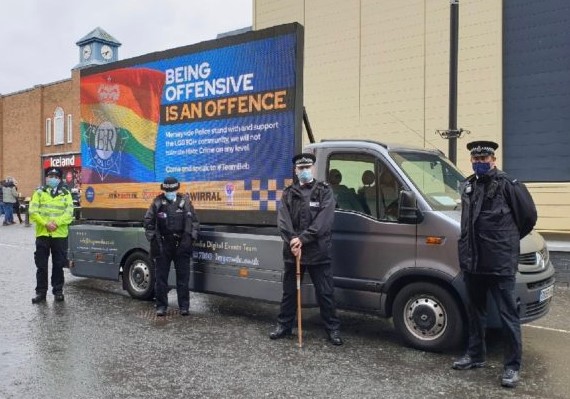
So that’s what the Thought Police look like!

Orwell must be either turning in his grave or saying I told you so! Grumpy

Categories
All About Guns Anti Civil Rights ideas & "Friends"

House Passes Gun Control Bill to Expand Background Checks – Here Are the 8 Republicans Who Voted with Democrats By Cristina Laila

The Democrat-led House on Thursday passed a gun control bill to expand background checks with a vote of 227-203.

8 Republican lawmakers voted with the Democrats to pass the “Background Checks Act” that prohibits private firearms transfers without having a background check:

Vern Buchanan (FL)
Brian Fitzpatrick (PA)
Maria Salazar (FL)
Andrew Garbarino (NY)
Chris Smith (NJ)
Fred Upton (MI)
Carlos Gimenez (FL)
Adam Kinzinger (IL)

Jared Golden (ME) was the one Democrat who voted against the bill according to a preliminary tally of votes.

00:1401:42

A second gun control measure, the “Enhanced Background Checks Act” will be considered by the House on Thursday.

This bill would close the loophole that allows some gun sales to go through before the background check is fully completed.

Categories
All About Guns Anti Civil Rights ideas & "Friends"

9 Reasons the Latest Democratic Gun Control proposal is faulty.

Two years ago, House Democrats pushed a bill requiring so-called “universal background checks” at the federal level, which would have effectively outlawed private sales throughout the country. That bill was H.R. 8, or the “Bipartisan Background Checks Act of 2019.”

Now, after taking control of all three branches, the Democrats are trying again and have just introduced, you guessed it: H.R. 8, the “Bipartisan Background Checks Act of 2021.” Who says Democrats can’t come up with new ideas?

This new bill, just like the old bill, would require that a federal background check be

conducted prior to all transfers of firearm possession. To many Americans, this may

seem like a reasonable idea. After all, law-abiding gun owners abhor the criminal

misuse of firearms

However, on closer examination, none of the claims from gun control proponents backing this bill holds water. We’re going to explore the top nine reasons this latest piece of gun control legislation is a bad idea..

Federally mandated universal background checks won’t end gun violence nor stop the criminal misuse of firearms, but they will significantly increase the burden of millions of law-abiding Americans who wish only to exercise their Second Amendment right to self-defense.

1. DEMANDS FOR NEW GUN CONTROL ARE AN ADMISSION THAT GUN CONTROL DOESN’T WORK

Background checks are used to ensure that a potential firearm possessor is not one of a class of “prohibited persons” who are prohibited from possessing firearms or ammunition under federal law. This class includes felons, fugitives, those subject to certain restraining orders, those convicted of crimes of domestic violence, and more.

This means current gun control laws already make it illegal for these people to

possess a firearm. Requiring more background checks is an admission that the

current law prohibiting these people from possessing firearms is not enough to

prevent their possession. This is true for all gun-control laws, because if we know one

thing about criminals, it’s this: they do not care if they break the law.

Every mass killing is caused by one thing: an evil person intent on killing many innocent people. The tool, whether it be an airplane, a pressure cooker, or a firearm, can change. Making even more laws restricting access to the tool will not stop mass killings, but it will make it more difficult for law-abiding citizens to defend themselves from potential violence. By definition, criminals don’t obey the law.

The horrific mass shooting at a school in Newtown, Connecticut, was not prevented by banning murder, banning guns on schools, banning the theft of firearms, nor requiring so-called universal background checks for every gun sale (Connecticut is one of the states that requires this). Adding yet another law on top of dozens of other laws that failed to prevent mass gun violence is an admission that these laws simply don’t work.

2. GUN DEALERS ALREADY CONDUCT BACKGROUND CHECKS

Federal law, promulgated via Bureau of Alcohol, Tobacco, Firearms and Explosives (ATF) rules, already requires all gun dealers to meet stringent requirements for getting their Federal Firearms License (FFL). As an FFL, they must ensure that a customer has satisfied the background check requirements prior to allowing the customer to have possession of a firearm.

Under current federal law, gun dealers are required to confirm, prior to any and all

sales, that a customer has passed a background check as part of every FFL transfer If

you head into a gun store to purchase a new firearm, that dealer must confirm that

you have satisfied the background check requirements before you can take

possession of that new gun and take it home. This is the case regardless of where you live

If you’re traveling across state lines and see a gun in another state that you’d like to purchase, you must either have that gun shipped to an FFL in your home state if it’s a handgun or, if it’s a rifle or shotgun, you must still pass a background check there before you can purchase and possess the firearm.

Nearly two dozen states place additional requirements beyond federal law on firearm transfers and already either require a background check to be conducted for every firearm transfer (even between private same-state resident individuals, like the Universal Background Check bill proposes) or a valid firearm possession license that is issued contingent upon a background chec

3. THERE IS NO ‘GUN-SHOW LOOPHOLE’

When someone brings up a desire for more background checks, it is often offered as a solution to close the “gun-show loophole.” There’s one big problem with that claim: there is no “gun-show loophole.” It is a myth.

As covered above, federal law requires that all sales from firearm dealers, or sales between residents of different states, must satisfy the background check requirements, regardless of whether those sales happen in a gun shop, at a gun show, or out of the back of somebody’s trunk in a parking lot. Many states also require background checks for individual sales.

There is simply no law anywhere that says if a gun is bought at a gun show, then the buyer doesn’t have to undergo a background check. A dealer who tries to sell a gun at a gun show without confirming that the buyer has passed a background check would be breaking the law.

Furthermore, federal law also prevents sales to anyone that any seller (not just FFLs) believes to be a “prohibited person” (e.g., a convicted felon). As a result, gun dealers regularly turn away potential customers if they think they are not legally allowed to purchase or possess a firearm. There is simply no special exemption or “loophole” in federal law that allows gun show sales to occur without background checks. Therefore, there’s no loophole to close.

4. THERE IS NO ‘ONLINE GUN SALES LOOPHOLE’

Another common call for universal background checks is based on a so-called “online gun sale loophole.” Similar to the “gun show loophole” above, it doesn’t exist. Firearms can be legally purchased (paid for) online as long as the purchaser is not a “prohibited person,” the firearm is legal to possess in the purchaser’s state of residence, and the state otherwise allows the sale.

The current legal process for online gun sales requires that the firearm be shipped to a federally licensed dealer (FFL) in the purchaser’s home state, where the purchaser must show up to fill out the required federal paperwork and satisfy the background check requirements prior to possession.

Just because you click “BUY” on a website that sells guns doesn’t mean you’ll have it shipped to your door without having to process the transaction through a federal gun dealer, who is required to confirm that you have passed a background check before you take possession of that new gun. Again, no loophole equals no loophole to close.

5. UNIVERSAL BACKGROUND CHECKS WON’T STOP CRIMINALS FROM GETTING GUNS

There are two categories of people looking to purchase a firearm: law-abiding citizens with clean criminal records and therefore not a “prohibited persons,” or people who are already legally prohibited from purchasing a firearm. As discussed above, the former category follows laws. The latter doesn’t.

Even under a legal regime that requires universal background checks, the person who is banned by law from owning a gun will continue to get a gun the same way criminals do today: by stealing it, having someone else by it for him or her, or purchasing it in the black market. A federal background check requirement will do nothing to prevent that already illegal sale.

Thinking this will stop the criminal misuse of firearms is like insisting upon a background check before someone can purchase crystal meth. Users of crystal meth, much like criminals with guns, act contrary to the law. If they can’t legally buy it, they’ll do it illegally. And the people in the business of illegally selling aren’t about to start complying with laws that require them to conduct their black market sales in a particular way.

Remember, it’s already illegal for a prohibited person to possess a firearm. If that law doesn’t stop them, requiring background checks in more types of transactions won’t either.

There’s also a real problem with “straw purchases” of firearms, wherein someone with a clean record buys a gun from a gun store for someone who can’t legally purchase it on his or her own. This is already illegal and our nation’s gun dealers are the front line of defense against these illegal transactions. However, despite the current background check requirements for gun dealers, straw purchases still happen, and illegal straw purchases will only become more popular and more difficult to discern if H.R. 8 becomes law.

6. BACKGROUND CHECKS WON’T STOP MASS SHOOTINGS

Demands for more gun control typically seem to follow mass shootings. It makes sense that we want to do something—these mass shootings are horrific, and we should do what we can to stop them. However, universal background checks will not end mass shootings nor gun violence.

Before proposing a new law that will create a hurdle to the exercise of a fundamental right, we should at least ask if the law would have prevented in the past whatever we’re trying to stop in the future. For example, universal background checks would not have stopped the deadliest mass shootings following the enactment of federal background check requirements in 1994:

Las Vegas 2017: Shooter purchased his firearms from a gun dealer (where background checks are already required).

Orlando 2016: Shooter purchased his firearms from a gun dealer.

Virginia Tech 2007: Shooter purchased his firearms from a gun dealer.

Sandy Hook 2012: Shooter stole his firearms.

Sutherland Springs 2017: Shooter purchased his firearm from a gun dealer. He had a criminal record and the background check system failed to stop him (the same system that would be used for private transfers).

Parkland 2018: Shooter purchased firearm from a gun dealer.

San Bernardino 2017: Shooters’ firearms were “straw-purchased” by someone else.

Fort Hood 2009: Shooter purchased firearm from a gun dealer.

Columbine 1999: Shooters’ guns were straw-purchased for them by someone else.

Thousand Oaks 2018: Shooter purchased firearm legally with a background check.

Navy Yard 2013: Shooter purchased firearm from a gun dealer.

Aurora 2012: Shooter purchased firearms from a gun dealer.

Democrats often cite stopping these mass shootings as a reason for enacting universal background checks. However, after seeing that universal background checks would have had zero effect, it invites the question: why are they really so eager to add burdens to lawful gun ownership?

7. IN-STATE COMMERCE IS A STATE ISSUE

Under current federal law, only firearms transactions between private, non-dealer residents who reside in the same state are exempt from federal background check requirements. That is because the federal firearm licensing system and background check requirements apply only to interstate commerce.

This is not because the federal government doesn’t want more power (since when has that happened?). Instead, it is a valid constitutional restriction on what types of activities and commerce the federal government may control.

As noted above, many states have their own gun laws and have placed additional restrictions on firearm possession above and beyond what the federal government already requires. These purely in-state transactions between private residents of those states should continue to be handled at the state level, as different states have different challenges that are best addressed with local solutions implemented by local representatives.

Furthermore, each state should retain the authority to decide whether it is willing to incur the additional costs and burdens that will arise from new gun control restrictions.

8. UNIVERSAL BACKGROUND CHECKS ARE TOO BURDENSOME

The current National Instant Criminal Check System (NICS) used for firearm background checks can only be used by federally licensed gun dealers or government entities. This restriction by the FBI on their system is due to them not being able to handle the burden of additional checks.

Opening the background check system, which already experiences significant backlogs and delays, especially with the record-breaking gun sales figures lately, will introduce an extra burden on the government, and on those who wish to exercise their Second Amendment right to keep and bear arms. The universal background check bill will amount to a delay and a tax on the exercise of a fundamental right.

First, a seller and buyer must find, and travel to, a local gun store during the store’s hours and wait for paperwork and a background check to be processed. Second, unless the federal government intends to force dealers into servitude, the dealer will charge a fee for his services conducting the background check. This fee, typically around $25-50, will be, in effect, an additional tax on every sale of a firearm.

There will also be a burden on gun dealers. Most gun dealers are small business owners who are focused on keeping their businesses running. This extra burden will take their time away from customers and other business duties including helping to spot and stop straw purchases. It will also significantly increase their ATF compliance burden, as they are liable for every piece of paperwork and transfer that takes place.

9. UNIVERSAL BACKGROUND CHECKS CREATE A DE FACTO FEDERAL GUN REGISTRY

It is currently illegal for the federal government to maintain a database of ownership of standard firearms (not including silencers, machine guns, etc. that require an FFL to have an “SOT License”). There is a good reason for this ban on a federal gun registry: a tyrannical government can only confiscate firearms if it first knows where they are all located.

Although a registry is not mentioned in the bill, it is a logical conclusion. After all, how could such a universal background check law ever be enforced absent a national gun registry showing who passed a background check, when, and for which particular firearms?

For law enforcement to prove that a firearm was purchased in a private transaction, they would need to know who was the most recent lawful possessor. Of course, someone with a lawfully possessed firearm could have a receipt from a gun store, but that could be lost or faked.

The natural conclusion to this law’s enforcement would be the creation of a database tracking the lawful transfers, and therefore current possessors, of all firearms in this country. It would be bad enough if the government were to maintain and use such a list, but what if hackers stole that list, just as they stole the personnel records of millions of federal employees? Suddenly, violent criminals in search of weapons would have a perfect map showing which homes to ransack when nobody’s home.

Mass shootings and gun violence are horrible, and we should try to stop them. However, demands for more gun control only make plain the truth that gun control cannot stop violence.

Current gun control doesn’t stop criminals. The latest gun control proposal is no different. It would do nothing to end gun violence, but it would drastically increase the burdens on law-abiding citizens who only wish to defend themselves and their families from violent criminals who don’t care whether something is against the law.

Ryan Cleckner is a former special operations sniper and a current firearms attorney, university lecturer, entrepreneur, and best-selling author of “The Long Range Shooting Handbook.” His most recent projects include online training to help people get an FFL and helping to educate gun owners at GunUniversity.com.

Categories
Anti Civil Rights ideas & "Friends" Grumpy's hall of Shame Hard Nosed Folks Both Good & Bad

The Thirty Tyrants

The Thirty Tyrants

The deal that the American elite chose to make with China has a precedent in the history of Athens and Sparta

BY

LEE SMITH
FEBRUARY 03, 2021
Original photo: Wikipedia
ORIGINAL PHOTO: WIKIPEDIA

In Chapter 5 of The Prince, Niccolo Machiavelli describes three options for how a conquering power might best treat those it has defeated in war. The first is to ruin them; the second is to rule directly; the third is to create “therein a state of the few which might keep it friendly to you.”

The example Machiavelli gives of the last is the friendly government Sparta established in Athens upon defeating it after 27 years of war in 404 BCE. For the upper caste of an Athenian elite already contemptuous of democracy, the city’s defeat in the Peloponnesian War confirmed that Sparta’s system was preferable. It was a high-spirited military aristocracy ruling over a permanent servant class, the helots, who were periodically slaughtered to condition them to accept their subhuman status. Athenian democracy by contrast gave too much power to the low-born. The pro-Sparta oligarchy used their patrons’ victory to undo the rights of citizens, and settle scores with their domestic rivals, exiling and executing them and confiscating their wealth.

The Athenian government disloyal to Athens’ laws and contemptuous of its traditions was known as the Thirty Tyrants, and understanding its role and function helps explain what is happening in America today.

For my last column I spoke with The New York Times’ Thomas Friedman about an article he wrote more than a decade ago, during the first year of Barack Obama’s presidency. His important piece documents the exact moment when the American elite decided that democracy wasn’t working for them. Blaming the Republican Party for preventing them from running roughshod over the American public, they migrated to the Democratic Party in the hopes of strengthening the relationships that were making them rich.

A trade consultant told Friedman: “The need to compete in a globalized world has forced the meritocracy, the multinational corporate manager, the Eastern financier and the technology entrepreneur to reconsider what the Republican Party has to offer. In principle, they have left the party, leaving behind not a pragmatic coalition but a group of ideological naysayers.”

In the more than 10 years since Friedman’s column was published, the disenchanted elite that the Times columnist identified has further impoverished American workers while enriching themselves. The one-word motto they came to live by was globalism—that is, the freedom to structure commercial relationships and social enterprises without reference to the well-being of the particular society in which they happened to make their livings and raise their children.

Undergirding the globalist enterprise was China’s accession to the World Trade Organization in 2001. For decades, American policymakers and the corporate class said they saw China as a rival, but the elite that Friedman described saw enlightened Chinese autocracy as a friend and even as a model—which was not surprising, given that the Chinese Communist Party became their source of power, wealth, and prestige. Why did they trade with an authoritarian regime and send millions of American manufacturing jobs off to China thereby impoverish working Americans? Because it made them rich. They salved their consciences by telling themselves they had no choice but to deal with China: It was big, productive, and efficient and its rise was inevitable. And besides, the American workers hurt by the deal deserved to be punished—who could defend a class of reactionary and racist ideological naysayers standing in the way of what was best for progress?

Returning those jobs to America, along with ending foreign wars and illegal immigration, was the core policy promise of Donald Trump’s presidency, and the source of his surprise victory in 2016. Trump was hardly the first to make the case that the corporate and political establishment’s trade relationship with China had sold out ordinary Americans. Former Democratic congressman and 1988 presidential candidate Richard Gephardt was the leading voice in an important but finally not very influential group of elected Democratic Party officials and policy experts who warned that trading with a state that employed slave labor would cost American jobs and sacrifice American honor. The only people who took Trump seriously were the more than 60 million American voters who believed him when he said he’d fight the elites to get those jobs back.

What he called “The Swamp” appeared at first just to be a random assortment of industries, institutions, and personalities that seemed to have nothing in common, outside of the fact they were excoriated by the newly elected president. But Trump’s incessant attacks on that elite gave them collective self-awareness as well as a powerful motive for solidarity. Together, they saw that they represented a nexus of public and private sector interests that shared not only the same prejudices and hatreds, cultural tastes and consumer habits but also the same center of gravity—the U.S.-China relationship. And so, the China Class was born.

Connections that might have once seemed tenuous or nonexistent now became lucid under the light of Trump’s scorn, and the reciprocal scorn of the elite that loathed him.

A decade ago, no one would’ve put NBA superstar LeBron James and Apple CEO Tim Cook in the same family album, but here they are now, linked by their fantastic wealth owing to cheap Chinese manufacturing (Nike sneakers, iPhones, etc.) and a growing Chinese consumer market. The NBA’s $1.5 billion contract with digital service provider Tencent made the Chinese firm the league’s biggest partner outside America. In gratitude, these two-way ambassadors shared the wisdom of the Chinese Communist Party with their ignorant countrymen. After an an NBA executive tweeted in defense of Hong Kong dissidents, social justice activist King LeBron told Americans to watch their tongues. “Even though yes, we do have freedom of speech,” said James, “it can be a lot of negative that comes with it.”

Because of Trump’s pressure on the Americans who benefited extravagantly from the U.S.-China relationship, these strange bedfellows acquired what Marxists call class consciousness—and joined together to fight back, further cementing their relationships with their Chinese patrons. United now, these disparate American institutions lost any sense of circumspection or shame about cashing checks from the Chinese Communist Party, no matter what horrors the CCP visited on the prisoners of its slave labor camps and no matter what threat China’s spy services and the People’s Liberation Army might pose to national security. Think tanks and research institutions like the Atlantic Council, the Center for American Progress, the EastWest Institute, the Carter Center, the Carnegie Endowment for International Peace, Johns Hopkins School of Advanced International Studies, and others gorged themselves on Chinese money. The world-famous Brookings Institution had no scruples about publishing a report funded by Chinese telecom company Huawei that praised Huawei technology.

The billions that China gave to major American research universities, like $58 million to Stanford, alarmed U.S. law enforcement, which warned of Chinese counterintelligence efforts to steal sensitive research. But the schools and their name faculty were in fact in the business of selling that research, much of it paid for directly by the U.S. government—which is why Harvard and Yale among other big-name schools appear to have systematically underreported the large amounts that China had gifted them.

Indeed, many of academia’s pay-for-play deals with the CCP were not particularly subtle. In June 2020, a Harvard professor who received a research grant of $15 million in taxpayer money was indicted for lying about his $50,000 per month work on behalf of a CCP institution to “recruit, and cultivate high-level scientific talent in furtherance of China’s scientific development, economic prosperity and national security.”

But if Donald Trump saw decoupling the United States from China as a way to dismantle the oligarchy that hated him and sent American jobs abroad, he couldn’t follow through on the vision. After correctly identifying the sources of corruption in our elite, the reasons for the impoverishment of the middle classes, and the threats foreign and domestic to our peace, he failed to staff and prepare to win the war he asked Americans to elect him to fight.

And because it was true that China was the source of the China Class’ power, the novel coronavirus coming out of Wuhan became the platform for its coup de grace. So Americans became prey to an anti-democratic elite that used the coronavirus to demoralize them; lay waste to small businesses; leave them vulnerable to rioters who are free to steal, burn, and kill; keep their children from school and the dying from the last embrace of their loved ones; and desecrate American history, culture, and society; and defame the country as systemically racist in order to furnish the predicate for why ordinary Americans in fact deserved the hell that the elite’s private and public sector proxies had already prepared for them.

For nearly a year, American officials have purposefully laid waste to our economy and society for the sole purpose of arrogating more power to themselves while the Chinese economy has gained on America’s. China’s lockdowns had nothing to do with the difference in outcomes. Lockdowns are not public health measures to reduce the spread of a virus. They are political instruments, which is why Democratic Party officials who put their constituents under repeated lengthy lockdowns, like New York Gov. Andrew Cuomo and Chicago Mayor Lori Lightfoot, are signaling publicly that it is imperative they be allowed to reopen immediately now that Trump is safely gone.

That Democratic officials intentionally destroyed lives and ended thousands of them by sending the ill to infect the elderly in nursing homes is irrelevant to America’s version of the Thirty Tyrants. The job was to boost coronavirus casualties in order to defeat Trump and they succeeded. As with Athens’ anti-democratic faction, America’s best and brightest long ago lost its way. At the head of the Thirty Tyrants was Critias, one of Socrates’ best students, a poet and dramatist. He may have helped save Socrates from the regime’s wrath, and yet the philosopher appears to have regretted that his method, to question everything, fed Critias’ sweeping disdain for tradition. Once in power, Critias turned his nihilism on Athens and destroyed the city.

Riding the media tsunami of Trump hatred, the China Class cemented its power within state institutions and security bureaucracies that have long been Democratic preserves.

The poisoned embrace between American elites and China began nearly 50 years ago when Henry Kissinger saw that opening relations between the two then-enemies would expose the growing rift between China and the more threatening Soviet Union. At the heart of the fallout between the two communist giants was the Soviet leadership’s rejection of Stalin, which the Chinese would see as the beginning of the end of the Soviet communist system—and thus it was a mistake they wouldn’t make.

Meanwhile, Kissinger’s geopolitical maneuver became the cornerstone of his historical legacy. It also made him a wealthy man selling access to Chinese officials. In turn, Kissinger pioneered the way for other former high-ranking policymakers to engage in their own foreign influence-peddling operations, like William Cohen, defense secretary in the administration of Bill Clinton, who greased the way for China to gain permanent most favored nation trade status in 2000 and become a cornerstone of the World Trade Organization. The Cohen Group has two of its four overseas offices in China, and includes a number of former top officials, including Trump’s former Defense Secretary James Mattis, who recently failed to disclose his work for the Cohen Group when he criticized the Trump administration’s “with us or against us” approach to China in an editorial. “The economic prosperity of U.S. allies and partners hinges on strong trade and investment relationships with Beijing,” wrote Mattis, who was literally being paid by China for taking exactly that position.

Yet it’s unlikely that Kissinger foresaw China as a cash cow for former American officials when he and President Richard M. Nixon traveled to the Chinese capital that Westerners then called Peking in 1972. “The Chinese felt that Mao had to die before they could open up,” says a former Trump administration official. “Mao was still alive when Nixon and Kissinger were there, so it’s unlikely they could’ve envisioned the sorts of reforms that began in 1979 under Deng Xiaoping’s leadership. But even in the 1980s China wasn’t competitive with the United States. It was only in the 1990s with the debates every year about granting China most favored nation status in trade that China became a commercial rival”—and a lucrative partner.

The chief publicist of the post-Cold War order was Francis Fukuyama, who in his 1992 book The End of History argued that with the fall of the Berlin Wall Western liberal democracy represented the final form of government. What Fukuyama got wrong after the fall of the Berlin Wall wasn’t his assessment of the strength of political forms; rather it was the depth of his philosophical model. He believed that with the end of the nearly half-century-long superpower standoff, the historical dialectic pitting conflicting political models against each other had been resolved. In fact, the dialectic just took another turn.

Just after defeating communism in the Soviet Union, America breathed new life into the communist party that survived. And instead of Western democratic principles transforming the CCP, the American establishment acquired a taste for Eastern techno-autocracy. Tech became the anchor of the U.S.-China relationship, with CCP funding driving Silicon Valley startups, thanks largely to the efforts of Dianne Feinstein, who, after Kissinger, became the second-most influential official driving the U.S.-CCP relationship for the next 20 years.

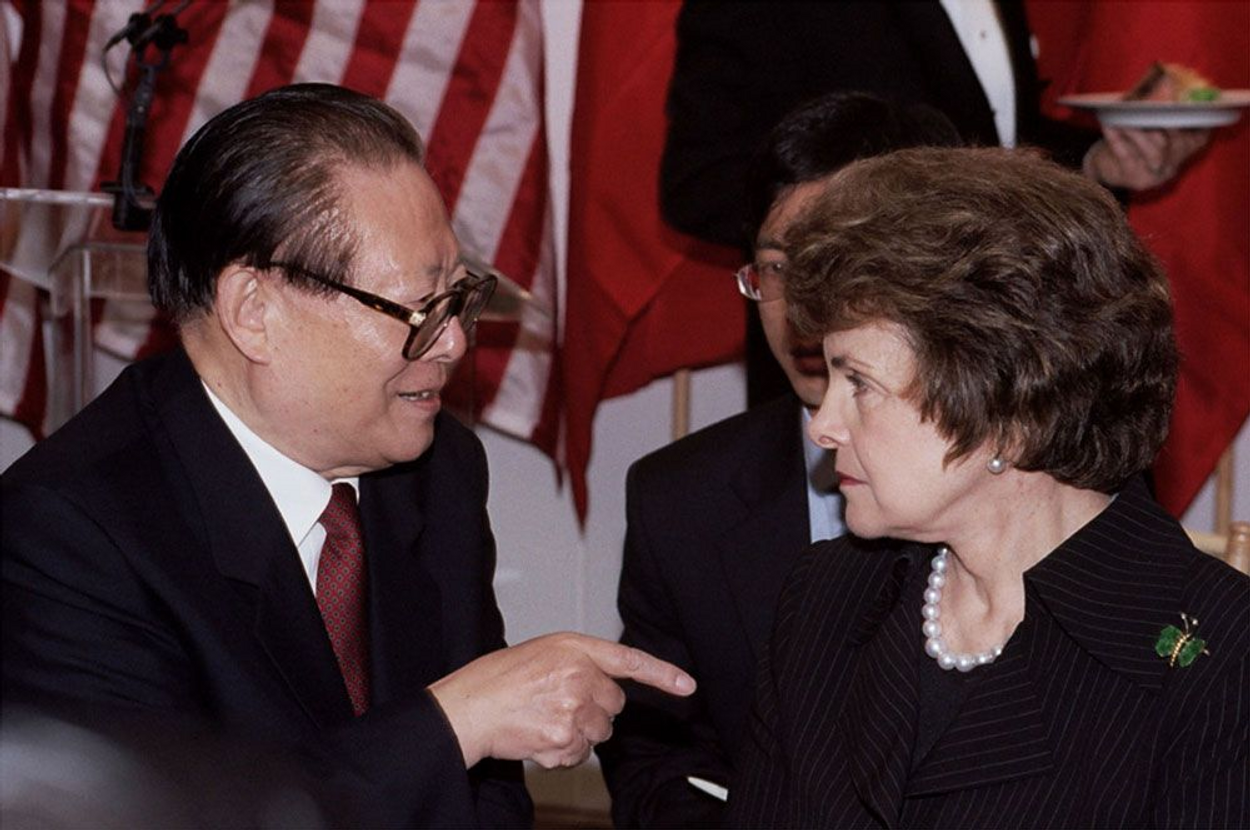
In 1978, as the newly elected mayor of San Francisco, Feinstein befriended Jiang Zemin, then the mayor of Shanghai and eventually president of China. As mayor of America’s tech epicenter, her ties to China helped the growing sector attract Chinese investment and made the state the world’s third-largest economy. Her alliance with Jiang also helped make her investor husband, Richard Blum, a wealthy man. As senator, she pushed for permanent MFN trade status for China by rationalizing China’s human rights violations, while her friend Jiang consolidated his power and became the Communist Party’s general secretary by sending tanks into Tiananmen Square. Feinstein defended him. “China had no local police,” Feinstein said that Jiang had told her. “Hence the tanks,” the senator from California reassuringly explained. “But that’s the past. One learns from the past. You don’t repeat it. I think China has learned a lesson.”

Yet the past actually should have told Feinstein’s audience in Washington a different story. The United States didn’t trade with Moscow or allow Russians to make large campaign donations or enter into business partnerships with their spouses. Cold War American leadership understood that such practices would have opened the door to Moscow and allowed it to directly influence American politics and society in dangerous ways. Manufacturing our goods in their factories or allowing them to buy ours and ship them overseas would’ve made technology and intellectual property vulnerable.

But it wasn’t just about jeopardizing national security; it was also about exposing America to a system contradictory to American values. Throughout the period, America defined itself in opposition to how we conceived of the Soviets. Ronald Reagan was thought crass for referring to the Soviet Union as the “Evil Empire,” but trade and foreign policy from the end of WWII to 1990 reflected that this was a consensus position—Cold War American leadership didn’t want the country coupled to a one-party authoritarian state.

The industrialist Armand Hammer was famous because he was the American doing business with Moscow. His perspective was useful not because of his unique insights into Soviet society, politics, and business culture that he often shared with the American media, but because it was understood that he was presenting the views that the politburo wanted disseminated to an American audience. Today, America has thousands of Armand Hammers, all making the case for the source of their wealth, prestige, and power.

It started with Bill Clinton’s 1994 decision to decouple human rights from trade status. He’d entered the White House promising to focus on human rights, in contrast to the George H.W. Bush administration, and after two years in office made an about face. “We need to place our relationship into a larger and more productive framework,” Clinton said. American human rights groups and labor unions were appalled. Clinton’s decision sent a clear message, said then AFL-CIO President Lane Kirkland, “no matter what America says about democracy and human rights, in the final analysis profits, not people, matter most.” Some Democrats, like then Senate Majority Leader George Mitchell, were opposed, while Republicans like John McCain supported Clinton’s move. The head of Clinton’s National Economic Council, Robert E. Rubin, predicted that China “will become an ever larger and more important trading partner.”

More than two decades later, the number of American industries and companies that lobbied against Trump administration measures attempting to decouple Chinese technology from its American counterparts is a staggering measure of how closely two rival systems that claim to stand for opposing sets of values and practices have been integrated. Companies like Ford, FedEx, and Honeywell, as well as Qualcomm and other semiconductor manufacturers that fought to continue selling chips to Huawei, all exist with one leg in America and the other leg planted firmly in America’s chief geopolitical rival. To protect both halves of their business, they soft-sell the issue by calling China a competitor in order to obscure their role in boosting a dangerous rival.

Nearly every major American industry has a stake in China. From Wall Street—CitigroupGoldman Sachs, and Morgan Stanley— to hospitality. A Marriott Hotel employee was fired when Chinese officials objected to his liking a tweet about Tibet. They all learned to play by CCP rules.

“It’s so pervasive, it’s better to ask who’s not tied into China,” says former Trump administration official Gen. (Ret.) Robert Spalding.

Unsurprisingly, the once-reliably Republican U.S. Chamber of Commerce was in the forefront of opposition to Trump’s China policies—against not only proposed tariffs but also his call for American companies to start moving critical supply chains elsewhere, even in the wake of a pandemic. The National Defense Industrial Association recently complained of a law forbidding defense contractors from using certain Chinese technologies. “Just about all contractors doing work with the federal government,” said a spokesman for the trade group, “would have to stop.”

Even the Trump administration was split between hawks and accommodationists, caustically referred to by the former as “Panda Huggers.” The majority of Trump officials were in the latter camp, most notably Treasury Secretary Steven Mnuchin, a former Hollywood producer. While the film industry was the first and loudest to complain that China was stealing its intellectual property, it eventually came to partner with, and appease, Beijing. Studios are not able to tap into China’s enormous market without observing CCP redlines. For example, in the upcoming sequel to Top Gun, Paramount offered to blur the Taiwan and Japan patches on Tom Cruise’s “Maverick” jacket for the Chinese release of the film, but CCP censors insisted the patches not be shown in any version anywhere in the world.

In the Trump administration, says former Trump adviser Spalding, “there was a very large push to continue unquestioned cooperation with China. On the other side was a smaller number of those who wanted to push back.”

Apple, Nike, and Coca Cola even lobbied against the Uyghur Forced Labor Prevention Act. On Trump’s penultimate day in office, his Secretary of State Mike Pompeo announced that the United States has “determined that the People’s Republic of China is committing genocide and crimes against humanity in Xinjiang, China, targeting Uyghur Muslims and members of other ethnic and religious minority groups.” That makes a number of major American brands that use forced Uyghur labor—including, according to a 2020 Australian study, Nike, Adidas, Gap, Tommy Hilfiger, Apple, Google, Microsoft, and General Motors—complicit in genocide.

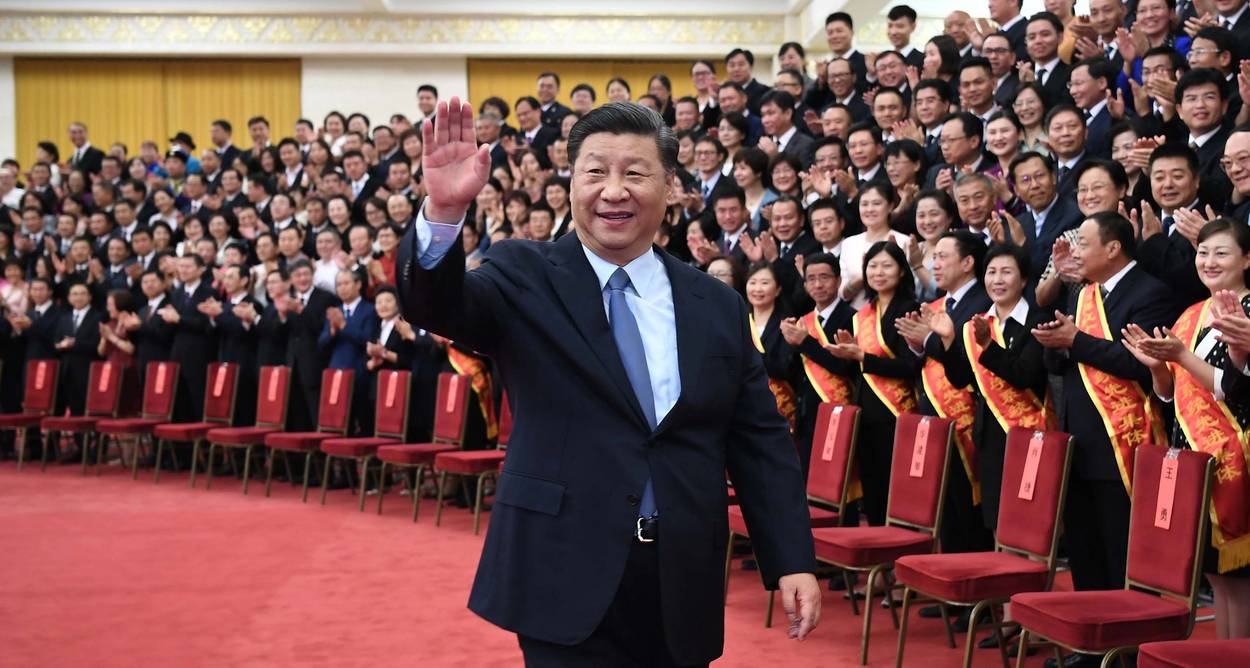
The idea that countries that scorn basic human and democratic rights should not be directly funded by American industry and given privileged access to the fruits of U.S. government-funded research and technology that properly belongs to the American people is hardly a partisan idea—and has, or should have, little to do with Donald Trump. But the historical record will show that the melding of the American and Chinese elites reached its apogee during Trump’s administration, as the president made himself a focal point for the China Class, which had adopted the Democratic Party as its main political vehicle. That’s not to say establishment Republicans are cut out of the pro-China oligarchy—Senate GOP leader Mitch McConnell’s shipbuilder billionaire father-in-law James Chao has benefited greatly from his relationship with the CCP, including college classmate Jiang Zemin. Gifts from the Chao family have catapulted McConnell to only a few slots below Feinstein in the list of wealthiest senators.

Riding the media tsunami of Trump hatred, the China Class cemented its power within state institutions and security bureaucracies that have long been Democratic preserves—and whose salary-class inhabitants were eager not to be labeled as “collaborators” with the president they ostensibly served. Accommodation with even the worst and most threatening aspects of the Chinese communist regime, ongoing since the late 1990s, was put on fast-forward. Talk about how Nike made its sneakers in Chinese slave labor camps was no longer fashionable. News that China was stealing American scientific and military secrets, running large spy rings in Silicon Valley and compromising congressmen like Eric Swalwell, paying large retainers to top Ivy League professors in a well-organized program of intellectual theft, or in any way posed a danger to its own people or to its neighbors, let alone to the American way of life, were muted and dismissed as pro-Trump propaganda.

The Central Intelligence Agency openly protected Chinese efforts to undermine American institutions. CIA management bullied intelligence analysts to alter their assessment of Chinese influence and interference in our political process so it wouldn’t be used to support policies they disagreed with—Trump’s policies. It’s no wonder that protecting America is not CIA management’s most urgent equity—the technology that stores the agency’s information is run by Amazon Web Services, owned by China’s No. 1 American distributor, Jeff Bezos.

For those who actually understood what the Chinese were doing, partisanship was a distinctly secondary concern. Chinese behavior was authentically alarming—as was the seeming inability of core American security institutions to take it seriously. “Through the 1980s, people who advanced the interests of foreign powers whose ideas were inimical to republican form of government were ostracized,” says a former Obama administration intelligence official. “But with the advent of globalism, they made excuses for China, even bending the intelligence to fit their preferences. During the Bush and Obama years, the standard assessment was that the Chinese have no desire to build a blue-water navy. It was inconvenient to their view. China now has a third aircraft carrier in production.”

Loathing Trump provided their political excuse, but the American security and defense establishment had their own interest in turning a blind eye to China. Twenty years of squandering men, money, and prestige on military engagements that began in George W. Bush’s “War on Terror” have proved to be of little strategic value to the United States. However, deploying Americans to provide security in Middle East killing fields has vastly benefited Beijing. Last month Chinese energy giant Zen Hua took advantage of a weak Iraqi economy when it paid $2 billion for a five-year oil supply of 130,000 barrels a day. Should prices go up, the deal permits China to resell the oil.

In Afghanistan, the large copper, metal, and minerals mines whose security American troops still ostensibly ensure are owned by Chinese companies. And because Afghanistan borders Xinjiang, Xi Jinping is worried that “after the United States pulls troops out of Afghanistan, terrorist organizations positioned on the frontiers of Afghanistan and Pakistan may quickly infiltrate into Central Asia.” In other words, American troops are deployed abroad in places like Afghanistan less to protect American interests than to provide security for China’s Belt and Road Initiative.

“There’s a belief that we are not in the same type of conflict with them as we were with the USSR,” says the former Obama official. “But we are.” The problem is that virtually all of the American establishment—which is centered in the Democratic Party—is firmly on the other side.

As late as the summer of 2019, Trump looked like he was headed for a second term in the White House. Not only was the economy soaring and unemployment at record lows, he was rallying on the very field on which he’d chosen to confront his opponents. Trump’s trade war with Beijing showed he was serious about forcing American companies to move their supply chains. In July, top American tech firms like Dell and HP announced they were going to shift a large portion of their production outside of China. Amazon, Microsoft, and Alphabet said they were also planning to move some of their manufacturing elsewhere.

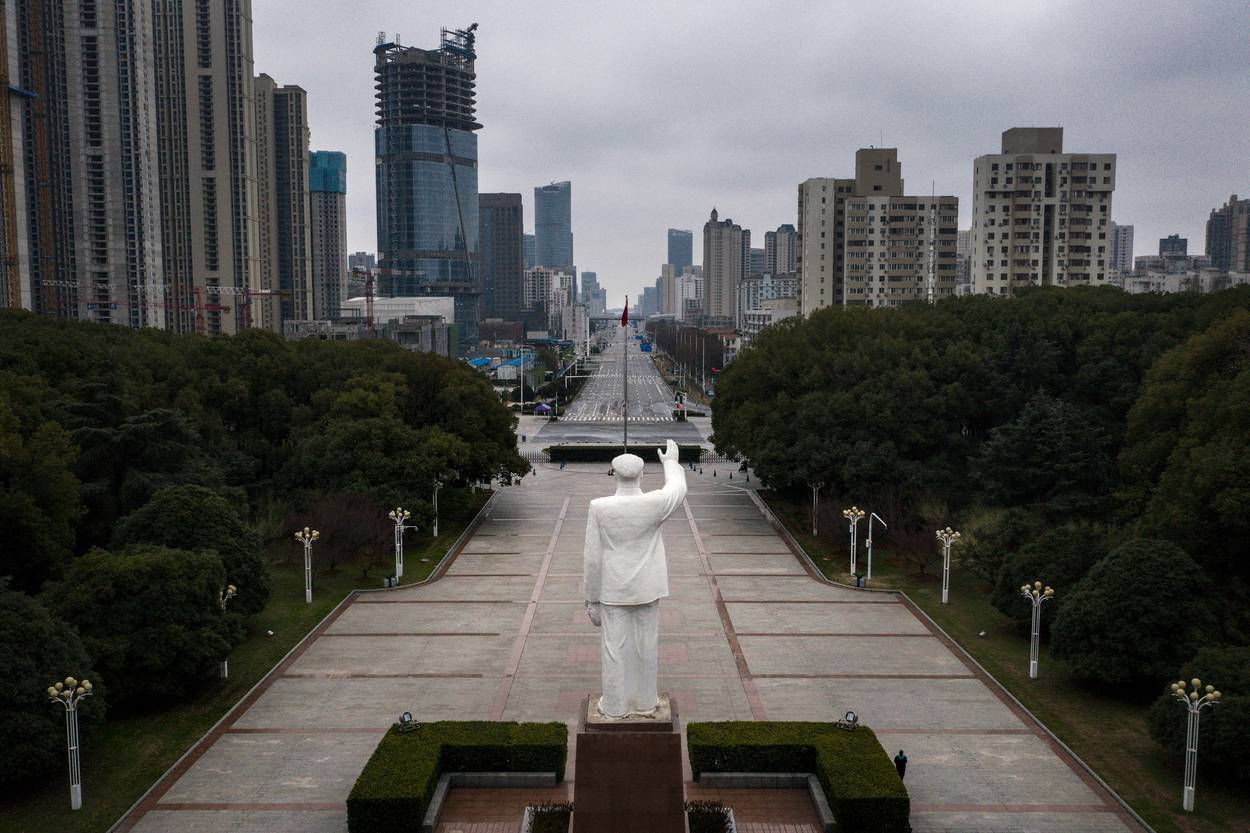
It was at exactly this same moment, in late June and early July of 2019 that the residents of Wuhan began to fill the streets, angry that officials responsible for the health and prosperity of the city’s 11 million people had betrayed them. They were sick, and feared getting sicker. The elderly gasped for breath. Marchers held up banners saying, “we don’t want to be poisoned, we just need a breath of fresh air.” Parents worried for their children’s lives. There was fear that the ill had suffered permanent damage to their immune and nervous systems.

Authorities censored social media accounts, photos and videos of the protests, and undercover policemen watched for troublemakers and detained the most vocal. With businesses forced shut, there was nowhere for protesters to hide. Some were carted off in vans. They’d been warned by the authorities: “Public security organizations will resolutely crack down on illegal criminal acts such as malicious incitement and provocation.”

What sent the residents of Wuhan to the streets at the time wasn’t COVID-19—which wouldn’t begin its spread until the winter. In the early summer of 2019, what threatened public health in Wuhan was the plague of air pollution. This is a hitherto untold part of the story of America’s ghastly last year.

To deal with the mounds of garbage poisoning the atmosphere, authorities planned to build a waste incineration plant—a plan that rightly alarmed the people who lived there. (In 2013, five incineration plants in Wuhan were found to emit dangerous pollutants.) Other cities had similarly taken to the streets to protest against air pollution—Xiamen in 2007, Shanghai in 2015, Chengdu in 2016, Qingyuan in 2017—each time sending waves of panic through CCP leadership, which was fearful of the slightest echo of the 1989 pro-democracy protests in Tiananmen Square and of the prospect of unruly democracy protests in Hong Kong making their way to the mainland and igniting a popular brushfire. What if unrest spread from one city to the next, with the entire country, 1.4 billion people, eventually spinning out of control?

The way to keep unrest from going viral, the CCP had learned, was to quarantine it. The party has shown itself especially adept at neutralizing the country’s minority populations, first the Tibetans, and most recently the Turkic ethnic Muslim minority Uyghurs, through mass quarantines and incarcerations, managed through networks of electronic surveillance that paved the way to prisons and slave labor camps. By 2019, the grim fate of China’s Uyghurs had become a matter of concern—whether heartfelt or simply public relations-oriented—even among many who profited hugely from their forced labor.

The country’s 13.5 million Uyghurs are concentrated in Xinjiang, or East Turkestan, a region in northwestern China roughly the size of Iran, rich in coal, oil, and natural gas. Bordering Pakistan, Xinjiang is a terminus point for critical supply routes of the Belt and Road Initiative, Xi’s $1 trillion project to create a global Chinese sphere of interest. Any potential disruptions of the BRI constitute a threat to vital Chinese interests. Xi saw an April 2014 attack in which Uyghur fighters stabbed more than 150 people at a train station as an opportunity to crack down.

Prepare for a “smashing, obliterating offensive,” Xi told police officers and troops. His deputies issued sweeping orders: “Round up everyone who should be rounded up.” Officials who showed mercy were themselves detained, humiliated and held up as an example for disobeying “the party central leadership’s strategy for Xinjiang.”

According to a November 2019, New York Times report, Chinese authorities were most worried about Uyghur students returning home from school outside the province. The students had “widespread social ties across the entire country” and used social media whose “impact,” officials feared, was “widespread and difficult to eradicate.” The task was to quarantine news of what was really happening inside the detention camps. When the students asked where their loved ones were and what happened to them, officials were advised to tell “students that their relatives had been ‘infected’ by the ‘virus’ of Islamic radicalism and must be quarantined and cured.”

But it wasn’t just those most likely to carry out terrorist attacks—young men—who were subject to China’s lockdown policy. According to the documents, officials were told that “even grandparents and family members who seemed too old to carry out violence could not be spared.”

When a real virus hit in the fall of 2019, Chinese authorities followed the same protocol, quarantining not just prospective troublemakers but everyone in Wuhan in the hope of avoiding an even larger public outcry than the one they’d quelled in the same city just months before.

There is a good reason why lockdowns—quarantining those who are not sick—had never been previously employed as a public health measure. The leading members of a city, state, or nation do not imprison its own unless they mean to signal that they are imposing collective punishment on the population at large. It had never been used before as a public health measure because it is a widely recognized instrument of political repression.

At the end of December 2019, Chinese authorities began locking down social media accounts mentioning the new virus, doctors who warned of it or spoke about it with their colleagues were reprimanded and another, allegedly infected by COVID-19, died. All domestic travel in and out of Wuhan was stopped. If the purpose of the lockdowns was really to prevent spread of the contagion, it’s worth noting that international flights continued. Rather, it appears that the domestic travel ban, like the social media censorship, was to keep news of the government’s blunder from spreading throughout China and leading to massive, perhaps uncontrollable, unrest.

If Wuhan’s streets had filled in June and July to protest the authorities’ deadly incompetence when they concealed plans for an incinerator that would sicken the population of one city, how would the Chinese public respond upon discovering that the source for a respiratory illness destined to plague all of the country wasn’t a freak accident of nature that occurred in a wet market, as officials claimed, but the CCP’s own Wuhan Institute of Virology?

In January, the Trump administration’s former Deputy National Security Adviser Matt Pottinger told British officials that the latest American intelligence shows that the likeliest source of COVID-19 is the Wuhan Institute of Virology. Pottinger, according to The Daily Mail—a British publication was one of the few Western press outlets that reported Pottinger’s statements—claimed the pathogen may have escaped through a leak or an accident.

According to a State Department fact sheet published in January, the United States “has reason to believe that several researchers inside the Wuhan lab became sick in autumn 2019, before the first identified case of the outbreak.” The fact sheet further explains that the Chinese government lab has conducted research on a bat coronavirus most similar to COVID-19 since 2016. Since at least 2017, the WIV has conducted classified research on behalf of the Chinese military. “For many years the United States has publicly raised concerns about China’s past biological weapons work, which Beijing has neither documented nor demonstrably eliminated, despite its clear obligations under the Biological Weapons Convention.”

Evidence the pandemic didn’t start in a Wuhan wet market was published as early as January 2020, days after Beijing implemented the lockdown on Jan. 23. According to the British medical journal The Lancet, 13 of the first 41 cases, including the first one, had no links to the market. In May the head of China’s center for disease control and prevention confirmed that there was nothing to link COVID-19 and the wet market. “The novel coronavirus had existed long before” it was found at the market, said the Chinese official.

After the Lancet report, Republican officials close to the Trump administration disputed Beijing’s official account. “We don’t know where it originated, and we have to get to the bottom of that,” Sen. Tom Cotton said in February. “We also know that just a few miles away from that food market is China’s only biosafety level 4 super laboratory that researches human infectious diseases.” Cotton said the Chinese had been duplicitous and dishonest. “We need to at least ask the question to see what the evidence says,” Cotton said. “And China right now is not giving any evidence on that question at all.”

The corporate American press disparaged Cotton’s search for answers. Jeff Bezos’ Washington Post claimed that Cotton was “fanning the embers of a conspiracy theory that has been repeatedly debunked by experts.” Trump was derided for contradicting American spy services when the president said he had a high degree of confidence that the coronavirus originated in a Wuhan lab. Sen. Ted Cruz said that in dismissing obvious questions about the origins of the pandemic the press was “abandoning all pretenses of journalism to produce CCP propaganda.”

The January publication of a New York Magazine article by Nicholson Baker arguing the same case that Trump and GOP officials had been making since last winter raises useful questions. Why did journalists automatically seek to discredit the Trump administration’s skepticism regarding Beijing’s origin story of the coronavirus? Why wait until after the election to allow the publication of evidence that the CCP’s story was spurious? Sure, the media preferred Biden and wanted Trump gone at any cost—but how would it affect the Democrat’s electoral chances to tell Americans the truth about China and COVID-19?

China had cultivated many friends in the American press, which is why the media relays Chinese government statistics with a straight face—for instance that China, four times the size of the United States, has suffered 1/100th the number of COVID-19 fatalities. But the key fact is this: In legitimizing CCP narratives, the media covers not primarily for China but for the American class that draws its power, wealth, and prestige from China. No, Beijing isn’t the bad guy here—it’s a responsible international stakeholder. In fact, we should follow China’s lead. And by March, with Trump’s initial acquiescence, American officials imposed the same repressive measures on Americans used by dictatorial powers throughout history to silence their own people.

Eventually, the pro-China oligarchy would come to see the full range of benefits the lockdowns afforded. Lockdowns made leading oligarchs richer—$85 billion richer in the case of Bezos alone—while impoverishing Trump’s small-business base. In imposing unconstitutional regulations by fiat, city and state authorities normalized autocracy. And not least, lockdowns gave the American establishment a plausible reason to give its chosen candidate the nomination after barely one-third of the delegates had chosen, and then keep him stashed away in his basement for the duration of the Presidential campaign. And yet in a sense, Joe Biden really did represent a return to normalcy in the decadeslong course of U.S.-China relations.

The new American oligarchy believes that democracy’s failures are proof of their own exclusive right to power.

After Biden’s election, China’s foreign minister called for a reset of U.S.-China relations but Chinese activists says Biden policy toward China is already set. “I’m very skeptical of a Biden administration because I am worried he will allow China to go back to normal, which is a 21st-century genocide of the Uyghurs,” one human rights activist told The New York Times after the election. With Biden as president, said another “it’s like having Xi Jinping sitting in the White House.”

In November a video circulated on social media purporting to document a public speech given by the head of a Chinese think tank close to the Beijing government. “Trump waged a trade war against us,” he told a Chinese audience. “Why couldn’t we handle him? Why is that between 1992 and 2016, we always resolved issues with the U.S.? Because we had people up there. In America’s core circle of power, we have some old friends.” The appreciative crowd laughed along with him. “During the last three to four decades,” he continued, “we took advantage of America’s core circle. As I said, Wall Street has a very profound influence … We used to rely heavily on them. Problem is they have been declining since 2008. Most importantly after 2016 Wall Street couldn’t control Trump … In the U.S.-China trade war they tried to help. My friends in the U.S. told me that they tried to help, but they couldn’t. Now with Biden winning the election, the traditional elites, political elites, the establishment, they have a very close relationship with Wall Street.”

Is it true? The small fortune that Treasury Secretary Janet Yellen has earned for simply speaking in front of Wall Street audiences is matter of public record. But she had hard words for Beijing at her confirmation hearing last month, even criticizing the CCP for “horrendous human rights abuses” against the Uyghurs. But the resumes of Biden’s picks for top national security posts tell a different story. Incoming Director of National Intelligence Avril Haines and Secretary of State Antony Blinken worked at a Beltway firm called WestExec, which scrubbed its work on behalf of the CCP from its website shortly before the election.

Longtime Biden security aide Colin Kahl, tapped for the No. 3 spot at the Pentagon, worked at an institute at Stanford University that is twinned with Peking University, a school run by a former CCP spy chief and long seen as a security risk by Western intelligence services.

As head of the Center for American Progress think tank, Biden’s pick for director of the Office of Management and Budget, Neera Tanden, teamed up with a U.S.-China exchange organization created as a front “to co-opt and neutralize sources of potential opposition to the policies and authority” of the CCP and “influence overseas Chinese communities, foreign governments, and other actors to take actions or adopt positions supportive of Beijing.”

Biden’s special assistant for presidential personnel, Thomas Zimmerman, was a fellow at the Shanghai Academy of Social Sciences, flagged by Western intelligence agencies for its ties to China’s Ministry of State Security.

U.N. Ambassador Linda Thomas-Greenfield gave a 2019 speech at a Chinese-government-funded Confucius Institute in Savannah, Georgia, where she praised China’s role in promoting good governance, gender equity, and the rule of law in Africa. “I see no reason why China cannot share in those values,” she said. “In fact, China is in a unique position to spread these ideals given its strong footprint on the continent.”

The family of the incoming commander-in-chief was reportedly given an interest-free loan of $5 million by businessmen with ties to the Chinese military, while Biden’s son Hunter called his Chinese business partner the “spy chief of China.” The reason that the press and social media censored preelection reports of Hunter Biden’s alleged ties to the CCP was not to protect him—$5 million is less than what Bezos has made every hour during the course of the pandemic. No, for the pro-China oligarchy, the point of getting Joe Biden elected was to protect themselves.

Reports claiming that the Biden administration will continue the Trump administration’s aggressive efforts to roll back China’s technology industry are misdirection. The new administration is loaded with lobbyists for the American tech industry, who are determined to get the U.S.-China relationship back on track. Biden’s Chief of Staff Ron Klain was formerly on the executive council of TechNet, the trade group that lobbies on behalf of Silicon Valley in Washington. Biden’s White House counsel is Steve Ricchetti whose brother Jeff was hired to lobby for Amazon shortly after the election.

Yellen says that “China is clearly our most important strategic competitor.” But the pro-China oligarchy is not competing with the country from which it draws its wealth, power, and prestige. Chinese autocracy is their model. Consider the deployment of more than 20,000 U.S. armed forces members throughout Washington, D.C., to provide security for an inauguration of a president who is rarely seen in public in the wake of a sporadically violent protest march that was cast as an insurrection and a coup; the removal of opposition voices from social media, along with the removal of competing social media platforms themselves; the nascent effort to keep the Trump-supporting half of America from access to health care, credit, legal representation, education, and employment, with the ultimate goal of redefining protest against the policies of the current administration as “domestic terrorism.”

What seems clear is that Biden’s inauguration marks the hegemony of an American oligarchy that sees its relationship with China as a shield and sword against their own countrymen. Like Athens’ Thirty Tyrants, they are not simply contemptuous of a political system that recognizes the natural rights of all its citizens that are endowed by our creator; they despise in particular the notion that those they rule have the same rights they do. Witness their newfound respect for the idea that speech should only be free for the enlightened few who know how to use it properly. Like Critias and the pro-Sparta faction, the new American oligarchy believes that democracy’s failures are proof of their own exclusive right to power—and they are happy to rule in partnership with a foreign power that will help them destroy their own countrymen.

What does history teach us about this moment? The bad news is that the Thirty Tyrants exiled notable Athenian democrats and confiscated their property while murdering an estimated 5% of the Athenian population. The good news is that their rule lasted less than a year.

Categories
All About Guns Anti Civil Rights ideas & "Friends"

A Picture that should NOT be seen by those with a weak stomach!!

image.png

I warned you didn’t I? Grumpy

Categories
Anti Civil Rights ideas & "Friends"

Never Enough: Canadians Press for More Gun Control, Including Total Handgun Ban by JORDAN MICHAELS

Canadian Prime Minister Justin Trudeau has promised to give anti-gun activists what they want. (Photo: Justin Trudeau Facebook)

Despite Canada’s already strict gun control regime, anti-gun activists in the Great White North are pushing for even more gun control after they successfully lobbied for an “assault weapons” ban earlier this year.
On a call with reporters Monday, the coordinator of the anti-gun group PolySeSouvient said she’s tired of waiting for promised gun control legislation from the liberal government, and she called on Public Safety Minister Bill Blair to make good.

“We urge minister Blair to return to the gun file with force and to aim to meet his commitments without delay,” Heidi Rathjen said.
Blair, who works as part of Prime Minister Justin Trudeau’s government, assured anti-gun activists he’s working to make their every wish come true.

“There is more to do, and we’re committed to doing it,” Blair’s spokeswoman, Mary-Liz Power, said Monday. “We will introduce legislation designed to deliver on the promises that we made to Canadians in the last election.”

SEE ALSO: Canadians Petition to Get Their Guns Back Following Confiscatory Ban

But Nicolas Johnson, who runs the pro-gun website TheGunBlog.ca, questioned Blair’s assertion that he speaks for all Canadians.
“We have to remember that the radicals pushing for even more prohibitions-confiscations in Canada’s severely regulated firearm industry are a tiny fringe with a few influential allies in media and politics,” he told GunsAmerica. “Canada has millions of families and individuals who hunt and shoot safely and responsibly. We manage millions of guns and hundreds of millions of rounds of ammo safely and responsibly 24/7/365. We are the mainstream.”
Back in May, the national government outlawed 1,500 models of what officials consider “assault-style” weapons. These rifles and pistols can no longer be legally used, sold, or imported. But the ban came via regulation rather than legislation, and PolySeSouvient wants Trudeau’s government to make the ban permanent.
The group also has a laundry list of additional demands, including ending the importation and manufacture of handguns.
Claire Smith and Ken Price, parents of a girl who was shot in Toronto in July of 2018, said at the PolySeSouvient news conference that the government should act swiftly to ban handguns nationwide.

SEE ALSO: Canadian Government Admitted in 2018 That Gun Bans Don’t Reduce Crime

“It’s been over two years since our daughter was shot,” Price said during the news conference. “And from our perspective, there has been zero legislative progress on handguns and the situation keeps getting worse.”
Along with the handgun ban, the group wants the following restrictions:

  • A system of pre-authorization for guns to ensure only new models inspected and authorized by the federal authorities can enter the Canadian market;
  • Limit firearm magazines to five rounds;
  • Give police officers easier access to commercial sales record data to help detect bulk gun purchases;
  • Invest significant efforts and resources in strengthening the screening and monitoring of gun-license applicants and licensed owners.

Blair has also promised imminent legislation to create a new “evergreen” framework for classification of firearms to ensure federal intentions can’t be easily overridden.

Categories
All About Guns Anti Civil Rights ideas & "Friends" Being a Stranger in a very Strange Land Born again Cynic! Dear Grumpy Advice on Teaching in Today's Classroom Grumpy's hall of Shame

Just another reason Why I am a Happy RETIRED TEACHER

14-Year-Old Posts Picture of Airsoft Gun on Snapchat, School Suspends Him for 3 Weeks

The principal calls it “very, very serious” wrongdoing.

|

A Maryland eighth grader was suspended for three weeks and did not get to graduate with his class in June. This was his punishment for appearing in the background of a friend’s video in which said friend held a disabled airsoft gun. The eighth grader also posed for a photo with the friend, who held him in a headlock with the fake gun pointing at his head. The picture was shared with 13 other friends on Snapchat.

Are you silently giving thanks that social media didn’t exist when you were a middle schooler? Me too. The 14-year-old boy later admitted he was trying to look like a “badass.”

On Monday his dad—David Bernstein, a nonprofit director—wrote a piece about the incident for The Washington Post. He said he had asked the private Silver Spring school to reconsider the punishment. After all, his son did not threaten anyone with a gun. He did not own a gun. He did not say anything about wanting to kill students, or take his own life, or do anything violent. He was, his dad wrote, just being a “knucklehead.”

But the school insisted the incident was “very, very serious” and therefore warranted suspension through the end of the year.

I’m just not sure how serious it is to be in a photo or video that is stupid but ultimately unthreatening and harmless. But anyway, in an email to me, Bernstein added that this was not the first time he was dismayed by the administration’s take on things.

“I first realized something was amiss at the school when I received a call earlier in the year about another ‘very serious’ incident,” said Bernstein. “My son had told a friend that he observed a teacher texting while driving. He was then hauled into the principal’s office and asked to apologize to the teacher, which he only did reluctantly. ‘The teacher was very hurt,’ the principal stated. ‘And [your son] didn’t seem to care.’ Confused about the ‘crime,’ I asked the principal what if my son was telling the truth. ‘That’s beside the point,’ she said. ‘He violated our community values by hurting the teacher’s feelings.'”

You don’t have to be John Grisham to sense something is a little off here. On the one hand, a child is punished for reporting an actual danger: a texting driver. On the other hand, the same child is punished for participating in a video and photo that did not represent an actual danger.

Clearly the school is very worried about feelings and not so worried about reality. It worried that the teacher accused of texting would feel hurt. And it worried that students might feel “anxiety” if they heard about or saw the video or snap.

In this way, the school is tutoring its students in safetyism—the word Jonathan Haidt and Greg Lukianoff use in The Coddling of the American Mind to describe the demand for pointless safety measures. The students are being taught to believe that they are literally unsafe when actually they are just uncomfortable—and that the administration is required to respond.

Note that responding doesn’t actually make kids any safer, because they were not in any real danger to begin with.

As for the three-week suspension, it seems to mirror the criminal justice system’s obsession with longer and longer sentences. Seems like any kid who is told to “reflect” on his actions for three days has done enough reflecting. “Indeed,” Bernstein noted in his piece, “multiple studies show that long-term suspensions make for worse, not better behavior.”

But of course, Bernstein is dealing with reality. The school is not.

Categories
Anti Civil Rights ideas & "Friends"

Poor New Zealand – This sounds so familiar to me!

New Zealand Prime Minister Announces New Raft of Gun Control Measures, Including Registry