Category: Anti Civil Rights ideas & “Friends”
Smith & Wesson CEO Mark Smith was fed up. He was running the largest firearms manufacturer in America, based in Springfield, Mass., where it had been making weapons since 1860, and yet state lawmakers were considering a bill to ban the manufacture of AR-15-style rifles for the civilian market. The proposed law would cripple Smith’s company. Sixty percent of Smith & Wesson’s revenue came from AR-15-style guns.

Feeling unwelcome in blue states, gun companies move to red ones© Charles Krupa/AP
So after years of flirting with the idea, Smith announced last September that Smith & Wesson was pulling up stakes and moving its headquarters from Massachusetts to Tennessee.
Deciding to leave was “extremely difficult,” Smith told investors, but “we feel that we have been left with no other alternative.”
At least 20 firearms, ammunition and gun accessory companies — including some of the industry’s biggest names, such as Beretta and Remington Arms — have moved headquarters or shifted production from traditionally Democratic blue states to Republican red ones over the past decade, relocating thousands of jobs and hundreds of millions of dollars in investment amid the nation’s sharpening divide over guns. The companies were enticed by tax breaks and the promise of cheaper labor. But the biggest factor often was the push for stricter gun laws in many of the Democratic-leaning states.
“They’re going where they’re wanted,” said John Harris, a Nashville attorney and executive director of the Tennessee Firearms Association.
The result is a firearms industry that is increasingly rooted in the South and, to a lesser extent, the West, weakening ties to the Northeast that stretch back to the Revolutionary War. The dramatic shift illustrates the economic fallout from political polarization among the states, where laws and attitudes are increasingly diverging on hot-button cultural issues, including abortion rights. It also reveals a growing frustration among some left-leaning lawmakers with a homegrown industry that they see as unwilling to even discuss gun violence.
“This is where we part ways,” said Massachusetts state Rep. Bud Williams (D), whose district includes Smith & Wesson’s historic headquarters. “And I’ve been a big supporter of Smith & Wesson. But there’s too many mass shootings. I’m not going to be silent.”

Activists gather before the final mile of the 50 Miles More walk against gun violence, which ended with a rally at the Smith & Wesson Firearms factory on Aug. 26, 2018, in Springfield, Mass.© Scott Eisen/Getty Images
The departures have come in waves, often prompted by legislative reactions to high-profile mass shootings — first the 2012 school shooting in Newtown Conn., and then the 2018 school shooting in Parkland, Fla. Some states run by Democrats tightened gun laws. Republican states often moved in the opposite direction, sometimes loosening gun restrictions in the wake of mass shootings, studies show.
New gun laws led Beretta USA to move its manufacturing operations from Maryland for Tennessee in 2014. Mossberg shipped its shotgun production from Connecticut to Texas that same year. That’s also when Magpul Industries, among the country’s largest producers of ammunition magazines, left Colorado for Texas and Wyoming.
In 2019, Stag Arms trumpeted its departure of Connecticut for Wyoming.
The next year, gunmaker Kimber Manufacturing fled New York for Alabama.
Last November, two months after Smith & Wesson’s farewell, the owner of Remington Arms, the nation’s oldest gunmaker, revealed it was moving its headquarters from Ilion, N.Y. to LaGrange, Ga., pledging to invest $100 million and hire 856 people in its new home.
“We are very excited to come to Georgia, a state that not only welcomes business but enthusiastically supports and welcomes companies in the firearms industry,” Ken D’Arcy, CEO of Roundhill Group, which owns RemArms, said in a statement. His company bought the Remington rifle brand and several others from Remington Outdoor in a bankruptcy sale.
Companies made more than $1B selling powerful guns to civilians, report says
Republican lawmakers have encouraged gun companies to move and looked to lure them to their own states, viewing it as an opportunity to add jobs and burnish culture war credentials.
Last year, Oklahoma lawmakers launched a study of ways to attract gunmakers to the Sooner state. At the 2022 Shot Show, the firearms industry’s major annual trade show, governors from six states traveled to Las Vegas to sell their communities to the manufacturers of guns, ammunition and accessories. All of them were Republicans.
“These states are openly attracting the industry. Some of them have been very aggressive,” said Mark Oliva, spokesman for the National Shooting Sports Foundation, a trade group based — as it has been for decades — in Newtown, Conn.
The pitch isn’t only about being a safe haven for gun rights. State officials also dangle economic incentives.
Georgia offered $28 million in grants and tax breaks to Remington for its new headquarters. Wyoming gave at least $8 million in grants to Magpul for its relocation. And Smith & Wesson got a big break on property taxes, along with a $9 million grant. Smith & Wesson’s move is expected to boost the company’s earnings per share by about 10 cents a share annually, according to financial disclosures.
“Whatever motivation they have about guns, they’re also motivated by dollars,” Harris, of the Tennessee firearms group, said of the gun companies.
Remington, Smith & Wesson, Magpul, Stag Arms and Kimber did not respond to a request for comment. Beretta declined to comment. Tennessee economic development officials also declined to comment.
The firearms industry is not a huge part of the overall U.S. economy, but it carries symbolic weight. Guns sit at the center of some of the country’s fiercest cultural fights, such as the reach of constitutional rights and worries about crime and violence.
CEO of gunmaker Smith & Wesson blames politicians for gun violence
These days, the firearms industry is growing rapidly, shaking off years of tepid sales during President Donald Trump’s term. (Gun sales tend to spike under Democratic presidents, when the potential for new gun laws seems greater.)

The frames of handguns sit on a rack at the Smith & Wesson factory in Springfield, Mass., in 2015. (Keith Bedford/The Boston Globe/Getty Images)© Keith Bedford/The Boston Globe/Getty Images
Americans bought an estimated 19.9 million firearms last year — the second most ever, right behind 2020′s pandemic-fueled record tally of nearly 23 million, according to Small Arms Analytics and Forecasting. Employment at firearms and ammunition companies jumped 28 percent from 2015 to 2021, totaling nearly 170,000 people nationwide, according to NSSF data.
The NSSF and the National Rifle Association have cheered on the gunmakers’ caravan of moving vans, attributing the trend to “anti-Second Amendment sentiment” and a search for friendlier states. An NRA journal called America’s First Freedom described the shift as, “Moving to Freer America.”
But most gunmakers are not abandoning blue states entirely.
Beretta USA, subsidiary of Italian gunmaker Beretta, moved 160 jobs from Prince George’s County’s Accokeek, Md., to Gallatin, Tenn., after Maryland lawmakers in 2014 banned dozens of assault-style weapons, including some made by Beretta.
“Why expand in a place where the people who built the gun couldn’t buy it?” Jeffrey Reh, general counsel for Beretta, said to The Washington Post while the state was debating the gun ban.
The bill passed, and Beretta moved. Its $45 million gun plant in Tennessee now employs about 300 people. And while Beretta’s production and research and development teams work there, the gunmaker’s executives and administrative staff — about 100 people — stayed in Maryland.
A recent search of online job ads showed Beretta had nine openings in Tennessee and five in Maryland.
A city that makes guns confronts its role in the Parkland mass shooting
Smith & Wesson plans to keep 1,000 jobs in Massachusetts even after it moves 550 positions, plus another 200 jobs from around the country, and its headquarters to Tennessee, which is expected to be completed next year.
But the loss has been a blow to Springfield.
The city of 155,000 people is located in the Connecticut River Valley, a region once so stocked with firearms manufacturers that it was known as Gun Valley. Springfield was its unofficial capital, the place where George Washington decided to locate the nation’s first armory. Gun making has long been woven into the city’s story.

The Smith & Wesson headquarters in Springfield, Mass.© Karly Domb-Sadof/The Washington Post
Smith & Wesson was among the city’s top employers. It donated to local charities and helped sponsor the annual holiday lights display.
“It’s a pretty significant impact,” Timothy Sheehan, the city’s chief development officer, said of the gunmaker’s departure.
Despite the shared history, the relationship between the company and the city had grown strained recently.
The headquarters and its factory gates were the frequent staging ground for protests. Students and religious groups have picketed outside several times since the 2018 Parkland shooting, when a gunman used a Smith & Wesson AR-15-style rifle to kill 17 students and staff.
Last year, the father of a teen killed in that shooting designed a highway billboard that overlooked the firearms plant. It carried the message: “I can’t turn 21 and enjoy my first legal beer because a Florida teen was allowed to get his first legal AR-15.”
Smith & Wesson has responding by digging in and balking at the suggestion it shares responsibility for how its guns are used. This summer, Smith, the chief executive, refused to join executives from other weapons makers when they testified before a House Oversight Committee looking into the firearms industry. He then issued a statement blaming politicians for gun-related crimes and accused them of trying to shift culpability.
The company used to be more willing to talk about ways it could help reduce gun violence.
In 2000, a year after the school mass shooting in Columbine, Colo., President Bill Clinton’s White House and Smith & Wesson announced a legal settlement that included the gunmaker agreeing to install child-safe triggers and to ban sales to gun dealers with checkered pasts. Other gunmakers considered joining the deal. But facing intense pressure from the NRA and the gun industry, Smith & Wesson eventually backed away from the deal. Its chief executive resigned.
The deal was scrapped.
Massachusetts went on to pass some of the strictest gun laws in the country. Long before the gunmaker’s move to Tennessee, it was illegal for Smith & Wesson to sell its AR-15-style rifles to civilians in its home state.
Last year’s proposed state bill would’ve gone even further and outlawed the manufacture of those rifles.
Sheehan, the city’s chief development officer, said he understood the difficult position that the company was in.
“I can also understand the point — the social point — that the legislation was driving at,” Sheehan said.
“But, in my mind,” he said, “you also need to weigh that with the economic impact.”
The bill didn’t pass.
But Smith & Wesson is not coming back.
Williams, the Springfield representative, was among the bill’s co-sponsors.
He knew what it could do to a company in his own backyard.
And he’d once been a big supporter of Smith & Wesson. It was the kind of place where a local kid could land a good job right out of high school and stay a lifetime. As a city councilman, he’d helped push for the company to get property tax cuts. He’d encouraged police departments to buy Smith & Wesson weapons.
But Williams increasingly took note of the toll of gun violence. It wasn’t just the mass shootings. There were the many smaller shootings that seemed to barely make the news.
Smith & Wesson refused to talk about any of it, he said.
He’d seen enough. It was too much. It didn’t matter anymore to him that this was a hometown company.
“I just felt that with all these shootings,” Williams said, “at some point it’s time to put lives over profit.”
Smith & Wesson is expected to open its headquarters down South next year.
Its new home is in a Tennessee county that a couple of years ago declared itself a Second Amendment “sanctuary,” where local leaders vowed to fight against gun control.
NASHVILLE, Tenn. (WKRN) — In Tennessee, you can buy and sell short-barrel shotguns and rifles—SB2628 made it legal earlier this year.
“We work in a gun shop and I am a firearms trainer,” said Blaise Lane, High Caliber Weaponry and Training director of operations. “So, I am hugely supportive of the Second Amendment and everyone’s ability to own firearms for self-defense, for sporting and any other requirement that they would have firearms for.”
High Caliber is a gun store in Nashville. Lane said there’s nothing wrong with the new law—it just doesn’t do anything. “Currently, it doesn’t change anything,” he said.
That’s because there’s already a federal law called the National Firearms Act (NFA) in place that’s allowed short-barrel guns since 1934.
In fact, Lane and his employees say the new law has probably caused more confusion than clarity.
“It’s a show bill,” he said. “The Tennessee legislature will already be prepared, should the NFA get abolished.”
The debate about guns has been prominent throughout the country the last few years. Critics of this new law say the bill’s passage is regressive despite the lack of effect.
“I believe it’s a step in the wrong direction because it’s slowly pushing the envelope and making it potentially easier to end some of the restrictions,” Silent No Longer Tennessee director, Greta McClain, said. “Which, some people call them restrictions, I call them safeguards.”
McClain, a former Metro Nashville police officer, also talked about her own personal experience with short-barrel guns.
“When I was with the police department, I was shot at three times by a man with a sawed-off shotgun. He was, at most, 15 feet away from me and missed,” she said. “So, the concern that I have, and I’m sure a lot of people have, is if somebody thinks that it’s appropriate for them to use deadly force, there’s just as much likelihood that they’re going to hit innocent bystanders as they are whomever they’re aiming at.”
McClain is referring to the notion that sawed-off shotguns are considerably less accurate.
Naturally, the Tennessee Firearms Association disagrees with McClain’s thoughts on the law.
“I think it is a step in the right direction,” director John Harris said. “It sends a message of the public policy that at least some of the legislators are holding at this point.”
But Harris did agree that the new law created uncertainty. “What it, unfortunately, has done is create some confusion in the public about whether or not a person still needs to go out and, if they acquire one, pay the federal tax and comply.”
Currently, to buy a short-barrel gun, you have to pay a $200 fee for taxes, file NFA paperwork, and send in your fingerprints for a background check.
Now, Harris and Lane both say they’ve had people tell them they can bypass those regulations with the new law in place, but that is not the case.
Harris went a step further in his criticism of gun laws in Tennessee. “Oh, they’re an absolute mess, they’re a disaster,” he said. “The laws should be simple enough that the average person, the average police officer, the average district attorney, the average judge, the average juror, the average person all agree, without having to look it up, what the law allows or prohibits.”
GOC has been hammering the point for years that our singular best remedy to the anti-gun garbage is going to be in the courts. Thankfully, the recent SCOTUS decision in NYSRPA v Bruen set the stage in elaborate fashion for what’s to come down the legal road.
Until that time, however, the Left has made no bones about it: they are out to do whatever they can to make sure that lawful citizens are as far away from guns as possible. While this may sound like some far-right conspiracy rant, it’s very true. Forget the ridiculous mantra of “I support the Second Amendment, but…” – forget the BS that all they want is “reasonable gun reform.” These are lies, lies and damn lies. The Left does not trust us – nor do they want us to be able to protect ourselves. Neither do they want us to protect our families, our homes or our businesses. Their real intent has become abundantly clear, especially given their antipathy for law enforcement: No guns. Nowhere.
Senator Anthony Portantino is especially keen on the no guns anywhere philosophy. His SB 918 was obviously introduced in angry response to the recent SCOTUS decision because it legally established California a “shall issue” state, and that’s not on the Left’s progressive menu.
Senator Portantino must be driven by something besides anger – it’s quite possible he’s literally terrified of people who have a CCW because his bill stipulates that there are about 2 places in the entire state where one can carry a concealed weapo n outside of their own home. He has likely trembled with fear when going out for dinner with fellow legislators after work. He may wonder who’s in the next booth, legally carrying a gun? Gasp!
And what about when he heads to Whole Foods to pick up some organic asparagus to go with his grilled chicken dinner? Uh oh! Who may have a concealed firearm while testing the cantaloupe in the produce section?
What if he’s on a picnic or an outdoor concert with his family at one of Napa’s lovely vineyards? Yikes! There might be someone snacking on some crackers and brie who might have a CCW! The trauma!
Portantino is clearly fearful of safe and responsible people being able to carry a concealed firearm, but doesn’t seem too preoccupied with the bad guys that are plaguing his very own Los Angeles County. Is he one of the privileged who can hire private security like so many celebrities? According to World Protection Group CEO Kent Moyer, because crime continues to rise in California, more celebrities are starting to hire private security. In Hollywood alone, homicides have jumped an incredible 75%, yet LAPD arrests are down by 20%. It’s no wonder people want some ability to protect themselves. Evidently though, elected officials like Portantino (and those who share his politics) don’t believe this should apply to the rest of us.
SB 918 is chock-full of highly subjective criteria – from who can be granted a CCW to who is even permitted to apply. Those on even the most benign prescription medications need not apply.
When SB 918 gets a thumbs up from the Legislature and Governor in the next few weeks, it will be interesting to see who on the Left will be shocked to learn their armed security detail won’t be able to follow them into virtually any facility in the state. (Check out the list below of prohibited areas for CCW holders – especially those that are bolded). The limitations are so significant, a CCW will be deemed useless.
Remember, no lawsuit can be filed until the law becomes operative; if the final version of the bill has an urgency clause, it will go into effect as soon as the Governor signs it. If the bill passes without the urgency, it would become effective January 1, 2023.
With far too many Californians making bad decisions by repeatedly electing anti-gun politicians, the courts have become our best recourse. While it seems as if we may not be successful in the short term, GOC is in it for long game and ultimately, we will come out of the mess with some significant wins. But it’s going to take some patience, hard work and yep – money. Rest assured, GOC will be involved the legal challenges to this legislation – and other bills that undermine the Second Amendment. Please support us in these efforts – the costs are great but the rewards will be greater.
Section 26230 is added to the Penal Code, to read:
(a) A person granted a license to carry a pistol, revolver, or other firearm capable of being concealed upon the person pursuant to Section 26150, 26155, or 26170 shall not carry a firearm on or into any of the following:
(1) A place prohibited by Section 626.9.
(2) A building, real property, or parking area under the control of a preschool or childcare facility, including a room or portion of a building under the control of a preschool or childcare facility. Nothing in this paragraph shall prevent the operator of a childcare facility in a family home from owning or possessing a firearm in the home if no child under child care at the home is present in the home or the firearm in the home is unloaded, stored in a locked container, and stored separately from ammunition when a child under child care at the home is present in the home so long as the childcare provider notifies clients that there is a firearm in the home.
(3) A building, parking area, or portion of a building under the control of an officer of the executive or legislative branch of the state government. government, except as allowed pursuant to paragraph (2) of subdivision (b) of Section 171c.
(4) A building designated for a court proceeding, including matters before a superior court, district court of appeal, or the California Supreme Court, parking area under the control of the owner or operator of that building, or a building or portion of a building under the control of the Supreme Court. Court, unless the person is a justice, judge, or commissioner of that court.
(5) A building, parking area, or portion of a building under the control of a unit of local government, unless the firearm is being carried for purposes of training pursuant to Section 26165.
(6) A building, real property, and parking area under the control of an adult or juvenile detention or correctional institution, prison, or jail.
(7) A building, real property, and parking area under the control of a public or private hospital or hospital affiliate, mental health facility, nursing home, medical office, urgent care facility, or other place at which medical services are customarily provided.
(8) A bus, train, or other form of transportation paid for in whole or in part with public funds, and a building, real property, or parking area under the control of a transportation authority supported in whole or in part with public funds.
(9) A building, real property, and parking area under the control of a vendor or an establishment where intoxicating liquor is sold for consumption on the premises.
(10) A public gathering or special event conducted on property open to the public that requires the issuance of a permit from a federal, state, or local government and sidewalk or street immediately adjacent to the public gathering or special event but is not more than 1,000 feet from the event or gathering, provided this prohibition shall not apply to a licensee who must walk through a public gathering in order to access their residence, place of business, or vehicle.
(11) A playground or public or private youth center, as defined in Section 626.95, and a street or sidewalk immediately adjacent to the playground or youth center.
(12) A park, athletic area, or athletic facility that is open to the public and a street or sidewalk immediately adjacent to those areas, provided this prohibition shall not apply to a licensee who must walk through such a place in order to access their residence, place of business, or vehicle.
(13) Real property under the control of the Department of Parks and Recreation or Department of Fish and Wildlife, except those areas designated for hunting pursuant to Section 5003.1 of the Public Resources Code, Section 4501 of Title 14 of the California Code of Regulations, or any other designated public hunting area, public shooting ground, or building where firearm possession is permitted by applicable law.
(14) Any area under the control of a public or private community college, college, or university, including, but not limited to, buildings, classrooms, laboratories, medical clinics, hospitals, artistic venues, athletic fields or venues, entertainment venues, officially recognized university-related organization properties, whether owned or leased, and any real property, including parking areas, sidewalks, and common areas.
(15) A building, real property, or parking area that is or would be used for gambling or gaming of any kind whatsoever, including, but not limited to, casinos, gambling establishments, gaming clubs, bingo operations, facilities licensed by the California Horse Racing Board, or a facility wherein banked or percentage games, any form of gambling device, or lotteries, other than the California State Lottery, are or will be played.
(16) A stadium, arena, or the real property or parking area under the control of a stadium, arena, or a collegiate or professional sporting or eSporting event.
(17) A building, real property, or parking area under the control of a public library.
(18) A building, real property, or parking area under the control of an airport or passenger vessel terminal, as those terms are defined in subdivision (a) of Section 171.5.
(19) A building, real property, or parking area under the control of an amusement park.
(20) A building, real property, or parking area under the control of a zoo or museum.
(21) A street, driveway, parking area, property, building, or facility, owned, leased, controlled, or used by a nuclear energy, storage, weapons, or development site or facility regulated by the federal Nuclear Regulatory Commission.
(22) A church, synagogue, mosque, or other place of worship, including in any parking area immediately adjacent thereto, unless the operator of the place of worship clearly and conspicuously posts a sign at the entrance of the building or on the premises indicating that license holders are permitted to carry firearms on the property. Signs shall be of a uniform design as prescribed by the Department of Justice and shall be at least four inches by six inches in size.
(23) A financial institution or parking area under the control of a financial institution.
(24) A police, sheriff, or highway patrol station or parking area under control of a law enforcement agency.
(25) A polling place, voting center, precinct, or other area or location where votes are being cast or cast ballots are being returned or counted, or the streets or sidewalks immediately adjacent to any of these places.
(26) Any other privately-owned commercial establishment that is open to the public, unless the operator of the establishment clearly and conspicuously posts a sign at the entrance of the building or on the premises indicating that license holders are permitted to carry firearms on the property. Signs shall be of a uniform design as prescribed by the Department of Justice and shall be at least four inches by six inches in size.
(27) Any other place or area prohibited by other provisions of state law.
Opinion

New Jersey – -(AmmoLand.com)- The Garden State is known for being an anti-civil rights wasteland. Firearm possession in the state is by exemption or permits. Up until recently, the permitting regulating the possession of handguns and pistols was an out-of-reach unicorn. Handgun and pistol owners had to largely rely on exemptions of the law, as NJ Rev Stat § 2C:39-5 b (2021) states one must first obtain a permit to carry prior to possessing a handgun. However, now in our post NYSRPA v. Bruen world, obtaining a permit to carry is possible.
Social media sites have been buzzing with people applying, allegedly getting denied, and also some rumors of permits to carry actually getting issued. To say a lot of rumors have been abound would be an understatement.
There’s plenty of counterproductive talks, such as people “in the know” going off when the uninitiated refer to the New Jersey permit to carry as a “CCW” or a concealed carry permit. The fact that NJ makes no distinction between open or concealed carry and said permit is referred to as a “permit to carry” is not cause for berating those that quickly refer to the permit as a CCW or a concealed carry permit. A collective sigh of relief should be exhaled by all persons in this fight, and while some kind of corrective rudder is not a bad thing, let’s not act like we don’t know what people are talking about.
There’s also been a ton of counterproductive talks about what is required to rope and wrangle one of these one-horned horses in the land of one thousand diners. I have spoken to two verified permit-to-carry recipients in New Jersey and want to share that information.
The first thing we should divert our attention to is a document on the New Jersey State Police website called: “Permit To Carry Instructions“. While the document is not necessarily the best, it does outline the needed steps to take to apply for a permit to carry in New Jersey. It’s important to note that New Jersey, at this time, also does not make a distinction between resident and non-resident permits. Non-residents are to apply to the closest State Police barracks that are not on a toll road to where the applicant would be entering the state.
The first recipient of a New Jersey permits to carry that I spoke to was Jamie DeAngelis. DeAngelis lives in Warren County, in Hackettstown, New Jersey. DeAngelis told me that he dropped off his completed application on July 26th at his police department. The local range where DeAngelis shoots, RTSP in Randolph, he said, had the complete process of what to do from beginning to end on their web page.
DeAngelis said before going in for any qualifications, he practiced what he thought the qualification would be, shooting out to 25 yards. He said that at RTSP, he did their CCW Qualification Course, a holster draw course, and the qualification with the firearm(s) he intended on carrying. RTSP, for their qualification, seems to be working off of a modified version of the NJ Retired Police Officer Qualification, the HQC2, on an FBI “Q” target. RTSP lists the qualification as such:
• 50 round total (per firearm)
• 10 rounds at 3 yards
• 10 rounds at 5 yards
• 10 rounds at 7 yards
• 10 rounds at 10 yards
• 10 rounds at 15 yards
Once DeAngelis completed all the training elements, he assembled his application packet.
- Application printed duplexed (on both sides) in triplicate, with live signatures from each reference on each application. All three applications with live notarization of the applicant’s signature on each one. From # S.P. 642
- Consent For Mental Health Records Search filled out and signed in the presence of the issuing authority. Note, that some people have been having issues with this form and opening it in a web browser. If that’s the case, download it onto the computer and open it with whatever pdf viewer is installed. Form # S.P. 066
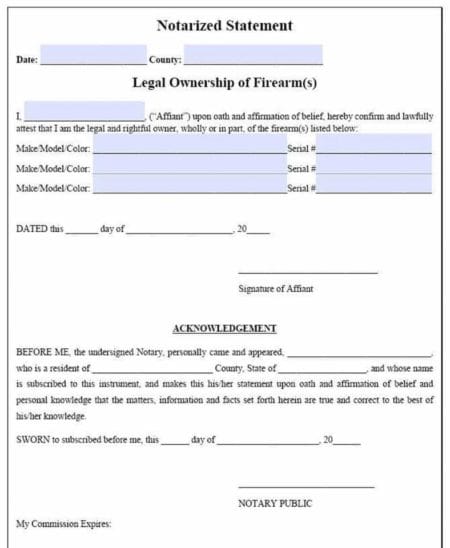
- An affidavit stating lawful ownership of the firearms intended to be carried. Instead of a letter listing the firearms with the make, model, and serial number, an applicant can use their pink copies of pistol permits or receipts to prove ownership of the handguns.
- The $50.00 certified money order was made out to “Treasurer, State of New Jersey.” (Make sure it’s signed before handing it in)
- Color copies of driver’s license and birth certificate. Instead of a birth certificate, applicants can bring passports or naturalization paperwork to prove citizenship, along with their driver’s license.
- Four 1.5″ x 1.5″ photos. These are called “passport photos”; however, passport photos are 2″ x 2″. It was noted that the correct size if trying to have someone look up the information at one of the many locations that provide this service is an Argentina-sized passport photograph.
- The certified qualification, along with any other training certificates an applicant may have that are relevant.
Fingerprinting is a requirement in order to get a permit to carry. After receiving instructions from the issuing authority, one can go and get that done per their direction.
DeAngelis received his New Jersey permit to carry on August 12th. About the process, DeAngelis had a message he wanted to get out to everyone. He said to me that it’s important that people realize that this is obtainable. He talked about going on the record for everyone to learn from his process:
“That’s why I was willing to do it (go on the record) because I mean, I really want people to realize it’s doable. And not because everybody I talked to was afraid to put it through and what got me was like they’re waiting for somebody, for people to start posting that they’re getting it before they do it. So that’s why I kind of posted it because I want people to see people are getting them. It’s real. It’s safe.”
Anecdotally, DeAngelis told me about getting the call to pick up his permit:
“A lady called me, and it was funny the lady from the courthouse called and she’s like, ‘I’m so and so from the courthouse of Warren and Belvedere. Your permit is ready.’ And I knew one of my references just turned in this thing. So I thought she was one of my friends messing with me. And because a lot of them were saying, ‘Oh, you’re gonna get declined, you’re gonna get denied, you’re not gonna get that.’ Everyone kept telling me as I was dumb and stupid for putting it in so early, I was gonna get denied. So in the back of my head, I thought ‘I’m gonna get denied.’ I really started thinking there’s no chances it’s gonna happen, I’m gonna get denied. When she called me and told me it was done. I asked, ‘Who put you up to calling me? One of my friends? One of my friends did this.’ She started laughing. And she’s like, ‘No. I’m serious. You could come pick it up, you just have to sign it.’”


DeAngelis said he was issued a permit to carry with no restrictions.
The other person I spoke to who also received their New Jersey permit to carry is Keith S. from Passaic County. Keith asked to go by first name last initial for understandable privacy reasons. Much like DeAngelis, Keith went to his local and trusted range, which in his case was Gun For Hire at The Woodland Park Range.
Keith talked at length about the years of training he had been putting in getting ready for the day that pistol carry would become a reality in New Jersey. Following closely the detailed instructions put out by Gun For Hire, which can be read HERE, Keith went about getting his qualification done and assembled his application packet. Keith said he was in the first class of the first day that was being offered at Gun For Hire.
Gun For Hire also uses a similar modified qualification, as noted on their page:
This is not a beginner course! You will be required to demonstrate safety, familiarity, and accuracy. It is pass or fail.
– No holster needed
– All shooting from the ready position
– 50 rounds per firearm
– FBI Q target
– 24 rounds at 7 yards
– 14 rounds at 10 yards
– 6 rounds at 15 yards
– 6 rounds at 25 yards
For a total of 50 rounds. Must hit at least 40 rounds out of 50 (80%)
Keith ended up qualifying with two handguns, which he used copies of his pink pistol purchaser’s permit to prove ownership to his town. On Monday July 1st his completed packet was with his town and he sent in verification that his fingerprints were done. On July 18th, he got the call to come down to the courthouse to pick up and sign his permit. Keith told me about showing up to meet the judge:
“You meet with the judge and he reads the statute to you. And then he reads to you the firearms that are listed on your permit, to make sure that the serial number and the firearm match. Which as it happened on my my qualification form…it happens that my serial number starts with like a six, and on the form said I qualify with the model 66, Sig Sauer. So I, I told the judge, ‘I’m sorry, Your Honor, but that’s not true. I qualify with a Sig 365.’ So he’s like, ‘Oh, my God.’ He took me through the paperwork to pull out the pink slip, he told the clerk to go on the back end just and fix it. I wait a couple of minutes, I sat in the front. They went back, they redid my paperwork, came out, handed me my permit. He told me to laminate it, and we had a great chat about firearm safety and everything.”
The big thing that Keith emphasized while discussing the process was the importance of training. Keith said it’s our job to be good ambassadors to the New Jersey public, and show them that safe and responsible firearm carry is okay and a reality. He spoke about the training he got over the years from Gun For Hire in high regard, noting:
“I would describe Gun For Hire like if you have a family member that says ‘Listen, you want to get this done? I got a guy. Let’s do it.’ And they walk you through it and they help you. They boosted confidence in you. People going through the qualification that day that were scared out of their mind and they talked them down. They made everybody feel comfortable and at home because it’s a serious matter and they don’t want people to look bad or feel bad or do anything bad either. But there were people that did fail and they simply pulled them aside told them what they did wrong, taught them difference. And you know said ‘this equipment’s not right for you. That’s not good for you. Maybe you should try this.’ So, I would describe Gun For Hire like a pristine establishment that wants you to succeed. And they want the state, not not only gun owners, but the state in itself to feel comfortable and safe.”
Keith was issued a permit with restrictions noting the make, model, and serial number of the firearms he qualified with at Gun For Hire.
These are just two of the many stories that are circulating about people actually getting permits to carry in the state of New Jersey. These are verified examples, and not just hearsay. While these are the steps that these individuals took to get their permits, we’re not all guaranteed to have the same experiences. Hopefully in due time the process will become streamlined and easier to navigate. In the meantime let’s celebrate that a bit of liberty has been returned to The Garden State.
The reality of carry has come to New Jersey, yes, because of the victory in NYSRPA v. Bruen. But the entire process, as it is and as it develops was and is made possible because of the countless hours of work by many people. New Jersey’s state association, the Association of New Jersey Rifle and Pistol Clubs (ANJRPC), with brilliant leaders and attorneys like Scott Bach and Daniel L. Schmutter, has really paved the way to make this a much smoother transition than could have come to the state. ANJRPC has been doing some serious heavy lifting, and letters from their “Strike Force” have offered some corrective rudder suggestions to jurisdictions that are not in line with the Constitution.
It is important to note that New York, where the opinion was directed, has now passed laws more stringent than they had prior to the opinion, and people in New Jersey are getting carry.
About John Petrolino:
John Petrolino is a US Merchant Marine Officer, writer, author of Decoding Firearms: An Easy to Read Guide on General Gun Safety & Use, and NRA-certified pistol, rifle, and shotgun instructor living under and working to change New Jersey’s draconian and unconstitutional gun laws. You can find him on the web at www.johnpetrolino.com on Twitter at @johnpetrolino, Facebook at @thepenpatriot and on Instagram @jpetrolinoiii .
.png)