Categories
All About Guns Ammo Anti Civil Rights ideas & "Friends"

War on Guns: Biden Commerce Dept. Will Make Small Arms Export Pause Permanent by Jim Shepherd

 Sources tell The Outdoor Wire that Commerce Secretary Gina Raimondo will announce the “pause” on government export licenses for firearms, components, and ammunition for “nongovernmental end users” will be permanent. The announcement could come as soon as tomorrow.

(Photo by Peerapon Boonyakiat / SOPA Images/Sipa USA)(Sipa via AP Images)

This morning, a briefing will be held by the Department of Commerce’s Bureau of Industry and Security (BIS) for “the Hill” regarding their interim rule regarding the “pause” on the issuance of new government licenses for firearms, related components and  ammunition for “nongovernmental end users.” 

The Outdoor Wire has learned the Commerce Department plans to make that “pause” on the issuance of new export licenses for firearms, related components and ammunition permanent.

That announcement, we’ve learned, could come as soon as tomorrow and “most definitely” by the first of next week.

More than a few United States Senators are  already less than thrilled at what they call yet another example of Biden administration bureaucratic overreach, but there’s little they can do at this point.

If Commerce Secretary Gina Raimondo presses forward with the change and Congress can’t reverse it, the costs to the gun industry could be as much as $238 million in annual revenues. 

That’s a far cry from the $10 million dollar cost estimate Commerce reportedly has assigned to the change. That estimate, to be clear, would put it under the threshold requiring Congressional approval.

Like the original announcement of BIS’s 90-day pause, the timing of this status change appears to be based on the old “Friday news dump” theory. Bad news, or controversial decisions, are historically dropped late on Fridays, preferably in the spring and summer. 

The “pause” has already put a financial hurt on many smaller producers in the industry. One machine company in Tennessee has already closed, putting ten people out of work. Company owners attribute the business closure to the Biden “pause” that stopped a major contract for more than $6.5 million worth of components to a single gun company.

Other small companies nationwide are suffering significant losses. Larger companies haven’t commented, but the pause has essentially stopped more than a thousand export licenses.  

The “pause” began on October 27, 2023, when the Commerce Department announced a “temporary pause” on the issuance of new licenses involving firearms, related components and ammunition for “nongovernmental end users” in certain countries.

The pause by the Commerce Department’s  Bureau of Industry and Security (BIS) was to last “approximately 90 days” and  allow  the department to assess current firearm export control review policies to determine whether any changes are warranted to advance U.S.  national security and foreign policy interests.”

In February, well past the 90-day pause window, Senators Mike Lee (R-UT) and Kevin Cramer (R-ND) sent a letter to the Commerce Department. In it, they expressed a concern that while there was little evidence the pause on new export licenses improved U.S. national security, there was extensive evidence it harmed small and medium-sized American businesses.

Here’s what they concluded:

According to industry experts, the 90-day pause implemented by the Commerce Department is likely to cost American businesses hundreds of millions of dollars in lost revenue.

The Departments pause on issuing new export licenses for firearms comes at the very same time that the Department has loosened restrictions on exporting products controlled under the Chemical Weapons Convention and Missile Technology Control Regime. 

It is difficult, therefore, for us to conclude that the Commerce Departments pause on issuing new licenses is truly motivated by a desire to promote U.S. national security. […] Nevertheless, 90 days have now passed and the Commerce Departments pause remains in full effect.”

A fairly significant political “fingerprint” indicates the whole pause scheme was initiated by the White House’s newest gun control group, the White House Office of Gun Violence Prevention.   

Unable to pass gun control legislation, the current administration appears to have included anti-gun moves in their “whole of government approach” to getting their agenda implemented without approval from Congress.

By changing administrative language and rule interpretations (think the ATF’s “in the business” or firearm definition changes) they achieve immediate results.

Reversing those administrative decisions requires slogging through the court system. In the interim, the damage is done, harming those affected by the rules with no risk of penalty to the administrators.

According to the Senators, the pause appeared to be a  “concerted and deliberate attempt to punitively target the American firearms industry.” They urged the Commerce Department to lift the pause and “refrain from imposing any new regulations that would unduly harm countless small and medium sized businesses across the United States.”

The letter appears to have neither motivated nor intimidated the BIS. Seven months after announcing the 90-day pause, and more than a month since the Senators’ letter was sent, the pause remains in effect. Now, it appears Commerce Secretary Gina Raimondo is prepared to make it permanent. 

Sources tell us the Secretary is also “cleansing” the Department of longtime employees and administrators who have gone on record as opposing the scheme. Earlier this week, a whistleblower in Commerce tipped Senators to the impending change. Shortly afterwards, he was told to “start making plans for future employment.” 

The whistleblower also told members of Congress that Commerce Department employees involved in the BIS were “assembled” and told to “either get onboard or prepare to get out”  prior to the plan being announced as permanent.

Small companies that manufacture components for firearms companies have already been suffering under the “pause.” But that doesn’t appear to bother either the bureaucrats or Secretary Raimondo one whit.

A permanent ban on exporting civilian products by the firearms industry will have a serious impact, and it won’t only hit firearms or ammunition manufacturers. Companies that supply the industry with everything from raw goods to machined component parts will share in the discomfort and some won’t survive.

We have the BIS briefing covered and as always, we’ll keep you posted.
Categories
All About Guns Anti Civil Rights ideas & "Friends"

Supreme Court Will Take Up “Ghost Gun” Case This Fall By Mark Chesnut

By a razor-thin margin, the U.S. Supreme Court on Monday agreed to hear the challenge to the Biden Administration’s “ghost gun” law.

The case, VanDerStok v. Garland, challenges the Department of Justice’s 2022 Final Rule that redefined important legal terms dealing with guns, including “firearm,” “receiver” and “frame,” making the longstanding American tradition of building personal firearms pretty much a thing of the past.

The vote to hear the case was 4-to-3, with no information released as to who voted for or against hearing the case. It takes four “yea” votes for the Supreme Court to grant a review in a case.

At issue is whether the DOJ and Bureau of Alcohol, Tobacco, Firearms and Explosives (ATF) overstepped their bounds in promulgating the Final Rule. Plaintiffs in the case argue that the rule is just another example of the bureaucrat-run agencies overstepping their bounds by making laws instead of enforcing them.

That’s exactly what a three-judge panel of the Fifth Circuit Court of Appeals found last November when it unanimously ruled to uphold an earlier district court decision on the matter. In that ruling, Judge Kurt Engelhardt, who wrote the majority opinion, agreed in no uncertain terms that the rule was an overstep.

“ATF, in promulgating its Final Rule, attempted to take on the mantle of Congress to ‘do something’ with respect to gun control,” Judge Engelhardt, a Donald Trump nominee, wrote in the opinion. “But it is not the province of an executive agency to write laws for our nation. That vital duty, for better or for worse, lies solely with the legislature.”

Judge Engelhardt further wrote that the Final Rule “flouts clear statutory text” and “exceeds the legislatively imposed limits” on agency authority.

“Because Congress has neither authorized the expansion of firearm regulation nor permitted the criminalization of previously lawful conduct, the proposed rule constitutes unlawful agency action, in direct contravention of the legislature’s will,” the judge wrote. “Unless and until Congress acts to expand or alter the language of the Gun Control Act, ATF must operate within the statutory text’s existing limits.”

The lawsuit was brought by the Firearms Policy Coalition (FPC) on behalf of itself, two individual FPC members and Tactical Machining LLC. News that the Supreme Court would hear the case brought a positive reaction from FPC Founder and President Brandon Combs.

“FPC and our members look forward to the end of President Biden’s unconstitutional and abusive rule,” Combs said in an FPC press release. “We are delighted that the Supreme Court will hear our case and decide this important issue once and for all. The Fifth Circuit’s decision in our case was correct and now that victory can be applied to the entire country.”

Cody J. Wisniewski, FPC Action Foundation president and counsel for the plaintiffs, said the case should teach the ATF a lesson about who is charged with making laws in the country.

“This is an important day for the entire liberty movement,” Wisniewski said. “By agreeing to hear our case, the Supreme Court will have the opportunity to put ATF firmly in its place and stop the agency from unconstitutionally expanding its gun control agenda. We look forward to addressing this unlawful rule in the Court’s next term.”

The case has been added to the high court’s calendar for the session beginning in October. Oral arguments in the case are expected to begin sometime this fall.

Categories
All About Guns Anti Civil Rights ideas & "Friends" Cops

Justice Department, ATF Issue Final Rule on What It Means to be “Engaged in the Business” of Selling Guns By TTAG Contributor

On the 31st anniversary of the Federal government’s assault on the Branch Davidian complex in Waco, Texas, more questions are being asked about another gross case of government overreach regarding the botched March 19 ATF SWAT team raid that killed Little Rock Airport executive director, Bryan Malinowski.

Just as in Waco where more than 900 FBI and ATF agents attempted to storm the complex by pumping tear gas into the building and ramming it with armored vehicles, leading to a conflict that caused fires that killed 76 people, Malinowski, was awakened by an ATF SWAT team storming into his home in the middle of the night. When he ran from his room, armed and unsure of who was invading his home, agents shot and killed him.

The very rule the ATF has used to justify their storming of the man’s house in the middle of the night is just now being issued and won’t be made final until 30 days after it appears in the Federal Register.

The Justice Department announced last week it had submitted to the Federal Register the “Engaged in the Business” Final Rule, which makes clear the circumstances in which a person is “engaged in the business” of dealing in firearms and thus required to obtain a federal firearms license, in order to increase compliance with the federal background check requirement for firearm sales by federal firearms licensees. Here’s what they had to say:

“Under this regulation, it will not matter if guns are sold on the internet, at a gun show, or at a brick-and-mortar store: if you sell guns predominantly to earn a profit, you must be licensed, and you must conduct background checks,” said Attorney General Merrick B. Garland. “This regulation is a historic step in the Justice Department’s fight against gun violence. It will save lives.”

“The Bipartisan Safer Communities Act enhanced background checks and closed loopholes, including by redefining when a person is ‘engaged in the business’ of dealing in firearms. Today’s rule clarifying application of that definition will save lives by requiring all those in the business of selling guns to get a federal license and run background checks — thus keeping guns out of the hands of violent criminals,” said Deputy Attorney General Lisa Monaco. “I applaud the hard work of ATF in drafting this rule and reviewing the hundreds of thousands of public comments, which overwhelmingly favored the rule announced today. Because of that work, our communities will be safer.”

“This is about protecting the lives of innocent, law-abiding Americans as well as the rule of law. There is a large and growing black market of guns that are being sold by people who are in the business of dealing and are doing it without a license; and therefore, they are not running background checks the way the law requires. And it is fueling violence,” said Director Steven Dettelbach of the Bureau of Alcohol, Tobacco, Firearms and Explosives (ATF).

“Today’s Final Rule is about ensuring compliance with an important area of the existing law where we all know, the data show, and we can clearly see that a whole group of folks are openly flouting that law. That leads to not just unfair but, in this case, dangerous consequences.”

The Bipartisan Safer Communities Act (BSCA), enacted June 25, 2022, expanded the definition of engaging in the business of firearms dealing to cover all persons who devote time, attention, and labor to dealing in firearms as a regular course of trade or business to predominately earn a profit through the repetitive purchase and sale of firearms.

On March 14, 2023, President Biden issued Executive Order 14092, which, among other things, directs the Attorney General to develop and implement a plan to clarify the definition of who is engaged in the business of dealing in firearms and thus required to obtain a federal firearms license.

The Final Rule conforms the ATF regulations to the new BSCA definition and further clarifies the conduct that presumptively requires a license under that revised definition, among other things.

Federally licensed firearms dealers are critical to federal, state, local, Tribal, and territorial law enforcement in our shared goal of promoting public safety.

Licensees submit background checks on potential purchasers to the FBI’s National Instant Criminal Background Check System, which helps to keep firearms out of the hands of prohibited persons.

Further, licensees keep records of sales transactions to help ensure that when a gun is used in a crime and recovered by law enforcement it can be traced back to the first retail purchaser; they help identify and prevent straw purchasers from buying firearms on behalf of prohibited persons and criminals; and they facilitate safe storage of firearms by providing child-safety locks with every transferred handgun and offer customers other secure gun storage options.

Unlicensed dealing, however, undermines these public-safety features — which is why Congress has long prohibited engaging in the business of dealing in firearms without the required license. 

To increase compliance with the statutes Congress has enacted, the Final Rule identifies conduct that is presumed to require a federal firearms license. And, in addition to implementing the revised statutory definition discussed above, the Final Rule clarifies the circumstances in which a license is — or is not — required by, among other things, adding a definition of “personal firearms collection” to ensure that genuine hobbyists and collectors may enhance or liquidate their collections without fear of violating the law.

The Final Rule also provides clarity as to what licensees must do with their inventory when they go out of business.  

The Final Rule goes into effect 30 days after the date of publication in the Federal Register.

On Sept. 8, 2023, the  Justice Department published a notice of proposed rulemaking, and during the 90-day open comment period, ATF received nearly 388,000 comments.

The final rule, as submitted to the Federal Register, can be viewed here.

And this is what the ATF announced:

On April 10, 2024, the Attorney General signed ATF’s final rule, Definition of “Engaged in the Business” as a Dealer in Firearms, amending ATF’s regulations in title 27, Code of Federal Regulations (“CFR”), part 478. The final rule implements the provisions of the Bipartisan Safer Communities Act (“BSCA,” effective June 25, 2022), which broadened the definition of when a person is considered “engaged in the business” as a dealer in firearms (other than a gunsmith or pawnbroker). 

The Final Rule clarifies that definition. It will be published in the Federal Register and will be effective 30-days from publication.

This final rule incorporates BSCA’s definitions of “predominantly earn a profit” and “terrorism,” and amends the regulatory definitions of “engaged in the business as a dealer other than a gunsmith or pawnbroker” and “principal objective of livelihood and profit” to ensure each conforms with the BSCA’s statutory changes and can be relied upon by the public. 

The final rule clarifies when a person is “engaged in the business” as a dealer in firearms at wholesale or retail by:

  1. clarifying the definition of “dealer,” and defining the terms “purchase,” “sale,” and “something of value” as they apply to dealers;
  2. adding definitions for the term “personal collection (or personal collection of firearms, or personal firearms collection),” and for “responsible person”;
  3. setting forth conduct that is presumed to constitute “engaging in the business” of dealing in firearms, and presumed to demonstrate the intent to “predominantly earn a profit” from the sale or disposition of firearms, absent reliable evidence to the contrary, in civil and administrative proceedings;
  4. clarifying that the intent to “predominantly earn a profit” does not require the person to have received pecuniary gain, and that intent does not have to be shown when a person purchases or sells a firearm for criminal or terrorism purposes;
  5. clarifying the circumstances when a person would not be presumed to engaged in the business of dealing in firearms, including as an auctioneer, or when purchasing firearms for, and selling firearms from, a personal collection;
  6. addressing the procedures former licensees, and responsible persons acting on behalf of such licensees, must follow when they liquidate business inventory upon revocation or other termination of their license; and
  7. clarifying that licensees must follow the verification and recordkeeping procedures in 27 CFR 478.94and Subpart H, rather than using an ATF Form 4473 when firearms are transferred to other licensees, including transfers by a licensed sole proprietor to that person’s personal collection.

Read Final Rule

Based on their own wording, it is unlikely Malinowski was making the majority of his income from selling firearms since being the executive director of a national airport pays pretty well last time we checked. (It’s ironic that the airport he was director of is the Bill and Hillary Clinton National Airport as Bill Clinton was president of the United States and head of the federal government at the time the Waco siege took place.)

And despite this new rule from the ATF, it will be of no help to them in defending their actions in Little Rock. The “Engaged in the Business” rule may be part of the falsely named “Bipartisan Safer Communities Act,” but for one Little Rock family, it has already cost them a life.

Categories
All About Guns Anti Civil Rights ideas & "Friends" Some Sick Puppies!

Upcoming ATF Rule Will Ban Most Private Gun Sales by JAMES WESLEY RAWLES

The ATF’s new re-definition of “Engaged in the Business” of selling firearms is expected to go into effect on or about May 15th. The ATF’s Final Rulemaking was announced on April 8, 2024.  Ignoring the weight of public comment, and ignoring logic, this new set of rules (see text at the ATF website) could make advertising and selling just one gun at a profit without a FFL a felony criminal offense.  Even worse, it shifts the burden of proof from the government to individuals. In effect, you will be assumed to be guilty unless you can prove that you made no profit. Given the ongoing onslaught of currency inflationjust breaking even after allowing for inflation could be deemed a “profit”.

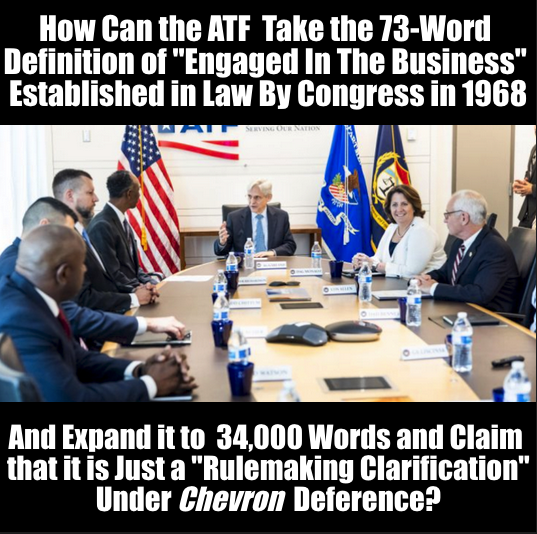
This new rule, which is 466-pages long, stems from the passage of the Bipartisan Safer Communities Act (BSCA), which broadened the definition of when someone is considered “engaged in the business”. Creepy Joe Biden signed this law on June 25, 2022. By abusing Chevron deference, the ATF’s minions then created this 466-page monstrosity, to wildly extrapolate just 73 words from the 1968 Gun Control Act into this lengthy set of rules.

There are some vague exemptions in the rule that redefine the term “personal collection” to clarify when people are not “engaged in the business” because they make only occasional sales to enhance a personal collection or for a hobby. But the rule also calls out exceptions to those exemptions.  Fo example, the new rule transforms “occasional” into just one sale at a profit, to qualify for prosecution under a Federal felony! The ATF has warned: Willfully engaging in the business of dealing in firearms without a license is subject to a term of imprisonment of up to five years, a fine of up to $250,000, or both.  They want to make everyone fearful of prosecution, and bow to their will.

Again, the burden of proof will shift from the government to individuals, to establish if the modern firearms they “occasionally” sell are part of a personal collection, and whether those sales are not intended to make a profit, but rather just to improve a collection.

The government use vague and ambiguous definitions where it suits them (like refusing to assign any number or frequency to the term “occasional”), but elsewhere in their rules they come down hard, with strict and picky definitions, to their advantage.

Absurdly, the word “sale” is redefined by the new rule, to include bartering between residents of the same state.

Even more absurdly, the ruling fabricates from thin air several new standards of “evidence” of criminal intent, none of which were mentioned in congressional legislation, such as:

Repetitively selling guns  “…that are of the same or similar kind (i.e., make/manufacturer, model,
caliber/gauge, and action) and type…”  — as proof of intent to be “engaged in the business”.

or,

Keeping a gun less than 30 days before reselling it — as proof of intent to be “engaged in the business”.

or,

including a factory box (“…persons who repetitively sell firearms in new condition or in like-new
condition in their original packaging…”) — as proof of intent to be “engaged in the business”.

or,

Keeping records of original cost versus sales price — as proof of intent to be “engaged in the business”.

The ATF rule includes this phrase: “…makes and maintains records to document, track, or calculate profits and losses from firearms repetitively purchased for resale.”  It bears mention that keeping records is often needed for tax or insurance purposes, but the ATF sees this as further evidence of someone’s intent to be “engaged in the business”

Elsewhere in the same 466-page-long set of rules, we learn that a lack of original purchase cost records would make it almost impossible to prove that you didn’t later re-sell any particular gun at a higher price. Thus, it is a case of: “You are damned if you do, and damned if you don’t.”   So, from a practical standpoint, what are we expected to do?  A.) Not keep records, but then be unable to document that we weren’t seeking a profit, or B.) Hide our cost basis records, and only reveal them if we are later charged with being “engaged in the business” without a license, to prove our innocence?  This all flies in the face of the time-honored “innocent until proven guilty” principle in American jurisprudence.

Sadly, the DOJ’s comment period for the proposed rulemaking has come and gone, and this new set of rules may stand, even if the Supreme Court does away with Chevron deference, with the upcoming Loper Bright Enterprises v. Raimondo case. We will simply have to live with it, most likely for several years.

INTRASTATE VERSUS INTERSTATE

By their very nature private party sales through local classified ads or at gun shows are intrastate (within a state) commerce. Buyers, sellers, and merchandise do not cross state lines. The Federal government only has constitutional authority to regulate interstate commerce. By effectively banning private party sales between residents of the same state, this new rule is a gross overreach of Federal authority. The ATF claims that they have authority because intrastate somehow magically “affect interstate commerce.  I spelled out their illogical nonsense in a recent SurvivalBlog article, titled: Fencing In Federal Jurisdiction.

PRE-1899 GUNS ARE EXEMPT

Thankfully, pre-1899 antique guns and blackpowder replica guns are exempt from the new rules. Per the Gun Control Act of 1968, any gun with a frame or receiver made on or before December 31, 1898 is not considered a “firearm”, regardless of its chambering, ignition system, or configuration. With the exceptions of only short-barreled cartridge rifles or shotguns, or full-auto guns (per the National Firearms Act of 1934) all other “antiques” are outside of Federal jurisdiction. Note, however, that some state and local laws apply. Needless, to say, after this rule goes into effect I expect to see some brisk sales of my  pre-1899 antiques and percussion black powder replicas, at Elk Creek Company. I invested in a big vault full of the right guns!

THE CLOCK IS TICKING!

I’ve warned SurvivalBlog readers about this upcoming rule for more than four years. (See: Preparing for a Private Gun Transfer Ban, posted in January 2019, and Some Very Bad Law: The ATF’s New “Engaged In The Business” Rule, posted in September 2023.)  I hope that my readers bought what they needed for their collections, quietly. (Read: Sans papiers.)

Some advice for those of you who live in any of the 34 “free” (private party sales) states: You now have less than a month to buy any private party guns or lowers that you want, to round out your collection. The clock is ticking. Do your purchasing while it is still legal, and while there are still some willing sellers. After the rule goes into effect, most people will be frightened into compliance, and nearly all sales of modern (post-1898) guns will be shifted to FFL channels — which means filling out an ATF Form 4473, and submitting to an FBI background check. Gun shows as we now know them in the 34 free states will become a thing of the past. The selection of guns offered privately will become pitifully small. There will be just a handful, and your chance of finding a particular model variant will become almost nonexistent, unless you submit to the Federal paperwork and background check.

Bottom line: Unless this rule is suspended or overthrown by the courts, by June of 2024, all gun shows will resemble California gun shows, where any modern guns get transferred only through Federally-licensed “transfer dealers.” This deeply saddens and troubles me. Another nail has been added to the coffin of American liberty.

P.S. : A reminder that there were 15 shameless U.S. Senators with a “(R)” after their names who voted for the BSCA bill. They knew that this bill would end private sales of used guns.  They were:

  • Roy Blunt, Missouri
  • Richard Burr, North Carolina
  • Shelley Moore Capito, West Virginia
  • Bill Cassidy. Louisiana
  • Susan Collins, Maine
  • John Cornyn, Texas
  • Joni Ernst, Iowa
  • Lindsey Graham, South Carolina
  • Mitch McConnell, Kentucky
  • Lisa Murkowski, Alaska
  • Rob Portman, Ohio
  • Mitt Romney, Utah
  • Thom Tillis, North Carolina
  • Pat Toomey, Pennsylvania
  • Todd Young, Indiana
Categories
All About Guns Anti Civil Rights ideas & "Friends" Cops

Police Only Allowing Gun Permits 1 Day A Week For Only 4 Hours Proves Need For Constitutional Carry

Categories
All About Guns Anti Civil Rights ideas & "Friends" Some Scary thoughts

The Doctor Will Ask About Your Gun Now Story by Nancy Walecki

The Doctor Will Ask About Your Gun Now© Illustration by The Atlantic. Sources: Science Photo Library / Getty

Aman comes to Northwell Health’s hospital on Staten Island with a sprained ankle. Any allergies? the doctor asks. How many alcoholic drinks do you have each week? Do you have access to firearms inside or outside the home? When the patient answers yes to that last question, someone from his care team explains that locking up the firearm can make his home safer. She offers him a gun lock and a pamphlet with information on secure storage and firearm-safety classes. And all of this happens during the visit about his ankle.

Northwell Health is part of a growing movement of health-care providers that want to talk with patients about guns like they would diet, exercise, or sex—treating firearm injury as a public-health issue. In the past few years, the White House has declared firearm injury an epidemic, and the CDC and National Institutes of Health have begun offering grants for prevention research. Meanwhile, dozens of medical societies agree that gun injury is a public-health crisis and that health-care providers have to help stop it.

Asking patients about access to firearms and counseling them toward responsible storage could be one part of that. “It’s the same way that we encourage people to wear seat belts and not drive while intoxicated, to exercise,” Emmy Betz, an emergency-medicine physician and the director of the University of Colorado’s Firearm Injury Prevention Initiative, told me. An unsecured gun could be accessible to a child, someone with dementia, or a person with violent intent—and may increase the chance of suicide or accidental injury in the home. Securely storing a gun is fundamental to the National Rifle Association’s safety rules, but as of 2016, only about half of firearm owners reported doing so for all of their guns.

Some evidence shows that when health-care workers counsel patients and give them a locking device, it leads to safer storage habits. Doctors are now trying to figure out the best way to broach the conversation. Physicians talk about sex, drugs, and even (if your earbuds are too loud) rock and roll. But to many firearm owners, guns are different.

Not so long ago, powerful physicians argued that if guns were causing so much harm, people should just quit them. In the 1990s, the director of the CDC’s injury center said that a public-health approach to firearm injury would mean rebranding guns as a dangerous vice, like cigarettes. “It used to be that smoking was a glamor symbol—cool, sexy, macho,” he told The New York Times in 1994. “Now it is dirty, deadly—and banned.” In the 2010s, the American Academy of Pediatrics’ advice was to “NEVER” have a gun in the home, because the presence of one increased a child’s risk of suicide or injury so greatly. (“Do not purchase a gun,” the group warned bluntly.) And when asked in 2016 whom they would go to for safe-storage advice, firearm owners ranked physicians second to last, above only celebrities.

In the past couple of decades, some states have toyed with laws that curtail doctors’ ability to talk with patients about firearms and the information they can collect, to assuage gun owners’ privacy concerns.
Only in Florida did the most restrictive version—what physicians call a “gag law”—pass, in 2011; six years later, a federal court struck it down. But “I think the gag orders, even though they’re not in effect now, really scared people,” Amy Barnhorst, an emergency psychiatrist and firearm-injury-prevention researcher at UC Davis, told me. A smattering of studies have found that doctors—particularly pediatricians—generally think talking with their patients about firearm safety is important, but most of the time, they’re not doing it. As of 2019, only 8 percent of firearm owners said their doctor had ever brought it up.

That year, in California, Barnhorst launched the state-funded BulletPoints Project, a free curriculum that teaches health-care workers how and when to talk about firearms with their patients. The program instructs them to keep politics and personal opinions out of the conversation, and to ask only those patients who have particular reasons for extra caution—including people with children, those experiencing domestic violence, or those living with someone with a cognitive impairment. It also suggests more realistic advice than “Do not purchase a gun.” Maybe a patient has a firearm for self-defense (the most common reason to have one), so they’d balk at the idea of storing a gun unloaded and locked, with the ammunition separate. A health-care worker might recommend a quick-access lockbox instead.

Researchers are now testing whether these firearm conversations have the best outcome if doctors broach them only when there’s a clear reason or if they do it with every patient. Johns Hopkins is trialing a targeted approach, talking about firearms and offering gun locks in cases where pediatric patients have traumatic injuries.

Meanwhile, Northwell Health, which is New York State’s largest health system, asks everyone who comes into select ERs about gun access and offers locks to those who might need them. Both of these efforts are federally funded studies testing whether doctors feel confident enough to actually talk with patients about this, and whether those conversations lead people to store their firearms more securely.

For doctors, universal screening means “there’s no decision point of who you’re going to ask or when you’re going to ask,” Sandeep Kapoor, an assistant professor of emergency medicine who is helping implement the program at Northwell Health, told me.

So far, Northwell’s trial has screened about 45,000 patients, which signals that the approach can be scaled up. Kapoor told me that with this strategy, gun-safety conversations could eventually become as routine for patients as having their blood pressure taken. When she was in primary pediatrics, Katherine Hoops, a core faculty member at Johns Hopkins’s Center for Gun Violence Solutions, worked firearm safety into every checkup, as she would bike helmets and seat belts.

(The American Academy of Pediatrics still maintains that the safest home for a child is one without a gun, but the organization now recommends that pediatricians talk about secure storage with every family, and offers a curriculum on how to have this conversation.)

Universal screening can also find people whom a targeted approach might miss: The team at Northwell recently learned through screening questions that a 13-year-old who came in with appendicitis had been threatened with guns by bullies, and brought in his parents, a team of social workers, and the school to help.

But a patient in the ER for a sprained ankle may understandably wonder why a doctor is asking about firearms. “There’s no context,” Chris Barsotti, an emergency-medicine physician and a co-founder of the American Foundation for Firearm Injury Reduction in Medicine, told me. The firearm community, he said, remembers when “the CDC wanted to stigmatize gun ownership,” so any movement for health care workers to raise these questions needs nuance. To his mind, these should be tailored conversations.

Betz, of the University of Colorado, raises the question only when a patient is at risk, and believes that firearm safety can otherwise be in the background of a practice—for example, in a waiting room where secure-storage brochures are displayed alongside pamphlets on safe sex and posters on diabetes prevention.

About half of firearm-owning patients agree that it’s sometimes appropriate for a doctor to talk with them about firearms, according to a 2016 study by Betz and her colleagues. They’re even more okay with it if they have a child at home. The physicians I asked said that the majority of the time, these conversations go smoothly.

But Betz’s study also found that 45 percent of firearm-owning patients thought doctors should never bring up guns. Paul Hsieh, a radiologist and a co-founder of the group Freedom and Individual Rights in Medicine, wrote in an email that gun owners he’s spoken with “find the question about firearms ownership intrusive in a different way than questions about substance use or sexual partners.”

Chethan Sathya, a pediatric trauma surgeon and the director of Northwell Health’s Center for Gun Violence Prevention, pointed out that those topics used to be contentious for physicians to talk about. To treat guns as a public-health issue, “we can’t be uncomfortable having conversations,” he told me.

But doctors have more power in this situation than they do in others. They might tell someone with diabetes to stop having soda three times a day, but they can’t literally take soda away from a patient. With guns, they might be able to. In states with extreme-risk laws, if a health-care provider believes that their patient poses an immediate threat to themselves or others, they can work with law enforcement to petition the court to temporarily remove someone’s firearms; a handful of states allow medical professionals to file these petitions directly. There are many people “across America right now who own guns and won’t come to counseling, because they don’t want their rights taken away for real or imagined reasons,” Jake Wiskerchen, a mental-health counselor in Nevada who advocates for such patients, told me. They worry that if their doctor includes gun-ownership status in their medical record, they could be added to a hypothetical national registry of firearm owners. And if questions about guns were to become truly routine in a doctor’s office—such as on an intake form—he said owners might just lie or decide they “don’t want to go to the doctor anymore.”

Physicians accordingly choose their words carefully. They talk about preventing firearm injury instead of gun violence—both because the majority of gun deaths are suicides, not homicides, and because it’s a less loaded term. Telling a diabetic patient to cut back on soda might work, but people “are not just going to throw their guns in the trash,” Barnhorst, of UC Davis, told me. “There’s a lot more psychological meaning behind firearms for people than there is for sodas.”

Barsotti says a public-health approach to firearm safety requires more engagement with the upwards of 30 percent of American adults who own a firearm. Owners of shooting ranges and gun shops are already “practicing public health without the benefit of medical or public-health expertise,” he told me. They’re running their own storage programs for community members who don’t want their guns around for whatever reason; they’re bringing their friends for mental-health treatment when they might be at risk. Betz’s team collaborated with gun shops, shooting ranges, and law-enforcement agencies in Colorado to create a firearms-storage map of sites willing to hold guns temporarily, and she counsels gun clubs on suicide prevention, as a co-founder of the Colorado Firearm Safety Coalition. Exam-room conversations can be lifesaving, but in curbing gun injury, Betz told me, health-care workers “have one role to play. We’re not the solution.”

Categories
All About Guns Anti Civil Rights ideas & "Friends"

How They’ll Try to Sue Glock Into Oblivion

Categories
All About Guns Anti Civil Rights ideas & "Friends" Cops You have to be kidding, right!?!

DOJ Creates New Center to Help Local Officials Apply ‘Red Flag’ Laws Against Certain Gun Owners

by Arjun Singh


The U.S. Department of Justice (DOJ) announced on Saturday the creation of a new entity to train state and local officials on procedures to apply “red flag” laws that temporarily prevent certain individuals from owning a firearm.

The National Extreme Risk Protection Order (ERPO) Resource Center is an entity created under the DOJ’s Office of Justice Programs (OJP) that will both educate and assist local officials when they initiate legal proceedings to obtain “red flag” orders that rescind an individual’s right to bear arms based on the belief that they pose a risk of harm to themselves or others, according to the DOJ’s press release. The individuals to be trained are “law enforcement officials, prosecutors, attorneys, judges, clinicians, victim service and social service providers, community organizations, and behavioral health professionals.”

“The launch of the National Extreme Risk Protection Order Resource Center will provide our partners across the country with valuable resources to keep firearms out of the hands of individuals who pose a threat to themselves or others,” Attorney General Merrick Garland said in the press release. “The establishment of the Center is the latest example of the Justice Department’s work to use every tool provided by the landmark Bipartisan Safer Communities Act to protect communities from gun violence.”

Red flag orders, or ERPOs, have previously been supported by gun control advocacy groups.

“Gun violence is a complex issue that requires comprehensive solutions. Extreme risk laws are an evidence-based tool that can help prevent many forms of gun violence tragedies before they ever occur — suicide, interpersonal violence, and mass shootings alike,” Brady: United Against Gun Violence, a non-profit organization that advocates for gun control, wrote on its website.

ERPOs are issued by state courts in civil proceedings to prevent persons from purchasing or possessing firearms should they be deemed likely to use them to harm themselves or others, the press release explains. Twenty-one states along with Washington, D.C. have passed such laws.

“OJP’s investment in ERPO programs demonstrates the Department’s commitment to addressing the gun violence crisis in the United States,” Assistant Attorney General Amy Solomon wrote in the press release. “This crisis cannot be solved at one level of government. We must use all of our resources and collaborate at the federal, state, and local levels to find innovative, evidence-based, and holistic solutions to help keep American communities safe.”

Measures such as ERPOs have been opposed by conservative groups, who argue that they are abused to deprive individuals of rights under the U.S. Constitution’s Second Amendment, which establishes that “the right of the people to keep and bear Arms, shall not be infringed.”

“So-called ‘Red Flag’ orders, or Emergency Risk Protection Orders, are designed to empower the government to confiscate Americans’ firearms without due process of law,” the National Rifle Association’s Institute for Legislative Action wrote in 2022. “Aside from allowing run-of-the-mill malicious actors to indulge personal grudges against law-abiding gun owners, in the current politically-charged environment, these laws enable the government to target those with First Amendment-protected political views the government disfavors.”

– – –

Arjun Singh is a reporter at Daily Caller News Foundation.
Photo “Merrick Garland” by The United States Department of Justice.

Categories
All About Guns Anti Civil Rights ideas & "Friends"

Gun Prohibitionists Show True Colors by What They DON’T Say of Russian Mass Shooting by David Codrea

If the laws they’re demanding are already in place and it doesn’t advance the gun banners’ agenda, they just don’t think a mass shooting is worth mentioning. (Mosreg.ru, CC BY 4.0 https://creativecommons.org/licenses/by/4.0, via Wikimedia Commons)

New deaths are still occurring following Friday’s massacre at Crocus City Hall just outside Moscow, with the figure at 137 at this writing. That’s almost 2½ times the body count amassed in the Las Vegas shootings, despite Russian gun laws that would merit an “A+” rating from the Giffords Law Center for U.S. states, with infringements including licensing, registration, background checks, psychiatric clearance, and police permission.

Now, despite facts still unfolding and the investigation being completed by a government of questionable credibility, fingers are being pointed with certainty by factions with a dog in the fight.

The official version is that ISIS has claimed responsibility and that an escape plan had been uncovered leading to Ukraine, which in turn points back at Russian President Vladimir Putin using this as an excuse to ramp up aggression. Others are claiming fingerprints all over this belonging to Mossad, MI6, and the CIA, especially after “the State Department warned Russia it was picking up ‘chatter’ about a possible terrorist attack that could occur at a concert.”

“Beyond a reasonable doubt” has never been the long suit of lynch mobs, and the agencies and governments mentioned have only their own past outrages to blame for being suspects. As for the reliability of information yet to be learned, while cutting off a terrorist’s ear, trying to force him to eat it, and plastering his bloodied mug on the front page may have a certain appeal to those looking for creative ways to deter domestic mass shooters looking for their 15 minutes of fame, any intel coerced with torture will have its own credibility issues (along with an Eighth Amendment proscription we allow to be disregarded at our peril). Besides, low-hanging fruits are generally the last to know who the informants and provocateurs in their cells really are or work for.

Plenty of other reports will talk about all this, so let’s look at an aspect of this story not getting any press—and that’s deliberate. Let’s look at what the gun prohibitionists, who are always quick to gin up the mob and demand more infringements before the facts are known, aren’t saying about the Russia concert massacre and why.

We can start with the Drudge Report, undeserving of its phony “conservative” reputation and undeservedly influential (“21,993,168 PAST 24 HOURS 527,508,370 PAST 31 DAYS 7,011,443,587 PAST YEAR” at this writing), with screaming headlines (BLOODBATHSTORMY DANIELS!) that are really thinly disguised in-kind contributions to Democrats.

Where are the extra-large bold font ALL CAPS links to the biggest mass shooting since Beslan?

Forget headlines. Why, on Sunday afternoon following the Friday massacre, must we scroll to find it buried at MSNBC and assigned equal importance as “What to know about the dizzying allegations around Dodgers star Shohei Ohtani’s translator” and “Alabama’s new anti-DEI law could cause a student athlete exodus”?

So much for the “media.” What about “social media”?

@TheDemocrats over at X, the party of citizen disarmament, can’t be bothered. They’re too focused on the competing priorities of Women’s History Month and how “@KamalaHarris  inspires girls and young women everywhere” (let’s hope not!).

Meanwhile, Gungrabber-in-Chief @JoeBiden is “proud to stand with the Latino community today and every day” (a few days after the El Paso border invaders exhibited violence that would have gotten J6 protestors 10 more years) and brags he will “fix broken student loan problems.” Can there be any doubt that had a shooting 1/10th the scale happened here, he’d be demanding more gun bans and telling more lies?

Ditto for Astroturf rice bowl prohibitionists @MomsDemand@Everytown@GIFFORDS_org@BradyBuzz, and @AMarch4OurLives. Not a word from them or from indignant professional pearl-clutcher David Hogg at this writing.

It’s almost like “gun violence” is just a made-up term used to exploit low-information voter emotions, and “gun safety” isn’t really the issue at all with these people. It’s almost like it’s all one big, stupid scam to swindle their countrymen out of their birthrights for reasons they won’t state, and if a story won’t serve those purposes, it’s not worth mentioning. Especially if, as in Russia, the government has already been doing everything they demand here – for years…


About David Codrea:

David Codrea is the winner of multiple journalist awards for investigating/defending the RKBA and a long-time gun owner rights advocate who defiantly challenges the folly of citizen disarmament

Categories
Anti Civil Rights ideas & "Friends" Born again Cynic! Well I thought it was funny!

If they can find them that is……………..