Category: Ammo
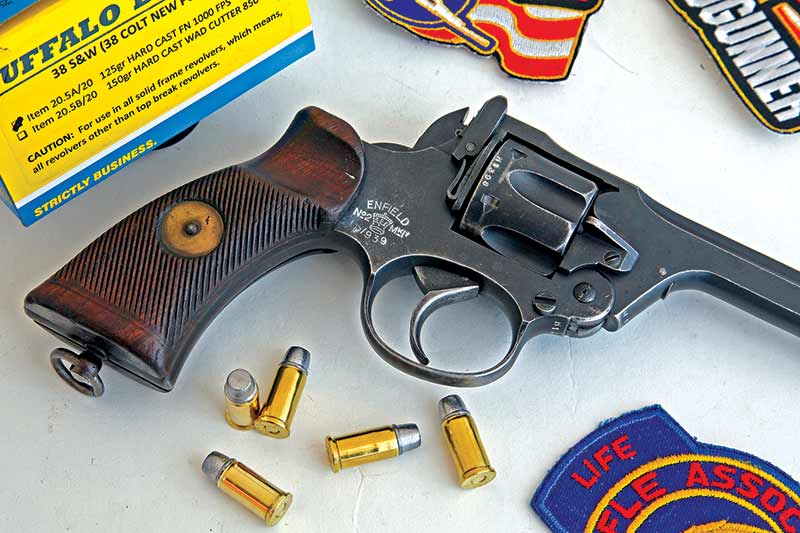
These Buffalo Bore hardcasts bring new life to lower power vintage revolvers.
British Enfield and Webley top-breaks are likely strong enough to contain modern ammo.
Bill, a neighbor, hunting partner, and certified old-timer, dropped by for coffee the other day. I was surprised when he asked for advice on a handgun for defense.
Bill said, “I’m thinking of a carry handgun. Now our state has constitutional carry, and I don’t need to get a license.”
I managed to hold back an eye roll. I’d bet a fair sum Bill hadn’t stepped out the door without something in his pocket for 50 years.
“Get a medium size 9mm semiautomatic with synthetic frame, rust resistant finish, at least 15-round magazine capacity, accessory rail for light/laser, and maybe tritium night sights, assuming you can still see the sights.”
Bill snorted derisively. “You haven’t been in a gun store for a while. The shelves are practically bare. And they told me I have to fill out a form to buy a gun! When did that happen?”
“About 50 years ago. Now they do an FBI background check too.” I remembered Bill hadn’t bought a gun since the 1960s, and they had been used guns even then.
Bill said, “I’m thinking of a revolver my Daddy had, a little S&W Regulation Police. We still have some of daddy’s stuff stored and if I looked long enough, I could probably find it. What do you think, is it a decent defensive gun?”
I was thinking, I bet you could find it all right. I could probably find it right now just by reaching into the pocket of the old hunting jacket you’re wearing. But he was asking for a lecture, and I dearly love to lecture. This is the gist of what I told Bill.
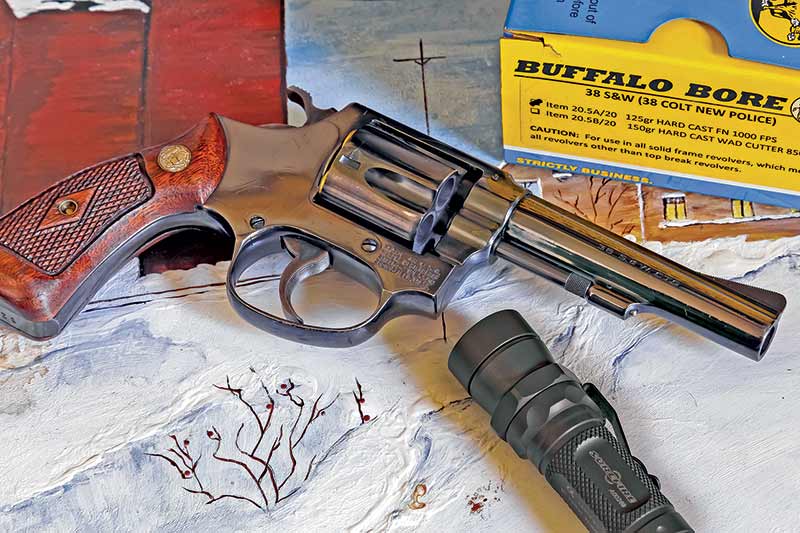
S&W Regulation Police in .38 S&W made on the Improved I-Frame.
The Overlooked .38
The old .38 S&W (also called the .38 Colt New Police) is a cartridge I’ve overlooked for years. I could never see much point in it when .38 Special revolvers and ammunition were readily available.
The .38 S&W has the same limitations as other old timers, such as the .45 Colt, .44 Special and others. Many firearms chambered for these cartridges were made when designs and materials were not nearly as strong as later firearms. When the Sporting Arms and Ammunition Manufacturers’ Institute (SAAMI) sets industry pressure limits, it has to keep these old designs in mind.
The SAAMI pressure limit for the 1870s-era .38 S&W is 14,500 psi. Many of the handguns made for it were top break revolvers, some of high quality such as those from S&W, others not so much. Personally, I wouldn’t fire a pre-1900 top break except with black powder loads.
There are many fine Colt, Ruger, and S&W small and medium frame handguns chambered for the .38 S&W. Colt offered the Official Police, Police Positive and Banker’s Special in .38 S&W (pardon, .38 Colt New Police). S&W chambered the compact I-Frame with 2″ barrel (Terrier) and 4″ barrel (Regulation Police).
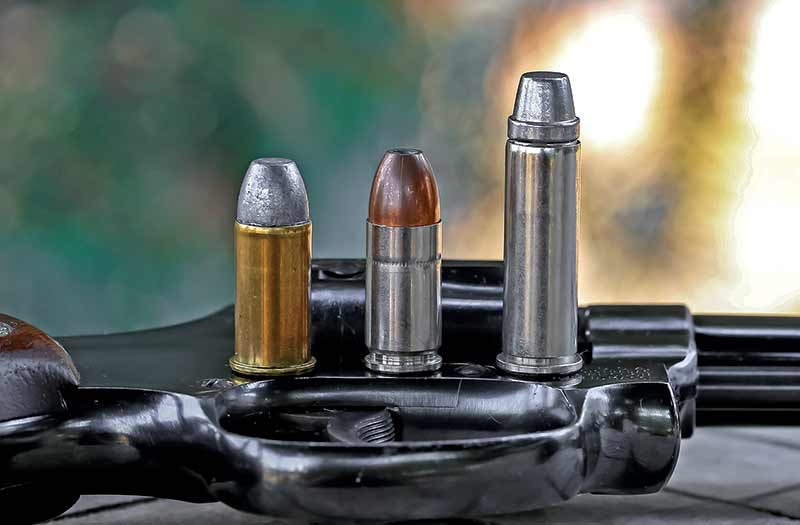
From left, .38 S&W; 9mm Luger; .38 Special. Similar in size,
the 9mm offers significantly more energy.
Bill’s Daddy’s Gun
I happen to have a Regulation Police in my modest S&W collection, so I got it out of the safe. “Yep,” said Bill, “My daddy’s gun looked just like yours. As best I can remember, of course.”
“Of course. This one was made shortly before S&W began stamping their guns with model numbers in 1957. Those old boys surely did know how to fit parts and polish steel. Trouble is the most common factory load is a 145-grain lead round nose bullet at about 650 fps. It would be foolish to use such ammo for self-defense.”
Bill seemed a bit uncomfortable. “Right, no one would be so foolish. What should I do, assuming I find daddy’s old gun?”
“I’d say you have two choices. Sell it to an S&W collector and use the money to buy something modern. Or if you are determined to carry it, get some Buffalo Bore ammunition. They load a hard cast, flat point 125-grain bullet at about 1,000 fps and it’s under SAAMI pressure limits. It’s great ammunition, in my view, essential in bringing some fine vintage handguns back to life.”
“There’s a third option,” Bill mused. “You could load me up a box or two of hot .38 S&W cartridges.”
“Hmmm, let me think it over. Nope. Not happening.”
Categories
22 Hornet and Distance

I’ve warned you guys. Weird things happen in gunfights. You should expect an Elbonian satellite to fall on your head, or a gopher the size of a grizzly to erupt from the ground at your feet. I’ve encouraged you to believe your eyes, shrug off bizarre twists, and stay focused on the threat. Some of you shared your own stories of bizarre “moments ’midst mayhem,” and a whole bunch of you asked for real-world examples. A few readers were even dubious about the possibility of such strange happenings happenin’. So, for you doubting Thomases, here are some examples from my private stock.
NUCLEAR .38 SPECIAL ROUNDS?
I was a rookie patrolman when my senior partner and I were called to back up a pair of robbery detectives. They planned to kick in a door at a felon-filled flophouse hotel, crunch some cockroaches and yank a sleepy stickup-shooting suspect outta his grimy sheets. His room was on the second floor of this converted century-old residence, and a rickety stairway led directly from his crib down to a garbage-littered lot. That’s where Davey and I were posted — just in case Plan A went South when the “dicks” kicked the front door. It did.
We weren’t quite “positioned” when multiple muffled gunshots preceded Hairball Harry’s rapid exit out onto the landing. There was a flash of light as the door banged hard against the rail, and both Davey and I thought it was a muzzle flash and gunshot. Davey was standing in front of me with his trusty 6″ S&W Model 10 aimed at Harry. He squeezed (or jerked) the trigger — and the stairway landing seemed to explode, with a hurricane of splinters and dust billowing out toward us as simultaneously, the entire stairway screeched, groaned, and collapsed to the deck.
I pushed past Davey when a second after that, a ground-floor back door flew open and two skivvie-clad bed-headed dudes with pistols in their mitts staggered outside, blinded by the clouds of dust, shouting stuff like “COPS! They’re usin’ grenades!” and searching for targets. Using some ungentlemanly language, I convinced ’em of the inferiority of their tactical situation. Good thing they didn’t fight — my partner was still standing there, frozen, with his revolver a hand’s-breadth from his nose, staring incredulously at the muzzle. He was lost in his own world, wondering how a lead 158 gr. SWC could blow up a stairway and two landings. Finally, I had to grab the gun and gently awaken him.
The gunshots were Hairball Harry’s response to his door gettin’ kicked. The dicks had sidestepped, and were occupied with straightening out a pair of pucker-factor-induced “wedgies.” That flash was the bulb of an outside light’s last gasp as its fuse blew out. The once-heavy wooden beams and planks of that stairway were virtually hollow shells filled with a century’s worth of termites and wood-powder. It simply imploded under Harry’s weight. He was unconscious, suffering multiple injuries, snoozin’ in the wreckage.
The Big Diff between me an’ Davey was that previous combat experience had taught me stuff blows up and weird things happen in gunfights, and you have to keep your head in the game.
ALLEYWAY ANTICS
A patrolman pal of mine had an armed dope dealer cornered in an inky-black blind alley. They were casually trading occasional shots, waitin’ for backup to arrive, when suddenly a huge supernova light came on, a door swung open, and the alley was instantly filled with laughing, leaping, twirling cheerleaders, complete with pompoms, ponytails, big bells on their shoes and those cute little kick-skirts. Dudes! Wanna talk weird here? The entire pep-an’-cheer outfit from a local college had just finished a late photo-session on a theatre stage. The best part? As the cheerleaders danced an’ advanced down the alley past my pal, the dope-dealer tried to sneak out with ’em!
“Unbelievable,” my buddy told me; “Here’s this dreadlocked dude wearing a Rastafarian cap and a filthy M-65 (field jacket), skipping along between cheerleaders, still holding a Beretta 92 in one hand. Skipping!” Rasta-man didn’t get away, and nobody got hurt, but my pal said it was an ugly scene. “The shrieking and screaming hurt my ears worse than the gunshots did,” he said. “Never jump out from behind a dumpster and point a pistol anywhere near a buncha cheerleaders.”

DON’T SHOOT WHITEY: HE’S MINE!
“Tommy D,” another badge-wearing brother, is well known for his morbid fear of dogs. They tend to bite him, fiercely and frequently. He had chased a biker bad guy into the back yard and the two were faced off pointing pistols at each other, when outta the shadows waddled an irritated overweight Welsh Corgi, who commenced chewing Tommy’s ankle.
Distracted but undaunted, Tommy and Biker Bill continued discussing whom oughtta throw down whose howitzer when suddenly, a little white Pit Bull pup ran between Biker Bill’s legs and skidded to a snarling stop in front of Tommy. That’s when I arrived — just in time to slap leather and watch in horror as T.D.’s eyes saucered and his shaking gun dropped to point at the Pit Bull!
I was a half-second short of blasting Biker Bill when he flung his gun to the grass and screamed, “Don’t shoot Whitey! He’s mine!” I’ll leave the detailed analysis to you guys. Just watch out for grizzly-gophers and Elbonian satellites, okay?
Categories
I’m a 44 Special man myself

Categories