In 1899, a group of Moro tribesmen in the Philippines took umbrage toward a United States occupation force in the southern islands, thereby initiating what became known as the Moro Rebellion. The Moros were fierce fighters, with a reputation of resistance toward any outside rule. Officers in the U.S. force were armed with Colt Model 1892 revolvers chambered in .38 Long Colt, a cartridge that originated the blackpowder era. The load at the time featured a 150-grain lead round-nose bullet launched at 750 f.p.s. using smokeless powder. Muzzle energy was 201 ft.-lbs., about the same energy as a .380 ACP with a 90-grain bullet.
The Moros were reputed to tie themselves up with strips of vegetation from the jungles to prevent excessive bleeding and ingested locally made drugs to block the pain from wounds. Engagements involving the Colt double-action Model 1892 often resulted in the officer being killed or severely wounded by these motivated Moro juramentados. This prompted the War Department to launch the Thompson-LaGarde Tests of 1904. As expected, the rather grisly tests showed the .38 Long Colt significantly lacking in the power needed to stop a determined assailant. The tests determined that what was needed were the ballistics of the .45 Colt in a more compact round. Semi- and full-automatic arms were being developed, and the old .45 Colt would not function in the new pistols.
Colt and John Moses Browning were developing a .41-cal. cartridge in a semi-automatic pistol in 1904. As a result of the Thompson-LaGarde Tests, the Ordnance Department specified a .45-cal. cartridge, and Browning obliged the department with a .45-cal. Model 1905 pistol. Browning and Colt continued to refine the design, and on March 29, 1911, the Colt Model 1911 pistol and the “Cal. 45 Automatic Pistol Ball Cartridge, Model of 1911″—now known as the .45 ACP—were formally adopted by the Army.
Winchester, Frankford Arsenal and the Union Metallic Cartridge Co. had been working on the loads for the new pistol cartridge. At the time of the trials, these ammo companies were loading a 200-grain full metal jacket (FMJ) bullet with a velocity of 900 f.p.s. This load passed the tests, but later, it was modified to have a 230-grain FMJ round traveling at 850 f.p.s. The first cartridges sent into service came from the Frankford Arsenal and were headstamped “F A 8 11,” for the August 1911 date.
Both cartridge and pistol enjoyed immediate success—too much, in fact, because as World War I came along, demand far outstripped availability. Both Smith & Wesson and Colt were forced to ramp up their large-frame revolver production chambered for the .45 ACP during World War I. These revolvers relied on “half-moon clips” to provide for simultaneous extraction and ejection of the rimless cases from the cylinder. After the war, the Peters Cartridge Company added a thick rim to the .45 ACP, calling it the .45 Auto Rim. It is ballistically and dimensionally identical to the ACP cartridge, save for the rim. This development was the result of thousands of surplus Model 1917 Smith & Wesson and Colt revolvers being dumped onto the surplus market.
The reason for the success of the .45 ACP cartridge is simple. It works. People shot with it “stay shot,” as it is often said. A 230-grain, .45-cal. bullet with proper placement is capable of effectively putting an assailant down. The .45 ACP cartridge also has the very desirable characteristic of being inherently accurate. A properly tuned semi-automatic pistol or revolver can often put five shots into a ragged hole at 25 yards.
A Smith & Wesson Model of 1917 service revolver chambered for .45 ACP.
For several decades, the M1911 pistol and .45 ACP cartridge had an undeserved reputation for being difficult to shoot. Early pistols were loosely fitted in order to keep them running in wartime environments of mud, dust and sludge. Pistols with a lot of free tolerances do not group as well as those that have had those tolerances tightened up. Of course, fitted pistols need to be kept clean and lubricated to maintain their reliability.
Any U.S. military cartridge is going to have some built-in popularity due to the surplus market. Surplus guns and ammunition are often heavily discounted, and when that gun and cartridge were the staple of the U.S. military and many law-enforcement agencies for 71-plus years, the result is that the .45 ACP is almost universally available.
The popularity of the .45 ACP was not limited to the M1911 pistol. The cartridge has been chambered for semi-automatic pistols made by Browning, Colt, Heckler & Koch, Ruger, SIG Sauer, Smith & Wesson, Taurus, Walther and many more. Colt and Smith & Wesson have been joined by Ruger and Taurus, as well as many Italian replica manufacturers, in creating revolvers chambered for the .45 ACP, both single action as well as double action. Carbines and submachine guns emerging after the famous Thompson have been chambered in .45 ACP. Micro pistols like the Semmerling LM4 and the Liberator were also chambered for the cartridge. It is safe to state that the .45 ACP is ubiquitous.
Two .45 Auto Rim cartridges, designed to work in revolvers like the S&W Model 1917 without the need for moon clips.
Handloading the .45 ACP is pretty straightforward, provided you don’t try to turn it into a magnum. Bullets—both cast and jacketed—are available from 118 to 250 grains, and when shoved by a medium-fast powder like Alliant’s Unique, Winchester’s W231 or IMR’s SR 4756, they provide good results. One note of caution, however, is that some .45 ACP brass has been made with small primer pockets. If you want to avoid suddenly ceasing your loading operation to pick out components from your reloading tools and punctuating that chore with loud profanities, make sure you separate small primer pockets from large primer pockets beforehand.
Factory ammunition runs an equally diverse profile, with everything from lightweight hollow points to monolithic solids and even some snake-shot loads. The length and breadth of what the .45 ACP is capable of doing is impressive.
Yes, there are cartridges with higher velocities and flatter trajectories. Yes, there are cartridges and loads that are more powerful and hit harder. But it’s worth noting that, even though the cartridge and its original pistol are more than 110 years old and have been superseded by “wonder nines” and “shorty forties,” the .45 ACP and the M1911 pistol are often still the preferred choice of many, whether in commercial circles, law enforcement or the military.
I’ve been paying close attention to the war in Israel and Gaza; watching a lot of footage. Came across some video of Palestinians — probably late teens/early 20s — throwing stones at vehicles in a chaotic protest on a road. This was, I believe, on Saturday, and it wasn’t clear to me whether the footage was real time or from recent protests.
Suddenly, one of the most active stone-throwers pulled up his right leg, his face knotted in a grimace of pain, and he began to hop away on his good leg. His comrades abandoned their pile of rocks and helped him down an incline and out of the frame.
I knew immediately what had happened: The stone-thrower had taken a .22lr round to the ankle or shin.
“Medics in the Gaza Strip have reported treating an influx of protesters who appear to have been deliberately targeted in the ankle by Israeli forces in recent unrest at the volatile boundary of the blockaded Palestinian enclave. At least one person has been killed and dozens more wounded since demonstrations by groups of young men, some of them throwing stones and molotov cocktails, began in mid-September.”
The Guardian being The Guardian, this was presented as a new cruelty inflicted by the Occupation on oppressed Palestinians.
Human rights groups say that such targeting procedures are unlawful as they allow the use of potentially lethal force with no immediate threat to soldiers’ lives.
They did get one paragraph of “balance” into the piece:
In a statement, the IDF said: “Over the past few weeks, the Hamas terror organisation has organised violent riots along the border fence, for purposes of harming Israeli security forces … It should be noted that the IDF resorts to live fire only after exhausting all available options, and only as necessary to handle imminent threat.”
For years, the IDF has been deploying integrally suppressed .22 caliber Ruger 10/22 carbines, originally as a “less lethal” option for riot control. They are also used as a “hush puppy” to take out dogs and lights in raid operations. Because Israel actually adheres to rules of engagement and laws of combat, the Israeli Judge Advocate General tested the effect of fire from the .22lr and reclassified it as a lethal weapon, which restricts its use.
But clearly, it was in the field in the weeks preceding the explosion of violence in Hamas’ Operation Al Aqsa Flood.
The use of a .22 in a sniper role at limited range, especially in urban environments makes a lot of sense. It’s comparatively quiet even unsuppressed, making it difficult for an enemy to determine where fire is coming from. Suppressed, it’s pretty close to silent; only the sonic crack of the bullet is heard. If your target is higher than the ankles, a .22 can be plenty lethal. Ask any emergency room doc.
Chechens deployed .22 snipers against Russian troops in urban combat in the 1990s, using makeshift suppressors made from plastic bottles — a technique depicted in the movie Shooter, based off of Stephen Hunter’s classic thriller Point of Impact. They were taking head shots.
The Russians took heed, and developed a purpose-built .22 sniper rifle, the Kalashnikov SV99:
The .22 LR SV-99 sniper rifle was developed as a precision small-caliber weapon for special forces snipers to silently engage enemy personnel and other targets at ranges up to 100 meters, as well as for training purposes.
For their part, the IDF now has an updated and upgraded Ruger to work with (seen in the top photo):
Countless threads on gun forums have flogged the topic to death and beyond, but it bears keeping in mind that the .22 is more than just a plinker.
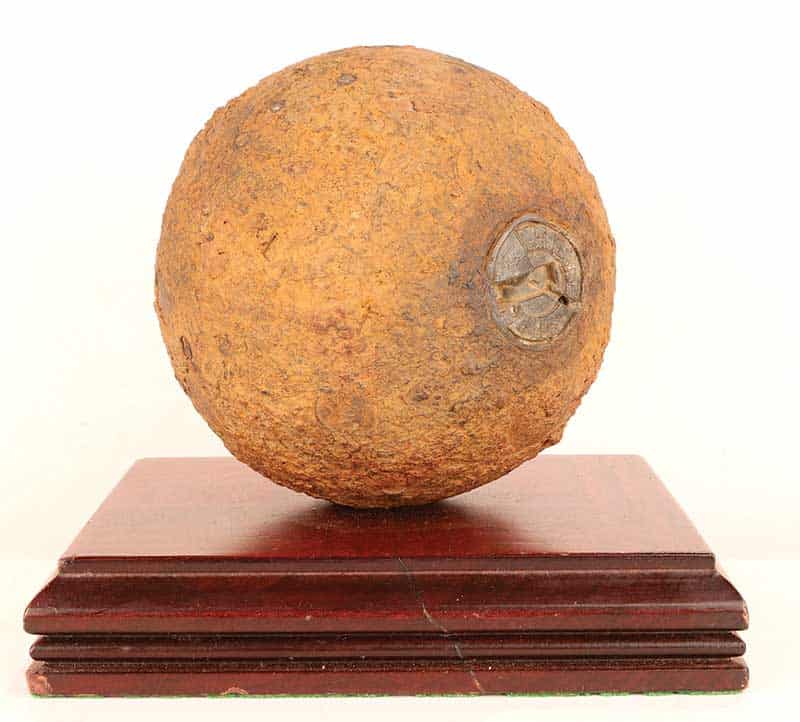
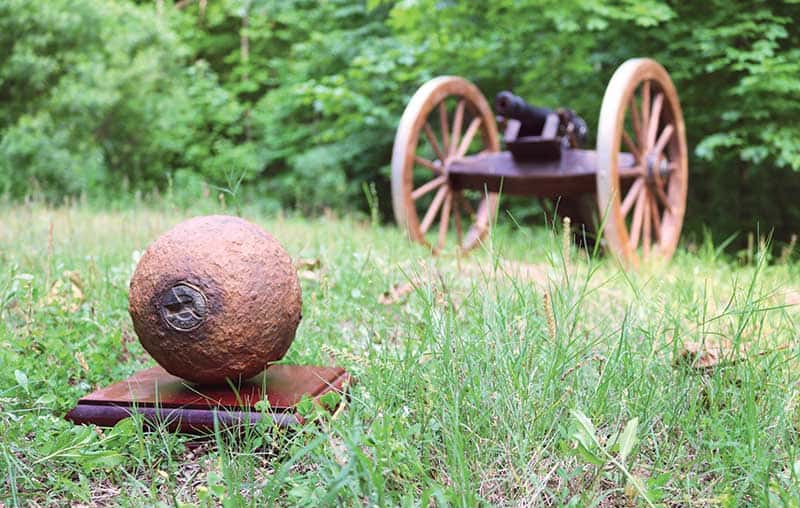
Will’s Civil War-era cannonball (above) originated from the guns of a Union gunboat that once plied the waters of the
Mississippi during the War Between the States.
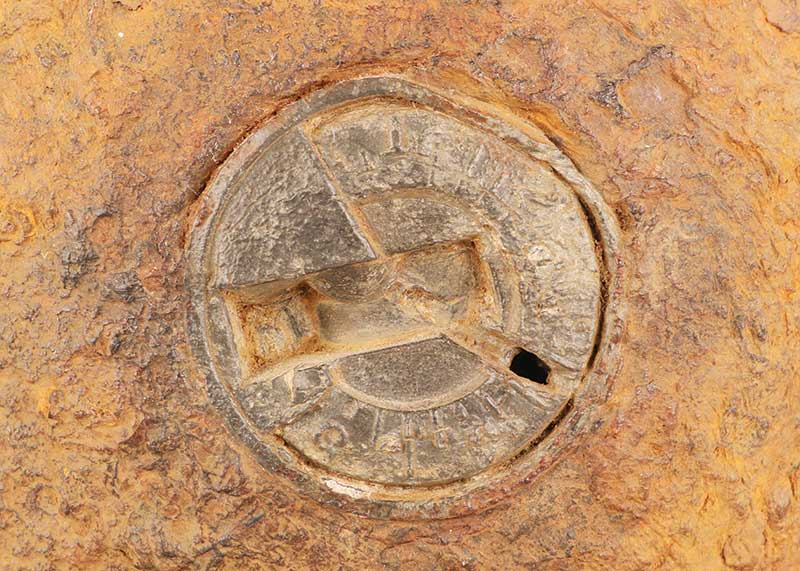
The Bormann time fuse was a simple powder train arranged underneath something like a clock face. The gunner turned
the fuse with a key and punched through the desired time delay with an awl. The train was supposed to ignite upon firing,
but Bormann fuses suffered a 50 percent failure rate in combat.
America, while still the finest place on earth to live, seems awash in a sundry of tribulations these days. Our moral compass spins faster than the federal government’s debt clock, and verifiable examples of sound judgment in Washington seem skimpier than Paris Hilton’s wardrobe. In addition to these oft-lamented ills, there also seems to be a precipitous and unprecedented decline and dearth of Dads.
Mind you, we’ve got scads of fathers. You can’t swing a dead cat in a public venue without striking a male who has fathered a child. But what we are really growing short on is good old-fashioned, share-an-address-with-his-children Dads. The impetus behind this contemporary pestilence is a complex contagion, but I am blessed with such a Dad, and I am proudly one myself. There are some interesting perks a man can expect from the job.
Mine was a fairly rural upbringing, and we Dabbs men have always prided ourselves on being able woodsmen. My own Dad was out squirrel hunting many years ago when he happened upon what looked like a piece of fruit half buried in the mud. This particular strand of Delta forest was on the wet side of the Mississippi River levee and as such had flooded vigorously every spring since the very beginning of time. Being a typical inquisitive American male, my dad acquired a stick and poked it. The incongruous item turned out to be, much to his surprise, a dud Civil War-era cannonball. As he and I share an unfortunate amount of genetic material, he did exactly what I would have done––he innocently picked it up and carried it home.
When this particular cannonball was fired in retaliation in 1862, weapons of war were far simpler. The naval cannon involved
was smoothbore and driven by blackpowder.
Obligatory Disclaimer
Before half the world writes in with colorful observations of what a rank idiot I am, this amusing little tome does indeed have a happy ending. However, never disturb or relocate unexploded ordnance. Your local Law Enforcement officials can put you in contact with the proper agencies for managing such things. The anecdote related herein occurred many years ago. My dad and I are both older and wiser now. The story is related solely for its entertainment value. Testosterone is the most potent poison known to man and many a voyage across the River Styx was indeed launched with the otherwise-innocent question, “I wonder what that does?” Now, back to our tale.
As my dad was walking to his Jeep with the heavy bomb hoisted upon his shoulder, he kept wondering what people would think if it spontaneously detonated. He doubted much would subsequently be discovered of his remains beyond his two smoldering boots. A typical local bait shop discussion might go something like this––“I heard Woody was out squirrel hunting the other day and just blowed slap up. I seem to recall the same thing happened to Billy Ray back in ’73.”
Anyway, he got the thing to the house, aggressively photographed it, and entombed the entire affair in the backyard. On my next free weekend, I made my way home. At the time, I was a mechanical engineer/former Army helicopter pilot grinding his way through medical school. Between the two of us, we had exactly zero useful professional expertise to lend to this unusual undertaking.
At cursory glance, the thing looked like a rusted version of the “Death Star” from the Star Wars movies. It was a typical example of hollow shot fired from the Union gunboats that plied the Mississippi River some nearly 150 years ago during the War Between the States. The iron ball incorporated a Bormann time fuse. This soft metal insert sports something akin to a clock face replete with embossed numbers. Prior to firing, the gunner would punch through the number corresponding to the desired time delay with an awl and load the bomb fuse-forward. Fiery blowby would supposedly ignite the black powder train enclosed therein and detonate the ball the appropriate distance from the gun. Bormann fuses suffered roughly a 50 percent failure rate in combat.
There had been a minor skirmish involving the nearby port town of Friars Point, Mississippi, where Union forces occupied the town and, for reasons lost to history, burned all the churches to the ground. Angry locals fired upon the moored gunboats from the banks of the river, and Union forces peppered the surrounding countryside with random cannonade. The sketchy performance of the Bormann fuse is the reason our example remained intact. Satisfied the fusing system was a simple waterlogged powder train and not some dangerous clockwork contrivance, we advanced to the next stage of our adventure.
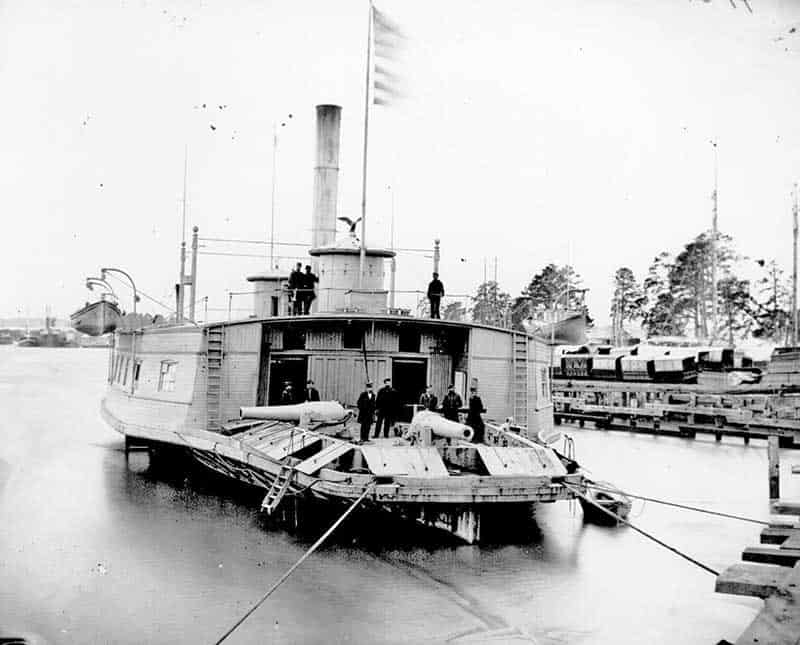
Civil War-era gunboats were remarkably complex vessels for their time. Steam-powered and heavily armed, these
leviathans projected Union combat power along the vital Mississippi River. The cannonball depicted in this article was
fired in 1862 from a gunboat similar to this one. Photo courtesy: US National Archives.
Technical Details
We procured a drill press, mounted it atop an old tabletop and headed out to the woods in my folks’ gosh-awful-huge motor home. Behind the RV we pulled a boat trailer loaded solely with a pickle bucket full of sand ridiculously over-secured with heavy nylon tie-down straps. As this is not a particularly atypical sight in the rural Deep South, we aroused little suspicion. Upon arrival at the base of the Mississippi River levee, we ran 300 feet of orange extension cord out into the forest and tied a comparable length of trotline to the drill press handle. We gently removed the sand from the bucket and replaced it with water to keep everything cool, fired up the RV generator and were in business. We had acquired a large rubber gasket upon which to place the rusty cannonball so as to retain it securely within our contraption. I oriented our proposed 1/4-inch breach 90 degrees out from the fuse.
Imagine if you will, the sight of two nominally grown men crouched in trepidation behind a large fallen log next to a motor home, big enough for its own zip code, parked at the base of the Mississippi River levee. Now picture we are also gently tugging a trotline snaking off blindly into the woods. This bizarre sight greeted the game warden as he pulled up alongside us in his big green cop truck.
No, this isn’t Will and his dad extracting gunpowder from their cannonball. Note the lack of safety equipment?
These Union troops had none as they extracted the gunpowder from captured Confederate torpedoes.
Photo courtesy: US National Archives
Law Enforcement Involved
“What you boys up to?” the cop inquired amicably. My dad and I looked at each other, and after a moment’s reflection I said, “Drilling a hole in an old cannonball?” They say honesty is always the best policy.
Now this is one of the countless things I do truly love about the rural Deep South. Had we lived in New York, New Jersey, California, or some similarly storied locale, we’d undoubtedly be immediately clapped in irons, transferred to some special dungeon and labeled a father-and-son homegrown terrorist squadron. However, as we live in God’s country down here in Mississippi (don’t knock it––at least our air is still invisible), this upstanding officer of the law simply said, “Cool. Don’t blow yourselves up.”
We socialized for a bit before he wished us good fortune in our undertaking and drove off. It turns out he was simply concerned we might be trying to camp at the base of the levee, a practice indeed verboten per local statute. Convinced our sojourn was but temporary he departed placated.
The entire process took about 3 hours. We gently tugged on the trotline for a few minutes then unplugged the extension cord to allow everything to cool off while we visited together in safety behind the ample fallen log. We repeated the process as needed while surveilling the ball through a pair of binoculars. When finally we had the hole bored, we allowed another 1/2 hour for cooling and squirted a bit of chilled motor oil into the hole as a spot of insurance.
The cannonball now rests proudly on my mantle, minus the 1/2-pound of quite volatile Yankee black powder it once contained, the very centerpiece of my ever-expanding cool guy-stuff collection. Additionally, Dad and I had an absolute blast together (figuratively, of course) and but for the grace of God got neither killed nor arrested.
The world is awash in fathers, but what it needs is more Dads. Will thanks the Lord every day for his dad.
Musings
deactivating Civil War-era artillery rounds. It is in the murky spaces between these two ends of the spectrum where profound happiness resides. My own three kids are grown nowadays, and were we to serendipitously trip over a Civil War-era cannonball today, we would indeed leave its recovery to the professionals. However, while we did our share of romping and stomping through the woods together, truth be told, they were not necessarily the greatest beneficiaries of our adventures. This notion has added a depth and richness to my life not to be found in the more civilized pursuits. In the broad field of human accomplishment, little brings quite so much satisfaction, if well executed, as the rewarding job of being a Dad. To my own Dad, thanks. I love you.
This Black Powder Project has always been about the “weapon” aspect of guns. Except perhaps for hunting, most people don’t think about black powder guns in the weapon context, even though back in the day, black powder guns were a revolution in weapons.
There are collectible guns. There are historical guns. Some guns give you an extra week and sometimes an extra deer for deer season. But at the heart of all guns are tools created as weapons. And though the technology is old, black powder guns are guns, and very effective weapons.
“Ballistics” is how we measure the technical proficiency of a load in a specific firearm, and it is composed of many factors. The weight of the projectile calculated with the speed at which it leaves the barrel is usually measured in foot-pounds. The more foot-pounds, the harder it hits, which I’ll explain. For long range, the shape of the bullet is also a factor in its role to buck the wind as it goes down range. This is called the ballistic coefficient, and for black powder, it usually isn’t that much of a factor because heavy slow bullets buck the wind really well.
For pistols (and yes, all handguns are pistols), close-range effectiveness is what we expect, and what we are trying to measure. But foot pounds don’t always tell the whole story. This is because in the equation to measure foot/pounds, velocity is squared, or multiplied times itself. The weight in grains of the bullet is only factored in once. That is then multiplied by a constant.
The Math of Ballistics
-Weight of the bullet (in grains) x velocity (in feet per second) x velocity again x 0.000002218 = muzzle energy in foot-pounds.
So a light bullet that travels faster is always going to have more foot-pounds of energy than a heavy bullet going slower. In practice, the numbers don’t always foretell the actual effectiveness of the load. This has led to endless arguments of 45ACP vs. 9mm and in the modern day 5.56NATO vs. 300BK. Heavier bullets hit harder, and tend to punch through more things. But the numbers give us an apples-to-apples comparison when weight and velocity are similar from load to load.
I have used a website called Ballistics by the Inch when I try to wrap my head around the factors of a new caliber when it comes to handguns. At some point, they burned a lot of ammo to come up with those numbers, and I am not aware of any other source as comprehensive.
Black Powder Substitute
For black powder, or by my preference, a black powder substitute, there is no data out there whatsoever. I have covered some basic velocity in this series over the years, just to show how effective these guns can be. But I have never measured head to head one barrel length against another.
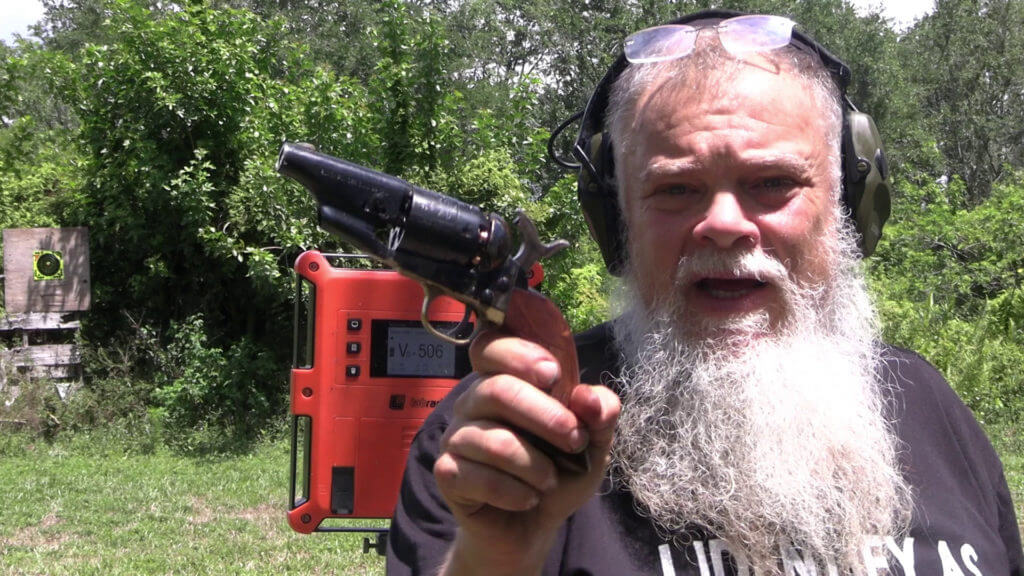
So I decided to measure it, and compare the data to BBTI, trying to match up the weight of the bullet and the velocity that I measured with my chronograph for the various barrel lengths that are available out there in black powder guns.
…even if only five people in the world actually care.
Why I Care
A lot of people buy these because there is no paperwork in most states, they’re shipped to your door, yet they have no idea how they behave as compared to other handguns.
The reason I care is because I have carried these guns in daily life many times. In the days before the reciprocity of carry permits, I carried cap-and-ball revolvers whenever I traveled. Since those days some states have gotten wise and incorporated “any weapon that fires a projectile” language, but back then it was not the case. Having shot SASS back in the 90s with my cap-and-ball guns, I am pretty natural with them, and I would be equally as comfortable carrying them today.
I used to carry some of these actual guns before the days of reciprocity between states. So I was for sure interested in what I was carrying.
But are they effective in the shorter sizes that are easier to carry? I didn’t know. They are guns of course, and the gun you can carry and will carry is always better than no gun at all. I was curious. So I measured it.
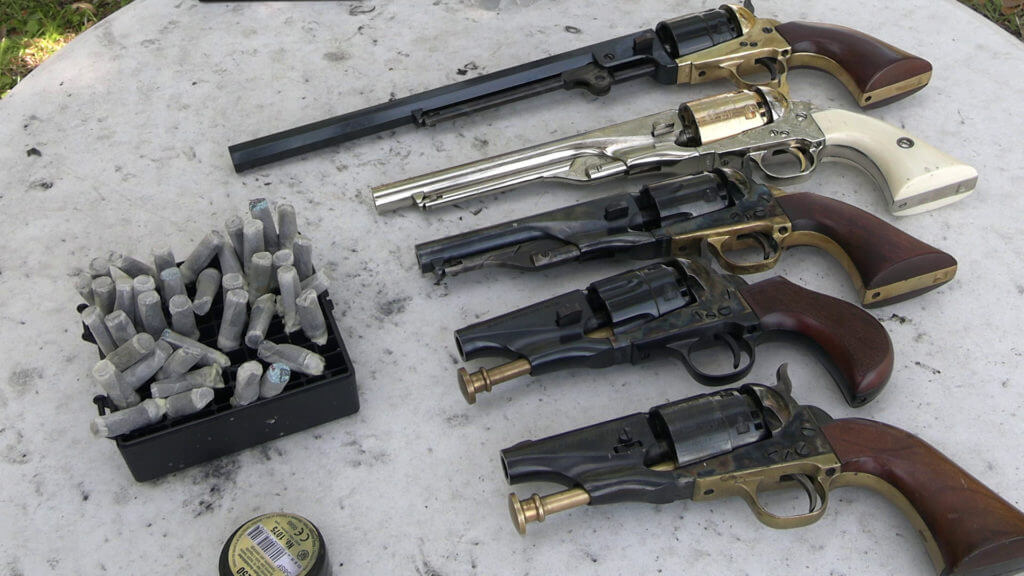
The Black Powder Project Guns
As you can see in the video, I used my old 1860 Army 3” snubbie as the shortest of the lot. I bought it out of the Cabelas print catalog decades ago, and you don’t see that model around these days. It has been replaced by Pietta with the same model, but with a bird’s head grip, like Billy the Kid’s gun. And though I’m sure many original 1860 Army Colts were cut down back in the day, there is no historical gun like the bird’s head model.
This gun I carried for many years. Later I found that that particular city already had laws on the books that would have made that not okay. So don’t assume that because the government does not consider these firearms you can just walk around with them loaded in your pocket.This original grip on the 1860 Army doesn’t seem to be around anymore on the snubbie, but Taylor’s is bringing in a birdshead grip model of the same gun that is much more concealable. There is a guy on Etsy who even makes belt holsters for them.
It was made to actually carry.
I also tried one of my 1851 Navy “Marshall” Colts, which you can still find for sale today. It has a 5 ½” barrel, and I had mine tuned up so it is super slick, and it has the little post to prevent the cap from jamming the action. Note that on the EMF website, you can order out-of-stock items and they will call you and only charge if and when it ever comes in again.
Call It Buntline Or Bison
I also included a 12” Buntline, which is also called the Bison. Though it has little practical value for anything besides horse or ATV carry, the long sight radius and adjustable sites make it practical for that purpose. It is an 1851 Navy frame, but the cylinders on mine are bored long, and with a heavier bullet loaded right up it will be a brutal firearm.
And I had to include the 12” barreled Buntline because I have a couple. Most of you have probably never even seen a Buntline at all, never mind in black powder. The gun was the concept of Ned Buntline, the author who originally fictionalized the shootout a the OK Corral, and though there is no evidence that Wyatt Earp carried one, as western guns the Buntline has always been a fascination, and in demand by consumers. Pietta calls them the Bison, which reflects why they are interesting. If you are in a part of the country where buying a handgun is a headache, yet would like something somewhat compact as a range gun, I think the Bison is a great fit.
Roundballs
I used roundballs for my test because, for one, I am not Ballistics by the Inch. This was not meant to be an exhaustive test, and frankly, most people shoot roundballs in these guns. See my older stuff on the Johnson & Dow conical, the Walker, the Kerr, and a 225-grain flat nose I found at Accurate Molds. Back in the day of these guns, plenty of people shot roundballs, but conicals were issued to most Civil War soldiers.
The Traditions .451 swaged roundball is smaller than I generally cast myself, but it does consistently leave an even solid ring when pressed into the cylinders.
Practically speaking, a heavier bullet is better for longer-barrel black powder firearms, because of the issue of leading. A 140-grain roundball is fast with black powder, and it can be too fast. Over 1,000 feet per second, a 100% lead bullet with no jacket tends to leave some lead in the barrel, and it is tough to get out. In bullets meant for cartridge firearms, you just add a little tin and antimony to create an alloy and this makes the bullet much harder. But with cap-and-ball guns, you have to shave the bullet as you push it into the chamber, and that is tough to do with harder lead alloys.
Black Powder of Choice
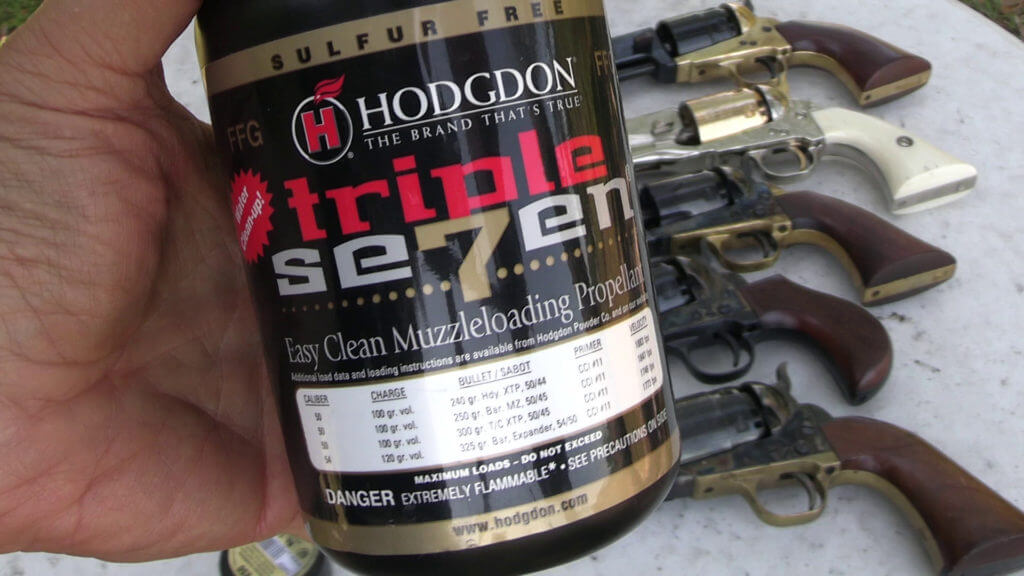
My powder, when possible (not in flintlocks), is always Hodgdon Triple Se7en. It produces more velocity, and I have never had any indication that a gun was overloaded, no matter how much of it I have squished in there. The big advantage of Triple Se7en is of course that you don’t have to freak out to clean your guns as quickly as with black powder, and it is more forgiving if you miss a spot. The data on the front of the Triple Se7en can is for deer rifles. My data probably isn’t novel, but I’ve never seen it before.
I use exclusively Hodgdon Triple Se7en black powder substitute in my BP pistols. The velocity is better and much more consistent than real Black Powder. You don’t have to go crazy cleaning your guns quickly (you still have to clean them), and they sell it at Bass Pro and most gunshops.
Cartridge Kits
I use paper cartridges for these projects, made with the kits at cartridgekits.com. Roundball cartridges are just as easy to make as conicals, but it does help to have the loading block because you will have fingers full of glue.
And as you can see from the video, I use pre-made paper cartridges when I work on these projects. The kit I use is at cartridgekits.com (http://www.cartridgekits.com), and they make kits for all of the pistols, as well as the 12 gauge Diablo/Desperado, and inline muzzleloaders. I was the primary engineer for these kits, so they work well. My method for these specific rounds was to fill the dipper so that you could see the rim of the dipper. This is the conservative Colt load, and as you can see, pushes a roundball at velocities that won’t cause leading. When you load roundballs with these kits, you extend the paper outside of the dowel, which leaves a cup at the end for the ball. Just be careful not to overload them, as much more powder than that will cause leading.
First, let’s compare the conservative ballistics of a standard 7 ½” Colt 1860 with roundballs. I was weary about leading in the buntline, and I wanted all of the powder to be equal, So the velocity was around 950 feet per second. Plugging that into our formula above with a 140-grain roundball, it equals 280 foot pounds of energy. That equates to about a 135-grain bullet in a 3” 38 Special revolver using the graph at Ballistics by the Inch. There is no comparable bullet for a 44 Special because factory ammunition is all conicals which are heavier in that caliber. But the foot-pounds are about the same as a 165-grain bullet in a 2-3” barrel.
Does Size Really Matter?
Over the years I’ve covered the velocity of roundballs and several conicals in these full-size Colts from the Civil War cap-and-ball era. But I never before took a look at how other barrel lengths, both longer and shorter, affected ballistics.
In a 9mm (www.ballisticsbytheinch.com/megraphs/9mm.html), the heavier bullets for the gun cross the 280 zone between 3 and 4-inch barrels. And even the venerable 45ACP crosses down into the 280 with 2 and 3 in barrels. I currently have one of those in my pocket.
So you see that even a modest roundball load with a standard-length Colt packs a punch. Loaded up to snot with a heavier conical, the ballistics are even more impressive in the numbers, as well as in the field.
Testing Different Guns
The 5 ½” Marshall lost a couple hundred feet per second, floating around 750. That drops us down to 174 foot pounds. In 38 Special the 2 and 3” cross into those values with the heavier bullets for the caliber. None of the 9mm falls that low, but the .380 is solid in that zone with under 100-grain bullets. It is safe to load this gun right up to snot, which will produce marginally more velocity. But remember, we are dealing with a slow black powder substitute, so loading the gun up will generally only make a bigger fireball as the extra powder burns outside the barrel.
The 3” barrel 1860 Army is even worse. At 550 feet per second, the bullet now leaves the barrel with 93 foot-pounds of energy. Now we are down in the territory of the 32ACP. The .22 Mag and 25 Auto are also down in this range, but all of these guns are with much lighter bullets, some even under 50 grains.
You can see from this data how velocity skews and even perverts the measurement of a firearm’s effectiveness. Would you rather be hit with a .22 Mag in a 2” gun, a 25 Auto, or this short 44? I know my answer. Those guns could all fail to penetrate your clothes, depending on what you are wearing. But the 44 will most likely go right through you and come out the other side.
Loading
For the other guns, this loading brings the ball up to about 1/8th of an inch from the top, which is about standard military load. Much more than this will make the ball supersonic in even the 7 ½” gun, and that can and will lead your barrel.
In the Buntline/Bison data, you can see what I meant about loading. My conservative loads were already around 1,100 feet per second, just south of supersonic. And even the diminutive roundball was already pushing 375 foot-pounds, with the same exact load as in the shorter guns. That is outside the bounds of 9mm in standard barrel lengths. In a 44 Special it equates to a 4 or 5 inch barrel. And even in the 45 ACP many of the loads fall in that range with a 4 and 5 inch barrel.
It completely outclasses the 38 Special in its standard 6” barrel, and the 38 was carried as the predominant caliber by both military and police prior to World War II. With a heavier bullet, like a 250-grain Johnson & Dow, this gun will be a beast when loaded up to snot. And the velocity should stay under supersonic, so there should be no real leading problem.
Conclusion On Black Powder Ballistics
My goal here was to demonstrate the disparity in velocity with guns that most people take for granted. The same ball, with the same powder charge, can by the numbers match a 25 Auto, and outclass a 38 Special, depending on barrel length alone. And that is with a powder that is closer to smokeless than it is to black. If you were shooting actual black powder the results would probably be even more amplified and disparate. But at the end of the day, I would stand at 100 yards and let you take a shot at me with any of these guns. Black powder firearms aren’t firearms according to the Federal Government and most states. There is no record kept of who has them, and nobody is on a mission to change that anytime soon. And yeah, they work pretty well.

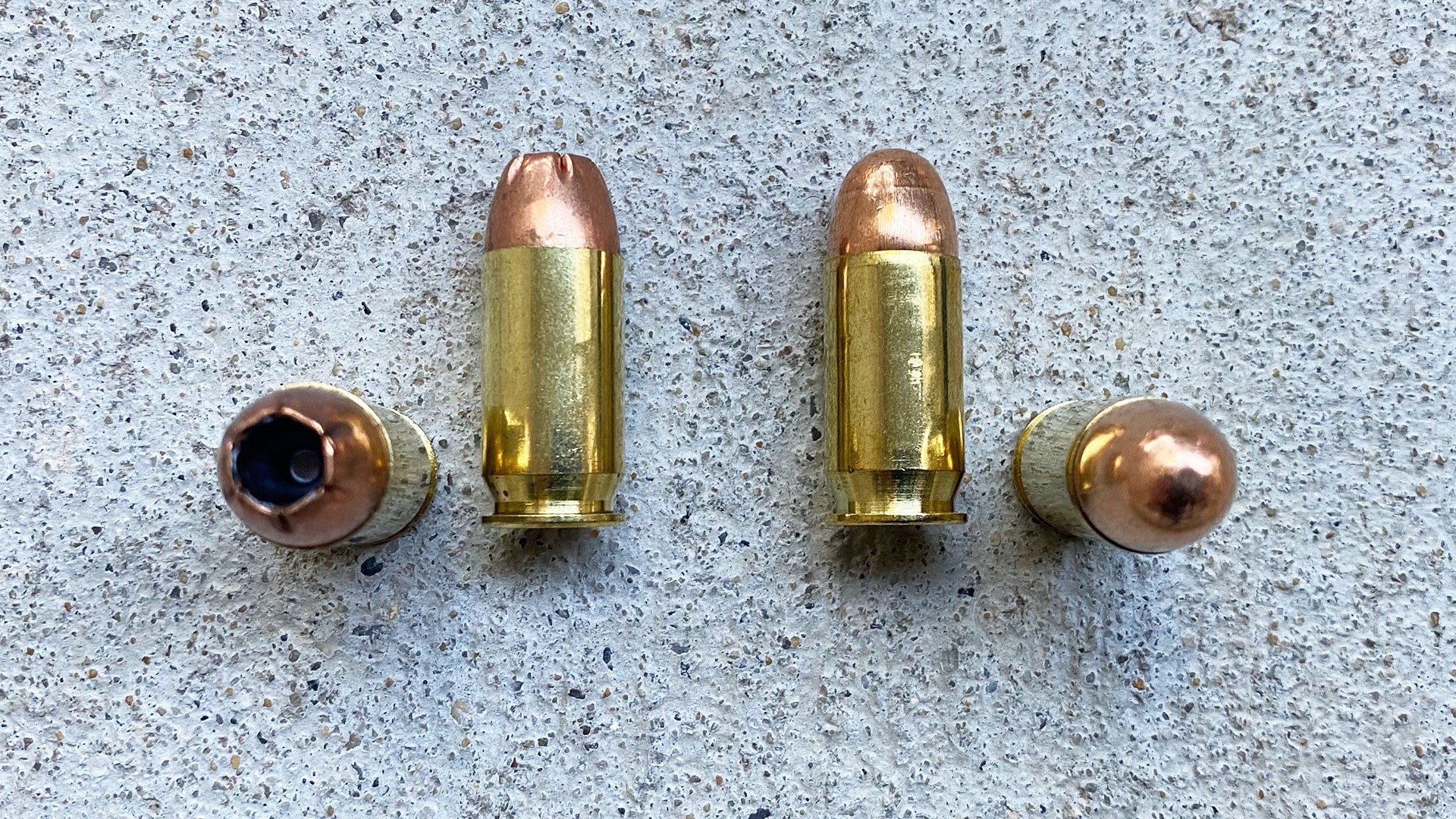 Remington 230-grain JHP .45 ACP loads (left), compared with Winchester 230-grain ball loads.
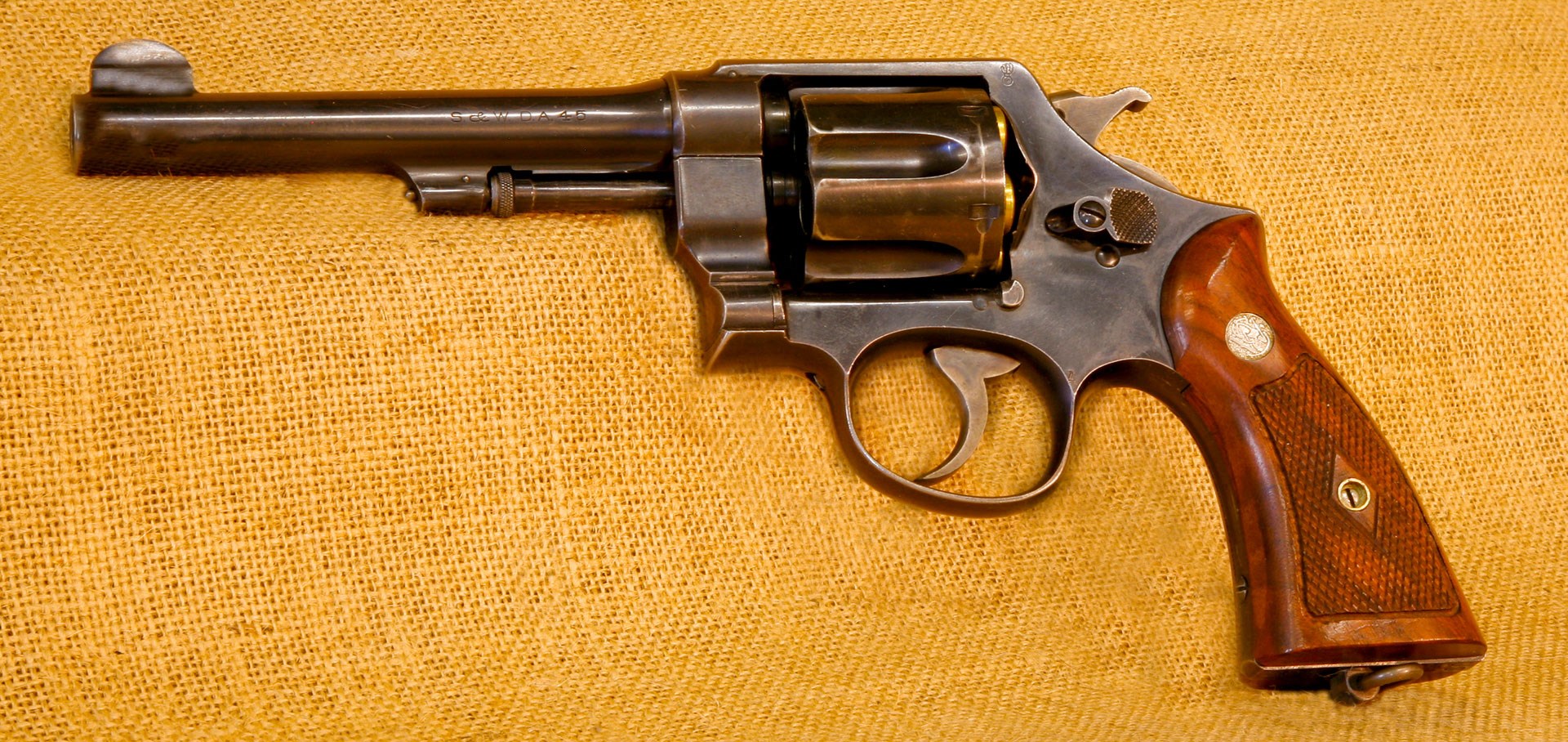 A Smith & Wesson Model of 1917 service revolver chambered for .45 ACP.
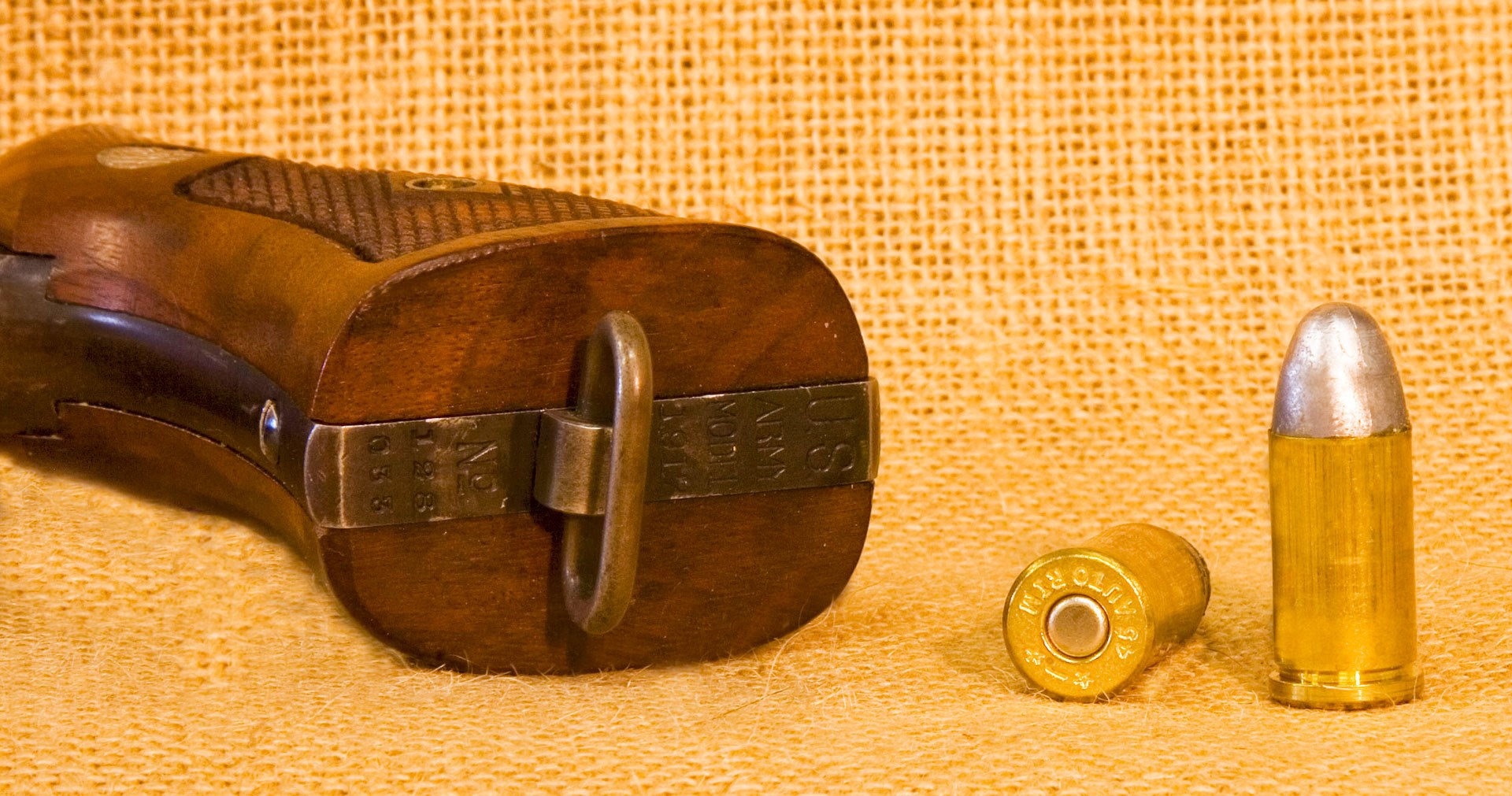 Two .45 Auto Rim cartridges, designed to work in revolvers like the S&W Model 1917 without the need for moon clips.