Category: Ammo
Categories
Artillery Ammunition Comparison (by Caliber)

For those who enjoy hunting with Winchester lever-action rifles, we’ve got a pair of fantastic cartridges for this comparison, purposely suited to their particular rifles, with enough horsepower to fill the role of an all-around cartridge. The latter decades of the 19th century saw Oliver Winchester’s company dominating the repeating rifle market, with John Browning-designed Models 1886, 1892, 1894, and 1895. Millions of Model 1894s—later known simply as the Model 94—would see the deer woods each year, and the Model 1886, chambered in cartridges such as .33 Winchester and .45-70 Government, would become known as one of the strongest lever guns ever made.
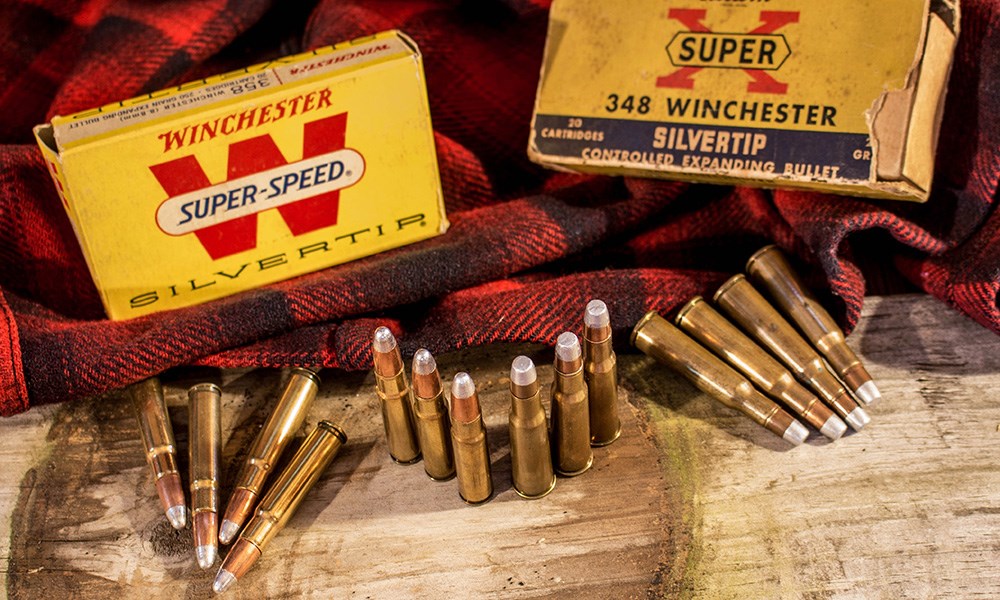
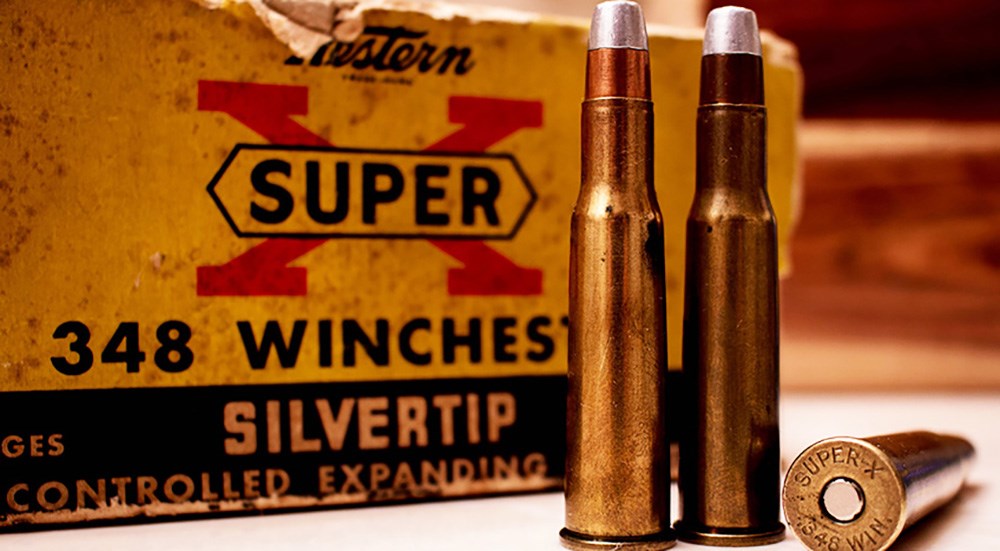
Looking to upgrade the Model 1886, due to sales dropping off, Winchester developed the other half of their premium rifle duo: the Model 71. While the ’86 came in a number of different cartridges, the Model 71 would be chambered for a single, new cartridge—the .348 Winchester—with a handful of very rare exceptions. Based on the .50-110 blackpowder cartridge, necked down to hold bullets of nominal diameter, the rimmed .348 Winchester offered ballistic flexibility, with three different bullet weights offered in the factory-loaded ammunition. 150-, 200-, and 250-grain bullets were loaded, at muzzle velocities of 2890, 2530 and 2350 fps respectively.
While the 200 is what has survived, it was the 250-grain bullet that was reached for when the animals got large. The cartridge uses a 19-degree, 10-minute shoulder, culminating in a neck which gives excellent tension, though because of the tubular magazine of the Model 71 the bullets are crimped firmly in place. With a case measuring 2.255 inches and an overall length of 2.795 inches, the .348 predominately uses flat or round nosed bullets to prevent a magazine detonation. With a cartridge generating between 2,700 and 3,000 ft.-lbs. of muzzle energy, the .348 Winchester was well-suited to a top-eject lever gun, which predominately relied on iron sights.
The Winchester Model 71—in the Standard and Deluxe Grades—lasted from 1936 to 1958, when it was discontinued. It was replaced by a revolutionary new design—the hammerless Winchester Model 88, with a three-lug rotating bolt lockup very similar to a bolt-action rifle. This allowed for the use of more powerful cartridges, as well as allowing for the use of a scope mounted low, over the bore thanks to the side ejection. Initially offered in the relatively new .308 Winchester, it was soon available in the new-fangled .243 Winchester, and the cartridge designed to supplant the .348 Winchester: the .358 Winchester.
Simply the .308 Winchester case necked up to hold .358-inch-diameter bullets—much like the .30-06 Springfield necked up will yield the .35 Whelen—and using the same 20-degreee shoulder for headspacing, the rimless cartridge fed perfectly from the Model 88’s box magazine, as well as the in the Model 70 and Savage Model 99. Pushing a 200-grain bullet to 2475 fps, and a 250-grain bullet to just about 2300 fps, the .358 Winchester makes a great medium-range cartridge, well-suited to black bears, elk, and even moose, while handling deer and similar-sized game just fine.
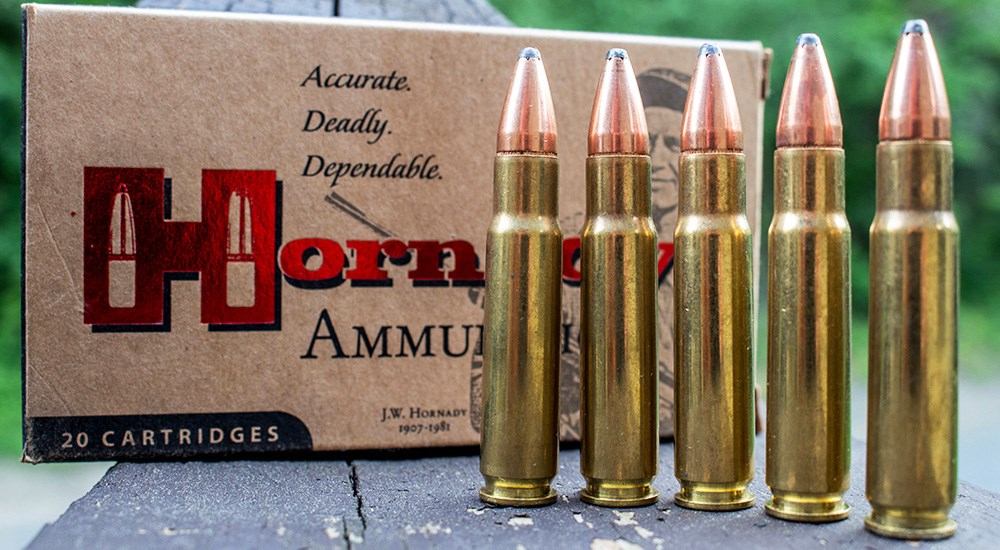
The issue with both cartridges is the lack of choices when it comes to factory-loaded ammunition. While both remain as effective as they were upon their release—and for the majority of hunting situations inside of 150 yards they work perfectly—they have been regulated to nostalgic pieces at best. But not all cartridge choices are about practicality; if so we’d all be shooting a .30-06 Springfield. Should you be fortunate enough to find a Winchester Model 71 in good shape, and I know I’d have a hard time laying off that purchase, you’ll need a supply of .348 ammunition. You could easily say the same about a Model 88 or Model 70 in .358 Winchester, though a competent reloader can, quickly and easily, convert .308 Winchester or .338 Federal brass into .358 Winchester, and there are all sorts of good .358-inch-diameter bullets available for handloading.
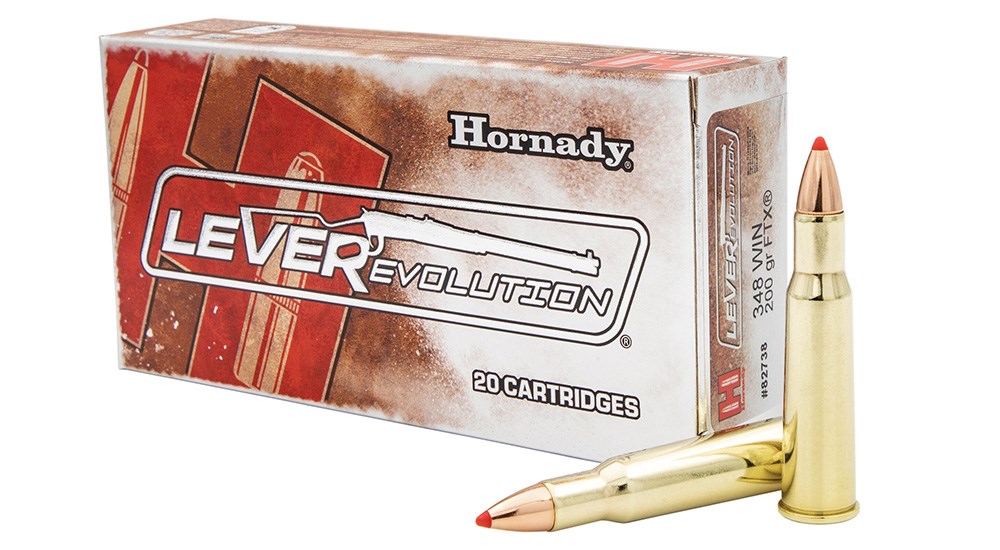
Hornady is the one major manufacturer offering ammo for both cartridges, with the 200-grain FTX loaded in the LEVERevolution line for the .348 Win., and the 200-grain InterLock in the Custom ammo line for the .358 Win. Checking the Winchester website, neither cartridge is offered any longer, though they had been just a few years ago. There is always the boutique option, with Buffalo Bore and Choice Ammunition offering ammo for both cartridges.
While we are comparing the pair of cartridges, the rifle does, in my opinion, come into play. The attractive lines and classic profile of a Winchester Model 71 lend some weight to the .348 Winchester, though a pre-’64 Winchester Model 70 Featherweight in .358 Winchester or the unique Model 88 in .358 Winchester doesn’t exactly suck. The differences are entirely subjective.
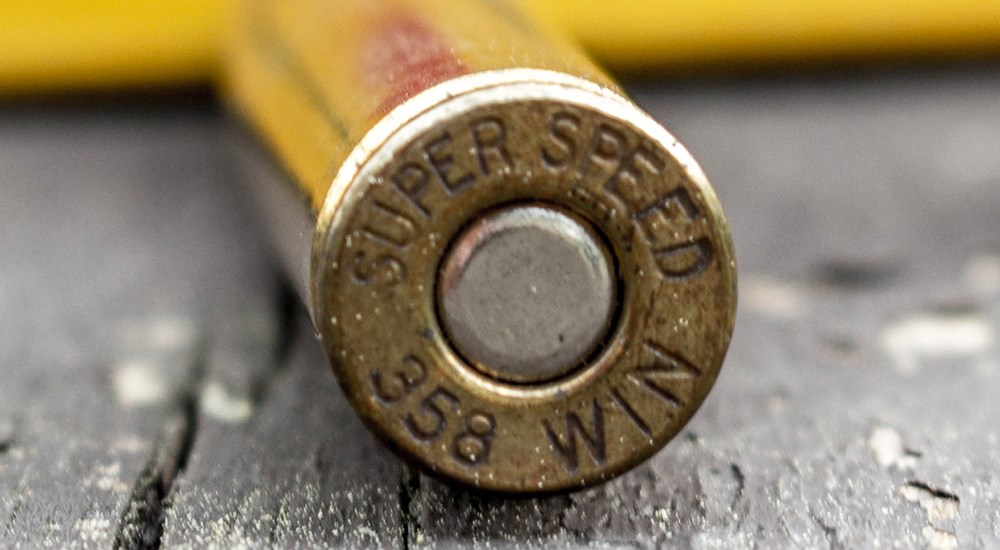
Performance-wise, I don’t think the 75 to 100 fps difference between the two cartridges would matter much to any game animal. The frontal diameter advantage—albeit slight—goes to the .358 while the sectional density advantage swings back to the .348; no obvious winner based on those criteria. What might seal the deal is the sheer number of available projectiles in .358-inch-diameter. Simply put, you can use the pistol bullets for the .38 Special and .357 Magnum for plinking and practice, while taking full advantage of the rifle projectiles for the numerous .358-inch cartridges. The .348 Winchester is the only cartridge in that bore diameter, and while that’s part of the mystique, it can also be a handicap. Yes, there are good bullets available, like the 200-grain Swift A-Frame and the Barnes Originals 250-grain lead core flat point, but the choices pale in comparison to the .35-caliber choices.
Accordingly, my practical nature gives the nod to the .358 Winchester, for the flexibility and ease of creating brass cases. That said, a well-worn Model 71 in .348 Winchester is one of those bucket-list rifles, and I’m always on the prowl for a deal, hiding in the dusty corner of a gun shop.

Categories
Some more red hot gospel!


The metric system has always been poorly received here in the United States, while having been adopted nearly the worldwide. We often struggle to adopt the metric cartridges—save the 7mm Remington Magnum and the more modern 6.5 Creedmoor—sometimes renaming them to something more familiar feeling. Many of the European bores have been renamed—the 7mms are .280, .284, .275 and the 6mms are .243 and .244—and some have been shunned altogether. The 9.3mm cartridges are one example; while the .375 H&H Magnum and similar cartridges have become favorites among the American shooting populous, the majority are unfamiliar with the slightly smaller 9.3mm cartridges. From the 9.3x62mm and 9.3×64 Brenneke to the 9.3x74R, this family of cartridges is often overlooked here in America, yet they make a great choice for the hunter. When is a 9.3mm not a 9.3mm? When the name is Americanized to the .370 Sako Magnum.
The 9.3mm bore equates to .366-inch, and sitting in between the .358-inch bore—which Americans have loved for so long—and the highly wide-ranging .375-inch bore is not a bad place to be, at all. Otto Bock’s 9.3x62mm Mauser, having been released nearly a century before the .370 Sako Magnum, affords a healthy following throughout Europe, and also in those African countries which were former European colonies. Designed for use in the 98 Mauser, the 9.3x62mm works just fine in that classic bolt-action rifle. Wilhelm Brenneke introduced his 9.3x64mm Brenneke in 1927, giving a boost in velocities for those who preferred the repeating rifles, giving performance on par with the .375 H&H Magnum in a rifle with a shorter receiver.
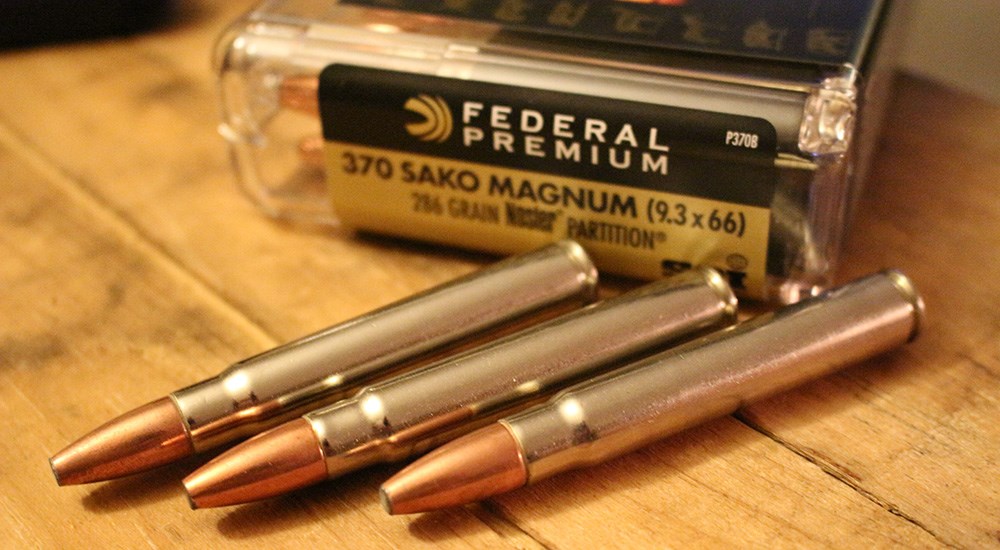
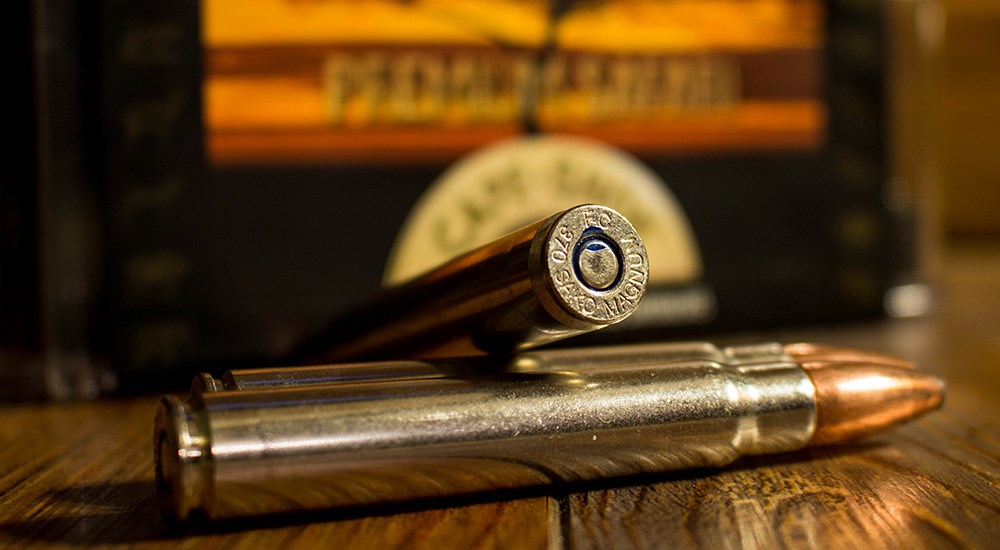
In 2003, the Finnish firearms manufacturer Sako released their own variant of the 9.3mm rimless cartridge: the 9.3x66mm Sako, or as it is known here in America, the .370 Sako Magnum.
It is, in essence, an elongated version of the 9.3x62mm Mauser, sharing many of the same characteristics in a longer format. It has the same 0.473-inch rim diameter common to the Mauser family of cartridges (carried over to a significant number of our American cartridges, including the .30-06 Springfield and .308 Winchester), and uses a 17 ½-degree shoulder; the .30-06 Springfield uses the same shoulder angle, and the 9.3x62mm uses a 17-degree shoulder.
Like the 9.3x62mm, the .370 Sako Magnum has a neck length of 0.307 inches; this is less than the desired one-caliber in length, and many reloaders insist on using a stout roll crimp to keep the projectiles where they put them, instead of relying on neck tension alone. With a case length of 2.598 inches (read 66mm) the .370 Sako offers an increased powder capacity when compared to the 9.3x62mm, yet the longer case maintains the 3.340-inch cartridge overall length common to a standard, long-action receiver.
Federal Premium loads the 286-grain bullets in the .370 Sako Magnum at a muzzle velocity of 2550 fps, generating 4,129 ft.-lbs. of energy at the muzzle. Comparing this to the classic 9.3x62mm, you’ll see the shorter cartridge launching the same bullet at 2360 fps, for 3,537 ft.-lbs. The .370 Sako Magnum is often (and rightfully) compared to the .375 H&H Magnum, which uses a 300-grain bullet at velocities ranging from 2440 fps to 2530 fps, delivering 4,000 to 4,250 ft.-lbs. of energy at the muzzle.
There are some African countries which specify a minimum of .375-inch bore diameter for hunting dangerous game, but in those countries where the 9.3mm cartridges are legal, I would have no qualms using the .370 Sako Magnum. The .375s will have a slightly larger frontal diameter, but the 300-grain .375 bullet and the 286-grain 9.3mm bullet share the same sectional density (S.D.) value of 0.305; any bullet with a S.D. value over .300 is considered to be a good choice for dangerous game work.
Looking at the trajectory of the .370 Sako Magnum (in the guise of Federal’s 286-grain Swift A-Frame load), a 200-yard zero will see the bullet striking 2.5 inches high at 100 yards, 10.1 inches low at 300 yards, and 30 inches low at 400 yards. This results in a rather flexible package; while the .370 Sako Magnum might not shoot as flat as a .300 Winchester Magnum with a sleek spitzer boattail, its trajectory isn’t radically different from the .30-06 Springfield, and makes a good choice for a bull moose across the swamp, a bull elk across a canyon, a Cape buffalo in the jesse, or a kudu in the rooibos.
The 9.3x64mm Brenneke can deliver slightly higher velocities than the .370 Sako Magnum by about 50 fps but the case dimensions are unique, and will require a unique bolt face which will result in a more expensive rifle. Does the .370 Sako Magnum have a future? Well, it absolutely should, as it delivers performance on par with the beloved .375 H&H, in a package which can hold one additional round in the magazine, in a lighter rifle. I also find the recoil of the .370 Sako Magnum to have less recoil than does the .375 H&H, and not much more than that of the 9.3x62mm.
Of late it seems the popularity of the .370 Sako has all but disappeared. Federal Premium still has two loads listed (and currently available) on their website: a 286-grain Swift A-Frame and a 286-grain Woodleigh Hydrostatically Stabilized Solid, both at 2550 fps. Other than the Federal ammo, you’d have to either handload the .370 Sako or contact one of the boutique ammo shops to make your ammunition. Despite the lack of popularity, if I found a Sako Model 85 chambered for the .370 Sako Magnum and it fit me well, I wouldn’t hesitate to take that rifle for any of the bigger game species.