Category: Ammo

Reloading success for the .30 Luger was achieved with Redding dies and
the Lee Factory Crimp die — after plenty of experimenting!
Late last year I was trying to organize my reloading room a little better and as I was checking out my cabinet full of reloading dies I stumbled on both .30 Luger and .30 Mauser dies. A thought came to mind as to whether I could fit a 9mm-chambered 1911 with a barrel chambered in .30 Luger and be able to use the same magazine. It turns out you can!
The next step was to contact Bar-Sto to see if they could make a barrel for my 9mm 1911 Springfield Armory chambered in .30 Luger, also known as the 7.65 Parabellum. They just needed to know which 1911 it would be used in and whether I wanted a standard or a match barrel, with the latter requiring fitting. I went for the former and when it arrived I took everything over to my gunsmith at Buckhorn Gun where they proceeded to fit it tightly with a new bushing. We were able to use the same recoil spring.
This was the easy part! The headaches began when I started reloading. I gathered up proper Hornady and Sierra .30 bullets, ordered 500 brand-new Starline brass cases and did my load homework. I already had two sets of dies so I figured everything would work fine. It didn’t. I had many problems getting cartridges to feed no matter what I tried. I even had 0.005″ taken off the bottom of my sizing die so I could adjust it to push the shoulder back.
I tried different settings, took 0.002″ and 0.005″ off the shell holder, with the only result being fired cases showing excessive headspace. Success did not come until I put the old dies away and ordered a new set of Redding .30 Luger dies and a Lee Factory Crimp die. Success! All worked once I got the settings right.

The .30 Luger compared to the 9mm. Who’d a-thought this would work?But it did!
Now I only had trouble with the first cartridge out of the magazine seating into the chamber. I was taught at least 60 years ago to pull back the slide on a semi-auto pistol and let it go to chamber the first round. Success with this operation came when I began letting the slide go forward on its own when releasing the slide stop. For some reason, this worked.
For powders I chose Accurate #2, Accurate #5 Accurate #7 and the old standby, Unique. I also tried several factory loads and found some of the modern loads — at around 1,050 fps — wouldn’t operate the slide. An old box of Remington Kleanbore .30 Lugers clocked out at over 1,250 fps and worked perfectly. With this info, I came up with different powder charges to begin my experimenting. When I began hitting muzzle velocities in the high 1,100’s and mid-1,200’s, everything came together. Some of my best loads for both function and accuracy were the Sierra 85-gr. bullet over 4.5 grains of Accurate #2 for 1,250 fps and a 5-shot 20 yard group of 11/4″ and the same bullet over 5.0 grains of Unique for 1,300+ fps and a solid 1″ group.
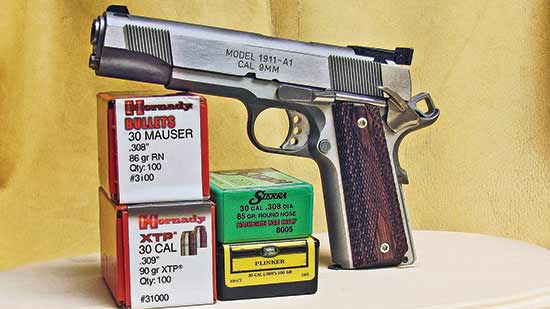
Bullets are easy to find for the .30 Luger. John had good luck with all of these.
Dialing In
Switching to the 86-gr. Hornady with 6.0 grains of Accurate #5 resulted in a 1″ group with a muzzle velocity of 1,235 fps. Five grains of Unique with the same bullet clocked out at 1,333 fps delivering a 11/2″ group. I’ve finally settled on the 90-gr. Hornady as my favorite bullet. With 4.5 grains of Accurate #2, velocity is over 1,250 fps with a resulting 11/4″ group. I hit the really sweet spot with this bullet using 5.0 grains of Unique for right at 1,300 fps and it’s my most accurate load at 7/8″ for five shots at 20 yards.
The .30 Luger is such an easy shooting cartridge it really puts fun into shooting. The .30 Luger is especially appreciated since my “shoot-big-bores-all-day” era is long gone! It’s certainly not a first choice for self-defense, but for varmints and small game — and especially the great sport of plinking — it’s right at home. Bar-Sto can supply high quality barrels for converting 9mm Luger 1911’s to .30 Luger, and brass is also easily obtainable from Starline. How fun is that!
COLUMBUS, Ohio (WCMH) — The Columbus Division of Police is missing around 160,000 rounds of ammunition meant for their officers.
Columbus police said it was stolen from a warehouse on the west side earlier in April. When the division noticed the delivery was short, it contacted the shipping company — who said everything had shipped. The ammunition was stolen before making it to CPD’s facility.
The stolen ammunition was meant for rifles.
Two men involved in another warehouse theft in March are linked to this incident, according to Columbus police.
“The two individuals that have been charged have actually been charged with theft or receiving stolen property out of that initial warehouse that occurred the week prior to the theft of the ammo,” Deputy Chief Smith Weir said. “Those cases have been joined, and we are working collaboratively between the property, crimes bureau, and then some of our other units of detectives.”
32-year-old James Scaff and 36-year-old Christopher Kimmel are charged with theft, according to court records.
But Columbus police are still on the hunt for the missing ammunition, and asked anyone who might have seen it to call them right away — particularly if you have purchased 5.56 ammo in recent weeks.
“If you bought it from someone you know, if you saw it on social media marketplace, if you’ve gone to a gun show and you’ve seen it, we would just like you to let us know,” Weir said. “We track the lot numbers and try to find the ammunition, we will be interested to see where it turns out.”
CPD personnel was questioned, and the division said on their end, all procedures were followed.
—————————————————————————————- Sounds to me to be an inside job & good luck getting any of it back. Grumpy
Categories
358 Winchester in a BLR, Accuracy?
Categories
S&W Model 25-5 .45 Colt Chapter 2
Categories
How Effective Is .40 S&W?

In 1912, Holland & Holland introduced the term “magnum” to describe what was then an oversized cartridge case designed to provide greater velocity and terminal energy over the then-standard cartridges of the day. The .375 H&H Mag. was head and shoulders above the so-called medium bores of the day. Its 2.85″ length and 0.513″ base diameter created a capacity of 95 grains of water. The cartridge was a winner then and remains a standard today.
However, like most inventions, people try to improve on the original. It didn’t take long for Holland & Holland to neck down the .375 H&H Mag. to .30 caliber—about 13 years—and produce the .300 H&H Mag. The .300 H&H Mag. was a marked improvement at the time over the standard .30-’06 Sprg.—some 300 f.p.s. faster with the 180-grain bullet—but it required a rather long, heavy and often expensive action to house it.
Fast forward to 1956 when Winchester took that 2.85″ case and shortened it to 2.500″, blew it out to .45 caliber, and thus created the first “short magnum” cartridge, the .458 Win. Mag. Seven years after that, Winchester debuted the .300 Win. Mag.—necking down the .458 Win. Mag. to .30 caliber and giving it a rather short 25-degree shoulder angle. The .300 Win. Mag. was an immediate success and has become one of the best open-country big game cartridges for so-called thin-skinned game.
Nonetheless, the tinkerers continued to tinker. They wanted a shorter bolt throw, a lighter action—and rifle—and that belt at the rear of the case had to go. Most handloaders resized their cases to headspace on the shoulder, like most cartridges do. The belt was deemed superfluous, so in the late 1990s, Winchester engineers started looking for a fatter case without a belt to base a new “short magnum” cartridge. They took the old .404 Jeffery case, shortened it to 2.1″—a smidgen more than the .308 Win.—put a 35-degree shoulder on it and christened it the .300 Winchester Short Magnum (WSM). Debuting at the 2001 SHOT Show, it generated a fair amount of interest. Winchester immediately began developing other WSM cartridges, beginning with the .270-cal. and 7 mm WSM cartridges.
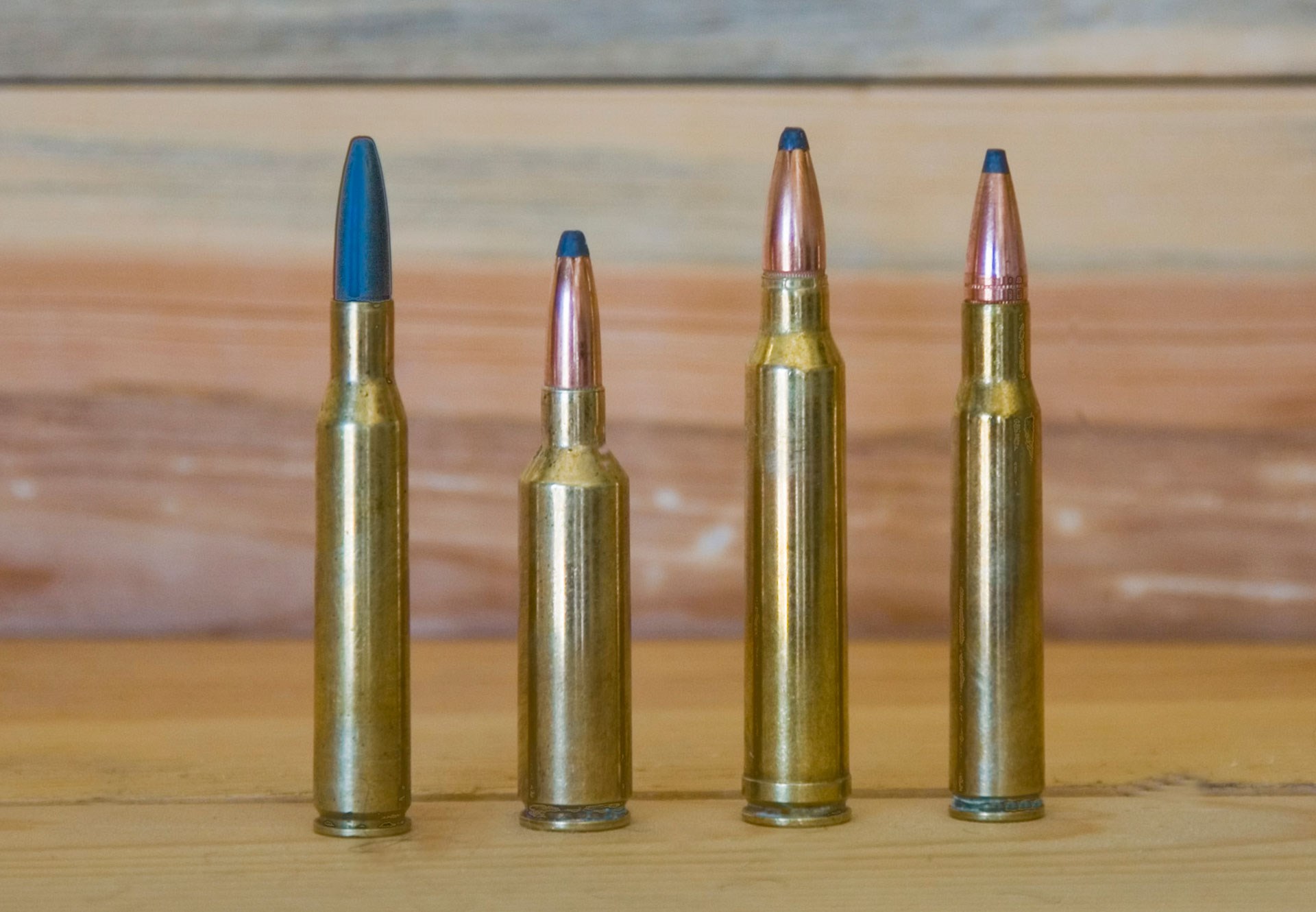 A comparison, from left to right, of the .270 Win., .270 WSM, .300 Win. Mag. and .30-’06 Sprg.
On Sept. 11, 2001, I was privileged to be on the first hunt with the .270 WSM near Monticello, Utah. As the twin towers fell, we were unaware of the havoc being ravaged on our country some 2,000-plus miles from us. When we found out about the attack, air travel had been shut down across the country. Phone lines back to the east were hopelessly overloaded. There wasn’t much for us to do but to continue our hunt. I knocked down a nice mule deer buck a day later from a distance of 265 yards by rangefinder.
The .270 WSM and 7 mm WSM were introduced to the public at the 2002 SHOT Show. Still later, a .325 WSM was spawned. Wildcatters went nuts necking the “new” WSM cases up and down through the dimensional spectrum—everything from .22- to .375-cal.—but the .270 WSM seems to have shaken down to be the best of the WSMs, judging by its acceptance. In my opinion, here’s why:
When Winchester necked down the .30-’06 Sprg. to accept .277-cal. bullets in 1925, it initiated a bullet speed race that continues to this day. The .30-’06 Sprg. had the tremendous advantage of being the standard U.S. military rifle cartridge of the time, and surplus ammo along with needed components were both cheap and plentiful. As such, the .270 Win. gained a fairly quick and widespread acceptance with hunters throughout North America. It is a fast, relatively light-recoiling and accurate round that—once good bullets were designed to operate at its velocity (3,100 f.p.s. for the 130-grain bullet)—could be counted on to reliably take big game up to and including elk. That, and the fact that it was regularly touted by Jack O’Connor, one of the most admired outdoor and hunting journalists of the day for more than 40 years, ensured its embrace into the bosom of American riflemen and hunters.
The .270 WSM was not the first improvement of that caliber. Roy Weatherby introduced his .270 Weatherby in 1943, but it never caught on as much, mostly because Weatherby’s cartridges are proprietar, and therefore had less distribution than could be had with heavy hitters like Winchester and Remington. That’s not to ding the Weatherby cartridges; they are accurate, fast and very effective on game, but the proprietary nature simply meant that only the well-heeled or avid aficionado would use them. The .270 WSM comes very close to the .270 Weatherby in performance, and does so in a smaller and more lightweight package. Weatherbys need a 26″ barrel and longer, heavier actions to achieve their speed. The .270 WSM is in a shorter action with a 24″ barrel, and is less costly.

In terms of performance, the .270 WSM is one of the relatively rare instances where the published data is pretty close to real-world numbers. Most claim about 3,290 f.p.s. with a 130-grain bullet and 3,250 f.p.s. with a 140-grain bullet. My Winchester Model 70 Featherweight in .270 WSM clocks in 3,260 f.p.s. with a Berger 130-grain hollow point bullet, and 3,225 f.p.s. with 140-grain Barnes TSX bullets. As an experiment, when Barnes came out with the 110-grain TSX, I was able to get 3,488 f.p.s. before chickening out. That load, by the way, shot like a laser to 400 yards before dropping quickly, and was like a death ray on pronghorn.
My experiences with both the .270 Win. and its newer brother are not exhaustive. Nevertheless, they do seem to be indicative of the experiences other hunters have had with these cartridges. I’ve taken probably eight pronghorn, close to a dozen mule deer and whitetails along with a couple of elk, including the one pictured in this article. That bull was killed in the Scapegoat Wilderness of Montana with a 140-grain TSX at 80 yards, and dropped in its tracks after a three-hour marathon calling contest. The most common claim regarding the .270 WSM is, “It’s like the .270 Win., only better.” That rifle has become my go-to for pronghorn and open-country deer.
No, the .270 WSM isn’t in any top-10 cartridge popularity lists that I am aware of. The .300 WSM edges it out a bit, and cartridges like the .270 Win., .30-’06 Sprg., .300 Win. Mag. and even the 7mm Rem. Mag. outsell it. Of course, those cartridges have a 60- to 90-year head start. But I still like it.