Categories
Category: Ammo

Over the years, cartridges come and go, and some even rebound in and out of popularity like the 10 mm Auto pistol cartridge. But every so often, a cartridge makes a name for itself and upholds a reputation that isn’t soon forgotten, even a century after introduction. However, the modern updates do have some advantages that may be worth investigating.
As a hint, all of these modern cartridges fit in a short action as one advantage, among others. This saves weight, adds magazine capacity, speeds cycle time, and you can even see improvement in barrel life, all of which are key benefits as we’ve upgraded technology and updated our rifle cartridges and chamberings. With that said, assume most of those perks come with the territory of going with the modern cartridge.
6.x55 mm Swede vs. 6.5 mm Creedmoor
Something special was born on the Scandinavian Peninsula in 1894: the 6.5×55 mm Swede. Now going strong for 128 years, the cartridge will push a standard 140-grain bullet to around 2,700 f.p.s., which matches the much-more-modern 6.5 mm Creedmoor cartridge. So what does a cartridge 113 years newer provide? With modern BC values in the Creedmoor, energy won’t be a problem. When it comes to availability, it’s difficult to find a company that doesn’t produce at least one 6.5 mm Creedmoor load. Plus, the Creedmoor case is designed a little more efficiently and can withstand higher pressures than the Swede case, making it a bit more versatile. But, it’s worth noting that most big-name ammunition companies, like Hornady—which developed the 6.5 mm Creedmoor specifically for long-range shooting in 2007—make both a 6.5×55 mm Swede and 6.5 mm Creedmoor load that use the same exact bullet advertised at identical velocities.
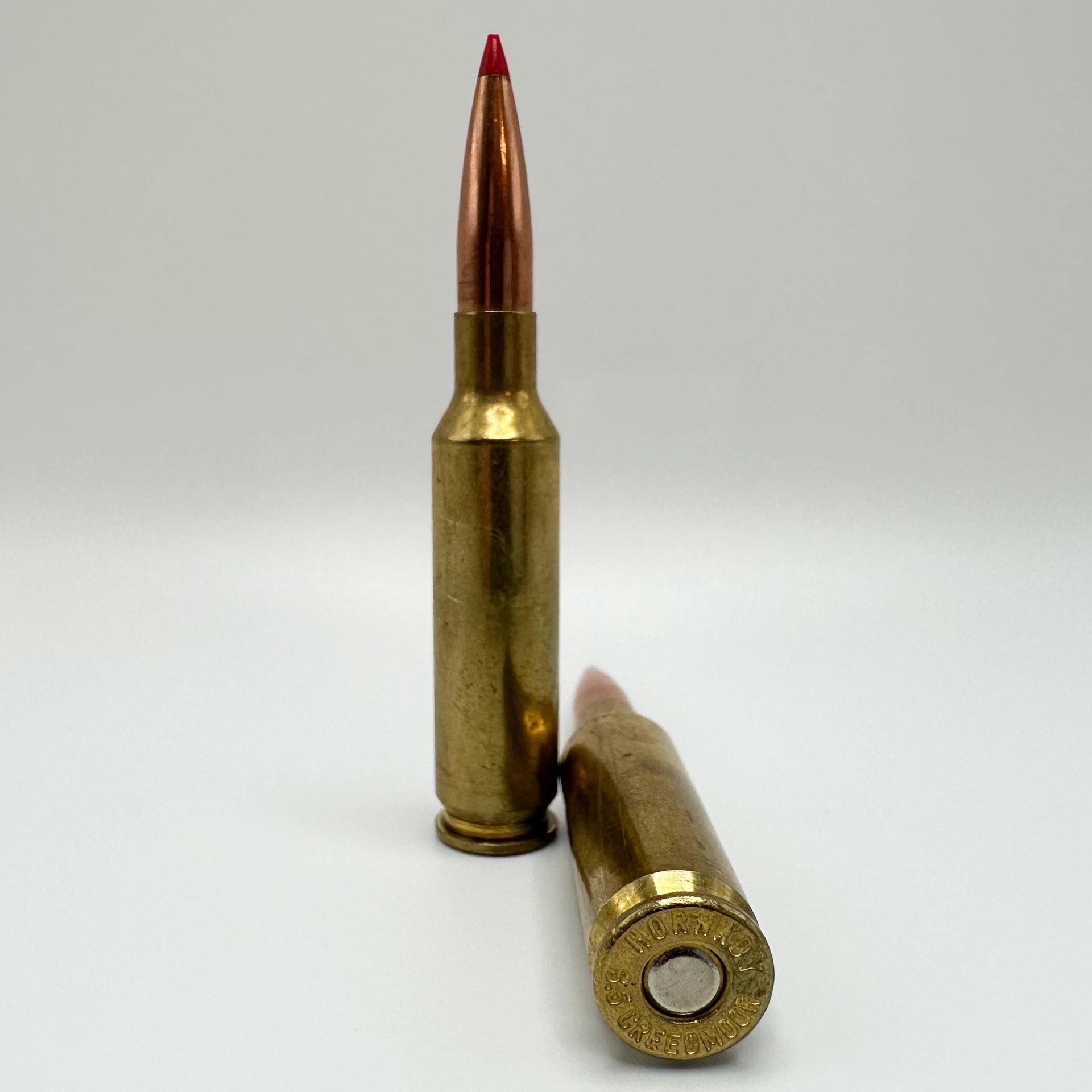
7×57 mm Mauser vs. 7 mm-08 Rem.
Much like the 6.5×55 mm Swede, the 7×57 mm Mauser, Peter Paul Mauser’s second cartridge design, came about before the turn of the 20th century in 1892. The cartridge initially used bullets on the heavier side of the weight spectrum, with the standard bullet coming in at 173 grains. Often known in British circles as the .275 Rigby, the cartridge was also loaded with lighter bullets in the 140- to 160-grain weight range to improve velocity for the British customers, and the throat was shortened slightly to decrease bullet jump. However, by the time 7 mm-08 Rem. hit the market in 1980 and ammunition components had improved, the much larger case capacity lost its edge.
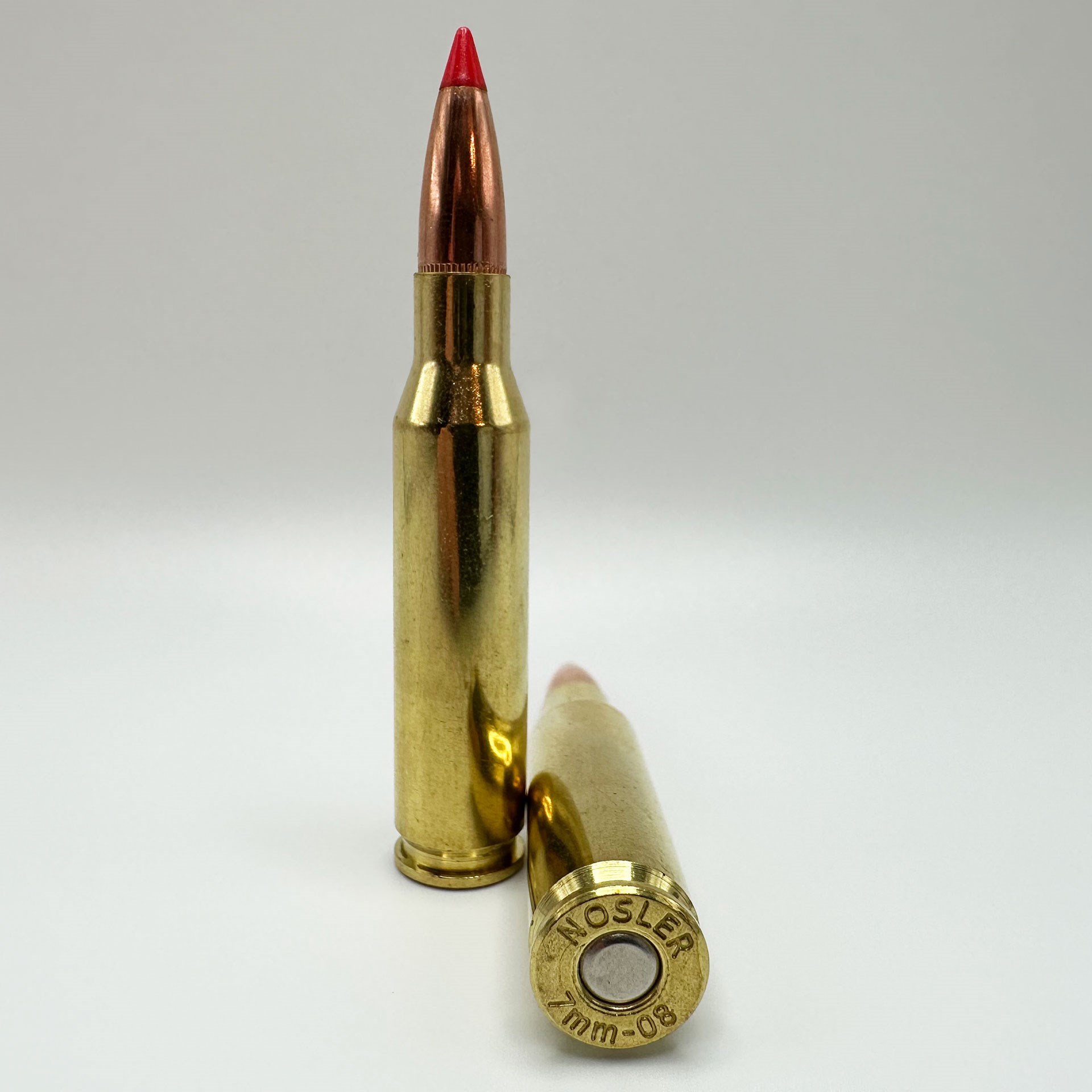
Factory loads, like Nosler’s 150-grain AccuBond Long Range Trophy Grade ammo, has made the 7×57 mm Mauser nearly obsolete. With modern powders, even heavy bullets can be reloaded in the 7 mm-08 Rem. to various degrees of success without losing much velocity. For example, using Hodgdon’s 6.5 Sta-BALL powder, trajectories matching the 6.5 mm Creedmoor can be achieved using bullet weights previously reserved for .308 Win. match-style bullets. Comparatively, the 7×57 mm Mauser, while it can still use the same bullet weights and even the same powder, falls a couple hundred feet per second short of the 7 mm-08 Rem.
.30-’06 Sprg. vs. .308 Win.
I’d be surprised if the readers of American Rifleman didn’t see this one coming from 1,760 yards away. But for those who are new, here’s a quick lesson on America’s beloved .30-cal. darling. The .30-’06 Sprg. was created in 1906, making it the “newest” of the old cartridges on this list, and it was the first U.S. service cartridge to use the concept of a sleek, aerodynamic spitzer-style bullet, compared to the old round-nose bullet from the previous century. It was also used by some of the most renowned firearms enthusiasts in U.S. history, including Teddy Roosevelt and Ernest Hemingway, and the tried-and-true .30-’06 Sprg. is still a plenty-capable round 116 years later. Yet the original loadings didn’t carry the mass they do now, which is why the .308 Win. was touted as the cartridge’s “modern” replacement when it was released almost half a century later in 1952.
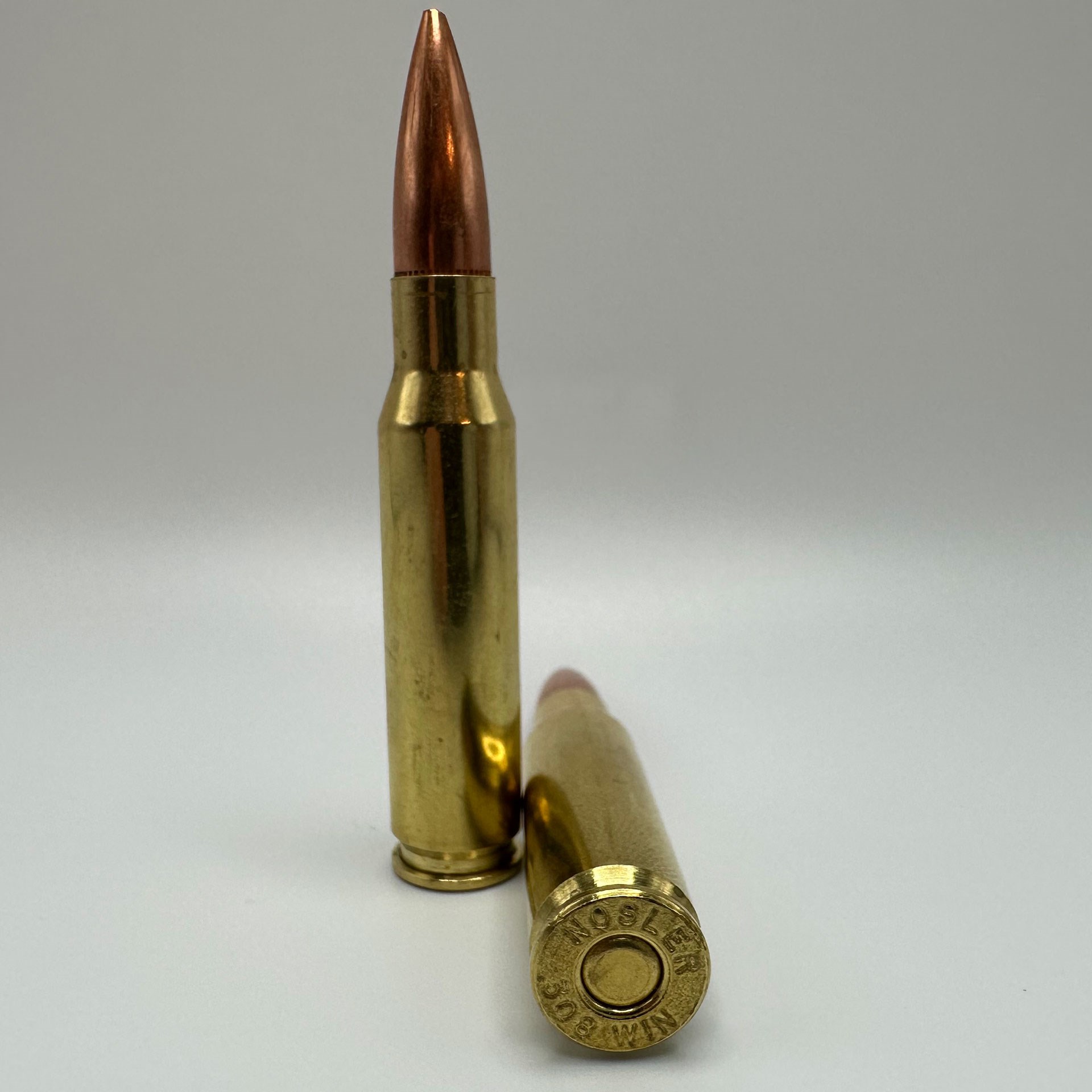
That said, to do a fair comparison, we’ll only reference the older cartridge ballistics to keep within the theme of this article. The original .30-’06 Sprg. loads used a 150-grain bullet traveling at a now modest 2,700 f.p.s. However, .308 Win. loads nowadays will do that and more, reaching nearly 3,000 f.p.s. using the same bullet weights. When attempting to match the velocity of the initial .30-’06 Sprg. loads, one could still load typical modern 168-grain match bullets—which now have much better ballistic coefficients—to provide better trajectories, energy transfer and velocity retention across the board.
7.92×57 mm Mauser vs. .338 Federal
This one is unique in that these cartridges do not use identical caliber measurements for their respective loadings. The old-school 7.92×57 mm Mauser, or 8 mm Mauser as it’s also known, is the second oldest cartridge on this list, created in 1888 by Peter Paul Mauser. One interesting thing to note about the 8 mm Mauser is that the cartridge changed bore diameters as it aged, starting with a diameter of .318” initially, then changing to .323” later in 1905. The standard loading utilized a 196-grain bullet moving along at 2,500 f.p.s.
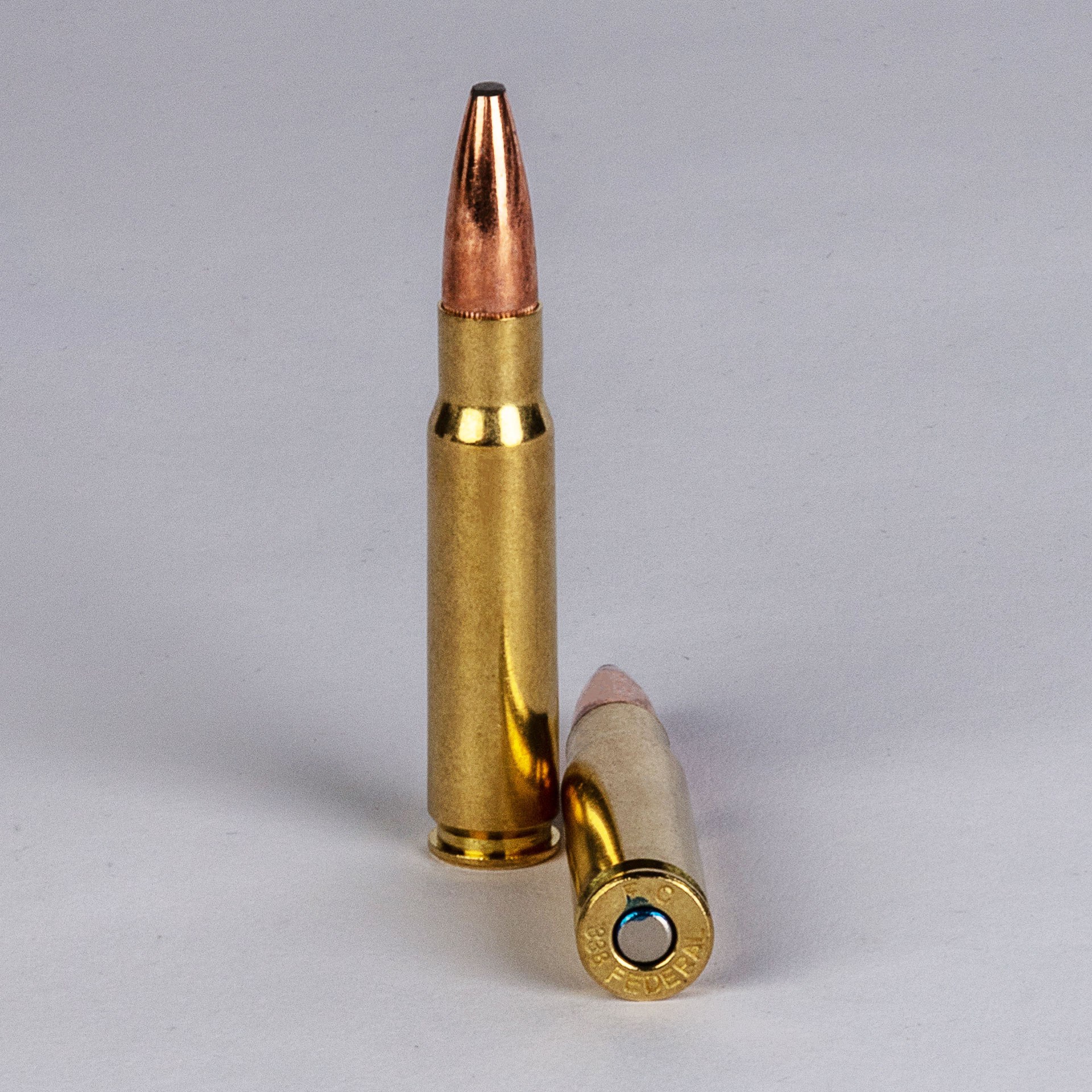
For those looking for a step up in performance, the .338 Federal is the ticket. Designed by Federal Ammunition in 2006, the round launches 200-grain bullets no slower than 2,600 f.p.s. (depending on the load) from any one of Federal’s ammo offerings; the fastest load tops out at 2,700 f.p.s. Shooters will also technically get a larger entry hole, but nothing noticeable to the naked eye. It’s an added benefit all the same, on top of more velocity, more energy and a flatter-shooting round.
.45-70 Gov’t. vs. .458 SOCOM
The oldest cartridge on this list: the .45-70 Gov’t. This should come as no surprise, as it’s the only cartridge on the list to make the transition from the antiquated days of blackpowder cartridges to the modern era of smokeless powders. Initially fielded for military use in 1873, the .45-70 Gov’t. cartridge is still loved both from a capability standpoint as well as a historical one. For the unfamiliar, the original .45-70 Gov’t. load propelled a 405-grain bullet to 1,400 f.p.s. using blackpowder. More modern loads involving smokeless powders tend to go a bit leaner on weight, pushing 300-grain bullets to just under 2,000 f.p.s.; that’s a significant improvement over the .45-70 Gov’t. blackpowder cartridges.
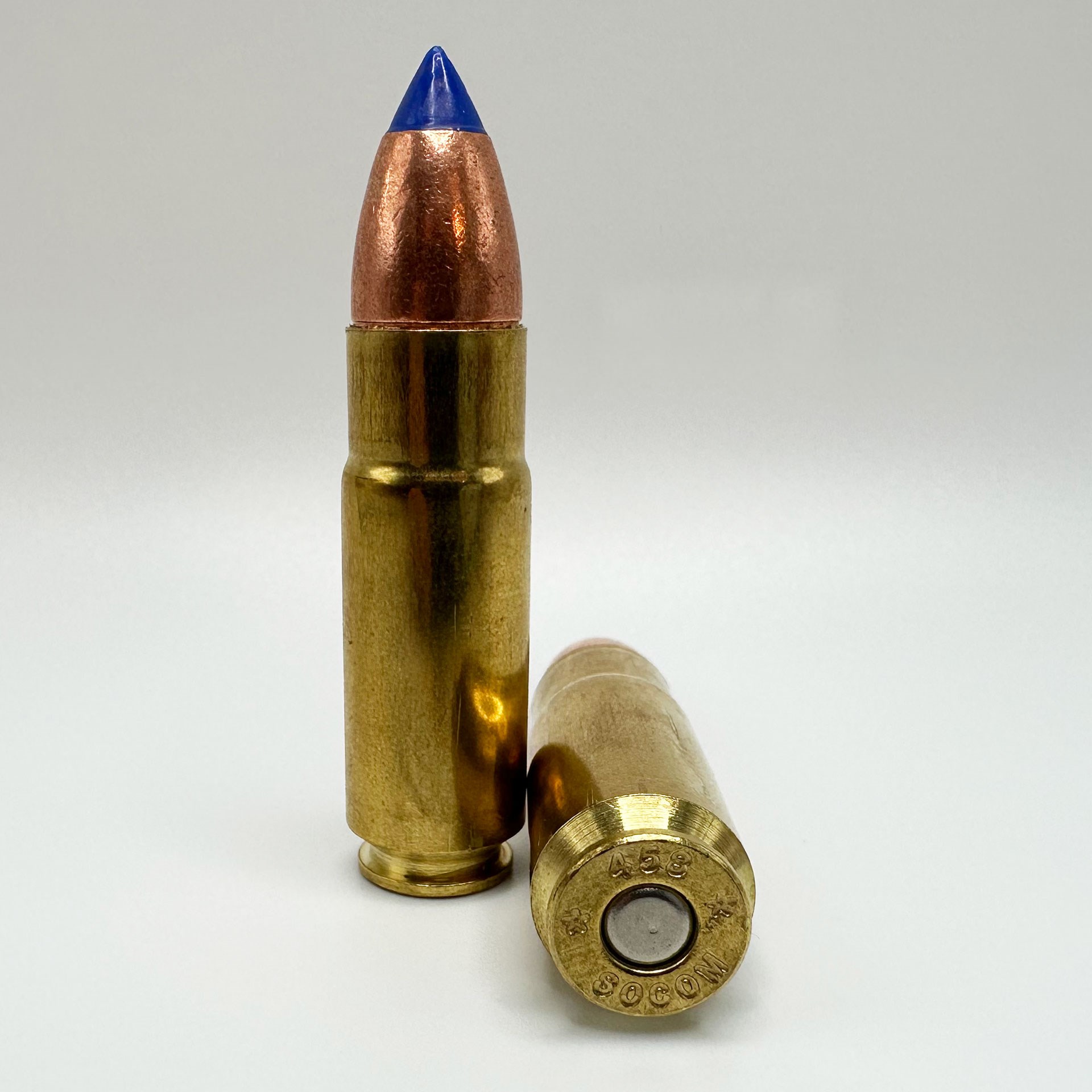
More impressive, though? A cartridge introduced in 2002 can do what the .45-70 Gov’t. does, but fits in America’s favorite black rifle, the AR-15, with nothing more than a barrel swap (though uppers by companies like Rock River Arms will do, too). Pushing 400-grain and 300-grain bullets to speeds around 1,600 f.p.s. and 1,900 f.p.s. respectively, the .458 SOCOM, ironically also designed by and for military purposes initially, puts the time-tested .45-70 Gov’t. not just into a smaller gun, but increases magazine capacity, which, when we’re talking about hundreds of grains in bullet weight in each cartridge, is incredible. It should be considered, however, that magazine capacity for a 5.56 NATO is cut by two thirds when swapping over to a .458 SOCOM, and that there are 7,000 grains in a pound. Also recall that a single .458 SOCOM’s bore diameter is roughly twice that of a 5.56 NATO bullet, and a 300-grain bullet packs on nearly five and a half times the weight of a 5.56 NATO M193 55-grain bullet.
With those numbers in mind, using a standard-capacity magazine, the total bullet weight loaded into a magazine with 5.56 NATO rounds is 1,650 grains in lead-slinging potential. Total bullet weight in a magazine loaded with 10 .458 SOCOM rounds? Nearly double that, at 3,000 grains, or almost half a pound in bullet weight alone. Put 500-grain .458 SOCOM ammunition into a magazine with one in the pipe, and you’re fitting to take over ¾ of a pound in bullet weight with you. Now try fitting 10 rounds of .45-70 Gov’t into a rifle using any bullet weight. Not happening. What’s more, shooters can carry a system that can swap those 10 rounds out for a fresh batch in a matter of seconds.
Why Still Shoot Century-Old Cartridges?
This probably raises the question of why we should even bother with older cartridges? For one, there’s something to be said about the fact that these cartridges still exist. That in and of itself is a testament to their utility. Have we made improvements, and in some ways all but obsoleted these ancient rounds? Sure, but if they weren’t still used, they wouldn’t have lasted this long and still be in production. Secondly, there’s a “cool” factor to using these cartridges in old rifles. Some collectors may scoff or ridicule you, but making a shot or taking a game animal with a cartridge over 100 years old is pretty impressive.
Lastly, it’s important for historical reasons; if we didn’t have these older cartridges before, we wouldn’t have something to build from and compare to when we were coming up with the more modern designs. For example, people still talk about the ballistic miracle the 6.5×55 mm Swede is, the historical context Paul Mauser gave firearms from his contributions, the wars fought with the .30-’06 Sprg., and the cultural icon that the .45-70 Gov’t. became due to the tales of buffalo hunters and Western lore. Without these cartridge’s accomplishments from the past, our present cartridges wouldn’t be so incredible.
Categories
Wildcat Cartridges That Went Legit

It may be hard to believe, but hundreds, if not thousands, of wildcat cartridges have been created through the years, and several books have been devoted to the topic. A couple of my favorite titles, both of which were written during the late 1940s, are Wildcat Cartridges by Richard F. Simmons and Woodchucks and Woodchuck Rifles by Charles S. Landis. Creating cartridges that offered performance unavailable from commercial ammunition-at least in the minds and perhaps the hands of their creators-got its start among varmint shooters during the late 1800s and peaked about three decades later. Today’s hunters, varminters and target shooters continue to develop cartridges with certain exceptional characteristics, claimed to be superior to available factory loads, but the golden era of wildcatting is long gone.
Some wildcats of yesteryear were no more complicated than changing the neck diameter of an existing factory cartridge case. An example is Parker O. Ackley’s .17 Pee Wee, formed by necking down the .30 Carbine case for 0.172-inch bullets. Moving to the opposite extreme in difficulty, we have Ackley’s .228 Belted Magnum. After special dies were used to swage a head-spacing belt on the .30-’06 Sprg. case, it was shortened, necked down and then fire-formed to minimum body taper and a sharper shoulder angle. As unforgettable names go, the .170 Landis Rimless Super Eyebunger may take the cake. On the .30 Rem. case, it was created by Charles S. Landis-who was probably responsible for the demise of more woodchucks than anyone before or since his time.
A few wildcats became so popular that their fans believed them destined for high-volume factory manufacture, but very few actually made it. During the 1940s, the .219 Donaldson Wasp on the .219 Zipper case absolutely dominated a new shooting sport called benchrest competition while the .22-3000 Lovell on the .25-20 Single Shot case was the apple of varmint shooters’ eyes all across America. Then in 1950 came a new factory cartridge called .222 Rem., and both wildcats were soon forgotten.
Here is a look at a few of the wildcats that beat the odds and continue in commercial production.
.22 Hornet
Loaded with blackpowder and a lead bullet with a nominal diameter of 0.226 inches, the 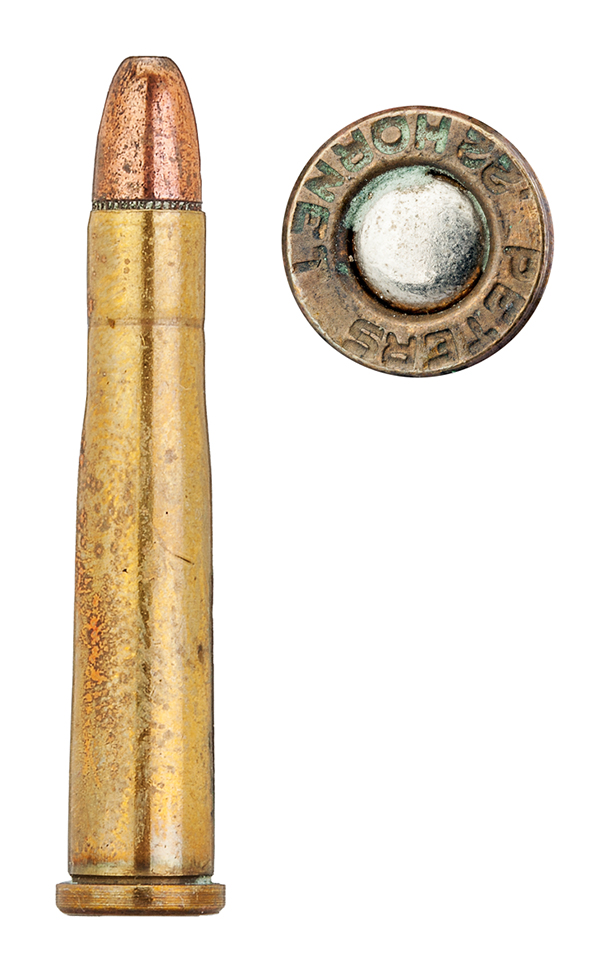 .22-13-45 Winchester Centerfire (WCF) was introduced in 1885. During the late 1920s, G.L. Wotkyns, A.L. Woodworth and G.A. Woody, who were associated with Springfield Armory in Massachusetts, decided to load the .22 WCF case with smokeless propellant and jacketed bullets made for the .22 Velo Dog pistol cartridge. Since the 1922 Springfield barrels they used had a groove diameter of 0.223 inches, the bullets were drawn down to that diameter.
An article written by Wotkyns on the new cartridge was published in the June 1930 issue of The American Rifleman, and Col. Townsend Whelen followed up with his report on the cartridge in the January 1931 issue. Soon thereafter, the Hercules Powder Co. developed a propellant specifically for the cartridge and, since it increased velocity to 2400 f.p.s., it became known as No. 2400. And so the .22 Hornet was born.
In 1930, Griffin & Howe introduced custom rifles in .22 Hornet built on 1922 Springfield actions converted to center-fire. Other actions were also used; one in my battery was built during the 1930s on a single-shot conversion of the 1898 Krag by Adolph Niedner. Winchester began loading the .22 Hornet in January 1931, and the first factory rifle chambered for it was the Savage Model 23D in 1932. It was followed by the Winchester Model 54 in 1933. The barrels of those and other early rifles have a groove diameter of 0.223 inches while later rifles are 0.224 inches. This is why Sierra and Hornady continue to offer 40- and 45-grain bullets in both diameters.
Early rifles as well as some made today have a rifling twist rate of 1:16-inch, which is too slow to stabilize bullets longer than 0.535 inches. And 0.535 inches just happens to be the length of the Sierra 45-grain Hornet. The Kimber Model 82 of yesteryear had a faster 1:14-inch rate of twist, as does the present Ruger Model 77/22H. They will stabilize heavier bullets but due to the relatively low velocities allowed by the small case, thin-jacketed 40- and 45-grain bullets designed specifically for the .22 Hornet are best for use on varmints.
I fell in love with the .22 Hornet when, at a very early age, I discovered how much farther away a friend’s Savage Model 219 would bag a crow than my Marlin 39A in .22 Long Rifle. That led to eventually collecting rifles chambered for the little cartridge. I still have a few of them with my favorite (and most accurate) being a custom Winchester Model 54 built during the 1930s by the Hart Arms Co. of Cleveland, Ohio.
.257 Roberts
The team of N.H. (Ned) Roberts, F.J. Sage and rifle builder Adolph Niedner are usually 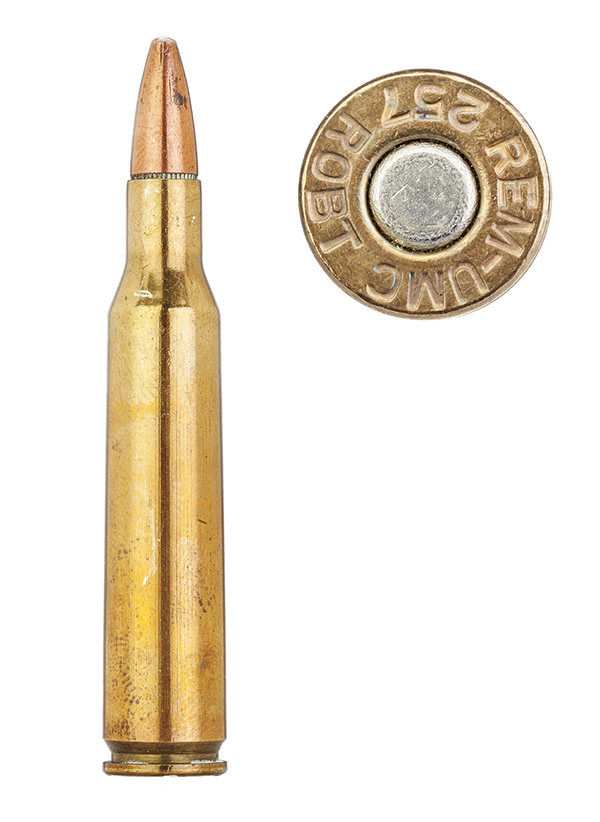 credited with being first to neck down the 7×57 mm Mauser case to .25 cal. At the time, L.C. Welden, who was the chief ballistician at Hercules during the 1920s, considered a case shoulder angle of 15 degrees (about the same as for the .30-30 Win.) to be ideal for the quick-burning propellants available during the 1920s; so that’s what the team used for their wildcat. Niedner built the first rifles in .25 Roberts, and by the early 1930s it was also available in rifles built by Griffin & Howe.
There are actually three different versions of the cartridge. When Roberts formed the original, he necked down the 7×57 mm case and slightly shortened its neck. When Griffin & Howe started building rifles for it, the 15-degree shoulder angle was retained but the case was left full length and the chamber neck reamed accordingly. Remington began loading the cartridge in 1934 and introduced it in the company’s Model 30 rifle. But prior to doing so, Remington modified the G&H version by moving the shoulder forward a bit and increasing the angle to just over 20 degrees. It also renamed it .257 Roberts.
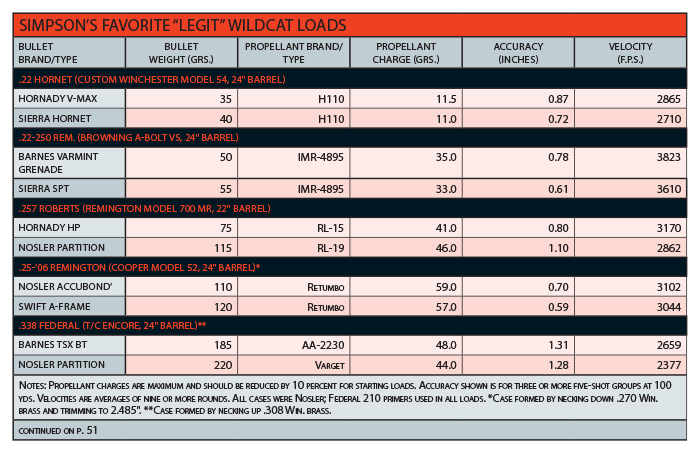
It was once a popular practice among handloaders to increase chamber throat length in rifles such as the Remington Model 30, Winchester Model 54 and Model 70 so bullets could be seated farther out of the propellant space of the case. From that technique was born the 3-inch .257 Roberts. The modification allowed heavier charges to be used for an increase in velocity, and it was a great success until Remington began loading a long-action cartridge called the .25-’06 Rem.
I have had an on-again, off-again love affair with the .257 Roberts for many years, and it has absolutely nothing to do with the cartridge. When hunting deer I prefer bullets weighing 115 to 120 grains and the 1:10-inch twist, which is standard for the cartridge, doesn’t always shoot them accurately. If ever I decide to build a rifle in .257 Roberts it will have a 1:9-inch twist rate.
.22-250 Remington
Back in the 1920s, a gunsmith by the name of Jerry Gebby spent a day with rifle designer 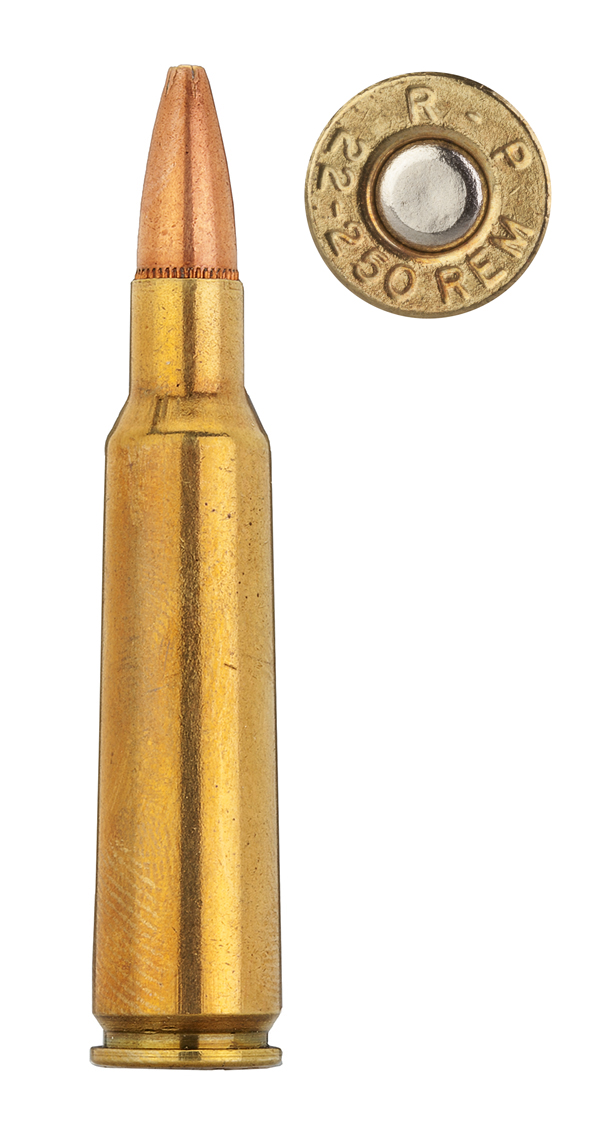 and manufacturer Charles Newton. Gebby had been superintendent at the Frigidaire unit of General Motors, which at the time was the largest manufacturer of .50 BMG barrels in the United States. Among other things, Newton had designed a couple of cartridges for Savage called the .250-3000 and .22 High-Power. He later necked down the .250 Savage case for the 0.228-inch bullet of the .22 High-Power but Savage never got around to chambering a rifle for it.
During his visit with Newton, Gebby obtained samples of several cartridges, including the .22 on the .250 Savage case. When making the decision to begin chambering rifles for it during the 1930s, he wisely chose the more readily available bullet diameter of 0.224 inches. Gebby decided to call the cartridge .22 Varminter and, in an attempt to maintain ownership of the wildcat, he had the name copyrighted. Other gunsmiths who were also building rifles chambered for the same cartridge got around that obstacle by simply stamping barrels “.22-250.”
During the late 1950s, Col. Townsend Whelen described the .22-250 as the most popular of all wildcat cartridges. Remington began loading it in 1965 but was not the first company to offer a factory rifle chambered for it. Browning had that honor, building rifles on the Sako action starting in 1963.
.25-’06 Remington
During the 1920s a number of people necked down the .30-’06 Sprg. case for 0.257-inch 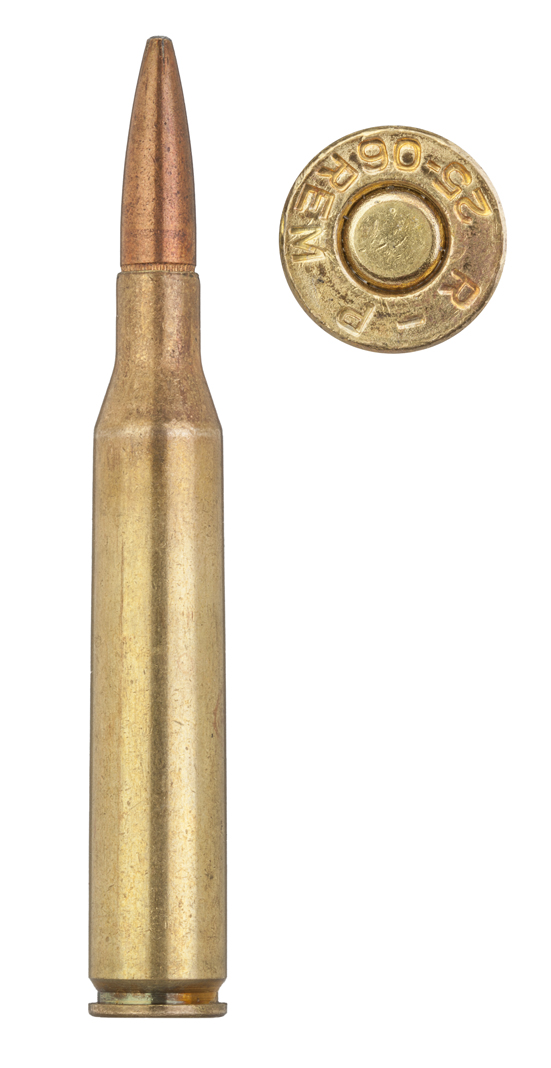 bullets, but the name most often associated with doing so has, for many years, been Adolph Niedner, the owner of Niedner Rifle Corp. of Dowagiac, Mich. He called it the .25 High Power Special and, since it was developed for long-range woodchuck shooting, his favorite load was an 87-grain bullet pushed along at 3200 f.p.s. by 44.0 grains of now-obsolete Hercules No. 20 propellant. It did not take long for big-game hunters to discover the cartridge as well and while it proved to be best suited for use on deer-size game at long range, some used it successfully on larger animals. One was oil tycoon F.H. Riggall who used a Niedner rifle in .25 Special and a 100-grain bullet at 3000 f.p.s. to take what was described as a “very large” Canadian grizzly.
The .25 Special caught on and, as other gunsmiths chambered rifles for it through the years, it became more commonly known as the .25-’06. Propellants available in the old days produced only slightly higher velocities than were possible with the smaller .257 Roberts, but that changed during the 1940s with the availability of a slow-burning, military-surplus propellant called “IMR-4350 Data Powder.” It was so called because load data for IMR-4350 could be safely used. Bruce Hodgdon, who began selling the propellant in brown paper bags at 60 cents per pound, eventually renamed it H4831 and if not for that, the .25-’06 would likely have disappeared many years ago.
I began hunting with a custom .25-’06-chambered rifle several years before Remington adopted it in 1969 and have used it to take quite a bit of game through the years. When loaded with a 75-grain bullet at 3600 f.p.s. it is potent groundhog medicine at long range; although cartridges of smaller caliber and less recoil may be better suited for that. I have friends who have taken a number of elk with the .25-’06, but it is at its very best when loaded with a good bullet weighing from 115 to 120 grains and used on deer-size game in open country.
.338 Federal
I first read about the .338 Federal almost 40 years ago when it went by a different name. 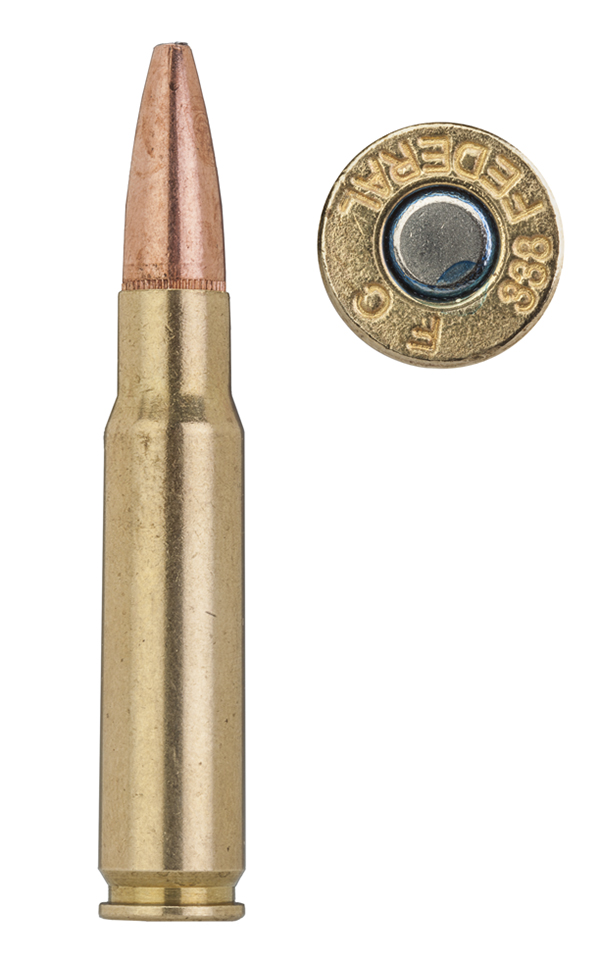 After an unpleasant encounter with a grizzly, Roy Smith decided to re-barrel his Winchester Model 88 for a cartridge he called the .33-308. In the May-June 1974 issue of Rifle magazine, Smith wrote about forming cases by expanding the necks of .308 Win. brass for 0.338-inch bullets. It was easily accomplished by running them over a tapered expander button in an RCBS full-length resizing die.
I did not get around to hunting with the .338-08 until a few months before it was introduced in 2006 as the .338 Federal. At the time no factory rifle was chambered for it, so the guys at Federal rounded up a couple of Sako rifles in .308 Win. and re-barreled them. During the 2006 Colorado season, I used one of those rifles to bag an elk with the “new” cartridge. I had the pick of two loads from Federal to use on the hunt, and since the one with the Barnes 185-grain TSX was more accurate, I chose that one.
In my opinion, the .338 Federal is great little cartridge, one with performance far exceeding what its appearance might indicate.
.338-’06 A-Square
During the late 1930s, Charles O’Neil, Elmer Keith and Don Hopkins came up with the 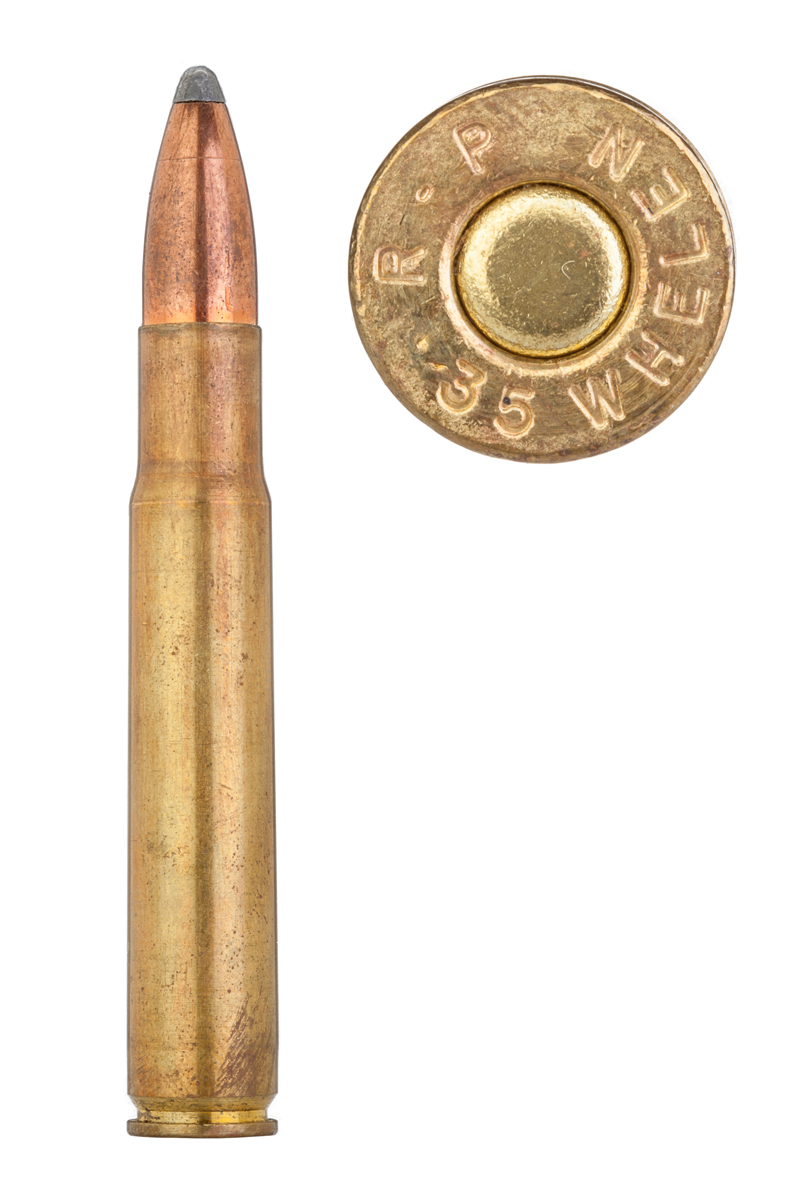 O.K.H. line of wildcat cartridges. One, called the .333 OKH was on the .30-’06 Sprg. case and used 0.333″ bullets that had to be imported from England, where they were made for the .333 Jeffery. Vernon Speer at Speer bullets eventually began offering that diameter but replaced it with 0.338 inch soon after Winchester introduced the .338 Win. Mag. in 1958. From that point on most wildcatters who wanted a rifle with .333 OKH performance switched to the slightly larger bullet and in doing so created the .338-’06.
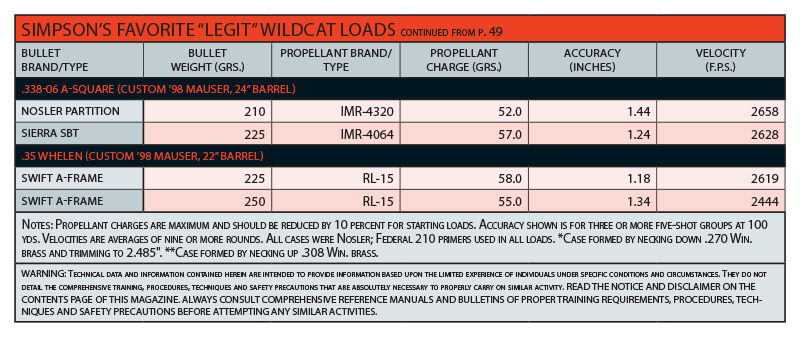
During the late 1990s A-Square’s Art Alphin received SAAMI approval of the .338-’06, and since then it has been known as the .338-06 A-Square. I have a custom switch-barrel rifle on the ’98 Mauser action with barrels in .270 Win. and .338-’06, and the latter barrel loves Nosler Custom ammunition loaded with 225-grain AccuBond bullets. Unprimed cases are available from Nosler, or it can be easily formed by necking up the .30-’06 Sprg. case or necking down the .35 Whelen case (as shown here). Plenty of loading data is available in reloading manuals from Hodgdon, Nosler, Hornady and Barnes.
The .338-’06 is a great cartridge and while it does not come as close to .338 Win. Mag. performance as some of its fans might claim, a 250-grain bullet at 2500 f.p.s. covers almost as much hunting territory with a bit less recoil.
.35 Whelen
If all the energy generated through the years by those who have debated the origin of the 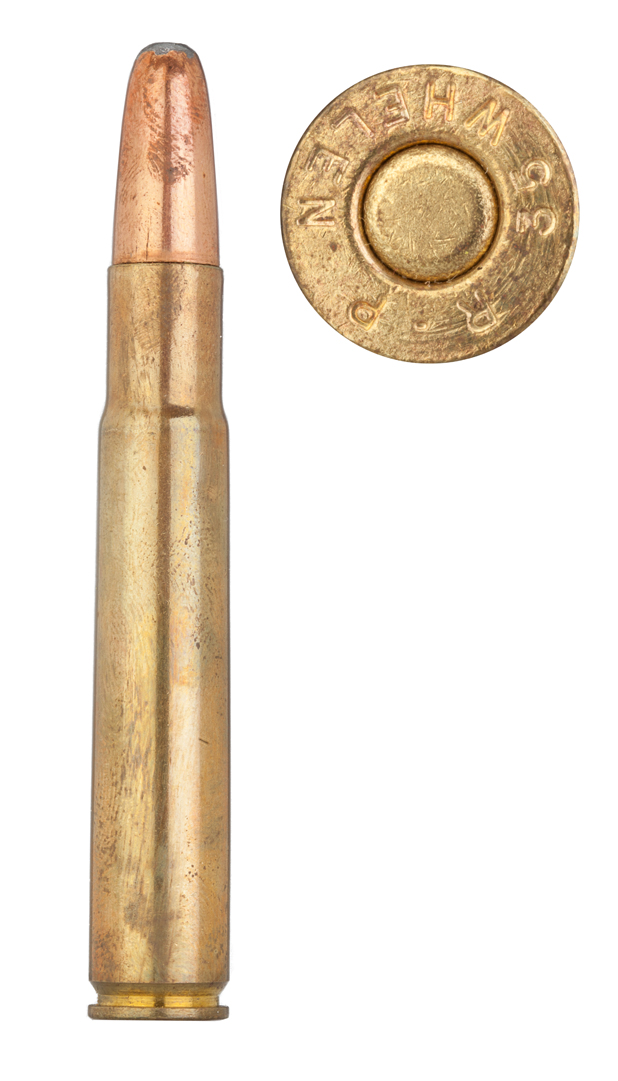 .35 Whelen could somehow have been captured and converted to electricity, it would likely be sufficient to keep all lights in the city of Casper, Wyo., burning brightly for several years. Some say necking up the .30-’06 Sprg. case for a 0.358-inch bullet was Townsend Whelen’s idea. And since the .25 Whelen, .38 Whelen and .400 Whelen were all his ideas, it only makes sense that he also created the .35 Whelen. Others opine with equal fervor that-while Whelen developed loads for the .35 Whelen around 1923-the cartridge was actually created by James Howe who named it in honor of his boss. This too seems logical since, in addition to being a gunsmith of great repute, Howe worked under Whelen while both were at Springfield Armory in Massachusetts.
I don’t have a horse in this race but I do have a copy of Whelen’s book Why Not Load Your Own (1957). In the .35 Whelen section on p. 185 he plainly writes “This cartridge was developed by James V. Howe in 1922, and was named for the writer.” That should settle the argument once and for all, but I hope it doesn’t because friendly ongoing discussions of grand old cartridges help keep them alive, and no cartridge deserves a long life more than the .35 Whelen. We should also thank Remington for giving us .35 Whelen factory ammunition and rifles chambered for it beginning back in 1988.
My favorite rifle in .35 Whelen is a custom job on the ’98 Mauser action built by Butch Searcy and stocked by the old Bishop Stock Co. Both my rifle and I are quite fond of the 225-grain Swift A-Frame pushed to 2600 f.p.s. by 59.0 grains of Reloder 15.
So there you have a few of the wildcats that have become factory-loaded cartridges. Other notables include the .17 Rem. Fireball, .22 PPC, 6 mm PPC, .243 Win., .244 Rem., .260 Rem., 6.5-284 Norma, 7 mm-08 Rem., 7 mm Rem. Mag., 7 mm STW, .300 Whisper and .416 Rem. Mag., but their stories will have to wait for another time.
FROM LEE PRECISION

There’s nothing like casting your own bullets for a sense of freedom and satisfaction.
If you’ve been around for a while, you know I love casting my own bullets! Casting bullets provides a sense of freedom and self-sufficiency akin to what our forefathers did out of necessity for their muzzleloader. I also love all things in .45 caliber. And lastly, I love inexpensive bullet molds.
When it comes to affordable bullet molds, Lee Precision is king! Their 6-cavity molds are the best bargain around. Casting a pile of bullets takes no time at all with the 6-banger molds. While I love custom molds, Lee Precision proves affordable molds can have good designs, allowing you to load excellent custom handloads. I’ve done it for years.
By now, you know I have an affinity for the .45 Colt. Despite “Duke” saying it sucks, I’m quite fond of our original brass cased .45 caliber. However, I do agree with “Duke” on the greatness of the .45 ACP and Auto Rim (AR). Their versatility cannot be denied despite shortcomings of overall length.
While their compactness is great for light and medium loads, they’re lacking for what the .45 Colt excels at; Turbo Charged loads capable of propelling heavy 300-plus grain bullets in excess of 1,200 fps. These loads are more powerful than the coveted .44 Magnum. Hell, in large-framed shooters with five-shot cylinders, the .45 Colt comes damn near .454 Casull velocities.
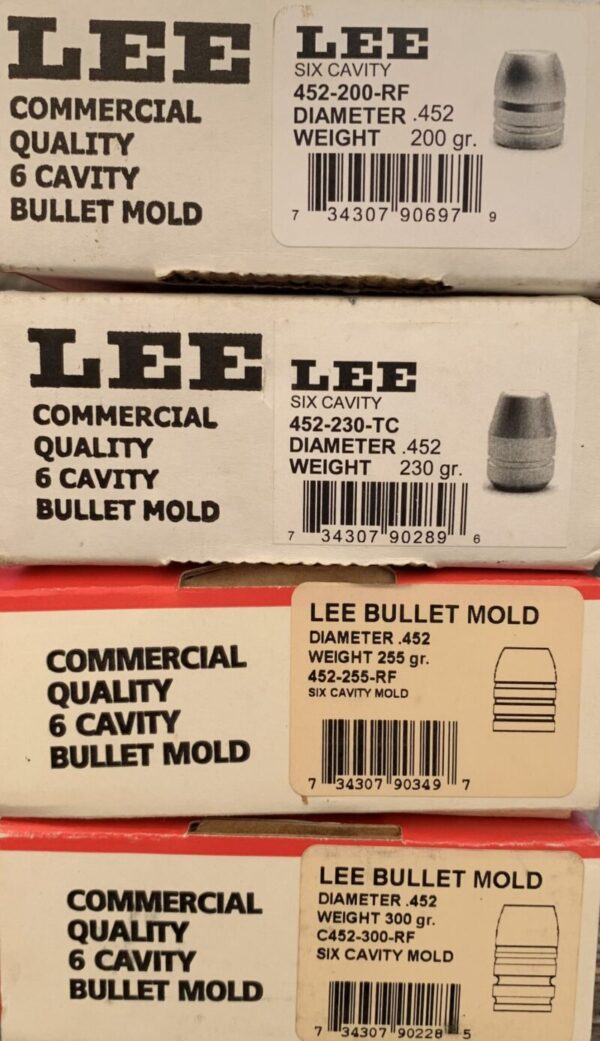
Here’s Tank’s well-used stack of Lee .45 caliber molds.
Some are over 30 years old and still dropping slugs as good as when they were new.
The Molds
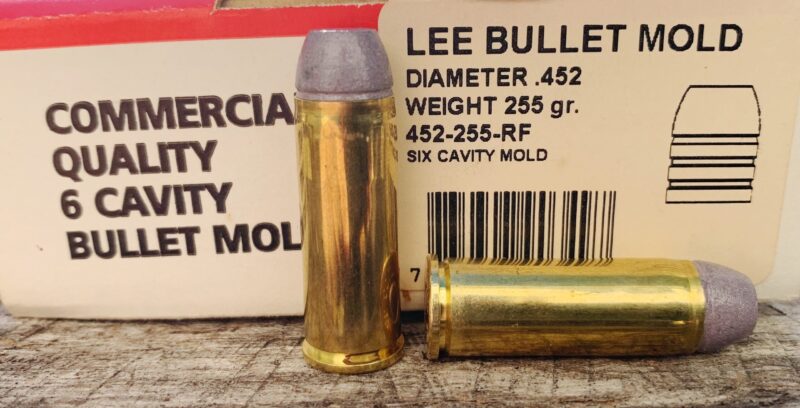
One of the first Lee molds I obtained was their .45 255-grain radiused flat-nose bullet. It is very close in profile to the Lyman 454190 slug. Loaded over 8 grains of 231 in my large-framed Rugers, it gives me just over 900 fps and is one of the most accurate handgun slugs I’ve ever shot. It also can be used in the .45 ACP/AR cases. Loaded over 7 grains of Unique, it closes in on 900 fps.

These purple powder coated poppers are perfect for .45 Colt, ACP/AR.
Big Boy
The next .45 Colt mold I got was their 300-grain radiused flat-nose slug with gas check. The nose is very wide — wide flat-nose wide. It hits hard, too! When cast of wheel weight alloy, my slugs drop at 330 grains. Loaded over a stiff charge of 22 grains of H110, sparked with a magnum pistol primer, it exceeds 1,200 fps. I’ve taken a few whitetails with this load, and it is a hammer. It is one of my favorite loads using home cast slugs from an inexpensive mold.
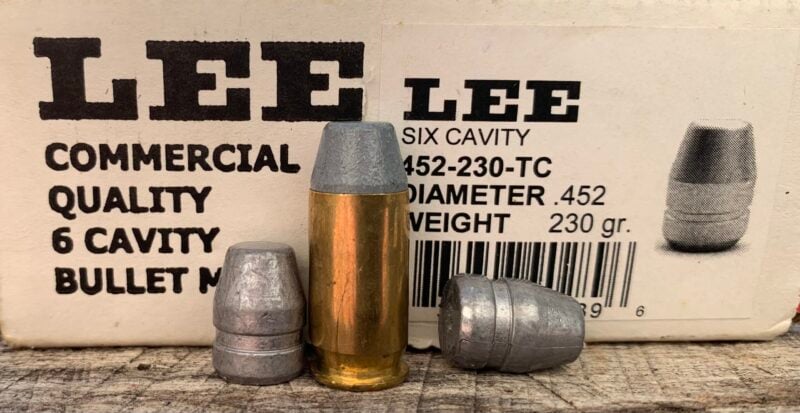
The Lee 230-grain Truncated Cone bullet feeds great in most every 1911.
It’s a popular and good choice bullet.
For the Shorties
My favorite .45 ACP bullet is the Lee 230-grain Truncated Cone (TC) bullet. It feeds like corn through a goose in most 1911s and is very accurate. Using 7 grains of Unique, or 5.3 grains of 231, velocity runs over 860 fps. I’ve even used it in the .45 Colt in a pinch, and it shoots great.
I can’t tell you how many hundreds of pounds of this bullet I’ve shot out of my .45 Colt revolvers.
It may be the most accurate of all my handgun molds.
The last bullet is the Lee 200 radiused flat-nose design. It is great for light loads in the .45 Colt and great for lighter recoiling loads in the .45 ACP/AR. Loading over 5-6 grains of 231 allows you to find the sweet spot for your gun with velocities running from low 800s to high 900s fps. I often use this bullet for gallery type, or lighter loads in the .45 Colt.

The Lee 300-grain wide flat-nose is a sledgehammer of a bullet!
Being almost full wadcutter design, it hits hard!

The Lee 300-grainer is plenty accurate too, as this 25-yard target shows.
The gun is a Mag-Na-Port custom by Ken Kelly.
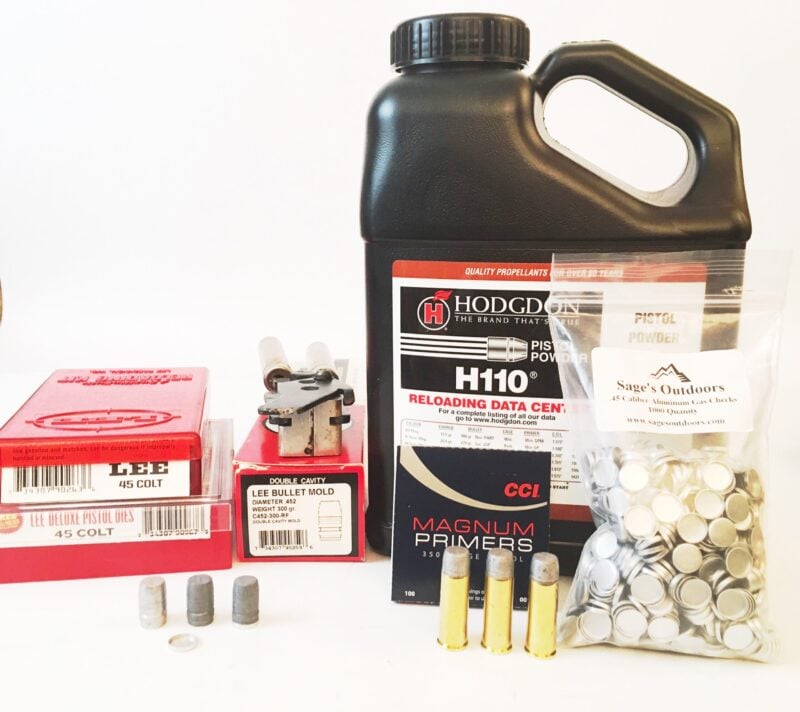
This is a minimalist of tools needed to load good ammunition — all from Lee Precision.
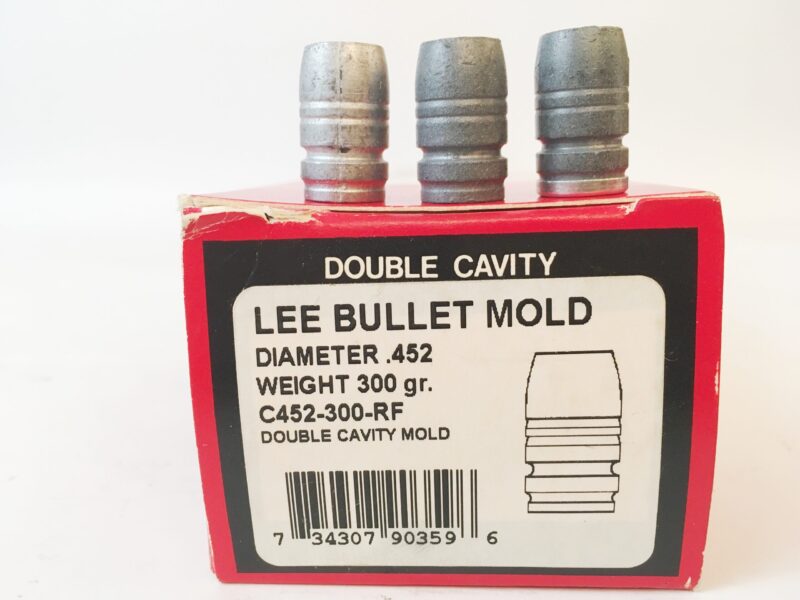
Tank first bought a two-cavity mold of this design to “try it.”
A six-cavity mold soon followed, as the bullet shot so well.
Pictured from left to rights — bullet as cast, powder coated, sized and gas check crimped on.
Give ‘Em a Try
If you want to experiment with casting, I’d give Lee Precision a try. They make affordable equipment, especially their double cavity molds. Don’t be surprised if some of the molds become your favorites.
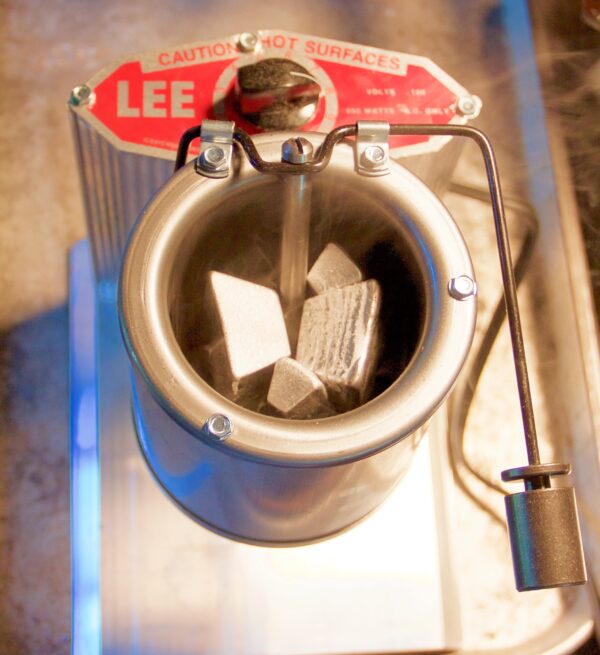
Lee Precision makes affordable casting pots too. Here’s a 10 lb. pot Tank uses
for quick, short casting sessions.

With this line up of Lee slugs, you can pretty much cover all your .45 caliber needs.
In a questionable new trend, supermarkets in the South now seem to be selling bullets right out of a dispenser.
It’s no secret that Americans love guns. Not only do nearly half of Americans say they live in a household with guns, but the U.S. beats out every other nation on Earth when it comes to gun density (the 2nd most gun-dense country is Yemen, and it’s not even close). The U.S. is actually the only country that has more guns than people. Given all that, it’s not much of a surprise that, in some states, you can now walk into a grocery store and buy bullets from a vending machine as if you were ordering a candy bar or a soda.
Well, sorta. Not quite. The vending machine company behind this new trend, American Rounds, says it uses artificial intelligence and facial recognition technologies to verify that buyers are of legal age to buy bullets. So it’s a slightly more rigorous process than buying a Twix.
There are shockingly few regulations around ammunition purchases in the U.S., but some of the few that exist are age-based. Federal law says you have to be at least 18 years old to buy ammunition for long guns, like rifles and shotguns, and if you want to buy bullets for handguns, you have to be at least 21. As such, American Rounds has created an identity verification mechanism for its bullet vending machines that can supposedly verify how old the person buying the ammunition is.
“Our smart retail automated ammo dispensers have built-in AI technology, card scanning capability and facial recognition software,” the company’s website states. “Each piece of software works together to verify the person using the machine matches the identification scanned.”
Cleveland.com originally reported on the proliferation of American Rounds’ machines, writing that they were currently available at six locations in Oklahoma and Alabama. On Friday, a local news outlet in Alabama reported that a store in Tuscaloosa had removed one of the machines after “the legality of the machine was questioned” at a city council meeting. The city’s legal department admitted the machines were legal if they met proper zoning requirements. The store has said that it “removed the machine on July 3rd because of a lack of sales,” the outlet reported.
Gizmodo reached out to American Rounds for more information about their business and will update this story if it responds.

Everyone has his own definition of accuracy, but on one thing we all agree: Every rifle is a law unto itself. What shoots well in one rifle may or may not shoot well in another.
Although the average factory rifle today, paired with premium factory ammunition, is vastly more accurate than it was even 20 years ago, for the absolute, very best, gilt-edged accuracy in any rifle, you must develop an accurate handload.
Undoubtedly, manufacturers today have the essential elements of accurate rifles down pat, to the point where they can produce some outstanding factory products at a low price. Ruger and Savage are good examples. Even so, they won’t all shoot well with every load, and all of them can be improved with handloads. Granted, sometimes the factory/factory combination is so good that handloading for improvement is hardly worthwhile, but that’s a personal judgment.
A Case in Point
Having said all that, let me now share a tale of a rifle that proves the point. Last year, I lucked into a custom .270 Winchester built by the legendary Al Biesen on an FN Deluxe action, probably in the 1970s. It is beautifully inletted, with the action partly glass bedded. It has a tight chamber with almost no freebore. In fact, with the Nosler 130-grain Partition (one of my all-time favorite bullets), it has no freebore at all. Seated to the SAAMI maximum cartridge length of 3.34 inches, the bullet just brushes the rifling, and seated to that depth, the base of the bullet is exactly even with the base of the neck. These are all ballistic virtues that we know promote consistency and accuracy.
I got the formula for a load from Tom Turpin, a .270 Win. lover of long standing, that he says delivers fine accuracy with any good 130-grain bullet. The load is 59.5 grains of H4831, long known as one of the finest powders for the .270 Win. As an experiment, I put together some rounds loaded with the Partition, as well as some with the Swift Scirocco II and the Sierra GameKing Spitzer boattail. The latter two do not fit the chamber specs mentioned above quite as well as the Partition, but they’re close.
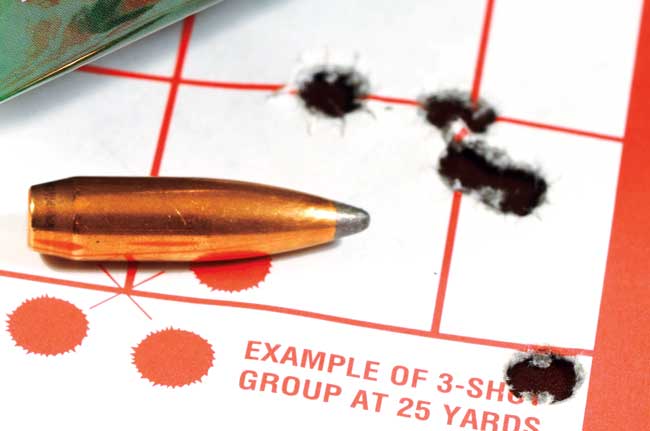
At the range, the Partition load was dreadful. Velocity wasn’t bad, at 3,020 fps, but its five-shot group was evenly spread out 3 full inches, side to side. The Scirocco II bullet won the velocity contest, at 3,060 fps, and also delivered the best accuracy overall with a 1.25-inch five-shot group. The Sierra bullet was the slowest at 2,998 fps but put four bullets into a tight cluster of 0.77 inch with one flyer expanding the group to 1.40 inches.
Let me hasten to say that I love Partition bullets, firmly believe they are among the most accurate bullets made, and have shot some of my all-time best groups with them, in several different calibers. From my chamber measurements, it looked to me as if Biesen fashioned this rifle specifically for the Partition, but apparently not. At least not at that velocity. I will try different powder charges and different powders before I give up on them. There is no reason that they shouldn’t shoot like a house afire.
Meanwhile, the other two are excellent hunting bullets, and a little variation up and down may tighten those groups even further.

Categories
What no 300 H&H!?!
