Categories
Category: Ammo
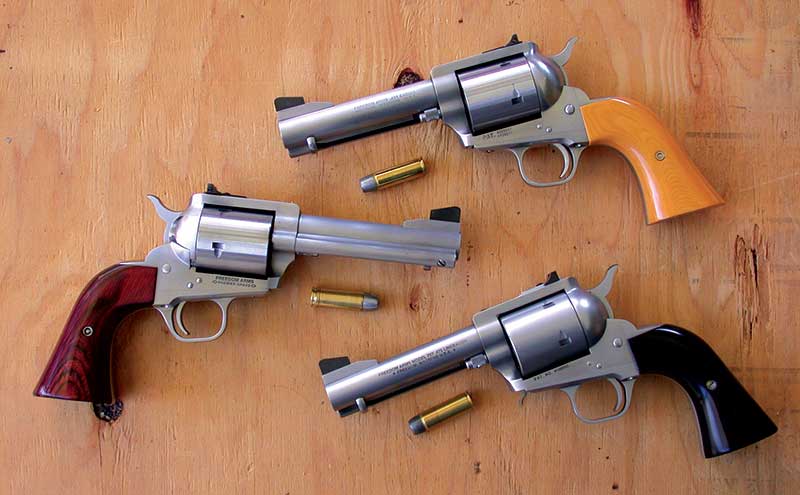
The .500 WE shows its family relationship to the same basic guns in .454 and .475.
This is a Potently Powerful Package. It can be Pleasurable or Painful, it comes at a Premium Price, and it’s even Purty. It’s the latest candidate for the title of Perfect Packin’ Pistol. The cartridge it houses is Proprietary and the sixgun itself will last in Perpetuity. This Phenomenon is the latest sixgun/cartridge combination from Freedom Arms, the .500 Wyoming Express. Perfect Packin’ Pistols are highly Personal and very dependent upon the Perception of just what is Perfect and quite often dependent upon the user’s locality. For anyone looking for the most Power Per Pound of Packing weight, this is it!
Since 1983, Freedom Arms has been producing the finest single-action sixguns to ever come from a factory. In the early 1980s, Wayne Baker and Dick Casull came together to produce not only the finest single action ever manufactured but the most powerful as well. That sixgun was the Freedom Arms .454 Casull. Both the sixgun and cartridge were destined to change the sixgunning
scene drastically. The .357 Magnum had arrived in 1935 heralded as the world’s most powerful revolver, unable to be handled by mere mortals. Twenty years later the .44 Magnum arrived pushing a bullet 100 grains heavier at the same speed of the early .357 Magnum loads. As a teenager I fired an early 4″ Smith & Wesson .44 Magnum with Remington factory loads and from my perspective then, I could not see any way I could ever handle one. It was a long learning process as I grew older.
While our early heroes were experimenting with heavy .44s in various forms, Dick Casull was experimenting with the .45 Colt. Casull started using heavy loads in the then new solid head .45 Colt brass in Colt Single Actions. When he soon discovered his loads where too heavy for production Colts, he started making his own fiveshot cylinders.
It did not take long to get past the safety factor and he soon decided to build his own larger, stronger revolver. He not only entered new levels of sixgun power he also disproved the old myth of .45 Colt brass being weak. However, when his .454 Magnum became reality the .45 Colt case was lengthened to prevent any of these heavy loads entering the chambers of older .45 sixguns, especially black-powder guns where the results would be decidedly disastrous.
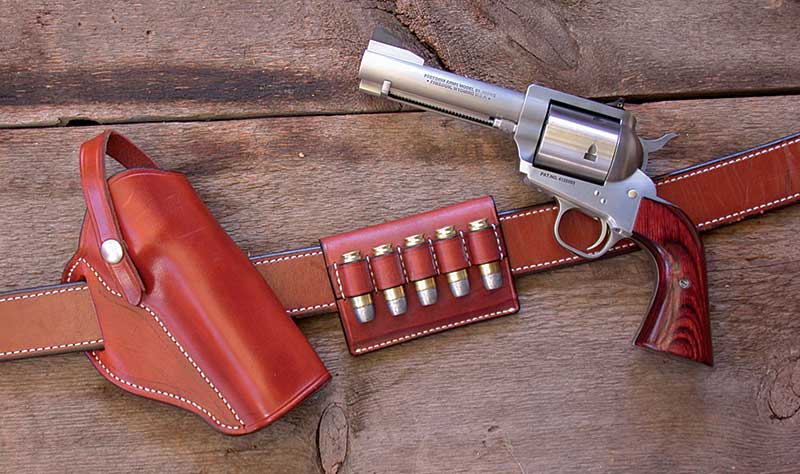
FA X-Draw holster, Sparks belt and Von Ringler carrier.
The Beginning
In the 1970s a very few .454 Casull chambered five-shot revolvers were produced by North American Arms, however it remained for Wayne Baker to form Freedom Arms and really begin producing what is now known as the Model 83 revolver. From the very first, these premium quality, five-shot, stainless steel sixguns were built with the best materials and exceptionally tight tolerances to be able to handle the power of the .454 Casull. In those days it was not easy to convince many writers to even try the .454. It gives me great pleasure to have been one of the first to spotlight the .454 as well as provide extensive loading data in Handgunner in the mid-1980s. It took awhile for the shooting public to discover the .454 and Freedom Arms went from a vault full of sixguns looking for owners to a back order situation. Handgun hunters especially, went for the .454 in a big way.
Freedom Arms did not stop with the .454 Casull-chambered Model 83. They soon offered their premium revolver in .44 Magnum, .357 Magnum, .41 Magnum and even the greatest of all cartridges, the .22 Long Rifle. A very few were even chambered in .50 Action Express. While Freedom Arms was producing those first .454s, John Linebaugh was experimenting with even larger calibers first using cut down .348 Winchester for his .500 Linebaugh (see The Sixgunner in this issue), which was followed up by the .475 Linebaugh using .45-70 brass. In the 1990s, Bob Baker of Freedom Arms took a good look at the .475 for chambering in the Model 83, however the rims were too large to fit the five shot cylinders of their production revolvers.
Baker experimented with the .475 by reducing the diameter of the parent .45-70 brass rims and found the cartridge would perform exceptionally well in the Model 83. However, he did not wish to produce a revolver for which shooters could not obtain factory loaded ammunition or at least factory brass of the proper dimensions. When loaded ammunition arrived from Buffalo Bore as well as factory brass from Starline, the Model 83 was chambered in .475 Linebaugh and to this day sixgunners still argue over which is more powerful, the .454 or the .475 Linebaugh. My answer in these types of situations is always “Buy ’em both!”
The next natural step up in caliber was the .500. However, this cartridge is so large that even by trimming the rim it was impossible to make it fit the Freedom Arms cylinder without also altering the cylinder ratchet. Baker hit on the answer and showed me the cartridge nearly two years ago. Meanwhile, Baker spent a long time experimenting with loads, tweaking the brass, and as he reached the top level of power possible with the new cartridge, he told me “I’m getting too old for this!” That should tell you something about the power possible in the new .500 Wyoming Express as Bob Baker handles the .454 Magnum like it’s a .44 Special.
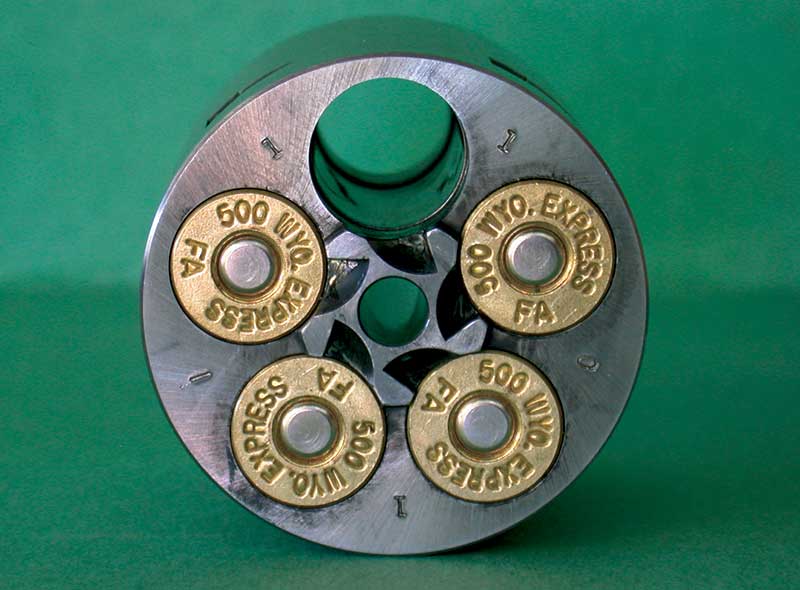
To solve the problem of cylinder size the Wyoming Express uses a belted case. Baker says of the new cartridge: “The .500 WE is a proprietary cartridge of Freedom Arms, Inc. using a 1.370″ length belted case. The belt provides reliable head spacing on a small shoulder which was required to work in the Freedom Arms Model 83 revolver. It also uses a .500″ diameter bullet with a maximum nose length of .395″ which gives a maximum overall cartridge length of 1.765″.
The cartridge was designed to not only get outstanding and predictable ballistic performance but to also minimize forcing cone erosion, thereby extending the useful life of your Freedom Arms revolver. This is done by matching powder column length, powder volume and bullet diameter to an expected range of bullet weights, velocity ranges and pressure levels.
Notice a couple of things here when comparing the .500 Wyoming Express to the .500 Linebaugh which inspired it. The .500 Linebaugh uses a large rim, the .500 Wyoming Express head spaces on a belt. The .500 Linebaugh brass is 1.400″ while the .500 WE is set at 1.370″. Bullets are not interchangeable with the .500 Linebaugh using .511″ diameter bullets and the .500 Wyoming Express designed for the use of true 1/2″ diameter bullets.
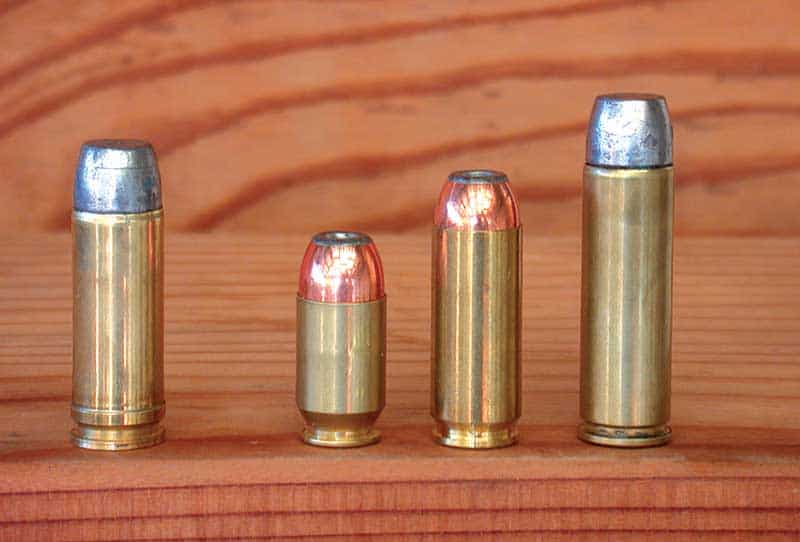
Left to right: .500 WE, .50 GI, .50 AE, .500 S&W Mag.
Strong Spirit/Weak Flesh
When Bob Baker first provided me with his experimental loading data for the .500 Wyoming Express with 350- and 370-grain bullets at 1,600 fps, 400s at 1,500 fps, and 440s at 1,400 fps (Freedom Arms will supply this data with their revolver) I remembered his
comment of “I’m too old for this!” I responded with “How do you think I feel with about two decades on you?” I knew there was no way I was about to be able to handle the heaviest loads in the .500 Wyoming Express. Twenty years ago, maybe; today, no way!
My heaviest loads just topped 1,200 fps and while manageable in a 71⁄2″, scope-sighted Model 83, they were brutal in the relatively lightweight 43⁄4″ version. The heaviest loads I used in the Perfect Packin’ Pistol 43⁄4″ Model 83 was the Cast
Performance Bullet Co.’s 440-grain Hard Cast Gas Checked LBT over 19 grains of Blue Dot for 1,201 fps in the 71⁄2″ version and 1,143 fps in the short barreled PPP. In the latter I was able to put three shots in 7/8″ at 20 yards and there is nothing I
am ever likely to encounter in the game fields I cannot take cleanly and completely with this load.
As I was testing both sixguns, my loads, and myself with the .500 Wyoming Express I thought of Elmer Keith and Tom Ferguson. When Keith finally got his much awaited .44 Magnum after 30 years of urging of manufacturers on his part, he reported in 1957 he had fired 600 rounds the first year; I fired more .500s than that from the Freedom Armsrevolvers in three days.
When Ferguson tested the .500 Linebaugh many years ago he fired a one-shot group and said that was enough. Both were smarter men than I am! Believe me even with the “lighter” loads the .500 WE recoils more, much more, than comparable revolvers chambered in .44 Magnum.
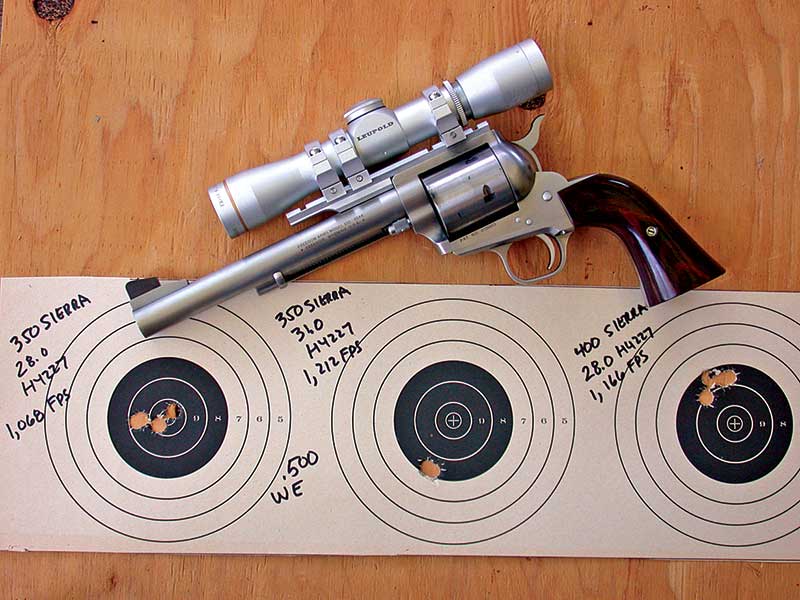
The middle 5-round “group” was fired by t he .50-g r. Sierra.
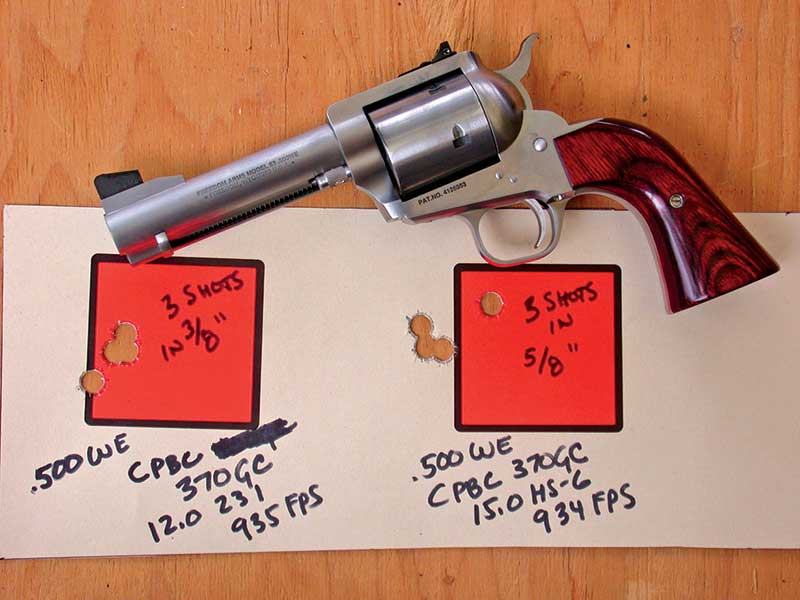
20-yard groups.
Test Guns
My pair of test guns were a brand new 43⁄4″ Freedom Arms Model 83 chambered in .500 Wyoming Express and my 71⁄2″ Model 83 .50 Action Express which was returned to the factory to have a second cylinder fitted in .500 WE. While it was there I had Freedom Arms fit an SSK T’SOB scope base as there is no other I will trust with really hard kicking revolvers. For a scope I chose a Leupold, as I’ve had excellent results with their products on hard kicking sixguns and single shot pistols for more than two decades. In this case the choice was one of their silver, 4X long eye relief scopes mounted with three rings on the T’SOB base.
Any Model 83 originally chambered in .50 AE can be retrofitted with a .500 WE cylinder, however at least at this time Freedom Arms is not offering the .50 AE cylinder as an option with the .500 Wyoming Express.
Freedom Arms is also offering the .500 Wyoming Express brass in plastic cartridge boxes holding 64 rounds as well as RCBS loading dies. The carbide three die set includes a special die setting gauge which is actually a washer which will place the carbide sizer at the proper position to not engage the belt on the cartridge case when full-length sizing. This washer is placed on top of the shell holder and the sizing die is then screwed down until it meets the washer. Once this is accomplished there is no danger of squeezing the belt, which would result in poor head spacing and possible misfires. Freedom Arms recommends seating and crimping in two separate operations so it would be handy to have a second sizing-crimping die.
For my loading of the .500 Wyoming Express I used four hard cast gas checked designs, Oregon Trails’ 370, and from Cast Performance Bullet Co. came 370, 400, and 440 LBT bullets. For jacketed bullets my choice was Sierra’s 350 JHP and 400 JFN. These were originally designed for the .500 S&W Magnum and when seated normally in the center of the cannelure that serves as a crimping groove will protrude from the front of the Freedom Arms cylinder.
I was able to use them by crimping at the very top of the crimping groove, however Sierra will be offering .500 WE versions with the cannelure set a little higher. Even in my hands the .500 WE has proven to be exceptionally accurate. The scope-sighted 71⁄2″ version is an excellent choice for the hunting of big, heavy, mean, nasty critters, while many will find the 43⁄4″ version to be the Perfect Packin’ Pistol. Should I dare to roam among mean nasty critters looking to end my sojourn here I would certainly load it to full horsepower. If needed, I doubt I would even feel the recoil! I like ’em both.
For more info:
Freedom Arms, P.O. Box
150, Freedom, WY 83120,
(307) 883-4432,
www.freedomarms.com
Leupold,
14400 NW Greenbrier Pkwy,
Beaverton, OR 97006,
(503) 646-9171
www.leupold.com
Categories
The Grizzly Conundrum
Categories
6 8 Westerner vs 270 Win SM
Categories
I would hate to see Rats of that size!

Epitaph For 3 Cartridges
The words said by his cohorts at the wake of a departed comrade can come nearer to describing him than the eulogy of the most golden-throated and well meaning of pastors, who maybe only met him on those rare Sundays it was too bad out to go hunting. And though some of us frostier-topped types don’t want to face it, the time has come to lay away not one, but three old pards.
This hadn’t dawned on me until one of the infrequent inventories of my mess of gear turned up a few mixed, partially full boxes of handgun ammunition in calibers 44-40, 38-40, and 32-20. The labels and generally scruffy condition of the cartons showed clearly that they had been around a lot longer than the glossier, styrofoam-inserted boxes that sided them. How long had it been since I owned a sixgun for these relics of a better, slower-paced time?
It was easy to remember that first handgun because it had come rather hard, costing the best part of a summer’s wages. Twelve-year-olds didn’t draw top money when I was young, and the 38WCF Colt single action and that first box of shells required an in-ordinate amount of flunkying about the farm.
I had been touted onto the 38-40 as the best handgun caliber going by an ex-Texas Ranger. “These automatics they carry nowdays – they’s nothin’ to ’em, nothin’ to ’em at all,” he counseled. “The Colt 45 is a good ‘un, and the 44 too. But if you want a gun that shoots hard, get you a 38-40. Don’t kick as much, neither.”
When this old cactus jumper held forth on these three calibers he meant them to be in only one gun, the single action Colt. If he was aware of the existence of other revolvers for the loads, he dismissed them from his mind as trifles.
And there were others. Certainly the best known and most frequently encountered, the Colt Model P single action in 44-40, 38-40, and 32-20 was a quick addition to the original 44 Rimfire, 44 Colt, and 45 Colt guns. The alacrity with which the Hartford company introduced the newer, and not necessarily superior, cartridges into their revolvers was prompted by the immense popularity of the 1873 Winchester rifle in those calibers.
When the Winchester ’73 first came in use it was doubtlessly a good idea to have a handgun that used the same ammunition. The little 44 rifle, however, is held by some as having been employed in the place of a handgun by many of its devotees, simply because it made use of their greater ability to hit with a rifle.
It also makes sense that if both a sixgun and a rifle were to be carried the rifle would be much more useful if it fired one of the more powerful cartridges of the day.
While the firepower of the ’73 made it a more versatile companion gun to the Colt than, say, the single shot 45-70 Springfield or 50-100-500 Sharps, it certainly was outclassed for the purpose by the 1876 and the later 1886 Winchesters which threw heavy buck busters like the 45-70, 45-90, 40-82, et al.
The ’92 Winchester was simply a scaled-down 1886, made for riflemen who wanted a fast shooting turkey gun. By the 90s, most serious riflemen had turned to longer ranged guns for hunting and defense, and the 44-40, 38-40, and 32-20 were used on the big stuff only by those who were too poor or too ignorant of ballistics to choose a better rifle.
The Texas Rangers were the last of the old time horseback policemen, and frequently rode far from supply sources. The worth of this combination rifle and revolver cartridge can be surmised in old photographs of ranger groups, which show that they stayed abreast of things and armed themselves with 1894 30-30 and 1895 30-40 Winchesters almost as soon as they were introduced.
Frank Hamer, the great ranger captain who rid society of Bonnie and Clyde, started his service as a very young man of 21 in 1906. Early photos show him with a ’94 Winchester. He soon switched to a Model 8 Remington automatic in 25 Remington, and was armed with the same type rifle in 35 Remington during his famous fight with the vicious pair.
Especially during the late 1870’s and early 1880’s, there must have been riders who carried revolver and rifle combinations in these calibers. More, I expect , in 44-40 and 38-40 than in the rather tiny 32-20. But mostly the users of the Winchester, Marlin, Colt, and other shoulder guns in these calibers employed these light rifles in lieu of a handgun. Handgunners stayed with these cartridges and the many revolvers made for them over the years because they were excellent handgun cartridges for the times.
The little Winchester rounds were chambered into a goodly assortment of handguns other than old Sam’s thumbuster. In fact, Winchester made up a few single action revolvers in 44-40 which boasted one of the first swing-out cylinders. It has been said that this was done to have some bargaining power for forcing Colt from the rifle business and that a deal was made whereby Winchester made rifles and shotguns and Colt made only handguns for a long time thereafter.
After the Model P was enjoying good health, Colt in 1877 introduced the Double Action Army. These oddly shaped sixguns were on 45 frames and were originally in that calibration, with 44-40, 41 Long Colt, 38-40, and 32-20 models coming later.
A total of slightly more than 50,000 of the side-ejection double actions, in all calibers combined, were made. Their somewhat fragile locking systems and perhaps their ugly sawhandle grips contributed to their comparatively early demise.
The next Colt made for the Winchesters shells is acclaimed by some as the most rugged revolver ever made. The New Service was manufactured from 1898 until 1941, with a few wartime guns being put together as late as 1943. During this span, the big DA sixgun was offered in a great many calibers, including various British service cartridges such as the 450, 455, and 476 Eley group, but the first variants from its initial 45 Colt boring were the 44-40 and 38-40. Unlike earlier heavy frame Colts, the New Service was never produced in 32-20.
This is not to say that there were no Colt double actions in 32-20. The Army Special, a 41-framed DA revolver was produced from 1908 until 1928, when it became the Official Police. Although best known in 38 Special, these fairly heavy guns made particularly nice small game getters when chambered for the 32 WCF. Another, lighter Colt in this caliber was the Police Positive Special, found in 32-20 with 4″, 5″, and 6″ barrels, and occasionally in a target model with adjustable sights.
The best known Smith & Wesson chambered for a Winchester rifle load is the venerable Military & Police model. Like Colt, S&W did not revive this caliber after WWII, but it remains a sought-after one in many areas, and I have seen a number of Smith 32-20 sixguns in use in Mexico. The light recoil of the factory ammunition makes it a comfortable gun to shoot, yet it is more powerful than other 32’s.
About 275 of the topbreak double action revolvers were produced in 38-40 by Smith & Wesson, along with an estimated 15,000 in 44-40. These guns were made between 1886 and 1910, but it came to be generally accepted that these loads were too powerful for topbreak revolvers. Also, about 2000 of the New Model 44 Russian caliber single action Smiths were made up for the 44-40 cartridge.
The beautiful New Century (Triple Lock) double actions by S&W are best known in 44 S&W Special, but a few were made in 45 Colt and 44-40. A successor to the New Century, the Hand Ejector was likewise predominantly a 44 Special, but a number were furnished in 44-40, including a model with adjustable sights.
The 1926 Hand Ejector Model, another fine Smith & Wesson designed around the 44 Special round, was made on special order for the 44 WCF. Many of these special order guns went to Central and South America, where the 44-40 enjoyed great popularity due, at least in part, to the numbers of Winchester ’73 and ’92 rifles (along with their Spanish Tigre copies) in use there.
Merwin & Hulbert marketed their versions of the Winchester-chambered revolvers, actually manufactured by Hopkins & Allen. Although quite sturdy, and still sometimes found in use in remote areas, these guns were never widely distributed after one of the partners was captured and killed by Indians.
The Winchester trio were the magnum handgun cartridges of their day. Jeff Milton, the illustrious peace officer who began his long career as a teenage Texas Ranger in 1880, told of swapping his 45 Colt single action for the first 44-40 SA he ever saw. His plans for being a 19th century swinger, with saddle carbine and sixshooter using the same shells, came to an abrupt halt when his new 44 froze up after the first shot.
The primer had flowed back into the firing pin hole in the recoil shield. After struggling with both hands to shear off the protruding primer and recock the gun, Milton re-swapped for another 45 and warned his companions-at-arms against the new innovation. Even in those days a closely-brushed firing pin was a necessity when shooting hot loads.
It seems likely that the 38-40, at least from about 1890 on, was a more popular sixgun caliber among western lawmen than the 44-40. I have known many of the old officers of that period who favored the gun and load, and when pressed for a reason they would like my old ranger mentor, point our that the 38-40 “shot hard” and didn’t kick as much as the 45 or 44-40. This lack of recoil was due to the 38-40 being a heavier revolver shooting a lighter bullet than its two compatriots. Its 180 gr. flatnosed slug traveled almost 1000 fps, as did the similarly shaped 200 gr. bullet of the 44-40 – a respectable load even by today’s standards.
After black powder had fallen into disuse, the ammunition companies loaded high velocity ammo with smokeless powder cartridges for use in rifles only. This stuff was marked on the boxes, and should never be fired in revolvers. Ammunition compounded with the older sixguns in mind was marked as suitable for use in either rifles or revolvers in good condition.
As the years went by, this dual purpose ammo was loaded lighter until it falls far below the velocity potential of good rifles such as the ’92 Winchester and is considerably underpowered for a late, sound revolver.
When I was younger I handloaded for all three of the Winchester calibers. I did this because these were the guns that were available to me, and all the while I was hoping to acquire newer sixguns in 357 Magnum and 44 Special. Reloading this trio, especially the 44-40 and 38-40, was for the birds.
These two shells are heavily tapered over their powder chambers, then extend more or less straight to the mouth over the section of case which holds the bullet. Especially in the older, folded head cases, they stretch enormously, requiring excessive resizing and frequent trimming. Case life is short. While I prefer for general use the standard, original bullets, such as reproduced in the Lyman #40143 (38-40) and #42798 (44-40) molds, there are better cast slugs for reloading these two cartridges.
Lyman’s #401452 and #40188 are great in the 38-40, both being of semi-wadcutter design and both having crimping grooves. Several of the similarly-shaped 44 Special bullets work fine in the 44-40 when seated over appropriate powder charges, deep enough in the case to fall within maximum overall cartridge length requirements. These crimping grooves are most helpful, since the round-shouldered standard bullets are prone to being pushed back into the case during rough handling.
The 32-20 is not as susceptible to these failings, since its case has a straighter taper, but it still lacks the versatility and ease of reloading enjoyed by the modern, straight-cased shells. The new Ruger 30 Carbine revolver supplants the 32-20 completely, the 38 Special can be loaded to equal or better it, and there is no solid ground on which to compare it with the 357.
Anything the 38-40 could accomplish is done better with the 41 S&W Magnum, and who would pit the 44-40 against the 44 Magnum?
Tough old Judge Roy Bean was a realist who sold warm beer in a saloon named after the most beautiful woman of his time, Lily Langtry. In his time, these were the best. Confronted with the refrigeration and Sophia Loren, the judge would never look back.
And if he were here today, he’d say “Vayan con Diós” to the three little Winchester shells.