Categories
Category: Ammo
Categories
NORTHERN PRECISION’S .405 WINCHESTER SLUGS
SOLVE ALL YOUR PROBLEMS WITH ‘BIG MEDICINE’

The two targets at left are from the TC Encore at 50 yards, while the two right targets are from the Ruger #1 at 100 yards.
The .405 Winchester was designed in 1904 for the Winchester 1895 lever gun. Today, it’s still considered one of the most powerful lever-gun rimmed cartridges. The hard-hitting cartridge was a favorite of Teddy Roosevelt during his long East African safari. With such a rich history, it’s no wonder there’s still a strong following for this nostalgic cartridge.
There’s something special when handloading, shooting, or even just holding cartridges designed over 100 years ago. Loading them into a firearm magically transforms you to times past, when shooting game was done at spittin’ distances.
Better yet is loading your rifle with these mythical cartridges for a long-awaited hunt, following the footsteps of your heroes as you head afield. These are the thoughts coursing through my mind whenever loading the .405 Winchester cartridge. It was Teddy Roosevelt’s “Medicine Gun” for lions and if it’s good enough for our 26th President, it’s surely good enough for us. Besides, it’s fun mimicking our heroes.
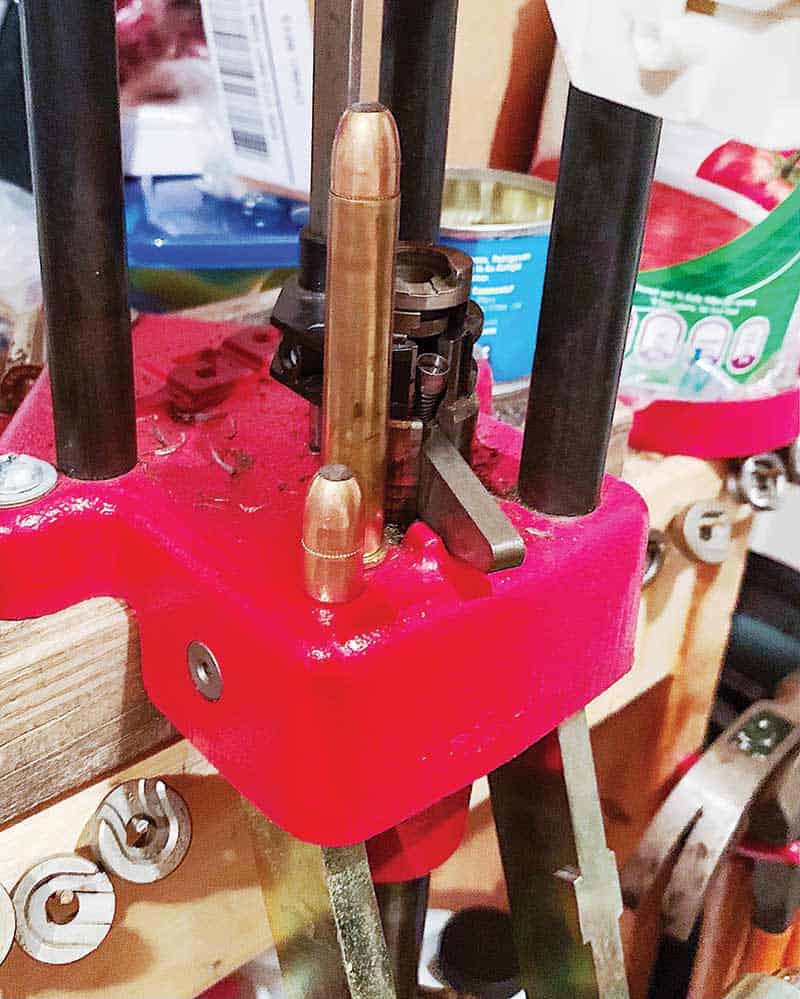
Tank’s Lee Classic Turret press, with Hornady dies was used
for all handloads with excellent results.
A Winner!
Years ago, I actually won a raffle in a fireman’s “gun-a-day” lottery. There’s a first time for anything, eh? I wasn’t interested in the gun listed but offered paying the difference for a gun I really wanted, the Ruger #1, chambered in .405 Winchester. The firemen agreed and the gun was ordered.
A few years later, I see an ad for some TC Encore barrels for sale chambered in the same caliber. I order one, happy to receive such a bargain. Now I had two .405 Winchester shooters with a grin bigger than Teddy’s on Mt. Rushmore because I know how cool this cartridge is.
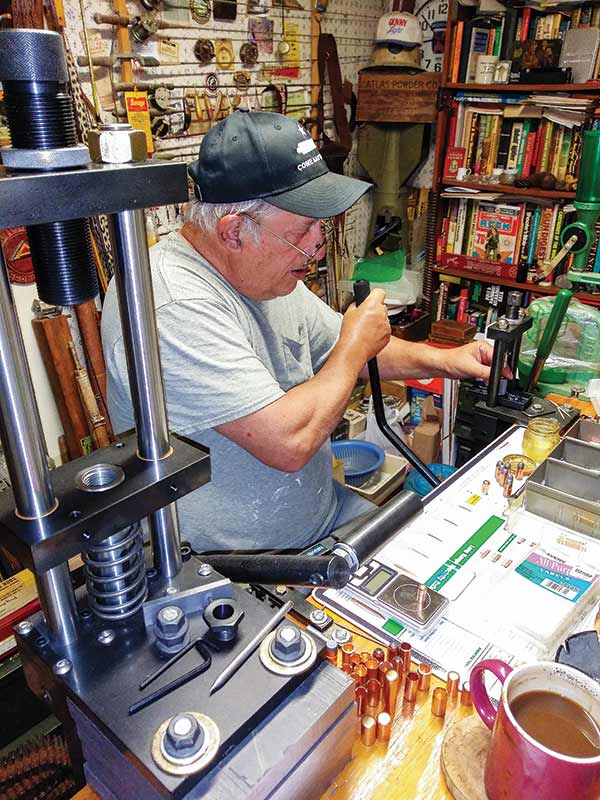
Here’s William Noody doing what he loves, making bullets for
handloaders to shoot. He’s a viable option for many out-of-stock
bullets in the bigger stores. Call him! Northern Precision bullets are accurate indeed.
Cool Cast Conversion
I have an RCBS .417 350-grain FNGC single cavity mold for my .416 Rigby rifles. It drops slugs at 0.417″ that is easily sized down to 0.413″, perfect for the .405 Winchester. Loaded over a stiff charge of Alliant ReLoader 7, it’s a very accurate load. I’ve shot thousands of these cast bullet loads from these guns and while taking a few deer too. The deer never knew what hit them! But being a handloader always has you looking for more options.
Imagine my surprise looking on the GUNS Magazine online site and seeing a headline — “Northern Precision .405 Custom Bullets.” Huh? Whoda’ thunk? I click on the heading and read about William Noody’s custom shop and the .405 bullets he makes. I’m stoked and make a phone call, ordering bullets in weights of 225-, 265- and 325-grains.
Noody uses heavy presses to swage and jacket his bullets. For tougher bullets he uses epoxy to bond lead cores to the bullet jacket, avoiding separation. Noody advises using his regular swaged jacketed bullets for sight-in and soft skinned game and more expensive bonded bullets for tougher, thick-skinned game.

Here’s the .405 Winchester line-up (from left to right) — a sized-down
RCBS 0.417” cast bullet, and Northern Precision bullets 225-, 265-, and 325-grain.
The Loads
For the 325-grain bullet, I use 55 grains of IMR 4895 for just over 2,150 FPS. Accuracy was excellent, with three-shot groups going 1″ to 1.5″ at 100 yards. Groups with the Skinner Sights peep-sighted TC Encore went the same, only at 50 yards distance.
The 265-grain loaded over the same powder charge went 2,250 FPS, with the same accuracy. This may be the perfect deer-sized-game bullet. It reminds me of the devastating 265-grain .444 Marlin load, only with a tad more SD because of the slightly smaller diameter.
Last, was the 225-grain screamer. Loaded over 53-grains of ReLoader 7, velocity reached 2,500 FPS. Wow! Talk about a terminator load for whitetail and smaller critters. Accuracy was again excellent, snugging right around an inch for three shots at 100 yards.
Options
It’s always nice having options as a handloader and thankfully we have Northern Precision providing us .405 Winchester lovers some excellent options. I think the extra weight and sectional density of the 325-grain bullets is pure perfection for heavy game like elk, moose and bear, while the 265- and 225-grain slugs will easily handle whitetail work.
Give Northern Precision a call and talk with William. He’s a heckuva’ nice guy and you just may learn something from him. Check out his other bullet options too. I also ordered some 250-grain .358 bullets from him for my .35 Whelen and I’m anxious to see how they do. As Teddy would say, “Bully for Northern Precision!” Now to find a Winchester 1895 …
Categories
A REAL DEAL
The .40 S&W Lost Its Charm.
This Means Bargains!
By Massad Ayoob
If you’ve been following handgun trends the last few years, you’ve noticed many police departments are abandoning the .40 S&W, mostly for 9mms, and based largely on the FBI’s announcement. The Bureau went back to 9mm from .40 due to ammo improvement in the smaller caliber, as well as slightly higher capacity with the narrower cartridges and the 9mm’s milder recoil. Lower cost of 9mm ammo is a factor, too. The civilian market seems to be following suit: gun dealers I talk to say so, and I’m seeing it in my civilian classes as well.
Last year, my favorite gun shop hangout announced a Christmas sale that included 15 percent off every .40 caliber pistol in the place. I asked the manager why. “Because nobody seems to want to buy .40’s anymore,” he answered.
The real savings are to be found at the used gun counter. One refrain I’ve heard repeatedly from gun shop owners is, “I don’t like to take .40’s in trade. Nobody wants to buy them. I have to offer less on trade-in so I can mark it down if I hope to sell it to another customer at all.” That’s bad news for the original owner and the dealer alike, but good news for the next buyer if they can be comfortable with a .40 S&W pistol.
Yes, ammo will be a bit more expensive. You’ll also have to be more cautious on maintenance. With a GLOCK .40, you want to change your RSA (recoil spring assembly) about every 3,000 rounds. I’ve seen 9mm GLOCKs go way beyond that before they actually needed a new RSA. That said, though, GLOCK RSA’s are cheap.
Recoil of the .40 is notably snappier than 9mm, and some find it more objectionable than .45 ACP, but a lot of that has to do with choice of ammo and recoil’s effect on the shooter is largely subjective anyway. Personally, I can’t tell much difference between the hottest 9mm’s and the lightest .40’s while shooting.
As a rule, .40 S&W generates more energy and slide velocity than 9mm in the same size platform. When the .40 came out in 1990, some models handled it better than others. Hotter loads always “wear” the same platform more than light loads, but some platforms handle it better than others. There are some—the Beretta 92 and the polymer Kahrs—that stand up very well in 9mm, but I for one wouldn’t buy a well-used .40 caliber Beretta 96 or polymer-framed Kahr .40 from the used gun shelf. High volume, intensive .40 shooting isn’t kind.

IDPA Five-Gun Master John Strayer demonstrates control
of .40 caliber S&W M&P.
.40 Pluses
The current “9mm equals .40 for potency” meme is predicated on using the best, latest, highest-tech ammo in 9mm. For almost 20 years now (remember Y2K and the two Obama elections?) we’ve seen ammo droughts in which we were lucky to buy any ammo at all. Let us remember the .40 came out in its original 180-grain subsonic loading at a time when cup-and-core hollowpoints were pretty much state of the art, and it was designed to give you “close to 9mm cartridge capacity” with “close to .45 ACP ballistics” with such ammo. Should shortages come to pass again and limit ammo choices, the same compromise factor that led the .40 to become the most popular police caliber in a few short years will again come into its own.
Speaking of which, many shooters noted during those ammo droughts when we couldn’t find 9mm or .45 on the shelves, most gun shops usually had at least some .40 in stock. Reason enough to have a .40 in one’s battery, methinks.
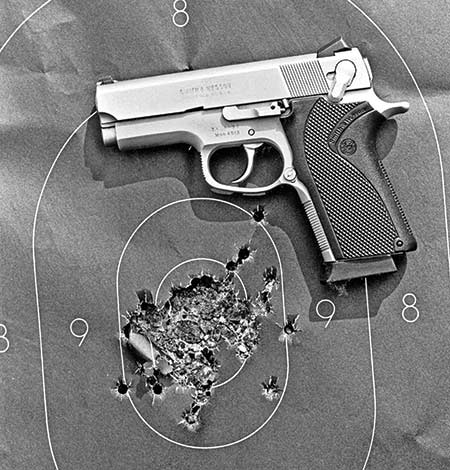
The .40’s are definitely shootable. This light, compact S&W 4013 delivered
this 60-shot group on a B27 target during timed qualification.
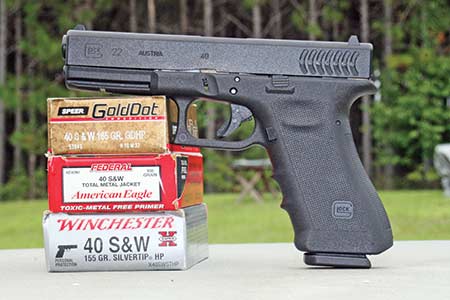
The Speer 165-grain Gold Dot at 1,140 fps, 180-grain Federal subsonic
and 155-grain Winchester Silvertip at 1,200 fps show just part of the
.40 versatility range. The pistol is a 16-shot GLOCK 22 RTF2.
Versatility Factor
In the early 2000’s I carried .40 caliber GLOCKs almost exclusively for almost 3 years. I wore a 16-shot G22 in uniform for the police department and most of the time off-duty and teaching privately, and the 10-shot G27 for backup in uniform and sometimes when I needed fairly deep off-duty concealment. My ammo was primarily the superbly accurate Black Hills 165-grain .40 JHP at a nominal 1,140 fps velocity. Shooting the G22 with it, I won my state’s annual police association shoot 3 years in a row, and a couple of times at local NRA Hunter Silhouette matches, won the iron sight class against target pistols at 100 long paces. The Black Hill’s 165-grain subsonic gave mild recoil in IDPA and GSSF matches.
”
When you look at overall value factor, you have to ask yourself what you’ll be doing, how much you’ll be shooting it, and what budget is at your disposal. The more shooting in your future, the more important lower-priced 9mm ammo will be in the long run.
In the last analysis, the .40 originally skyrocketed to popularity with cops for very good reasons: versatility, street-proven effectiveness, and solid elements of compromise. The way the .40 market is going now, traded-in .40’s may become the best handgun buy since the great wave of trade-in service revolvers.
Categories