Category: Ammo
Categories
Bullseye! By Jeff “Tank” Hoover
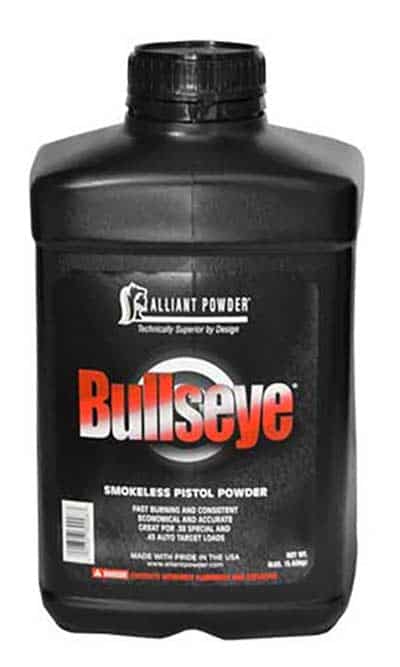
Here’s my 8 lb. jug of Bullseye from Alliant Powder.
There’s a lot of reloads in there.
During these dreaded days of chain supply unreliability and high prices, handloaders need to be creative in their pursuit of happiness, i.e., being able to stuff empty cartridge cases with some kind of smokeless powder. What do we do when the powder coiffures are running low?
Sometimes, older powders fall by the wayside as newer, cleaner powders are released. Scanning our powder shelf, we look for anything suitable for our next batch of handloads. Sometimes, the answer is right in front of our noses.

My .32 Colt Police Positive Special loves Bullseye powder.
Versatility vs. Productivity
Unique is hands down one of the most versatile powders ever devised. It performs great for most handgun loads and even works for most rifle loads, albeit in a reduced velocity sense. At least it makes shooting our long guns possible in a pinch. For handgun cartridges, there’s another choice from Alliant Powder that’s as versatile as Unique — Bullseye!
While this fast-burning powder won’t get as much velocity as Unique, Bullseye uses less powder per charge, allowing for more reloads per pound than just about any powder. Best yet? It’s remarkably accurate. In fact, it was Elmer Keith’s favorite powder for low-velocity, accurate practice and competition loads. Obviously, this powder has been around if Elmer used it, but it’s just as versatile today as it was back then.
Bullseye’s main purpose is obvious. Just a pinch of powder allows the shooting of light recoiling loads with a consistent velocity spread, providing accurate loads. I’ve used Bullseye for years with outstanding results in many different calibers and thought it time to share a few of my favorites.
A few years ago, I stumbled upon an 8 lb. keg of Bullseye. While not a favorite, I certainly knew its value and was going to make the most of it. Here are some of my favorite loads I use.
• .32 Long: Using RCBS 98 grain SWC or MP Molds 100 grain HP, I use 2.6 grains of Bullseye for just over 800 fps and excellent accuracy from my S&W pre-31 revolver.
.• 32 H&R: My favorite .32 cartridge. Using RCBS 98-grain SWC, this baby “Keith” slug when loaded over 3.6 grains Bullseye runs damn near 1,100 fps with wonderful accuracy. Speer 85-grain JHP over 4 grains of Bullseye runs 1,170 fps and are very accurate.
• 9mm: My favorite bullet for the 9mm is a cast bullet from the Lee Precision 125-grain radiused flat-nose mold. Powder coated, I load these over 4 grains of Bullseye and get just over 1,100 fps. It’s mild shooting and accurate.
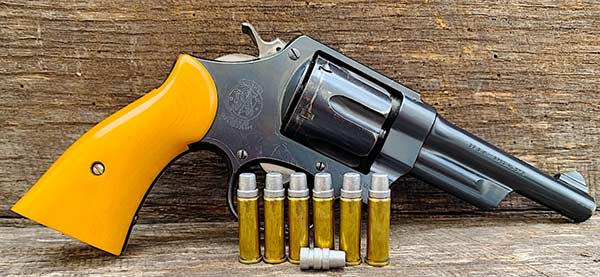
A S&W 38/44 Heavy Duty gobbles up Bullseye
loaded .38 Special loads without a hiccup.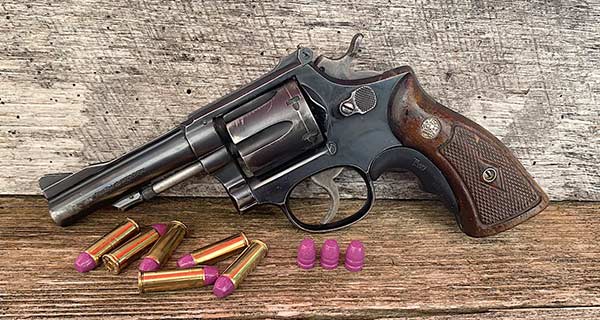
Lee Precision’s 125-grain RFN cast bullet mold makes wonderful
light loads for the .38 Special shown with Tank’s Model 15.
• .38 Special: I use the same 125-grain slug from the 9mm. With 4.5 grains of Bullseye, velocity runs just under 1,000 fps from most guns with great accuracy. Bullets from 158-170 get 3.5 grains of Bullseye and run around 850 fps. The classic PPC load is 2.7 grains of Bullseye with a 148 HBWC at around 700 fps.
• .38 Special +P: 125s gets 5 grains of Bullseye for 1,070 fps while 158-170 grain slugs get 4 grains for 920 fps.
• .357 Magnum: Speer 110-grain UCHP bullets loaded over 8.7 grains of Bullseye run just over 1,400 fps. Cast slugs in the 158-grain range loaded over 5 grains of Bullseye run 950 or so.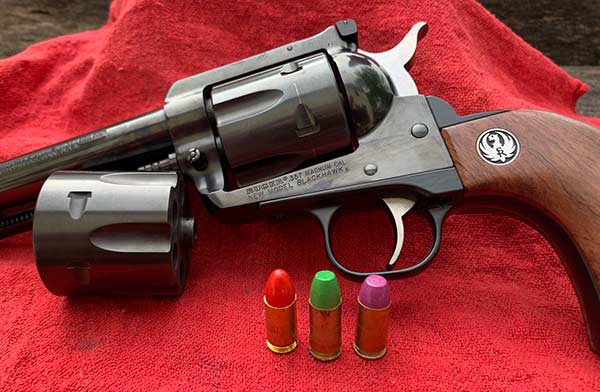
Loaded with Bullseye powder, the 9mm shoots just fine.
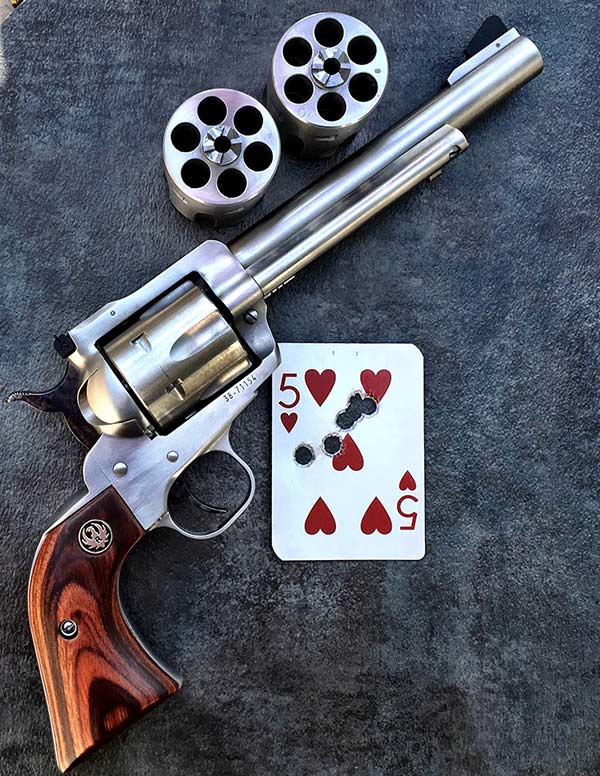
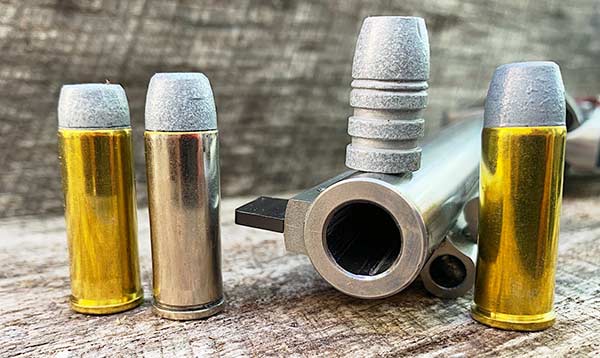
Tank’s Ruger Blackhawk with three cylinders — one, a .40 S&W,
makes light work with Bullseye powder. Other cylinders are
.38-40 and 10mm.
• 40 S&W: The .40 S&W is a favorite cartridge of mine for semi-auto’s and a special Ruger Blackhawk. 165-grain copper-plated slugs get 6 grains of Bullseye for just under 1,100 fps.
• .44-40: I use the same 2000-grain Lee mold for my .44-40 loads. Using 6 grains of Bullseye gives me just under 900 fps and all the accuracy I can hold for.
• .44 Special: Using Elmer’s 250-grain slug again, we only need 5.5 grains of Bullseye to get 850 fps. I like using Lee’s 200-grain RFN mold. Slugs from it over 6 grains of Bullseye run about 950 fps. Both loads are easy on recoil and accurate and won’t strain your gun. Elmer’s pet gallery load was 5 grains of Bullseye.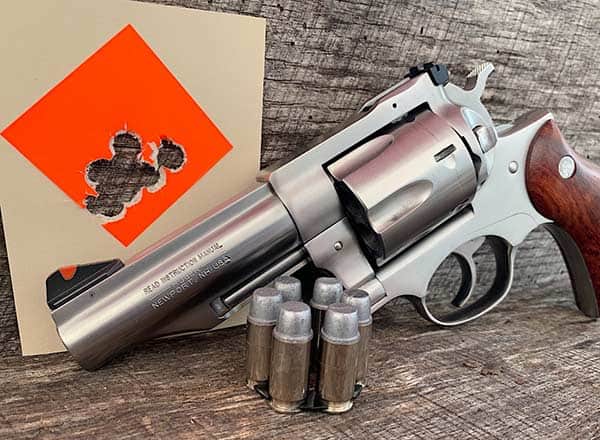
.45ACP loaded with Bullseye and Keith SWC’s
are fun and accurate to shoot.
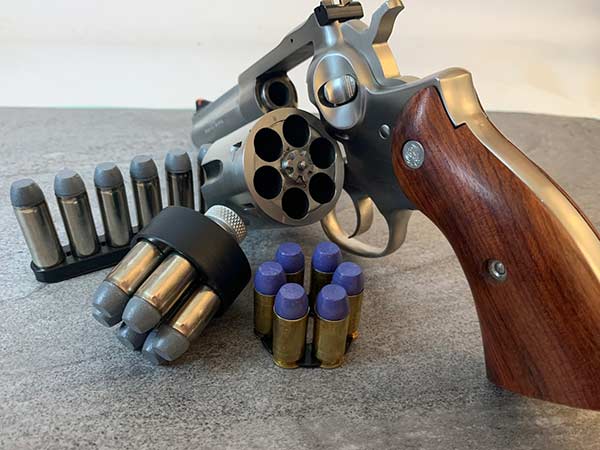
Both .45 Colt and .45 ACP can be fired in Tank’s
Modified Redhawk reloads using Bullseye.
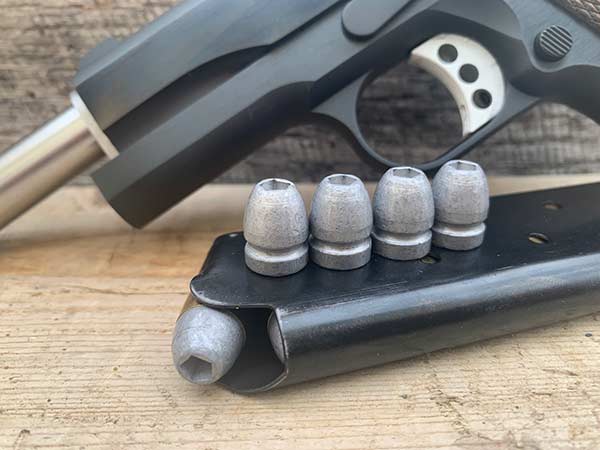
MP Molds 200-grain HP is ideal with Bullseye in .45ACP.
• 44 Magnum: Using the Lyman 429421 250-grain cast slug, it only takes 6 grains of Bullseye to push Elmer’s baby 900 fps. This load is a joy to shoot while being very accurate. It’s a great way to use a favorite gun without beating yourself up for a day of shooting.
• .45 ACP/AR: Six grains of Bullseye pushing a cast slug from Lee’s 230-grain mold runs around 940 fps and is accurate in both semi-autos and sixguns. Elmer used 5 grains of Bullseye for his target load with his 232-grain 454423 slug.
Heavy bullets in .480 Ruger are a pleasure to shoot when
loaded with Bullseye. Bullets are Lee 400-Grain RFN and
MP Molds 477640 HP.
Bullseye is useful, pleasant and fun in a variety of guns. Pictured
top to bottom: .45 Ruger Blackhawk, .475 Linebaugh and .44
Magnum flattop.
• .45 Colt: A 260-grain 454424 Keith bullet over 7 grains of Bullseye runs over 900 fps very accurately out of most sixguns. Elmer used 5-6 grains for his favorite light target load with his bullet.
• .480 Ruger: I have two bullets I almost shoot exclusively with my .480 Ruger. Le’s 400-grain RFN and MP Molds 386-grain 477640. I use 7-9 grains of Bullseye for 900-950 fps. It’s an easy shooting load and accurate.
• .475 Linebaugh: Seven to 9 grains of Bullseye can be used for lighter loads with 420-grain bullets. My favorite is Lee’s 400 RFN mold, along with MP Molds 477640. Velocity goes from 830 to 950 fps with Bullseye. Accuracy is all you can hold.
That’s a Wrap
While Bullseye powder may not be the answer to all your handloading woes, it can be used for fun, accurate shooting. If you happen to have some Bullseye already, break it out, roll up your sleeves and dirty up your gun for some of the cleanest fun on earth.
WARNING FROM GRUMPY – Don’t blame me if your gun blows up from info given here !!

Categories
The .244 H&H Magnum By Chuck Hawks

The .244 H&H Magnum was introduced in 1955. It could be considered the final word in 6mm cartridges. As factory loaded it exceeds the muzzle velocity (MV) of the .240 Weatherby Magnum by about 100 fps. Loaded to the same pressure with modern powders it would beat the hot Weatherby Magnum by more, as it has a longer and fatter case of considerably greater capacity.
The other modern 6mm magnum, the .243 WSSM of 2003 pales in comparison to real magnums like the .240 Weatherby and .244 Holland & Holland. (See my article “Compared: The .243 WSSM and .240 Weatherby Magnum.”)
The .244 is based on the full length .375 Magnum case with less body taper and a shortened neck. The rim diameter is the usual .532″ of magnum cartridges. The base diameter just forward of the belt is .508″ and the shoulder diameter is .445″. The case length is 2.78″ and the cartridge overall length (COL) is 3.58″. Bullet diameter is .243-.244″, and large rifle magnum primers are required.
The British factory ballistics called for a 100 grain bullet at a MV of 3500 fps and muzzle energy (ME) of 2725 ft. lbs. This was achieved by some 74 grains of an unspecified smokeless powder (not Cordite). At 200 yards the remaining velocity was 2970 fps and the kinetic energy 1980 ft. lbs.
I do not know the ballistic coefficient of the British bullet, but the trajectory of that load using a 100 grain Speer Grand Slam bullet (BC .351) would look like this: +2.3″ at 100 yards, +3″ at 165 yards, +2.7″ at 200 yards, and -3″ at 330 yards. The maximum point blank range (+/- 3″) would thus be 330 yards, putting the .244 H&H Mag. near the top of ultra-long range cartridges.
There is always a price to be paid for that kind of performance, and in the case of the .244 Magnum that meant excessive recoil and muzzle blast for a .24 caliber cartridge and short barrel life. Forcing that much incandescent gas through a small bore cannot be good for the barrel.
As it happened, shooters all over the world for once rewarded moderation and good design by laying down their hard earned cash for .243 and 6mm rifles, while sales of Holland’s super magnum lagged. Today the .244 H&H Magnum is, as far as I can determine, obsolete. Given sufficient monetary incentive, however, Holland & Holland might be willing to make one up. No factory loaded ammunition or production rifles are offered in the caliber.
If so, reloads would be a matter of research and educated guesswork. Obviously, the slowest burning powders would be called for. I’d probably start with .240 Weatherby loads using RL-25 or IMR 7828 powder behind a 100-105 grain bullet and work up gradually.
Nevertheless, the .244 H&H Magnum represents some sort of high water mark in the development of the 6mm cartridge. To use an aviation analogy, you could think of it as the Concorde of rifle cartridges.