Category: Ammo

Offering many of the same advantages, the .38 Special and 9mm nevertheless shine for much different shooters.
In .38 Special vs 9mm considerations:
- History and performance of the .38 Special
- History and performance of the 9mm
- Guns chambered for the cartridges
- Concealed carry performance
- Cartridges’ versatility
- Ammunition availability and cost
Truth told, the .38 Special and 9mm aren’t a world away. Put your pitchforks away and quit lighting your torches, the implication isn’t the time-tested cartridges are carbon copies of each other. Not by a long shot. Their countries of origin are disparate, there’s plenty that separates them ballistically and, even as most novice shooters know, they are generally shot from much different handguns.

That said, if you sit down and rattle off the .38 Special and 9mm’s virtues, you’ll end up with nearly identical lists. To start, both are relatively versatile for medium-bore handgun cartridges. Shot out of the right gun, they’re accurate and mild recoiling. Both have more than proven their worth as self-defense options. And each is economical, plentiful and just plain fun to shoot.
From that perspective, they almost seem echoes of each other, maybe even a bit redundant. So, everything laid bare, does it really matter who comes out on top in .38 Special vs 9mm?
Like so many aspects of the gun world, the answer isn’t as clear-cut as picking one or the other. Both are proven and excel at similar applications. But as is so often the case, each shines a bit more than the other for certain shooters.
.38 Special: The Persistent Revolver Cartridge
For a rather notorious cartridge, the .38 Long Colt had a particularly large influence on firearms and ammunition development. Its poor showing in the 1899-1911 Moro Rebellion not only led to the eventual adoption of the .45 ACP and Colt 1911 by the U.S. Military, but also spurred the development of what would become one of the most prolific cartridges of the 20th Century – the .38 Special.

Starting life in 1899 as a black powder cartridge, the .38 Special was essentially an elongated .38 Long Colt that offered greater case capacity. In turn, the .38 Special generated greater velocities as well as shot heavier bullets, which added up to greater penetration potential – an asset sorely lacking in the .38 Long Colt. Proving extremely popular shot from the Smith & Wesson K-frame Military & Police revolver, the cartridge was soon switched over to the modern marvel of the day – smokeless powder.
Given the respectable velocities for its day and the fact it was a kitten to shoot, the .38 Special became the primary service revolver caliber of most American law-enforcement agencies over the decades. Early on, the typical defensive load was a 158-grain lead semi-wadcutter hollowpoint, though later a 200-grain soft-cast lead round nose “Super Police” load become common, offering officers a bullet that yawed upon impact and created a larger wound canal.
Generally pushing bullets around 700 to 1,000 fps, the cartridge was quickly overshadowed by magnum and high-pressure semi-automatic pistol cartridges. Furthermore, almost exclusively a revolver round (yes, there are a few exceptions), the 5- and 6-round guns chambered for it paled in capacity to the double-stack pistols that started to dominate in the last quarter of the century.

The cartridge’s saving grace was the concealed carry movement of the past few decades. Double-action revolvers are among the easiest and most reliable handguns around – simply aim, pull the trigger and they go bang. This sort of dependability appealed to some armed citizen, particularly those who didn’t wish to master a semi-auto’s more complex manual of arms. Furthermore, material advancements shrunk down .38 revolvers to the point they became some of the easiest handguns to carry.
Think the polymer-framed Ruger LCR or aluminum-framed Smith & Wesson Model 642. Next to nothing weight-wise, the revolvers not only became a staple for those seeking the utmost convenience, but were light enough they gained popularity as insurance-policy backup guns.
There’s little arguing, the .38 Special is a bit of a throwback to a different era of handgun cartridges, but its usefulness has far from run its course.
9mm: Perhaps The Perfect Pistol Cartridge
In 1901, you would have gotten some funny looks had you claimed this little German cartridge would become among the most consequential ammo advancements of the last 100 years. Going further and maintain it would be among the most utilized centerfire cartridges of all time, heck they might have shipped you off to a nice comfortable rubber room.

Georg Luger’s upstart flew in the face of most conventional wisdom of the time – the 9mm wasn’t a revolver cartridge and it wasn’t big bore. Yet, it succeed and for an important reason — it was designed for semi-automatic pistols and came at a watershed moment when the advancement in handguns got its footing. Not to mention, the 9mm offered plenty of advantages in the breakthrough system.
Going down the list, the 9mm ticks off almost every box of desirable pistol cartridge traits. It was accurate and easy to shoot. It was possible to chamber small pistols for the cartridge. And, perhaps most importantly, it offered the potential firepower once only dreamed about when it came to handguns. There’s plenty of peace of mind in 15-plus rounds, standard capacity of most double-stack 9mms today.
Given it was designed to use smokeless powered, from the start the 9mm operated under much higher pressures than the .38 Speical and generated greater velocities. The maximum pressure for standard loads today is 35,000 psi. And, depending on the bullet weight (it shoots between 115 and 147 grain), generally the cartridge generated somewhere around 1,000 to 1,300 fps of velocity at the muzzle.
Lively, the cartridge for the most part not only meets FBI penetration standards, but it also works well with most jacketed hollow point bullets, ensuring the projectiles reached their maximum expansion diameter. This is particularly true with the new generation of bullets engineered for controlled expansion.

Over the years, militaries and law enforcement recognized these advantages and have flocked to the 9mm. Accordingly, the “Nine” has also become a favorite of armed citizens, who seek not only the assets of the cartridge, but also the guns chambered for it.
Perhaps no other cartridge more options to send it flying. In turn, especially from a defensive standpoint, you’re likely to find exactly the gun to meet your needs — be it a pistol to maximize your capacity or on one to cut down your carry profile.
.38 Special vs 9mm: Guns
There’s an old misconception the .38 Special ideal for novices. That is, given the simplicity with which a double-action revolver operates, the tame cartridge makes it perfect for new shooters learning the ropes. In a sense, this is true, if you’re talking about a 4-inch barreled revolver and up. Not so much when discussing many of the popular carry models.

Take the Ruger LCR, for instance. At 13.5 ounces, the ultra-light revolver’s recoil can prove quite stout, generating a bit more than 7 ft/lbs of recoil energy when shooting Hornady’s 125-grain American Gunner ammo. This is nearly twice the amount from say a 4.2-inch barreled Ruger GP101. With the latter, of course, you have a much larger gun you have to contend with, a drawback for concealment. If it’s a plinker or competition gun, this might not matter a lick.
To be fair, you have to deal with the same physics with micro 9mm pistols. The Ruger LC9s generates around 8 ft/lbs of recoil energy spitting out Hornady’s 124-grain Custom ammo.
But, this can become considerably more bearable given the pistol offers the 9mm’s superior ballistics (it’s 210 fps faster than the .38 load), capacity (three more rounds) and concealment. Admittedly, there are hairs to split on the last point, but generally, semi-autos offer a much slimmer profile than revolvers, making them easier to keep under wraps.

OK, so what? You’ll get used to the recoil, what you care about reliability. Good point, on average a .38 Special revolver will experience fewer malfunctions than a 9mm pistol. Yet, the good ol’ revolver isn’t immune to failures and the argument exists that when a wheelgun fails it’s much more catastrophic than a pistol.
There’s no simple “tap and rack” to solve something like a pulled bullet or a stuck case in a revolver; in many circumstances getting it in working order involves tools – not ideal if your life depends on getting the gun back into the fight.
.38 Special vs 9mm: Concealed Carry
Overall, it’s difficult to argue that when it comes to concealed carry, for most modern shooters the 9mm edges out the .38 Special. As mentioned before, the semi-auto pistol cartridge offers better ballistics, is chambered in larger-capacity guns, of which there is a greater selection and, for the most part, are easier to conceal. Certainly, semi-auto pistols do require more practice to become competent, given the greater odds of having to solve a malfunction. Though, to many, this is a small trade-off.

With that said, the .38 Special is no slouch. Over the years, it has more than proven itself a capable self-defense cartridge and in recent times has benefited from the advancements in ammunition. In the right hands and with the proper round, there’s no reason to believe the tried-and-true revolver cartridge won’t perform admirably in a self-defense situation.
Additionally, a streamlined manual of arms, mastering most of the guns chambered for it is generally a simpler task. While it may not be most people’s first choice any longer, it is no less a valid choice overall.
.38 Special vs 9mm: Versatility
Stepping away from defensive applications, the one area the .38 Special perhaps has an edge on the 9mm beat is versatility, particularly on two fronts: guns and reloading. To the former, since it is the parent of the .357 Magnum, it is possible to shoot the .38 in nearly any gun chambered for the larger cartridge.
This is a benefit from the standpoint that it is normally less expensive per round than the magnum and a magnitude less punishing to shoot. To the latter, given it has more case to work with the .38 also has more potential on the reloading bench. With experience and understanding about its capabilities, a handloader can get a lot out of the cartridge.
.38 Special vs 9mm: Ammunition

The .38 Special won’t break the bank by any stretch of the imagination. At the same tick, it still won’t outdo the 9mm for economy. Outside of the .22 LR, there is perhaps no more cost-effective option out there – especially when talking centerfire cartridges.
A quick survey of LuckyGunner.com gives a good example. At their cheapest, the .38 Special comes in at around .25 cents per round, the 9mm .14 cents – roughly a whole three more rounds per dollar spent. Over a long afternoon shooting that adds up.
Parting Shot
There is no doubt modern shooters have embraced the 9mm and for good reason. Of nearly all handgun cartridges on the market today, it is among the most well-rounded and allows even new shooters the ability to become proficient. Furthermore, dominating the gun world as it has, the 9mm just plain has more options when it comes to firearms.
You’re more likely to find a gun to fit exactly what you need, be it a service-pistol for your nightstand or a single stack for your belt holster. Finally, given ammunition advancements, it will perform in the direst circumstances.
Nevertheless, the .38 Special is still around for more than just the sake of nostalgia. While overall it doesn’t offer all the advantages of the 9mm, it remains a very competent cartridge, one of which many still trust their lives.
Arguably, the cartridge takes a bit more research to find the optimal defensive round, but for those who desire the reliability of a revolver that’s a small hurdle.

At this time of year, many of us are taking to the field for hunting. Unfortunately, hungry predators are also gearing up for winter, which always leads us to a discussion of bear and mountain lion guns.
Archery hunting is fun and all, but a bow is not what anyone wants to be holding when we find ourselves between a Momma and her cubs.
The problem with most guns of caliber big enough to stop a bear is that they are heavy and unwieldy. Smith and Wesson, always innovating in revolver design, has stepped in to fix that with the Combat Magnum Model 69.
S&W — A Perfect Sidearm For Bears?
The first of the Combat Magnum line goes all the way back to Bill Jordan, legendary gunfighter of the Border Patrol. Jordan, with extensive experience not only as an Agent but as a Marine in WW II and Korea, convinced Smith and Wesson to adopt K Frame revolvers for .357 Magnum.
Until that time, they were only built on the heavier N-Frame. New metallurgy and improved design finally resulted in the first Combat Magnum being introduced in 1955. Finally, in 2015, the Combat Magnum line was extended to include the new model 69 in .44 Magnum.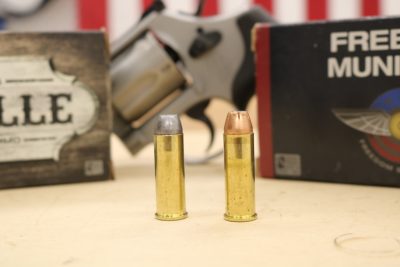
SPECS:
- Model 69 Combat Magnum
- Cartridge: .44 Magnum
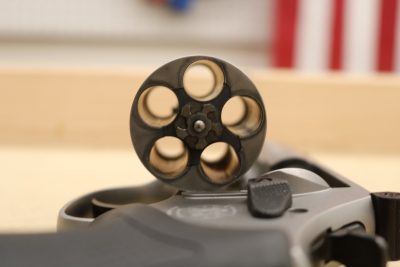
- Capacity: 5 rds.
- Barrel length: 2.75 in.
- Overall Length: 7.8 in.
- Single/Double Action
- Synthetic Grip
- Barrel & Frame: Steel
- Full-length extractor rod
- 2 Piece Barrel
- MSRP: $849
 .44 Magnum L Frame
The new Combat Magnums in both calibers are built on the L Frame, slightly larger than the K, but smaller than the N.
What do you give up, moving a .44 Mag down to this frame size? A little bit of capacity, and a chunk of weight. The model 69 has a capacity of 5, which given the caliber should be plenty. If you can’t stop a charging bear with 2 or 3 rounds, the odds of you getting 4-6 off are about zero.
The weight difference between the 69 and full-size Model 696 with a similar barrel length is 4 ounces. That doesn’t sound like a lot, but it is a tenth the total weight of the gun. And the model 69 in that comparison has a further ¼ inch of barrel.
The slightly slimmer frame of the 69 is noticeable when you pick it up, but it has a nice weight and balance. The grip is rubber, which you are going to appreciate when you start cooking off full power rounds.
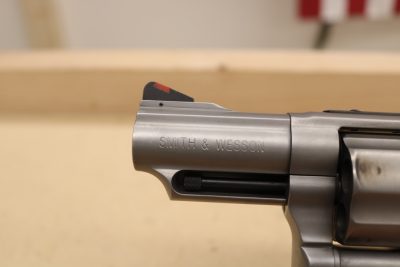
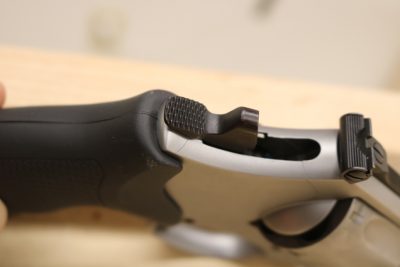
The fit and finish are what we expect from Smith and Wesson, which is to say they are outstanding. The finish is a brushed stainless steel, with a blued trigger, hammer, and cylinder release.
Article Continues Below
The hammer has a very aggressive texture, which I grew to like switching back and forth from single action to double action. The single action trigger pull is nice and crisp, also expected from its heritage.
The front sight is a blade with an orange insert, which picks up quickly on snapshots. The rear sight is all black, and adjustable for windage and elevation.
One change from previous revolvers, this one features a ball detent lockup. The weakest point of a revolver has always been the yoke that supports the cylinder, and the ball detent system spreads the force of firing over a greater surface area.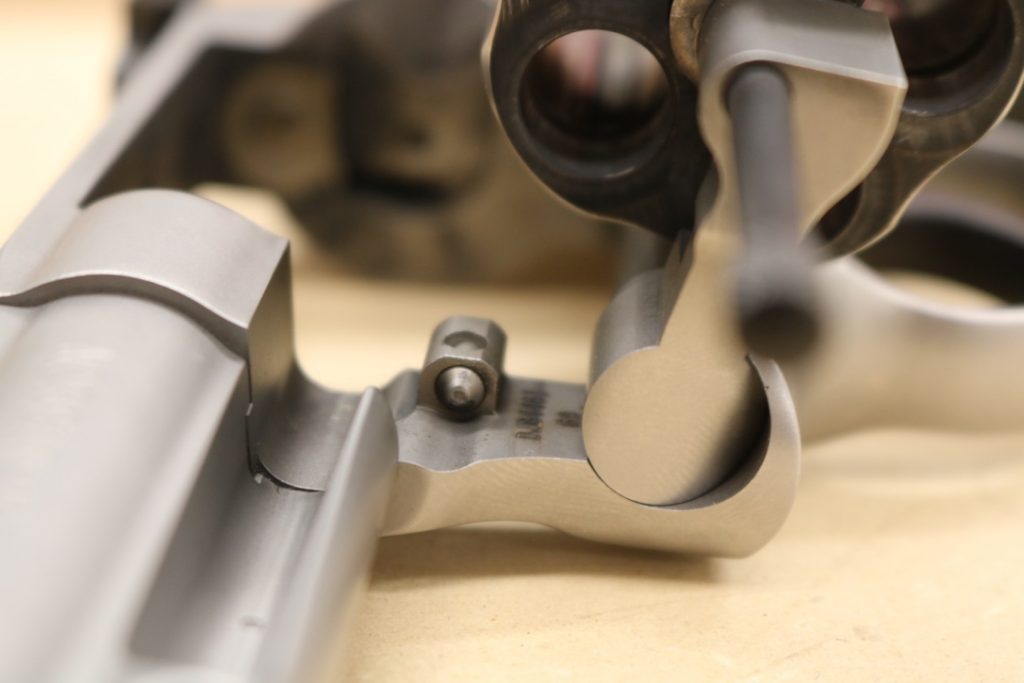
Range Time
Heading out to the range, I was curious how the Model 69 would handle. I’m not recoil sensitive, but insanely powerful handguns are definitely not my thing. In fact, at the Smith and Wesson factory, I politely handed the snubbie 500 back after two rounds. I like enough umph in my handguns, but if the pain is part of the recoil cycle, I’ll have something else thank you.
Fortunately for me, Freedom Munitions was providing the ammunition this week. Not only did I get some full power 240 grain, but also the new Leadville 200s. The Leadville is downloaded to a sane 1,000 feet per second (fps), the cast lead projectile is great for shooting steel. I would go so far as to say, the Leadville in the Model 69 was a joy to shoot.
Go behind the scenes with Freedom Munitions.
The full power loads were a little much, but if you are accustomed to full bore 44, probably not much of an issue. This is one of the great strengths of revolvers, they eat whatever you feed them. It is nice to have a low recoil training round, and an ass kicker for field use. If you ever do need your Model 69 in a life and death encounter, I am sure you won’t notice the recoil at all.
All in all, the Combat Magnum Model 69 is a great addition to the Smith and Wesson revolver family. If you need a backcountry gun, or a very serious CCW one, the Model 69 has you covered.
For more information about Smith & Wesson revolvers, click here.
You just know that some idiot will try this out even after being told to not do it, Right?

I think that this would make an excellent pair of book Ends! Grumpy
The Smith & Wesson Model 27-2 is a pinnacle of handgun craftsmanship within the venerable Springfield Massachusetts manufacturer’s history.
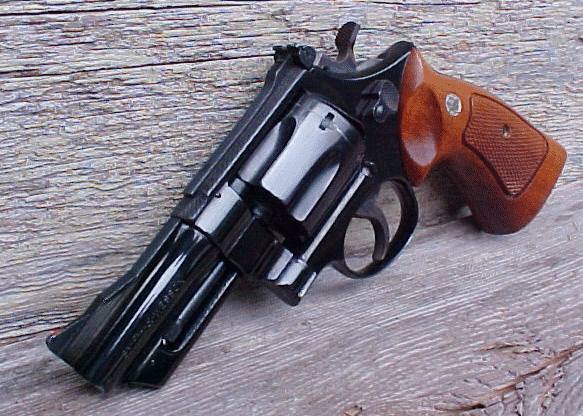 It was built and fitted by craftsmen that are no longer working, and polished by hand prior to receiving one of the most exquisite blue finishes ever available. The Model 27 is the direct descendent of one of the most revered S&W wheelguns ever built, the Registered Magnum.
It possesses a close resemblance to a previous N-Frame, the .38/.44 Heavy Duty. The .38/44 HD was developed to shoot the radically uploaded .38HV cartridge, essentially a .38 Special round, in response to law enforcement needs at the time.
It was the precursor to the .357 Magnum. The .357 Magnum itself was developed as a sans pareil handgun and cartridge suited to both law enforcement and sporting use. Smith & Wesson predicted the high cost of the revolvers in the Great Depression economy to be a limiting factor on production.
From the time of introduction in 1935 until 1938, .357 Magnum revolvers bore individual registration numbers and included a certificate of registration.  Demand for the premium handgun far exceeded expectations. With the completion of some 5,500 units, it became obvious that a limited production strategy was not practical, and individual registration stopped. Thus, the Registered Magnum became the Pre-model 27.
I purchased this Smith & Wesson Model 27-2 from a private seller at a gun show. The three and a half inch barrel is not exactly scarce on a Model 27, but it is hard to find. This example was pinned and recessed, and wore a set of target grips.
 Demand for the premium handgun far exceeded expectations. With the completion of some 5,500 units, it became obvious that a limited production strategy was not practical, and individual registration stopped. Thus, the Registered Magnum became the Pre-model 27.
I purchased this Smith & Wesson Model 27-2 from a private seller at a gun show. The three and a half inch barrel is not exactly scarce on a Model 27, but it is hard to find. This example was pinned and recessed, and wore a set of target grips.
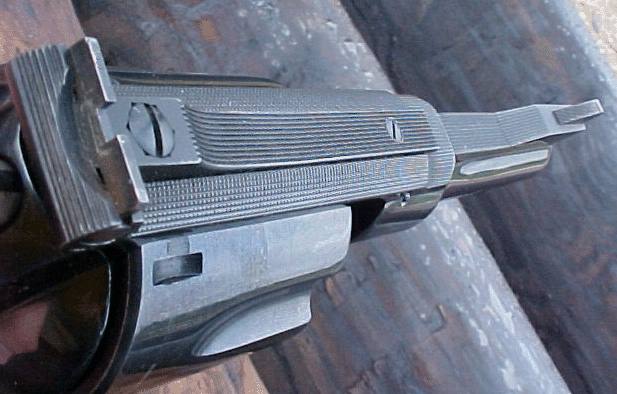
The checkered topstrap and sight rib is a unique feature of the Model 27. I took the revolver to the range with a 50 count box of 125 grain Winchester White Box .357, and a Winchester Value Pack of .38 Special.
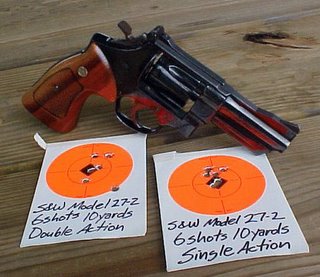 I found the revolver to already be sighted in suitably for myself. The previous owner had dabbed some orange paint on the front ramp, but I had removed that the night before.
 I found the revolver to already be sighted in suitably for myself. The previous owner had dabbed some orange paint on the front ramp, but I had removed that the night before.
The Model 27’s trigger pull was consistent throughout it’s arc. Firing double action, it was not difficult to hold the sights on target. When fired single action, the revolver was a precision instrument.
The heavy N frame easily absorbed the recoil of the .38 Specials. When the .357 Magnum rounds were slid into the chambers it became a fire belching weapon of the gods. This revolver was accurate on both loads, and a hell of a lot of fun to shoot.
When a person considers the advantages of practicing often with your carry gun, shooting your carry loads, it is easy to understand why some would opt to carry the N frame snubbie rather than a K frame such as the Model 66.
I also own a pristine Model 27-2 with an eight and 3/8 inch barrel. I have shot that long barreled revolver only a few times, relegating it to it’s wooden presentation box for my son to receive someday. This three and a half inch Model 27 is mine, and it will be shot often.
I also own a pristine Model 27-2 with an eight and 3/8 inch barrel. I have shot that long barreled revolver only a few times, relegating it to it’s wooden presentation box for my son to receive someday. This three and a half inch Model 27 is mine, and it will be shot often.
Labels: N Frame Smiths, Range Reports
Categories
Some 44 Magnum Humor
