Category: Ammo

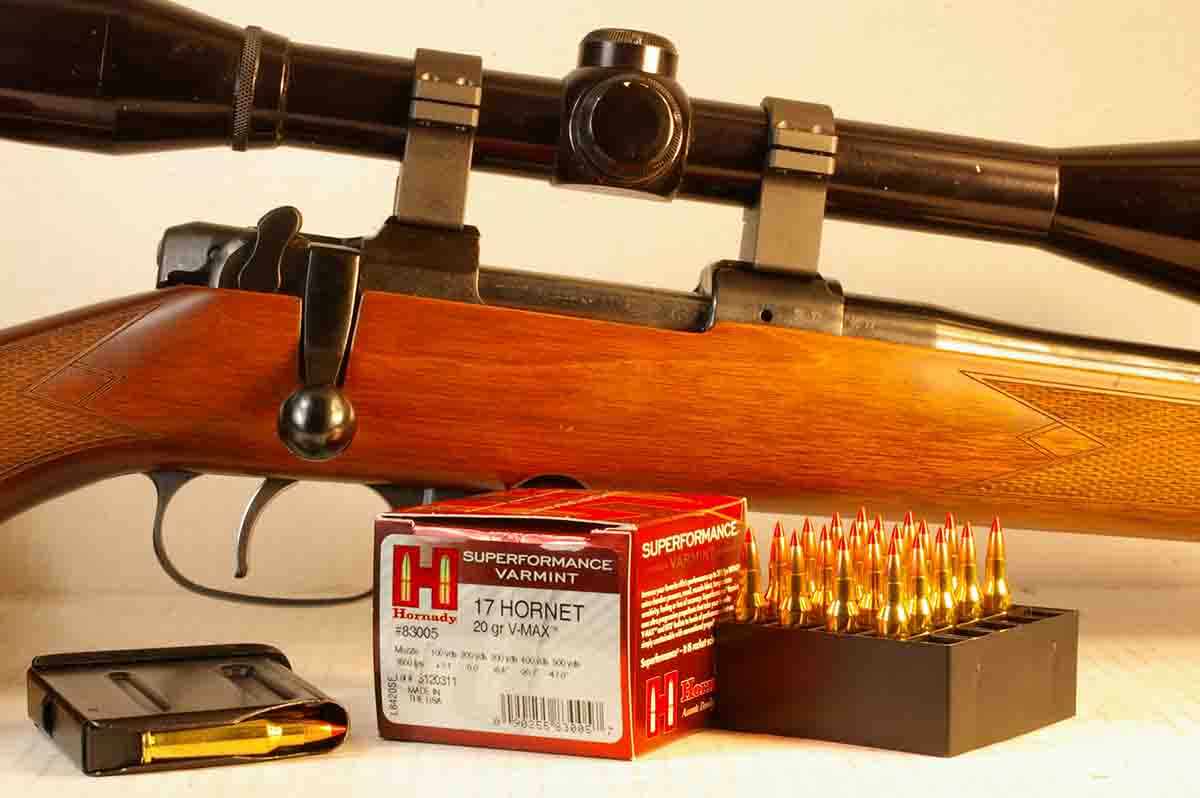
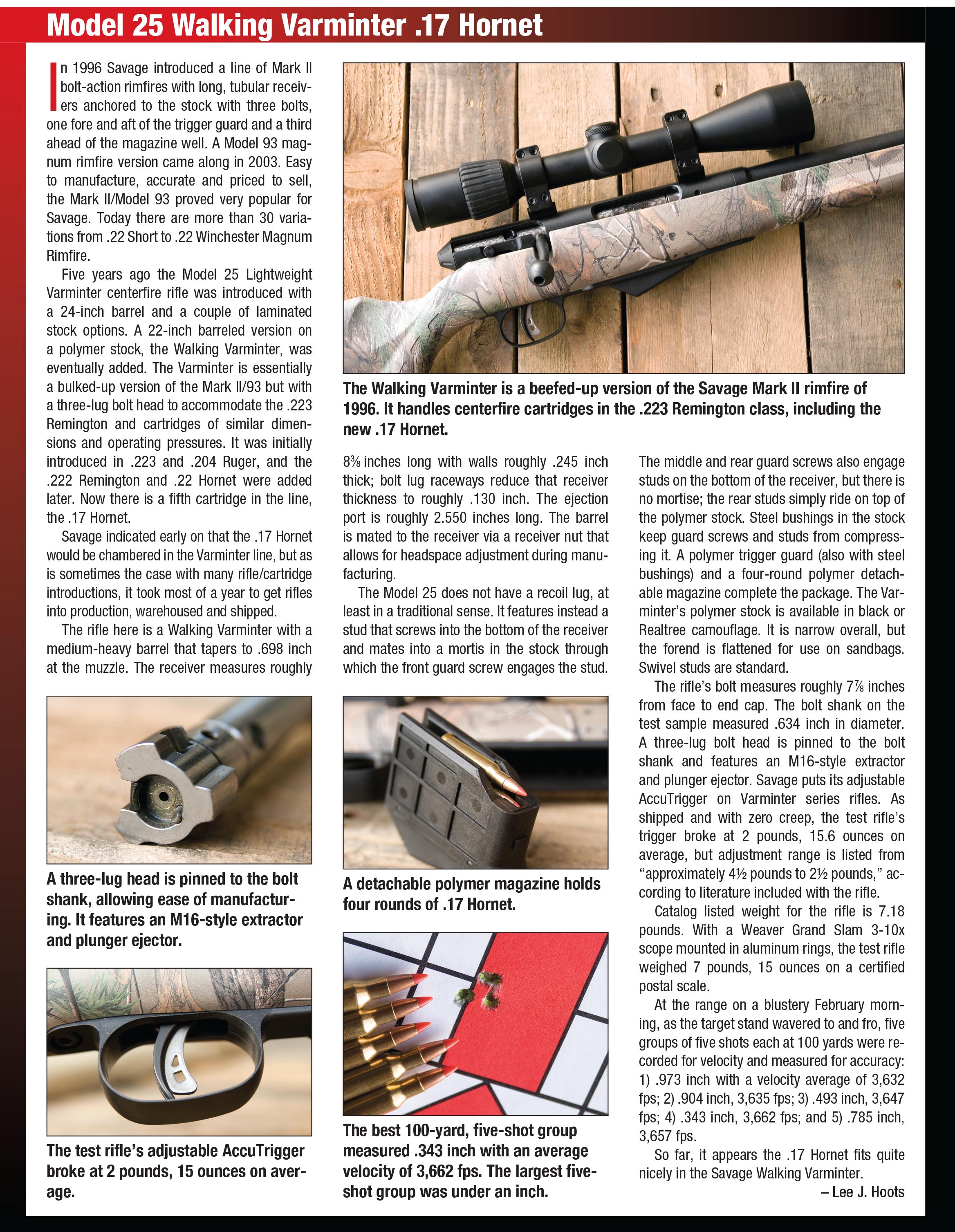
Hornady currently loads its .17 Hornet with 20-grain V-MAX and 15.5-grain NTX bullets. The factory 20-grain loads were accurate and had a velocity of 3,567 fps when shot from a CZ 527 American.
When a new cartridge is introduced, its origins can often be traced to a cartridge P.O. Ackley had his hand in developing decades previously. A case in point is Hornady’s new .17 Hornet with roots back to the beginning of .17-caliber cartridges in the years following World War II.

In Handbook for Shooters and Reloaders, Volume II (1966), Ackley writes about himself: “The author may or may not have been the originator of the .17 caliber in this country. The reason the author made the first .17 caliber was the result of a deal with the late C.H. O’Neil of OKH fame. During the first years of World War II, Mr. O’Neil came up with the idea of a .17 caliber cartridge, believed to have been based on the .22 Hornet.
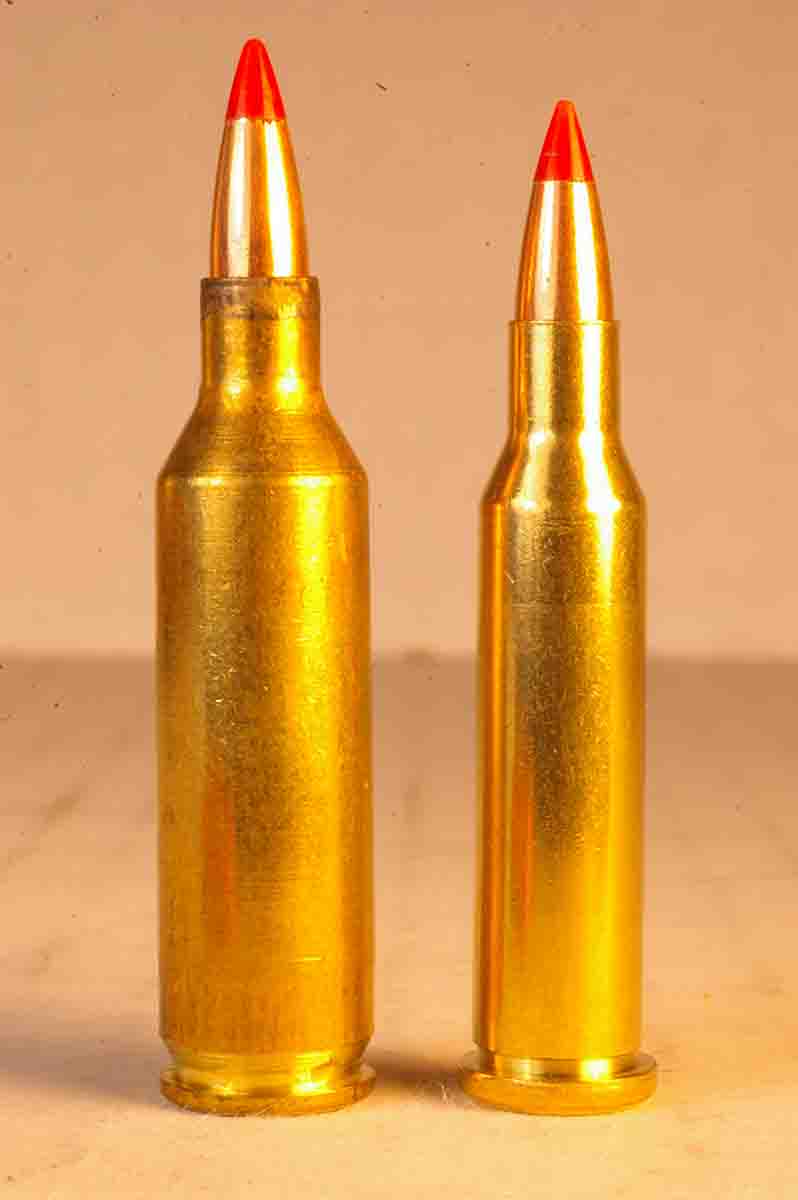
The .17 Hornet (left) looks like a larger version of the .17 Hornady Magnum Rimfire (right). The .17 Hornet will become a very popular cartridge if it garners even a small percentage of the .17 rimfire’s popularity.
The author obtained the tools, which took some time, and by the time the tools were ready Mr. O’Neil had other things to occupy his mind, so that the project remained static until 1945. Having the tools, it was decided to make a few barrels. The first one was chambered for the so-called .17 Pee Wee, which was simply the .30 Carbine cartridge necked down to .17, and the first rifle was built . . . by an Oregon gunsmith and was exactly right for this small cartridge. Bullets were made out of copper wire and results on small game such as prairie dogs were quite amazing. The impossibility of getting suitable actions for the .17 Pee Wee cartridge, made it necessary to design several other cartridges which would be suitable for available actions. The first one was the .17 Hornet, closely followed by the .17 Bee and later by the .17/222.”
Ackley describes the .17 Hornet as sort of an “improved” .22 Hornet necked down to .17 caliber. Ackley’s load data lists 25-grain bullets with a velocity of 3,585 fps from 12.0 grains of 4198 and 3,570 fps from 11.5 grains of 4227.
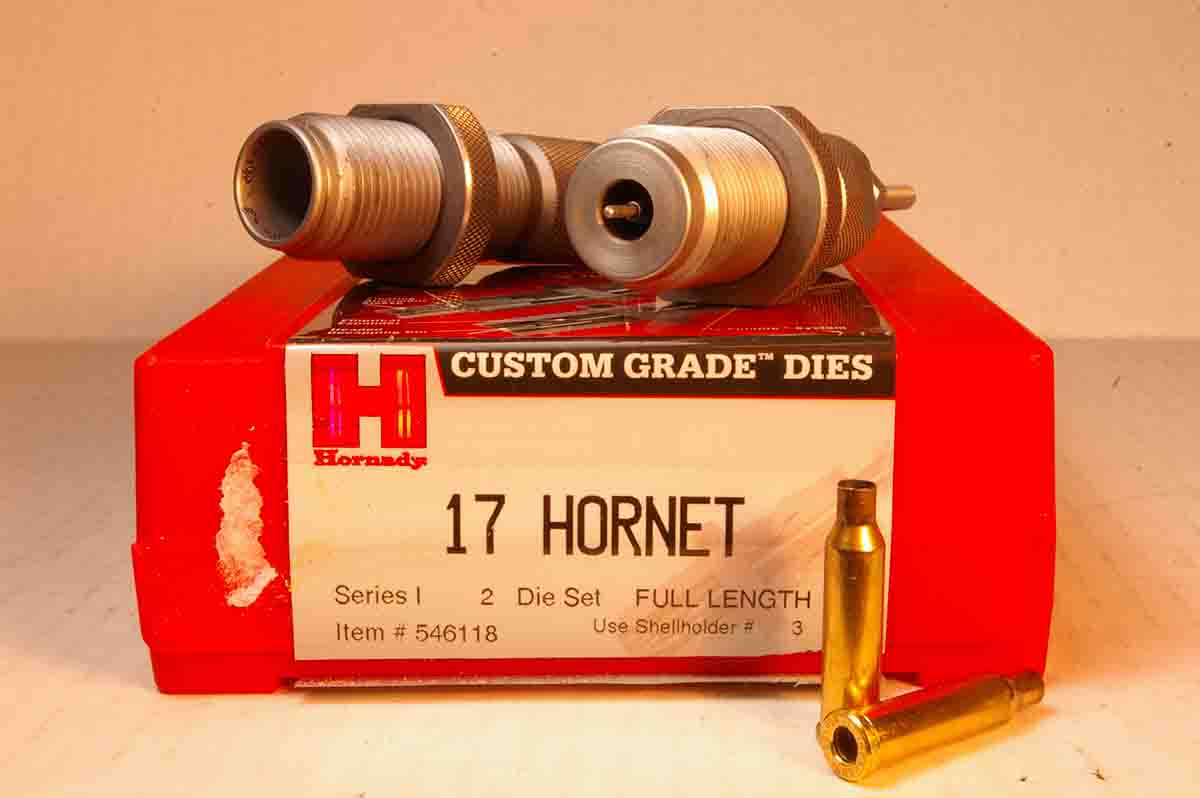
Hornady dies were used to handload cartridges for the .17 Hornet. Backing the sizing die a partial turn from contacting the shellholder on the press set headspace on the case shoulder instead of on the cartridge rim.
Hornady also calls its new .17-caliber cartridge the .17 Hornet. The Hornady .17 case, however, is a bit shorter in length and to the base of the shoulder than the Ackley case. The shoulder diameter of the Hornady case is also a bit wider in diameter than the Ackley. The new case most likely is shorter so it can be loaded with relatively long and pointed Hornady 20- and 25-grain V-MAX bullets and still retain the same 1.723-inch overall cartridge length of the .22 Hornet. That length allows Hornady’s .17 Hornet to fit in existing magazines and bolt actions originally intended for the .22 Hornet, like the CZ 527, Ruger 77/22 Hornet and Savage Model 25.
Because the .17 Hornady Hornet case is smaller than the .17 Ackley Hornet case, handloading data for the two cartridges should not be casually interchanged. Hodgdon Powder is the only current source of handloading data I could find for the new and old .17s. The Hodgdon’s 2012 Annual Manual and the Hodgdon website list about the same maximum loads for the .17 Ackley Hornet and .17 Hornet with some powders. However, maximum powder charges for the .17 Ackley are 0.2 to 0.7 grain heavier than for the .17 Hornady. That is a significant difference in such a small cartridge case that only holds about 12 grains of powder.
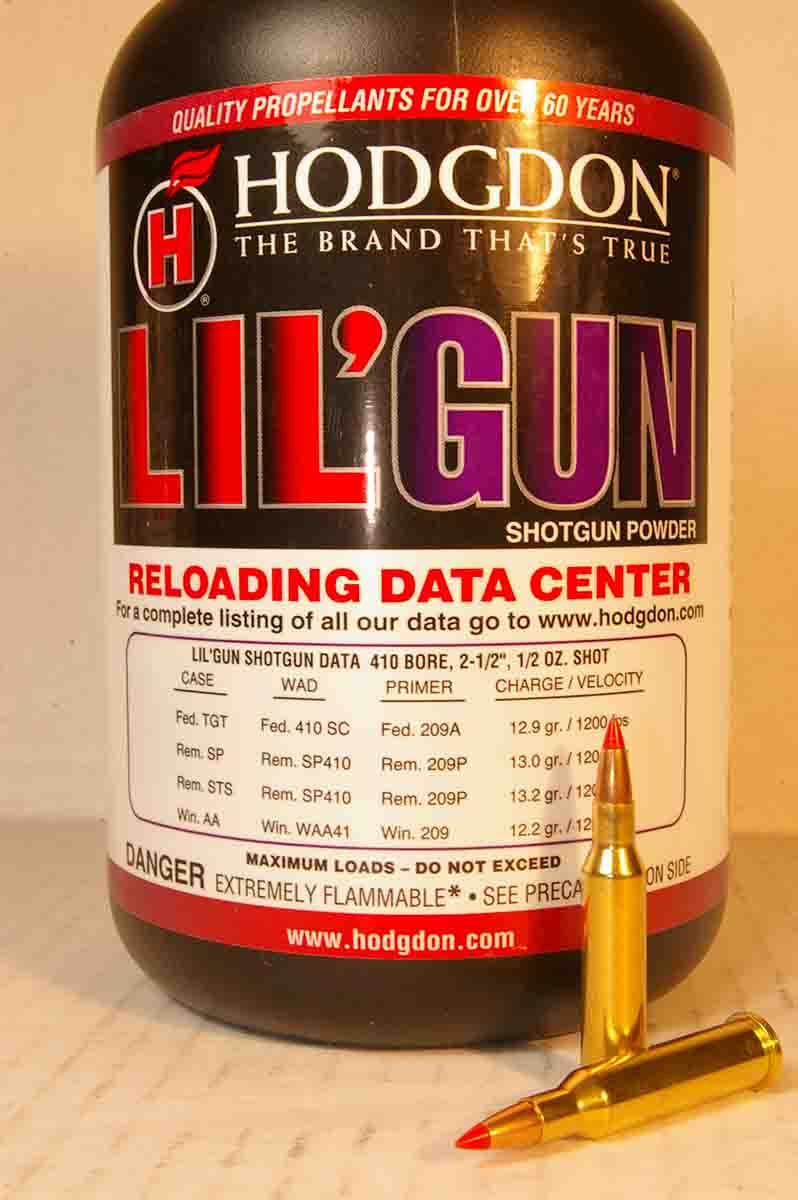
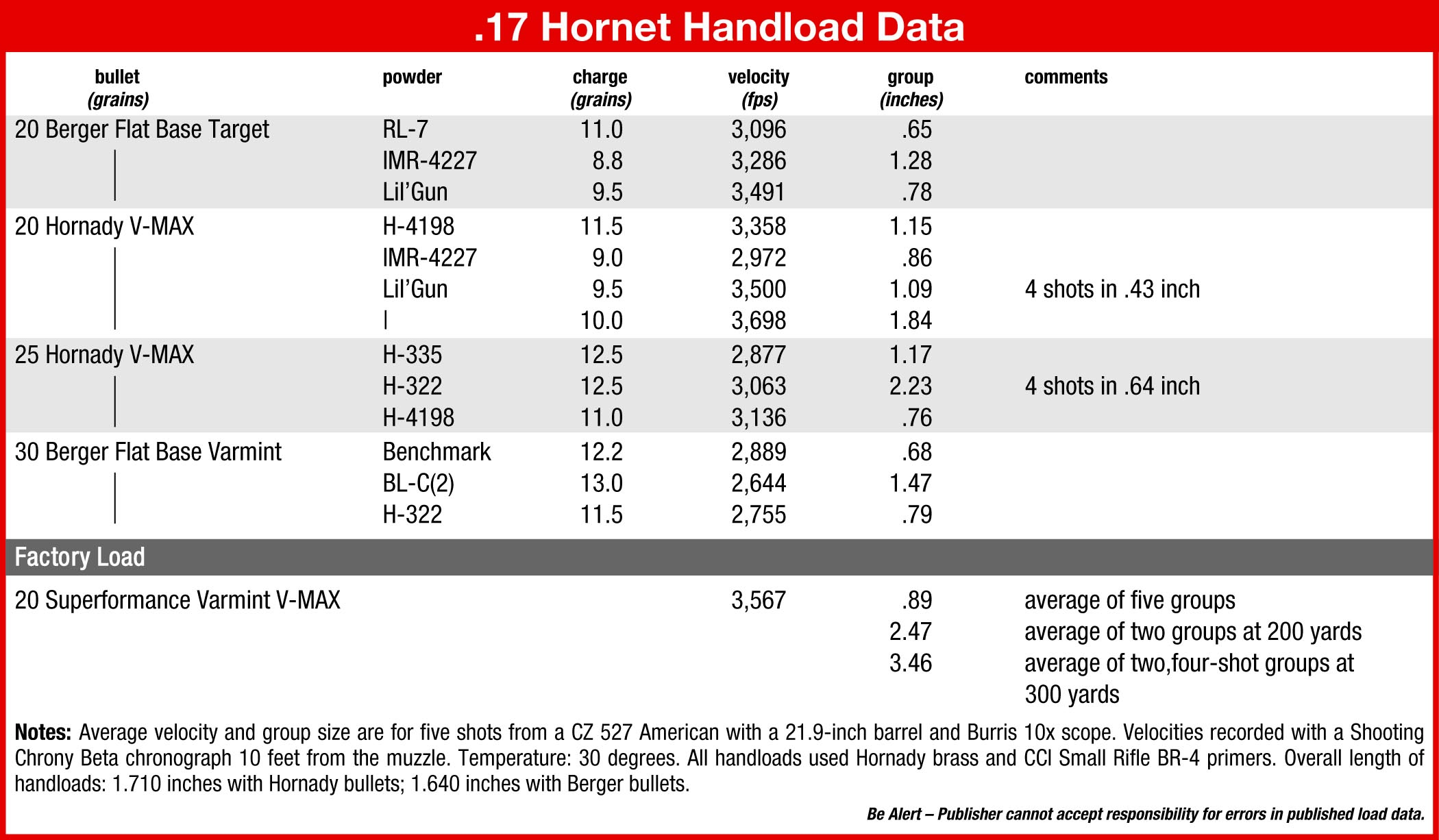
Hodgdon Lil’Gun was the best powder tried for high velocity and good accuracy in the .17 Hornet.
Hornady loads its .17 Hornet Superformance Varmint cartridges with 20-grain V-MAX bullets and 15.5-grain NTX bullets, with a stated muzzle velocity of 3,650 fps for the V-MAX and 3,870 fps for the NTX. The V-MAX bullets had an average velocity of 3,567 fps for 10 shots recorded 10 feet in front of the muzzle of the 21.90-inch barrel of a CZ 527 American.
CZ calls the 527 a “micro-Mauser” due to its nonrotating claw extractor that grabs the rim of a case as it’s pushed forward out of the magazine and blade ejector. The supplied scope rings that clamp on the square bridge of the receiver are a nice touch. The 527 has a single-set trigger with a pull of 3.5 pounds that contains some creep, but pushing the trigger forward “sets” it, and pull weight changes to a light one pound. The 527’s barrel is slender with a diameter of just over .5 inch at the muzzle. The rifle weighs right at 7 pounds with a Turkish walnut stock and a Burris 10x scope.
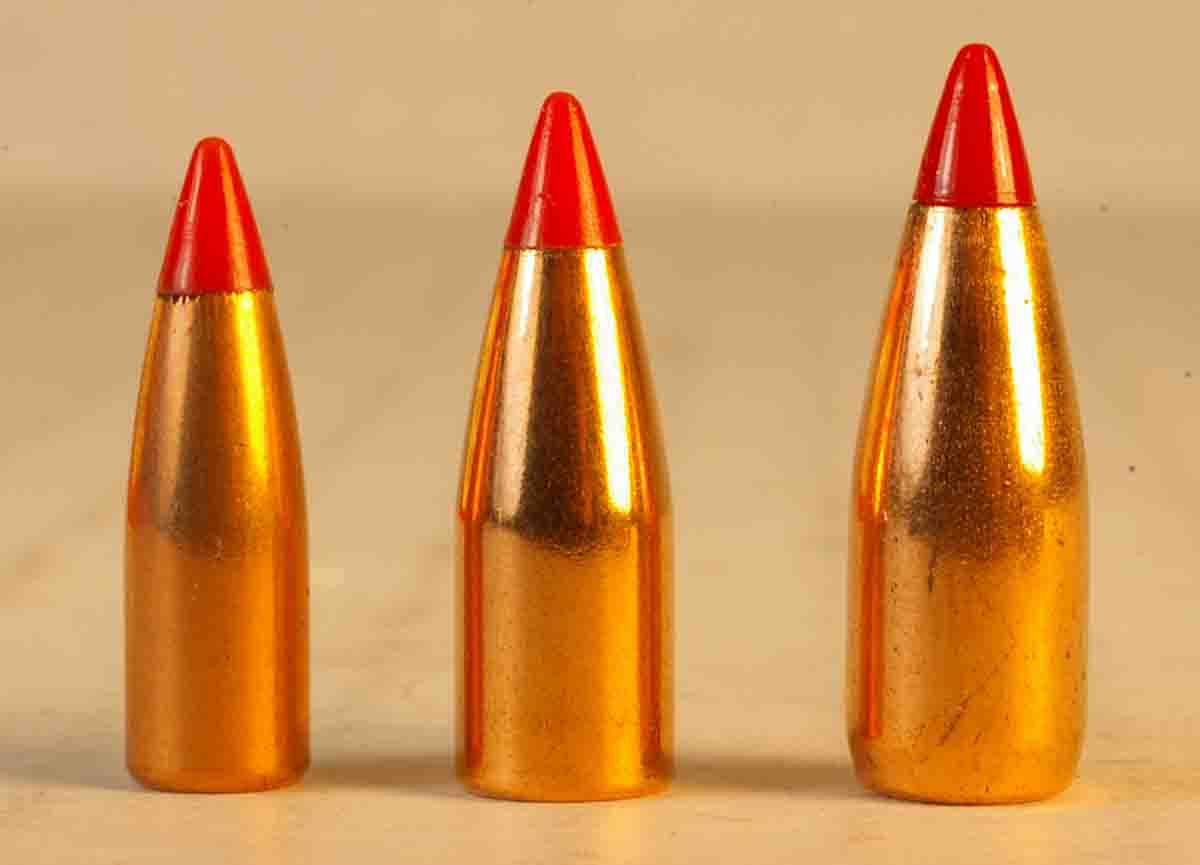
The .17-caliber, 20-grain V-MAX (left) is not that much smaller than the .20-caliber, 32-grain V-MAX (center) and Hornady’s .22-caliber, 40-grain V-MAX (right).
The little rifle and varmint loads made an accurate pair, too. Five, five-shot groups measured an average of .89 inch at 100 yards. Two, five-shot groups averaged 2.47 inches at 200 yards and 3.46 inches at 300 yards. Recoil was so gentle the scope’s crosshairs barely bounced, and when shooting I often saw a tiny black hole appear on the white target paper at 100 yards. After shooting the .17 Hornet, the recoil and muzzle blast from a .22-250 Remington felt like a .338 Winchester Magnum.
I figured Hornady 20-grain V-MAX bullets would pretty much drop out of the air after they reached 200 yards, but the tiny bullets surprised me. With the CZ sighted in 1.40 inches high at 100 yards, the bullets still hit an inch above aim at 200 yards. At 300 yards they dropped 5.50 inches. That meshes closely with Hornady’s 200-yard zero figures: +1.1 inches at 100 yards and -6.40 inches at 300 yards. So with some hold-over aiming finesse, the .17 would make a decent ground squirrel and prairie dog cartridge out to 300 yards.
It’s not a spectacular cartridge, though, because a hanging steel plate at 300 yards didn’t even move when shot with the tiny V-MAX bullets, but the approximately 200 foot-pounds (ft-lbs) of energy the little bullets still carry at 300 yards is enough to kill a ground squirrel.
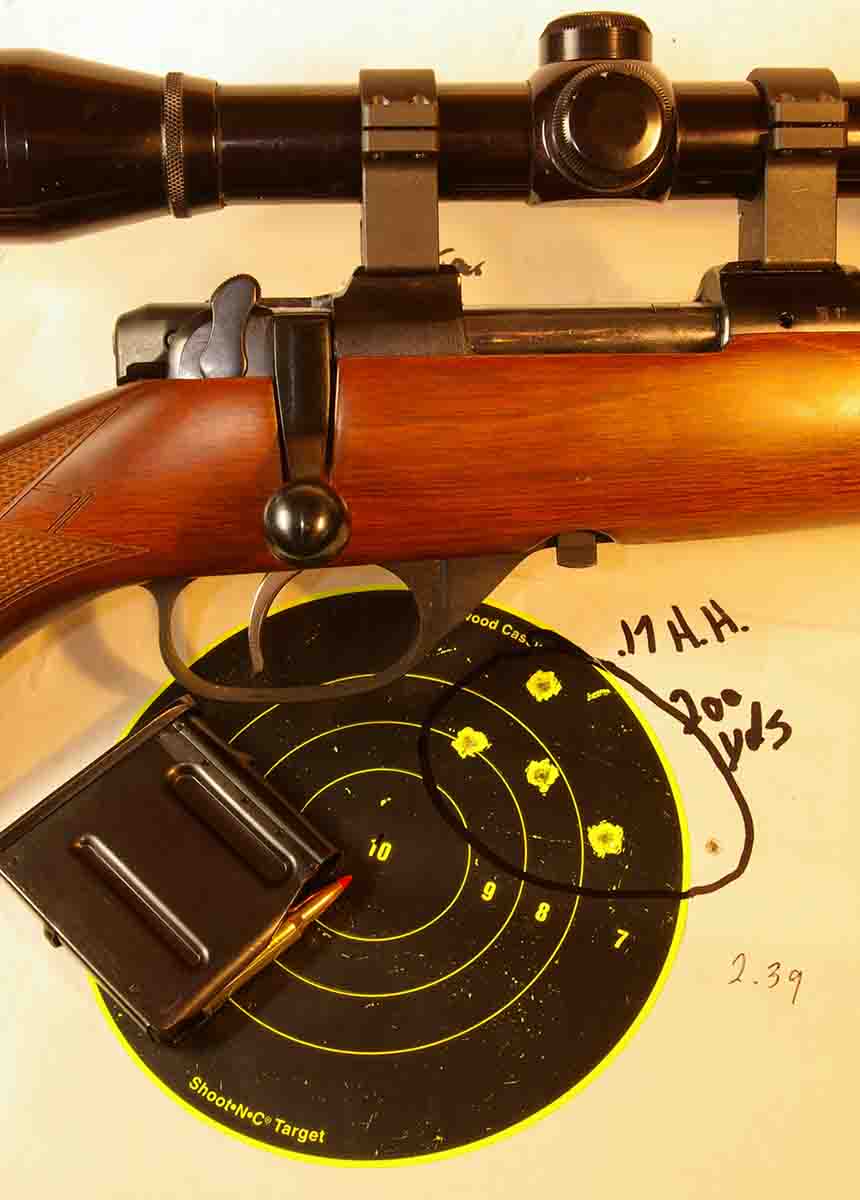
The CZ 527 and Hornady factory loads combined for this 200-yard group.
After shooting 80 Hornady loads one afternoon, I soaked the CZ’s bore with solvent for a day and then gave it a good scrubbing with a bronze brush. Patches pushed through the bore came out with the black gunk of powder fouling but no blue color to indicate jacket fouling.
Handloading the .17 Hornet
The .17 Hornet (right) is quite a bit smaller and burns about three-quarters as much powder as the .17 Remington Fireball (left). The Hornet’s velocities are about 500 fps slower than the Fireball’s.
The choice of .17-caliber bullet weights is rather slim. Most common weights are between 20 and 25 grains. Berger used to make 20-, 25- and 30-grain hollowpoints but now offers only 25-grain bullets. Hornady has been committed to .17-caliber bullets for decades and makes 20- and 25-grain V-MAXes and 25-grain hollowpoint .17s. Nosler offers 20-grain Varmageddon bullets with either a hollowpoint or plastic tip. Powder choice is also rather limited, with Hodgdon listing loads with six different powders.
The .17 Hornet’s tiny bullets and a small case capacity mean velocities vary considerably with a slight change in powder weight. Hodgdon’s load data shows 11.0 grains of H-4198 gave the 20-grain V-MAX a velocity of 3,226 fps. An additional 0.8 grain of the powder increased velocity by 237 fps. One of my handloads with 9.5 grains of Lil’Gun gave the 20-grain V-MAX a speed of 3,500 fps. An additional 0.5 grain of Lil’Gun increased the velocity of 20-grain bullets by 198 fps. Hodgdon lists as little as 0.3 grain between minimum and maximum powder charges for the .17 Hornady.
The powder weights for all the loads but one listed in the table were weighed as precisely as I could on a balance scale. Still, extreme velocity spreads ranged from 104 to 368 fps with IMR-4227, 142 fps with Reloder 7 and 162 fps with H-4198 shooting 20-grain bullets. Lil’Gun delivered much lower extreme spreads of 45 to 69 fps. As a comparison, the extreme velocity spread was 108 fps for 10 shots of Hornady’s Superformance Varmint 20-grain load. The heavier bullets had much lower extreme spreads, with 43 to 45 fps for the 25-grain bullets and 30 to 66 fps for the 30-grain bullets.
Hodgdon Lil’Gun is the powder for the .17. Ten grains gave 20-grain bullets a velocity of nearly 3,700 fps, which is all you can expect from such a small amount of powder. A 9.5-grain charge of Lil’Gun shot five 20-grain Bergers in .78 inch at 100 yards. The same charge with 20-grain V-MAXes started out with an even tighter group, but I flipped out the bullet from the fourth shot, which enlarged the group to 1.09 inches at 100 yards.
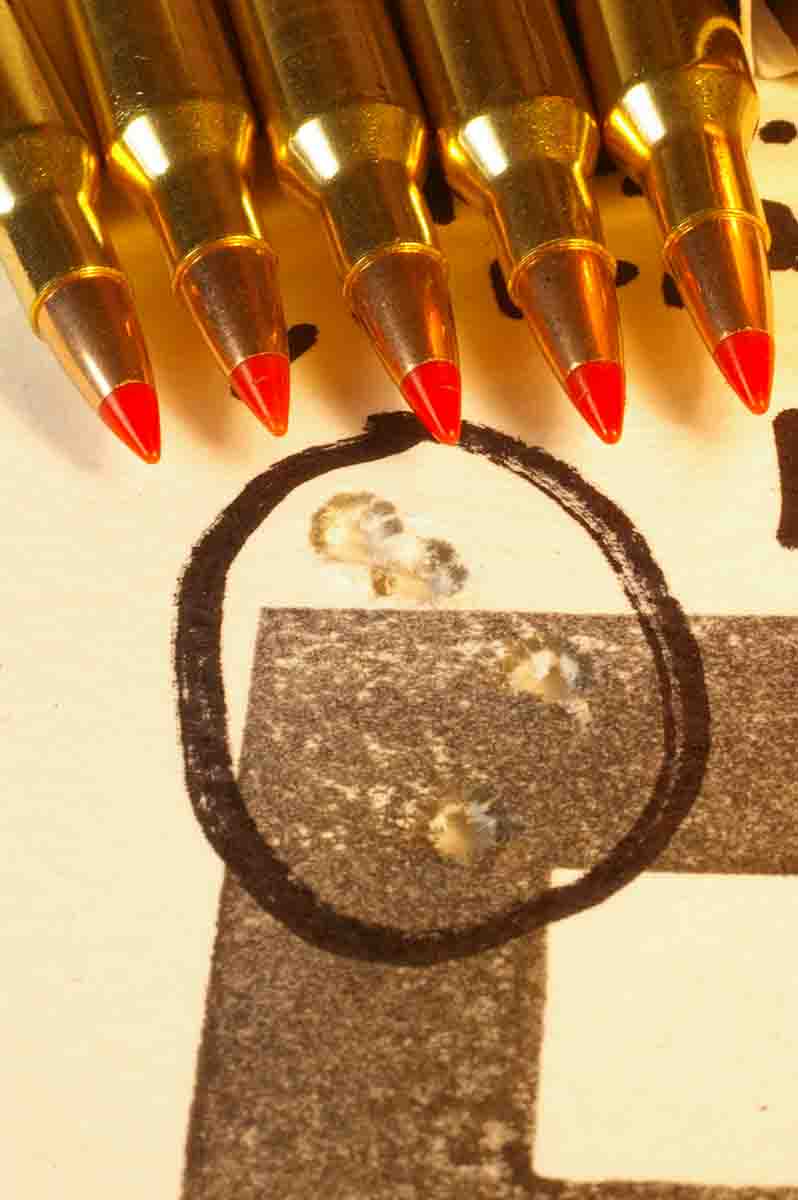
This five-shot, 100-yard group is from 20-grain Superformance Varmint V-MAX loads shot from a CZ 527 American rifle.
H-4198 was also a good powder. It attained the second highest velocities with 20-grain bullets and the highest velocities with 25-grain bullets. I don’t know how Hodgdon fit 11.8
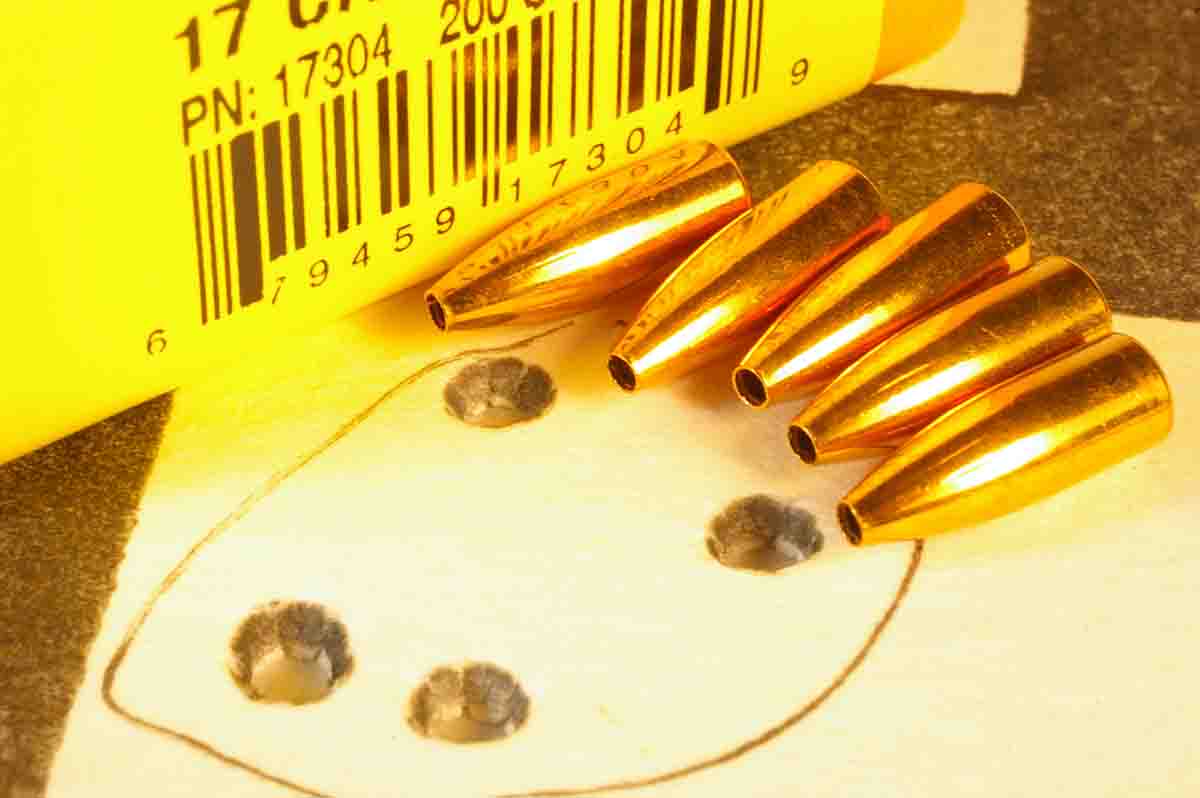
This .65-inch, five-shot group was from John’s handloads with Berger 20-grain Flat Base Target bullets and Reloder 7.
grains of H-4198, as listed for 20-grain bullets, in cases, however. Even poured from a funnel with a long drop tube, I could only fit 11.5 grains of H-4198 in a case. Even then, a small mound of powder protruded above the case mouth. The powder did compress with no undue pressure on the press handle while seating bullets.
Hornady Custom Grade full-length dies were used to size and load the .17s. Cases did stretch some during firing and then sizing. Cases from unfired Hornady factory loads had a length of 1.338 inches, which I used as a trim length. After firing the factory loads, case lengths had stretched to 1.343 inches. Neck sizing the cases stretched them to 1.344. After the cases were trimmed, loaded and fired, they had not grown in length any appreciable amount. Full-length sizing the fired cases, though, lengthened them .006 inch.
Full-length sizing is fine if you want cartridges to headspace off the .17’s rim, but that amount of sizing set the case shoulders back .005 inch, which can cause cases to split around the web after firing them a few times. To barely bump back the shoulders of cases and set headspace on the shoulders, I turned the size die up a partial turn from contacting the shellholder. That partial, full-length sizing helps reduce the stretch of firing and the squeeze of sizing to extend case life.
The .17 Remington Fireball introduced a few years ago is a somewhat larger edition of the .17 Hornet, but the Fireball is less than trendy. I’m betting the .17 Hornet will hang in there, however, because it has a ready-made home as any gun chambered for the .22 Hornet can also be chambered for the .17. Plus, what’s not to like about a cartridge with a near absence of recoil that shoots flat enough to take small game out to 300 yards? I’ve been wrong before when predicting the cartridge-buying habits of small game hunters, but I hope I’m not wrong about the .17 Hornady Hornet.
Categories
When men get bored

Categories
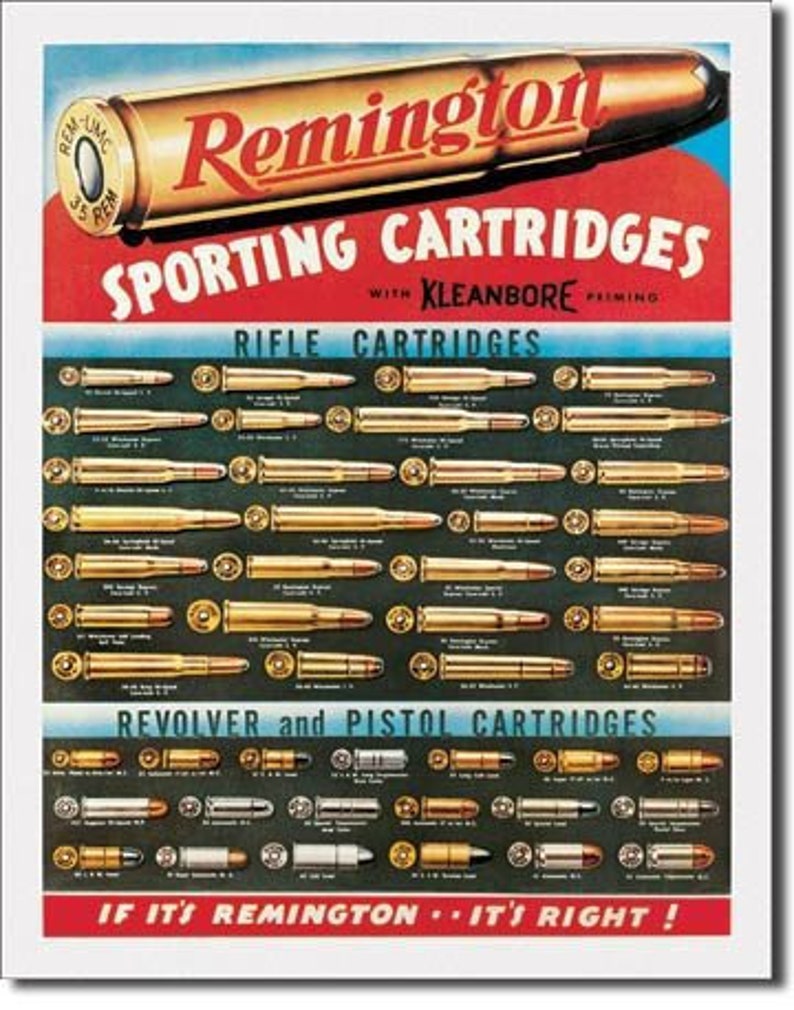
A Old School Ammo Chart



BY RACHEL MASON VIA STORYFUL A California Democrat is calling for a ban on live ammunition on movie sets in response to the deadly “Rust” film accident last week that left the cinematographer dead after actor Alec Baldwin unknowingly fired a gun containing a lead bullet while filming in Santa Fe. State Sen. Dave Cortese of San Jose announced this week that he will soon unveil legislation for the 2022 session that would prohibit the use of live ammunition and guns that can fire live rounds in theatrical productions. Cortese said that language is already being drafted. Cortese, who chairs the Senate Committee on Labor, Public Employment and Retirement, said the proposal wouldn’t ban guns in motion pictures. Rather, it would set up safety requirements for their use on set.
“There’s a whole heck of a lot of better ways to get imagery of a firearm into film or video than to actually be rehearsing with or brandishing that kind of live weapon on a live set, a crowded set,” he said. The “Rust” accident devastated the entertainment industry after news broke that Baldwin, who was both the lead actor and a producer of the western film, fired a live round during a scene rehearsal that killed cinematographer Halyna Hutchins.
The bullet also injured the film’s director, Joel Souza, who was hospitalized and then released after treatment. Capitol Alert newsletter Get political and Capitol news in your inbox every weekday, plus breaking alerts. SIGN UP This site is protected by reCAPTCHA and the Google Privacy Policy and Terms of Service apply. An investigation is still underway, but New Mexico officials confirmed Wednesday that the gun was loaded with a lead projectile. Authorities also discovered 500 rounds of ammunition on the set of “Rust,” which they believed to be a combination of live and dummy rounds. Not all productions use real firearms as props, and the industry already has strict rules against using live ammunition.
When real guns are used, often for authenticity purposes, they’re usually filled with blanks to mimic a real discharge. Sometimes special effects are used in place of a blank. Specialized crew members, called “armorers,” handle firearm safety on set. Those in charge of the weapons on the “Rust” set have said they did not know the gun was loaded with a live projectile. One armorer said she did not know how live ammunition showed up on set, and claimed that the production lacked safety training. The incident prompted some within the industry to calling for a ban on using real guns on set.
Despite the tragedy, another California Democrat who oversees entertainment industry regulations said she isn’t sure a ban on live ammunition should be up to the Legislature. $2 for 2 months
Fullerton Assemblywoman Sharon Quirk-Silva, chair of the Assembly Arts, Entertainment, Sports, Tourism and Internet Media Committee, said she’s open to considering Cortese’s legislation that tightens existing rules.
But ultimately, Quirk-Silva said, the unions that have historically negotiated workplace safety regulations should determine what needs strengthening. “As far as saying no live ammunition, I would want to hear from both sides,” Quirk-Silva said. “The motion picture industry and workers. I like to see them negotiate this among themselves rather than the state get involved when we don’t need to.” Quirk-Silva also said California is home to some of the toughest gun laws in the country and that an on-set accident like this hasn’t happened in decades. “We want movie sets to be as safe as can be,” Quirk-Silva added. “We know California has the highest standards and will continue to work toward improving those standards if there’s a need.” CalOSHA spokesperson Luke Brown said that there “no workplace safety regulations specifically related to the handling of firearms on film and TV sets.” “TV and Film production sets in California for the most part just fall under general industry safety orders,” Brown said, adding that CalOSHA and the Department of Department of Industrial Relations do not get involved in labor contract negotiations.
The International Alliance of Theatrical Stage Employees did not respond to The Sacramento Bee’s email request about what rules exist for using live ammunition in performances. Cortese acknowledged that labor groups might already have standing agreements that ban live ammunition on sets in California. Still, Cortese said there should be similar requirements for non-union sets and for California-based companies to adhere to when they’re working outside of the state. “There’s room for additional safety,” he said. This story was originally published November 2, 2021 5:00 AM. RELATED STORIES FROM SACRAMENTO BEE
Read more at: https://www.sacbee.com/news/politics-government/capitol-alert/article255387991.html#storylink=cpy
———————————————————————————
Never waste an Crisis! Grumpy
Categories
22 Ammunition | A Brief Discussion
Categories
Ditto for me!

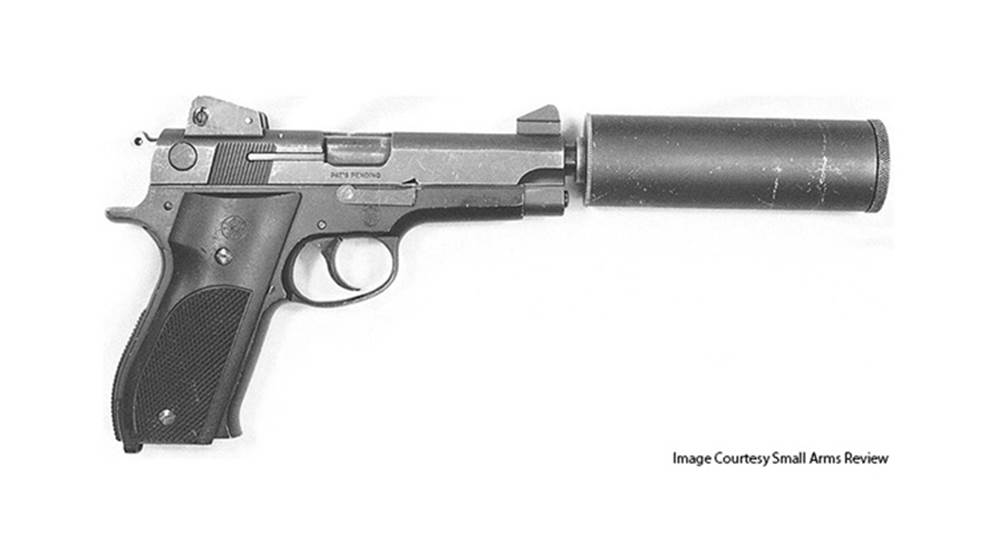
During the Vietnam war, the Sea, Air and Land special operators (SEALs) were just developing their covert techniques that would eventually make them into the finest fighting force in the world. Most of what these men did—the war stories and how they accomplished what they did—remains classified. Some facts eventually do leak out, and one of them was the existence of the “Hush Puppy” pistol, a modified Smith & Wesson Model 39 with a screw-on suppressor that was named the Mark 22 pistol by the U.S. Navy.
The SEALs were given the freedom to utilize non-standard military arms because of their special-operations status. At first, the Navy bought a handful of Model 39s for testing purposes. The fledgling SEALs got hold of them and found them useful. The Model 39 is a 28-oz. 9 mm double-/single-action semi-auto pistol with a 4” barrel and a single-column, 8-round magazine. At 11 ozs. less than the Model 1911A1, the compact 9 mm seemed to offer exactly what a covert operator needed in a sidearm. Its light weight and smaller profile were highly desired features by the early SEAL operators.
Then, as today, the guys in the field started pining for modifications to the standard Model 39. Relatively few were modified into Mark 22 status. Those modifications included a slightly longer barrel threaded at the muzzle to accept the suppressor, high-profile sights that could be seen and used with the suppressor, and a grip reconfigured to accept originally a Browning P35 double-column, 13-round magazine—later to accept a Smith & Wesson designed 14-rounder. A slide-lock switch was added to the frame to prevent the slide from operating, thus making the pistol a single shot. This was done to prevent the enemy from hearing the pistol operate. The suppressor was so effective with subsonic ammunition that the loudest part of the gun was the cycling of the slide. A detachable wire shoulder stock and holster were also part of the weapon package.
That suppressor, called the Mark 3, was 5” long and weighed 8 ozs. Because the frogmen often operated in a marine environment, a chamber plug and muzzle cap made from phenolic were included in the Mark 22 kit. Special ammunition, Mark 4, featured a 158-gr. FMJ bullet with a green tip and loaded to 900 fps. Also included as part of the kit was a spare suppressor insert tube with extra heavy rubber wipes. These wipes were reputed to be serviceable for a couple of dozen rounds or so before needing replacement.
If that seems rather fragile, remember this pistol was not intended as a quintessential self-defense weapon; rather it was designed around the need to take out sentries very quietly. SEALs were—and are—superb combat marksmen and were fully capable of neutralizing a target with a single round.
Altogether, the “Hush Puppy” Mark 22 package, including the pistol, can and a loaded 13-round magazine weighed in at 40 ounces, only an ounce heavier than a 1911A1 pistol. It was replaced in 1991 by the Mark 23 pistol, a 12-round-capacity .45 ACP made by Heckler & Koch. Though larger, heavier and more powerful than the first Mark 22 pistols, the concepts developed more than 50 years ago for a covert pistol for SEALs and other special operators still remain the foundation of such weaponry.
Very few—some say only two—original Mark 22 Hush Puppies have found their way into private collections. I was unable to find a “going rate” for such a collectable, but it would likely be astronomical.
The Model 39 Smith & Wesson remained cataloged for 27 years—1955 to 1982. Eventually Smith & Wesson made a commercial model of the Hush Puppy pistol, the 14-shot Model 59—sans the can, shoulder stock and extra-high sights. Later generations of these pistols were among the so-called “Wondernines” during the late 1980s and early ’90s.
Hush Puppy image courtesy Small Arms Review.