Categories
Ammo

Gunmen in Mexico Steal 7 Million Ammunition Rounds Headed to Texas

Gulf Cartel

By ILDEFONSO ORTIZ and BRANDON DARBY

2:17

A group of gunmen in Central Mexico hijacked two tractor-trailers containing more than seven million rounds of ammunition headed to Texas. Mexican authorities recovered the two trucks without the ammo-loaded trailers following a large-scale search operation.

The incident took place this week in the state of Guanajuato. Authorities first learned of the theft when representatives from Tecnos Industries, who manufactures Aguila Ammunitions, contacted federal authorities after losing contact and GPS information from their two vehicles and security detail, Mexico’s Proceso magazine reported.

Authorities believe a group of gunmen managed to stop the vehicles and forced the drivers and security detail to get out while they drove away with the cargo. The gunmen left the trucks several miles north of the scene of the robbery.

According to court documents from the case, the majority of the rounds were .22 caliber. The shipment also included pallets of .38 Super, .40, and .45 caliber ammo, as well as various sizes and types of shotgun shells.

The robbery comes at a time when Guanajuato and other once-peaceful states in Central Mexico have seen a dramatic spike in violence as rival drug cartels fight for control of drug routes, local drug sales, and the control of the lucrative underground fuel market. The escalating violence in the area also led to an ongoing spike in highway robberies, particularly targeting commercial shipments.

Ildefonso Ortiz is an award-winning journalist with Breitbart Texas. He co-founded Breitbart Texas’ Cartel Chronicles project with Brandon Darby and senior Breitbart management. You can follow him on Twitter and on Facebook. He can be contacted at Iortiz@breitbart.com

Brandon Darby is the managing director and editor-in-chief of Breitbart Texas. He co-founded Breitbart Texas’ Cartel Chronicles project with Ildefonso Ortiz and senior Breitbart management. Follow him on Twitter and Facebook. He can be contacted at bdarby@breitbart.co

Categories
Ammo

Near PERFECT Lead Recovery! Bullet Trap Tested

Categories
All About Guns Ammo

500 S&W Magnum Snub Nose vs 460 S&W Magnum Snub Nose !!! (Thanks but I will forgo the Honor!)

Categories
Ammo

Behind the Bullet: .300 Winchester Short Magnum by Philip Massaro

Behind the Bullet: .300 Winchester Short Magnum
The family of .300 magnums grew at the turn of the 21st century, with the 1999 release of the .300 Remington Ultra Magnum and the release of the .300 Winchester Short Magnum in 2001, both based on the classic and underrated .404 Jeffery case.
The former was assuredly a speed demon, requiring a magnum action and driving a .30-caliber bullet to speeds only rivaled by the voluminous .30-378 Weatherby Magnum, but the latter was equally revolutionary and slightly reminiscent of the 6.5 and .350 Remington Magnums of the 1960s.

Federal .300 Winchester Short Magnum 180-grain Trophy Copper Ammunition

Where those Remington Magnums were both based on the belted .375 H&H case, shortened to fit in the short-action (.308 Winchester-length) receivers, the new .300 Winchester Short Magnum (WSM) was not belted, relying instead on its 35-degree shoulder for headspacing. The concept of the short, fat cartridge—with a more compact powder column—wasn’t exactly new, as the .308 Winchester and its family had shown in the 1950s.
The history of the .300 WSM is a sordid one, involving lawsuits and court cases; Rick Jamison had a huge part in the development of the design, yet without raking the muck, isn’t always credited for that work (the original name of the .300 WSM was to be the .300 JRW, standing for Jamison, Ruger and Winchester). Nonetheless, the cartridge is a unique design, intended to duplicate the ballistics of the venerated .300 Winchester Magnum, released in 1963.

Winchester 190-grain .300 WSM Expedition Big Game AccuBond Ammo Box

That cartridge in turn mimicked (actually bettered) the performance of the classic .300 H&H Magnum, but in a long-action receiver instead of the magnum receiver required by the .300 H&H, and now in turn, Winchester offered the same velocity from a short-action rifle. The advantages of the shorter receiver are commonly thought to be enhanced rigidity (a rigid action can help in the accuracy department), reduced weight and a faster follow-up shot due to the shorter bolt throw.
The .300 WSM uses a case which measures 2.100 inches, just .085 inches longer than the .308 Winchester, yet a cartridge overall length of 2.860 inches, compared to the .308’s 2.800-inch overall length. The only way to give a case this short the powder capacity to achieve magnum velocities is to make the case wider, and that’s exactly what the .300 WSM does. Using the base diameter of the common H&H belted case (presumably for ease of manufacturing) instead of that of the slightly larger Jeffery parent case, the .300 WSM has a slightly rebated rim. The case body has very little taper, measuring 0.555 inches and the base, and 0.538 inches at the datum line (where the case body transitions to the shoulder), to provide as much volume as possible.
The velocities of the .300 WSM can supersede those of the .300 Winchester Magnum in factory cartridges. For example, the standard 180-grain load of the .300 Winchester Magnum is 2960 fps, while many of the .300 WSM loads with the same bullet weight will run at 3000 fps or better. While there are few game animals which could ever tell the difference between the two, many shooters appreciate the higher velocity figures. The common factory loads run between 150 grains and 200 grains, though the .300 WSM can handle the full range of .30-caliber bullets. And like the .30-06 Springfield, .308 Winchester and .300 Winchester Magnum, the .300 WSM has a wide selection of factory ammo, from simple cup-and-core bullet choices up through the premium bonded-core and monometal bullet choices.

Federal .300 WSM 180-grain Partition, 180-grain Fusion, and 180-grain Trophy Copper Ammo

Like the other .300 magnums, the .300 WSM is fully capable of taking the full range of North American big game—though I personally feel there are better tools for the brown bear and bison—and any African plains game species at all, as well as being just about perfect for leopard, and will handle lion in a pinch.
There are factory loads specifically designed for taking deer—Hornady’s American Whitetail load drives a 165-grain InterLock cup-and-core bullet to 3130 fps—but like the .300 Winchester, the magnum velocity can make a mess of things, leaving a bunch of blood-shot meat. Think about the distances at which you shoot and adjust your bullet choice accordingly; if you want to use your .300 WSM in the Northeast where shots are close, choose a premium bullet to avoid an excessive mess.
The .300 WSM design does have its issues, not the least of which is a steep shoulder which can often lead to feeding issues. I have shot quite a few different .300 WSM rifles, and unless it was a custom rifle where special attention was paid to the magazine follower and feed ramp, I have had quite a few feeding problems with this cartridge. Driving a large 35-degree shoulder into the feed ramp can obviously pose an issue, and this warrants a bit of concern.
Handloading for the .300 WSM isn’t exactly difficult, but I have found the cartridge to be a bit more finicky than the .300 Winchester. Look to powders in the H414/Reloder 22/IMR 4350 range for all-around choices, keeping in mind that case capacity is at a premium, and that a good many loads will be compressed. Ball powders like Hodgdon’s H414 and Alliant’s Power Pro 4000-MR will generate the velocities you’re looking for without compromising case capacity; you’ll definitely want a large rifle magnum primer to spark the heavy powder charges.

Browning .300 WSM 185-grain BXC Ammunition

There are those who feel the WSM family is an example of the law of diminishing returns, and that the shooter/hunter may be better off with a more traditional cartridge. I do feel that the smaller siblings of the .300 WSM—namely the .223, .243 and .25 WSSM cartridges—suffer from a lack of attention from the ammunition manufacturers, as both ammo and component brass cases are quite often unattainable, and they probably won’t be with us for very long. I also feel the .300 WSM is the best design of the lot, and that includes the .270 WSM, 7mm WSM and .325 WSM.
The .300 WSM has proven to be wonderfully accurate in a well-tuned rifle, and when things are built properly it truly is the equal of the .300 Winchester Magnum; it just requires more attention to make sure the cartridge feeds properly. Will it push the belted .300 Winchester Magnum out of the limelight? I don’t think so. There is, however, room for both.
Looking for previous installments of our “Behind the Bullet” series? We’ve got you covered.
• 28 Nosler
• 6.5 PRC
• .22 WMR
• .458 Winchester Magnum
• .204 Ruger
• .22 Hornet
• .280 Ackley Improved
• .240 Weatherby Magnum
• .458 Lott
• .264 Winchester Magnum
• .348 Winchester
• .33 Nosler
• .260 Remington
• .30-30 Winchester
• .416 Rigby
 .358 Norma Magnum
• .22 LR
• 7mm-08 Remington
• 8mm Remington Magnum
• .338 Federal
• .224 Valkyrie
• .338-06 A-Square
• 9.3x62mm Mauser
• .257 Weatherby Magnum
• .45-70 Government
• .300 H&H Magnum
• .25-06 Remington
• .30-06 Springfield
• 6.5 Creedmoor
• .300 Remington Ultra Magnum
• 7mm Remington Magnum
• .470 Nitro Express
• .280 Remington
• .300 Winchester Magnum
• .270 Winchester
• .222 Remington
• .45 ACP
• .404 Jeffery
• .44 Remington Magnum
• .41 Remington Magnum
• .243 Winchester
• .338 Winchester Magnum
• .357 S&W Magnum
• 6.5-284 Norma
• 8×57 Mauser
• .38 Smith & Wesson Special
• 7x57mm Mauser
• 9 mm Luger
• .35 Whelen
• .454 Casull
• .375 H&H Magnum
• .45 Colt
• .22-250 Remington
• 10mm Auto
• .308 Winchester
———————————————————–Let me see now. You have a round that nobody wanted really. Plus you lose one round capacity in your magazine. That and you will have one hell of a time finding it either in the city. Or God help you, If you try and find a box or two out in the field. As I doubt Jimmy Bob’s Gas Station in the back of beyond.  will carry a box of it. But a box or two of 223, 30-06, 270 Win or 243? Oh Hell yeah, This is America Bubba!
Other than that its a brilliant solution to a problem that did NOT exist!! Grumpy

Categories
All About Guns Ammo Well I thought it was neat!

A Marlin Ballard Pacific model in 40-85 Everlasting

Categories
All About Guns Ammo

Marlin 1893 25-36 vs. Milk Jugs

Categories
All About Guns Ammo Anti Civil Rights ideas & "Friends"

Manufacturers Say Ammo Shortage Will Stretch Out for Years Stephen Gutowski

Bare shelves at a gun rangeShelves lay bare at a Virginia gun store

America is more than a year into the latest ammunition shortage, and it appears supply will not catch up with demand anytime soon.

As store shelves lie barren and prices for the most popular ammunition hover at two, three, or even five times their pre-pandemic levels, manufacturers said they are still scrambling to bring enough product to market. They said they are still working through several years’ worth of orders that have already been placed.

“On certain products, we are certainly seeing backlogs that stretch out two years and beyond,” Brett Flaugher, president of Winchester Ammunition, told The Reload. “For those who shoot 9mm and 5.56 ammunition, which are both in high demand, it’s very uncertain how long it will be before people will consistently have ammunition readily available.”

“I’m looking at two and a half years’ worth of demand already on order,” Jason Hornady, vice president of Hornady Manufacturing Company, told The Reload. “So, I’m not seeing a slowdown for two and a half years.”

The shortage has become bad enough that many gun owners have simply stopped shooting for months on end. Some ranges have even run out of ammo to sell not just to customers who want to take it home but also those who want to use it on the range.

“People have been saying for a long time they haven’t shot guns because there’s no ammo to shoot,” Brandon Wexler, owner of Wex Gunworks in Delray Beach, Florida, told The Reload. “And they don’t want to shoot what they have right now.”

Retailers like Wexler said they still have trouble stocking their shelves. Lucky Gunner, one of the largest online ammunition dealers in the country, said it faces wait times to get ammo unlike anything it has experienced before.

“At this point, the total amount of ammo that we have on backorder from manufacturers is up year over year and sits at an all-time high for us,” Anthony Welsch, a spokesman for the company, told The Reload.

A Demand Problem

He said the issue was less about supply slowing down and more about demand continuing at a pace the industry hasn’t seen before.

“We’ve seen manufacturers continue to deliver product at steady intervals, but once it’s available for sale, it just doesn’t last long,” Welsch said.

Flaugher said the industry is simply struggling to keep up. He said three main factors have driven sales and continue to drive them beyond the industry’s ability to expand supply. The first was pandemic-induced safety concerns that drove millions of Americans to purchase guns for the first time. The second was the increased participation in recreational shooting and hunting during the lockdowns. The third was concern over new gun-control legislation after President Joe Biden won the 2020 election and Democrats who favor new restrictions took control of the Senate.

“We have certainly experienced unprecedented demand for all categories of ammunition over the past year—rimfire, centerfire rifle and pistol, as well as our shotshell products,” Flaugher said. “Over the past year, we’ve seen more than 21 million firearms sold, with over 9 million to first-time gun buyers. This is an incredible number. Overall, more than 52 million people in the U.S. participate in the shooting sports, which is actually 2.5 times higher than the number of people who golf.”

Hornady estimated demand jumped to a degree that most industries could not keep up with, let alone a centuries-old one built around physical manufacturing.

“If General Motors or the NFL, or you pick the industry, all of a sudden had 9 million new customers, how would they react? What would they do?” he said. “I mean, if the NFL all of a sudden had 9 million more people who want to go to games, what the hell are they gonna do? They’d have to build new stadiums. If they had to build new stadiums, how long is that going to take?”

And he said the surge only got worse as the year went along.

“Last year, we were up 30 percent-ish,” Hornady said. “Our whole industry was up 30 percent-ish. In the short term, you do what you can to maximize hours and maximize what you can. We got that 30 percent, and now the market is asking me for another, not just 30 percent, it’s asking for 80 percent.”

Numbers from one of the world’s largest ammo makers back up Hornady’s estimate.

Ammunition sales are the largest part of Vista Outdoor’s shooting sports business which, in turn, is the largest segment of the publicly traded company. Vista’s combined ammunition brands, including Federal Premium and newly acquired Remington, represent the largest share of the commercial market in the United States. Vista Outdoor did not agree to an interview with The Reload but did provide links to the company’s latest earnings reports, which show its sales were up more than 27 percent in the past fiscal year. Sales increased even further in the quarter that ended in March 2021.

“Sales increased 37 percent to $403 million compared with the prior year quarter, primarily driven by strong demand for commercial ammunition and hunting and shooting accessories,” the company said in a statement.

Like Winchester, Vista said it expects “continued increased demand” for ammunition due to the pandemic and political atmosphere in the United States. It said its customer base had expanded as well.

The company said in its SEC filings that the broadened consumer base “has resulted in a much larger total addressable market opportunity for the industry and for our company. We expect to see continued increases in participation as consumers look to local outdoor activities as a substitute for travel and other competing pursuits impacted by the COVID-19 pandemic.”

No Easy Fix

Hornady said the industry is already at max capacity, and increasing supply is difficult.

“I can promise you, even though they’re my competitors, every guy I know in the ammo business is trying to make as much as possible,” he said. “We don’t want to make 30 percent more. We want to make 50 or 100 percent more. And every one of us wishes right now we had an extra factory sitting around ready to go. But that’s not very practical.”

Spinning up a new factory involves buying dozens of specialty machines and custom installing them into a new space. It’s a process that costs a great deal of money and can take up to a year. Hornady Manufacturing Company had actually finished building a new factory in the lead up to 2020.

“We just built a new factory 18 months ago, which we moved into and more than doubled our space,” Hornady said. “We’re very rapidly filling the space we have. We were doing that whether there was an election, a pandemic, or a riot. We were already planning to grow.”

But the problem for manufacturers who are considering building new plants is uncertainty about where demand will ultimately settle out. If a company like Hornady, which has more than 500 employees, bets big on building another new factory and demand flattens back out before it’s finished, they could lose millions and be forced to lay people off. That’s why Hornaday relies on long-term plans instead of trying to react to the peaks and valleys in demand.

“I remember my father having to lay people off as a young person,” he said. “And that is something I don’t want to do. I want to keep everybody busy as long as we can. That’s important to us.”

Neither Winchester nor Vista Outdoor provided details on whether they planned to open new factories in the coming months or years.

Prices on the Rise

The imbalance of supply and demand has dramatically affected ammo prices. But it’s not just the reduced supply of finished rounds creating the problem. It’s also the reduced supply of basic materials being felt across many industries, including construction and computer chip manufacturing.

“The unfortunate part is we had to take our first mid-year price increase across the board starting June 1 of this year, and it was roughly a 10 percent increase,” Hornady said. “But we didn’t have a choice. Material costs are through the roof. Copper was $2.45 a pound a year ago. Today it’s trading at $4.50. And that is, in my career of 51 years, the all-time high. We go through several hundred pounds of copper a month. Zinc is the same way. Steel is the same way.”

Hornady had bought eight months of supplies for ammunition making when the pandemic began to make sure they could keep going regardless of where the market went. But shortages have popped up where the company never expected to see them.

“Where we’ve been caught off guard is things like tape and cardboard,” he said. “There’s a cardboard shortage right now. The other one is freight. There is a definite freight shortage occurring in the United States and, actually, globally too. Even just truck freight is overwhelmed and in short supply.”

Wexler said he’s gone from selling 9mm ammunition, one of the most popular handgun rounds in the world, for about 22 cents per round to 60 cents per round. And he’s actually undercutting the rest of the market.

“I’ve seen 9mm at ranges for a dollar a round, straight up,” he said. “It’s ridiculous.”

Welsch said anyone “looking for a specific load or bullet” is going to face long waits or exorbitant prices.

Prices for the most desirable ammunition have been pushed beyond reason.

“We saw a case of 6.5 PRC, which right now if you have that it’s going like cocaine laced with gold, go for $1,800 the other day,” Hornady said. A case used to go for around $550.

A Summer Cool Down?

The onset of summer could offer a reprieve. Demand for firearms and ammunition has traditionally followed a seasonal pattern, with summer experiencing the lowest levels. If demand wanes as temperatures rise, manufacturers could get some breathing room.

“This summer should tell us a lot about what to expect moving forward,” Welsch said. “[The slowdown] could afford the supply side of the market a chance to catch up.”

Wexler said he’s already seen supply creep up a bit.

“I feel like some ammo is being put out there,” he said. “I’m not saying in any large amounts, but when you’re used to getting nothing, it’s noticeable.”

But neither man was confident things would return to normal. Welsch said even with a slowdown, “it would not be surprising to see hunters struggling to find some of the more niche rifle calibers this fall” because “supplies of .243 Winchester, .22-250, and .30-30 ammo are incredibly tight with little sign of change coming quickly.” Wexler said a self-perpetuating cycle of buying, shooting, and re-buying driven by pent-up demand makes it hard see when things get back to normal even after the ammo supply increases.

“It’s such a hard prediction,” he said. “I think the ammo that comes out, people are going to suck up because they want to build their supply, and they want to be able to shoot. And if they shoot, they’re going to need more ammo.”

Hornady was more certain and even less optimistic.

“This business is going to continue on the pace it is for the next 18 months to two and a half years,” he said. “That’s how long it’s gonna be before you walk in and find a box of .223, and come back tomorrow and buy a box of .223 or 9mm, or you pick the caliber.”

If you want to read about another factor driving the shortage, check out this exclusive piece for Reload members on the rise of ammo hoarding.

Categories
All About Guns Ammo

Dangerous Game Rifle: Dakota Model 76 416 Remington Magnum

https://youtu.be/8N9RhgsNF58

Categories
Ammo

Make your Own Home Made Caps & Primers for your “Ghost Ammo”~ VIDEO by Dean Weingarten

Editors Note: With all the made-up hysteria over the fake scare word “ghost guns” we figured we would set the bait and see what anti-gun hack started to use our next made-up word for unregistered “ghost ammo”. Who do you think will be the first ignorant clown to try and scare Karens with it? I am guessing they will have a (D) near their name.

Image by Marshall Thompson, used with permission

U.S.A. –-(AmmoLand.com)- For most of a year now commercial ammunition primers #ad have been almost impossible to purchase due to demand. I once believed primers were the weak point in making and reloading your own ammunition. Cartridge cases last a long time, when used with moderate loads. There are tens or hundreds of billions of them in existence.  Bullets can be cast from lead or swagged for those willing to do the work. Gunpowder can be made. Hobbyists make black powder fairly commonly. There are even a few substitutes for smokeless power, or which can be used to stretch smokeless powder.

One shotgun round has enough gunpowder for 3-5 pistol rounds.

But primers… many people consider them beyond the capability of the average person. They are wrong.

Home Made Caps & Primers

Dedicated hobbyists have done the work and the research necessary to allow the ordinary person, using the same sort of care used in reloading ammunition, to recharge/reload primers and to make percussion caps if desired.

All activities have a level of risk associated with them. This correspondent and AmmoLand News have no control over what readers chose to do. The information in this article is for educational purposes only. No activities should be undertaken without using all necessary safety precautions.

There are several different methods used to recharge primers, varying from the simple to the complex. The simplest uses roll caps which can be purchased at the local dollar store. The most complex requires wet chemistry at a senior high school or freshman college level of expertise and care.

Marshall Thompson has become the guru of recharging caps and primers. He is a PHD chemist who has tested all the methods he documents. His work has been condensed into a 46-page manual which can be downloaded for free. The latest update was in June of 2019.

Here is a link to download Marshall’s Homemade Primer Course  here or here on making/recharging caps and primers.

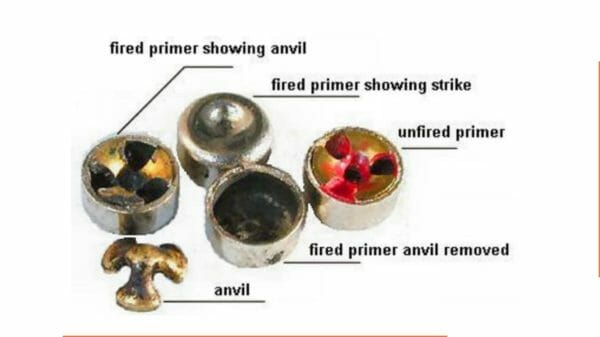
The roll cap (commonly used in cap guns) method is shown in this illustration from Marshall Thompson’s course/manual. The illustration is of a cross section of a primer recharged with two caps and a thin layer of powder, with the anvil seated on top.

Image by Marshall Thompson, used with permission

1/8″ paper punch is used to cut the two roll caps to the proper diameter.  Place one in the bottom of the primer cup. Place a small amount of fast pistol powder on top of the first roll cap. Place a second roll cap over the pistol powder. Seat the boxer primer anvil on top.

Expect 1 in 20 to detonate while the anvil is being seated. Use hearing and eye protection, and seat them one at a time away from any gunpowder.

Marshall describes two methods using match heads to make primers, from both strike anywhere matches, and strike on the box matches. They work but take a bit more time than the roll cap method.

Excellent results can be had using purchased chemicals to make priming mix. The easiest is the same mix used by the US Army in World War I. It is called H48. The chemicals are available without special permission. Only small quantities are needed.  One ounce, 30 grams, is enough to make more than a thousand primers.  One pound of the more sensitive chemical is easily purchased.

Marshall has made how-to videos on the processes. Link to video to mix H48 priming compound.

If the chemicals cannot be found, they can be made at home with simple chemistry.

Marshall describes in detail the methods and chemistry to make more sophisticated, non-corrosive primers. Most of them require a bit of wet chemistry to make the precursor chemicals for the priming mix. In the latest update to Marshall’s manual,  he details 10 different methods and priming mixtures, ranging from moderately simple to moderately difficult.

All of the methods described by Marshall Thompson contain detailed instructions on how to complete each step.  The history of primers included in the manual and the requirements for good priming compounds are worth reading in themselves.

Marshall notes homemade primers only approach commercial products in efficacy and reliability. The best method is to stock up on components when they are cheap and readily available. That method is temporarily unavailable at a reasonable cost to most. When the ammunition bubble deflates again (it may be years in the future), remember to stock up.

While the above methods are perfectly usable, they take considerable time. One person using them can expect to produce 1-2 primers per minute.

That is plenty for hunting, most defensive cases, or moderate practice. It is about the same amount of time required to reload ammunition using the simplest handloading tools, such as the Lee loader, which I used for years while growing up.

How to make your own primers is worthwhile knowledge. Download the manual while it is still legal to do so. I recommend printing out the document before the information gets banned.

I have sold a few copies at gun shows at $2 apiece, the cost of copying. People seldom appreciate things that are given away.

How to Build Homemade Ammunition Primers Course


About Dean Weingarten:

Dean Weingarten has been a peace officer, a military officer, was on the University of Wisconsin Pistol Team for four years, and was first certified to teach firearms safety in 1973. He taught the Arizona concealed carry course for fifteen years until the goal of Constitutional Carry was attained. He has degrees in meteorology and mining engineering, and retired from the Department of Defense after a 30-year career in Army Research, Development, Testing, and Evaluation.

Categories
Ammo

I know I can't!