Category: Ammo
Categories
Impressive work!


A little history in the 10mm Auto.
Early in the 1970s Whit Collins (who was on staff with Guns and Ammo magazine) was interested in rechambering the 9mm Browning Hi-Power into a more powerful cartridge. He initially looked at the Super .38 (which came about in 1929 using the.38 Automatic but increasing the propellant to give law enforcement an edge in handgun firepower) but consulting with Col. Jeff Cooper (a retired Marine and renowned gun writer) who had the idea of a 200gr bullet .400″ in diameter traveling around 1000 feet per second.
He began to work on that idea. Whit then looked at cutting down the .30 Remington Rifle case (similar to the 30-30 Winchester) for the case and the .40 caliber 180gr bullet from the 38-40 Winchester for the prototype round. He then asked Col. Cooper for his assistance on the development. Then Irv Stone of Bar-Sto barrels and John French, a gunsmith, began work on the project and in 1972 a rechambered Browning Hi-Power chambered in .40 G&A was test fired.
The round was a 180gr .40 that was traveling about 1050 feet per second. Col Cooper then began developing the .40 Super and around 1980 he collaborated with Thomas Dornaus and Michael Dixon, who was working toward the same goal as Col. Cooper, and the .40 Super evolved into the 10mm Automatic we have come to know and love.

Dornaus & Dixon Enterprises INC of Thomas Dornaus and Michael Dixon came into being in 1981 and they began to work with Norma Ammunition to produce the round and aid in pistol design. Many of the characteristics of the CZ-75 were used in the development of the Bren Ten which began to be produced in 1983 and remained in production until 1985. Dornaus & Dixon Enterprises were plagued with issues with the pistol as they were shipped before they could be thoroughly tested in order to keep up with the already high demand.
That coupled with the high MSRP and not being able to get reliable magazines from Mec-Gar, an Italian company who had several issues with the heat treating and feed lips becoming deformed, caused customers to cancel orders in 1986 and forced Dornaus & Dixon into bankruptcy.
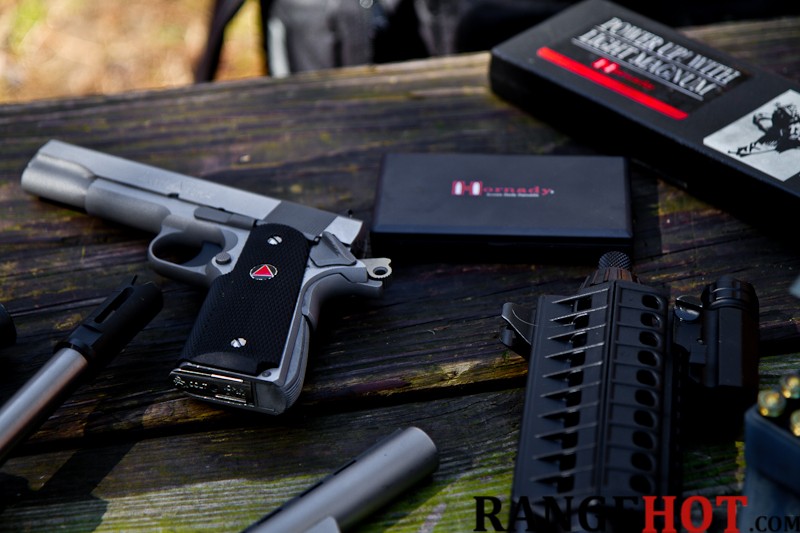
This would not be the end of the 10mm Auto by any means as Colt Manufacturing saw the potential of the 10mm and began to chamber their Colt Delta Elite, a Government Model in 10mm Auto.
In 1986 Michael Lee Platt and William Russell Matix (men who had met and became friends in the US Army) who had no prior criminal record murdered a man while he was target shooting, stole his car, and the two became bank robbers.
Please bear with me as this story holds relevance to the 10mm Auto. A team of FBI agents assembled in order to search for the stolen Monte Carlo on a hunch they would be robbing a bank that day. Sure enough, the car was spotted and the FBI attempted to pull them over, there was an accident and a brutal gunfight erupted.
The FBI agents were primarily armed with 9mm pistols and .357 Magnum revolvers (loaded with .38 Special +P). While Platt was armed with a Ruger Mini 14 and .357 Magnum and Matix was armed with 12 ga. shotgun. There were eight FBI agents and the two suspects and in under five minutes just under 150 rounds were exchanged. Matix was hit a half dozen times and Platt was hit a dozen times through the battle, both finally expiring but not before killing two agents and wounding five. One final note, neither Platt or Matrix were under the influence of any drugs.
After the shootout the FBI did an extensive investigation and concluded that the agents’ deaths were at least partly due to the lack of stopping power of their issued sidearms, also realizing the slow reloading time of a revolver and the limited ammunition capacity as compared to a semi-automatic they begin to look for a more powerful cartridge chambered in a semi-automatic handgun. The FBI chose the Smith and Wesson model 1076 chambered in the 10mm Auto round.
Many of the agents had difficulty with the recoil so Federal was commissioned to load a 180gr bullet to about 950 fps, and that round became known as the 10mm FBI or 10mm Lite. In 1990 Smith and Wesson realized that with the decreased powder charge the case of the 10mm Auto could be shortened allowing the grip on the handgun to be smaller. So they partnered with Winchester, and the 10mm Auto case was shortened by .142″ and the .40 Smith and Wesson was born also known as the .40 S&W. The S&W Model 1076 lasted less than five years with the FBI.
The .357 Sig round also owes its existence to the 10mm Auto as it is a .40 S&W case necked down to accept a 9mm bullet (.355″) created by SIG-Sauer and Federal Ammunition in 1994. There are a few other rounds that have used the 10mm Auto as inspiration.
So now we know a bit of history on the Ten Mike Mike.
Short video of a female student running a Glock 29 with full power 180gr FMJ 10mm. Makes me think maybe all the hype of that round being tough to control is hype.
You can also sort through reviews I have done on 10mm Auto firearms and see a multitude of shooters of all skill levels running the firearms.
Ruger GP 100 Match Champion 10mm
As you can see I have a bit of experience with several platforms in the 10mm Auto as well as a ballistic test
I fell in love with the big 10 in the mid 1990s when I bought my first Colt Delta Elite. I went into this old country store to look around at their decent selection of guns. I saw the stainless Colt, lying there in a side case with other second hand pistols. I spoke to the man at the counter and learned it was a trade in on a shotgun or something along those lines.
It had been there well over a year largely ignored, for attention was on the newest shotgun or some super short magnum bolt gun. I had heard of the 10mm and knew a little about it but the gun was priced to move and so I took the Colt home with me, stopping off for some 10mm reloading dies and bullets. It was then I began to learn of the cartridge and develop a true appreciation of its potential. I still have the Delta Elite as well as a modest collection of 10mm handguns. It is easily my favorite handgun cartridge of all time.
The cartridge has risen and fallen several times, through no real fault of its own. Just as it begins to fade into oblivion it is snatched back from the jaws of history and reenergized. When the .40 S&W was chosen over the 10mm it seemed the cartridge was doomed to never reach mainstream for the last time. Few manufacturers were offering factory pistols and factory loaded ammunition was slim pickings.
Yet again the 10mm began to gain traction, but not due to any real reason in particular. In my opinion, some of the factors were handgun hunting was gaining popularity. Concealed carry had become very popular and many sought out a powerful handgun for the streets as well as the woods, all the while the cult-like following continued to sing its praises in increasingly popular internet forums and message boards.
I imagine it was a lot of small reasons for the resurgence and not most of the major manufacturers offer a handgun option in 10mm while several carbines have been introduced. The ammunition manufacturers have also put some R&D into the cartridge and have given us a plethora of options for target, hunting, and self-defense applications.
I am thrilled the 10 is making its comeback and it appears it has embedded itself well into the shooting community it shall not be going away anytime soon. With the ability to be downloaded for easy range use of punching paper but the capacity for some very serious self-defense ammunition, the 10mm has a lot of variables. With so many options of bullet weights, designs, and velocities it is not hard to tailor your 10mm firearm for several tasks, with plenty of overlap so you should never be undergunned. If you have not added something in 10mm to your collection, well now is as good of a time as any, especially if you are looking to upgrade your carry gun.

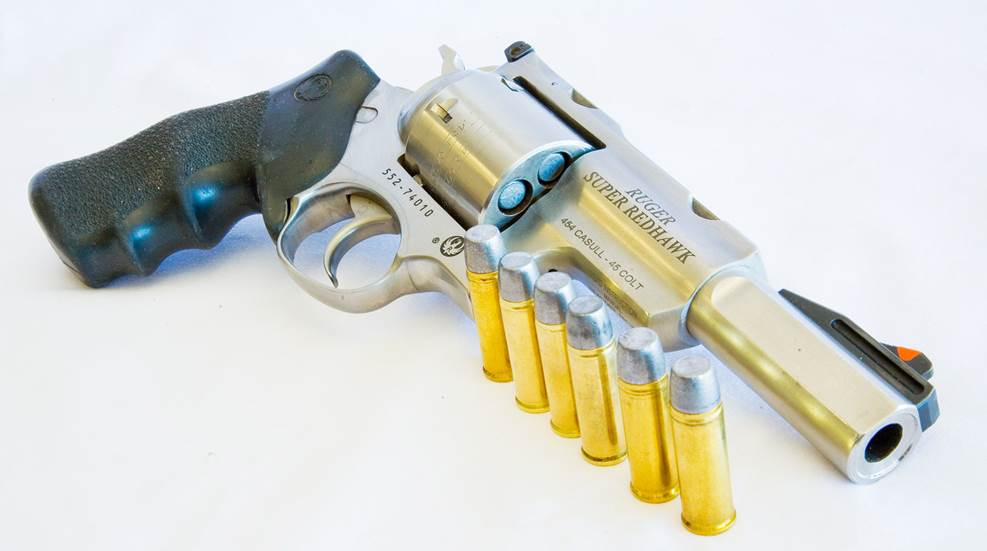
In November 1959 an article appeared announcing a new and very powerful wildcat handgun round called the .454 Casull that set the handgun world on fire. The cartridge came about as a collaborative endeavor between Jack Fulmer, Duane Marsh and led by a young gunsmith, Dick Casull. Years later Casull told me that developing the cartridge and the revolver capable of safely handling it took three years. On the surface, it doesn’t seem too complex from today’s perspective, but remember this was some 63 years ago.
A lot of today’s common metallurgical, machining and manufacturing technology had yet been developed. Casull showed me the first .454 Casull revolver he made one day at his home in Freedom, WY. Originally it was a first-generation (black powder) Colt Single Action Army. Externally it wasn’t all that unique looking, other than the cylinder lacked fluting. Internally, however, Casull had to re-engineer the lockwork to work with a five-shot cylinder that he machined from stock. The first-generation Colt frame was relatively low in carbon content.
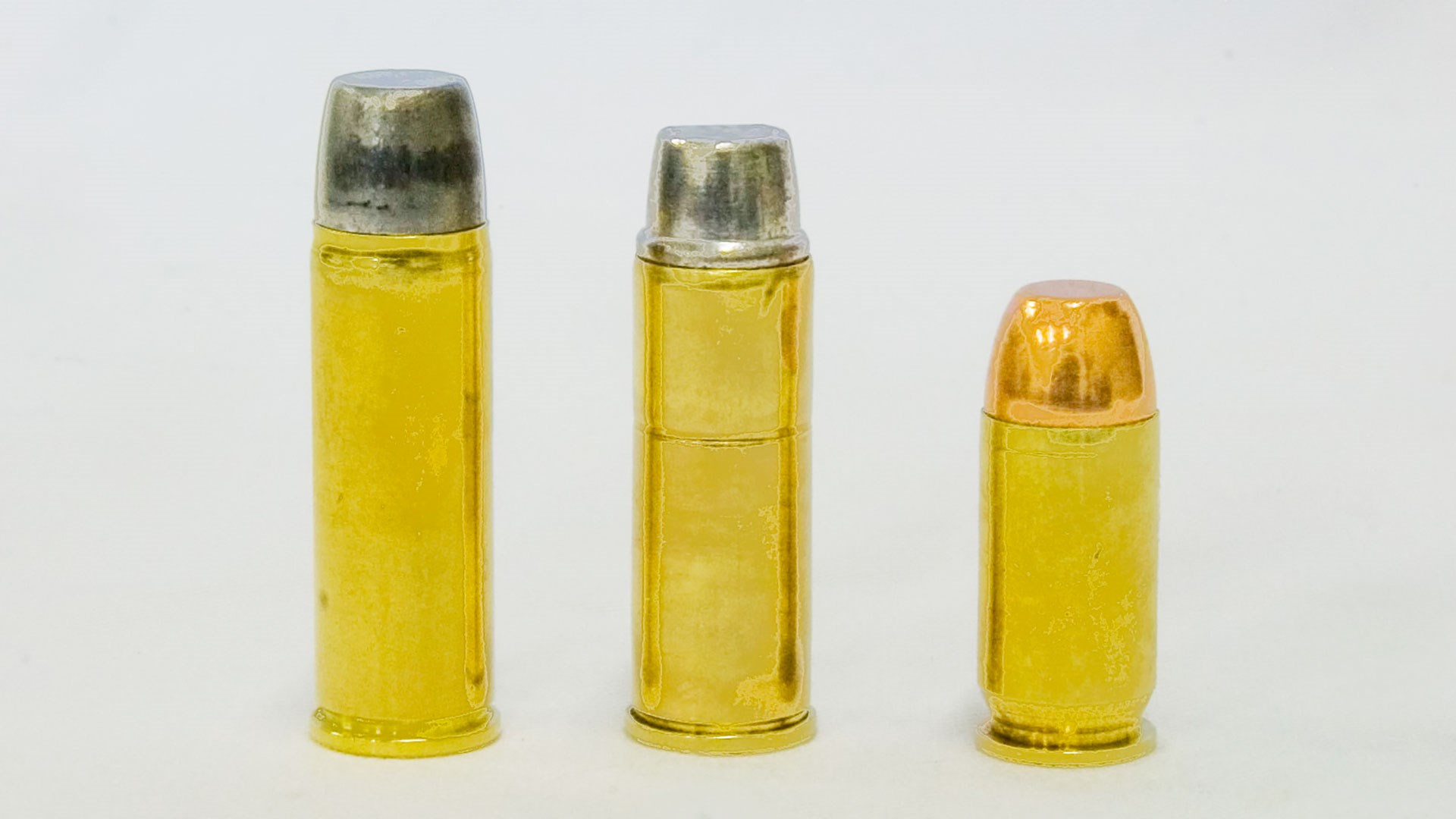 The .454 Casull (left), compared with .357 Mag. (center) and .45 ACP (right).
Carbon is a major component in giving steel its greater tensile strength. Casull told me—and later actually taught me—how he added the necessary strength to the old Colt by repeated case hardening treatments until the entire frame essentially became case hardened, thoroughly infused with carbon and immensely stronger. I asked him how many old Colt frames he blew up developing the .454 Casull. He smiled wryly and said he didn’t recall. Casull was like an encyclopedia of gun knowledge. P.O. Ackley, who Casull once worked for, was quoted saying that Dick Casull was the finest gunsmith and gun designer since John Browning.
The .454 Casull was spawned from the .45 Colt case, lengthened about 0.10″ and made thicker in the web. Casull’s cartridge spits out a 250-gr. bullet at more than twice the velocity of its parent—1,900-plus f.p.s. compared to 900 f.p.s. I once stopped by Casull’s place while he was applying an annular crimp to the small rifle primers he used in the .454 Casull. His goal was to break the 2,000 f.p.s. barrier in a 7 1/2″ barreled revolver with the 250-gr. bullet, but the primers kept backing out.
He did it, but the pressures were well beyond anything anyone—including Casull—wanted to put out to the public. Throughout the bullet weight range the .454 Casull maintains a 25-percent to 33-percent velocity advantage over the .44 Remington Magnum. Pressures are in the magnum centerfire rifle range, 65,000 CUP compared to 36,000 for the .44 Rem. Mag. and 14,000 for the .45 Colt. Recoil, as one might imagine, is also starkly different. The .454 Casull with a 260-gr. bullet at 1800 f.p.s. in a 3-lb. revolver churns up 39 ft.-lbs. of energy with 28 f.p.s. in recoil velocity.
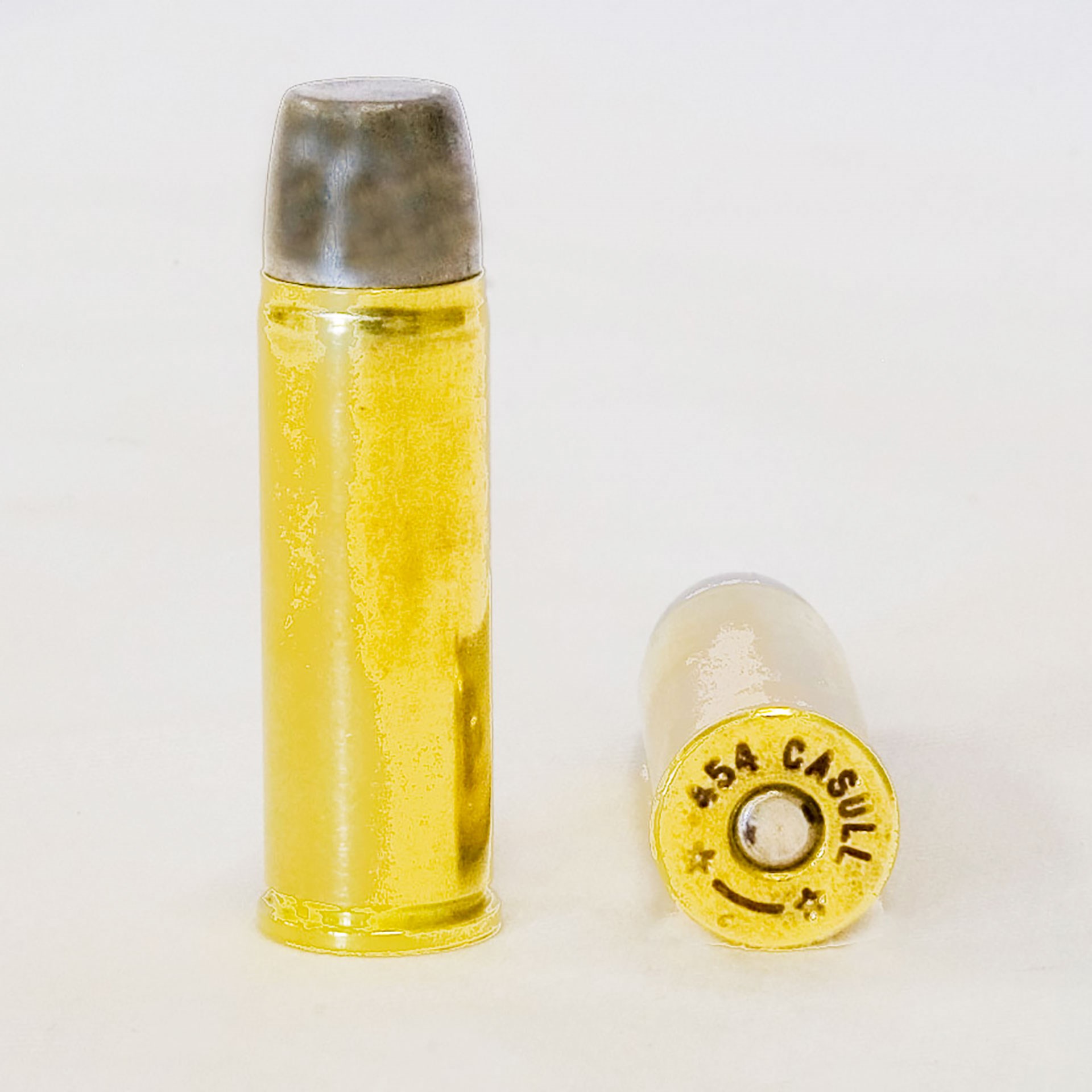 A view of a .454 Casull cartridge and head stamp.
In a .44 Rem. Mag. with a 240-gr. bullet at 1,450 f.p.s., the figures are 22.5 ft.-lbs. and 21.9 f.p.s., respectively. That famous .45 Colt man stopper compares at 10.4 ft.-lbs. and 15.6 fps driving a 250-grain bullet at 900 fps. When I met Dick Casull in 1980 he was working with Freedom Arms to bring his brainchild to market. Like a lot of inventors, Casull had some great ideas but lacked the capital to bring them to market. It seems to be the universal conundrum of inventors. Casull was the consummate perfectionist, and he insisted that each revolver bearing his name be the absolute best that can come from human hands.
Eventually Freedom Arms did build his revolver, bringing it to market in 1983. The Freedom Arms Model 83 is widely considered to be the finest single-action revolver ever produced. I’ve shot several of them in a variety of chamberings, and I would not try to challenge that statement. Freedom Arms revolvers are—for all practical purposes—semi-custom guns, and because of that production volume is slow. It took a powerhouse manufacturer like Ruger to make the .454 Casull available to the masses.
Ruger began chambering its Super Redhawk double-action revolver for it in 1997. A year later, Taurus chambered its Raging Bull in .454 Casull, and in 2010 added its Raging Bull Magnum that chambers .454 Casull, .45 Colt and .410 bore shotshells. For a time its sister company, Rossi, chambered its M92 lever-action carbine in .454 Casull. Big Horn Armory began chambering its superbly made Model 90A lever-action rifle in .454 Casull in 2014. With this many guns available, it didn’t take long for ammunition manufacturers to jump into the game.
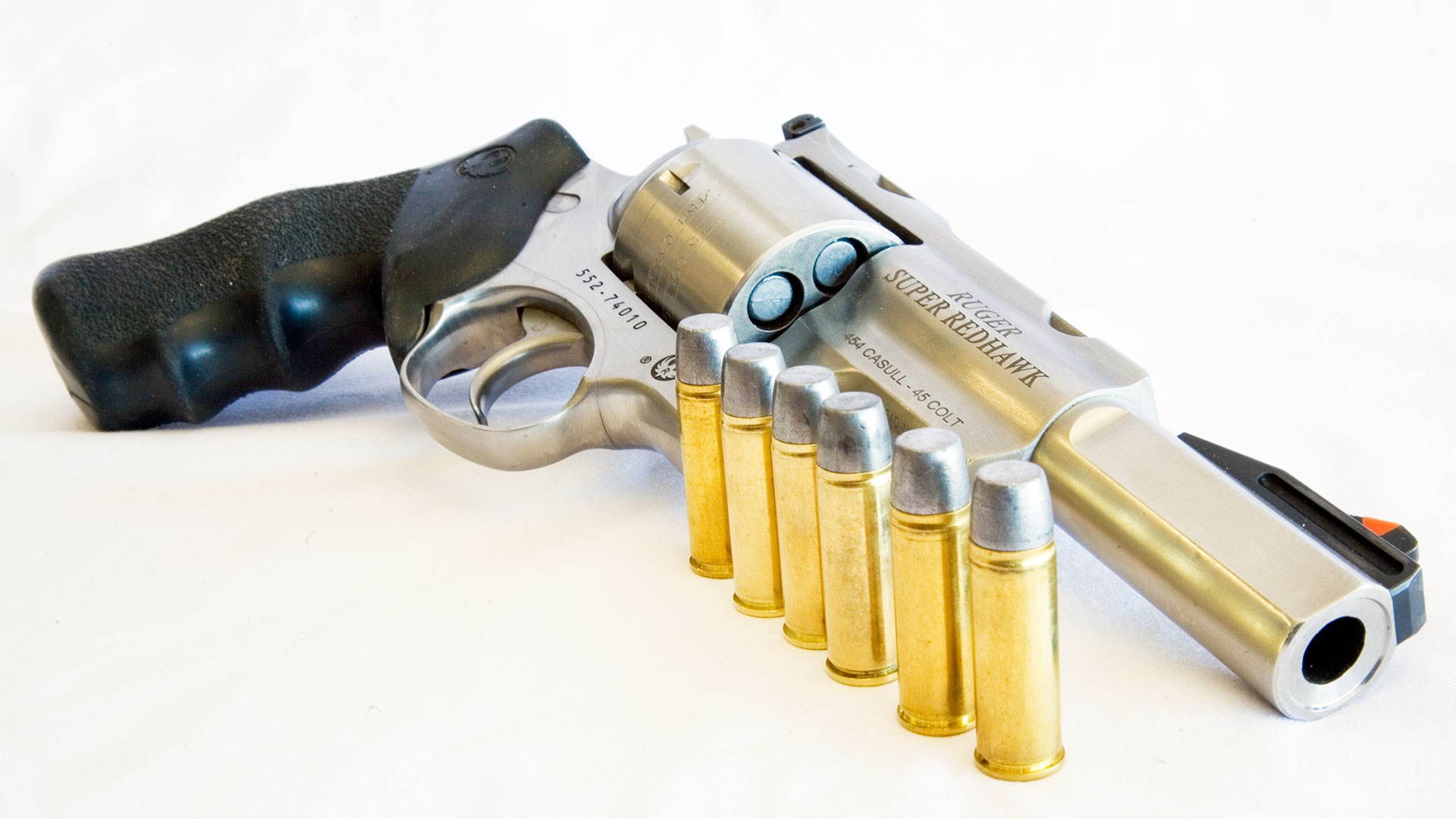 The Author’s Ruger Super Blackhawk loaded with .454 Casull cartridges.
Currently Barnes, Buffalo Bore, Doubletap, Federal, Hornady, Magtech and Winchester are loading ammo in the big .45. Now take a breath. A 20-round box will lighten your wallet $75 now, if you can find it. That’s $3.75 per round. Handloading will ease the financial burden a bit, but again components are almost as difficult to find as loaded ammo now. Be aware that the .454 Casull need small rifle—often small rifle magnum—primers.
Early on Casull determined that with the pressures he was generating and handgun technology what it is, the smaller surface area of a small primer helps lessen the chances of them backing out during firing. Many apply the aforementioned crimp as further insurance. Jacketed bullets designed for .45 Colt often are too fragile and soft for the .454 Casull in full-house loads. Hardened cast bullets are often used by those seeking maximum penetration.
It’s hard to imagine anyone needing—much less wanting—more power in a handgun than the .454 Casull offers, but power hungriness is just as applicable to pistoleros as it is to politicians. Dick Casull’s .454 magnum cartridge has been eclipsed by Smith & Wesson’s .460 and .500 Mag. cartridges, as well as the still semi-custom Linebaugh line of handgun cartridges. But if power is your game, the .454 Casull is a good place to start.

When preparing to hunt with a muzzleloader, it is extremely important to choose the right bullet for the job. A good bullet must shoot accurately out of your muzzleloader and offer acceptable terminal performance.
While there are a number of high-quality muzzleloader bullets currently on the market, they are not all created equal and some bullets are better choices than others. Here is how to choose the right muzzleloader bullet for hunting.
The first step is to determine the rifling twist of your muzzleloader. Usually, you may find out this information by looking in the manual. For best accuracy, you must use bullets the rifling in your muzzleloader will stabilize. Generally speaking, when comparing bullets of the same caliber, longer bullets need a faster rifling twist in order to be properly stabilized.
For instance, a muzzleloader with a 1:66″ rifling twist (one full rotation every 66″) is designed for shooting round balls. This is a very slow rifling twist, and it will likely shoot round balls, which are relatively short and light, accurately. However, a muzzleloader with a 1:66″ twist will probably not shoot conical bullets well. Pictured, from left: 320gr Thompson Center Maxi-Ball, 177gr Round Ball, 350gr Thompson Center Maxi-Hunter.
 Pictured, from left: 300gr Thor Bullet, 348gr PowerBelt Copper, 270gr PowerBelt Platinum, 250gr PowerBelt AeroLite, 350gr Hornady FPB.
 Pictured, from left: 250gr Hornady SST, 250gr Barnes T-EZ, 250gr Barnes TMZ bullets with and without sabots.
While there are a number of high-quality muzzleloader bullets currently on the market, they are not all created equal and some bullets are better choices than others. Here is how to choose the right muzzleloader bullet for hunting.
The first step is to determine the rifling twist of your muzzleloader. Usually, you may find out this information by looking in the manual. For best accuracy, you must use bullets the rifling in your muzzleloader will stabilize. Generally speaking, when comparing bullets of the same caliber, longer bullets need a faster rifling twist in order to be properly stabilized.
For instance, a muzzleloader with a 1:66″ rifling twist (one full rotation every 66″) is designed for shooting round balls. This is a very slow rifling twist, and it will likely shoot round balls, which are relatively short and light, accurately. However, a muzzleloader with a 1:66″ twist will probably not shoot conical bullets well.
Pictured, from left: 320gr Thompson Center Maxi-Ball, 177gr Round Ball, 350gr Thompson Center Maxi-Hunter.
There is nothing wrong with using a plain, round ball, especially for hunting deer. After all, that is the type of bullet Daniel Boone and Davy Crockett used, and plenty of hunters these days still use round balls in their muzzleloaders with great success. They are also cheap, and you can even make them yourself. However, when comparing them to most modern muzzleloader bullets, round balls are relatively lightweight, have a low ballistic coefficient and offer the least reliable penetration.
That being said, there are some better bullet choices to use for hunting with a muzzleloader. There are two broadly-defined types of conical bullets: full bore conicals and sabots. Though conical bullets typically require a faster rifling twist to properly stabilize, most modern inline muzzleloaders have a 1:28″ rifling twist, which is usually quite good for stabilizing most conical bullets as well as sabots.
There are dozens of full bore conical bullets on the market today. They range from lead conicals, like the Thompson Center Maxi-Hunter and Maxi-Ball (above) to the copper Thor bullets (below left).
Generally speaking, full bore conical bullets tend to be heavier and have a higher ballistic coefficient when compared to a round ball. While the actual accuracy and terminal performance of full bore conical bullets varies, they are generally good choices for hunting.
Pictured, from left: 300gr Thor Bullet, 348gr PowerBelt Copper, 270gr PowerBelt Platinum, 250gr PowerBelt AeroLite, 350gr Hornady FPB.
Another option is to use a sabot (pronounced “say-bo”). This is a bullet smaller than the bore diameter (like a .45 caliber bullet shot from a .50 caliber muzzleloader) that sits in a plastic sleeve (called a sabot) that falls off in flight.
Saboted bullets generally obtain the highest velocities and have the flattest trajectories out of all bullets designed for muzzleloaders. Like with full bore conicals, the accuracy and terminal performance of saboted bullets varies, though they are also generally great choices for hunting.
Pictured, from left: 250gr Hornady SST, 250gr Barnes T-EZ, 250gr Barnes TMZ bullets with and without sabots.
Each muzzleloader is unique, and there are often significant differences between different brands, models and even individual muzzleloaders with regard to which particular load shoots the most accurately.
Because of this, the best way to find out which bullet shoots most accurately out of your muzzleloader is to pick a couple of different brands and bullet weights and test them out at the range. The manual for your muzzleloader can be used as a reference for a few recommended bullets types and weights, but the only way to know for sure is to shoot them yourself.
Finally, before you go hunting, make sure you check the hunting regulations for your state, because they can vary widely. For instance, some states (like California) mandate the use of a lead-free bullet (like the 100 percent copper Barnes bullets). On the other end of the spectrum, Idaho mandates that only lead or lead alloy (no jacketed or saboted) bullets must be used.
Regardless of where you intend to hunt, ensure that you are in compliance with the hunting regulations for that area.