Categories
All About Guns Ammo

Hunting with .458 Win Mag vs. Cape Buffalo By Terry Nelson

A box of classic Winchester 458 Win Mag ammo

The .458 Winchester Magnum was designed by Winchester in 1956 for the sole intent of hunting dangerous game. The idea was to provide comparable performance of the powerful double rifle cartridges in a bolt-action rifle.

It did not take long before the .458 Winchester Magnum became a success as dangerous game hunters adopted the cartridge. Additionally, game wardens, and professional hunters in Africa began use of the .458 Winchester Magnum as part of their every day job duties. In short order the .458 Win Mag became the standard African dangerous game cartridge.

A look at .458 Win Mag ballistics

The .458 Win Mag is a belted magnum cartridge. The belt, just above the rim on the case helps to assure proper head spacing or chamber positioning and aids in smooth feeding from the integral box magazines found on most bolt rifles. Below are just a couple of examples of .458 Winchester Magnum ammo available today.

Hornady .458 Win Mag Dangerous Game 500 Grain DGX Bonded

Distance
Velocity (fps)
Energy (ft/lb.)
Trajectory (inches)
Muzzle
2140
5084
—
100 yds
1880
3924
200 yds
1643
3924
-8.4
300 yds
1432
2276
-29.8

Federal .458 Win Mag 400 Grain Bonded Bear Claw

Distance
Velocity (fps)
Energy (ft/lb.)
Trajectory (inches)
Muzzle
2250
4496
—
100 yds
2025
3641
200 yds
1813
2919
-7
300 yds
1619
2327
-24.8

As you can see the .458 Win Mag is not designed for long range shooting, but rather closer distances in thick brush or timber. It is an excellent cartridge for moose, bear, elk, and of course all manner of dangerous game in Africa. Many Cape buffalo, hippo, elephant and the like have been taken with this cartridge on the Dark Continent.

Hunting Cape Buffalo with the .458 Win Mag

Cape Buffalo in Zambia
They say Cape buffalo always look at you as if you owe them money.

My experience with the cartridge came on my first trip to the Dark Continent over 40 years ago. Although I have not hunted with the cartridge since, I put it through its paces on the plains of Zambia in the best way possible, hunting Cape buffalo. The manner by which I came to utilize the .458 Win Mag and the buffalo taken with this cartridge is the real story.

Having a contact in the South-Central African country of Zambia made my first safari a bit easier. A good friend, Ray Mwenifumbo, a native of Zambia, happened to be chief warden at one Zambia’s conservation areas, Kafue National Park. I met Ray early in the 80’s while attending New Mexico State University in Las Cruces, New Mexico in the wildlife science program.

Ray and I often talked about his native country and its wildlife. When the time came for Ray to return home, I had an open invitation to be a guest at his headquarters inside Kafue National Park.

He said “just get to Lusaka (the capital of Zambia), and we will take care of the rest.” Ray also hinted at the possibility of hunting as he knew how much I wanted to hunt in Africa. I decided right then and there I had to make this happen. A year after Ray returned to Zambia, I found myself landing at the Lusaka airport in July 1985.

Firearms Available

While I spent a great deal of time game viewing and taking photos of Zambia’s diverse wildlife species, hunting was always in the back of my mind. However, I was unable to bring firearms on my trip as I was not on a “scheduled safari” for that purpose.

However, Ray did have in his keep three long guns for “official game warden business”. Two Winchester pre-64 Model 70’s, one in 30-06 and the other in .458 Winchester Magnum. The third gun, was a Winchester 12-gauge pump shotgun. Both rifles were iron sights only. Unfortunately, we had limited ammunition for both rifles. There was a fair supply of 12ga 00 buckshot however.

Checking zero on the rifles was limited to one round each but I found that at 50 yards I could keep each shot more or less centered on the base of a metal five-gallon bucket. Ammo available for the .458 Win Mag — Winchester 500 grain solids.

Now to the “official game warden business” and the heart of the story. Ray had conveniently managed to schedule the monthly meat ration hunt to coincide with my visit. These ration permits were used to provide food for workers who resided within the park headquarters. As it so happened, Ray arranged for me to conduct most of the hunting for the month’s meat rations during my stay. All hunting was to take place outside of Kafue NP in the surrounding hunt concessions. What a deal.

The Hunt Begins

500 Grain 458 Win Mag ammo on display
I took three Cape buffalo with these four rounds, the 500 grain solid bullet was salvaged from the largest bull

Although we were allowed plains game our main target was Cape buffalo due to the amount of meat obtainable in short order. I was still able to hunt plains game and took species such as waterbuck, hartebeest, reedbuck, warthog, zebra, and oribi.

The latter two required a separate license fee on my part as they were not considered standard meat rations. As a point of interest, I took the oribi, warthog, and reedbuck with the shotgun. We used the 30-06 for the larger plains game. In case you’re wondering, the park staff utilized every speck of meat from all game taken.

Cape Buffalo Hunt

On the day we set out to hunt buffalo our goal was to kill three to four specifically for meat rations. We set out before sunup with the sole purpose of finding one of the large herds of buffalo residing in the area. The game scouts knew of a particular herd that left the park every night and would feed in the outlying savannah before heading back into the park around sunup.

Before long we found fresh tracks of a large number of Mbogo (Swahili for buffalo), as they are also known, crossing a two-track road headed towards the park. Within minutes we found the herd numbering 100-200 strong. I don’t mind saying I was a bit apprehensive about getting out on ground level with so many these bovines. Some call them Black Death.

The scouts knew their country well and hurriedly took an old road that would get us in front of the herd and in a good shooting position. By the time we stopped and exited the beat-up Toyota Landcruiser pickup and covered 100 yards of ground through the miombo woodlands on foot the first of the herd was already crossing in front of us in open savannah. I carried the .458 Winchester and Dixon one of the game scouts had the 30-06. Dixon’s instructions to me; you have five rounds of ammo, kill three to four adult buffalo. I can do that!

Loading Up & Taking My Shot

Already having three rounds of the big finger long cartridges in the magazine, I opened the bolt, held the top round down and dropped a fourth cartridge directly in the chamber and closed the bolt and placed the safety on.

The herd was crossing left to right at 50 to 75 yards. I put the iron sights on a youngish bull and pressed the trigger. He went down in a cloud of dust. Working the action on the old model 70 and picking up what I believed was an older cow, I pressed the trigger again; she collapsed. Two for two at this point.

I was determined to pick a bigger bull next. Of course, the herd was now in full run. A bull came passing by that I believed was as good as I could hope for and I put a 500-grain solid behind his shoulder. He kept going but was obviously hit hard. Working the bolt frantically I chambered the last round in the rifle and fired again as he quartered away aiming for that front shoulder. He ran another 15 or so yards and was down.

Success!

The author posing with a cape buffalo shot in Zambia with 458 Win Mag.
A nice cape buffalo taken with the 458 Win Mag.

When the dust settled there were four buffalo down, as Dixon also took a yearling bull via the 30-06. We salvaged every scrap of meat including the stomachs and internal organs. Once back to the compound the folks living there showed up with tubs, pots, and buckets to get their share of protein. In a matter of minutes, the meat was all gone.

As to the bigger bull that I picked out at the end of the melee, he was just at 40 inches wide with good heavy bosses. I salvaged one of the 500 grain solids from that bull along with all four of the empty cases I fired to take down three buffalo. I still have those in my possession today, 41 years later. The .458 Win Mag cartridge certainly performed well and I would have no issue using it again.

I have taken buffalo since that first safari, but I must say it will be hard to top that day in the African bush with Mbogo so many years ago.
Categories
Ammo

Ammo Brief: 6mm Remington by Gun Digest Editors

Ammo Brief: 6mm Remington

We take a quick look at 6mm Remington, aka .244 Remington, a true middle-weight heavy hitter of a cartridge.

The 6mm Remington has exactly the same case dimensions as the .244 Remington. They differ only in the fact that the 6mm Remington is loaded with bullets of up to 100 grains, whereas the .244 Remington was never loaded with bullets of more than 90 grains.

Ammunition marked .244 Remington can be fired in 6mm Remington chambers and vice versa. However, rifles marked .244 Remington will not always stabilize the 100-grain bullet. The difference between the two is that .244 rifles (if manufactured by Remington) have a 1:12 rifling twist, and rifles marked 6mm have a 1:9 twist.

book
This is an excerpt from Cartridge’s Of The World, available now at GunDigestStore.com.

When Remington introduced the .244, in 1955, it selected the 1:12 twist as best suited to long-range accuracy with bullets of 75 to 90 grains. That was correct, except that most shooters wanted to use bullets of 100 to 105 grains to cover the range of game from varmints through deer with the same rifle. To correct this misjudgment, Remington renamed the cartridge 6mm Remington and changed to a 1:9 twist.

To have retained the .244 designation and simply changed the twist would have brought on complaints from purchasers of the original .244s with the slower twist, when they tried to use the new 100-grain load. The change in cartridge nomenclature to 6mm and the faster twist occurred in 1963. The Remington 700 series and 788 bolt-action rifles, as well as the firm’s autoloaders and the slide-actions, have been available in 6mm.

General Comments

The original 6mm Remington was loaded only with the 100-grain bullet. However, it’s now available with 80-, 90- and 100-grain bullets, which greatly extends its flexibility. Although the older .244 lost out to the .243 Winchester, the 6mm Remington with faster twist barrels is gradually picking up a following. It is an excellent choice for the varmint hunter who also wants to use his rifle for deer and antelope.

Although the 6mm has a slightly larger powder capacity than the .243, the difference in performance is negligible as far as killing power is concerned. Nevertheless, this small advance in ballistics appeals to some people and so does the longer neck of the 6mm case, which many handloaders consider desirable. This caliber is commercially loaded by Federal and Winchester, as well as Remington.

6mm Remington Loading Data and Factory Ballistics

Bullet
(grains/type)
Powder Grains Velocity Energy Source
55 Nos BT H4895 45.5 4,115 2,065 Hodgdon
60 HP H-335 42 3,700 1,824 Sierra
70 SP IMR 4350 47 3,400 1,797 Sierra, Hornady
75 HP IMR 4064 41 3,500 2,041 Speer, Nosler
75 HP IMR 4350 47 3,450 1,983 Nosler, Speer, Sierra
80 SP IMR 4350 45 3,200 1,820 Hornady
80 SP IMR 4831 47 3,200 1,820 Hornady, Speer
90 HP IMR 4350 45 3,200 2,047 Speer, Sierra
90 HP IMR 4831 45 3,100 1,921 Speer, Sierra
100 SP IMR 4350 42 2,900 1,868 Hornady, Speer, Sierra, Nosler
100 SP IMR 4831 44 2,900 1,868 Speer, Sierra, Hornady
100 H1000 51 3,111 2,145 Hodgdon
105 SP IMR 4350 42 2,950 2,030 Speer
105 SP IMR 4064 37 2,900 1,961 Speer
80 SP FL – 3,470 2,139 Factory load
90 SP FL – 3,190 2,133 Factory load
100 SP FL – 3,100 2,133 Factory load
Categories
Ammo You have to be kidding, right!?!

Now I myself really do like the 45 A.C.P. but com’on!

Categories
Ammo

The .257 Roberts: The Quarter-Bore That Deserved Better

  • Hornady 12th Edition Handbook of Cartridge Reloading

    Hornady 12th Edition Handbook of Cartridge Reloading

    Purchase on Amazon

  • Nosler Reloading Guide 9th Edition

    Nosler Reloading Guide 9th Edition

Modern Status and Availability

The .257 Roberts hasn’t completely disappeared, but it’s not thriving either. As of this writing, factory ammunition is available from a handful of manufacturers — Hornady, Nosler, Remington, and Winchester have produced runs in recent years, though it’s not always sitting on the shelf at your local sporting goods store. You may need to order online or, better yet, load your own. Brass is available from Nosler, Hornady, and occasionally from Remington and Winchester.

Rifle availability is more limited. Ruger has chambered the No. 1 and the M77 Hawkeye in .257 Roberts on occasion. The cartridge shows up in semi-custom offerings from companies like Cooper and Kimber from time to time. But you won’t find rows of .257 Roberts rifles at a big box store. Most shooters who fall in love with the Bob end up having a rifle built on a custom or semi-custom action, which honestly suits the cartridge’s personality just fine.

Ruger Hawkeye Standard bolt-action rifle with walnut stock
Image courtesy of Sturm, Ruger & Co., Inc.
Ruger No. 1 single-shot falling block rifle with walnut stock
Image courtesy of Sturm, Ruger & Co., Inc.

Who Is the .257 Roberts For?

In my opinion, the .257 Roberts is ideal for a few specific types of shooters. First, anyone who is recoil-sensitive but wants genuine medium-game capability — the Roberts delivers deer-killing performance at recoil levels closer to a .243 than a .270. Second, handloaders who appreciate case efficiency and barrel life. Third, anyone who hunts in open country where 250-300 yard shots are common but 500-yard bombing runs are not the goal. And honestly? Anyone who just appreciates an elegant cartridge that does its job without fanfare. You may also be interested in our coverage of The .32 Rimfire Cartridge: History and Variations.

The .257 Roberts may never reclaim a top-ten spot on the best-seller charts. The market has moved on, and there’s no going back. But cartridges don’t become obsolete just because newer ones exist. The Bob still does exactly what Ned Roberts intended it to do — put .25-caliber bullets on target with precision, efficiency, and minimal fuss. If that sounds appealing, grab a reloading manual and start down the quarter-bore rabbit hole. You won’t regret it.

Categories
All About Guns Ammo

Winchester model 70 Classic super express in 416 Rem Mag

Categories
Ammo

Remember these?

Categories
Ammo

The big Dreyse *D printed sabot test

Categories
All About Guns Ammo

Behind the Bullet: The .333 Jeffery by Philip Massaro

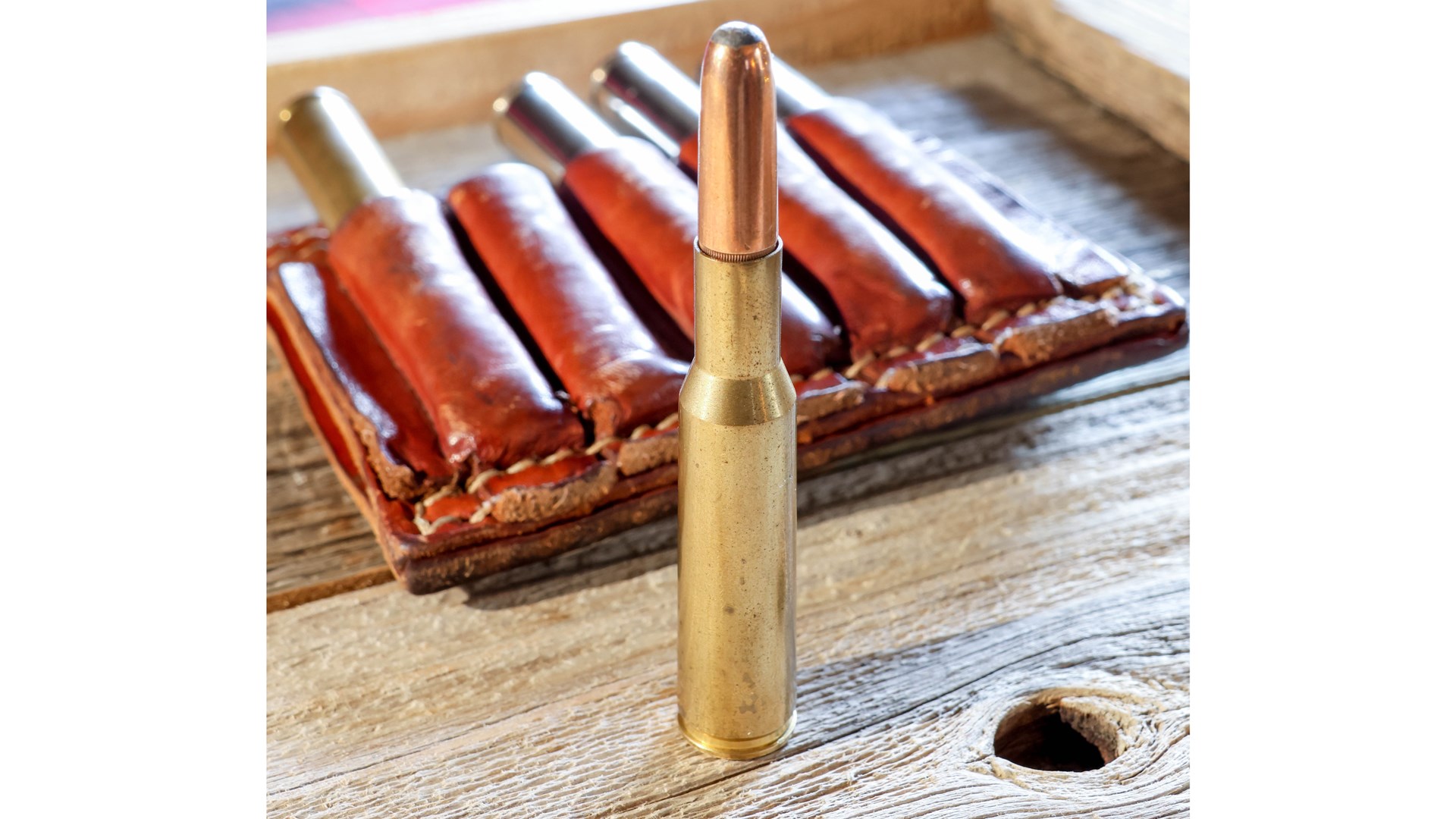
333 Jeffery

The first dozen years of the 20th century saw British gunmakers hard at work, developing those cartridges for the bolt-action repeating rifles which would go on to become the benchmarks of international hunting.

Having made the transition from black powder and pure lead projectiles to smokeless powder and copper-jacketed bullets, the accepted caliber and bullet-weight minimums were definitely being challenged.

Those traveling sportsmen headed for the various British and European colonies were both pushing the boundaries and—through field trials—developing many of “rules” by which we still abide to this day.

Among these cartridges were big-game legends like the .375 Holland & Holland Magnum, .416 Rigby, .404 Jeffery and the .425 Westley Richards. It was common for these prestigious names to pair these larger ‘medium’ bores with a smaller cartridge, one suitable for all game in a pinch, but without the stopping power of their larger siblings.

These pairings included the .350 Rigby Magnum and .416 Rigby, .425 Westley Richards and .318 Westley Richards, .375 Holland & Holland and (initially) the .275 Holland & Holland Magnum or (in 1925) the .300 Holland & Holland Magnum, and finally the .404 Jeffery and .333 Jeffery. I have fallen head-over-heels for the .404 Jeffery, but the .333 Jeffery has sadly faded into near obscurity; yet it played an important role in a few ways, and still makes a great choice for larger thin-skinned game animals.

333 Jeffery Repeating rifle

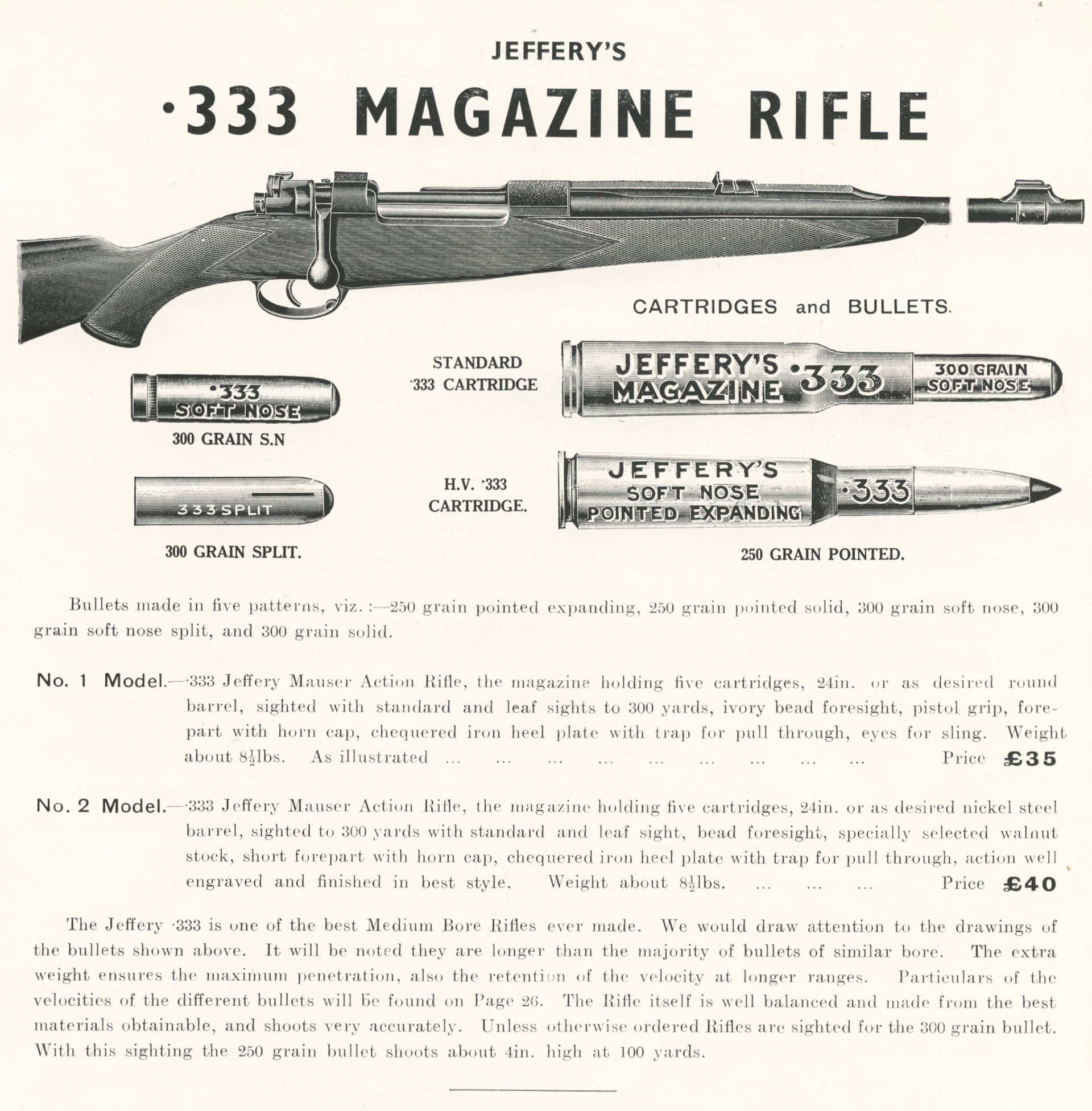
W.J. Jeffery & Co. of London had released the .404 Jeffery in 1905, designed for use in a Mauser bolt-action repeating rifle, and they necked that excellent cartridge down to hold bullets of .333 inches in diameter. Exactly where that bullet/bore diameter came from is lost to history, and it seems to be entirely proprietary.

Using a case measuring 2.475 inches, with a cartridge overall length of 3.500 inches, the .333 Jeffery fits neatly in a long-action receiver. In near-opposition to the .404 Jeffery’s slight, eight-degree shoulder, the .333 uses a 19-degree 51-minute shoulder to handle the headspacing duties and the 0.538-inch neck will certainly hold even the longest bullets firmly in place.

And long the bullets for the .333 Jeffery are! The original ammunition loadings saw a 250-grain copper-capped hollowpoint bullet at a muzzle velocity of 2,500 fps, generating 3,480 ft.-lbs. of energy at muzzle, and the much more famous 300-grain bullet at 2,200 fps, for 3,230 ft.-lbs. of energy at the muzzle.

Please keep in mind that, common for the era, these velocity and energy figures were derived using a ballistic pendulum and a 28-inch barrel, so in reality the velocity and energy figures you might see in reality would be a bit lower. This is common to a good number of cartridges of this early 20th century-era.

That 300-grain slug has a Sectional Density of .386—a fantastic figure when it comes to penetration—and it was that bullet that helped garner the reputation that the .333 Jeffery had among the early hunters of Africa and India. With a mild recoil and a projectile which offered impressive penetration even on larger game species, the .333 Jeffery has been used on all game species, including the massive African elephant, though the larger bore diameters are invariably better suited for that work.

333 Jeffery wand cartridge wallet

It was the reputation of the .333 Jeffery’s bullets that led Charlie O’Neil, Elmer Keith and Don Hopkins to mate the .333-inch diameter projectiles with the common and plentiful .30-06 Springfield case, resulting in the wildcat .333 OKH, a precursor to the .338-06, in 1945.

That trio also developed a .334 OKH, using the same projectiles, but with a shortened .300 H&H Magnum case; this was assuredly the inspiration for the .338 Winchester Magnum, which mated a shortened H&H case and the .338-inch-diameter projectiles of the earlier .33 Winchester.

In addition to the rimless cartridge, W.J. Jeffery offered the .333 Jeffery Flanged, a rimmed variant of the design, for use in the single shot and double rifles. Essentially just a rimmed version of .333 Jeffery, the pressures were lowered slightly, and velocities ran about 50 fps or so below those of the rimless cartridge. The .333 Jeffery Flanged remains a rarity, even in comparison to the rimless version.

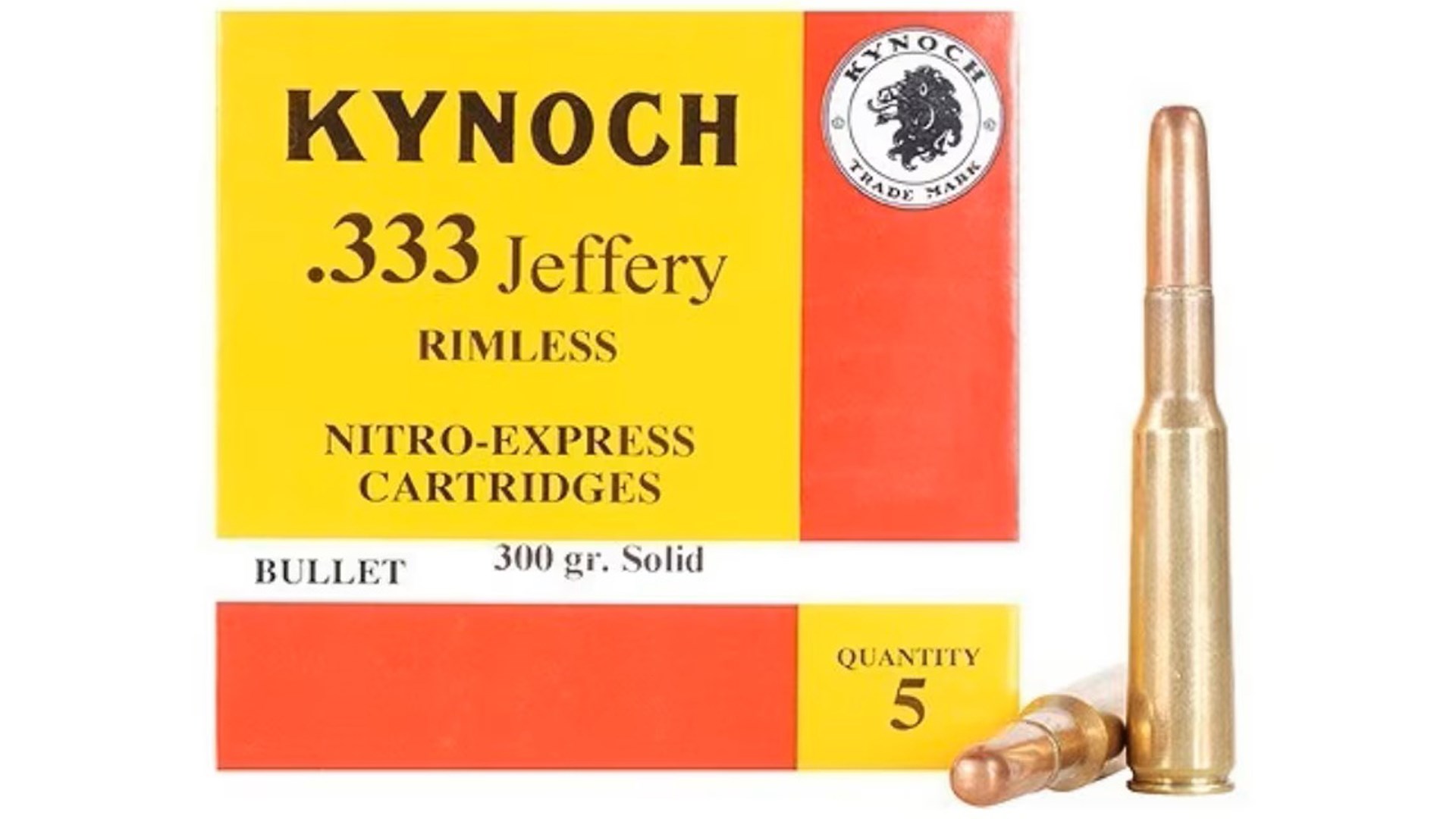
Kynoch 333 Jeffery Rimless

The major issue with the .333 Jeffery is the lack of available factory-loaded ammunition. When Kynoch ceased the production of ammunition for so many of those cartridges referenced in the classic African and Indian hunting literature, many of those British guns went silent.

Federal Premium did the world a big favor when they brought back ammunition for the .416 Rigby and .470 Nitro Express in 1988, and Hornady’s efforts to provide quality ammunition for many of those British cartridges—the .404 Jeffery, .450/400 3” NE, .450 NE and .500 NE—are most certainly appreciated.

To keep a .333 Jeffery rifle fed, you’re going to have to look to handloading, with cases available from Quality Cartridge (in limited runs), dies from RCBS and CH4D or on a custom basis, and projectiles produced by Woodleigh (in 250-grain softpoint, and 300-grain softpoint and solid), or a custom shop like Hawk bullets from New Jersey. Look to powders in the H4350 or Reloder 19 burn rate, and a good large rifle magnum primer.

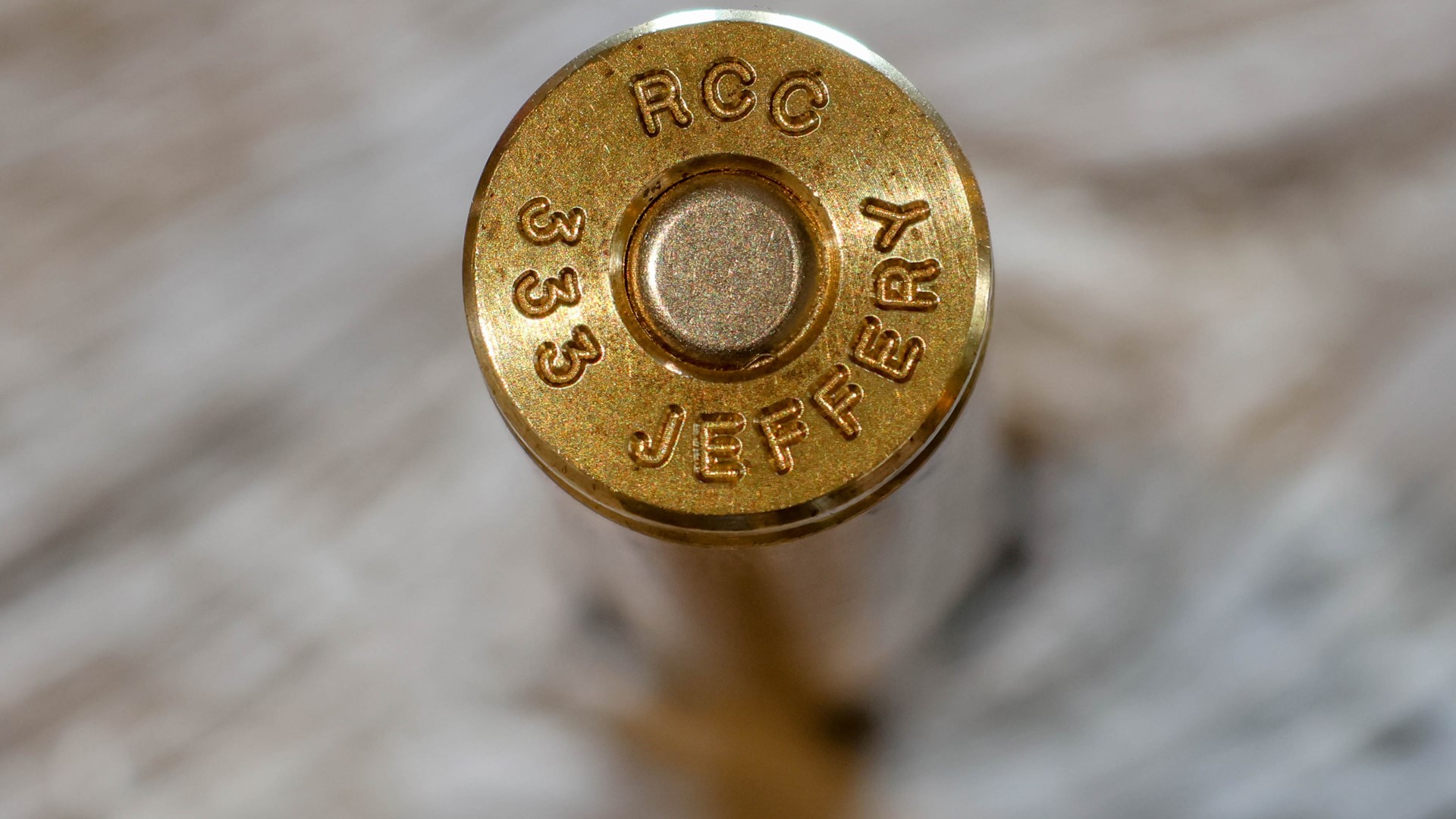
333 Jeffery Headstamp

“Practical” is not a word I’d associate with the .333 Jeffery, but if I saw a hunter show up in safari camp with a rifle so chambered, I’d beg a look at it.

The cartridge surely represents the Golden Era of African safaris, and that experimental period when the limits of smokeless powder cartridges were being defined. Yes, the .404 Jeffery and .500 Jeffery remain much more popular than the 333 Jeffery, but the fact that the cartridge is wonderfully effective in the field cannot be ignored.

Categories
Ammo You have to be kidding, right!?!

Also my Credit Card melted for some reason!

Categories
All About Guns Ammo

AR-15 Goat Gun Review | Goat Gun Toys