Category: Ammo
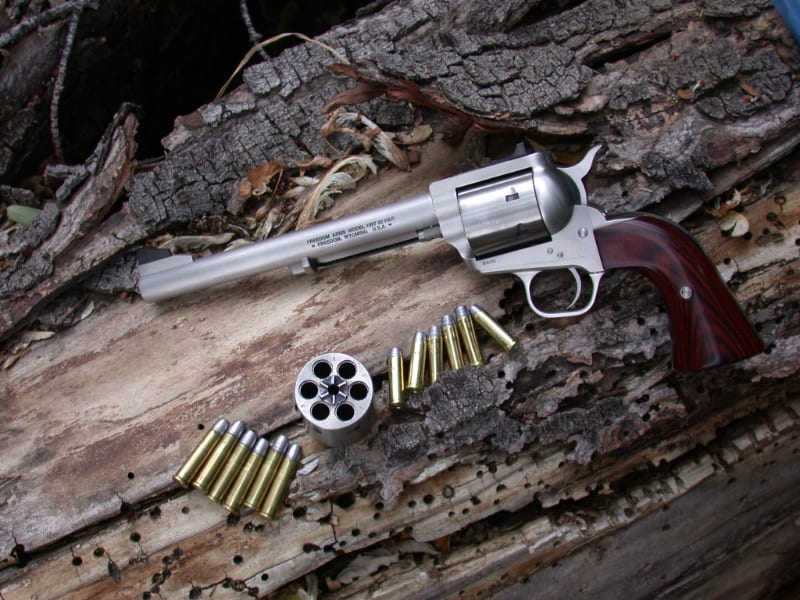
Freedom Arms .32 Magnum Model 97 with extra cylinder chambered in .32-20.
Did you ever have one of those weekends when everything seems to come together? My friend and fellow Shootist, Fermin Garza of the Corpus Christi Police Department, found a couple Bisley Model .32 Magnums in Arizona a few years back. Bisley Model .32 Magnums are not easy to find and here we had both an adjustable-sighted and a fixed-sighted version. I made arrangements for them to be shipped to my dealer and while there discovered another .32 Magnum — a 4-5/8″ Single-Six. After several years of not being able to find a single Ruger .32 Magnum, I now had a trio of these excellent little sixguns.
I didn’t fire any of them before sending them to Gary Reeder in Flagstaff with instructions to turn them into something special. Both of the Bisley Models were fitted with new 7-1/2″ barrels while the Single-Six was turned into a true long-range sixgun with a 9-1/2″ barrel. Gary also put my name on all three and finished them in the high polished blue he is so well known for — nobody does it better. Both of the Bisley Models already had steel grip frames. When they came back, I removed the alloy frame from the Single-Six and fitted it with a brass grip frame to add a little weight in the back and change the balance. With my favorite 8.5 grains of #2400 under the Hornady 100 grain JHP it runs 1,065 fps and groups five shots in ½.″ The adjustable sighted Bisley Model prefers the Speer 100 JHP over the same powder charge for just under 1,100 fps and a 7/8″ group. I call them superb varmint pistols.
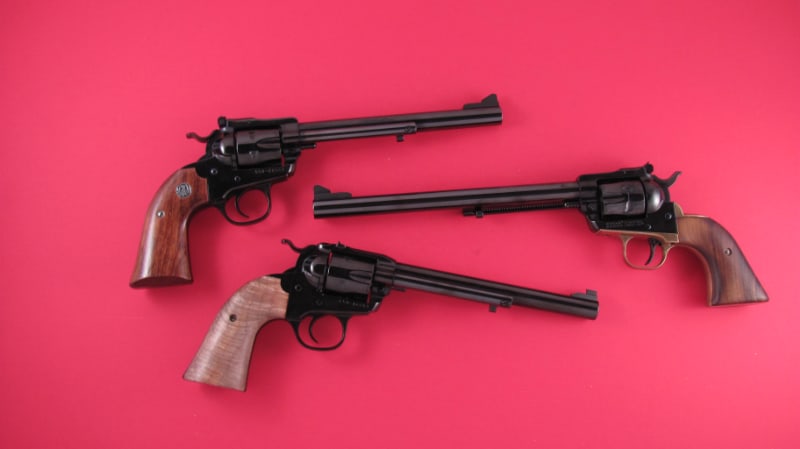
All three of these Ruger .32 Magnums have been customized by Gary Reeder. The two Bisley Models, one with adjustable sights and the other with fixed sights now have 7-1/2″ barrels while the Single-Six has been fitted with a 9-1/2″ barrel.
When the .32 Magnum arrived, Elgin Gates, then head of IHMSA, sent me a Dan Wesson Field Pistol version with an 8″ Heavy Barrel and instructions to really put it to the test. I took it to the first Shootists Holiday in 1986 and never got to fire a single round. It was passed from Shootist to Shootist — all declaring it a superb sixgun. When the stainless-steel version arrived, I had a second .32 Magnum from Dan Wesson. Both of these have been excellent shooting .32s over the years. I especially prefer the Sierra 90 JHC over, yes you guessed it again, 8.5 grains of #2400 for 1,150 fps and another 1/2″ group. The Speer 100 JHP over the same powder charge is right behind it for 1,165 fps and a 7/8″ group. I don’t believe Dan Wesson ever made a revolver which would not shoot very tight groups with the right loads.
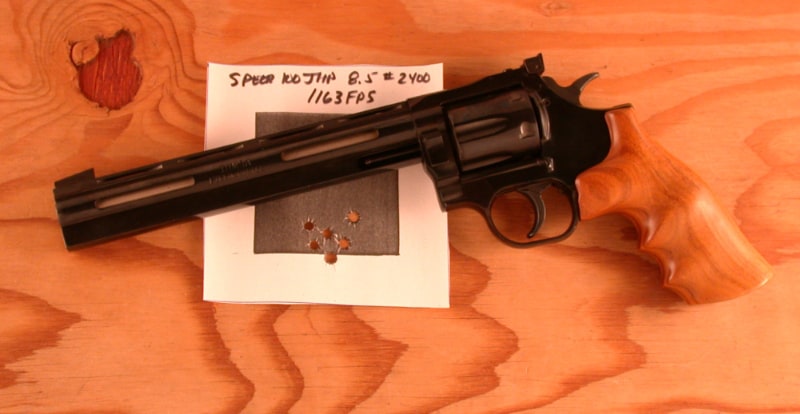
The Heavy Barreled 8″ Dan Wesson .32 Magnum was originally designed for IHMSA Field Pistol matches.
The Freedom Arms Model 97 is a natural for the .32 Magnum and my first is a 7-1/2″ version with the added versatility of a .32-20 cylinder. This one has gone through a lot of testing. I met with Bob Baker of Freedom Arms at a Shootists Holiday and we spent considerable time running my handloads and factory loads through both cylinders with a 2X Leupold in place. It didn’t take long to see we had a superbly accurate sixgun. Ten different .32 Magnum handloads averaged 3/4″ for five shots at 25 yards though the best group was smaller. The Sierra 90 JHC over 10.0 grains of H110 averages 1,260 fps and groups in 1/2″ while the Hornady 85 XTP and the Speer 85 JHP both over my favorite 8.5 grains of #2400 do 1,295 fps and 1,250 fps respectively. Both shoot in ¾.″ The Speer does even better over 10.0 grains of H110 yielding 1,270 fps and a 5/8″ group. This is one of those rare sixguns which simply shoots everything superbly.
When the .327 Federal Magnum was unveiled, I ordered a second .32 Magnum Model 97 — this time with a 10″ barrel and two extra cylinders in .327 Federal Magnum and .32-20. While other .32 Magnums are somewhat selective in which loads shoot best, the Freedom Arms, as we have already seen, shoots everything well. It’s no wonder why Freedom Arms’ sixguns are the most expensive factory produced revolvers out there. Some may complain about the price but I’ve never heard anyone who actually bought one and shot it say it was too expensive!
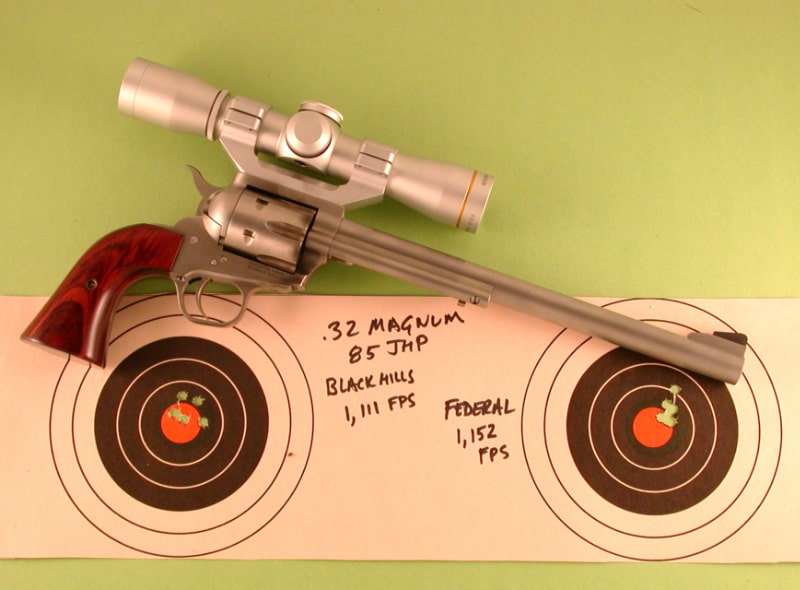
Targets shot with the 10″ Freedom Arms .32 Magnum.
The 10″ Freedom Arms is so accurate it deserves a scope. Mine wears a 4X Leupold. The Sierra JHC over 8.5 grains of #2400 clocks out at 1,220 fps with a five-shot group at 25 yards of 5/8″ while the Black Hills factory loaded 85 JHP has a muzzle velocity of 1,110 fps and a group of ¾.″ The Federal 85 grain JHP factory load clocks out at 45 fps more and groups into one-half inch. I have yet to try any load in this revolver that doesn’t shoot under one inch.
I really enjoy the big bores, especially the .44 Special, .45 Colt, and .44 Magnum, however, there are times when they are not really needed. Sometimes I just want to relax and shoot an accurate sixgun with little felt recoil. The .32 Magnum is just the recipe needed.
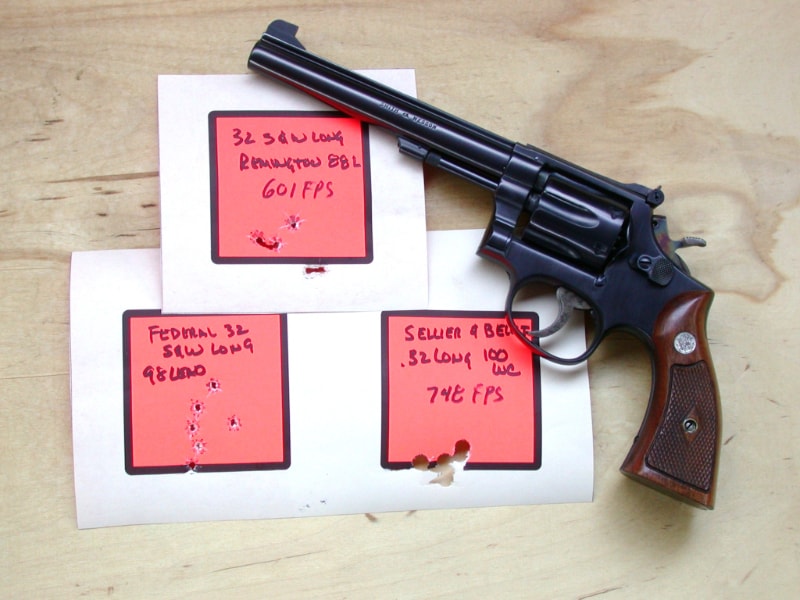
The Smith & Wesson K-32 is an exceptionally accurate .32
My major growing up, my true formative years, took place in the 1950s. The 1950s were also a great time for sixgunners. During those few short years Colt resurrected the Single Action Army and introduced the .357 Magnum and the .357 Python. Ruger gave us the .22 Single-Six, the .357 Magnum Blackhawk, the .44 Magnum Blackhawk and the .44 Magnum Super Blackhawk. Smith & Wesson outdid both companies with the arrival of the 1950 Target and Military Models in .44 Special and .45ACP, the .357 Magnum Highway Patrolman, the .357 Combat Magnum, the 1955 Target in .45ACP and Elmer Keith’s long-awaited .44 Magnum.
My grade school, the house I lived in the 1950s, the shipping and receiving docks I worked on after high school — all are now just a memory. The same is true of every single sixgun mentioned from the big three manufacturers of the 1950s. Most have been dropped while others exist in name only. The only Colt which remains is the Single Action Army and it has changed in several ways. All the Old Model Rugers have been dropped or replaced by New Model versions and only a few Smith & Wessons are resurrected from time to time in their Classic Series. The latter guns are excellent, but definitely not the same as they were in the Golden Years.
These are the guns I have used and prefer; your choice may be entirely different. Choosing favorites is not always easy. Sometimes I can pick one favorite; other times it will be several. With that in mind we herein look at Taffin’s Top .32 Magnum sixguns.

The Smith & Wesson K-38 chambered in .32 S&W Long was the middle sixgun to the K-38 and K-22 in the line-up of target revolvers.
When the .32 Magnum first arrived, I didn’t take it seriously. My friend Joe Penner acquired one of the first 9-1/2” Ruger Single-Sixes available. We loaded up some JHPs and searched for suitable targets. I found some well out of date cans of split pea soup and since I don’t like the stuff anyhow, I figured it would be great for experimenting. Putting a jacketed hollow point through the first can set at 25 yards changed my mind about the little Mighty Mouse Magnum. The can of split pea split — sending green soup all over us and my red Bronco. This cartridge was no toy!
The first factory loads from Federal were very mild as the .32 Magnum arrived in Harrington & Richardson revolvers. (That’s why it is officially known as the .32 H&R Magnum.) The old H&Rs were not especially strong, but handloads for use in the Ruger Single-Six could be loaded much hotter.
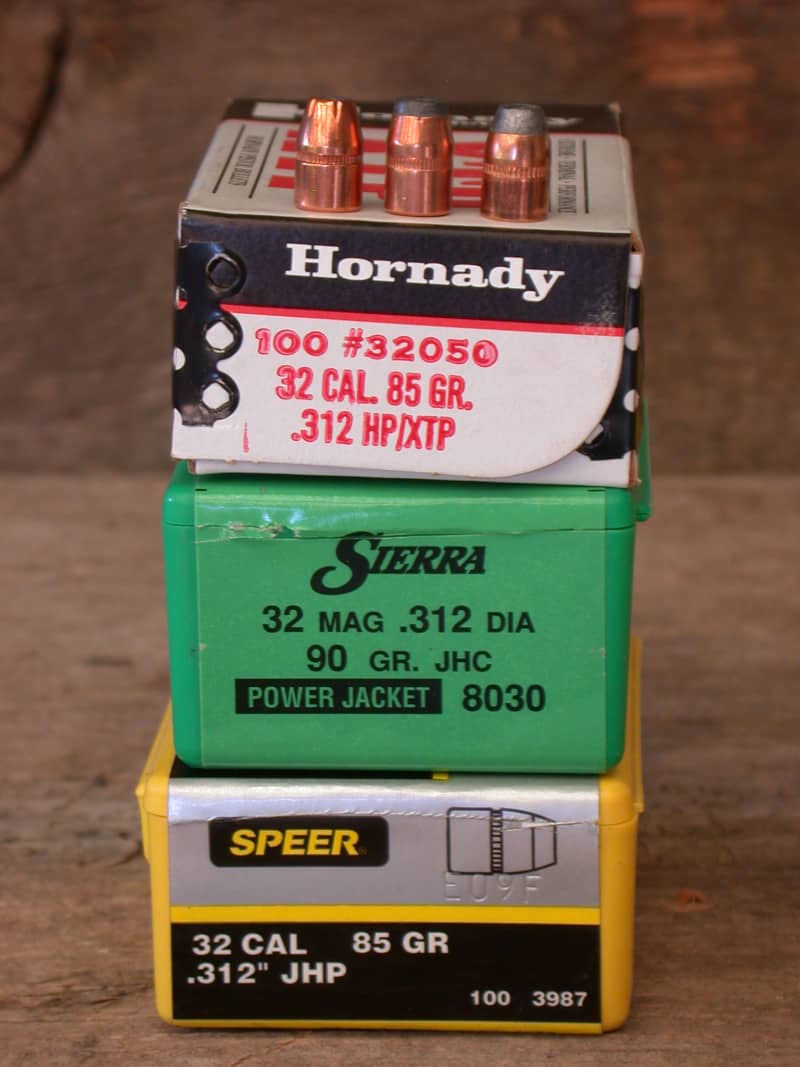
Hornady, Sierra, and Speer all offer excellent jacketed bullets for the .32 Magnum.
The .32 Magnum begins with the .32 S&W Long and is nothing more than an elongated .32 Long — a most pleasant shooting and accurate cartridge especially when chambered in the Smith & Wesson K-32. Back in 1956 I passed up a brand-new K-32 at the local gun shop. A friend bought it instead. He still has it and a half-century passed before I ever came up with one at a reasonable price. These excellent sixguns are regarded as collector’s items, however thanks to a reader I was able to get one for an unbelievably low-price. It had been nicely re-blued, which may bother a purist collector but certainly not me as a shooting collector. When Bullseye was the number one handgun shooting sport in the middle of the last century, Smith & Wesson offered three K-Masterpieces in .22, .32 S&W Long, and .38 Special — all having the same balance and weight controlled by the length of the rib on the barrel. Classic K-22s and K-38 are relatively easy finds but not in the .32 version. The .32 Long WC is a viable solution for those who have trouble with recoil. My wife, Diamond Dot, has a fully engraved, ivory stocked 4” S&W .32. She does not feel undergunned at all.
Moving up to the .32 Magnum, my stable of Ruger .32s doesn’t include a single factory version, but customized sixguns by both Andy Horvath and Gary Reeder instead. Andy is well-known for his Lil Guns and I’m proud to know I introduced him to sixgunners more than 25 years ago. The first Lil Gun Andy did for me was a 4” round-butted .44 Special followed by a trio of .22s and then .32 Magnums. Starting with a standard Single-Six and a Bisley Model, he cut the barrels to just under 4” along with the ejector housing and ejector rod, totally tuned the actions, round-butted the grip frames, and finished both in a high bright blue. They make excellent single action versions of the classic Kit Gun, and fit easily into a backpack or carry nicely in a holster. I mostly use these with the Sierra 90 JHC, Hornady 100 JHP, or Speer 100 JHP over 8.5 grains of #2400 for an accurate shooting 1,060 fps.


Last night, news broke that the Biden Administration is taking behind-the-scenes steps to further strangle the already constricted market for ammunition in the United States. The move could result in a reduction of the commercial production of 5.56 caliber ammunition by over thirty percent.
The move, if completed, would dramatically reduce availability of ammunition for America’s most popular rifle (and, not coincidentally, the one most targeted by gun prohibitionists).
Supplies would undoubtedly plummet and prices would undoubtedly skyrocket, putting the availability of ammunition for self-defense, training, and competition out of reach to many Americans.
News of the move was broken by Larry Keane, the general counsel and senior vice president at the National Shooting Sports Foundation, the leading trade association for America’s firearms and ammunition industries. Keane on Wednesday night published a tweet, which stated: “The U.S. Military is actively considering shutting down the sale [of] M855/SS109 ammo from Lake City to the commercial market.”
The cartridges mentioned in Keane’s post are very popular forms of 5.56 caliber ammunition, the most common caliber for the AR-15.
Close followers of Second Amendment issues will remember that these same rounds were targeted by the Obama/Biden administration under the guise of relabeling them “armor piercing ammunition,” which is banned from commercial sale by federal law. The resulting (and righteous) furor from the Second Amendment community was so intense that it culminated in Obama’s ATF director, B. Todd Jones, quitting his job. Jones had been the first and only confirmed ATF director since Senate approval became required for that post.
Lake City is a sprawling ammunition plant in Independence, Missouri, originally established by Remington in 1941 to manufacture and test Ammunition for the U.S. Army. It is currently owned by the government and operated by private contractors and produces well over a billion rounds of ammunition per year.
Ammunition in excess of the government’s requirements has long been made available to the private commercial market. Lake City’s output, according to some estimates, accounts for one-third of the 5.56 caliber ammunition available to U.S. consumers.
Of course, gun prohibition advocates have a long-standing desire to ban the AR-15 and other types of semiautomatic long guns outright. Joe Biden in particular loves to brag of authoring the so-called “assault weapons” ban that Bill Clinton signed into law in 1994. Congress, however, allowed the ban to expire 10 years later, after a Department of Justice sponsored study was unable to substantiate any significant crime reduction benefit from it.
Needless to say, this attack on America’s ammunition supply is just the most recent in a long line of anti-freedom attacks by the Biden Administration.
NRA will be working to fight this effort to crush America’s ammunition supply, just as we did with the last attack on M855 ammunition, and will provide updates as more information becomes available.
The .300 H&H (Holland & Holland) Magnum’s tapered shoulder and belted base set the stage for later .30-caliber Magnums; here’s its history.

November 23, 2021
In 1912 the respected British firm Holland & Holland established the future of the belted rifle case with the .375 H&H Magnum. It was not the first belted case, but it was the one that set the dimensions for a century of cartridges to come. H&H’s head and belt design have been used almost unchanged in a staggering number of standard, proprietary, and wildcat cartridges.
In about 1920, H&H applied those head dimensions to a then-new .30-caliber cartridge, first called the “Holland’s Super 30.” The same length as the .375 H&H case, the newcomer had a long, tapered shoulder. Soon its standardized name became the .300 H&H Magnum, and there was a sound reason for that funny-looking shoulder.
I’ve previously written about how handloaders can deal with belted rifle cases, but not so much on why they had to exist. First, let’s reconsider “Magnum” and “belted” for the benefit of our younger or newer readers.
To many shooters, “belted” and “magnum” are conjoined twins, but that cannot be further from the truth. “Magnum” is a non-technical, marketing term. It may imply a performance improvement, but that improvement does not have to be real.
Conversely, the belt has a compelling technical reason to exist. It is a raised ring at the head end of a cartridge case lying where the extraction cannelure meets the case body. The magazine bolt-action rifle and the British love affair with Cordite propellant drove H&H to develop this case.
Magazine rifles function best with rimless cartridges, but those cartridges need a rim substitute for headspacing. Typically, that is a pronounced case shoulder or the cartridge’s case mouth. However, if the bullet will be crimped as with most factory ammo, the case mouth can’t be used. So why not simply use enough shoulder?
That is where the Cordite connection entered. Cordite was an early, high-nitroglycerin-content smokeless propellant. It came in long sticks roughly the diameter of a pencil lead that is cut to a length that fits between the inside of the case head and the base of the bullet or sometimes an over-powder wad. You didn’t pour this stuff into a case; you inserted a bundle of sticks.
The need to insert Cordite bundles resulted in many British-developed cartridges having cases with shoulders that are either a narrow width—like the
.375 H&H—or a shallow angle like the .300 H&H. The latter’s shoulder angle is only 8.5 degrees. Compare that to the .30-06 shoulder at 17.5 degrees.
People think the belt adds case strength at a critical point. I don’t. The critical point is ahead of the belt. I’ve seen belted cases just as mangled as non-belted ones when suffering an 80,000-psi overload.
The .300 H&H was first loaded in the United States in about 1925, but shooters had to wait another decade for a domestic rifle chambered for it: the Winchester Model 70 Super Grade. The .300 H&H supplanted the .30-06 as the most powerful commercially loaded U.S. .30-caliber cartridge. Original H&H specs were close to 3,000 fps.
The .300 H&H ruled the .30-caliber world until the .300 Weatherby came out in about 1944 and held its own for another 20 years until the .300 Winchester Magnum edged it out. Today, the H&H’s published nominal velocity with 180-grain bullets has been downgraded to about 2,900 fps. With safe handloads and current propellants in 24-inch barrels, it can still drive a 180-grain bullet to just over 3,000 fps.
There are not a lot of tricks to handloading the .300 H&H. The complicating factor is cartridge overall length (COL) in custom rifles. COL is a function of both action length and how the chamber’s throat and the bullet’s profile marry up. Custom rifles don’t have to follow industry guidelines. The standard chamber throat drawing shows no freebore and a 2-degree leade that is 0.114 inch long. The industry COL is 3.600 inches; the sample cartridge pictured has a match bullet seated to max COL. It chambered easily in one custom rifle but contacted the rifling in another.
Custom .300 H&H rifles have been built on an array of bolt-action lengths. Some may not eject a live round that is within COL values and chambers normally. With so many custom rifles for this cartridge, the saying, “COLs are guidelines, not gospel,” is important to remember. Determining proper COL for your rifle is your job.
The .300 H&H’s 3,000 fps velocity and more than 3,500 ft-lbs of energy with safe handloads is impressive performance, even considering the handful of newer .30-caliber cartridges that exceed those marks. Not bad for a century-old hunting buddy.

Categories
What a waste of Ammo!

Chances are if you own a firearm in a military caliber you have looked at surplus ammunition. In a nutshell, surplus ammunition is ammunition that was decided to be “surplus” to the needs of some entity. In most cases, this happens when a caliber or loading is replaced in service. If you’re not intimately familiar with it, it can be very confusing to know exactly what it is that you are looking at. A lot of times, the markings on the boxes or containers are in a foreign language. In some cases, some surplus ammo may not be suitable in the firearm in which you wish to use it for one reason or another. In this article, I’m going to hopefully shed some light on what’s what when it comes to military surplus ammo.

Some of what I’m going to discuss isn’t currently being imported for different reasons. And a few of these types haven’t been imported in quite a while. But it has already been imported in sufficient quantities that you may well run into some anyway. There is a bunch of imported ammo produced specifically for commercial sale, but that is beyond the scope of this article. The specifics of the different loads can vary depending upon who produced the ammo in question and when, so the bullet weights I’ve provided are intended to be a general idea of what to expect. There are so many variables with regards to velocity, that data on it would be almost useless. So I’m not including it here. I am also focusing on ball (FMJ) loadings here, as that’s by far what’s most common.
Typically speaking, there are one or two loads that exist for ball ammunition in a given caliber. Everyone who produces it tends to stick with them or something close for the most part. The reasons for this are pretty obvious when you start looking at what weapons each nation equipped its army with. Even going back 100 years, you find that most of the small arms then in use came from only a few places.

I’ll start with 5.56x45mm because it’s probably the most popular caliber in the US today. Fortunately, the situation with surplus 5.56 is not particularly complex, as there aren’t a whole bunch of different loadings of military ammo to deal with. There are really only 2 loads. In the mid-1980’s NATO standardized 5.56×45 as its rifle caliber. Unlike other calibers, they actually specified a particular bullet (the FN designed SS109) and load. M855 is what the US military calls that ammunition. Any 62gr 5.56mm NATO military surplus ammo will be this loading. The one exception to that rule (that I am aware of), was some Radway Green 62gr ammo that was imported about 15 years ago. It was rather lightly loaded in comparison to the typical NATO loading. At any rate, all of these loads do contain steel in the bullets which I mention because some ranges may not allow the use of it. Some nations have different nomenclatures for this ammunition, but fortunately, that information is easy enough to sort out.
The M193 load is the original 5.56x45mm loading, and it predates the actual 5.56mm NATO specifications by about 25 years (which certainly muddies the waters of the whole .223 vs 5.56mm debate). M193 uses a 55gr FMJBT bullet. It was loaded by a lot of different nations. But aside from some of them using Berdan primers, this ammo is essentially all the same.
7.62×51 NATO was standardized in the late 1950s. Unlike 5.56mm, while the cartridge was standardized the load really wasn’t. Through the years, we’ve seen a bunch of different nationalities of 7.62×51 NATO surplus ammunition imported. While there are differences in the loadings, the differences are fairly insignificant, as they were all in the 140-150gr range. The US load is 147gr, and is called M80. Some other nations also use the same nomenclature, though most did not. The situation with surplus ammo in this caliber is a bit different, so I’m going to go into a bit more detail.

I’ll start with the ammunition produced in India, as there are some things to be aware of. There are predominately 2 types of 7.62 NATO ammo that came from India, ammo packed in bandoleers on 5rd stripper clips, and ammo packed in 10 round clear plastic packages. The ammo in the 10rd plastic packages is dated from the 1990s. This ammo is responsible for the very bad reputation Indian ammo received years ago, and deservedly so. Put plainly, I would not advise shooting this ammo as it was notorious for squib loads (when the powder doesn’t burn properly and a bullet is left in the barrel) and other problems. I personally experienced squibs in this ammo when I shot some years ago. So this isn’t just internet rumors. If you handload, you could use it for some components as the brass is boxer primed at least, but even then you should inspect the bullets and brass carefully. The Indian 7.62 NATO ammo on stripper clips is dated from the 1970s and is considerably better quality. I have fired a fair amount of this ammo, and never had any problems with it. If you’re looking at Indian 7.62 NATO ammo, and you’re not 100% sure what it is, pass on it or buy it just for components. The headstamp on Indian ammo is “OFV” and a two-digit year, which I mention in case you find some not in its original packaging.

7.62 NATO produced by the various European nations (i.e. England, Germany, Austria, Spain, etc) is usually decent quality ammo. It is almost always berdan primed, and non-corrosive. As I mentioned previously, there are slight differences in the loadings of different nations, but it’s all fairly similar. The same goes for the South African ammunition as well. There is only one type of corrosive 7.62 NATO or .308 Winchester ammo that I have seen. It is Czech, and in bluish colored boxes. While I believe this ammo was intended to be for commercial sale, I have seen it advertised as surplus which is why I mention it.
Calibers from the Soviet era have become more prevalent in the US as the years have passed. These are a little bit trickier to figure out if you’re not familiar with them. Most of this ammo is packaged quite similarly. If you are lucky enough to find it in quantity, it always seems to be packed in some sort of “spam can” (or if you’re really lucky a crate). In a lot of cases, if you find this ammo in the corner of your local shop or at a gun show, the can has been opened but may still be present. These cans are about the same size, and there were a number of different calibers packed this way. In order to know what they contain, you have to be able to “read” them. Also, should you purchase any ammo packed in these, make sure you obtain one of the proper “can openers” for them.
5.45×39 is a caliber that has not been available in the US for very long in comparison to other calibers. A lot of shooters still have never heard of it. However, I really like AK-74 rifles, so it’s one of my favorite calibers. For surplus ammo, there is really only one loading available. This is the 7n6 ammunition that was banned from import a few years back. A lot of it was imported from Russia when it was allowed into the US. However, there was also some Bulgarian ammo as well. All of this ammo is corrosive. All of the Russian stuff I’ve seen was produced in the late ’70s or ’80s. It was packed in crates of 2160 rounds, containing 2 1080rd cans. Inside the cans, the ammo is packed in 30rd boxes.

Another popular caliber here in the US is 7.62x39mm. In this caliber, there are 2 specific loadings surplus ammo is found in. The M43 loading is the original load, and worldwide the most popular. However, imports of this were cut off a number of years ago owing to the steel core construction of the bullets. This was done for economic purposes, rather than enhancing penetration or armor-piercing reasons as is commonly thought, lead being more expensive than steel. At any rate, occasionally it turns up on gun show tables and similar in spite of not having been imported for some time. M43 found here is typically Chinese or East German, though it is my understanding that there have been others as well.

Like everything else weapon related, the Yugoslavs had to be different. They developed the M67 loading. We are fortunate here, as this load uses a lead core bullet and as such is still imported into the US. The vast majority of this ammo is corrosive, but I have seen some recently that was advertised as non-corrosive. It typically is in crates containing 1120 rounds or 1260 rounds. The crates of 1120 contain boxes of 40 rounds on SKS type stripper clips, while the crates of 1260 contain boxes of 15 rounds. This ammo is also brass-cased, though being Berdan primed it is a bit more work to reload.
7.62x54r has been around a long time. So naturally, there are more configurations that it was loaded and packed in. I’ve never actually encountered any 7.62x54r in the US from before WWII, and should you find any it should probably be regarded as collector ammo due to its rarity and age. So I’m going to stick to post-war loadings. I’ve primarily seen two different loadings here, the M30 (aka heavy ball) and the LPS (aka light ball) load. The heavy ball load is marked with a yellow painted tip. It’s 182grs and uses a lead core bullet. At one point it was decided that there should only be 1 ball loading in 7.62x54r and that would be the LPS loading. It’s about 147grs (there are slight variations depending on who loaded it), and the most commonly found surplus ammo. The bullet in this ammunition does contain a steel core, like the 7.62×39 ammunition I mentioned above. It was marked with a silver painted tip for a time. This practice was stopped after a while, presumably when all of the M30 ammunition was out of service. So there is a lot of it out there with no paint on the bullet tip to mark it. However, it is my understanding that all of the Yugo ammo out there in this caliber is the M30 loading, and it does not have a paint marking on the tip as they only used the M30 loading.
There is one more load out there that, while fairly rare, could still be encountered. That would be the 7n1 load. This ammunition was specifically loaded for the SVD, and is considered to be a “match” loading. It used a special 152gr BT bullet. The crates, cans, and packages of this ammo all have a marking to note what this ammo is. I would strongly advise that you do some research before purchasing any ammunition of this type.

For packaging, the most common in this country is the 440rd can, packed 2 to a crate. Inside the crate, the ammo was packed in 20rd boxes. I’ve seen it packed another way as well. Once in a great while, some will turn up in 300rd cans (these being more square then the normal “spam cans”), 2 to a crate. This ammo is packed in boxes of 15, on 5 round Mosin-Nagant clips. The only real clue to us as to which it is (if the crate is unopened), is the round count marked on the container. There is also some that are in an 800rd crate, containing 1 large can.
7.92x57mm, also known as 8x57mm and 8mm Mauser, is another caliber that has seen a large amount of ammunition imported for it. There are predominately 2 loads for this caliber as well. The 154gr load was the WWI era rifle loading, and what the sights on WWI era Mauser rifles are calibrated for. The 198gr load was the WWII era load, and obviously what’s intended for use in WWII and post-war Mausers. All of this ammo should be considered corrosive. Before using any of this ammo, ensure that it’s safe to do so in the particular rifle you intend to use it in as not all 7.92x57mm rifles are intended for the same ammunition.

This leads us to the Turkish 7.92x57mm ammo that, while not as cheap as it once was, is still floating around in sizeable quantities. It is found in cloth bandoleers, loaded in 5rd Mauser stripper clips. It is essentially a copy of the WWI era 154gr load. All of it that I have seen has been dated in the 1930s-1950s. There have been problems reported with this ammo, so I would recommend you do some research before using it. I’ve never personally had a problem with it, though I’ve only ever used it in bolt action rifles.
There have also been quantities of Romanian produced 7.92x57mm imported as well. This ammo was packed in “spam cans” like the Soviet calibers typically are. The cans were either packed with 340 or 380 rounds, with the 340rd cans having their ammo on 5rd clips. This ammo is steel cased but otherwise similar to the WWI era load being about 150grs.
Yugoslavian ammo seems to be what I find most often for 7.92x57mm surplus ammo. It is typically packed in 15rd boxes, inside of 900rd cans-though sometimes it can be found in machine gun belts. All of the Yugo 7.92mm ammo I have seen is the later 198gr loading. The Yugos also loaded special ammunition for the Zastava M76 “Sniper” rifles, which is referred to as M75. This ammo is supposed to be better quality than the typical ball ammo, but is basically the same load and is still corrosive. I have fired a fair amount of the regular ball ammo, and I’ve had pretty good luck with it.
Surplus ammunition can be an excellent value. In a lot of cases, it is packaged for long term storage, making it very suitable for people wanting to store some ammunition “for a rainy day”. A lot of it is corrosively primed, but this just requires some extra cleaning to deal with. Some of it is specifically loaded for use in a particular weapon, and may not be suitable for some firearms in that caliber. When in doubt, do some research on the specifics of the ammo in question before you use it in a particular firearm. Hopefully, this has given you a little bit of information about that dusty ammo crate sitting in the corner of your favorite shop. Until next time, Happy Shooting!
Categories