Categories
All About Guns Ammo

The .357 Magnum: History & Performance by DAVE CAMPBEL

Campbell 357Mag 4

It would almost seem ridiculous to introduce a product that was at least 25 percent more expensive than any of the other products a company manufactures in the depths of the Great Depression, but that is exactly what Smith & Wesson did when it introduced the .357 Magnum in 1935. Smith & Wesson historian Roy Jinks said that the top brass at Smith & Wesson felt that this new custom-made revolver would not have a large demand, given its $60 price tag. They were wrong. As soon as it was introduced, demand outstripped the factory’s capability to satisfy it. Barely 120 revolvers per month were shipped, and the orders were way more than that.

Like most of the magnum cartridges, the .357 Mag. was concocted outside the factory by enthusiasts. In this case, it was the brainchild of Phil Sharpe, a ballistician, writer and member of NRA’s technical staff from the 1930s into the 1950s. He collaborated with then-Major Douglas B. Wesson, grandson of founder Daniel Wesson. Elmer Keith designed the first bullets for the cartridge when he developed 160- and 173-grain semiwadcutter (SWC) bullets for the .38 Special in the early 1930s. The heavy loads featuring these bullets over 13.5 grains of Hercules 2400 proved to be very accurate in the Smith & Wesson .38/44 N-frame revolvers of that time.

Smith & Wesson needed something to answer Colt’s .38 Super, a cartridge designed for the M1911 that launched a 147-grain full metal jacket with a flat point at 1,225 f.p.s. and 490 ft.-lbs. of slap, enough to penetrate the door of a speeding getaway car. The .38 Special and 9 mm Luger just were not up to that task. Sharpe and Wesson brought Winchester into the mix to develop a suitable revolver cartridge. Winchester added 0.125″ to the length of the case and ran the velocity of a 158-grain SWC to 1,525 f.p.s. in an 8.5″ barreled revolver. The load was very effective for hunting, and Wesson toured far and wide hunting everything from woodchucks to walrus with his .357 Mag.
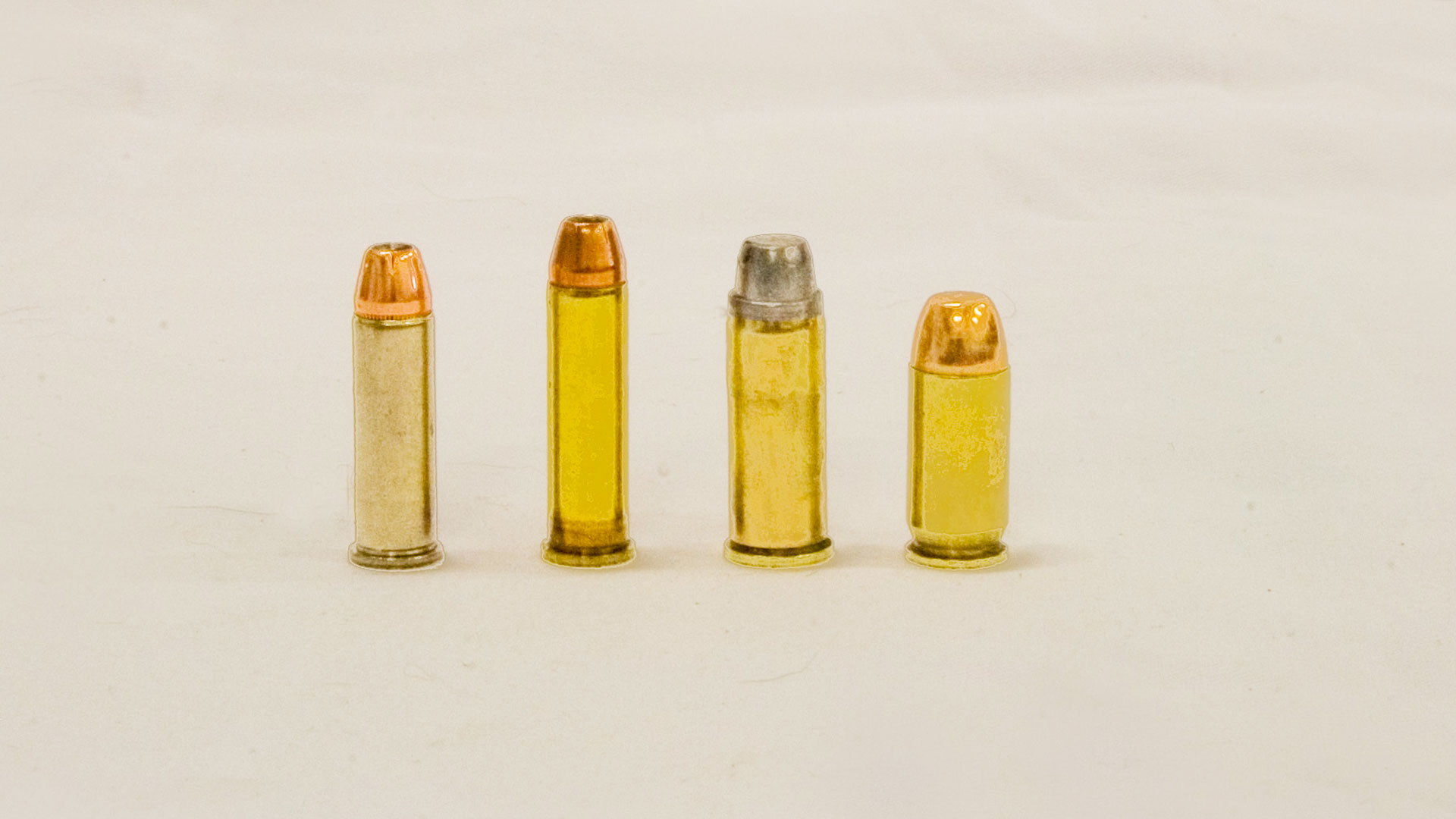
A size comparison between, from left to right, .38 Spl., .357 Mag., .44 Spl. and .45 ACP.

A size comparison between, from left to right, .38 Spl., .357 Mag., .44 Spl. and .45 ACP.

This load may be effective, but the revolver with such a long barrel was pretty unwieldy for the cop on the street. Smith & Wesson bobbed the barrels on its .357 Mag. to as short as 3.5″ for the law enforcement community. The 5″ and 6″ barrels were quite popular on the .357 Mag. until well into the 1960s, and even early ’70s. My 5″ Model 27—the model numbers came about in 1957—is a great balance of heft, sight radius and velocity. Though now in semi-retirement after some 40,000 rounds, it will still generate 1,280 f.p.s. with any good 158-grain bullet, and I have won a few impromptu matches with it.

The reviews of the .357 Mag. have been pretty consistent and positive over its 87-year life. Naturally, the experimenters have to play with bullet weights—everything from 90 to 200 grains, and perhaps beyond, have been tried. Flyweight 110-grain jacketed hollow points (JHP) churn up impressive velocities, like nearly 1,500 f.p.s. in a 6″ barrel, but typically have been a bit too fragile to maintain structural integrity and penetration. Hefty 180 and 190 grainers will plow through almost anything short of armor plate, but have trajectories like a rainbow. So, like most things, a compromise has been achieved.

For field use, I usually go with 158-grain SWCs in front of 14 grains of Alliant 2400 for 1,150 to 1,300 f.p.s. in my 4″ to 6″ barreled .357s. This is an excellent small game load, and I even dumped an 80-lb. feral pig with this load many years ago. Nowadays, when I carry a .357 Mag. it’s usually either a Model 342PD or a 2.5″ Model 66. I have had to recognize that bullet and powder technology has evolved since the Great Depression, and now carry Speer 135-grain Gold Dot Hollow Points SB (for short barrel) in them. This load has a great reputation as a fight stopper, and even I have to admit that it shoots as well or better than my own cast bullets.
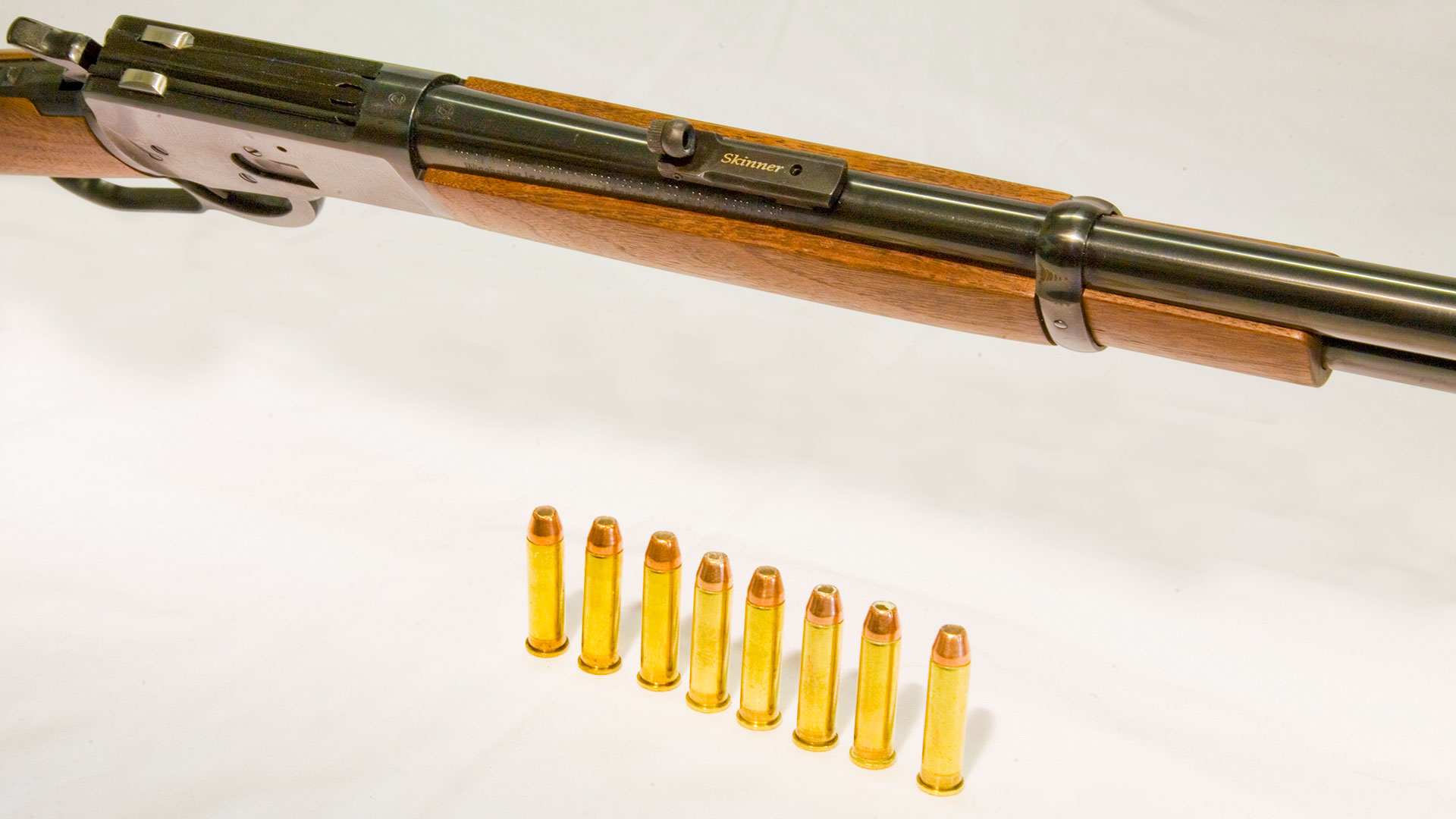
The author's Winchester Model 92 lever-action rifle chambered for the .357 Mag. cartridge.

The author’s Winchester Model 92 lever-action rifle chambered for the .357 Mag. cartridge.

The popularity of the .357 Mag. remains as strong as ever. In a modern world of semi-automatic pistols with magazines that hold the better part of a box of cartridges, virtually every manufacturer of revolvers—either single or double action—makes a .357 Mag. Much of this is due to the versatility of both cartridges and revolvers. Most know that you can easily shoot .38 Spl. in a .357 Mag. chambered gun and still get all the accuracy inherent of that particular piece. Wadcutters are as easy on the hands as a rimfire—no small matter to those of us with some arthritis in our hands. Too, wadcutters are easier on the budget than full-house magnum loads. But when plenty of thump is needed, a shooter can load up some “T-Rex” loads as they are sometimes called, featuring heavy bullets, slow-burning powders and magnum primers to deal with outsized problems.

Smith & Wesson isn’t the only manufacturer of .357 Mag. firearms. Colt just reintroduced its iconic Python in this caliber. Ruger has been building some of the stoutest .357 Mag. revolvers ever since the 1950s. My Flat Top dating back to the 1950s is one of the most accurate .357s in my collection. Kimber has been making a very nice double-action revolver chambered in .357 for a few years now. Nighthawk is importing and customizing the superb Korth revolver. Taurus has a .357 Mag. to suit just about anyone’s fancy. You need not limit yourself to revolvers, as WinchesterHenry and a host of European and South American replica manufacturers make lever-action rifles chambered in .357 Mag. as well. My Winchester Model 92 shoots very well, especially since I replaced the factory rear buckhorn sight with a Skinner aperture rear sight.

The .357 Mag. has ensconced itself into the shooting brethren so well that it is about as common—necessary?—as the .22 LR. Most shooters have at least one, even if their current tastes have migrated to other chamberings. It is simply that universal—and well earned.

Categories
Ammo

#10MinuteTalk – 6.8 SPC: Talk, Talk, Talk. Action?

Categories
Ammo

Elk Hunting Cartridges and Calibers – Randy Newberg’s thoughts

Categories
Ammo

Mine too!

Categories
Ammo The Green Machine War

The DEADLY DESIGN of The War between the States Bullets

Categories
All About Guns Ammo

BECAUSE IT’S DIFFERENT! FINDING THE MAGIC WITH A BLACK SHEEP CALIBER WRITTEN BY DAVE WORKMAN

It was a time when everyone was enamored with the .44 Magnum S&W Model 29, the Dirty Harry gun for which so many would add their names to waiting lists, patiently waiting their turn.

But I’m different, and not terribly patient. I’d done some homework and didn’t care for the .44 Magnum’s recoil, not to mention waiting lists. But there was another magnum available, and it intrigued me.


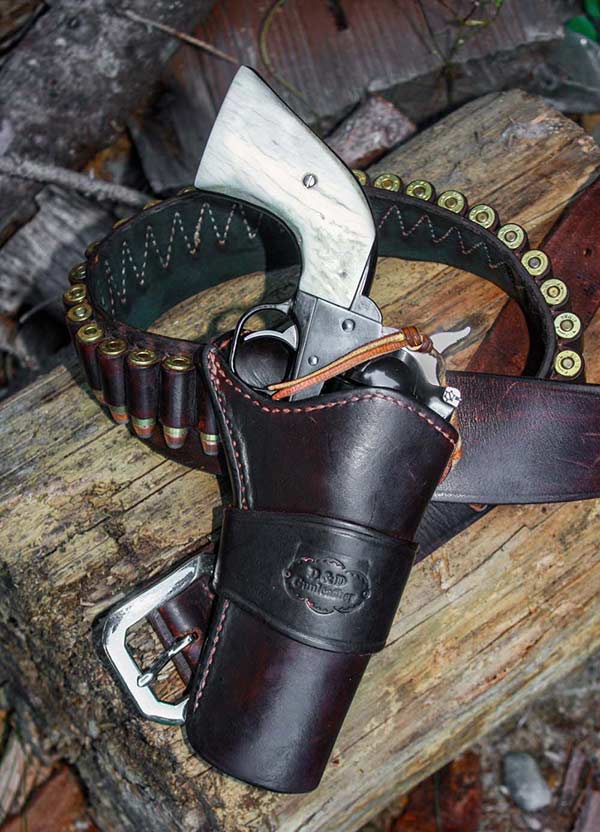
A good sixgun in a major caliber only needs spare ammunition. Dave prefers a
fully-loaded cartridge belt for backcountry trips.

A Cult Favorite Magnum


Introduced in 1964, the .41 Magnum was originally aimed at the law enforcement market, according to the writings of the late Elmer Keith. He’d been approached by Bill Jordan in the early 1960s and the two were able to talk S&W into building the gun while Remington developed the ammunition, according to Keith’s narrative.

When the gun and caliber didn’t catch fire with lawmen, hunters and silhouette shooters found it to be a superb cartridge for their purposes. The .41 Magnum shoots flatter than the .44 Magnum and also produces slightly less recoil, yet it can do anything the .44 does with comparable loads. It has become something of a cult favorite.

Keith was a well-known big game hunter and long-range handgunner, and my research included reading about the .41 Magnum’s development. He’d shot a couple of caribou in Alaska with a .41 Magnum, and wrote about it in his first autobiography, Keith. At the time I was among folks in Washington State advocating for handgun hunting. When the state finally approved, I went shopping.

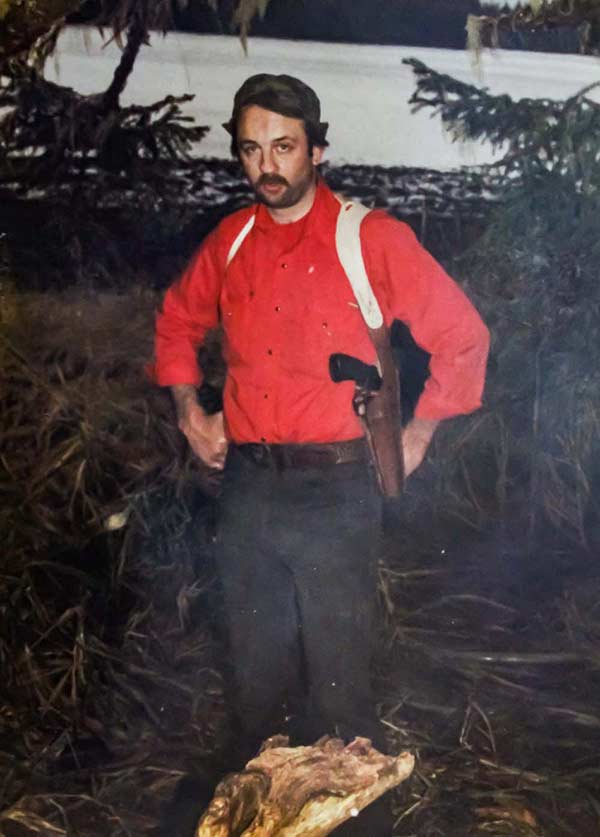
Vintage Dave drying off between rain showers on day 3 of an Alaskan deer hunt
circa mid-1980s. Cool Safariland shoulder holster!

My First


My first .41 Magnum was a Ruger Blackhawk with a 6.5″ barrel. I swapped out the factory wood grips for a Pachmayr one-piece. Using handloads topped with the old Speer half-jacket 200-gr. bullet or the Hornady 210-gr. XTP, both propelled by a stout charge of the then-Hercules 2400, the gun accounted for a blacktail buck and a 2-point mule deer, the latter as my young family looked on.

We were on a Sunday morning drive on a 4X4 road high in the mountains, coming downhill. We rounded a corner and there he stood, just as surprised as we were. He leaped into the brush; my rifle got stuck between the console and bucket seats so out the door I went with sixgun in hand. He’d gone into an old clearcut and was trying to sneak into some thick alders, but I was just a hair faster. Two rounds high behind the shoulder put him down.

Going Double-Action

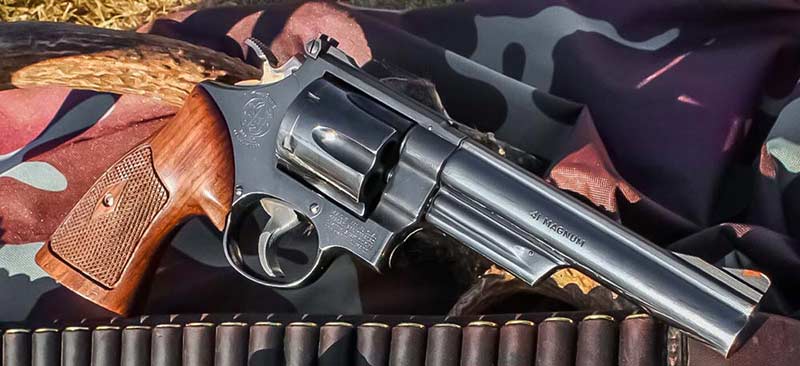
Then along came a 6″ Model 57 S&W in handsome deep blue with walnut grips. It was on sale from John Jovino, the famous New York City gun store, and I couldn’t resist. It may not have been “the most powerful handgun in the world,” but my name didn’t gather any dust on a waiting list, either.

It arrived in the factory blue cardboard box, which I still have; a masterpiece of machinery with the elegant profile of a movie star. And it shot very well.

The following year, both the Ruger and S&W traveled along to Southeast Alaska’s Prince of Wales Island on a deer hunt. The day before we left, I’d shot a buck with the Ruger, which seemed to impress my eastern companions. Alas, we flew into lousy weather, the local Sitka Blacktail population went to deep cover and nobody scored. I carried the Model 57 in a Safariland shoulder holster, slogging through muskeg, across a couple of rivers and rain for four days.

I’ve found the shoulder holster more practical for such a large size handgun and it’s still my “go-to” favorite for long-range shooting.

Dave spent a year carving and shaping a set of elk antler grips for his Ruger Blackhawk with a 4-5/8″ barrel.

Finding “The” Load


Factory .41 Magnum ammunition wasn’t always easy to find, and it was pricey. So, I got heavily into reloading, learning that maximum loads aren’t always the best, and in some cases, should be avoided. Suffice to say I flattened some primers and even some head stamps along the way.

Eventually, I found some bullet-powder combinations that work consistently and stuck with them.

There are lots of good propellants for magnum handgun loads, and my two favorites are H110 and 2400. I use 20.0 grains of H110 or 15.7 grains of 2400 behind a Nosler 210-gr. JHP, the latter listed as “the most accurate load” for that powder/bullet combination.

The Nosler bullet works well in cartridges carried in an HKS speed loader, and the same is true for the XTP and Sierra’s 210-gr. JHP.

During Pacific Northwest winters, I’ve carried the Model 57 under a parka and nobody was any the wiser. Confident that a .41 Magnum will stop just about any unpleasantness one might encounter, a handgun in this caliber is never far away when I leave the pavement.

Raj Singh at Eagle Grips built a set of Kirinite target-style grips for Dave’s 4-incher.
He prefers this style of grip for his double-action magnums.

Memorial Shoot

Some years back, I was invited to an event called the “Elmer Keith Memorial Long Range Handgun Shoot,” held in farmland southwest of Spokane. It’s an invitational affair to raise money for the NRA Foundation, and the 6″ Model 57 always goes along.

This gathering typically attracts 40 to 60 shooters. I’ve happily taken 2nd, 4th and 7th place, and once during a practice session a few years ago I actually managed to walk one round (out of five) into a 600-yard deer-size target, set up to simulate the 600-yard shot Keith made on an Idaho buck with a .44 Magnum many years ago.

My 6-incher now wears a set of Heritage walnut grips from Eagle Grips, and my hand wraps around them perfectly.

Sleek styling and rugged good looks combine to make the Model 57 S&W a superb
combination of handgun and cartridge. They’re classics in every sense.

“Oh, Deer!”


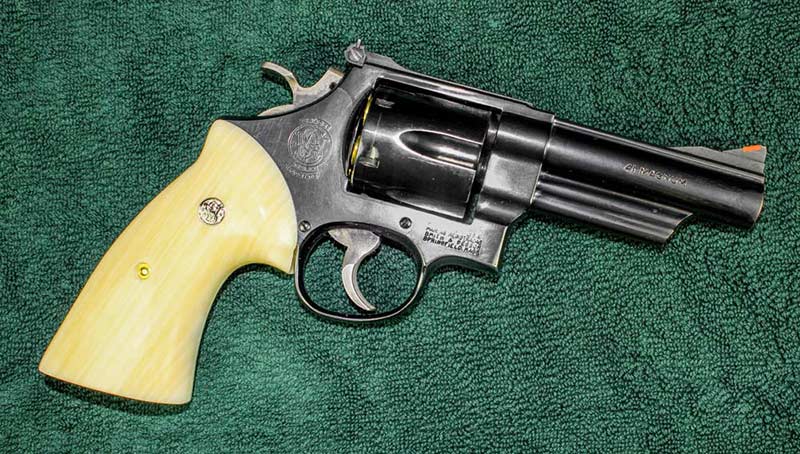
I waited many years go get my hands on a 4″ Model 57. A guy needed some money, and the gun came with 250 rounds of ammunition, two speedloaders and a set of brand-new dies. “Sold!”

I slapped on an old set of “bonded ivory” grips I’d purchased years ago and started shooting. The sights needed only a bit of adjustment, and nowadays it’s one of my favorite handguns, riding in a belt holster under a vest or jacket.

A couple of years ago, while hunting on a farm owned by a pal’s daughter and son-in-law, I used a rifle to drop a 2×3-point buck. As we drove across an alfalfa field to dress the animal, to everyone’s shock it got up and started zombie-walking toward a nearby hillside. My rifle was unloaded and cased, so out came the 4″ ’Smith — a handgun I never expected to use on game — and a head shot put him down.

Incidents like this reinforce my conviction the .41 Magnum is a grand, albeit often overlooked, cartridge. It seems the perfect match. It’s not special, nor is it exotic. It’s just different, and it works. I like that.

Categories
Ammo

6.8 Western: A Review After One Year (Plus some juicy rumors)

Categories
All About Guns Ammo

17hmr vs 22mag – CLAY BLOCKS!!! (But good on finding either Grumpy)

Categories
All About Guns Ammo

BIG .38 SPECIAL IS THERE REALLY A DIFFERENCE? WRITTEN BY MIKE “DUKE” VENTURINO

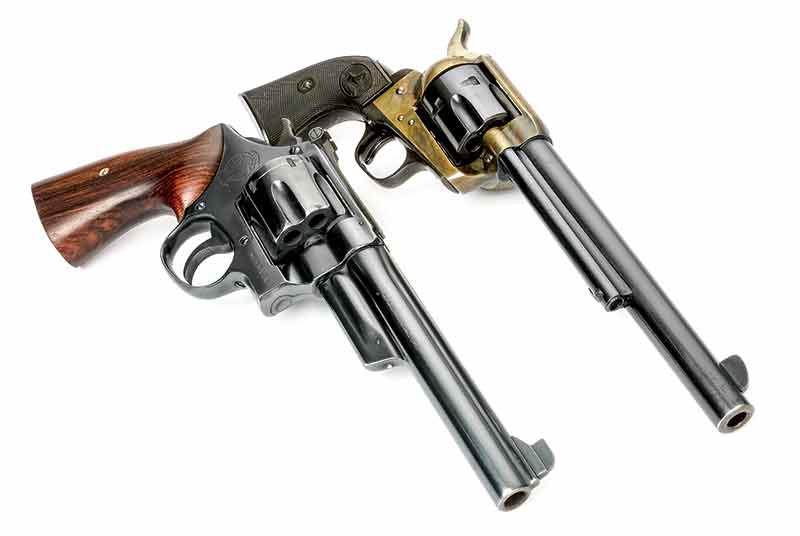
Duke’s current two Big .38 Specials are (left) S&W Outdoorsman (later Model 23)
and 2nd Generation Colt SAA.


Today we think of .38 Special mostly as a self-defense round for snub nose revolvers, But, before .500, .480, .475 and .460 revolvers, before .357, .41 and .44 Magnums, before even +P .38 Special factory loads, there was the .38-44. It was introduced in 1930 and featured a 158-gr. RN bullet just like the one used in standard .38 Special factory loads except nominal velocity was a whopping (for those days) 1,150 fps. The idea was to give a hotter factory load for police, one that would penetrate automobile windshields and doors of the many criminals roaming the roads during the 1930s.

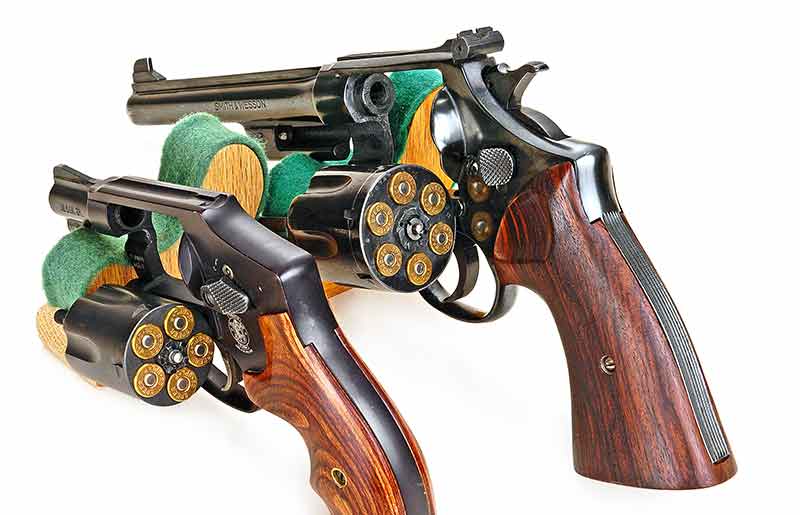
Note the much thicker S&W Outdoorsman cylinders compared to the .38 Special J-Frame.

Heavy Duty

Because of its high pressure, S&W had to introduce a new big revolver specifically for .38-44s. It was built upon their large N-Frame that accounted for the somewhat strange name — a .38 caliber revolver on a .44 size frame. In those days S&W, and Colt too for that matter, did not give model numbers to their handguns. Instead they got names. The new .38-44 was named Heavy Duty and came in 4″, 5″ and 61/2″ barrel lengths with the middle one being far more common. I don’t have evidence of that; it’s just my experience-based opinion.

The Heavy Duty was a utility style sixgun with a groove down its topstrap serving as the rear sight and half-moon shaped front sight. Thereafter S&W brought out a second BIG .38-44 named Outdoorsman. It had a fully adjustable rear sight and the square shaped front called Patridge. The only barrel length offered as standard on the Outdoorsman version was 6.5″. After S&W transitioned to model numbers the Outdoorsman became the Model 20 and the Heavy Duty became the Model 23.

Colt was not about to let a good thing pass and soon specified their large frame DA New Service was suitable for .38-44 loads as well as the Colt Single Action Army. The former DA Colt was offered in 4.5″, 5.5″ and 7.5″ barrel lengths and the SA came in 4.75″, 5.5″ and 7.5″ lengths. Both Colts had the traditional grooved topstrap and blade front sights, but Colt also offered their target sighted Shooting Master in .38 Special.

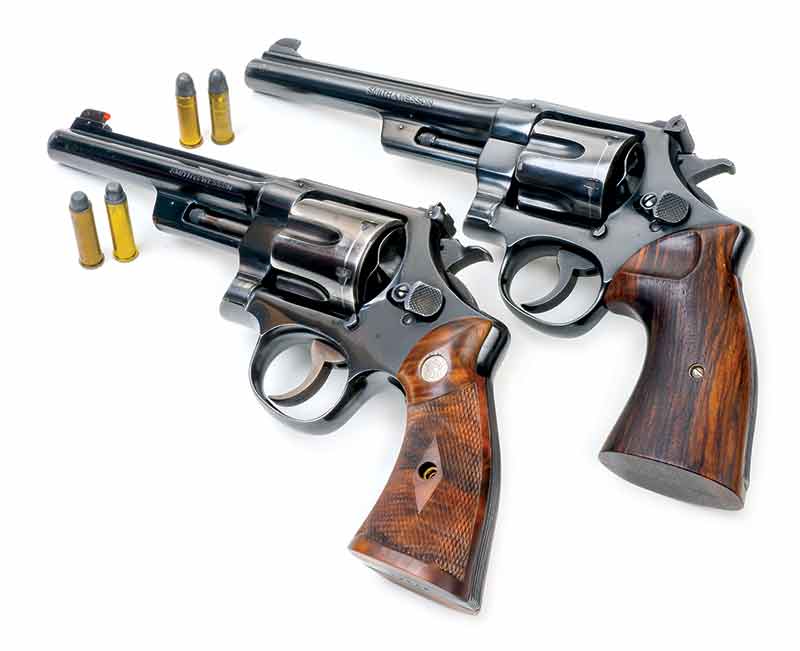
The .38-44 (1930) predated .357 Magnums (1935) by five years. S&W’s .357 Magnum (left)
was identical to the.38-44 Outdoorsman (right) in size, weight and barrel length.

Magnum Impact


With the advent of magnums — .357 in 1935, .44 in 1956 and .41 in 1964 — interest in .38-44 pretty much died. And of course, the ability to shoot such loads in any .357 Magnum accelerated its demise. By 1966 S&W dropped both the Models 20 and 23. Colt let the New Service expire in 1944 but when the SAA was reintroduced in 1956 .38 Special and .45 Colt were its caliber choices. By 1964 the company had dropped the .38 Special.

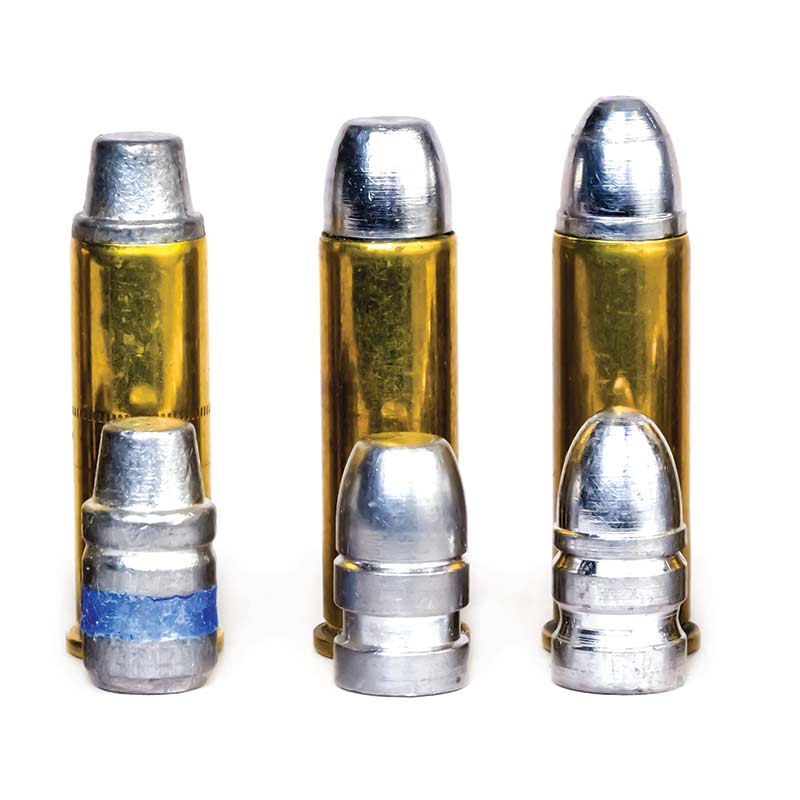
When making .38-44 equivalent handloads Duke has tried these three cast bullet styles.
From left: 150-gr. SWC, 158-gr. RN/FP and 158-gr. RN. Duke favors the middle one.

Boys Will Be Boys


As big .38 Specials disappeared from the catalogs of new handguns a West Virginia hillbilly kid began his handgunning career with a beloved S&W K-38 and a setup for making .38 Special handloads. One of my most fondly remembered friends that senior year of high school was named Mike Bucci (pronounced “Butch”). His father was our town’s chief of police. He approved of our interest in shooting and gave “Butch” his old .38 Special duty gun so we could shoot together. It was an S&W Heavy Duty with a 5″ barrel. The local gun club was only three miles from our high school, so Butch and I spent many late afternoons plinking away with our .38s. Later, when I started loading .45 ACP Chief Bucci would allow us to take the department’s Thompson Submachine Gun out by ourselves. Yes, it was a different era.

Perhaps Butch’s Heavy Duty was the reason I developed a lifelong affinity for sixguns of yesteryear. Factory loads for .38-44 were gone by that time, but as a careful handloader I was able to copy them. Not having a chronograph, we thought .38-44 ballistics were duplicated.

Butch and I still got an idea of how regular .38 Specials and .38-44s differed. For my K-Frame .38 the usual handload was 3.0 grains of Bullseye with 150-gr. lead bullets. For Butch’s Heavy Duty we loaded 11.0 grains of 2400 with the same bullets. My load would knock over old bricks from about 50 feet. Butch’s loads busted them. My .38 Special would knock over chunks of wood. The bullets stayed inside. Butch’s bullets penetrated completely.

By the late 1960s, I began spending summers in Montana and Butch got married. Mid-summer of 1971, I got word Butch had died from a rare form of cancer. I never saw his guns again, but my exposure to .38-44 as a big handgun cartridge stayed with me. I never did land a Colt New Service or Shooting Master .38 Special but have owned all three barrel lengths of .38 Special Colt SAAs. Several S&W Heavy Duty/Model 23s have passed through my hands, including one HD factory lettering to the first year of production. Those are gone but an Outdoorsman (pre-Model 20) given to me by a friend is here as is a like-new SAA .38 with 7.5″ barrel.

The .38-44 factory loads carried the same bullets as standard .38 Specials
but were loaded to be 300 fps faster.

In machine rest testing Duke’s Colt SAA .38 Special grouped (12) .38-44 equivalent
handloads into just 1.5″ at 25 yards.

Home Grown .38-44s


So, what does it take to turn a .38 Special into a .38-44? First off you need a big .38 revolver, although S&W K-Frame .357 Magnums and medium frame Colt Python and Trooper .357s will suffice. Next you need some common sense. The .38-44 is not a .357 Magnum. Don’t try to make it one. That old load I used of 11.0 grains of 2400 with 150-gr. bullets is an absolute maximum. It used to appear in old reloading manuals even for K-Frame S&W .38s which is where I found it back in 1966. Modern manuals are far more conservative so hear me — stick with big .38 revolvers for .38-44 shooting.

Here’s an alternative. For me .357 Magnums are ear ringers even with good ear protection. Many people shoot .38 Specials in their .357s for this reason. If an intermediate load will suffice then .38-44 ballistics can be achieved by loading down .357 Magnums. Stick with .357 Magnum cases and still use 2400 powder but go one grain (only) over what I listed for .38-44 — 12 grains of 2400 with 150- to 160-gr. lead alloy bullets. I personally favor the RN/FP designs from RCBS and Lyman. Such handloads will put a .357 Magnum in the old .38-44 ballpark.

Those handloads from my big .38 revolvers gave near amazing accuracy. From my Ransom Pistol Machine Rest, my Outdoorsman and Colt SAA gave 12-shot, 25-yard groups of 1.5″ or less. That’s the sort of sixgun precision anyone can be proud of.

Categories
Ammo

Cartridge Hall of Fame: 38-55 Winchester Ammunition | MidwayUSA