
Their all 9mm by the way. Grumpy
Their all 9mm by the way. Grumpy

Dawn broke cold over the high country, with a threat of snow hanging in the air. Twelve cow elk grazed in a meadow at 11,500 feet, one small five-by-six bull still sleeping off his night of debauchery. I crept into place, rested my .300 Winchester Magnum atop a lightweight tripod, and squeezed the trigger. The bull never regained his feet.
Two years later I approached the same meadow, this time with a friend who carried a 6.5 Creedmoor on her shoulder and an elk tag in her pocket. Fresh elk tracks showed the way and we flushed another, bigger 5X6 bull. I cow called, my friend pressed the trigger, and another bull lay still in the snow. Both elk succumbed to a single shot. Only the duration of the kill was different. Mine died almost instantly; the other bull stayed on his feet for almost a minute, even though he was hit perfectly.

For decades big, hard-hitting calibers held court across America’s hunting grounds. Recoil wasn’t considered the detriment it is today, indeed some shooters and hunters acclaimed hard-kicking rifles as superior, and accused those chambered in more mannerly cartridges as being sissified. This opinion was created by the projectile performance of the day. Simply put, the then-new high-velocity cartridges of the 20th century generated so much speed that traditional bullets struggled to maintain their composure when impacting heavy hide and bone. Bigger, heavier bullets had a better chance of holding together and penetrating deeply.

Today the pendulum has swung, and many hunters and shooters opine that bigger, harder-hitting calibers belong with folks of limited intelligence. According to these same hunters and shooters, anyone with enough electronic devices and high enough projectile BC (ballistic coefficient) can kill a mastodon at 1,000 yards with a 6mm Creedmoor. The one thing they do have right is that things have changed. Coming full circle, it’s all about bullet performance. Today’s premium projectiles are incredibly accurate and consistent. More to the point, they penetrate deeply and perform reliably at a wide variety of impact velocities. What this means is that today’s small, recoil-friendly calibers can kill as cleanly as yesterday’s bigger, harder-hitting calibers.

Smaller calibers and cartridges kick less. They tend to be accurate and are certainly easier to shoot well. Loaded with a premium bullet they penetrate deeply and create a devastating wound channel. They do everything a big, hard-kicking caliber can do, right?
Wrong. There are two things they can never do as well:
Hit Hard: Two elements affect how hard a bullet impacts. The first is frontal diameter. The greater the frontal diameter, the more surface area and tissue the bullet impacts directly. Remember; surface area in a circle increases exponentially as diameter increases. The second element is weight. The heavier a projectile is the harder it hits. Consider the difference between getting hit by a pencil eraser traveling at 100 feet per second (fps), and a softball traveling the same speed. Neither will penetrate your skin, but the softball will hit much harder due to greater weight and diameter.
Penetrate Deep: In a nutshell, bigger, heavier bullets penetrate deeper than smaller, lighter projectiles of the same design. That said, modern-day bullet design has leveled the scale, to a degree. Projectiles such as Barnes’ TTSX, (a monolithic, solid copper/alloy bullet), and Federal Premium’s Terminal Ascent (built with a rapid-expanding jacketed lead front and a solid copper rear portion) maintain weight and drive deep, even in lighter, more friendly calibers.
The final word, though, is that a 200-grain bullet from a .300 Win Mag will out-penetrate a same-design 130-grain bullet sent from a 6.5 PRC.

Light/sweet-shooting calibers are easier and friendlier to shoot, and now (with premium bullets) perform and penetrate admirably. Bigger calibers kick harder, but also hit harder and penetrate better. So what is best? The answer is, of course, situation and species specific. The light/sweet crowd will say, “It’s all about shot placement. Just wait for a good broadside shot and place your bullet right in the boiler room”.
To an extent that’s true. But what if your quarry never offers you a broadside shot? Let’s consider a common elk-woods scenario: You’re on a dream hunt in the Rocky Mountains. You’ve hunted hard, and you want to kill an elk in the worst way. On the last day of your hunt, you finally find a bull, a good one with heavy six-point antlers. You’re set up on a little rocky outcropping, using your pack as a dead rest. The bull is going over a thick timbered ridge and isn’t giving you a shot at all. You keep your crosshairs on him, hoping against hope that he steps into a clearing and gives you a shot. Finally, it happens; 350 yards away he stops, turns, and bugles back down the canyon. You can see his shoulder clearly between tree trunks, but he’s steeply quartered toward you. Your crosshairs are steady, your finger on the trigger. But you subscribe to the “wait till they’re broadside” strategy, and inside your rifle’s 6.5 PRC chamber rests a rapid-expansion 140-grain bullet. What do you do?
If you’re honest and ethical, you let the bull walk.

The chance that your soft, rapid-expansion bullet will make it through the many inches of hide, flesh, bone, and sinew protecting the vitals at this angle is remote. You pull that trigger, and you’re likely in for a long, heart-wrenching recovery effort. But if you continue to wait for that broadside shot the bull will likely walk over that ridge and out of your life forever.
Now, hit rewind and change your chosen bullet to a 130-grain Federal Premium Terminal Ascent. Suddenly, you’ve completely altered this scenario. You’re not going to hit a massive old bull elk very hard with a 130-grain bullet at 350 yards, but an accurate shot with this deep-penetrating bullet will kill him, even through the point of the shoulder. And that’s what has changed. That’s the new difference.
Rewind the scenario again, and change your rifle to a .300 Win Mag. Shooting a 200-grain Federal Premium Terminal Ascent bullet, you will hit that bull very hard and kill him very quickly. No doubt about it, this is the better elk round. If you can handle the kick and shoot it well, by all means use it. But if the recoil loosens your fillings and crosses your eyes every time you squeeze the trigger, you better lighten up.

This scenario changes dramatically, of course, if the primary species you hunt is deer, pronghorn, or sheep. For smaller, lighter boned members of the big game family the 6.5 PRC and similar cartridges are optimal. Loaded with one of the premium bullets mentioned above they will penetrate into a deer’s vitals from any angle. Recoil is civilized, and terminal performance all you will ever need. But what if you use one rifle to hunt a broad spectrum of big game – elk one week, deer the next, and moose the third?

In my opinion, the ideal solution for an all-around rifle is a mid-level cartridge like the .280 Ackley Improved, .30-06 Springfield, or 7mm Remington Magnum. Recoil generated by these cartridges will not rattle your teeth or cross your eyes, yet they hit hard enough and penetrate admirably. Loaded with premium bullets, they’re cheerfully adequate for everything from coyotes to Alaskan moose.
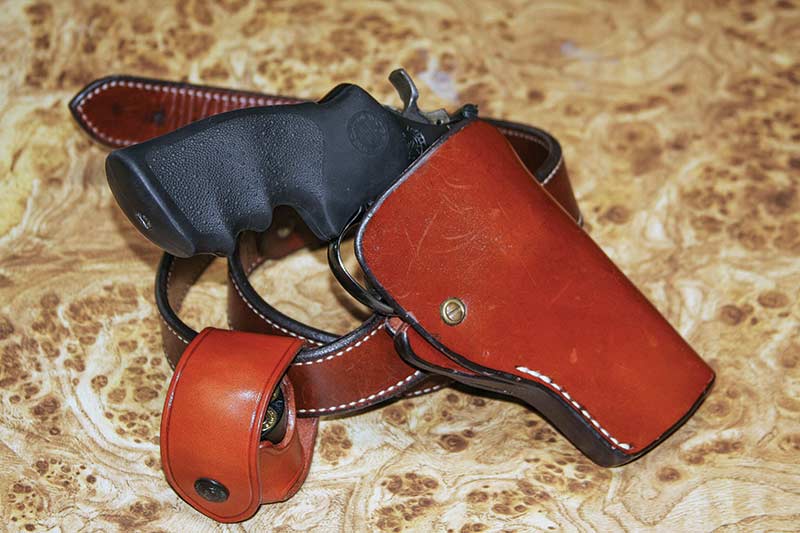
The compact design of the Milt Sparks-style holster allowed Dick to make it comfortably
through a full day of training drills at the Gunsite Academy in Arizona.
While I have long been fascinated with N-Frame Smith & Wesson revolvers, I came to the party only after seeing the movie “Dirty Harry.” Prior to the movie, all my shooting was done single-action, influenced no doubt by having grown up in the 1950s watching cowboy shows on television.
Once bitten by “the most powerful handgun in the world”-bug, I realized double-action revolvers produced outstanding results when first cocked before pressing the trigger. Even with a superb action job, it was difficult to maintain a precise sight picture throughout the long double-action trigger pull of the large-frame Smiths. Much of my handgun silhouette shooting and big game hunting in Colorado and Wyoming during the ’70s and ’80s was done with a 6.5″ barreled Model 29 but always fired single-action.
As the years went by and Father Time reminded me more frequently I wasn’t indestructible, I recalled perhaps the greatest fight-stopping handguns in American history were .45 caliber, not the least of which was the venerable .45 Colt. These were available in N-Frame Smiths and looked exactly like my .44 Mag Model 29s but were easier to handle with factory loads.
Not to sound like a fairy tale, there came a day on one of my frequent visits to the North County Shooting Center in southern California when I saw my future S&W Model 25 with 4″ barrel in the display case. A brief examination of the gun confirmed the finish, timing and double-action trigger pull were excellent.
Negotiations were over in seconds, but of course California required another 10 days to decide I could take the gun home.
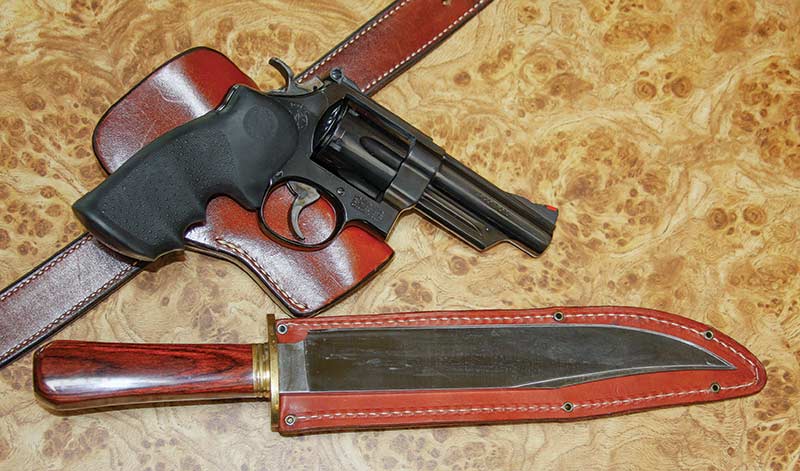
In “Lonesome Dove,” Capt. Augustus McCrea believed the revolver
made the large fighting knife an unnecessary item but Dick thinks
pairing of a big knife and large caliber revolver was rather common —
and comforting — in the old west.
Except for the action job and the Hogue rubber grips, the gun is “as issued” by Smith & Wesson. The Hogue grips are relatively narrow with an open back and finger grooves. The stippled sides provide enhanced controllability for fast follow-up shots. Most importantly, they fit my hand perfectly with the open back allowing proper finger placement on the wide serrated trigger. If I had ordered the gun from the factory, I would have requested the smooth combat trigger but the double-action pull is so smooth I had no trouble maintaining a good sight picture throughout.
The trigger is slightly narrower than the trigger guard, ensuring it can’t catch the edge of the holster when the gun is returned to leather. “Back in the day” when handgun hunters and recreational shooters fired big bore Smiths single-action, wide checkered trigger shoes became popular as they allowed the trigger to be pressed slightly sideways while still causing the hammer to fall. It made things easier for those with smaller hands to reach the trigger and shoot the guns equipped with the oversize walnut target grips. I heard stories of guns firing when being re-holstered, but I never witnessed such an event — perhaps they occurred when someone mistakenly tried to holster a cocked revolver.
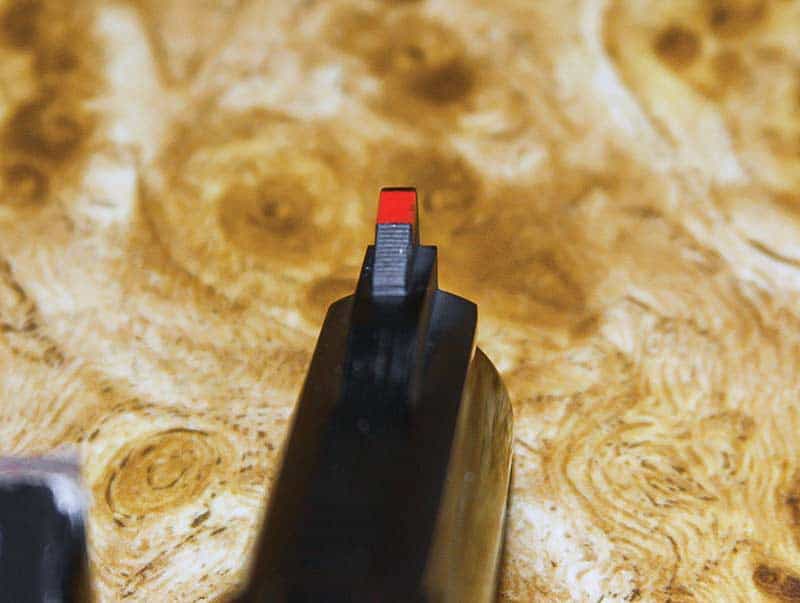
A major factor in successful handgun shooting is seeing the front sight.
The M25’s orange insert helps in the diminished light conditions predators favor.
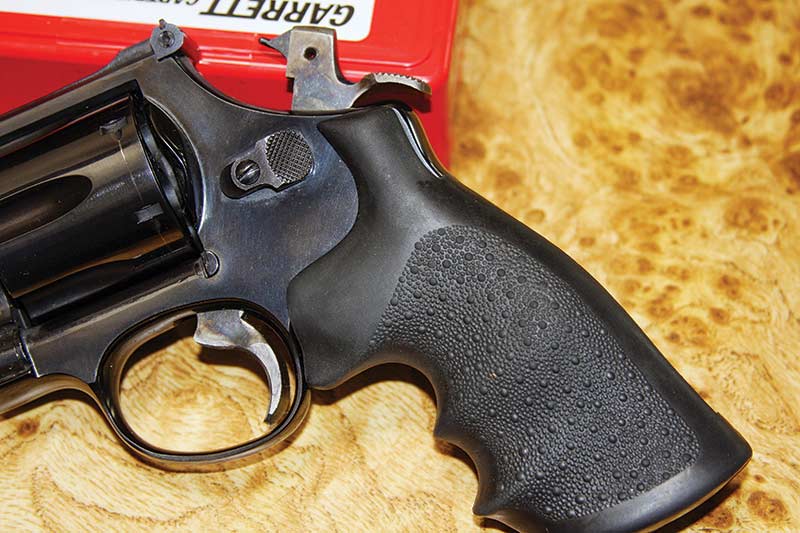
Hammer-mounted firing pin and absence of “key hole” in the frame
reveal some of the old school features of the Model 25, while the stippled
Hogue grips facilitate shot-to-shot recovery.
The adjustable sights are classic S&W. That’s “classic” mid-20th century, not 19th or early 20th century. The fixed front blade has the orange/red plastic insert for enhanced visibility. The rear sight has a white outline around the notch, can be adjusted for both elevation and windage, and features the long tang mounting into a matching machined slot in the frame’s top strap. Windage and elevation adjustment screws take the same-size screwdriver, something I’ve always appreciated in a gun designed to go afield, not just the range.
The hammer is the old-school wide target spur, aggressively checkered to facilitate manually cocking for single-action fire. On an N-Frame Smith, this is an excellent “win/win” feature. Because it’s not a pocket pistol, you don’t need a reduced size hammer, but when you’re out in winter weather at an informal match or a late fall deer hunt wearing gloves, it’s a real asset.
The firing pin is mounted in the hammer rather than in the frame like the pre-“keyhole in frame” Smith & Wessons. When the trigger is pulled fully to the rear, either double- or single-action, the firing pin protrudes through a small hole in the frame striking the cartridge primer. When the trigger is released, the firing pin retreats/rebounds to a safe position behind the breech face. The firing pin doesn’t actually “float,” but it can move vertically. Spring pressure keeps the firing pin low in the hammer. If for any reason the pin isn’t lined up exactly with the firing pin hole when the hammer falls, the pin strikes an angled ramp in the frame that guides the pin up the ramp to and through the hole and allows it to strike the primer.
I’ve been told a frame-mounted firing pin system is stronger and safer but I’m not sure I buy into this. With the hammer at rest, the vulnerable parts are contained inside the frame, so unless you’re walking around with a cocked revolver, everything is protected. The only advantage I’ve found in a frame-mounted system is it’s easier to block the hammer with your support-hand thumb when decocking the revolver or if a game animal moves after you’ve cocked the gun and you’re waiting briefly for a better shot.

The S&W Model 25 (6-1/2″ barrel version shown) is a classic N-Frame
that handles the .45 Colt without manhandling the shooter. Photo: S&W
Let’s talk a bit more about the front sight. The top surface of the orange plastic is smooth, meaning it’s quite reflective in bright sunlight. On testing day, the sun was extremely bright, causing a glare off the top of the insert and making it quite difficult to see exactly where the upper edge of the front sight ended so groups tended to expand vertically. While shooting long-range steel in Colorado on a sunlit day, I sprayed the front sight black to cover the orange ramp. When handgun hunting deer, I prefer having the orange strip visible since the most productive hunting is in the lower light levels of early mornings or late afternoons. In addition, it was likely I would be moving in and out of timber.
In a recent writers’ event at Gunsite Academy, I had a chance to work the Fun House with the Model 25. I went through all the drills with the big Smith & Wesson riding comfortably in a Milt Sparks-style strong-side holster shooting DoubleTap 255-grain hard cast semi-wadcutters. Although we “cleared” the house during the daylight hours, changing light conditions became a decisive factor as we went from the bright sunlight of an Arizona afternoon in July to the deeply shaded areas inside the house. As we grow older, our eyes need more light to see well plus we adjust to changing light conditions less quickly.
At first, there were dark targets I couldn’t identify at all. As my eyes adapted, I could see some targets but was unable to determine whether they were holding weapons or not. Once I could tell whether the intruder was armed or not, the orange front sight came into play and I could see well enough to make a decisive shot. Of course the best answer is “always have a flashlight.”
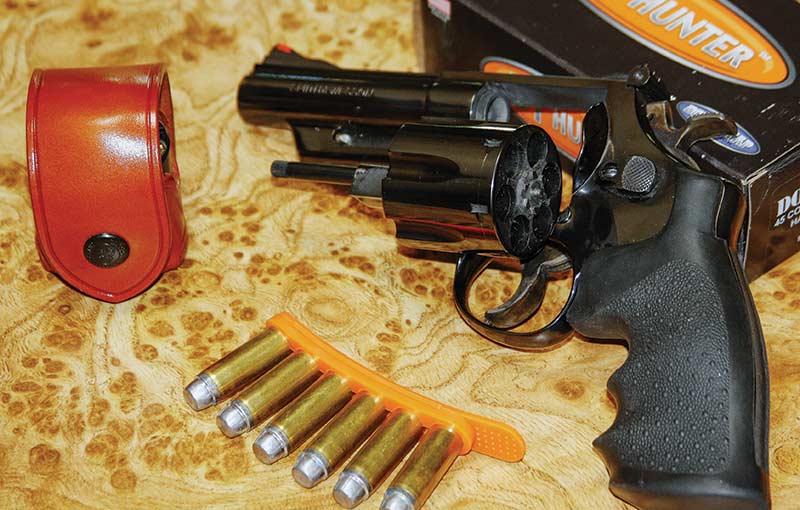
While a speed loader is the fastest way to fully reload a revolver, it
doesn’t allow for partial reloads, the preferred “load as you shoot” technique.
While I’ll admit my purchase of the Model 25 was an act of passion rather than careful planning, I would not be reluctant to carry the big revolver full-time for both self-defense and hunting. Had my “attackers” been made of other than paper and steel, there is no doubt in my mind as to the outcome. I don’t think any handgun caliber has decisively ended as many fights over a 150-year time span as the old .45 Colt and most of those were before we learned the advantages of a large meplat making the initial entry.
Old fashioned — yes. Still effective — heck yes!


PTR’s green-stocked GIR .308 rifle is a dead ringer for the Bundeswehr-era G3,
with the addition of a Picatinny 1913 rail. Add low-cost practice options and you’re off to the races!
The ammo shortage is no longer news and has sharply limited most of our ability to practice. Fortunately, this scarcity is not new to the military which has used things like subcaliber conversions for nearly a century. A .22 conversion was one of the first accessories developed for the M1911 and the U.S. military even adopted a floating-chamber .22 conversion for their belt-fed .30 machine guns — both, interestingly, designed by Dave “Carbine” Williams of M1 carbine fame. With its 0.223″ bore, the M16/AR15 was and remains particularly easy to convert. Alas, it’s harder for us who love the .308 as $0.50 a shot was a good price in normal times. But there is hope.
Millions of HK roller-locked G3 .308s (and its predecessor the CETME) were issued across the world and semiauto versions are common in the U.S., largely thanks to South Carolina’s PTR which purchased Portugal’s HK-licensed G3 tooling. They lead the U.S. industry in semiautomatic versions of the iconic .308, including producing receivers on an OEM basis for other makers.
Along with the very affordable Century Arms C308, PTR guns cost far less than original HK rifles such as the HK91, which goes for more than some cars I’ve owned. As many countries have moved to newer rifle designs, spare G3/CETME parts of all kinds have flooded the market, including two of particular interest to us — a rollerless bolt for plastic training ammo and a .22 rimfire unit.
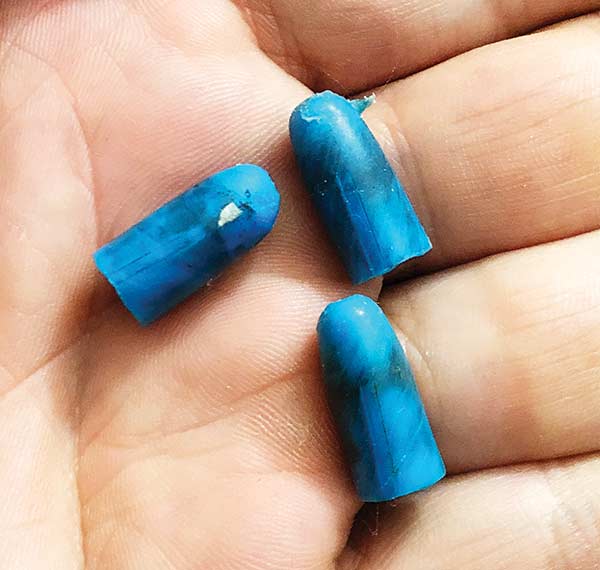
Not a toy, the 9.9-grain plastic bullets still penetrated the
plywood target backer at 100 yards.
Reportedly available in multiple colors for different applications, I’ve only ever seen the plastic ammo in blue. Basically a one-piece plastic case with a metal casehead, upon firing the powder charge separates the casehead and the bullet, sending the little plastic pill downrange at a blistering 4,000+ fps. Word to the wise: While not appropriate for hunting or self-defense, this is still a bullet and is fully capable of taking a life. Treat it like the lethal projectile it is. While no longer readily available, plastic training ammo was also made in 9mm, for which HK made a dedicated MP5. Sounds like fun, but I’m sure it costs more than my house.
As a safety feature, both the casehead and training bolt face for plastic ammo are slightly smaller in diameter than the usual .308 to keep the unlocked bolt from being able to fire full power ammunition. I fired several hundred rounds of the blue ammo using the training bolt or cycling them by hand in an unmodified C308 and a Ruger Scout rifle. In spite of the smaller casehead, there were no extraction issues.
Basic physics tells us a 9.9-grain bullet has little momentum and will slow quickly, so long-range accuracy with plastic bullets is not a thing. And while the limited recoil is a welcome reprieve, the cartridge’s low power cannot cycle the stock action. The simple solution is to manually cycle the bolt, which gets really old, or purchase the rollerless training bolt/carrier assembly.
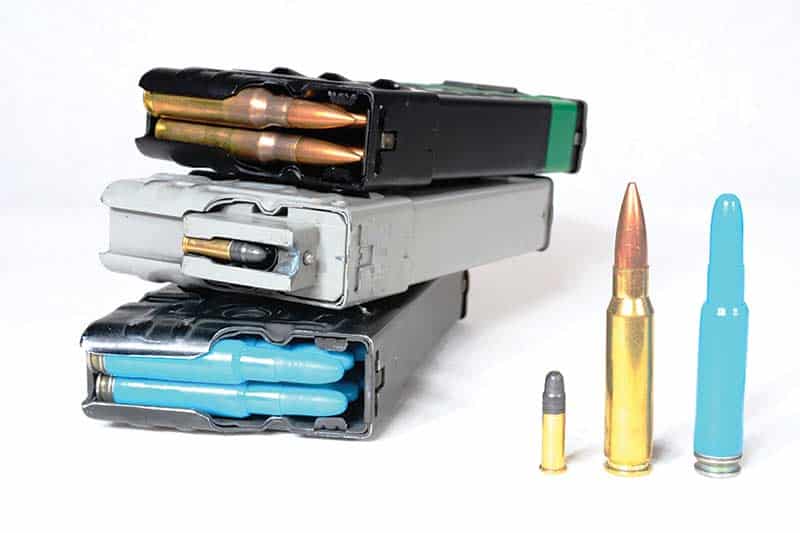
Training adaptors for the G3 family make it possible to keep
shooting even in the midst of an ammo drought.
Unlike the blue ammo training bolt which removes the locking element of the design, the .22 conversion has a smaller, lighter breechblock mounted in the carrier and powered by its own recoil spring. While the carrier is still used to manually load or unload, it does not reciprocate with recoil, which leads to one of the conversion’s quirks. While it only needs a short length of travel to cycle with .22 ammo, the carrier can still be drawn back the full length required for .308 rounds. When you do this, the carrier modifications required to make the smaller .22 round feed will cause it to get stuck behind the hammer where it will stay until you field strip the gun and fix it.
The wise .22 shooter will get a length of vacuum hose at the local car parts store, slit it and slide 2″ of it on the recoil spring guide rod to act as a stop to keep the carrier from coming back too far. Magazines are likewise a bit of a sore spot. The grey-bodied conversion mags have a separate .22 magazine bolted into place in a positioning block riveted into a steel .308 magazine. The internal .22 mag holds 20 rounds just like the big boy version and is surrounded by a standard .308 magazine spring, a bit of superfluity only serving to retain the magazine baseplate.
Two mags usually come with the conversion, but they are unobtanium if purchased separately and run around $200. Black Dog Machine, however, sells a magwell insert that will take their Uzi magazines: the insert and one mag are $25, while the insert alone goes for $10.
While mine feeds well, the standard or even high velocity .22 LR will not push the bolt back far enough to eject. This likely means hyper velocity ammo will be required, further reducing cost savings.
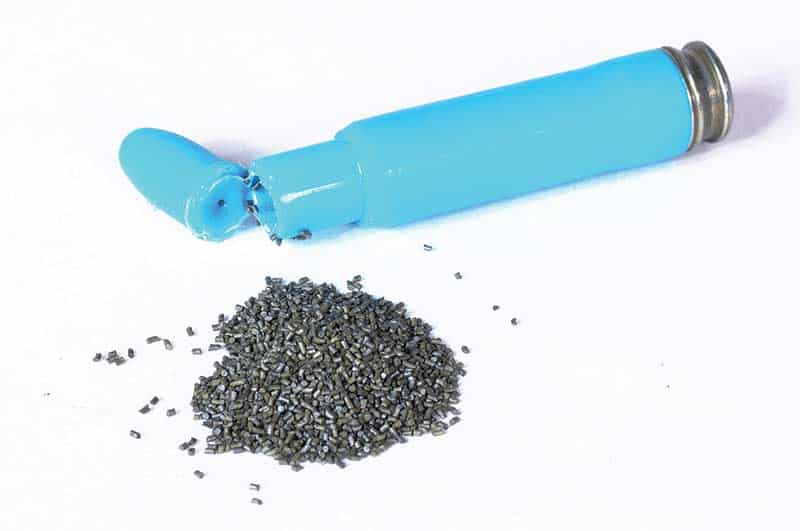
Don’t let the cheerful color fool you — the plastic “bullet” does better than 4,000 fps!
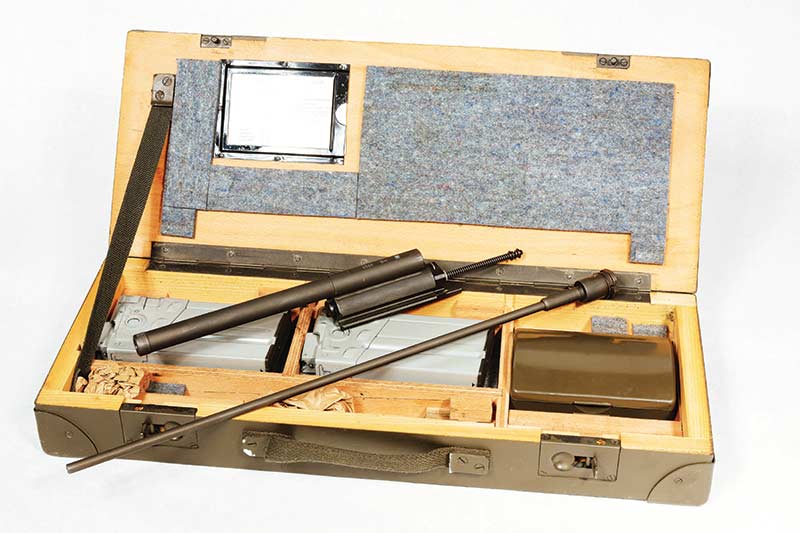
Cooler but more finicky, the .22 conversion kit includes a rifle barrel insert,
the conversion and a couple of the super-rare magazines.
For those unfamiliar with the roller lock, both conversions are installed in the same way. After clearing the rifle, push out the two push pins holding the stock in place and slide the stock backwards off the receiver. Since, unlike the AR, the pins are not captive, feel free to stow them in the two holes in the stock provided for this purpose. Pivot the trigger housing downwards at the rear until it can be pulled off of its forward mounting point at the rear of the magazine well. Use the cocking handle to unlock the bolt carrier and remove the carrier from the rear. If installing the .22 conversion, insert the barrel liner into the bore prior to reassembly, which is in reverse order.
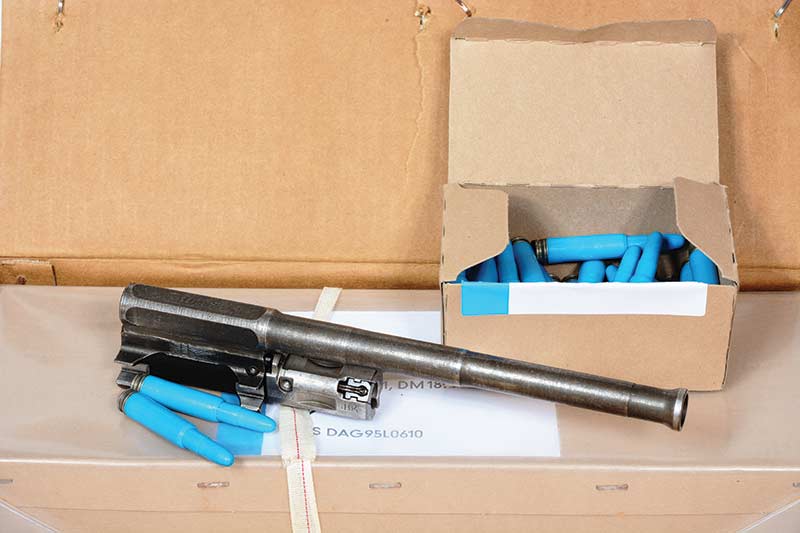
Blue plastic ammo and the matching training bolt can be purchased as a package.
Jeremy paid under $300 for the bolt and a thousand rounds and it’s been available
ever since the pandemic started.
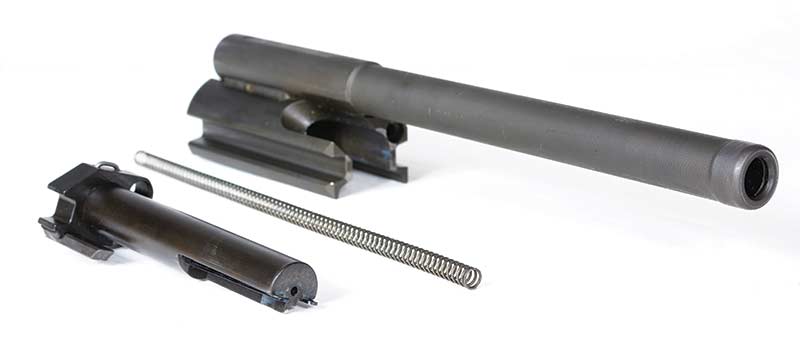
The .22 conversion uses a smaller, separately sprung bolt contained
within a full-sized carrier which is used to cock the rifle —
and, if you’re not careful, to overcock it.
For semi-auto fire, I used the training bolt in a pair of PTR rifles, one a modified 16″ collapsible stock gun and the other a green-stocked GIR, a dead ringer for the Bundeswehr G3. In order to get the best out of the gun, I paired the GIR with Leupold’s VX Freedom AR scope. I mounted it in a pair of 30mm rings sourced from Brownells, mounted to an AR-style riser to get the scope up above the rear sight.
Assuming good magazines are used, the plastic training ammo ran flawlessly although malfunctions basically break the cartridge in half. The light recoil made it a joy to shoot. While there is some change in point of impact, my Scout Rifle with a 200-yard zero put them at point of aim at 100 yards. At this distance, groups tended to open up and when the bullets struck in the plywood target backer, most penetrated. Like I said, not a toy.
Blue ammo has gone in and out of stock through the years but as this is written, it’s still available online — as it has been throughout the pandemic — for under $200 per thousand.
The .22 conversion is somewhat less of a money saver. Running between $500–$600, the G3 .22 conversion comes in a wooden case with dividers to hold two magazines, the bolt, a barrel liner, a manual in German and the ubiquitous plastic cleaning kit.
For the coolness factor, it’s hard to beat the .22 unit. But you’ll pay for it and its ammo needs mean you won’t get the same savings as most rimfire conversions. The same money buys a training bolt and 2,500 rounds of blue ammo. Much as I’m a sucker for a rimfire, if you can only get one, it’s an easy choice.
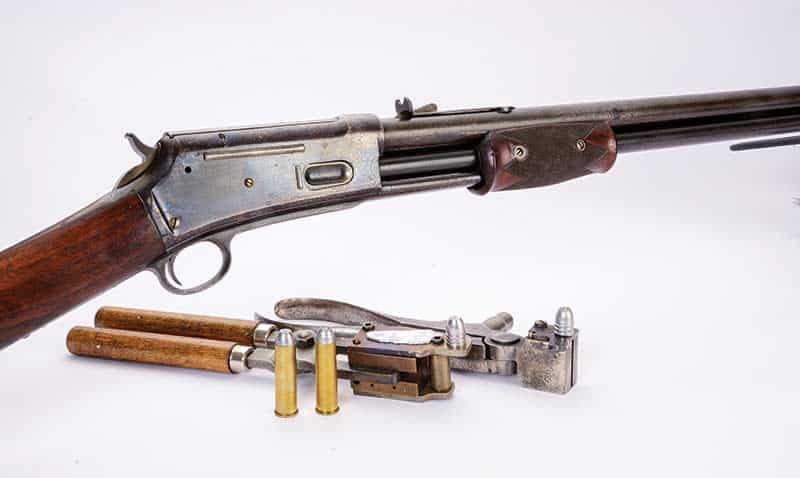
This Colt Lightning .50-95 wears British proof marks. Collectors today call
it a “cat gun,” because it was likely intended for lion or tiger hunting.
From the advent of metallic cartridge ammunition unto this day, .50 caliber rifles have won the hearts and minds of American riflemen. A remarkable variety of rifles chambering the huge .50 BMG are floating about nowadays. Likewise, there was no shortage of .50 caliber rifles in the Old West.
Builders
They were built by all the premier rifle manufacturers of the time. For example, the famous Sharps “buffalo rifles” of the 1870s were made for three lengths of .50 caliber cartridges. Remington only chambered for one .50. However, their factory turned out 900,000 military and sporting No.1 (rolling blocks) by 1877. A significant portion of them were .50-70s so they were likely only second to the U.S. Government in making .50 caliber rifles. Three different .50 cartridges bore the Winchester name between 1878 and the early 1900s, none of which set great sales records.
The U.S. Government got the .50 caliber ball rolling in 1866 with a conversion of leftover Civil War .58 caliber rifle-muskets to shoot a .50 cartridge of 1¾” case length. Military spec loads for the .50 Gov’t were 450-grain bullets over 70 grains black powder — hence the nickname .50-70. The first .50 Gov’t was the Model 1866. It was followed later by Models 1868 and 1870. They were used all over the west.
Sharps Rifle Company grabbed the government’s idea and literally stretched it. Their rifles also chambered the .50-70 but they also developed a .50 with a 2″ case. It went nowhere and is virtually unknown. The third was a .50 with 2½” case famous today as .50-90 Sharps, although the Sharps factory always loaded it with 100 grains of black powder. Remington had to stick with the .50-1¾” case because the long hammer spurs of their No.1s wouldn’t allow passage of longer cases. Their factory loads came with 400- and 450-grain bullets, both over 70-grain powder charges.
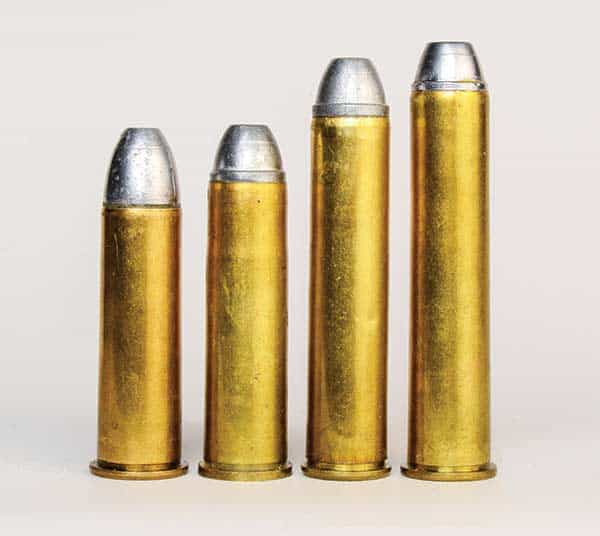
The Murderer’s Row of Old West .50 caliber cartridges. From left:.50
Gov’t (.50-70), Winchester .50-95, Sharps .50-90 (aka .50-100)
and Winchester .50 Express (aka .50-110).
Winchester cornered the repeating rifle market early on but had difficulty in coming up with a .50 caliber repeater. In 1878 they gave it a try with their Model 1876. Case length had to be reduced to 1.94″ and bullet weight was only 312 grains. However, the 95-grain powder charge did give it some oomph. In 1887 Winchester gave .50s another try in their strong Model 1886. Using a 2.40″ case, they were able to fit 110 grains of black powder under 300-grain bullets. The round was called logically .50-110 but it seems rifles for it were caliber stamped .50 Ex (Express). Winchester’s .50 Express made it into the smokeless powder era and wasn’t dropped from Winchester’s catalogs until 1919.
There is no lack of bogus information about Old West fifties. For instance, despite original factory records proving no Sharps rifles were ever chambered for a .50 cartridge with 3¼” case, misinformation about such existing still abounds. Actually Winchester did chamber their single shot (aka “Model 1885 High Wall”) for a .50 with 3¼” case for a short while.

Duke shooting a Uberti/Cimarron Model 1876 .50-95 with black powder handloads.
There is also the fallacy .50s were long-range cartridges. They weren’t; their bullets were short and wide. Long range bullets were longer and of lesser caliber. Fifty caliber rifles were meant to smack large animals hard! Out west there were bison, elk, grizzly and moose, and there were horse-mounted native warriors of all sorts roaming the west. A .50 caliber hit on a warrior’s horse effectively put him out of the fight.
Interestingly, some Winchester Model 1876 .50-95, Model 1886 .50-110 and even Colt Lightning pump action .50-95’s carry British proof stamps. They were imported to Africa and India for hunting lions and tigers. Collectors today call them “cat guns” and they bring premium prices. The .50 caliber oomph factor in a repeating rifle was important to big cat hunters.
Velocities given by Old West .50 calibers are not impressive compared to the .50 BMG at 2,700 fps. The .50 Gov’t gave about 1,250 fps and Winchester’s .50 Express could break 1,500 fps.
Starting in 1981 I became a Big Fifty shooter and handloader with a modern Shiloh Sharps Model 1874 .50-90. Since then, I’ve gained experience with a few dozen Old West .50s and I’ve shot whitetail deer, mule deer, elk and bison with them. We who appreciate those Old West big bore rifles should give thanks to manufacturers like Shiloh and C. Sharps, and importers such as Cimarron Arms, for making available modern replica Big Fifties!