Categories
All About Guns Ammo

The Best .38, .357, .44 Snub Nose Revolvers Ever (Epic Carry Guns) by LJ BONHAM

LJ Bonham is a semi-subsistence hunter, hunting magazine editor, and firearms enthusiast who lives in the Rocky Mountains.

Learn all about the best .38, .357, and .44 caliber snub-nosed revolvers.

Learn all about the best .38, .357, and .44 caliber snub-nosed revolvers.

Creative Commons License_No Attribution_Free to Use

The Best Snub-Nosed Revolvers

What are the best .38, .357, and .44 caliber snub-nosed revolvers—ever? Tough question, there are and have been so many good ones. However, which are the true greats?

Regardless the brand, snub-nosed revolvers have one definitive characteristic: barrels three inches or shorter. Between two and two and a half inches is most common, though. Why do snubbies exist, anyway? Short barrels make them easier to conceal than their long-barreled brethren.

A secondary benefit is a shorter barrel clears a holster’s mouth quicker on the draw than a longer weapon. This reduces time to target, and in gun fights, milliseconds often separate the living from the dead.

Snubbies have been around since handguns were first developed. Small, concealable wheel lock, flint lock, and percussion cap muzzle loaded pistols were quite popular in their day. They were also favored as last ditch problem solvers by well-heeled gentlemen, women, lawmen, gamblers, and general riff-raff alike.

When Samuel Colt introduced the world’s first viable mass produced revolver in the 1830s, it didn’t take long before he, and many other gun makers who followed, developed short barreled versions. By the late 19th century, snubbies (the British called them “Bulldogs”) evolved with the then new double-action revolver into the form we recognize today.

Snub nosed revolvers have been produced in almost every handgun caliber ever invented. Today, snubbies are, in the main, offered in just a few: .38 Special, .357 Magnum, and either .44 Special or .44 Magnum. There is some overlap when you consider the magnums can fire their special counterparts (but not vis-a-versa).

Here, then, are the best snub nose revolvers—ever—in each caliber.

19th century British Webley "Bulldog."

19th century British Webley “Bulldog.”

Wiki Commons_Commander Zulu

The Best .38 Caliber Snub Nose

Most snub nose revolvers on the market today are .38s. They are, as a rule, built on a gun maker’s smallest revolver platform so they are the most concealable snubbies available. The good news is there are so many to choose from, the bad news is it’s difficult to tell the exceptional ones.

The runners up in this segment are the Ruger LCR, the classic Colt Detective Special, the new Colt Cobra, various Taurus models, some from Rock Island Arsenal, and Rossi, to name a few. These are all fine revolvers. The Ruger brought innovative polymer frame technology to the revolver world. The tried and true Detective Special and a Rock Island model offer six shot cylinder capacity as opposed to the segment’s normal five.

As good as these guns are, there is one snubbie which still dominates and looks poised to maintain the lead for a long time. It is Smith and Wesson’s ubiquitous J-frame. The diminutive J-frame evolved from the company’s I-frame in 1950. Dubbed the “Chief’s Special,” the original Model 36 offered a carbon steel frame and cylinder, a two-inch barrel, a strong two lug locking mechanism, and a five shot cylinder.

J-frames have been produced in many variations: shrouded hammer; DAO concealed hammer; aluminum frames; even lighter Scandium frames and cylinders; stainless steel frames and cylinders; and many grip options.

I once owned a blue steel Model 36. The gun did have some short comings—which lead me to sell it. J-frames are so small, even the heavier all steel guns are a bit snappy to shoot with standard pressure .38s. I also felt the gun weighed too much to justify the .38’s reduced punch when fired from so short a barrel.

Things have changed, though. It took a while, but Smith got the formula right when they debuted the alloy-framed, steel cylinder Model 642 in the 1990s. The 642 is the old Airweight Centennial (1952) but without the questionable grip safety. The 642 is near perfect. The hammer shroud’s fluid design means it won’t snag when drawn. Plus, you can fire it from inside a coat pocket in an emergency! The concealed hammer can’t get caught on anything. The 642 is also rated for +P ammunition so it gives a bit more thump at the business end than my old Model 36—with increased recoil, though. Its light weight means you stash it just about anywhere on your person as either a primary or backup gun.

Some complain the factory trigger is a bit heavy, but if you carry it in a pocket or handbag, you’ll appreciate the extra safety margin this provides. In my experience, the triggers lighten up a bit as they are used, and some basic practice will let you master what is still a smooth, even, pull.

Smith and Wesson Model 642.  The ultimate snub nose .38 in author's opinion.

Smith and Wesson Model 642. The ultimate snub nose .38 in author’s opinion.

Creative Commons License_Gte893m

The Best .357 Magnum Snub Nose

In a bygone era (the mid to late 20th century) a person had just a few choices when it came to snubbies chambered for the fabled .357 Magnum. For the most part, you picked either a K-frame Smith & Wesson, such as the Model 19, or Colt’s magnificent Python. Since these guns were just short barrel service-sized revolvers with steel frames, they were on the large and heavy side compared to a J-frame.

As a former S&W Model 19 owner, I can attest a 2-1/2-inch barreled .357 Magnum is a challenge to shoot. Think enough muzzle blast to induce a migraine, muzzle flash akin to a flamethrower, and ballpeen hammer recoil. The undersized ejector rod wouldn’t always free stubborn spent cases, either. Yeah, I sold it. If I ever go this route again, I’ll get a Model 65 with a three-inch barrel and its attendant full-length ejector.

In 1988, Bill Ruger stood the snub nosed .357 world on its head when his eponymous company introduced the SP-101. No one had ever seen anything quite like it. The SP-101 had a five shot cylinder which made it thinner by a significant margin than the six-shooter Smiths and Colts. It weighed less, too. Even with the optional, easier to shoot three-inch barrel it still took up less room in a waistband than its rivals. Over-engineered, all stainless steel construction meant you could carry it next to sweat soaked skin and it wouldn’t corrode. It could digest the stoutest .357 loads as a steady diet and not shoot itself loose like some medium framed guns will.

Today, there even more choices. Ruger’s newer LCR comes in .357 as do several S&W J-frames, and Kimber’s new K6s offers the smoothest trigger in the segment. Still, these other guns don’t offer the SP-101’s wonderful balance between size, weight, power, and price. The trigger is pretty good, to boot.

Ruger SP-101. Author's pick for best .357 Magnum snub nose.

Ruger SP-101. Author’s pick for best .357 Magnum snub nose.

Public Domain

The Best .44 Caliber Snub Nose

.44 caliber snub nose revolvers lay moribund for decades after World War Two. Once a popular bore size, and epitomized by the .44 Special, it fell on hard times until the .44 Remington Magnum hit the scene. The major motion picture, Dirty Harry, catapulted it back into the mainstream in 1971. However, despite the .44 Mag.’s celebrity, the market offered few snubbies.

You could get S&W’s large N-frame with a three-inch barrel, but this gun proved big and quite heavy. Not the best to cart around tucked into a waistband when you’re in summer attire. The other option lay in Charter Arms’ .44 Special Bulldog model. A good enough gun, but not the Smith’s equal in overall quality. Plus, use by infamous “Son of Sam” serial killer, David Berkowitz, in the 1970s cast a pall over the Bulldog in many people’s minds.

In the past decade the .44 Special has risen from the ashes. Some people want a big bore carry gun and the market has responded. Ruger offers the Super Redhawk .44 Magnum with a two-inch barrel and their GP-100 in .44 Special. Smith and Wesson have their ubiquitous N-frame available with three or even one-inch tubes and now the Model 69, a five-shot L-frame, both in .44 Magnum. Taurus has several .44s suitable for carry, in particular the Tracker and M445. Charter Arms is still around and has improved the Bulldog. There are other, less well known gun makers with .44 snubbies as well.

The .44 snub noses present unique challenges for designers and shooters both. It is difficult to balance size with power due to a .44 cartridge’s diameter. Lighter, more compact guns, such as the Bulldog and M445, ramp up the .44 Special’s recoil and they intimidate some shooters. This can be said about all the .44 Magnum snubbies, the Tracker and S&W’s scandium offerings in particular. The large frame guns are less than comfortable to carry concealed all day, but they offer the best shooting dynamics when stuffed with .44 Specials.

I’ve shot a custom three-inch barrel S&W Model 57 in .41 Magnum. It’s not as bad as you might imagine. My guess is a similar size and weight .44 Mag. would prove just as manageable as the .41 if stuffed with moderate 185 or 200 grain loads.

The best .44 snub nose revolvers offer a balance between bulk and power. Based on this metric, the S&W Model 69 is the best in the lot. Its medium frame and five-shot cylinder allow it to carry as well as a big bore can, yet it has enough heft to dampen recoil. The fact it can shoot either specials or magnums gives it a versatility which the dedicated .44 Special guns do not possess.

Categories
All About Guns Ammo Born again Cynic! Karma can be a bitch! The Green Machine

Shooting the EM-2 in .280 British

Its just a pity that we did not adopt this round back then instead of playing politics with our Allies! But now we have adopted the 6.8 round. Which is a sorta, kinda version. Oh well better late than never!

Grumpy

Categories
All About Guns Ammo

Spanish M93 & Chilean M95: Early 7mm Mauser Rifles & Carbines (C&Rs Are Fun)

Categories
All About Guns Ammo

Shooting reduced 30-06 loads in M1 Garand

Categories
All About Guns Ammo

Matt D. 2020 yards 7mm Dakota

The 7mm Dakota

By Chuck Hawks

7mm Dakota
Illustration courtesy of Dakota Arms
Dakota Arms offers a line of proprietary magnum hunting cartridges designed by Don Allen and based on the .404 Jeffery case shortened to function in standard (.30-06) length actions. These come in a variety of calibers including 7mm. Factory loaded ammunition is supplied only by Dakota.

The 7mm Dakota uses standard .284″ diameter bullets. It is based on a rimless, bottleneck case with a rim diameter of .545″. This case is 2.50″ long and has a sharp 30-degree shoulder. The cartridge overall length is 3.33″.

Because the 7mm Dakota has a larger rim diameter than the standard belted magnum cartridges, it requires a bolt specially manufactured or modified to match. No doubt this will continue to limit the cartridge’s popularity.

7mm Dakota factory loads are offered with a 140 grain and two 160 grain bullets. Dakota also offers unfired 7mm brass to reloaders, priced at $175/100 cases.

The 140 grain bullet has an advertised muzzle velocity (MV) of 3400 fps and muzzle energy (ME) of 3593 ft. lbs. The 160 grain bullets have an advertised MV of 3200 fps and ME of 3637 ft. lbs.

The handloader has many more bullet choices, of course. Projectiles from 100 to 175 grains are commonly available, but for a case the size of the 7mm Dakota the 139-140, 150-160 and 175 grain bullets probably make the most sense. Slow burning powders work best with these bullets in the 7mm Dakota.

The Sixth Edition of the Hornady Handbook of Cartridge Reloading shows 7mm Dakota loads for their various 154 grain bullets at MV’s from 2700 fps to 3200 fps with a number of powders. IMR 7828 seems like a reasonable choice for the 7mm Dakota. 66.7 grains of IMR 7828 behind a 154 grain Hornady Spire Point Interlock bullet gives a MV of 2700 fps. A maximum charge of 76.7 grains of the same powder gives a MV of 3200 fps and a ME of 3501 ft. lbs. with the 154 grain bullet.

The trajectory of that load looks like this: +2.4″ at 100 yards, +3″ at 150 yards, +2.4″ at 200 yards, +0.7″ at 250 yards, -2.1″ at 300 yards, and -6.3″ at 350 yards. The MPBR (+/- 3″) of that load is 311 yards. These Hornady loads used Dakota cases and Federal 215 primers and were chronographed in the 25″ barrel of a Dakota 76 rifle

Categories
Ammo

The Moving Sniper Bullet

https://youtu.be/fWtjZo0Ya5c

Categories
All About Guns Ammo

Firing .600 Nitro Express Hand Cannon – FULL VIDEO

Categories
Ammo

The Round That Won The West

Categories
Ammo Gun Info for Rookies

.223 Rem vs. 5.56 NATO: What’s the Difference? We think of them as the same, but the 5.56 NATO and .223 Remington are different enough to matter.

.223 Rem vs. 5.56 NATO: What's the Difference?

We think of them as the same, but the 5.56 NATO and .223 Remington are different enough to matter.

You don’t have to play in the AR playground very long before you hear or ask the question; “Does .223 vs. 5.56 matter?” The argument can reach near-religious proportions, with some on both sides vehemently arguing their cases. The deal is this: They do differ, and, yes, it does matter.

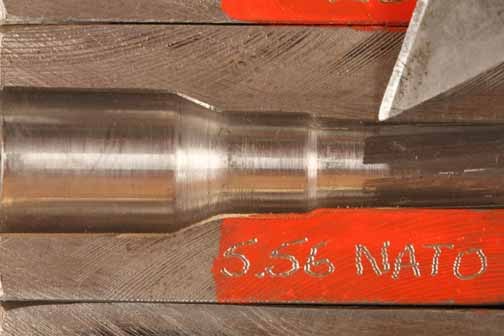
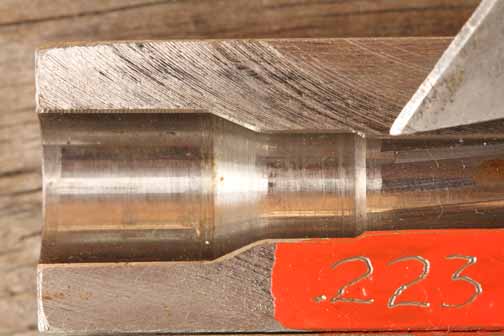
The differences really come into play with the starting path of the bullet and the unrifled portion of the chamber ahead of the rifling, called the leade. A narrower (less diameter) leade keeps the bullet from tipping as it moves forward, which enhances accuracy. A larger leade allows for more buildup and gunk and thus greater reliability.

At the end of the leade is the rifling. To prevent bullet mangling, the rifling has an angle on its front face to allow the bullet to slide in and smoothly begin rotating. The steeper this angle (within reason) the more quickly the bullet is controlled by the rifling and thus potentially delivering greater accuracy. However, the steeper the angle, the more the bullet “stalls” on engaging the rifling and the greater the pressure spike.

5.56 NATO Cartridge

The 5.56 chamber has a slightly longer leade and shallower rifling angle, allowing the 5.56 cartridge to be loaded to higher pressures.

A shallower angle on the rifling- in effect, a longer ramp- also creates a longer effective leade, as the ogive of the bullet has to travel a greater distance before it engages shallow-angle rifling than it would with steep-angle rifling.


When the .223 was invented, it was meant as a benchrest and varmint round. As such, accuracy was paramount. Velocity was a good thing, but not if it meant losing accuracy. So the .223 was designed with a short leade and steep rifling engagement, which is fine for shooting varmints or targets.


When the Army was forced to adopt the M16, however, it tried to avoid adoption by moving the goalposts, insisting on 500 yard penetration performance. To get that, the designers had to boost pressure and velocity. To control pressure (and also to get full utility out of tracer ammo, which uses bullets nearly twice as long as typical full metal jacket ammo), they modified the shape of the leade and rifling angle. And later, taking advantage of the longer leade and gentler angle, ammo makers tuned the 5.56 round to maximum performance using that extra margin.

.223 Remington Cartridge

By contrast, the .223 Remington has a shorter leade and sharper rifling angle, the design stemming from a desire for top accuracy.

Today, the difference can be marked. The leade on a proper 5.56 chamber is twice or more than that of a .223 chamber, and the onset angle of the 5.56 rifling creates a ramp with four times the distance. Firing .223 in a .223 chamber, or a 5.56 chamber, is not a problem. But firing real-deal 5.56 ammo in a .223 chamber can be a big problem.

The SAAMI-spec maximum average pressure for the .223, measured at the middle of the case, is 55,000 psi. The NATO spec for 5.56 is determined by SAAMI’s European counterpart, CIP. CIP measures at the case mouth and lists the 5.56 pressure spec of 62,000 psi. Measured at the case middle as SAAMI does, it shows 60,000 psi- so either way it’s higher than the .223.

But the problem isn’t just pressure. That CIP pressure of 62,000 psi? It is measured in a 5.56 chamber. If we take the same round, which shows 60,000 psi per SAAMI (which is already 5,000 psi over the .223 max) and put it into a .223 chamber, things get ugly. The pressure spike piles onto an already over-pressure round.

I’ve talked to professional ballisticians, guys who use million-dollar labs to measure ammo for their ammo manufacturing bosses. They have reported some instances of 5.56 ammo demonstrating peak pressures at or above 75,000 psi in .223-chambered pressure barrels. That is the pressure of the proof load gun makers test each rifle with before it’s shipped.

Almost all the “generic” ammo you shoot is not 5.56. Oh, it says “.223 Remington/5.56” on it, but it isn’t really 5.56. The high-volume, low-cost ammunition that most of us use is not loaded right to the red line. I’ve chronographed enough of it to know that much of it falls 100 to 200 fps short of full-book 5.56 spec. That right there is enough to make it no big deal because the peak pressure of the .223 load is sufficiently less than that of a true 5.56 that the artificially induced spike still falls below the pressure ceiling.

However, you can have a serious problem if the variables stack up against you in a range session. Rifles get hot when you shoot them. They also get hot in the summer. So on a hot day you’re shooting 5.56-spec ammo through your .223-chambered rifle. The summer sun beats down- note that black rifles left in the sun can easily reach 140 degrees even before they are fired- and pressures rise.

.223 Rem vs. 5.56 NATO Difference

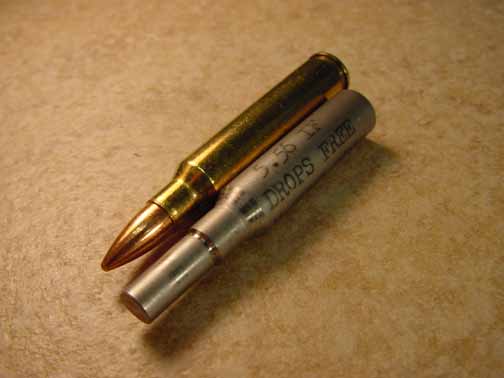
Barrel markings don’t always tell you the real story of what chambering you have. A throat gauge like the one available from Michiguns is the only way to tell for sure.

Let’s make it worse: Your 5.56 ammo is at the top of the allowed pressure and at the bottom of the allowed brass hardness. Your rifle suddenly stops working. What happened? The heat increased the already maximum-made-excessive pressure, and on extracting a fired case, the pressure had expanded the case enough for a primer to fall out of the primer pocket and into your rifle.

How can you check for it and solve it? First, you can’t depend on the markings on the barrel. Some makers can be counted on to actually make 5.56 chambers in their barrels. However, many rifle makers do not make their own barrels. They buy barrels, and the barrel makers have been known to ship barrels marked “5.56” that were actually given .223 chambers because .223 chambers tend to be more accurate, and everyone insists on m.o.a. AR-15s these days..

Are there makers you can count on, ones who will supply the proper chamber? Yes. Based on measurements I’ve done over the years, CMMG, Colt, Daniel Defense, LMT, Noveske and Stag deliver chambers that match what’s stamped on the barrel.

Everyone else? Unless you know who makes their barrels, you have to check them, and for that you need a leade/throat gauge. I recommend the .223/5.56 Gage from Michiguns. The gauge is simple. It is ground to just over the minimum specs of a 5.56 leade/throat. Drop it in, and if it drops free, you have a 5.56 leade. If it sticks (it is hardened steel, don’t pound it in) you have a .223 leade.

Okay, so you have a .223 chamber, but you wanted a 5.56. If the rifle is still brand-new, you can send it back. However, the maker probably only has more barrels from the same maker, and you may not get a 5.56. So you need a specialized reamer. One that cuts the leade and the leade only because you don’t want your headspace changed.

The various reamer makers will be happy to supply you with a 5.56-spec finish reamer. You just have to be aware that a finish reamer will also ream the shoulder if you aren’t careful. You may go in attempting to make a 5.56 throat and end up creating excessive headspace. Michigun makes a reamer that does not cut on the shoulder at all. When you feel it stop cutting, you are safely done. It also makes a leade longer even than that of 5.56, by a small margin.

What if you have a chromed barrel and don’t want to cut the chrome? Stick with a chromed .223 chamber. But if you really want a 5.56 leade, yes, the reamer will remove chrome. However, the area being cut is the area where the chrome is blasted off first, so if you’ve put more than a few hundred rounds down your barrel, there is probably not much chrome left there, anyway.

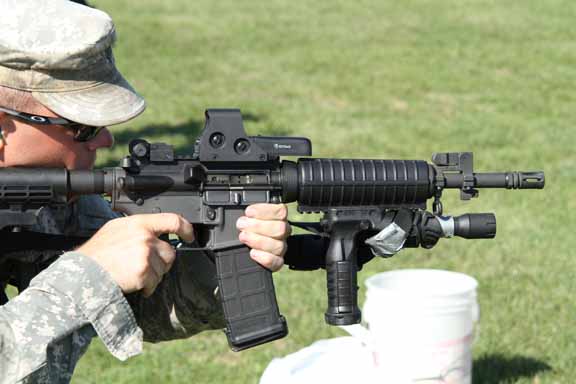
Having a .223 chamber in your AR is a greater concern than just the social ostracism of having a rifle that is not mil-spec. However, it is something you can test and fix if needed. Me, I’m checking all of my rifles, and those that don’t pass the test will get corrected.

What about you? Will you change if your current AR isn’t what you wanted or expected?

Categories
All About Guns Ammo

357 Magnum Vs. 38 Special In Snub Nose Revolvers