Categories
Ammo Fieldcraft

How Much Ammo? Published by Divemedic

Once you pick your flavor of ammo as we did earlier this week, how much of it should we have on hand? Some people say that the most handgun ammunition that you need on hand is 250 or 500 rounds. That’s ridiculous. I have more than that in any given caliber.

For starters, there are two types of ammo: range ammo and war shots. PewPew Tactical recommends 500 rounds as a starting point, with 150 of those rounds being war shots. I still think that’s low. So what do I consider to be a good amount of ammo?

For range ammo, I buy in bulk because it’s cheaper, meaning in 1,000 round cases. If I find a good deal, I snap it up. That’s how I scored 9mm FMJ for 15 cents a round back in January of 2020, when I got 2,000 rounds for $300. Of course, that was pre-COVID. Good luck getting 9mm at that price now.

For starters, .22lr comes in bricks of 500 rounds. I own a few .22 firearms, both pistols and rifles. You will seldom see me with less than a couple of thousand rounds of .22 lying about. Of course, there is really no such thing as a “war shot” with .22lr. A brick of .22 will cost you about $30 at today’s prices, making it the cheapest way to shoot. It’s also great for squirrels and rats. That’s why I keep a bunch on hand.

When it comes to range ammo, I try to stock a minimum of 500 rounds per caliber. For the high use calibers of 9mm and .45, I find that 1,000 rounds on hand is a minimum.

For defensive handguns, we need to consider war shots. For semi-autos, I try to keep a minimum of 500 war shots per handgun. For revolvers, 150 war shots per handgun. So if I have a pair of 9mm handguns, that’s 1,000 rounds.

When we get into 5.56mm and 7.62x51mm, we get into a whole different ballgame. For the AR, all I stock in 5.56mm is Green Tips. I don’t do different war shots and range ammo, because I want my war shots to perform identically to my range ammo. For that reason, I try to keep a minimum of 5,000 rounds on hand of 5.56mm.

Likewise for the 7.62x51mm, but my round count there is lower simply because it is more expensive and takes up more room. So I want my minimum there to be no less than 2,500 rounds. With the 7.62, I look for nothing but the 147 grain. That way, every round is similar in performance to every other round.

For shotguns, all I have are 12 gauges. I stock 250 defense rounds in buckshot and slug, and 250 rounds of #7 shot (for hunting).

Toss in a few smoke grenades and a couple of pepper grenades, and the fire marshal’s office will shit themselves if they ever find out about that stash.

So as you can see, that means a lot of ammo on hand. We are talking about more than 20,000 rounds of ammo. I didn’t get there by buying it all at once. I just buy ammo on a regular schedule, buy a case at a time when I do buy, and try to get more than I shoot. Eventually, you get a decent stockpile.

Categories
Ammo

FREEDOM MUNITIONS ADDS .38 SPECIAL TO X-DEF LINE-UP WRITTEN BY HANDGUNNER STAFF


Freedom Munitions continues to expand its X-DEF defense line with the addition of the .38 Special caliber.

Like all X-DEF products, Freedom’s X-DEF .38 Special hollow point ammunition has been designed from the ground up by Freedom Munitions with optimum penetration and weight retention in mind.

X-DEF ammunition is intended for personal protection. The cartridges utilize a brass case with X-Treme Bullets’ copper plated, 158-grain X-DEF hollow point expanding bullet and are loaded with premium, low-flash powder.

Tested in Freedom Munitions’ own underground ballistics lab, the 158-grain projectile travels at a velocity of 925 fps with a 6” barrel and penetrates 13”-15” in clear ballistic gelatin.

Earlier in 2023, Freedom Munitions also released .357 Mag X-DEF in two weights and a 200-grain 10MM X-DEF round.

X-DEF .38 Special is available now in 50 count at FreedomMunitions.com.

Categories
Ammo

Winchester’s WSSM’s: Is It A Total Fail?

Categories
All About Guns Ammo

When one has to absolutely and reliably get the job done, then there is always the 45 Lonf Colt waiting for the call

Categories
Ammo

.280 British From Wikipedia, the free encyclopedia

The .280 British was an experimental rimless bottlenecked intermediate rifle cartridge. It was later designated 7 mm MK1Z, and has also been known as 7 mm NATO, .280/30, .280 Enfield, .280 NATO, 7 mm FN Short, and 7×43mm.

Like most armed forces in the immediate post-World War II era, the British Army began experimenting with lighter rounds after meeting the German StG 44 in combat. The Army began development in the late 1940s, with subsequent help from Fabrique Nationale in Belgium and the Canadian Army. The .280 British was tested in a variety of rifles and machine guns including the EM-2, Lee–Enfield, FN FAL, Bren, M1 Garand and Taden gun.

Despite its success as an intermediate cartridge, the .280 British was not considered powerful enough by the U.S. Army and several variants of the .280 British were created in an attempt to appease the U.S. Army. However, the U.S. Army continued to reject these variants, ultimately adopting the cartridge that was then designated the 7.62×51mm NATO.

History[edit]

Impetus[edit]

During World War II the standard British rifle and machine gun round was the venerable .303 British. Efforts to replace the .303 with a more modern round predated even World War I, but a series of events kept it in service in spite of its rimmed design causing a number of alleged problems[citation needed].

During the war the Allies encountered the new 7.92 “Kurz” cartridge on the battlefield and noted its effectiveness. The Kurz was an “intermediate power” round, less than a conventional rifle round like the .303, but more than pistol rounds like the 9mm Parabellum. This gave the Kurz rifle-like performance in close-range encounters, while still having a small enough recoil that it could be fired in fully automatic fire. This led British small arms designers to begin the development of their own intermediate round.

The goal of the British designers was to create a cartridge that would replace all small arms in .303 calibre including the Bren, the No.4 Rifle and the Vickers medium machine gun with a cartridge suitable for a “light rifle”. Thus the cartridge had to demonstrate ballistic performance equal to that of a full powered rifle round, yet exhibit as little recoil and blast as possible. This appeared possible through improved bullet shaping. A shorter cartridge producing lower recoil also enabled the weapon to be shorter and lighter, and hence easier to use.

Selection of the .280[edit]

After extensive tests by the “Ideal Cartridge Panel” in 1945, the British decided upon two 7 mm cartridges – the .270 and the .276. Both designations reflected the measurement of the distance between the rifling lands in the cartridges’ respective barrels; the .276 bullet‘s actual diameter was .284 inches (7.2 mm). In order to focus their efforts, the British ceased research on the .270 and concentrated their efforts on the .276. The .276 was later renamed the .280 British even though no dimensions were changed.

Recoil of the .280 British cartridge was calculated to be a little under half of the .303. Long range performance actually surpassed that of the .303, and shooters reported that it was much more comfortable to fire with the reduced recoil and reduced blast. It seemed that the British designers had accomplished their goals, and proceeded to introduce the cartridge to their NATO allies.

.280/30 British sectioned cartridges. Bullet types from left to right: type C mild steel core, type B 140 gr ball and type S12 140 gr ball based on the 1913 pattern 7×57mm Mauser spitzer bullet that was chosen for the 7 mm MK1.[3]

From left to right: .30-06 Springfield, .280 British and 7.62×51mm NATO cartridges.

Counterparts in Belgium and Canada proved very interested, and the Belgian company FN would introduce their own gun designs based on the .280 as well as produce the rounds in quantity. However, the Americans refused to adopt a calibre under .30 inch, or with ballistics inferior to the then-standard .30-06 Springfield round. The British then attempted to appease the Americans though a series of changes to the round. The first was a small change to the rim diameter of the .280 to the size of the .30-06 Springfield to produce the .280/30 cartridge, which was produced in large numbers and is the basis of the dimensions listed to the right. The .280/30 cartridge weighed 20.3 grams (313 gr), making it a rather heavy cartridge by intermediate standards.

When the .280/30 was rejected by the Americans as being too weak with too great a drop in trajectory beyond 800 yards (732 m), the British and Belgians made larger changes to the cartridge design. These resulted in several different variations; one was just a .280/30 with the bullet seated less deeply so more powder could be put in the case, another was a T65 cartridge case necked down to 7 mm. The different cartridges that the British and Belgians eventually came up with fired 140-grain (9.1 g) bullets at around 2,700 to 2,800 feet per second (820 to 850 m/s), but with a much greater blast and recoil than the .280/30, which defeated the design parameters of the initial .280 concept.

Unsatisfied with the U.S. Army’s response on the issue, the British adopted the EM-2 and the .280/30 as their primary rifle and ammunition in 1951 with the .280/30 being re-designated as the “7 mm MK1Z”.

Selection of 7.62 NATO[edit]

Britain, Canada and the United States, founding members of NATO, had all signed an agreement that member states would develop and deploy common small arms and cartridges, developed through competitive trials in co-operation together. Britain and Canada had been open about their developments, and the Americans claimed they were not developing a round of their own and were known to be trialing the British designs.

In fact, Colonel Rene Studler, head of the US Small Arms Bureau of Ordnance had been diametrically opposed to a bullpup design and the .280 cartridge, and had started two secret projects on a .30 calibre cartridge. These were the T25 rifle at Springfield Armory under the direction of Earle Harvey, firing the T65 cartridge being developed at Frankford Arsenal. Between 1947 and 1952 the British and Canadians made clear to the United States they were aware of their secret work, stating that it was against the open, collaborative nature of the agreement, making their disapproval clear.

Matters took a turn for the worse when Rene Studler went on record, stating that, any non-American design was “a waste of time” and refused point blank to accept any “foreign” design.[4] It was learned that Studler had gone so far as to bury reports that suggested the .280 was superior in US testing. During firing tests in 1950 at the Aberdeen Proving Ground the Maximum Average Pressure (MAP) for .280 British ball ammunition was measured at 43,600 psi (300.6 MPa). The highest measured maximum pressure was 47,300 psi (326.1 MPa).[5]

A change of government meant that the 7 mm, EM-2 and Taden gun projects were abandoned soon afterwards by Winston Churchill, who returned as the prime minister and desired commonality between the NATO countries. Small amounts of .280 British ammunition were later produced during the 1960s for various small arms trials. At the same time, the British and Canadians, who were very impressed with the cartridge originally planned to have their FN FAL rifles chambered in .280. However, eventually, they agreed to a quid pro quo where the British would use the US-derived .30 (by now the 7.62) while the Americans accepted the FN FAL. This too proved not to be the case, and the US eventually chose their M14 rifle over the FAL.

After .280[edit]

The .280 British concept would later prove to have been far ahead of its time, as the U.S. itself adopted an intermediate cartridge — 5.56×45mm NATO — by the end of the following decade. Soon after America’s large-scale involvement in Vietnam commenced in 1965 the 5.56×45mm NATO ArmaLite AR-15 rifle, later standardised as the M16, was purchased in ever increasing numbers and by the late 1960s had displaced the 7.62×51mm NATO M14 rifle in combat units. After insisting on a .30 calibre round with full-power ballistics almost identical to those of the existing .30-06 Springfield, the U.S. then adopted the 5.56×45mm NATO intermediate cartridge, which demonstrated the emergence and dominance of intermediate cartridges on the battlefield (the other notable one being the 7.62×39mm AK-47 round). The adoption of the 7.62×51mm NATO round and the adaptation of the intermediate cartridge CETME (later developed into the Heckler & Koch G3) and FN FAL designs to fire it, produced rifles that were relatively longer and heavier and had greater recoil. The result was weapons that performed well as longer-range semi-automatic rifles, but were more cumbersome and only marginally controllable in automatic fire. These guns also had a higher training burden and were not well suited to soldiers of smaller stature, again due to the recoil. Coincidentally, in 2002 the Americans developed a military calibre intended for the M4 version of the M16 family called the 6.8mm Remington SPC — with similar ballistic properties to the .280 British cartridge — which was intended to provide better ballistics than the 5.56×45mm NATO.

In the late 1960s, a version of the .280 British was created using a 6.25 mm bullet in a necked-down .280 British case. It was designed in response to experiments in the U.K. trying to find an ideal military small-arms round. Large caliber bullets were calculated to need more energy to penetrate various levels of body armor to inflict disabling wounds on soldiers. Out of several “optimum solutions” ranging from 4.5 mm to 7 mm, the 6.25 mm was the preferred solution. The 100 gr (6.5 g) bullet had a muzzle velocity of 2,680 ft/s (820 m/s) and 2,160 J (1,590 ft⋅lb) of muzzle energy. While the 7.62×51mm NATO required 700 joules (520 ft⋅lb) of force on impact to penetrate helmets and heavy body armor, the 6.25 mm required only 580 joules (430 ft⋅lb) of impact force to deliver the same penetration effects out to 600 m. It remained effective for a longer distance and produced recoil closer to that of the 5.56×45mm NATO.[6] However, it was not designed for very long range and its bullet was relatively light.[7] Testing of the 6.25×43mm was conducted from 1969 to 1971, when development ceased in favor of the smaller 4.85×49mm.[8]

In April 2022 in recognition of the decreased effectiveness of the NATO 5.56mm round particularly against personnel in body armour the American Army let a ten year contract to Sig Sauer for production of the XM5 rifle, XM250 Automatic rifle and 6.8mm (.277”) cartridge.

Categories
Ammo Well I thought it was funny!

Thank God that my Wife would be fine with it!! Grumpy

Categories
Ammo Gun Info for Rookies

Cap and Ball Revolver CHAINFIRE MYTH We’ve All Been Told

Categories
Ammo

Cartridge Making (1940)

Categories
All About Guns Ammo

WMD GUNS .300 BLACKOUT By Denny Hansen

The inimitable J.D. Jones while working under S.S.K. Industries (a company he started) invented the .300 Whisper caliber in 1992 as a wildcat cartridge. The parent case that J.D. Jones used to make the .300 Whisper was the .221 Remington Fireball necked up to accept .30 caliber bullets. The end game was to use a heavy bullet traveling at sub-sonic velocities with a silencer.

The .221 Remington Fireball is identical to the .223 Remington except the .223 is longer and uses more powder. By doing this, the .300 Whisper in an AR-15 platform can use the same bolt-carrier group and magazines as a standard5.56mm/.223 Rem rifle.

One thing that has made the AR-15 platform so popular
is its modularity. You can mix, match and accessorize your rifle
to your heart’s content. It’s like Barbie for men.

Now let’s examine the more recent and commonly known .300 AAC Blackout (.300 BLK). The caliber’s name partly comes from the company that “invented” it which is Advanced Armament Corporation (AAC). So what is the difference between .300 AAC Blackout and the synonymous .300 Whisper? Without boring the reader with things like the measurement of the barrel throat etc. the answer is not much really.

The largest difference is that the .300 Whisper started as a wildcat round and AAC went to the trouble of getting the cartridge recognized by the Sporting Arms and Ammunition Manufacturers’ Institute (SAAMI) as a standard round.

As a sad side note, J.D. Jones never received any royalties and little recognition for his efforts. Partly in homage to J.D., Black Hills Ammunition lists the cartridge as. the .300 Blackout/Whisper.

So much for the history lesson.

BARBIE FOR MEN

One thing that has made the AR-15 platform so popular is its modularity. You can mix, match and accessorize your rifle to your heart’s content. It’s like Barbie for men.

I have exactly one AR that has not been “customized” in some way—an original Colt SP-1. For awhile I replaced the Delta rings with round ones and so I could add a quad rail to it but nothing else was changed. Out of nostalgia more than anything else, I went back to the original triangular handguards.
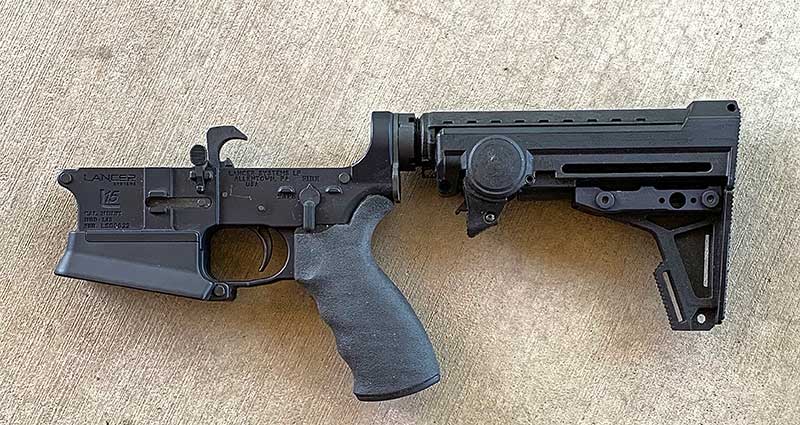
 

Lancer Systems lower receiver was used as the foundation.

Several years back I had a rifle chambered in .300 BLK. I reload for every caliber I own and after much deliberation I decided I didn’t want to add another and sold the rifle. I’ve regretted that decision ever since.

Having several completed lowers sitting around, I decided to turn one of them into a .300 BLK.

I decided to use Lancer Systems lower for the “build.” The unique thing about this receiver is that there is a takedown pin at the bottom of the trigger guard that allows for attaching different sizes of funnel-type magazine wells. I used the medium size, as it offers a quick reload without becoming too bulky.

WMD GUNS TO THE RESCUE

I contacted WMD Guns about receiving one of their excellent uppers for the project. Wynn Atterbury of WMD was enthused about the project and agreed to send one to me. I received the upper receiver within two weeks.

The forged upper receiver has a 16” barrel, is fitted with a 15” M-LOK handguard. The rifle has a mid-length gas system. The top rail run from the rear of the receiver to within an inch of the muzzle, with a total of 56 M-LOK slots so there’s plenty of real estate for a wide variety of accessories. A brake is attached to the muzzle that has three large slots on each side and three holes at 12 o’clock.
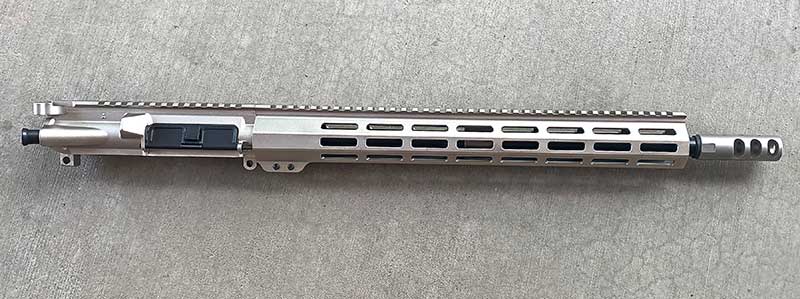
 

WMD Guns upper receiver has their proprietary NiB-X finish with a matte silver/gray appearance.
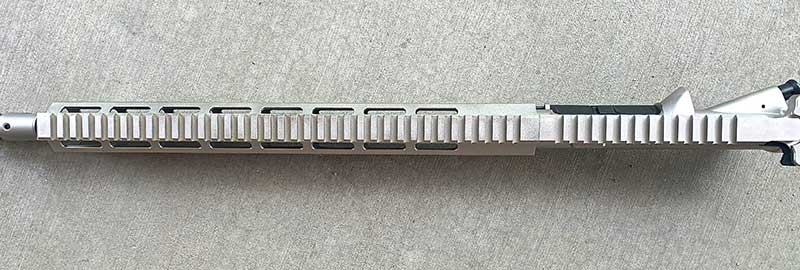
 

Top rail runs from the rear of the receiver to within an inch of the muzzle.


WMD Guns muzzle brake was very effective.

The upper features WMD’s proprietary NiB-X (Nickel Boron eXtreme) finish. This coating is tougher than hard chrome with a coefficient of friction near Teflon with excellent lubricity. This coating requires little wet lubrication and so it cleans easily after shooting, while protecting against the elements.

NiB-X is offered in a matte silver/gray appearance, distressed, or polished to a near chrome look. I opted for the matte silver/gray finish. It gives the rifle a classic two-tone look and is fairly unique for an AR-15-type rifle. I personally find it aesthetically pleasing.

AVOID THE KABOOM!

The .300 BLK cartridge will chamber in a 5.56 rifle, but in no way, shape or form should you ever try to fire it. The .22-caliber bore simply isn’t big enough to handle the .30-caliber projectile of the .300 BLK round, and all that pressure from the round needs to go somewhere once the primer is struck and the results can be devastating.
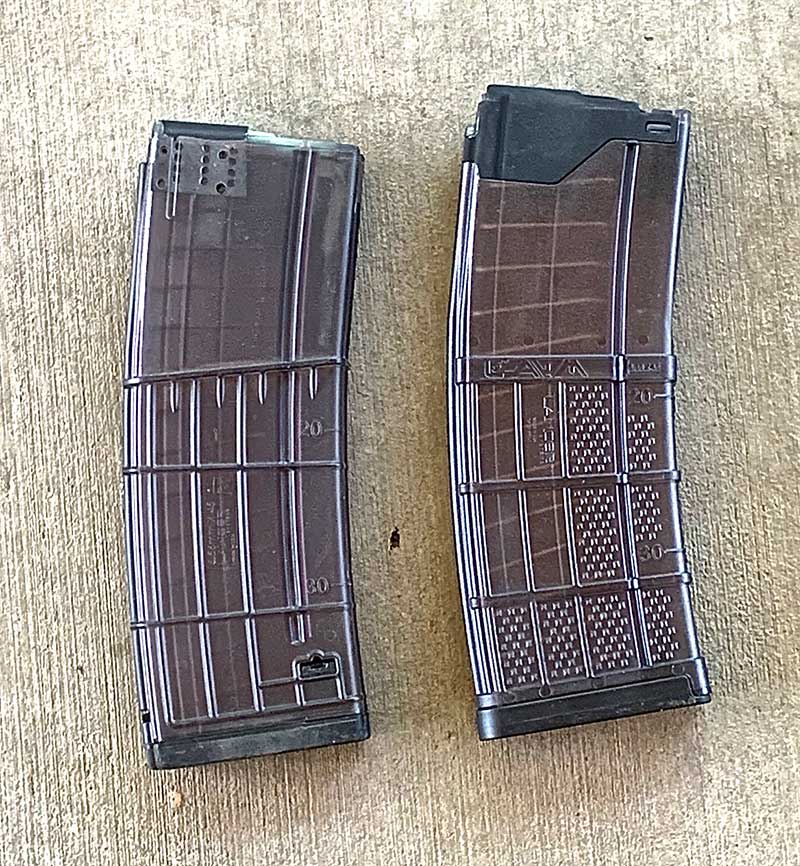
 

To avoid a possible kaboom, only Lancer Systems magazines are used in the .300 BLK.

When I had my first .300 BLK rifle I avoided this by using only Lancer magazines—both the original and Advanced War Fighter—in the rifle. I have never placed a .5.56 round in them or a .300 BLK round in any other AR mag.

I can almost hear someone saying, “Just pay attention to what ammo you’re putting in the gun.” I agree with this in a perfect world but I often shoot with family members, including grandchildren, where there is probably three or four ARs on the range and by using a noticeably different magazine it minimizes the chance of a kaboom.


HOW DOES IT SHOOT?

I attached an Aimpoint Micro T-2 to the top rail. The T-2 has a 2 MOA dot so it covers two inches at 100 yards, four inches at 200 yards and six inches at 300 yards. That suits me fine as I rarely, if ever, shoot beyond that distance with anything but a precision rifle.

The “trick” to shooting smaller groups with a red dot sight (RDS) is to lower the intensity. While this doesn’t actually change the size of the dot, it gives the illusion of a smaller dot for greater accuracy.

I went with the ammo I had on hand for the .300 Blackout which was the Black Hills Ammunition 125-gr. TMK (Tipped Match King). This load develops 2,100 feet-per-second and 1,224 foot-pounds of energy at the muzzle.

I obtained a rough zero at fifty yards and then fine-tuned the T-2 at 100 yards.

Shooting from the bench, I shot four three-round strings. My best group measured 1.5 inches while the average group size was 1.8 inches. Not too shabby at all with my first time out and using a RDS instead of conventional rifle scope.

I found the muzzle brake to be quite effective though, like all brakes, very loud.
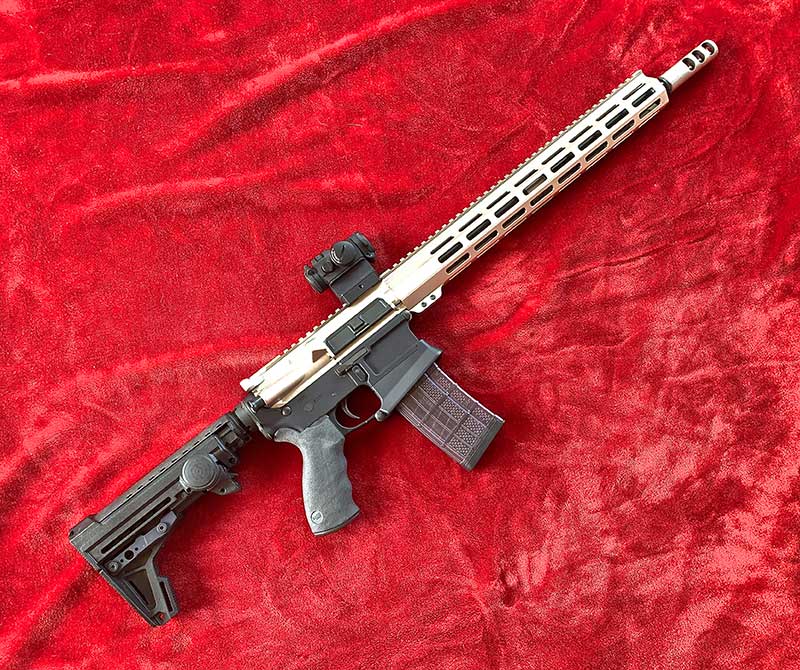
 

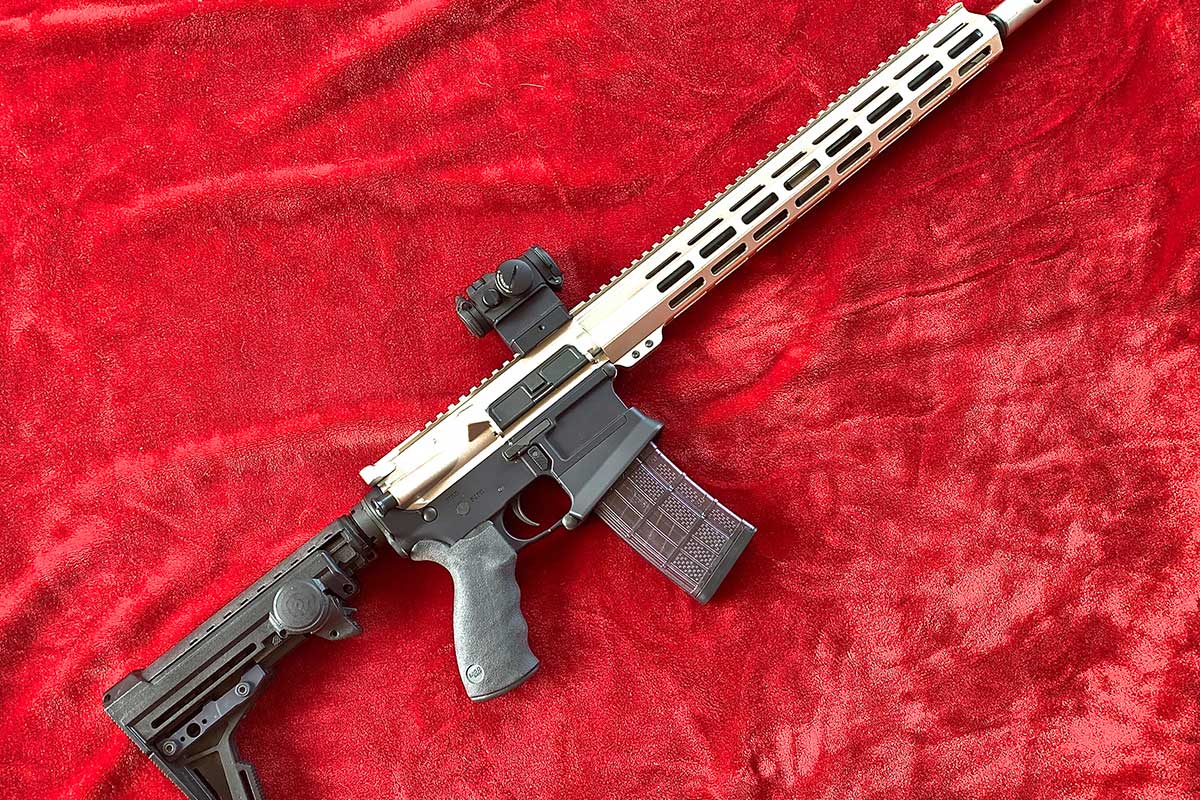
Completed rifle equipped as evaluated. Author likes the classic two-tone look.


SUMMARY

I don’t have a .30 caliber suppressor at the moment, but I plan to resolve that problem in the near future to fully utilize the potential of the .300 BLK.

WMD not only offers parts and assemblies, but entire guns and NiB-X coatings.

Whether you are looking to assemble your own or purchase an entire gun, check out WMD Guns. You won’t be disappointed.

WMD GUNS
https://wmdguns.com

AIMPOINT INC.
www.aimpoint.com

BLACK HILLS AMMUNITION
www.black-hills.com

LANCER-SYSTEMS
https://lancer-systems.com
Categories
Ammo

5 Forgotten .35-Caliber Cartridges: Are They Doomed?