Categories
All About Guns Ammo Cops

THE MYSTERY OF THE EXPLODING HEAD WRITTEN BY WILL DABBS, MD

There’s quite a lot of science that goes into modern expanding bullets.
In the end they do exactly what they are supposed to do.

It still amazes me after all these years that I can speak so dispassionately about this stuff. Ours was a fairly large, extremely violent city, and I didn’t know many people. The possibility that a patient might be an acquaintance was small. This made it easier to depersonalize. An inability to depersonalize would disqualify you from service. Nobody could do this long-term otherwise.

The cops rolled in with the ambulance. Witnesses said this guy’s car veered off the crowded Interstate and onto the shoulder. The vehicle gradually lost speed until it came to an unceremonious but not unduly violent stop against an overpass abutment. The first bystander opened the door to find that the driver’s head had exploded.

That’s not hyperbole. The front bit looked quite normal. However, there was a defect to the right rear occiput, the back part of the skull, that would admit an adolescent tangerine. The skull was peeled outward, and a substantial volume of the poor guy’s personality was still back in the car someplace. Amazingly, when we met he was still breathing.

Of the literally countless things I found shocking about medical training, principal among them was just how tough it can be to kill a man. I’ve seen folks shot straight through the brain who kept on kicking and twitching for a quarter hour or more before their bodies finally got the memo. So it was here. There was clearly no happy ending to be had, but we still needed to go through the motions.
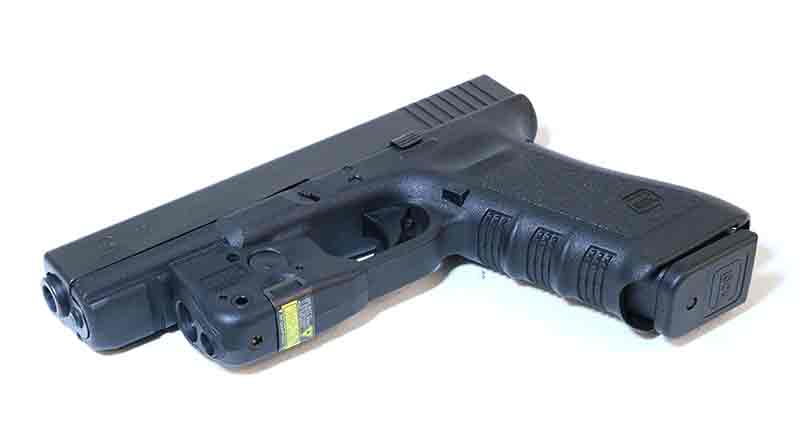
The physics behind guns and gunshot wounds can at times seem otherworldly.


When it was all done we put the guy in the Trendelenburg position. Modern medicine is so freaking stupid. Trendelenburg simply means you orient a person head down and feet up. Why we couldn’t just say “lower his head” or something similarly sensible escapes me. To make it worse, to orient a patient head up and feet down is called “Reverse Trendelenburg.” Please…as though the study of modern medicine were not sufficiently complicated already. We arranged a big garbage can underneath his nugget and let him be for a while.

I was just a medical student, but I spoke guns more fluently than anyone in the hospital. The cops literally had no idea what happened to the guy. There was no visible damage to the vehicle—no bullet holes or blown-out windows—and they could find no weapons in the car. He had apparently just been cruising down the Interstate when his head detonated. To exercise a tired cliché, the authorities were baffled.

I went back into the trauma room alone to study the guy for a while. Aside from being motionless and a little colder nothing was different. I donated a pen to the cause and started poking around the exit wound. A substantial piece of skull had been lifted loose and rolled back but was still attached to a flap of scalp. As I explored amidst the gore I saw it.

There was a circular scrap of gold-colored metal trapped between the skull fragment and scalp. I tugged it free, ran it under the sink, and studied it in good light. To the experienced eye it was clearly the base of a bullet jacket.


I moved around to the front and studied the dead man’s face. There just wasn’t anything out of the ordinary there. I then pried his mouth open and oriented the bright trauma room light so it would angle down his gullet. There back in the deepest recesses of his oropharynx I could see the beginnings of some powder burns. This was a suicide. The guy had shoved the muzzle back past the back of his tongue before he stroked the trigger.

I miked the bullet jacket on a piece of EKG paper at eleven millimeters. I then put it in a little bag and tracked down the cop who had come in with the guy. Our dude had killed himself with a .45ACP handgun. The pistol was still in the car someplace. They just hadn’t found it yet. The cop made a radio call.

They found the .45-caliber Glock deep underneath the passenger seat. Nobody had any idea the physics that could have put it there. The bullet core was lodged in the headliner and impossible to see if you weren’t specifically looking for it. I was just a lowly med student at a Level 1 trauma center, but that night everybody thought I was a rock star.
Categories
Ammo

Which Handgun Rounds Will DEFEAT Body Armor??? (It Might Surprise You

Categories
Ammo

Cartridge Hall of Fame: 45 Colt Ammunition | MidwayUSA

Categories
Ammo

6 Cartridges Better than 6.5 Creedmoor

Categories
All About Guns Ammo

A Guide to Tank Ammo | Koala Explains: Tank Ammunition Types and their Differences

Categories
All About Guns Ammo

The Very Rare FN CAL at the Range

Categories
All About Guns Ammo

25-20 Winchester Model 53

Categories
All About Guns Ammo

9mm vs.38 Special… Bone Test

https://youtu.be/joYaZqwzaY8

Categories
All About Guns Ammo

Best Moose Cartridges!

Categories
All About Guns Ammo Cops

NO CONTEST RURAL SHERIFF SAYS DRUGS, NOT GUNS ARE THE PROBLEM WRITTEN BY DAVE WORKMAN

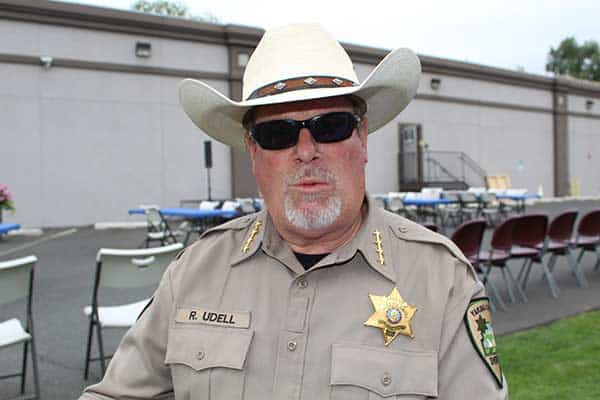
Yakima County Sheriff Bob Udell, a tell-it-like-it-is veteran lawman.

Yakima County Sheriff Robert Udell is one of those rare public servants willing to speak to his constituents with the sort of candor most three-piece-suit politicians avoid like a tough interview.

Insider Online caught up with the 34-year law enforcement veteran, in his second term as the top lawman in his east-central Washington county (he ran unopposed last November), at a gathering recently during which he told the small audience that drugs, not guns — especially semi-auto rifles — are the real problem he and his colleagues face. Why liberal politicians stubbornly refuse to recognize this escapes him.

“Our liberal friends are so focused on semiautomatic firearms,” Udell said, “especially long guns of all types (which) kill so few people that, statistically — what are we, a nation of 340 million? — statistically it’s not that relevant.”

In any given year, Udell explained, there are fewer than 500 homicides reported that involve rifles.

“Every one is a tragedy,” he stressed. “If someone uses a rifle in a school shooting, that is horrific but that’s not the norm. It is so rare that any child in our school system has a greater chance of being killed in a car wreck than (by) violence in school.”

Yakima County, he said, is something of a hub for drugs and gangs. Udell said fentanyl is being trucked into his jurisdiction and it kills many times the number of people annually as firearms do. “There’s no match,” he observed, “it’s crazy.” Still, legislators seem blind to this, so they focus on restricting gun rights while going soft on drug users. That’s the difference between lawmakers and lawmen, one presumes.

“The border is nearly wide open,” Bob Udell lamented. “The fentanyl is coming up here literally in semi-trucks and it is a solid upward trend of people dying from it, and yet the same people that want to restrict our Second Amendment rights seem good with an open border and people dying.”

He estimates this year could end with at least 150 fentanyl overdose fatalities, while last year, his department investigated 37 homicides in his county, which spans more than 4,000 square miles.”

“Right now,” he said recently, “we are sitting at 20 (murders) and the vast majority are directly related to the drug culture.”


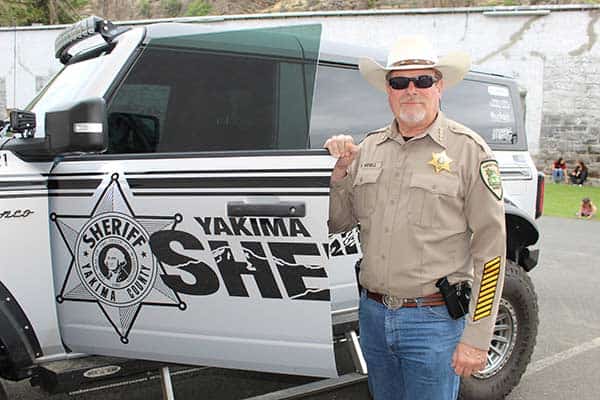
Sheriff Udell sometimes rides around in a rather stout 4X4 rig.
It can come in handy during the winter months.


While Udell says anti-gunners who support drug legalization suffer from “fuzzy thinking” (“It doesn’t make any sense at all; it’s lunacy,” he said), his own perspective is pretty clear, especially when it comes to private gun ownership. Funny how this seems to run strong in rural lawmen who support the Second Amendment.

He’s on his second SIG SAUER pistol. His current sidearm is a SIG P226 in .40 S&W. His first was a P220 in .45 ACP, essentially the same model my younger son owns. Josh came across it a few years ago at a gun show and brought it home. It’s a good shooter, and Udell gave his own P220 the same high marks.

“I still feel comfy using the 220,” he acknowledged.

He also confessed to occasionally packing a single-action sixgun on the job. However, the .40-caliber offers a few more rounds in the magazine, and the cartridge is a known fight-stopper.


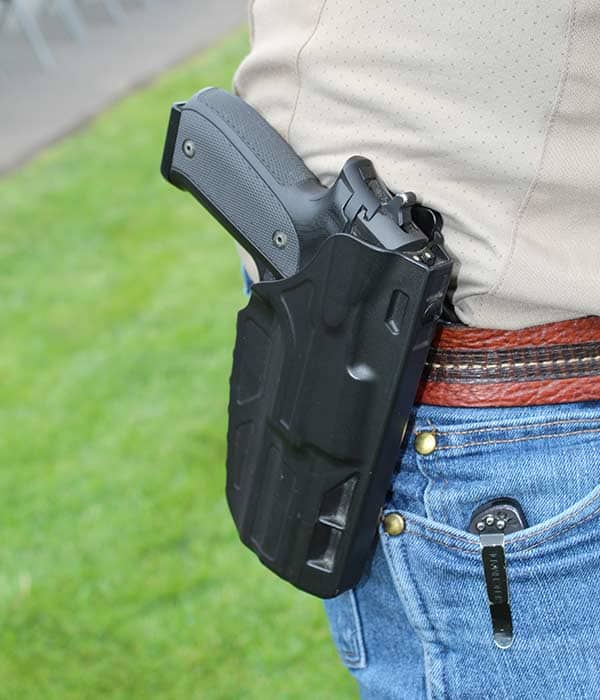
Sheriff Udell carries his trusty SIG P226 in .40 S&W, though
he’s got a SIG P220 in .45 ACP for making bigger holes.


What’s on the horizon? Sheriff Udell doesn’t see a light at the end of the tunnel because the policy makers seem contentedly stuck in the dark.

“By ignoring why we have this issue (of drugs and violent crime), you’re not going to fix it,” he said.

So, like so many of his contemporaries in law enforcement — people serving in big counties or small towns — he just deals with the problem with the resources he’s got.


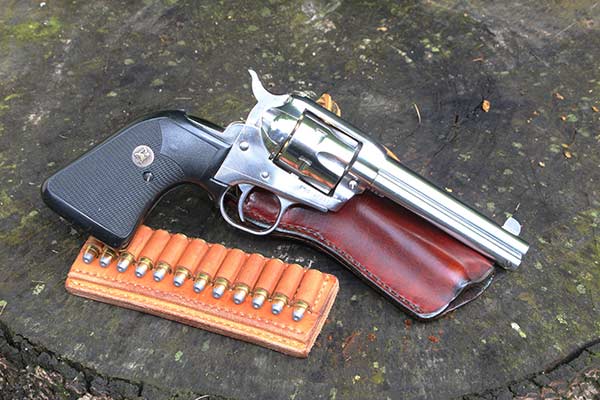
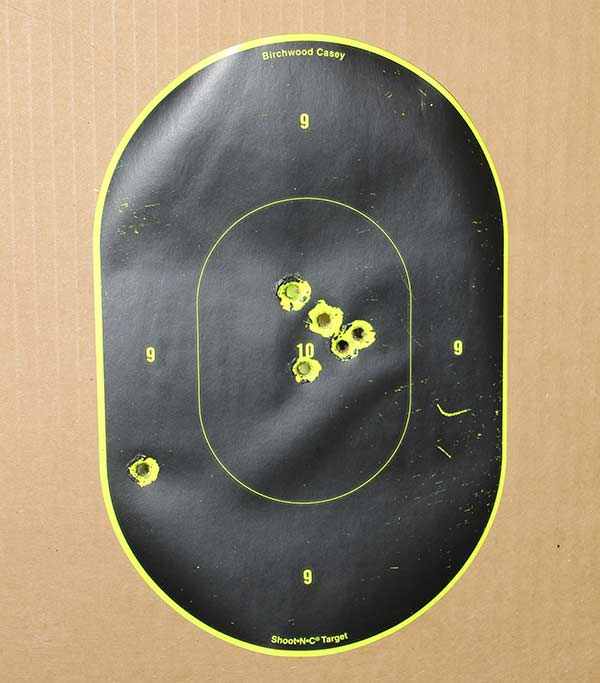
One of Dave’s favorite sixguns is this .32 H&R Magnum on a
Ruger Single Six frame with fixed sights. He’s on the hunt for a
good handload using Hornady XTP 100-grainers.

Small Caliber, Big Surprise


This next thing started with an email exchange I had with American Handgunner’s John Taffin back in mid-May. He’d written a piece on the .32-20, about which I complimented him because it was a good read, and the conversation reminded me I had a bunch of .32 H&R Magnum brass out in the workshop in need of reloading.

The brass had been tumbled months ago and many things got in the way of putting together fresh loads, but finally I stole part of a Sunday morning and got to work. Sometime last year, my brother found some 100-grain Hornady XTPs at a local gun shop and scooped them up. I’d been using 100-grain Speer JHPs ahead of 10.0 grains of H110, for a little more than 1,000 fps out of my Ruger fixed-sight sixgun on a Single Six frame with its 4 5/8-inch barrel.

Hornady doesn’t offer a comparable load recommendation for H110, but I did check out some interesting suggestions for other propellants including a promising one using 5.0 grains of Hodgdon’s HS-6 — the max recommended powder charge for this bullet — for a loading manual velocity of 1,000 fps.


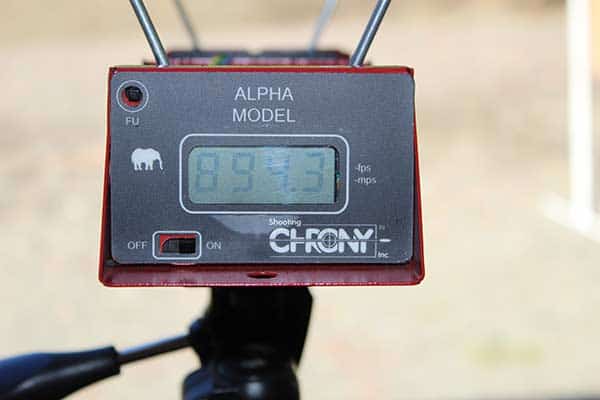
The chronograph doesn’t fib. Dave’s top velocity over the screens
was noticeably less than the 1,000 fps listed in the Hornady manual,
but from a gun with a 6 ½-inch barrel. His shorter tube delivered less velocity.


However, my Chrony’s top recorded speed with the screens set up 3 feet ahead of the muzzle was 894.3 fps, which makes sense, since the loads listed in the Hornady manual were tested in a Ruger Single Six with a 6 ½-inch barrel. The load combination was definitely accurate at 10 yards (see the image), and good enough to put the hurt on small game at two or three times that distance.

This little reloading adventure did reveal something I’d talked about with a couple of guys at the recently revived Elmer Keith Invitational long range handgun match held this year in a large meadow several miles north of Spokane.


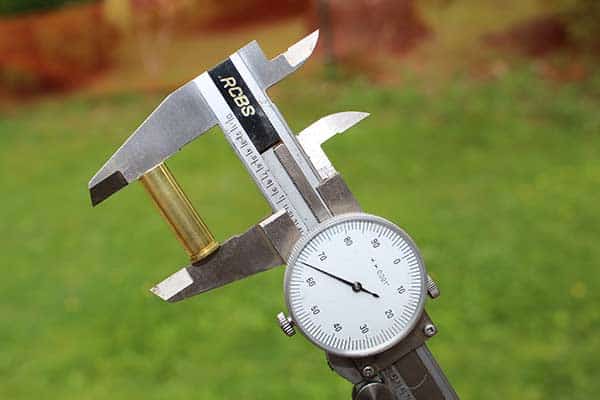
Dave discovered he had to trim his Starline .32 H&R brass to
1.065-inch, so out came the dial caliper for the final measure.


We were chatting about the need for precision loads in long-range shooting endeavors, and one of the guys brought up the need to trim straight-wall cases. As it happens, my empty .32 H&R brass had been reloaded a couple of times, so out came the dial calipers, set to the trim length of 1.065-inches and surprise of surprises, all but three cases needed some trimming.


Brass Tips


Not only should cases be trimmed, but our conversation also touched on the necessity to clean out the primer pockets for a snug, flush fit. I was using CCI 500 primers, with which I’ve always had very good luck, and my old Piggyback progressive press, built years ago by RCBS.

I checked the trim length after resizing, did the trim, chamfered the case mouths, and then cleaned out each primer pocket with a wire brush. I was using Starline brass, which is very good stuff, so every round was loaded as precisely as I could.


While he didn’t get the velocity, he did enjoy the accuracy.
Dave’s little Ruger always delivers the goods in this department.


For years I tumbled brass in corn cob media, but a few years ago I transitioned to wet tumbling with hot water and detergent, and thousands of tiny stainless steel pins. The result is a highly-polished case inside and out which looks just like new. I dry them in the greenhouse, where summer temperatures can reach upwards of 100-110 degrees.

So, what I had with this batch of reloads was ammunition as close to brand new as possible.

This might not seem important to casual plinkers, but for someone like me, who just might take a shot at game in the fall with a sidearm, churning out the best loads possible is important.

At the Keith shoot, I listened intently to veteran handgunner Al Fernandez about how he and his dad, Ace, used to meticulously clean and reload their brass when they first got into long-range shooting. Al’s advice would be very much like my own. Each cartridge must be loaded as carefully and consistently as possible for the best odds of connecting with the target, whatever it happens to be.

Years ago, I wrote how the bullet is the only link between you and the target. It is the bullet which seals the deal. A bullet launched from a poor platform may not make the connection, which could mean no meat in the cooler or no prize following a match, and no stories to tell back home.

That would make life pretty boring.