Category: Ammo

During the late 19th century and into the early 20th century, when the boundaries of cartridge capabilities were being simultaneously defined and broken, certain cartridges rose to the top. With the colonization of East Africa and India, British hunters were regularly pursuing the most dangerous game on the planet, including the elephant, Cape buffalo, rhinoceros, gaur, tiger, lion, leopard and hippopotamus.
The transition from blackpowder to smokeless, and from pure lead projectiles to what we now know as the jacketed softpoint, and onto the non-expanding ‘solid’ bullets certainly changed the capabilities of the known cartridges.
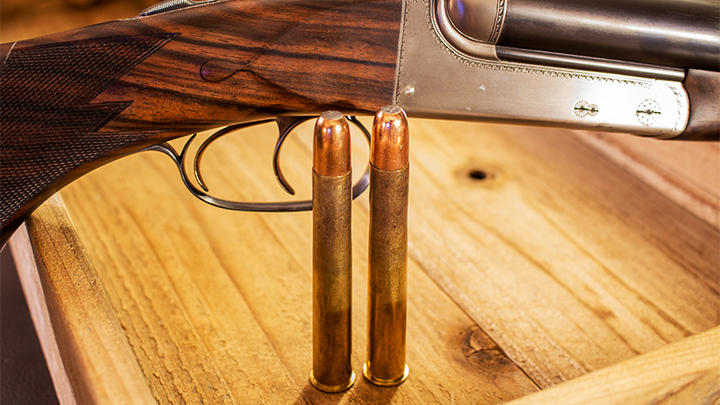
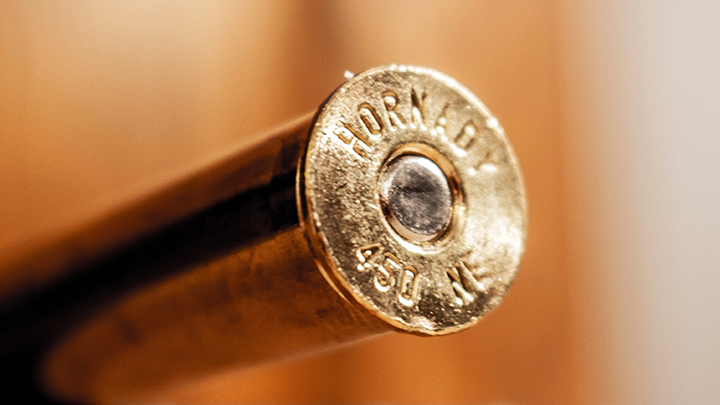
Among the dangerous game cartridges which successfully made the transition to earn its place as the industry standard is the .450 3¼-inch Nitro Express. The .450 Black Powder Express certainly paved the way, but John Rigby & Company released the smokeless version in 1898, a rimmed affair driving a 480-grain bullet of .458-inch diameter to a muzzle velocity of 2150 fps via a charge of 70 grains of Cordite, the long, thin spaghetti-like propellant of the era. The case is straight-walled and gently tapering, measuring 3¼ inches, and was designed for the single-shot and double rifles so popular in that era.
The .450’s formula would go on to define what we now consider to be the proper specs for a stopping rifle cartridge, as it develops just under 5,000 ft.-lbs. and has a recoil level manageable by most hunters. The projectiles—while of cup-and-core construction—have a sectional density (SD) value of 0.327, and will give the necessary penetration for thick skinned animals; our premium bullets only make this vintage cartridge even better.
The uprisings in India and Sudan led to a 1907 British ban on all .45-caliber ammunition in its colonies and territories—predominately to keep the .577/450 Martini-Henry ammo and any similar components out of the hands of the insurgents—and many different alternatives to the .450 NE formula were introduced, not the least popular of which is the .470 NE. The fact that the .450 was imitated in so many different ways, and I’ll point to the .500/465 NE, .475 NE, .475 No. 2 Jefferies and .476 NE, is a testament to the effectiveness of the cartridge.
During the post-WWII era, when both travel and safari hunting began to gain a head of steam once again, Britain’s premier ammunition manufacturer—Kynoch—began to slowly but assuredly fade away, and the ammunition for the so many of the classic British rifles simply dried up. Winchester saw the void, and immediately set out to fill it with an affordable and available cartridge with their name on it. Their solution?
The .458 Winchester Magnum, which was designed to replicate the ballistics of, wait for it, the .450 Nitro Express. The .458 Win. Mag. originally used a 510-grain bullet at an advertised muzzle velocity of 2150 fps, though it didn’t make it to that benchmark for a number of years. Based on a shortened .375 H&H belted case, the .458 Winchester will give .450 NE ballistics in a repeating rifle, and remains a popular choice in Africa among Professional Hunters and visiting sportsmen alike.
The .450 NE was the chosen cartridge of Capt. C.H. Stigand and the Hon. Denys Finch Hatton (of Out of Africa fame) and while it is available in a good number of vintage double rifles and single shots, there are modern rifles available for the classic cartridge. Heym’s excellent model 89B double rifle is available in .450 NE and the highly popular Ruger No. 1 single shot rifle was also available so chambered, in their Tropical line.
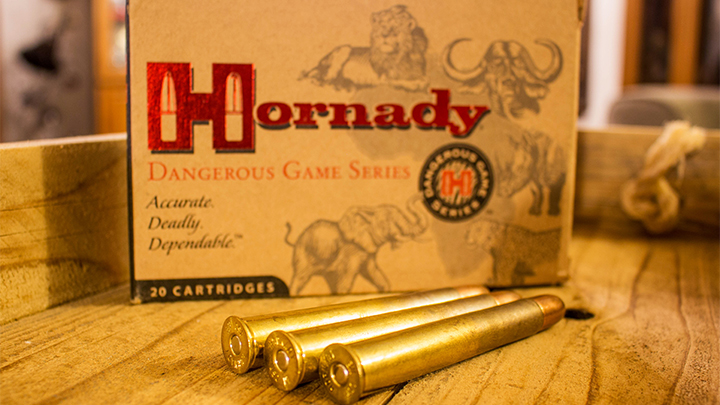
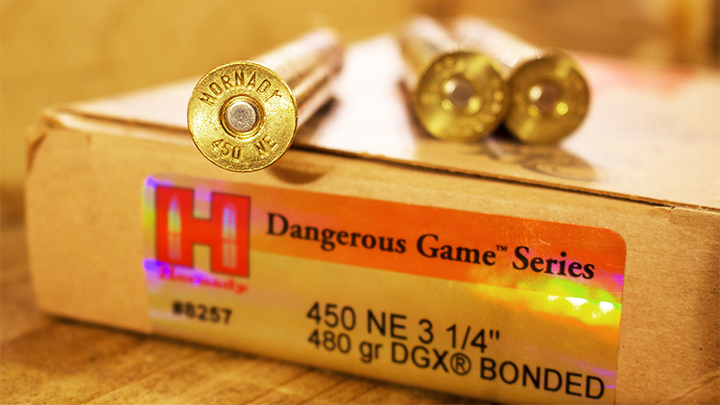
Hornady has played a big role in keeping the older safari cartridges alive, and the .450 3¼-inch Nitro Express is no exception. They offer their duo of 480-grain DGX Bonded softpoint and DGS full metal jacket solid, at a muzzle velocity of 2150 fps—this is the velocity at which so many of the vintage double rifles were regulated—so should you find a rifle which tickles your fancy, there is at least one good source of American ammunition.
For those who handload, components for the .450 NE are readily available. The myriad of .458-inch diameter bullets made for the .458 Winchester Magnum, .458 Lott, .450 Rigby, .45-70 Government and will all work in the .450 NE, though be aware that if you own a double rifle, it will more than likely require the 480-grain bullets for which it was regulated. Hornady makes component cases as well as resizing dies.
It seems a bit of a shame that the .450 NE has become such a limited product, as it truly is a great design. But it is clearly evident that the .470 NE won the popularity contest, even in my gun safe. Even John Rigby & Co. adopted Joseph Lang’s .470 after the 1907 ammo ban, and I feel that when Federal reintroduced .470 NE ammunition in 1989, that may have been the death knell for the .450, though it hangs on by a thread. For the hunter, the field performance of the two cartridges is so close it is negligible. The .470 has a bit more frontal diameter, the .450 has a better SD; and the 20-grain difference in weight shouldn’t make a difference at all. However, the wider availability of the .470 ammunition has given those rifles a greater resale value.
We all owe the .450 3¼-inch Nitro Express a debt of gratitude, even if for the fact that it established a ballistic formula upon which so many dangerous game hunters rely. Among the professional hunters I’ve shared a camp with, only one has readily used a .450 NE, but in spite of the rarity, it remains a reliable cartridge for nearly any hunting situation involving dangerous game at close quarters.
Categories
Thompson contender .30 herrett
 Now that would leave a mark that even bondo would be hard put to fix! Grumpy
Categories
Browning model 65 .218 Bee
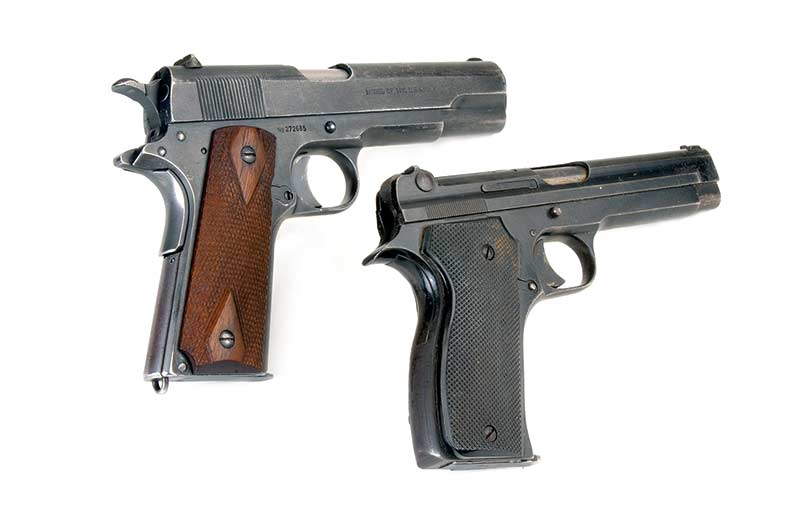
At right is a French Model 1935A. At left is a U.S. Model 1911.
There is much hoopla in the firearms press about the new .30 Super Carry and the handguns being built for it. I don’t own one of the pistols, have never seen one of the cartridges and doubt I ever will shoot a .30 Super Carry. This isn’t being ugly; it’s just the Way of the Dinosaur. (That’s me.)
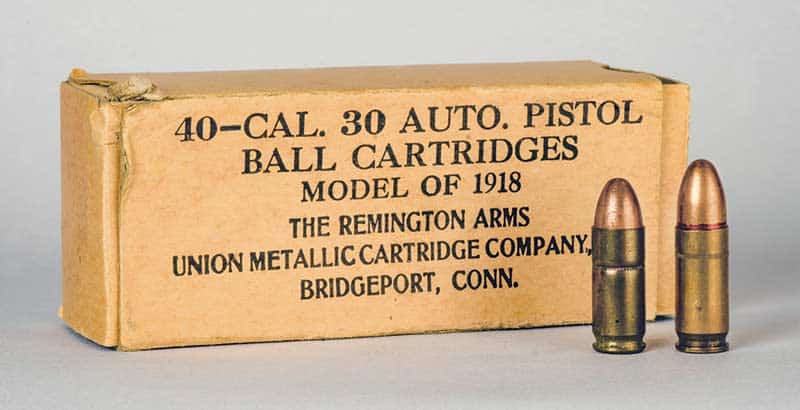
This is an original box of the U.S. .30 Auto Pistol Model of 1918 ammunition.
The cartridge at the left is a round from the box. At right is a round of French 7.65mm Long.
The Pedersen Device
But I can give you some interesting backstory. Let’s return to 1917/1918. The U.S. Army was embroiled in World War I’s trench warfare. Invading German trenches with five-round capacity Model 1903 Springfield rifles battle-zeroed for 547 yards and fighting at off-the-muzzle ranges just wasn’t an optimal situation. Especially considering the Germans had thousands of their 8″-barreled P08 “Artillery” 9mm Lugers with 32-round drum magazines with which to shoot back. Of course, the reverse was true when German Sturm Truppen landed in Doughboy trenches.
Therefore, a solution to the U.S Army’s dilemma was envisioned in 1917 by noted arms designer J.D. Pedersen. On his own, he developed a device that could be fitted to M1903 .30-06 Springfield rifles converting them from bolt action, five-round shooters to semi-auto, 40-round shooters. U.S. Army officials were wild about the idea.
However, the Pedersen Device necessitated a new cartridge. Mr. Pedersen had developed it too. It used a rimless case, 0.78″ long with a 0.308″, 80-grain bullet giving nominal velocity from an M1903’s 24″ barrel of 1,300 fps. The U.S. government christened it with the lengthy name of U.S .30 Auto Pistol Model of 1918. (The words “Auto Pistol” were used to fool German spies.)
The Pedersen Device fed those rounds from an awkward-looking magazine angled from the top right of special Mark I M1903s and ejected fired cartridges through a port on the action’s left side. Pedersen Devices and its “.30 Auto Pistol” ammunition made it to France but hostilities ended before them seeing action.
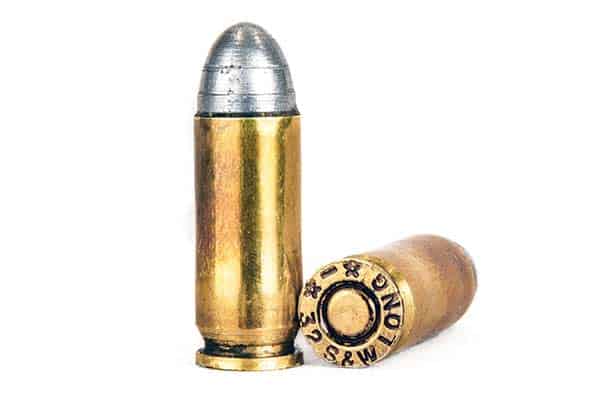
Duke’s favorite 7.65mm Long handload uses 81-grain cast bullets from
Lyman mold #313249 in newly manufactured Starline brass.
The French Go .30
Now we’re into the mid-1930s. A French engineer named Charles Petter, working for Societe Alsacienne de Constructions Mechaniques (SACM), designed a new pistol for the French Army. Although it vaguely resembled the American U.S. Model 1911, it was petite in comparison. Barrel length was 4.30″ with a weight of only 26 oz. Chambering was for a likewise petite cartridge called 7.65mm Longue (Long). Have you figured out where I’m heading here? That’s right, the “new” French cartridge had a rimless case of 0.78″ length, with an 85-grain bullet at a nominal velocity of about 1,100 fps. Evidently, the French had obtained some of the U.S. .30 Auto Pistol Model of 1918 ammunition and liked it, except they increased the bullet diameter to 0.310/0.311″.
France’s new military pistol was designated Model 1935A. It is a delight to handle with a slightly curved grip frame that fits hands better than most straight grips. Also, its checkered black plastic grips are comfortable. Safety is a hammer block type. Flip it up and solid steel blocks the hammer from hitting its firing pin. A magazine disconnect doesn’t allow the pistol to fire if its magazine is absent. Sights are simple: a small blade front dovetailed to the slide and notched rear machined integral with the slide. What ruins its aesthetics is a baked-on, black paint finish.
Are you wondering why I’m so familiar with the French Model 1935A? The story is too long to detail here, but I got my first while in my teens and sold it long ago. I bought another in 2010. I managed to purchase some original French ammo with the newest one. In sealed boxes and looking pristine, not one round of it would fire. My shooting has been chiefly with cast bullets from Lyman mold #313249, sized to 0.313″ and weighing 81 grains. Brass is brand-new from Starline. In fact, I use properly adjusted .32 Auto reloading dies. My velocities are running around 1,100 fps, depending on the exact handload.
What Comes Around, Goes Around
So how does this connect to the new .30 Super Carry? Well, the new case is rimless, 0.827″ long and loaded with 100- to 115-grain, 0.313″ jacketed bullets. The velocity quotes I see mention 1,250 fps but with stupendous pressures of 45,000 psi. By comparison, the maximum 9mm Luger pressures are 35,000 psi. Is the .30 Super Carry just a copy of the old U.S. .30 Auto Pistol Model 1918 round but made a mite longer for safety’s sake? Supposedly not. Regardless, there is definitely a backstory worth considering.

There’s quite a lot of science that goes into modern expanding bullets.
In the end they do exactly what they are supposed to do.
It still amazes me after all these years that I can speak so dispassionately about this stuff. Ours was a fairly large, extremely violent city, and I didn’t know many people. The possibility that a patient might be an acquaintance was small. This made it easier to depersonalize. An inability to depersonalize would disqualify you from service. Nobody could do this long-term otherwise.
The cops rolled in with the ambulance. Witnesses said this guy’s car veered off the crowded Interstate and onto the shoulder. The vehicle gradually lost speed until it came to an unceremonious but not unduly violent stop against an overpass abutment. The first bystander opened the door to find that the driver’s head had exploded.
That’s not hyperbole. The front bit looked quite normal. However, there was a defect to the right rear occiput, the back part of the skull, that would admit an adolescent tangerine. The skull was peeled outward, and a substantial volume of the poor guy’s personality was still back in the car someplace. Amazingly, when we met he was still breathing.
Of the literally countless things I found shocking about medical training, principal among them was just how tough it can be to kill a man. I’ve seen folks shot straight through the brain who kept on kicking and twitching for a quarter hour or more before their bodies finally got the memo. So it was here. There was clearly no happy ending to be had, but we still needed to go through the motions.
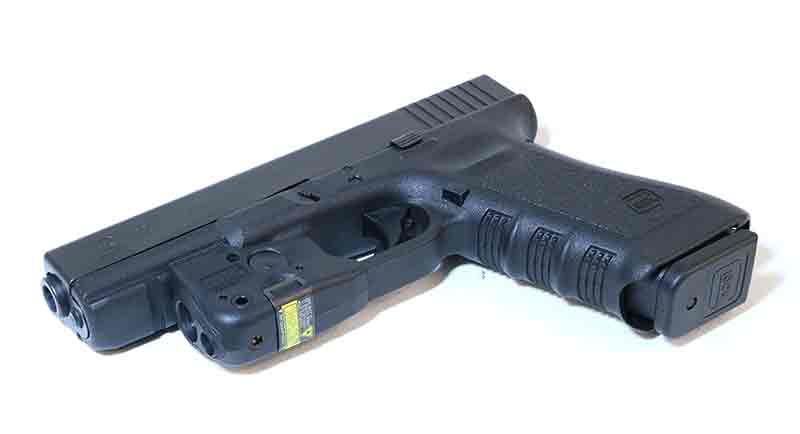
The physics behind guns and gunshot wounds can at times seem otherworldly.
When it was all done we put the guy in the Trendelenburg position. Modern medicine is so freaking stupid. Trendelenburg simply means you orient a person head down and feet up. Why we couldn’t just say “lower his head” or something similarly sensible escapes me. To make it worse, to orient a patient head up and feet down is called “Reverse Trendelenburg.” Please…as though the study of modern medicine were not sufficiently complicated already. We arranged a big garbage can underneath his nugget and let him be for a while.
I was just a medical student, but I spoke guns more fluently than anyone in the hospital. The cops literally had no idea what happened to the guy. There was no visible damage to the vehicle—no bullet holes or blown-out windows—and they could find no weapons in the car. He had apparently just been cruising down the Interstate when his head detonated. To exercise a tired cliché, the authorities were baffled.
I went back into the trauma room alone to study the guy for a while. Aside from being motionless and a little colder nothing was different. I donated a pen to the cause and started poking around the exit wound. A substantial piece of skull had been lifted loose and rolled back but was still attached to a flap of scalp. As I explored amidst the gore I saw it.
There was a circular scrap of gold-colored metal trapped between the skull fragment and scalp. I tugged it free, ran it under the sink, and studied it in good light. To the experienced eye it was clearly the base of a bullet jacket.

I moved around to the front and studied the dead man’s face. There just wasn’t anything out of the ordinary there. I then pried his mouth open and oriented the bright trauma room light so it would angle down his gullet. There back in the deepest recesses of his oropharynx I could see the beginnings of some powder burns. This was a suicide. The guy had shoved the muzzle back past the back of his tongue before he stroked the trigger.
I miked the bullet jacket on a piece of EKG paper at eleven millimeters. I then put it in a little bag and tracked down the cop who had come in with the guy. Our dude had killed himself with a .45ACP handgun. The pistol was still in the car someplace. They just hadn’t found it yet. The cop made a radio call.
They found the .45-caliber Glock deep underneath the passenger seat. Nobody had any idea the physics that could have put it there. The bullet core was lodged in the headliner and impossible to see if you weren’t specifically looking for it. I was just a lowly med student at a Level 1 trauma center, but that night everybody thought I was a rock star.