Category: Allies

Jack Mann during wartime: the LRDG ranged over huge distances, travelling behind enemy lines to gather intelligence for the 8th Army – Courtesy of family
Jack Mann, who has died aged 100, served with the SAS and the Special Boat Service (SBS) and was believed to be the last surviving member of the Long Range Desert Group (LRDG).
Mann volunteered to join the LRDG as a radio operator in January 1943. The unit was born of the expertise of a small number of prewar desert explorers. It ranged over huge distances in North Africa, travelling behind enemy lines and navigating with the aid of the stars and a sun compass – a primitive but effective device – to gather intelligence for the 8th Army.
Primarily a reconnaissance unit, the LRDG did not seek confrontation, but if it ran into trouble its vehicle-mounted machine guns proved highly effective. Mann was responsible for receiving and deciphering the double-coded messages that directed operations over great distances.
Using modified No 11 sets, housed in cabinets on Chevrolet and Ford trucks, he had to contend with high desert temperatures and sandstorms which degraded equipment and disrupted incoming signals. As the enemy’s range-finding equipment became more sophisticated, transmissions became increasingly hazardous.
The LRDG made the desert their accomplice. Their patrols believed that they could always outwit the Axis forces on the ground. Mann, however, hated the desert. “Don’t talk to me about sand,” he used to say. “I’ve had it in my eyes, my mouth, up my nose, in my food, everywhere.”
He served with the SAS in North Africa and Italy before moving to the RAF Ramat David camp in Palestine, then under British administration, where he took a parachute course. The training included jumping out of a truck at 20mph and leaping from the top of a 15ft ladder without a harness.

As a radio operator he had to contend with high desert temperatures and sandstorms which degraded equipment and disrupted incoming signals – Courtesy of family
Mann subsequently moved to Nahariya, the base camp of the Special Raiding Forces, and transferred to the newly formed Special Boat Service as a radio operator – one of its original members. It was commanded by Lieutenant-Colonel George Jellicoe, the son and heir of the 1st Earl Jellicoe, a naval commander at the Battle of Jutland and Admiral of the Fleet in the First World War.
Mann was seconded to the Greek Sacred Squadron, which had trained with the SAS and seen action in North Africa. The Squadron used small boats and took part in hit-and-run amphibious operations against German garrisons in the Eastern Mediterranean, the Aegean Sea and the Dodecanese islands.
These islands off the coast of Turkey were controlled by the Italians up to Italy’s surrender in September 1943; Turkey then claimed sovereignty over them. Churchill, who hoped to bring Turkey into the war on the Allied side, committed substantial forces in an attempt to seize the islands as a springboard for an attack on mainland Greece. The Dodecanese operation failed primarily because of lack of air cover.
Mann was involved in reconnaissance missions using kayaks and a camouflaged hide-out near Bodrum on the Turkish coast. On other raids, Royal Navy motor torpedo boats and launches took members of the squadron to Turkey, where they were transferred to fishing caiques. Their rations were sometimes supplemented by wild boar, and fish dynamited in the sea.
On one occasion, Mann had just finished preparing a meal when an officer pushed his way to the front. When Mann told him to get back in the queue, he was arrested and marched off to a military prison.
In his paybook, however, he had given his nationality as Russian Orthodox instead of Jewish and, using his language skills, he persuaded his jailers that he was a Russian and insisted that he be allowed to appeal to the Soviet authorities. They decided that he was too much trouble and returned him to his unit.
One night, Mann was asleep in his hide-out on the island of Chios when he and a comrade were awakened by a German “E” Boat, a fast motor torpedo boat, approaching the shore. The two men, armed with rifles but in their underwear, greeted the German crew in Greek.

Mann, middle row, fourth from the right, with his LRDG comrades in 1943 – Courtesy of family
The crew surrendered but they tried to be friendly, claiming that they were all Anglo-Saxons. Mann retorted that he was a Jew, ordered them to cut off their swastika badges and had them placed in the local prison. There they were made to clean a local building of faeces left by the occupying German forces.
Jack Mann was born Zacharia Zuckerman in Cairo on September 23 1925. His father, Zachary, who had died two days earlier, was an eminent dental surgeon from Bucharest in Romania who had gained his degree in dentistry in France.
His mother, Victoria, née Warshawsky, from Odessa, was Russian, spoke French and came from a well-to-do family. Mann’s uncle, Henry, was also a dental surgeon and treated members of the Egyptian royal family.
Mann spent the first years of his life living in Paris before returning to Cairo. He was educated at the Cairo Lycée Français, where he learnt Arabic, English, French and Italian. By 1942 he was learning from his relations in Europe that fellow Jews were being rounded up and sent to concentration camps.
He falsified his age in order to enlist in the British Army to fight the Nazis and joined the Royal Corps of Signals as a radio operator. He was subsequently recruited by the Intelligence Corps and tasked with infiltrating a POW camp to glean intelligence from captured Italians. He decided, however, that his Italian was not fluent enough to maintain his cover.
In 1945, after several more months liberating islands from German control, the Aegean Raiding Forces were disbanded. Mann moved to a naval base near Alexandria in Egypt, where he rejoined the Royal Signals. After the end of the war, he resigned from the Army.

Jack and Helga Mann at Cannes in the 1960s – Courtesy of family
As a Jew, he had been determined to fight the Nazis, and then to help the Jewish diaspora and displaced Jews of Europe when the war ended. In November 1947, the UN passed a resolution to divide British-ruled Palestine into separate Jewish and Arab states.
Israel declared independence in May 1948. Arab armies invaded in what became known as the Arab-Israeli War and Mann joined the conflict to help establish a state of Israel. He was given the rank of major and put in charge of communications on the Southern Front.
During a crisis in which he had to get to HQ urgently, he commandeered Moshe Dayan’s jeep. Ignoring the fact that the commander of the important Jerusalem Front was sitting in it, he ordered the driver to take him straight to HQ. The war ended in 1949 with an armistice agreement.
Mann moved to Britain and worked in a shipping business based at Southampton. He subsequently became European sales manager for two leading chemical companies, a job which involved him in extensive travel. In his spare time he enjoyed swimming; he also had a passion for music and played the piano by ear. He also worked as a Samaritan and supported a number of charitable causes.
He remained closely involved with the veteran associations of the Special Forces in which he had served, and at his funeral his coffin was escorted by standard-bearers from the SAS Regimental Association, the SBS Association and the Association of Jewish Ex-Servicemen and Women.
Mann had a host of friends and a fund of amusing stories and was the best of company. On his 100th birthday last year he received a handwritten letter from the King, together with a bottle of champagne.
Jack Mann married first, in 1950, Elizabeth Fine. When the marriage came to an end, he married, in 1965, Helga Jorgas. She survives him with two daughters from his first marriage and two daughters from his second.
Jack Mann, born September 23 1925, died August 13 2026
A burning Vickers Wellington was coming apart over Holland when Sergeant James Ward did something almost impossible. He crawled outside the bomber at 13,000 feet and went after the fire himself.

Between 3 and 6% of the general population suffers from acrophobia. That’s the doctor word for fear of heights. Most normal people are rendered a bit uneasy if exposed to a high place, particularly without reliable safety measures.
The military weaponizes this. Back when dinosaurs roamed the plains and I was training to become an Army officer, we had to walk along a long board set up on cinder blocks maybe eight inches off the ground. The objective was to step over a big wooden box mounted in the middle. At the time, we thought that a fairly ridiculous exercise.
Then we climbed a tall tower out over a deep lake and had to do the same thing. This time, however, the long plank was secured forty feet above the water. What had been a bit of a lark down on terra firma became a gut check that high up in the air.
That exercise was supposed to teach us something, though I don’t recall exactly what. It did, however, leave an impression on me.
Even though I am not in that 6% myself, I still wasn’t too crazy about having to clamber over that big box suspended forty feet above a lake. While we can likely all agree that a modest fear of heights is pretty physiological, a WW2-era aviator named Sergeant James Allen Ward did not seem so encumbered.
Table of contents
- James Ward: The Kiwi Sergeant Who Was About to Redefine Brave
- Vickers Wellington: The Fabric-Skinned Bomber That Refused to Die
- Vickers Wellington Mk IC Specifications
- 8 July 1941: A Bf 110 Turns the Wellington Into a Fireball
- 13,000 Feet Up, James Ward Climbs Onto the Burning Wing
- Victoria Cross Glory, Then a Brutal Final Mission
- James Ward’s Victoria Cross Story Still Defies Belief
- Related Reads from GunsAmerica Digest
James Ward: The Kiwi Sergeant Who Was About to Redefine Brave

James Ward was born on 14 June 1919 in Wanganui, New Zealand, to English parents Percy Harold and Ada May Ward. He attended Wanganui Technical College and trained to be an educator. Ward had just accepted his first teaching position in 1939 when World War 2 kicked off. He volunteered for the Royal New Zealand Air Force and was accepted for flight training.
At this point in the history of the British military, pilots could be either commissioned officers or sergeants. James Ward was the latter. Additionally, unlike their American counterparts, most British multi-engine bombers were typically configured to fly with a single pilot. Even the massive four-engine Lancaster flew with a single pilot alongside a flight engineer who was trained to manage the flight controls in an emergency. When a unit had enough pilots, they would take along a spare whenever possible, but it wasn’t necessary. This was, however, important for new inexperienced aviators just learning their trade.
James Ward was eventually assigned to No. 75 Squadron flying twin-engine Wellington bombers. At the time of his arrival, No. 75 Squadron only had a single flight position remaining open. Ward earned the posting on the strength of a coin toss.
Vickers Wellington: The Fabric-Skinned Bomber That Refused to Die

The Vickers Wellington was called the “Wimpy” by the men who flew it. 11,461 of these tough twin-engine bombers were produced. The plane carried a crew of five and evolved through several marks. The Wellington Mk IC was 64 feet long and sported an 86-foot wingspan. Maximum takeoff weight was 28,500 pounds, and the plane would carry 4,500 pounds’ worth of ordnance.
The Wellington Mk IC carried two.303-caliber Browning machineguns in each powered turret in the nose and tail. There were fittings for two more .303 Brownings in waist positions. The plane’s maximum speed was 235 mph, and the service ceiling was 18,000 feet. The Wellington had a maximum range of 2,550 miles. The plane remained competitive with similar German, Japanese, and American designs.

The Wellington was curious in that it was formed around a geodetic skeleton covered in doped fabric. This made the airframe strong but light and was a cost-effective way to build airplanes. However, the fabric covering was not as substantial as aluminum. It was also quick to burn.
Vickers Wellington Mk IC Specifications
| Aircraft | Vickers Wellington Mk IC |
|---|---|
| Length | 64 feet |
| Wingspan | 86-foot wingspan |
| Maximum Takeoff Weight | 28,500 pounds |
| Ordnance | 4,500 pounds’ worth |
| Maximum Speed | 235 mph |
| Service Ceiling | 18,000 feet |
| Maximum Range | 2,550 miles |
8 July 1941: A Bf 110 Turns the Wellington Into a Fireball
By mutual acclimation, the British bombed at night, while the Americans operated during the daytime. This kept the pressure on German air defenses around the clock. However, the Germans quickly adapted. Particularly early in the war, their day and night fighter forces were without peer.
On 8 July 1941, Sergeant Pilot James Ward was flying with his commander, Squadron Commander Reuben Widdowson. This was Ward’s sixth combat mission with this pilot and crew. Their objective was the Dutch coast. Everything went smoothly until Ward and Co turned the big plane for home.

Out of the darkness, Ward’s Wimpy was attacked by a German Bf 110 night fighter. These aircraft eventually carried their own radar and variable geometry guns optimized for the night fighter mission.
At this point in the war, however, German night fighter pilots usually received rough guidance from radar ground controllers and then finalized their attacks, keying off of the small yellow flames emitted by the target planes’ exhaust stacks.
The Bf 110 carried four 7.92mm rifle-caliber machineguns tightly clustered in the nose along with a pair of 20mm cannon fitted in the belly and boresighted to fire alongside the smaller machineguns. This extreme concentration of firepower brought down many an Allied bomber.
On the evening of 8 July, this Bf 110 raked the Wellington along the right wing root. The fuel tank in the starboard wing ruptured and began spilling gasoline. This fuel caught fire and threatened to burn through the aircraft’s structure.

The tail gunner was hit in the foot, though he did successfully shoot down the marauding Messerschmitt. However, in short order, the plane’s fabric skin began conflagrating. The crew hacked a hole in the fuselage to access the fire and expended all of their onboard fire extinguishers fruitlessly. They even threw their coffee onto the flames in an unsuccessful effort at putting out the stubborn fire.
With the fire spreading steadily, Squadron Leader Widdowson ordered his crew to bail out while he still retained control of the aircraft.
However, Sergeant Ward made one last suggestion. What if he could crawl outside the airplane and then use an engine cover to smother the flames? This operation would be unimaginably dangerous. However, it might just prevent the crew from spending the rest of the war in a prison camp or worse. Widdowson relayed his bailout order.
Nobody had ever done this before, and the plane was not designed to support a NASA-grade EVA (Extra-Vehicular Activity) in flight. Ward just had to make this up as he went along. He removed the astrodome navigation port and harvested a length of rope from the onboard survival dinghy. Once he had the dinghy rope secured around his waist, SGT Ward crawled out of the airplane. The hole was too small to accommodate a parachute.
13,000 Feet Up, James Ward Climbs Onto the Burning Wing

The Wellington stalls at around 65 knots or about 75 miles per hour. That number goes up if the flaps and landing gear have not been deployed. Ward somehow fitted his parachute while also clinging to the exterior of the airplane. With the slipstream tearing at his face and hands, SGT Ward actually crawled along the outside of his airplane heading to the right wing root that was actively ablaze.
There was nothing to hang on to, so Allen punched foot and handholds into the Wellington’s fabric skin with a fire axe…while also being buffeted around at 13,000 feet over Holland in the dark.
Ward described his experience outside on the wing of the aircraft while exposed to the slipstream, as “…being in a terrific gale only worse than any gale I’ve ever known.” He did, however, eventually reach the engine along with the part of the wing that was fuel-soaked and burning.
The plane’s navigator, SGT Joe Lawton, kept tension on the dinghy rope while Ward was crawling around on the outside of the big flaming airplane.
They had previously been using the padded engine cover as a seat cushion. Cushion in tow, Ward crawled three feet down the fuselage to get to the wing and then slithered another three feet hand-over-hand to reach the fire. Now he was oriented right behind the screaming prop that was trying desperately to blow him off into space.
Ward used the engine cover to smother the fire and discovered a gaping hole in the plane along with a severed piece of tubing that appeared to be the source of the fuel leak. He attempted to plug the hole and staunch the leak with the cushion. However, a gust tore the cover out of his hand, and it was lost.

Now utterly exhausted, Ward clawed his way back through the astrodome. However, the fuel line was still leaking. As they neared their home airfield, accumulated gasoline flared up again but miraculously burned itself out without reigniting the wing fabric. Despite the severe damage to the airplane, Squadron Leader Widdowson and Sergeant Ward successfully wrestled the big machine safely to the ground.
Victoria Cross Glory, Then a Brutal Final Mission
On 5 August, SGT James Ward was awarded the Victoria Cross, Great Britain’s highest decoration for gallantry in combat. SGT Ward was one of only three New Zealanders to earn the VC during World War 2.
The award was presented by Winston Churchill himself at 10 Downing Street. Once in the presence of the Prime Minister, Ward found himself unable to speak. Moved by the young man’s discomfited state, Churchill said, “You must feel very humble and awkward in my presence.” Ward replied, “Yes, sir.”
Churchill continued, “Then you can imagine how humble and awkward I feel in yours.”

While on leave to receive the award, Ward attended a formal dinner in his honor. Someone spilled fuel from a cigarette lighter onto Ward’s hand and inadvertently set it alight. The injury was trivial, but Ward fainted. Realizing the emotional trauma that the young man had clearly endured, Ward’s treating physician drafted a note to keep him off of flight duty. That note was never passed up the chain.
I wish the tale ended there. However, SGT Ward kept flying combat missions. Upon his return to his unit, Ward was given his own plane and crew. On his second mission as aircraft commander, Ward’s Wellington was engaged by a German night fighter.

The plane caught fire in short order. Appreciating that the machine was doomed, Ward held the aircraft steady and ordered his crew to bail out. Two of the five-man crew did so and were made prisoner. Ward and his other two mates rode the plane in. James Ward was 22 years old at the time of his death.
James Ward’s Victoria Cross Story Still Defies Belief
There is brave, and then there is “climb outside a flaming aircraft to save your buddies” brave. James Ward was next level. His amazing sacrifice ultimately helped drive the Allies to victory. Now, better part of a century later, I am legitimately in awe of the man.


Categories
IT’S THE LITTLE THINGS
NOW AND THEN, WE’RE REMINDED HOW NICE IT IS TO HAVE FRIENDS
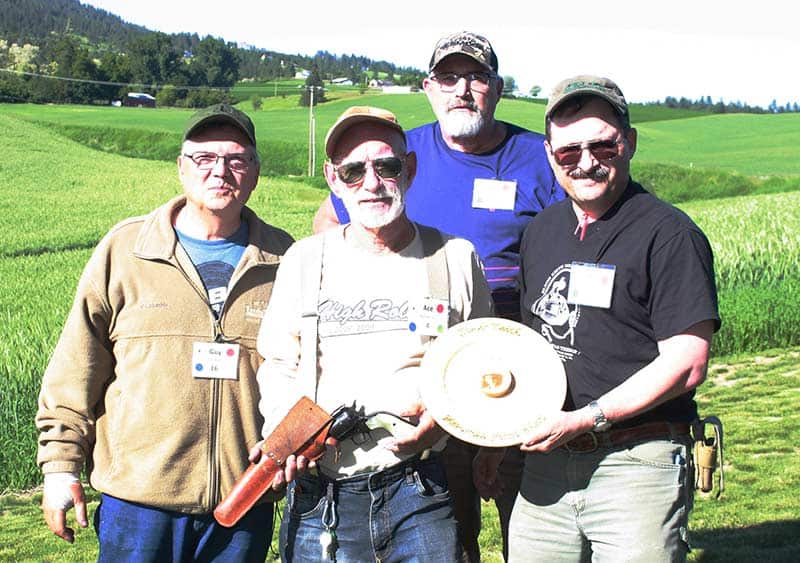
That’s Ace Fernandez, celebrating a win at one of the past Elmer Keith Long
Range handgun shoots. He’s holding a vintage Ruger Super Blackhawk in .44
Magnum, and he knows how to use it! He is flanked by Guy Maakad (left),
Ed Parry (right) and Bob Toppen to the rear.
Ace Fernandez is walking proof one should never compete with a guy named “Ace,” and never, ever, underestimate anybody on a shooting range who has a snow white beard, mild demeanor, affable disposition and a great, big hogleg.
I’ve known Ace for at least a decade and then some, and I can say without fear of contradiction — because he’s done it in front of witnesses — he is one of the most remarkable and annoyingly proficient long-range handgunners anywhere. Perhaps what I like most about this old gentleman is that he hasn’t made a career of running around bragging about it. Guys like Ace do what they do and then go about their business.
Fernandez is, or we should say was, a mainstay at the annual Elmer Keith Memorial Long Range Handgun Shoot, which I wrote about a few months ago under the headline “The Last Dance,” (add internal link to previous story) because after 20 years, this wonderful little gathering of handgunners from around the Northwest came to an end this year. I will miss watching him shoot.
So, when a nondescript padded envelope with something inside appeared in my office mail recently, with his return address label on the corner, it got my immediate attention. It felt kinda like a pocketknife, but wasn’t quite heavy enough. Out came my dangerously sharp Spyderco and with a quick swipe or two through layers of tape, what came out of an inner package was a stunner.
There, in my greasy little palm, was a pistol magazine for an original Ruger Standard semi-auto, about which I also wrote recently. Original magazines are fairly rare anymore, so a couple of days later, while taking a break from house painting (yeah, even writers have “normal” chores during the summer!), I called Ace to thank him and see what I owed him for this little treasure.
From the ‘Old School’
Me: “Do I owe you anything?”
Ace: “For what?”
Now there’s a guy from “the old school” with whom you could sit at a campfire, reminisce, share a tall tale or two, and burn powder most of an afternoon in the farmlands south of Spokane and never get tired. It is, after all, the “little things that count” in life, and guys like Ace are to be treasured, only if for the sake of saying you met them.
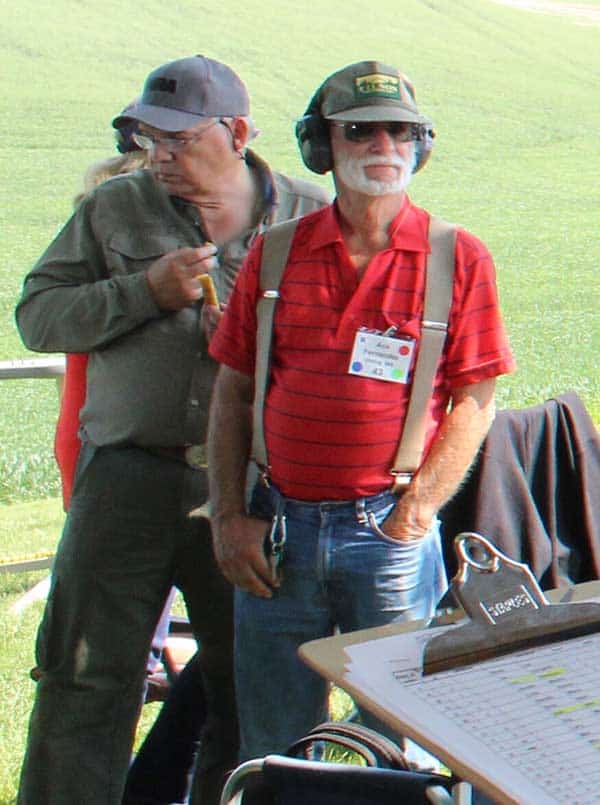
Ace Fernandez may look like an old guy who might shoot a little,
but don’t kid yourself. This particular old guy is one of the best long-range
handgunners I’ve ever seen. And he’s generous!
According to his brief narrative, Ace was sifting through some boxes of stuff (that’s what we call junk out here in the wilds) and came across this Ruger magazine. Apparently, there was no longer a gun for it in his safe, and I can only presume he had read my earlier piece on shooting grouse with .22 pistols — a horrid habit us westerners have developed over several generations, much to the chagrin I presume of haughty New Englanders who sit around the fireplace at the hunting lodge in the fall, reminiscing about all the great missed shots they’ve fired through their 28-gauge Purdeys, but at least we folks in the settlements eat well — and decided the magazine needed a new home.
It evidently occurred to Ace he knew this cantankerous, and frequently obnoxious gun scribe upon whom charity is probably a wasted effort. So, he explained, “I needed to get rid of some stuff.” Thus, his package with the treat inside landed on my desk. Well, it wasn’t my birthday and it wasn’t Christmas (in my case, they fall on the same day in December), so being the pitiful wretch that I am, I gratefully and most humbly accepted his generosity.
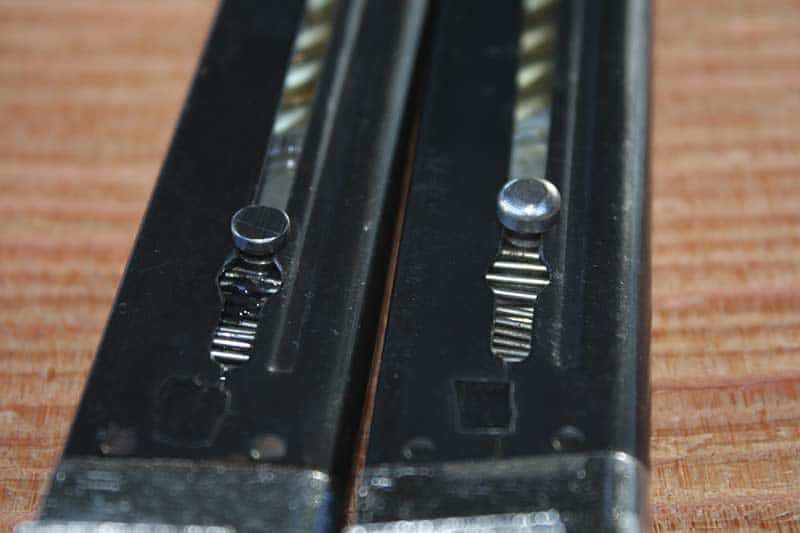
See the difference in follower buttons? The one on the left was sent to
Dave by Fernandez, who found it in a box of “stuff” and it fits an original
Ruger Standard pistol.
Now, this particular specimen must have been a really old original. I reached that conclusion because instead of a rounded head on the magazine follower button, the “Ace model” has a flat button. I cannot recall ever having previously seen one of those, but everything else about this magazine was true to form. The first thing I did was insert it into my pistol and it fit like a glove.
However, I quickly discovered the follower didn’t descend and rise smoothly, and it turned out the magazine was so dry inside — likely from sitting idle for years — I had to lube it up with some gun oil and Gunslick graphite compound. Works good, now! By the time you read this, I’ll have likely capped off a few rounds at fool hens, and hopefully will be dining this evening on grouse, barbecued or fried in a cast iron skillet, remembering Ace helped put it there.
The Moral
I guess the moral to this story is that one can never take for granted the friendships that spawn on a gun range, or around a campfire or any other place where camaraderie is always on the agenda.
Little gestures make big impressions because they are the sort of thing nobody ever has to do, but does so anyway. That is the sort of fellow Ace is, and there is usually somebody just like him in any fellowship. You know the type. The older guy with wrinkles he earned, probably the hard way, to whom there is much more than meets the eye.
But be wary of the ones called Ace. They can probably shoot rings around you on their worst day, and do it with such nonchalance it may drive you nuts.
How Stupid Is This?
It’s quiz time, and the question for this week is “How Stupid Is This?”
Late last month, at an apartment complex in Parkland, Wash., a pair of teens pulled handguns and pointed them at a 10-year-old girl. Fortunately, adults in the apartments were observing. They called the Pierce County Sheriff’s Department and shortly thereafter, the little punks were in custody, according to an entry on the sheriff’s Facebook page.
Now, it’s dumb enough to be packing hardware at the age of 17, but one of these boneheads was armed with (wait for it) a handgun that had been reported stolen in 2021. Both of these guys got a free ride in a public vehicle to the juvenile detention center, and are now facing charges of unlawful possession of a firearm. The kid with the hot gun has an additional charge of possession of a stolen firearm. Both were also charged with felony harassment.
You guessed correctly. This was pretty stupid.
But Wait, There’s More!
In Philadelphia last month, a would-be robber was not only captured, but during a physical confrontation with his intended victim, was shot with his own gun.
According to Fox News, the suspect approached the intended victim in broad daylight while the man was unloading groceries from his car. The perpetrator candidly advised the fellow with the grocery bags, “This is a robbery,” and aimed a gun at him.
Surprise of surprises, the victim quickly demonstrated it wasn’t a robbery, but a shooting. He grabbed for the gun, a nasty struggle ensued during which the would-be robber was “grazed” in the mid-section. He went to the hospital.
The intended victim’s hand was injured, apparently when the suspect bit him. Is that what they call “taking a bite out of crime?”
‘Justin Case’ Response
The following note from a reader was sent in response to my previous column titled “Justin Case: Canadian Prime Minister Trudeau Hates Handguns.”
I have my 12(6) on my gun license, as I owned prohibited handguns prior to changes in 1996. I can buy prohibited short barrel handguns and have been doing so because I can give my son any that were made before 1946. I have transferred a bunch to him and he now has his 12(7). He can only acquire pre-1946 guns from me.
I have some post-1945 guns that have to get munched when I die or sold to someone else with a 12(6). There are getting to be fewer and fewer of us and soon all the newer handguns will be destroyed.
My son and I can take these prohibs to the range and shoot them. There are a bunch of other prohibs like the FNFAL and machine guns etc. You can only look at those in your home.
Hopefully, that pansy Trudope gets voted out next election and Conservatives roll back the rules. I fear my four AR’s will be crushed before then. My son also has one. They have been sitting in my safe since May 1, 2020. They haven’t been on the streets as the Liberals say.
Dave, Our gun laws are stupid you have no idea … Love watching the Gun Cranks!
Dave Jones
Royal Canadian Mounted Police retired 35 years
Langley, British Columbia, Canada
Thanks for trying to clear up confusing Canadian gun control laws. The more I learn about what constitutes firearm regulation in your country, the more I’m inclined to agree with your assessment the laws are, as you state,“stupid.”
Now there was a REAL Soldier!
Berlin was collapsing, the Reich was finished, and Georg Diers still had one terrifying steel monster left to fight with. This is the brutal, strange, and curiously compelling story of Germany’s last operational Tiger tank and the man who rode it into the end of the world.
Villains, Warfighters, and Why This Story Still Grabs You by the Throat

The Nazis are nature’s perfect villains. These original jack-booted thugs murdered entire people groups simply because they found them to be inconvenient. It is literally impossible to get away with saying anything positive about World War 2-vintage National Socialists in modern woke America. This is quite understandable. The Nazis were objectively horrible in every conceivable way.
After the war, there were actually strikingly few Nazis. Most everyone, from little old lady civilians to recently demobilized combat veterans, said they were all just following orders and that they had no idea that the atrocities were taking place. Some of that might be true. Most of it probably was not. What is incontrovertible, however, is that the Germans during World War 2 produced some exceptionally effective soldiers.
The War Savants Who Rewired Modern Combat

In addition to being really snappy dressers, these guys literally wrote the book on modern combat tactics. Guderian’s blitzkrieg inspired the Air-Land Battle doctrine I was taught when I was in uniform. It drives whatever they are calling it these days as well.
The Germans showed us that audacity and flexibility were the keys to success in modern war, and that the ability to reorganize badly attritted combat units on the fly seriously enhanced their effectiveness.
German tactical decision-making was pushed down to the lowest possible level. Initiative was both encouraged and rewarded. We see that demonstrated in spades in the US Army today. That all really blossomed with the Heer and the Waffen SS during the Second World War.
With the world crumbling around them in 1945 and the Allies advancing on all fronts, ravaged German combat units coalesced for a desperate yet futile last stand. A core of what remained of the German war machine fell back to Berlin to defend der Führer in his final days, desperately hoping for some kind of dark miracle. Arguably the most compelling example of this most compelling time was Georg Diers and Germany’s very last operational Tiger tank.
The Tiger I, The Machine That Terrified Allied Troops

The Tiger tank was a masterstroke of marketing genius. While it was an undeniably impressive war machine, it was hardly invulnerable. However, Allied troops the world over were rightfully terrified of the thing.
The Tiger came in two broad flavors. The Tiger I had its origins in the 1937-vintage Durchbruchwagen or “breakthrough vehicle.” The proposal for this machine stipulated that it weigh between 30 and 33 tons and be sufficiently swarthy as to crush all comers. The actual weight ended up being roughly twice that. This concept vehicle eventually evolved into the Panzerkampfwagen VI, which was the definitive first Tiger tank.
1,347 copies were eventually produced. Despite weighing sixty tons, the Tiger I was relatively fast with a top speed of 28 mph on a smooth surface. The Tiger’s armor protection was legendary, and its KwK 36 L/56 88mm main gun would kill any armored vehicle on Planet Earth at any reasonable range. The real beast, however, was the subsequent Königstiger or King Tiger.
Tiger II: Bigger, Meaner, and Far Less Forgiving

We call it the Tiger II. The Germans actually designated the vehicle the Panzerkampfwagen Tiger Ausf. B. This literally translates to Tiger B. Aside from sharing a common Maybach HL 230 P30 V-12 petrol engine, the Tiger I and Tiger II were otherwise completely dissimilar.
Introduced in 1944, the Tiger II weighed 69 tons and sported a longer, meaner 88mm main gun than did the Tiger I. When it worked, the Tiger II did about 25 mph on the road. However, the Tiger II was plagued with mechanical gremlins from the very outset.
492 copies saw service by war’s end. The Tiger II figured prominently in Operation Watch on the Rhine, the late 1944 German offensive through the Ardennes that we christened the Battle of the Bulge. The tale of the last operational Tiger II to see action drips with both drama and pathos.
Georg Diers, The Forgotten Soldier Behind Germany’s Last Tiger

SS-Unterscharfüher Georg Diers was a noncommissioned officer in the Waffen SS in 1945. With the war winding down, he found himself in command of Königstiger 314 with SS Panzerabteilung 503. Diers and his mates were tasked with the hopeless mission of defending Berlin against the inevitable Russian onslaught.
Georg Diers was born in 1921 in Niedersachsen, Germany. He originally worked on a farm but also trained as an apprentice butcher. In 1939, Diers volunteered for the Waffen-SS. He first saw combat with the Wiking Division on the Eastern Front from 1941 to 1942. He was badly wounded while fighting in Grozny.
From Farm Kid to Tank Man: How Diers Landed in a Königstiger

After an extensive convalescence, Diers was again ready for action in the summer of 1943. He was then assigned to III SS Panzer Korps under the command of Obergruppenführer Felix Steiner. In this capacity, Diers served in Yugoslavia fighting against Tito’s partisans. While in Yugoslavia, he was transferred to the Panzerwaffe. Georg Diers was now a tank man.
Diers completed training on the Königstiger in January of 1945. He immediately deployed to the Eastern Front as part of a massive force of forty-two Mk VII Tiger II tanks. Once there, they aggressively attacked, rupturing the Soviet lines.
Despite these local successes, German units found themselves in various stages of annihilation by April of 1945. Diers’ Tiger 314 and Königstiger 100 were therefore task organized as part of a Kampfgruppe alongside the 33rd SS Division Charlemagne. The 33rd SS was comprised of French expats fighting for the Nazi cause.
The war was clearly lost, and, thanks to some epically poor judgment, these unfortunate Frogs were royally screwed. They had clearly picked the wrong team. With little left to lose, the Charlemagne Division fought like lions. Curiously, these misguided Frenchmen found themselves at war’s end tasked with the defense of Berlin. Diers served under an SS battalion commander named SS Sturmbannführer Fritz Herzig.
Berlin 1945: A Hopeless Last Stand Inside a Steel Beast
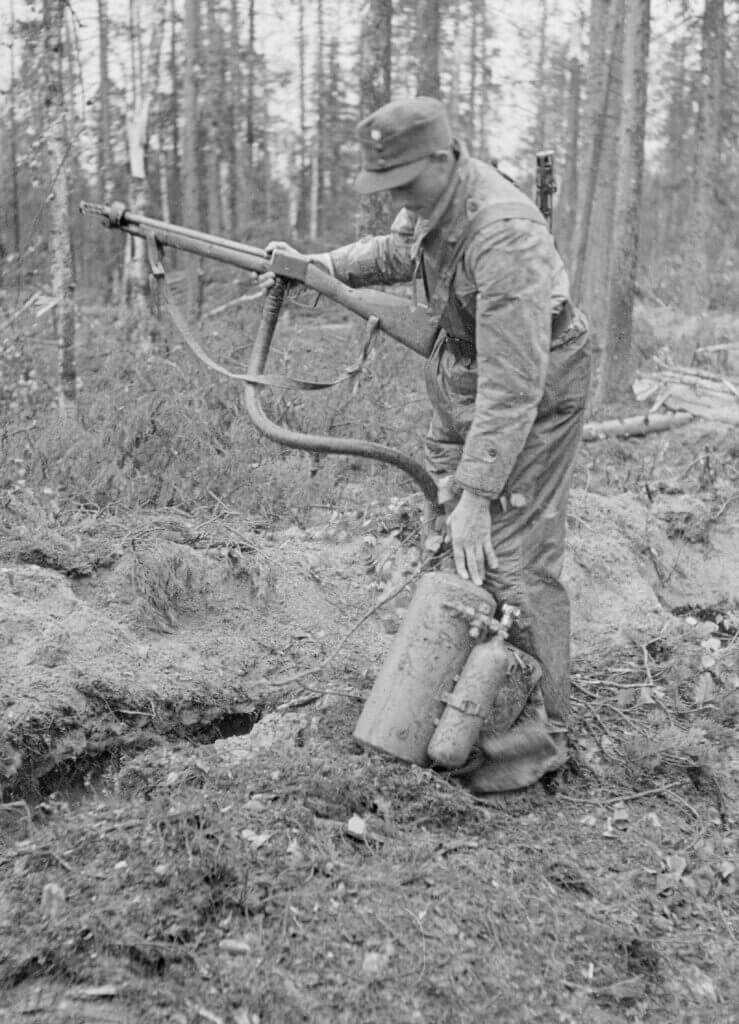
Please cut me some slack on the details. Several sources disagreed on the particulars. It was a chaotic time.
The Königstiger was indeed a formidable weapon, but the Russians blanketed the area with a seemingly endless deluge of artillery shells. They also made widespread use of flamethrowers. These weapons took a toll on even the vaunted Tigers. However, despite these impediments, Diers and his wingman cut the attacking Russians to pieces.
Diers and his sister tank, Tiger 100, were directed to attack from Potsdamer Station to Anhalter Station, several blocks away in the heart of Berlin. These two massive German juggernauts engaged in a running fight with numerous Russian T34 and JS2 tanks. Tiger 100 was eventually shot to pieces and abandoned.
After a frenetic gun battle, Diers’ track and another tank regrouped at the Reich Chancellery. At 11 o’clock on 30 April, these two armored vehicles refueled and rearmed at Goebbels’ nearby villa in preparation for occupying battle positions near the Reichstag.
Over the course of about 45 minutes, Diers and his wingman engaged large numbers of Soviet tanks across the River Spree. Along the way, Diers’ Tiger took twelve hits to the turret, none of which penetrated. During the battle for Berlin, SS-Unterscharfüher Diers and his crew purportedly accounted for an extraordinary thirty-nine Soviet tanks destroyed.
Enraged Soviets were swarming into the city like ants. Diers engaged the massed infantry attacks with his machine guns and high-explosive rounds out of his long-barreled 88mm gun. His Tiger was subjected to suffocating artillery fire throughout this merciless fight. The incessant mind-numbing clanging inside the hull must have been unimaginable.

Diers’ two battered tanks were eventually directed to again regroup adjacent to the Reich Chancellery. By this point, Adolf Hitler was already dead. Protracted activity outside their tank was intolerably dangerous due to the overwhelming superiority of Soviet artillery.
Amidst the chaos, Diers was ordered to report directly to Joseph Goebbels himself. There, he supposedly found Martin Bormann along with Generals Burgdorf, Weidling, Krukenberg, and Mohnke. Goebbels briefed Diers on the latest battlefield developments and directed a breakthrough to the north. Hitler’s psychopathic propaganda minister killed himself soon thereafter.
From the vicinity of Weidendammer Bridge, Diers struck out northwards towards Oranienburg. With the war now lost, the ultimate objective was to surrender to British-Canadian forces in Schleswig-Holstein. Entering Soviet captivity was considered tantamount to suicide, particularly for an SS tank commander. No more than five tanks remained operational for this final desperate mission.

At midnight on 2 May, Diers and his small armored contingent attempted to break through Soviet lines. As soon as the Russians realized what they were doing, they cut loose with everything they had. It was only the legendary strength of their machine that allowed Diers and his men to prevail.
Eventually, Diers met Major-General Bärenfänger. Bärenfänger directed them along a new route designed to better facilitate their escape. However, after only about 100 meters, Tiger 314 ran over a German anti-tank mine. Diers reported to Bärenfänger that it would take about two hours to repair the damage. The Königstiger was indeed a rugged machine, but it could not shrug off a Teller mine to the tracks.

Realizing they did not have two hours to spend working on a wounded tank amidst such suffocating Russian artillery, Major-General Bärenfänger pragmatically directed Diers and his crew to blow up their Tiger and attempt a breakout on foot. They subsequently snatched up their personal weapons, destroyed the vehicle, and attempted to reach the British and Canadian lines.
Despite their best efforts, Diers was eventually captured by the Soviets. He was interrogated in the summer of 1945 outside Berlin before being shipped first to Moscow and then on to Minsk.
Diers spent most of the next five years in Soviet labor camps. At Christmas of 1949, the veteran SS tank man was finally repatriated to what was then West Germany. Once there, the commander of Germany’s last operational Tiger tank found work as a butcher.
After the Firestorm: What Became of Georg Diers

Georg Diers eventually built up his own company making and selling hot dogs. In 1983, he sold his business and retired. Afterwards, Diers settled down alongside his wife in his home village of Niedersachsen.
In retirement, Diers enjoyed hunting moose in northern Sweden alongside a Swedish Waffen SS veteran and friend named Ingmar Somberg. The two men hunted together well into the 1970s. He also made time to stalk big game in Africa as well. It was a curious end to the man who commanded Germany’s last operational Tiger tank.
Tiger I and Tiger II Specifications at a Glance
| Machine | Tiger I | Tiger II |
|---|---|---|
| Official Designation | Panzerkampfwagen VI | Panzerkampfwagen Tiger Ausf. B |
| Origins / Introduction | Origins in the 1937-vintage Durchbruchwagen | Introduced in 1944 |
| Weight | sixty tons | 69 tons |
| Main Gun | KwK 36 L/56 88mm main gun | longer 88mm main gun |
| Top Speed | 28 mph on a smooth surface | about 25 mph on the road |
| Engine | Maybach HL 230 P30 V-12 petrol engine | Maybach HL 230 P30 V-12 petrol engine |
| Production / Service Total | 1,347 copies | 492 copies |
| Notable Characteristic | legendary armor protection | mechanical gremlins from the outset |
Pros and Cons of the Tiger II, According to History
- Pros: Crushing battlefield presence, tremendous armor protection, devastating 88mm gun, terrifying psychological effect, capable of surviving shocking punishment when everything worked.
- Cons: Mechanical unreliability, brutal fuel demands, enormous weight, vulnerable tracks, difficult logistics, and a habit of becoming a very expensive pillbox when something broke.