The Czech-based parent company of CZ and Connecticut’s Colt have come to an agreement, leaving the European gunmaker increasingly American.
Announced on Thursday, the Česká zbrojovka Group, or CZG, will acquire a 100-percent stake in the historic Colt’s Manufacturing Company as well as its Canadian subsidiary, the Colt Canada Corporation. CZG has agreed to a cash and stock deal that includes $220 million upfront and the issue of just over 1 million shares of newly issued common stock. The combined group will have annual projected revenues of over $500 million.
The heads of both companies painted the merger as a strategic step in which both stand to make great gains as brands.
“The acquisition of Colt, an iconic brand and a benchmark for the military, law enforcement, and commercial markets globally, fits perfectly in our strategy to become the leader in the firearms manufacturing industry and a key partner for the armed forces,” said Lubomír Kovařík, president and chairman of CZG.
CZG already has not only assorted international CZ brands under its umbrella, but also Dan Wesson, Brno Rifles, and Swedish optics mount maker Spuhr, employing 1,650 people in the Czech Republic, Germany, and the U.S. – not counting the Colt acquisition. (Photo: CZG)
“We are very pleased with the prospect of such a strategic combination,” said Dennis Veilleux, president and CEO of Colt. “Having completed a historic turn-around of the operations and financial performance at Colt over the past five years, this important next step with CZG positions the company to take advantage of significant growth opportunities. We are excited to join forces with CZG which will be a powerful combination for both brands and for our customers.”
According to figures from federal regulators, Colt in 2019, the latest year that data is available, produced 29,022 pistols, 21,049 revolvers, and 10,091 rifles. Colt’s sole U.S. factory is in West Hartford, Connecticut. Colt Canada is in Kitchener, Ontario, and produces M4-style carbines and FN MAG general-purpose machine guns for not only the Canadian military but also for several other NATO countries.
As for CZG, the company’s CZ-USA and Dan Wesson subsidiaries have locations in Kansas City, Kansas, and Norwich, New York. They produced 20,315 pistols, 10,565 rifles, and 58 revolvers in 2019 domestically. Two years ago, CZ-USA announced an important $90 million expansion in Arkansas, namely a 65,000-square-foot manufacturing facility to be completed on approximately 73 acres at the Port of Little Rock.
While some purists may bemoan the acquisition of an iconic American firearms brand by an overseas concern, it should be pointed out that this is not a first in history. Smith & Wesson at one time was owned by Tompkins, a British engineering firm, and the Herstal Group of Belgium – owners of FN – has long held control of both the Browning Arms Company and Winchester Repeating Arms Company. Likewise, some companies traditionally seen as European have largely transferred operations to the U.S., for example, Sig-Sauer, who shuttered its German factory last year, while its American offshoot is booming and expanding.
The muffled beat of our horse’s hooves on frozen sand sounded steadily into the crisp desert air; air still frosty with dawn’s coming. Buffalo tracks lay on the ground before us, fresh in leftover snow where the afternoon sun doesn’t reach its fingers. We were hunting the buffalo, following their trail in a once-in-a-lifetime effort to put bison meat in the freezer and a buffalo robe on the floor.
My buddy Dan had drawn a cow bison tag for Utah’s legendary Henry Mountains. It was mid-December, we’d found buff after three days of hunting, and our lust to close with the herd was palpable on the air. We followed the tracks, Dan riding loose in the saddle with his buffalo rifle in hand.
Two American icons: a Bison and a Winchester 1886 rifle.
BUFFALO RIFLE
Dan opted to hunt his buffalo with a lever-action Winchester 1886 chambered in 45-70; one of the most influential repeating rifles in early American history. It was the first lever-action repeater strong enough to be chambered for the big bore “buffalo” cartridges of the day. Designed by John Moses Browning and produced by Winchester from 1886 to 1935, the rifles were originally chambered in .45-70 Springfield and .45-90 WCF, among others.
Black Powder was the standard propellant of the day, but the ’86 action was so strong that it made the transition to smokeless powder with ease, being chambered for the smokeless powder .33 WCF cartridge just after the turn of the century. The largest round it was originally chambered in was, to my knowledge, the massive .50-110 Winchester. Rifles were produced in a variety of configurations and with barrel lengths ranging from twenty to twenty-eight inches.
My good friend Spencer Wyatt of Texas with his heirloom Winchester 1886, passed down from many great grandfathers ago. The rifle is in good shape and still shoots true, and Spencer still hunts with it.
Today, original Winchester ’86 rifles are hard to find and very expensive, especially if they are in even reasonably good condition. If you’re fortunate enough to find an original, the old rifle may be aged or worn to the point that it’s not functional, but taking it to a regular gunsmith for renovation will significantly decrease its value. But if you’re anything like me you love shooting and using vintage firearms, and owning one that is non-functional is, well, just not much fun. Enter Doug Turnbull.
Most serious aficionados of lever-action rifles and vintage restoration are familiar with the synonymous-with-quality Turnbull name.
Doug grew up and worked in the Creek Side Gun Shop; the largest firearm shop in upstate New York at the time. In 1983 Turnbull started a firearms restoration business, focusing on matching and restoring original finishes on vintage firearms – particularly color-casehardening.
Today he is known as one of the finest restoration artists in North America, and perhaps the only one who can actually make your vintage lever-gun more valuable. Typically, when a vintage firearm is refinished it looses much of its value. Not so when worked on by Turnbull Restoration.
As you can see on Dan’s buffalo rifle, the bone charcoal color casehardening done at Turnbull Restoration is spectacular.
For those of us not fortunate enough to own a vintage Winchester rifle, Turnbull also offers contemporary lever-action rifles that have been “Turnbull Finished”. Essentially, they take recent production rifles, polish the metal to match the work of the late 1800s, and then refinish everything with Turnbull’s legendary bone charcoal color casehardening, bluing, and vintage-type wood finish. Dan’s buffalo gun was one of these. It sports simple but nicely grained walnut, a 26-inch blued barrel, shotgun butt plate, and spectacular color casehardening over most of the metalwork.
Three .45-70 loads of modern design. From left: 325-grain Black Hills HoneyBadger, 325-grain Hornady FTX, and 250-grain Hornady Monoflex.
Dan ordered his rifle chambered in .45-70 Springfield, mainly because a wide variety of ammunition is readily available in that caliber.
Buffalo hunting on the Henry Mountains is notoriously tough, so we opted to forego traditional ammunition in favor of a load that would offer a bit more velocity and reach when used with the rifle’s simple iron barrel sights. I ordered some of Hornady’s excellent LEVERevolution ammo in 250-grain MonoFlex and 325-grain FTX iterations, and also some Black Hills ammo stoked with their 325-grain solid copper fluted-point HoneyBadger projectiles.
I didn’t keep records of accuracy averages and velocities during testing, so you’ll have to take my word for it; each of these loads shot consistently and grouped well.
Dan’s Turnbull buffalo rifle sports a nicely-finished iron bead front sight with an ivory-colored insert.
All three loads grouped high though, in fact, the 250-grain MonoFlex load (the fastest of the three) grouped almost eleven inches high at 100 yards. I didn’t want to remove the front sight and replace it with a taller one (who wants to mess with a Turnbull rifle!) to bring the point of impact down. Black Hills’ 325-grain HoneyBadger ammo impacted about four inches high at 100 yards, which would work perfectly.
The solid copper bullet should maintain all of its weight upon impact, which combined with the design’s chisel-like frontal “X”, should enable the bullet to drive deep. The flutes create a surprisingly devastating temporary wound cavity when shot into ballistic gelatin, and should be equally devastating on game. I was on pins and needles to see how the projectile would perform on a bison.
The Winchester’s rear barrel sight is graceful and strong, and adjustable for elevation via a sliding step ramp.
I hung a bison vital-sized steel target against a little mesa, and Dan exercised the Winchester at 50-yard intervals. The traditional rear sight sports an adjustable ramp, and Dan was able to use it to make consistently good groups out to 350 yards. The rifle bellows with authority and kicks with enthusiasm when loaded with high-performance loads, but the shotgun-style buttplate rendered recoil tolerable, if not entirely comfortable.
Eight rounds of .45-70 is a lot of muscle. Back in the late 1880s, these rifles possessed the greatest firepower available in a handheld firearm.
Capacity on the Turnbull Winchester 1886 is eight plus one. The action is very strong and fast but must be worked with authority. In the hands of a good lever-gun man, the rifle is capable of sending a massive amount of lead downrange in very short order. The trigger in Dan’s rifle is quite fair by lever-action standards, breaking at an average of 5 pounds 2.5 ounces. The overall weight of the rifle comes in right at 9 pounds 5.5 ounces.
Lever Action rifles are not known for having awesome triggers. This one is above average, breaking at just over 5 pounds.
CONCLUSION
The Turnbull Winchester 1886 rifle we tested is a spectacular firearm. The color casehardening, in particular, is extraordinary. We had zero malfunctions, the rifle shot well, and carried nicely in the hand and in a saddle scabbard. Accuracy was good.
Daniel, with his Turnbull Winchester 1886 and his hard-earned, once-in-a-lifetime Henry Mountain bison.
We stepped off our horses and tied them when the bison tracks grew hot. Following carefully, Dan spotted a horn flashing in the sun amongst a hilltop copse of Junipers. A circuitous stalk put us within range, but the buffalo were still out of sight in the thick desert timber. Then the breeze stroked us across the back of our necks, and the herd erupted in a wave of pounding hooves.
When they paused 175 yards distant Dan placed a HoneyBadger bullet through a big cow. She had started to move just as his trigger broke, and she departed in the shadow of the herd’s dust. Following, we jumped the cow and Daniel finished her. The Black Hills bullets performed admirably, each one passing completely through the bison.
Headed out of the backcountry with buffalo meat, skin, and skull loaded on the packhorses.
We processed the buffalo, loaded the meat onto our horses, and slid the long Turnbull rifle into its saddle scabbard. Swinging into our saddles, we pointed our horses toward the trailhead, eight miles distant. It had been a great hunt, with a great rifle, for one of America’s most iconic animals.
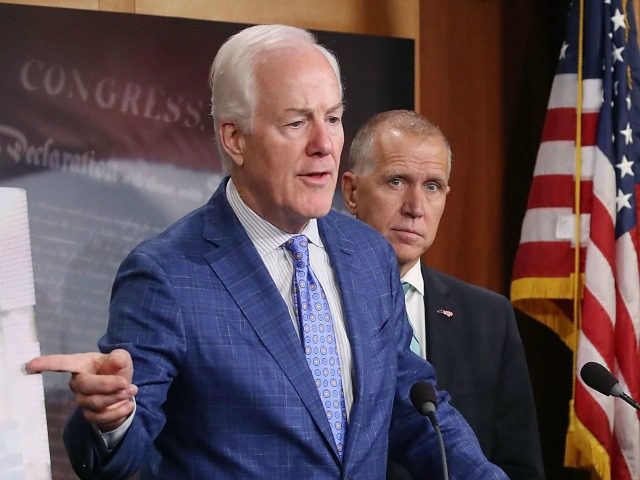
Sen. John Cornyn (R-TX) introduced national reciprocity legislation for concealed carry in the Senate on Thursday.
The NRA-backed bill would treat concealed carry licenses like driver’s licenses, ensuring permit holders could drive state-to-state and have their concealed permit recognized as valid.
BREAKING NEWS: NRA-Backed National Concealed Carry Reciprocity introduced in the U.S. Senate by Sen. @JohnCornyn (R-TX).
Cornyn released a statement coinciding with the introduction of the legislation, saying, “This bill focuses on two of our country’s most fundamental constitutional protections — the Second Amendment’s right of citizens to keep and bear arms and the Tenth Amendment’s right of states to make laws best-suited for their residents. I look forward to working with my colleagues to advance this important legislation for law-abiding gun owners nationwide.”
Breitbart News noted Rep. Richard Hudson (R-NC) introduced national reciprocity legislation in the House on January 4, 2021.
Hudson’s legislation, the Concealed Carry Reciprocity Act (HR38), treats concealed carry licenses like driver’s licenses as well, recognizing the license from one state as valid in the other 49.
Hudson released a statement upon introducing HR38:
Our Second Amendment rights do not disappear when we cross state lines, and H.R. 38 guarantees that. The Concealed Carry Reciprocity Act of 2021 is a common sense solution to provide law-abiding citizens the right to conceal carry and travel freely between states without worrying about conflicting state codes or onerous civil suits.
“I am especially proud to have such widespread and bipartisan support for this measure and will work with my colleagues to get this legislation over the finish line,” he concluded. AWR Hawkins is an award-winning Second Amendment columnist for Breitbart News and the writer/curator of Down Range with AWR Hawkins, a weekly newsletter focused on all things Second Amendment. He is the political analyst for Armed American Radio. Follow him on Twitter: @AWRHawkins. Reach him directly at awrhawkins@breitbart.com. Sign up to get Down Range at breitbart.com/downrange.