Category: Allies

Blacks Commit 73 Per Cent Of All Justified, Self-Defense Killings—Mostly Of Other Blacks

11/20/2021
This is not news to me. In 2013, Eric Holder attacked “Stand Your Ground” laws (not a factor in the Zimmerman case, Zimmerman was pinned to the ground by Trayvon Martin) because he thought the “victims” of self-defense (failed carjackers, armed robbers, home invaders, etc.) are disproportionately black.
Mark Levin tweeted:
This is true. In his 1993 review of Jared Taylor’s Paved With Good Intentions: The Failure of Race Relations in Contemporary America, Peter Brimelow wrote this about disparate crime rates:
Nor is the disparity caused by middle-class law enforcers over-concentrating on street crime. In 1990, blacks were nearly three times as likely as whites to be arrested for white-collar crimes such as forgery, counterfeiting, and embezzlement. And, finally and conclusively, blacks themselves are responsible for 73 per cent of all justified, self-defense killings. The vast majority of the people they kill are other blacks. [Invisible Men, National Review, January 18, 1993]
Yes, George Zimmerman lived near a black neighborhood and was forced to kill an attacker to survive. Blacks live in black neighborhoods. See this Karen de Coster story for an example of what that’s like:
Barbara Holland is a black woman living in Detroit. Clabe Hunt was a black man. Clabe entered her small, used car dealership one day, asking all sorts of strange questions, and then left. Barbara is a woman with a concealed weapons permit…
Barbara is alive, and Clabe is dead, and quite right, too.
What Jared Taylor originally wrote in Paved With Good Intentions was this:
Sixty percent of the people killed by police are black, even though they are only 12 percent of the population. Is this because the police are racist? Maybe not. Nationwide, blacks account for 58 percent of all arrests for weapons violations, 64 percent of all arrests for violent crimes, and 71 percent of all robbery arrests. It is less well known that blacks are responsible for 73 percent of justified, self-defense killings by civilians, and the overwhelming majority of the people they kill are other blacks. [William Wilbanks, The Myth of a Racist Criminal Justice System (Monterey, Calif.: Brooks/Cole Publishing Company, 1987), p. 78].
I realize these aren’t recent figures; if you have a more recent source, email me at jfulford@vdare.com.
Categories
Now there is a man who always been a Stud
Colonel Cross of the Gurkhas
In the mountains of strife-torn Nepal, some lessons about modern warfare from a British throwback
ROBERT D. KAPLANThis article appears in the May 2006 issue.
Check out the full table of contents and find your next story to read.

The U.S. Army major, who did not wish to be identified, is with the American team trying to help the beleaguered Nepalese monarchy in its campaign against the Maoists, and he and I had traveled to Pokhara to meet a military legend: the retired British army colonel John Philip Cross. Eighty years old, Cross greeted us outside his compound wearing a topi, dark glasses, a smart cravat, pressed shorts, and high woolen socks pulled up nearly to his knees. Those knees, I noticed, were tanned and powerful. He has covered 10,000 miles on foot through the Nepalese hills over the years, and still hikes twelve miles a day. Cross enlisted on April 2, 1943. On June 8, 1944—“D-Day plus two”—he boarded a troop ship for Bombay. Except for short visits to England he has lived in Asia ever since.


Cross is a confirmed bachelor because of “hot blood and cold feet,” he explains. His library of battered books, medals, and kukri knives, each object charged by a memory, is decayed by heat and humidity, for he has no air-conditioning. He sleeps on a spartan bed in the next room.
Now, writing books on irregular warfare and Himalayan history that deserve to be read even though they aren’t, he is a minor and very eccentric offshoot of a British imperial species that reached perfection in the person of the former soldier and literary travel writer Patrick Leigh Fermor, whom I interviewed in Greece in 2002. Both are inveterate walkers: Fermor across Europe, Cross across Nepal.
One cannot think about Nepalese fighting men—whether the Royal Nepalese Army, which is the government force, or the Maoist rebels—without thinking about the fierce and fabled Gurkhas. Throughout my travels with the U.S. military I ruminated on the American effort to raise indigenous troops and use them to project power. The story of the Gurkhas shows that the British were past masters at this.
The term “Gurkha” comes from a British mispronunciation of the town of Gorkha, in western Nepal, where the first units of these warriors were initially raised among Gurungs and Magars, Nepalese tribes of Mongolian origin. Not a true ethnic group, the Gurkhas represent what British officers since the mid-eighteenth century have considered the fighting classes of Nepal. The British first encountered them during the 1814–1816 war between Nepal and the Bengal Presidency of the East India Company. Impressed by their cheerful disposition even when wounded, the British bonded with their erstwhile adversaries. The relationship was solidified during the Indian Mutiny of 1857, when Gurkha recruits to the Indian army declined to revolt and in fact came to the aid of British civilians.
Their shoulders held the sky suspended;
They stood, and earth’s foundations stay;
What God abandoned, these defended,
And saved the sum of things for pay.
“The toughness of Gurkha skulls is legendary,” writes the historian Byron Farwell. In 1931, on the North West Frontier, when a mess mule kicked a Gurkha havildar in the head with his iron-shod hooves, “the havildar complained of a headache and that evening wore a piece of sticking plaster on his forehead,” according to Farwell. “The mule went lame.”
I found the old Gurkhas a haunting presence, because they were sharpened, refined, exaggerated forms of the Marines and soldiers I had been befriending and describing in previous travels. There was something indisputably antique about these gentlemen warriors, who told me their life stories under a black-and-white photograph of Queen Elizabeth II. To call them Kiplingesque would be to cheapen them; they were practically out of the Iliad.
Balbasdar Basnet, a retired corporal in his seventies, was the most memorable of them. He had joined the Gurkha Rifles of the British army when he was sixteen. His shriveled, nut-brown face was capped by a topi. He had teeth on the right side of his mouth only, and his raspy voice fought against time.
Balbasdar was from a village so impoverished that he’d never tasted tea before joining the army. After basic training he served for eight months on the North West Frontier, guarding the border against “Pathans” (he used the nineteenth-century British term for what today we call Pushtuns). From there he went to Bombay, and then by ship to northwest Malaya for three months of jungle training, just as World War II was gathering force. Finally he fought the Japanese in close combat.
“Were you scared?” I asked.
“No, I was thinking only to do and die.” He actually said that.
For fifteen days he and other Gurkhas marched in the jungle, retreating from a much larger force of Japanese. He was taken prisoner early in the war, and for four years subsisted on beatings and 200 grams of rice a day, moving around among labor camps in Malaya, Java, Sumatra, and New Guinea, wearing nothing more than a loincloth. Hiroshima liberated him from his sufferings, he told me. Suddenly he was being fed and clothed, and a few weeks later New Zealand troops arrived to formally liberate him. Proud to have served Her Majesty, he told me.
“Late-nineteenth-century warfare never stopped,” Colonel Cross told me, “though it was masked for a time by the Cold War emphasis on atomic bombs. And in this type of warfare that you Americans must master, only two things count: the mystic dimension of service and the sanctity of an oath. It’s about the giving of one’s best when the audience is of the smallest.
“Now take your Gurkha,” he went on, motioning toward Buddhiman Gurung, his beloved adopted son, who has been with him for twenty-eight years, and whose family the colonel has also adopted. “He’s a hungry peasant with a knife who is out for the main chance. There are none finer. I placed these western hillsmen in the Singapore police, and they never failed me. The Mongoloid doesn’t die easily. Plainsmen will never defeat such people in hill battles without field artillery. Clausewitz said as much.”
This was all bad news for the Royal Nepalese Army, I thought, though Colonel Cross was careful not to make explicit political statements, given his circumstances: the Maoists are in the hills nearby, and government forces are down the street. The fact is that the Maoists come from the same sturdy hill tribes that Cross recruited for decades, while many of the RNA’s forces are softer plainsmen and can’t employ artillery, because even a handful of civilian casualties would ignite protests from the international community. Moreover, the Maoists are fortified by “the mystic dimension of service and the sanctity of an oath,” whereas RNA recruits—aside from some specialized units—join for a salary and a career.
Of course, Colonel Cross is a throwback. His outlook and manner of expression can be brutal, almost perverse. He is living in a threatened backwater of the only country he can call his own. Still, there was a certain cruel logic in his pronouncements.
“It’s not about sugarcoated bullets and dispensing condoms in PXes,” he said. “You can’t fight properly until you know that you are going to die anyway. That’s extreme, but that’s the gold standard. You don’t join the army to wipe your enemy’s ass. You join to kill, or for you yourself to be killed, and above all to have a good sense of humor about it.”
Categories
My Kind of Dog!


Boston, MA – -(Ammoland.com) – On November 26, 1926, John Moses Browning passed away in Liege, Belgium, at the age of 71.
Hailed today as the greatest arms inventor of all time, John came by his profession honestly: his father Jonathan was also a gunsmith, and it was in his father’s shop that John began tinkering with guns at a young age. Overshadowed by his son’s achievements, Jonathan was actually quite the designer himself. He created an early repeating rifle with a horizontal “harmonica” magazine – one of the first of its kind.
By the time John Moses was in his early 20s, he partnered with his brothers and created their own arms manufacturing company.
In 1879, John received a patent for a single-shot rifle. Once production began in earnest, it was an almost instant success in and around their local Utah community. Unfortunately, his father Jonathan died that same year, without ever seeing the tremendous success his son would achieve.
Within a few years, one of those guns had made its way east and into the hands of Thomas Gray Bennett, the Vice President of the Winchester Repeating Arms Company. He quickly purchased the manufacturing rights to the rifle, thus beginning a decades-long relationship that would prove to be incredibly fruitful for both parties involved.
The Browning-Winchester partnership provided Browning with the most valuable asset needed by an inventor: time. Winchester essentially bought anything and everything Browning patented, whether they produced it or not, simply to keep it from falling into the hands of a competitor. This gave Browning the money he needed so that he could spend his time working on new designs instead of having to worry about marketing existing arms.
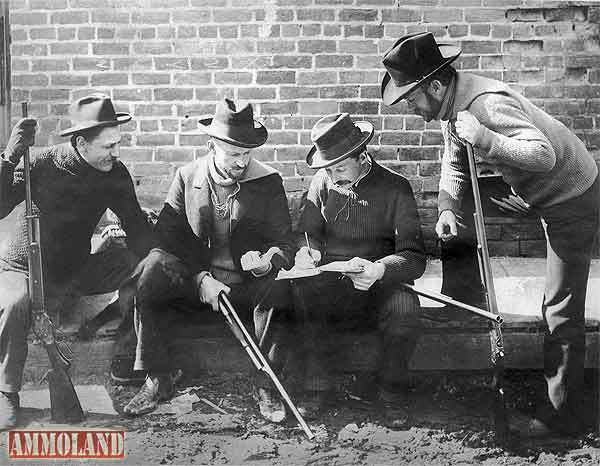
In turn, the partnership provided Winchester with the rights to produce some of the most iconic arms of the late-19th and early-20th centuries, cementing their place at the forefront of the American arms industry. Just some of the Browning-designed arms produced by Winchester include the Models 1886, 1892, 1894, and 1895 lever-action rifles and the Models 1893 and 1897 pump-action shotguns.
John’s designs weren’t just limited to long guns, and a gentleman’s agreement between Winchester and Colt provided an opening for him to market his arms to the latter of the two. (Winchester had agreed to stay out of the handgun business while Colt agreed to stay out of the long gun business.) Outside of the United States, Browning had partnered with Fabrique Nationale to make a blowback-operated, semi-automatic pistol that began production in 1899.

At the dawn of the 20th century, Colt released the first semi-automatic pistol available in the US, and it was, of course, a Browning design. Just a little more than a decade later, the partnership would result in the Colt Model 1911 semi-automatic pistol. It would go on to be the standard US military sidearm for the next 74 years.
Backing up a bit to 1902, Bennett and Browning ended their partnership over what would later become the Auto-5 self-loading shotgun. After an untimely death at Remington, Browning headed overseas for the first time to offer the gun to Fabrique Nationale. This would be the first of many, many ocean voyages in the following two-and-a-half decades. Browning would come to see Liege as sort of a second home, spending countless hours at his FN workbench, developing new ideas.
Browning died of heart failure while at his workbench; he was tinkering with the design that would eventually be refined into the Hi Power semi-automatic pistol.
Plenty of people claim that they want to die doing what they loved. John Moses Browning was one of the very few who actually did just that on November 26, 1926.
About Logan Metesh
Logan Metesh is a historian with a focus on firearms history and development. He runs High Caliber History LLC and has more than a decade of experience working for the Smithsonian Institution, the National Park Service, and the NRA Museums. His ability to present history and research in an engaging manner has made him a sought after consultant, writer, and museum professional. The ease with which he can recall obscure historical facts and figures makes him very good at Jeopardy!, but exceptionally bad at geometry.

