Categories
All About Guns Allies Dear Grumpy Advice on Teaching in Today's Classroom

6 Ways to Turn Off a New Gun Owner Firearm training can take a hard left turn quickly if the instructor falls into one of these categories. by HEIDI LYN RAO

Handgun Class

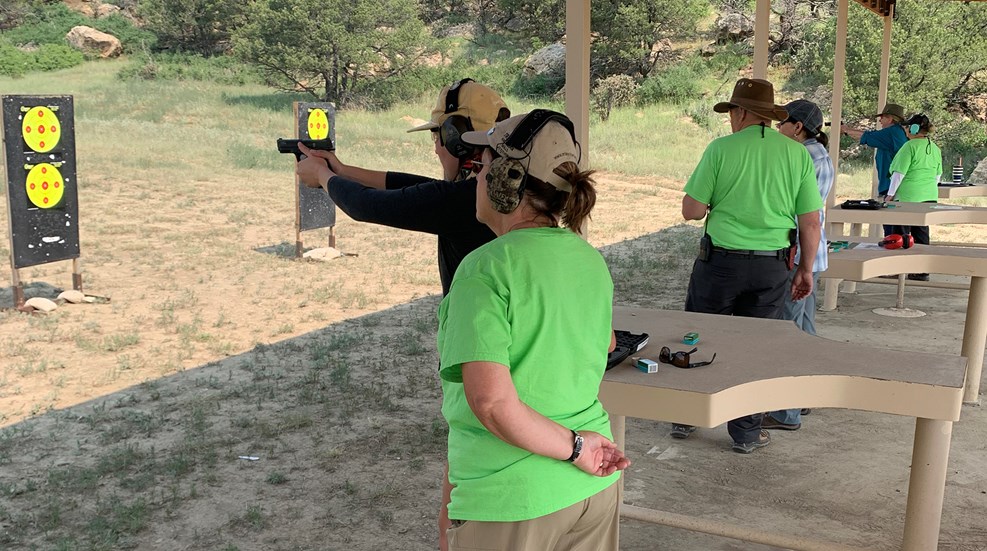
Firearm sales are continue to be brisk, with more people purchasing their first firearm—one third of them by women in 2021. Many are seeking formal training to learn the safe and responsible use of that firearm. As instructors, we only get one chance to make a good first impression. I strive to make that first contact with new gun owners a positive, memorable and impactful experience. As exciting as this first impression can be, it can take a hard left turn quickly!

The last thing we want to do is to overwhelm or intimidate a new firearm owner with too much information, or talk or train too high over their head. And we certainly don’t want them to leave. With that in mind, here are six instructor stereotypes to avoid when conducting a beginning firearms class.

1. The Tactical Instructor
This instructor conducts his or her class in tactical gear. There is definitely a place for this gear, equipment and accessories if you are teaching a tactical class and have advertised your training as such. However, meeting new firearm owners for the first time is not the place to gear up. This can be a quick turn off for someone who knows nothing about firearms and is only seeking the introductory basics.

2. The Open Carry Instructor
Open carrying a firearm may be appropriate for advanced classes, but it can be very intimidating to a new gun owner. New gun owners may be anxious about their new purchase, and possibly nervous at the thought of taking a class on firearms. An instructor who is wearing a gun, visible on their belt in a holster, or one strapped to their thigh, may be very distracting to a novice student. A new student may be too focused on the firearm on your belt to hear what you are saying.
3. The “Patch Collector” Instructor
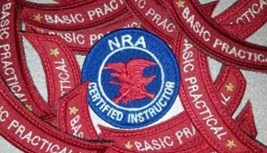
Yes, it is very impressive that you have spent many years and invested a lot of money to advance your firearm training, knowledge and credentials, gaining patches and certificates along the way. Although something to be proud of, these highly decorated shirts or vests may have an opposite effect when working with new firearm owners. I used to teach in a decorated instructor shirt, displaying my patches of credentials, until a few students told me they were intimidated by all the patches on my shirt. I now wear a simple “Instructor” T-shirt purchased from the NRA Store to make students feel more at ease.

4. The “All About Me” Instructor
We’ve all been there—sitting in a class, training or meeting where the speaker is more interested in sharing his or her personal stories rather than staying on topic. The reason someone signs up for training is to gain knowledge about a particular item or topic. A few relevant stories here and there may be appropriate during the lesson, but straying off topic and boasting personal stories is not. This is a huge turn-off, especially to a brand-new gun owner seeking knowledge about their new purchase. There is a distinction between an instructor sharing their credentials and credibility for speaking to the topic at-hand, versus standing on a platform and touting story after story.

5. The Graphic Instructor
I recently attended an event advertised to recruit new women gun owners. The classroom was filled with eager-to-learn ladies who were brand new to firearms. Before even discussing firearm safety or going over the basic gun parts, the instructor started telling these new gun owners why they needed to use hollow-point bullets, and described the physical damage they can cause. This was just the beginning of the “blood and gore” class. I knew from the looks on the faces of these ladies that they had already tuned out the instructor. Some of the women left after break time, and others commented, “I just don’t think this is for me.”

6. The Confusing Instructor
The terms we use matter. Instructors need to use the correct vocabulary when teaching. For example, avoid referring to cartridges as bullets or describing magazines as clips. Firearms have their own language. I was once talking about the different magnum revolvers and using the phrases “.357 Mag,” “.41 Mag.” and “.44 Mag.” A student raised his hand and asked what a “mag” was. I realized that I was abbreviating “magnum,” which was confusing my students. Instructors should also avoid using the word “weapon” when referring to a firearm with new gun owners, which may be very intimidating to someone in a basic firearms class.

If you are fortunate enough to help new firearm owners become familiar with their new purchase and comfortable on the range, it is important to remember one thing: Teach and train at their level. Remember how long it took you to get to the level you are with your firearms knowledge and handling. We want these brand-new gun owners to have a positive first experience, so they recruit more new gun owners to share the knowledge, skills and proper attitude!

Categories
All About Guns Allies

The Man has some stones, pity that I can’t vote for him!

https://youtu.be/BVRxzoKQ8Zk

Categories
All About Guns Allies Anti Civil Rights ideas & "Friends"

Why the Second Amendment Applies Especially to Travelers by Dean Weingarten

Lake County Becomes Florida’s First ‘Second Amendment Sanctuary County’Why the Second Amendment Applies Especially to Travelers

U.S.A. –-(AmmoLand.com)-– The United States Supreme Court has defended and restored the bear half of the right to keep and bear arms, in the recent Bruen decision.

Much work remains to be done. It is clear that the people have a right to bear arms outside the home. One of the major purposes is for the defense of self and others.

An area left undefined in Bruen is the right to bear arms in defense of self and others while traveling, particularly while traveling across state lines.

There was no prohibition on carrying arms at the time of ratification in 1791. Carrying arms for defense, while traveling, was common and accepted. Even the strictest colonial restrictions on the bearing of arms, the East New Jersey law, enacted in 1686, had an exception for people who were traveling. The colonial law, which was in effect for about six years, was cited by both sides in the Bruen decision: From  P. 6 of amicus curiae briefs on Bruen. 

In 1686, East New Jersey enacted a law providing that no person “shall presume privately to wear any pocket pistol, skeines, stilettoes, daggers or dirks, or other unusual or unlawful weapons,”  and that “no planter shall ride or go armed with sword, pistol or dagger” except certain officials and “strangers, travelling upon their lawful occasions through this Province, behaving themselves peaceably.”3

An exception noted in the earliest and most extreme of the colonial “bear arms” laws should be given some weight.

As noted by an English traveler in the early Republic, traveling armed was common. From  Isaac Weld, TRAVELS THROUGH THE STATES OF NORTH AMERICA 233-34 (2d ed. 1799) (1796, on the roads from Kentucky/Tennessee to and from Philadelphia/ Baltimore:

“the people all travel on horseback, with pistols and swords.”

There were, effectively, no other attempts to infringe on the right to bear arms until Kentucky enacted a law in 1813. The law was challenged in court, as a man was charged with carrying a sword cane. The law against carrying concealed weapons was struck down as unconstitutional under the Kentucky state constitution in 1822. Again, even this extreme, early law, relatively close to the ratification of the Bill of Rights in 1791, contained an exception for people who were traveling.

In the first Kentucky case outlawing concealed carry, there was an exception for carrying concealed while traveling. P. 25:

The first such law appears to have been enacted in Kentucky in 1813; it imposed a fine on anyone “who shall hereafter wear a pocket pistol, dirk, large knife, or sword in a cane, concealed as a weapon, unless  when travelling on a journey.” Similar laws were en-acted in seven additional States or territories by 1860.

England was more restrictive than the United States, but even in England it was clear carrying weapons for self-defense while traveling, was common and accepted as a part of the right to keep and bear arms. From an 1870 English case from Kopel  p. 15-16

(“A man has a clear right to protect himself when he is going singly or in a small party upon the road where he is travelling or going for the ordinary purposes of business” but not to carry arms in a manner “calculated to produce terror and alarm.”); Gun License Act, Act 33 & 34 Vict. c. 57 (1870) (10-shilling annual license from the post office to carry a firearm; postal clerks had no discretion to refuse a fee-paying applicant).

There was an upheaval in the law after the Civil War. Justice Thomas, in Bruen, says we should take into consideration what was considered to be the right to keep and bear arms in 1868 when the Fourteenth Amendment was ratified.

When the amendment was ratified, Texas had a reconstruction government that had imposed a new Constitution on the state. The new constitution had gutted the protection of the right to keep and bear arms which existed throughout Texas history to that point. The Fourteenth Amendment was clearly meant to insure freed slaves had the right to keep and bear arms.

In 1871,  the Reconstruction government felt compelled to keep the right to bear arms while traveling:

..provided, that this section shall not be so contrued as to prohibit any person from keeping or bearing arms on his or her own premises, or at his or her own place of business, nor to prohibit sheriffs or other revenue officers, and other civil officers, from keeping or bearing arms while engaged in the discharge of their official duties, nor to prohibit persons traveling in the State from keeping or carrying arms with their baggage…

After the Fourteenth Amendment was passed, numerous other states passed restrictions on the carry of weapons. These restrictions primarily had the effect of disarming freed slaves and other disfavored groups. But even these laws made exceptions for the right to bear arms while traveling.

A Tennessee law made clear an exemption for traveling, in 1878, in State v. Callicutt, 1878.  p. 579

The law at issue had made it “a misdemeanor to sell, give, or loan a minor a pistol, or other dangerous weapon, except a gun for hunting, or weapon for defense in traveling.”10

Missouri enacted a law on carrying concealed weapons in 1879. Even that late restriction on bearing arms had an exemption for people who were traveling:

 Prior to 1909, the statutory exemption applied “to persons moving or traveling peaceably through this state.” § 1275, RSMo 1879.

The traveling exemption in Missouri was made more restrictive in 1909 to change the traveling exception to:

“is traveling in a continuous journey peaceably through this state”

1909 is much later in the game. It is clear carrying weapons, even concealed, was common and considered a right, before the statute in 1879 was enacted.

Arkansas law also made an exception for travelers, in 1881:

Provided, further, That nothing in this act be so construed as to prohibit any person from carrying any weapon when upon a journey, or upon his own premises. 

Mississippi law had an exemption while traveling, Section 1027 as of 1888, although the exemption appears to be in place by 1880:

Prohibition on possession of concealed and prohibited weapons does not apply while traveling, or setting out on a journey:

(b) That he was traveling and was not a tramp, or was setting out on a journey and was not a tramp;

Thus, even in a period when legislatures were moving to restrict the right to keep and bear arms, they recognized the right to bear arms while traveling.


About Dean Weingarten:

Dean Weingarten has been a peace officer, a military officer, was on the University of Wisconsin Pistol Team for four years, and was first certified to teach firearms safety in 1973. He taught the Arizona concealed carry course for fifteen years until the goal of Constitutional Carry was attained. He has degrees in meteorology and mining engineering, and retired from the Department of Defense after a 30 year career in Army Research, Development, Testing, and Evaluation.

Dean Weingarten

Categories
All About Guns Allies Anti Civil Rights ideas & "Friends" Cops

British Obsolete calibre law changes

Categories
All About Guns Allies Anti Civil Rights ideas & "Friends"

GUN OWNERS’ RIGHTS GROUPS JOIN TOGETHER IN COURT TO STOP GOVERNOR NEWSOM’S ATTEMPT TO END YOUTH SHOOTING IN CALIFORNIA

July 8, 2022- Last Friday Governor Newsom signed AB 2571 into law under an emergency order to have the law go into effect immediately. The law is will cripple youth shooting in California as it prevents the promotion of firearms and firearm-related products and events to youth.

This new law impacts Associations, Camps, Clubs, FFLs, Hunter Education, Instructors, Firearms Trainers, Youth Organizations, ranges, and those who work in association with any youth shooting program — including firearm safety training. Any promotion of firearms to those under 18 years of age may lead to hefty fines of $25,000 per incident.

Today CRPA, Second Amendment Foundation, Gun Owners of California, and others are standing up to Newsom and his propaganda. These groups filed a lawsuit to stop the further implementation of this unconstitutional law and are seeking an immediate injunction to block the law from taking effect.

“This law is a clear First Amendment violation of speech and assembly. It’s really an attempt to wipe out the next generation of hunters and shooters,” said CRPA President and General Counsel Chuck Michel. “Politicians in Sacramento are not even trying to hide their disdain for the “gun culture,” which they neither understand nor support. They want to wipe it out.”

Newsom not only does not support Second Amendment rights; he has been working to make it practically impossible to acquire, own or use a gun for sport or self-defense. With this bill, designed to keep youth out of the shooting sports, Newsom hopes that the current generation of freedom-loving gun owners will be the last.

“We must fight for the the next generation of gun owners so they can learn about firearms and their safe use, train, experience the joy of sport shooting and hunting, have fun, learn discipline, and understand their Second Amendment rights,” said Michel.

To receive updates on this and other 2A cases, SIGN UP to receive CRPA communications and follow up on social media. Knowledge is the first step to political power.

With the Supreme Court affirming that the Second Amendment has teeth and prohibits government infringement, now is the time for a long overdue SECOND AMENDMENT RECKONING. Gun owners must support litigation efforts and groups like CRPA, GOC, and SAF that fight for your rights, and have been for decades. There are LOTS of lawsuits to be filed as we fight back against the BLUE RESISTANCE to the Second Amendment.

Categories
Allies Soldiering

British Army Uniform Evolution from 1770 to Current | 230 Years of British History

I myself could not even imagine fighting in many of these outfits or being in oh say India with such gear. But I guess that I am a wimp at heart. Grumpy

Categories
All About Guns Allies Anti Civil Rights ideas & "Friends"

A Century of Opposition to New York’s Sullivan Law

A Century of Opposition to New York’s Sullivan Law

On June 23, the U.S. Supreme Court struck down New York’s discretionary carry licensing regime as a violation of the Second Amendment right to bear arms in the NRA-backed case NYSRPA v. Bruen. The law at issue was the modern version New York’s Sullivan Law, which was enacted in 1911.

Named for notorious Tammany Hall political boss “Big” Tim Sullivan, the law imbued bribery and favoritism into the licensing process and empowered those with racial, ethnic, or other prejudice to prevent those they disfavor from exercising their Second Amendment rights.

Gun owners should understand that this victory was the culmination of more than a century of opposition to the Sullivan Law. In that spirit, NRA-ILA would like to share materials from its archive chronicling some of the early gun owner resistance to the measure.

As evidenced by the pages of American Rifleman precursor Arms and the Man magazine, gun owners were skeptical of the New York pistol licensing regime from the start. In 1911, Arms and the Man operated as the unofficial journal of the NRA. The magazine would be purchased by NRA in 1916 for one dollar and was renamed the American Rifleman in 1923.

The publication took New York’s politicians to task in the June 8, 1911 edition of the magazine with an article titled “An Obnoxious Arms Law.” Describing the Sullivan Law, the publication explained,

Ostensibly directed towards the use of concealed weapons by unworthy persons, it actually will accomplish an infringement of the guarantees of liberty contained in the Constitution of the United States.

The Constitution says in the Second Amendment: “A well regulated militia, being necessary to the security of a free state, the right of the people to keep and bear arms, shall not be infringed.”

In the meaning of those who wrote the Constitution the word “militia” embraced every able-bodied citizen.

The piece went on to note,

The law may be expected to operate in a prohibitive manner against good citizens, who, if they had weapons, would do no harm with them, and to be inoperative against bad men whose disregard for the laws relative to killing may be expected to extend to other laws.

This was followed by an article in the September 28, 1911 Arms and the Man titled, “The New York Pistol Problem.” The item stated,

Considerable agitation and much uncertainty exists in New York and vicinity at the present time with regard to the so-called “Sullivan Pistol Law.” As far as can be ascertained the only “good” the law, which went into effect September 1, has done, has been to… cause a great deal of inconvenience to numerous members of the rifle and revolver associations of New York and vicinity, and make the Attorney General and the District Attorney, judges and police officials sit up nights and try to place an interpretation on this law…

[W]hat has really been accomplished has been to take away from peaceful and law-abiding citizens the opportunity to shoot.

NRA members and other gun owners didn’t warm up to the law once they saw it in practice. In 1931 and 1932, a serious effort was made to amend the law to make it easier for law-abiding New Yorkers to exercise their rights.

In May 1932, the American Rifleman published a piece titled, “Governor Roosevelt Upholds Sullivan Law.” The piece explained how then-New York Governor Franklin D. Roosevelt rejected legislation passed by the New York State Assembly to repeal and replace the Sullivan Law and challenged a Roosevelt statement that accompanied the veto. Describing the legislation, the magazine noted,

[the bill] would have repealed the Sullivan Law in New York State, and would have substituted a sensible law, which, the Governor of New York State admits, a great many sportsmen had urged him to approve.

The piece went on to excoriate Roosevelt for defending the Sullivan Law, stating that,

[NRA] is grinding no political axe when it takes exception to the shallow, fallacious and uninformed views of the present Governor of New York in regard to the needs of the public welfare in matters pertaining to firearms.

In his veto message, Roosevelt specifically downplayed the use of handguns for self-defense, to which the American Rifleman responded,

Readers of THE AMERICAN RIFLEMAN who have been following the monthly listing of cases called to our attention in which private citizens armed with the pistol have successfully protected their lives and property and assisted in the apprehension of criminals, and who have probably been making mental notes of many additional cases of a similar type published in their local newspapers, will have small patience with the theoretical self-protection argument used by Governor Roosevelt in his veto message. These readers of THE AMERICAN RIFLEMAN may seriously question just how much alive to important public-welfare problems involving the citizens of his own state Governor Roosevelt has been, in failing to investigate how much theory there is in the self-protection afforded by a good gun in the hands of a man who knows how to use it.

Taking up the fight for target shooters, the piece expressed disgust that law-abiding New Yorkers were,

subjected to the inconvenience of a czarist-type police supervision, discrimination and political byplay in order to enjoy a sport which provides not only recreation, but meets an obligation of good sportsmanship both in preservation of local order and the protection of national rights.

Alongside the re-publication of a news article about the U.S. Senate examining the efficacy of the Sullivan Law, in May 1936 the American Rifleman published a letter from an NRA member in Brooklyn, New York in the magazine’s Guns vs. Bandits section (precursor to the Armed Citizen). Titled, “How the Sullivan Law Works,” the member explained,

I put in an application with the Police Department for a pistol permit and I have been refused. It took them two months to make up their minds to disapprove my application…

Gentlemen, I am calling for your aid. I am a legitimate business man in the finance business, I am a sportsman and have an inherent love for guns, I have won medals, been a member of the C.M.T.C. for two years, and I can handle a gun. I am treasurer of this company and it is my duty to handle large sums of money and deposit them at the end of the day. I have never been arrested in my life. I can submit an unlimited number of character witnesses as well as business references. My bank will vouch for my responsibility and personal and business integrity.

It is a ridiculous system of society which allows thieves to get all the pistols, gas bombs, machine guns, etc., with very little difficulty but stops an honest citizen from getting a pistol to protect himself and his interests from our modern highly organized crime.

You would almost think that criminal lords have such powers that they have issued instructions to the New York Police Department to refuse permits for pistols to all legitimate citizens, so that robbing will not be such a hazardous occupation.

A quarter-century later, the American Rifleman revisited the history of the Sullivan Law in an April 1962 article titled, “The Sullivan Law: The origin and complexity of New York State’s concealable weapons law.” As the title implied, the author surveyed the then-half-century history of the Sullivan Law using a variety of sources.

Despite his scholarly effort, the author did not come away with a complete understanding the unconstitutional measure. The item noted,

After considerable study, I find that there isn’t really one Sullivan Law, nor does it relate to pistols alone, nor is it forthright, nor was it understood by most of the legislators who passed it. The law itself, together with its more than 50 amendments, is so complicated that judges, prosecutors, police chiefs, and defense attorneys have widely divergent opinions as to what it all means.

Identifying the chief constitutional defect in the law, the piece explained,

The license-issuing authority (police commissioner in New York City and Nassau County; elsewhere, judge or justice of a court of record in the county of residence) has almost unlimited discretionary power in passing upon a licensing application. Thus, he may, and frequently does, deny an applicant fully qualified in every respect on the arbitrary ground that he does not choose to issue a license. Moreover, the licensing official may and does issue rules and regulations which not only spell out procedural requirements but also impose, in effect, additional substantive restrictions having little or no support in the law.

Another portion of article laments, “Once a bad law is on the books, it’s terribly difficult to get it off.” Well, it took another 60 years, the tireless efforts of NRA members and other gun rights supporters, and three U.S. Supreme Court cases affirming the Second Amendment right to keep and bear arms, but gun owners can finally celebrate that this century-old bad law is officially off the books.

Categories
Allies Soldiering

The Garheads showing off!

Categories
Allies Cops

It’s time to shut down the failed, vast, arrogant monster our police forces have become By PETER HITCHENS FOR THE DAILY MAIL

Like some dud bog-standard school, Britain’s most important law-enforcers, the Metropolitan Police, find themselves humiliatingly condemned to ‘special measures’. About time too.

Now we have also learned that one in seven police forces is in special measures. Quite frankly, I’m not surprised.

The howling, blatant failure of all Britain’s police forces to do the job for which we pay them so much has been a scandal for years. It has been at its worst in the capital.

Now, at last, even our political class has begun to notice. If we have the sense to seize it, the moment has come to replace our failed police, who have traded for decades on a reputation won by others many years ago.

Normally the liberal elite, cocooned by money and power, have little idea of what is going on in this country. They seldom visit anywhere outside their privileged enclaves, and dismiss reports from the real Britain as ‘moral panic’.

For years they have not cared, as most of us have, that the police are too politically correct, and too absent, to be any use against crime and disorder. Now, it turns out that the police are not politically correct enough, either. Everyone thinks they are useless.

Scotland Yard’s fall comes after it was subjected to the leadership of Cressida Dick – for years the liberal establishment’s favourite police officer, groomed and polished so that she could finally step into the Commissioner’s job. And then she turned out to be an utter flop on almost every measure known.

Former Metropolitan Police Commissioner Dame Cressida Dick standing with Mayor of London Sadiq Khan

+4
View gallery

Former Metropolitan Police Commissioner Dame Cressida Dick standing with Mayor of London Sadiq Khan

What are the police for? Why do we put up with them? If your car won’t go, or your hoover stops hoovering, or your fridge no longer keeps your food cold, you get rid of them and buy new ones. So what do you do when your police stop policing?

And they have stopped. Their response to burglary and car theft is now such a national joke that even official statistics have begun to reflect it. Their interest in quelling the nasty disorder that infects so many of our streets is zero.

As Her Majesty’s Inspectorate of Constabulary said of the Metropolitan Police this week, they suffer from ‘a barely adequate standard of crime recording accuracy, with an estimated 69,000 crimes going unrecorded each year, less than half of crime recorded within 24 hours, and almost no crimes recorded when victims report antisocial behaviour against them’.

The flat phrase ‘anti-social behaviour’ does not begin to describe a huge and horrible problem. For many years, in the long-ago days when people still had some expectation of police support, I was often contacted by despairing men and women trapped in their homes by menacing louts, intolerable noise, screeching persecution or incessant thefts from their small businesses, from which they could not protect themselves.

They knew that if they dared raise a hand in their own defence, the police – protecting their monopoly of force – would come for them. They, unlike their persecutors, were easy targets, not frightening, ready to co-operate with authority.

The Metropolitan Police of Wayne Couzens who was jailed for the kidnap, rape and murder of Sarah Everard

The Metropolitan Police of Wayne Couzens who was jailed for the kidnap, rape and murder of Sarah Everard

I remember a lawyer who wrote to me in a state of shock, having had his career ruined by the police after he grabbed a young vandal and tried to march him to the police station. He was the one who ended up in court. We all recall the horrible case of Fiona Pilkington, who killed her own severely disabled daughter Francecca and herself, after enduring ten years of unimaginable persecution from cruel neighbours – in which the police were barely interested.

We all remember Garry Newlove, kicked to death outside his home, after confronting a gang of youths he suspected of vandalising his wife’s car. The area had suffered for years from uncontrolled disorder of this kind.

But these events are not unique. They are among thousands of miserable episodes that never make the headlines, but which show the failure of the police to prevent this kind of thing.

Well, that problem only affected ordinary people, so the authorities, the BBC and The Guardian newspaper paid little attention to it and learned no lesson from it.

Sarah Everard, 33, was murdered by serving Met officer Wayne Couzens after she was abducted as she walked home in south London

Sarah Everard, 33, was murdered by serving Met officer Wayne Couzens after she was abducted as she walked home in south London

But the police reaction to the murder of Sarah Everard by a serving officer – pitiful, lumbering and stupid – probably turned the balance among our governing class. Here was something they could not ignore: a woman had been murdered by someone she should have been able to trust utterly.

How had he been in a position to do this? One problem is that the police, as they now are, do not always attract the right sort of recruits, or retain the kind of men and women they really need.

The killer, Wayne Couzens, was obviously totally unfit to be a police constable.

He should never have been hired in the first place. His blatant lewd behaviour should have made sure that he was got rid of very quickly.

Yet he stayed, and seems to have been too readily tolerated by some of his colleagues. Then came the lumpish, concrete-headed police treatment of a perfectly reasonable vigil in memory of Miss Everard. Once again, the questions began to form, in letters of fire, in the public mind: ‘Whose side are the police really on? What actual use are they?’

I could write a book about the crisis of the police. In fact, I have done. (It is called ‘The Abolition of Liberty’ and is still in print 19 years after it was first published.) I have pressed it into the hands of senior police officers and one Home Secretary, begging them to pay attention. Not one of them has even responded.

Former prime minister and founder of the modern police force Sir Robert Peel

Former prime minister and founder of the modern police force Sir Robert Peel

The police, I have argued now for almost 20 years, are doing the wrong thing. Their problems have nothing to do with numbers (they used to do far more with many fewer officers).

Their job is not to patrol Twitter, but to patrol the streets on foot, to prevent crime, to show that order and law will be upheld, to deter the first signs of bad behaviour so that it never gets out of hand.

This method still works (it was used to great effect in New York City a few years ago) and it was what they were originally hired to do by the great Sir Robert Peel.

Constables engaged in these simple, comforting activities do not need to get involved in politics or opinions. They rapidly become the friends of the law-abiding public, get to know their neighbourhoods, see trouble coming and pick up intelligence about all kinds of problems.

This kind of policing came to an end thanks to a few decisions mainly taken by the arch-liberal Home Secretary Roy Jenkins in the 1960s. We were never asked about them. Jenkins killed off regular foot patrols, and destroyed dozens of local forces that knew their areas and were respected there, replacing them with vast distant bureaucracies.

In Scotland, even more worryingly, local policing ended entirely with the creation of a nationwide organisation, which has unsurprisingly run into grave trouble since.

It would be just as easy to reverse these decisions, to begin next week to recruit and establish new, small local constabularies dedicated to the old Peel principle of prevention above all. And once they were ready, we could close down the vast, failed, arrogant monster which our police have disastrously become.

There is no longer any point in pretending that they have not failed. And when institutions fail, the best thing to do is to replace them from top to bottom. That would be a truly special measure.

Categories
All About Guns Allies Anti Civil Rights ideas & "Friends" Cops

Here For Your Guns! – ERPO Gun Confiscation