Man exchanges 3D printed guns for $21,000 at New York gun buyback program
At an event held in Utica, NY in August, one man allegedly gamed the system, walking away with thousands of dollars after turning in over 100 guns he made using his 3D printer.
Since 2019, New York Attorney General Letitia James has been encouraging residents of her state to participate in her office’s gun buyback program, wherein the government offers money for firearms, “no questions asked.”
At an event held in Utica, NY in August, one man allegedly gamed the system, walking away with thousands of dollars after turning in over 100 guns he made using his 3D printer.
According to WKTV, the man, known only as “Kem,” had seen posts online about people pulling off such stunts, and decided to try it for himself.
Using his $200 3D printer, Kem quickly birthed a battery of plastic firearms, and drove six hours from his home to Utica, where the buyback program was holding an event.
“I 3D-printed a bunch of lower receivers and frames for different kinds of firearms,” said Kem.
Kem explained that upon arriving in Utica, he was asked how many guns he wished to turn in, to which he replied, “110.”
After spending the rest of the day negotiating with staff, Kem was presented with 42 gift cards, each worth $500, making the total payout $21,000.
“I’m sure handing over $21,000 in gift cards to some punk kid after getting a bunch of plastic junk was a rousing success,” Kem told WKTV, adding that, “gun buybacks are a fantastic way of showing, number one, that your policies don’t work, and, number two, you’re creating perverse demand.”
He argued that programs such as James’ “don’t actually reduce crime whatsoever.”
According to James’ office, the August 27 buyback event “resulted in the collection of 296 guns, including 177 ghost guns, 42 long guns, 41 handguns, 33 non-working guns, and 3 assault rifles.”
Ghost guns are firearms that are unregistered and unregulated, often built by users themselves. Kem’s 3D-printed weapons would fit into this category.
Since 2019, James’ program has resulted in the buyback of 3,500 guns, and she has no intention of stopping any time soon.
In a statement to KWTV, her office slammed Kem for his actions, and explained that they have “adjusted [their] policies to ensure that no one can exploit this program again for personal gain.”
Judge Benitez Issues Ruling to Save Magazine Owners from Government Confiscation and Prosecution
On Monday, September 26, 2022, Judge Roger T. Benitez proved once again that he is ten steps ahead of the California government and its anti-gun leaders when he re-issued his ruling to protect “traditional” magazine owners from prosecution.
If you have been following the “merry-go-round” that has been the life of Duncan v Bonta (formerly Becerra), it’s entirely possible that you have been confused.
Let’s break this down:
Initially, the case of Duncan v Becerra (ban on 10+ round magazines which originated from legislation and an initiative) went before Federal District Court Judge Roger T. Benitez. He said that it violated the text, history and tradition of the Second Amendment using the test that Justice Scalia established in Heller v DC and was therefore unconstitutional. Knowing that the crazy 9th would use a different standard, Benitez ruled that it would still be unconstitutional regardless of what standard was used.
This opened what became known as “Freedom Week” where Californians legally purchased between one and two million magazines.
California threatened to appeal the ruling to the 9th Circuit Court of Appeals, so Judge Benitez issued an order staying his decision from going into effect until all legal proceedings were completed, thus preventing the California government from banning any “Freedom Week” magazines.
The 9th assigned the case to a 3-judge panel who agreed with Judge Benitez that the mag ban was unconstitutional.
Angered by this defeat, the State immediately asked for an 11-judge en banc panel who as expected, reversed the previous pro 2A decisions and sided with the State.
The pro-gun forces – which included Gun Owners of California– appealed to the Supreme Court of the United States (SCOTUS). SCOTUS kept the case alive pending their decision in NYSRPA v Bruen. Once the court declared that the only rule that lower courts can use to test Second Amendment challenges, that being text, as informed by history and tradition and nothing else, the court accepted the case (granted Certiorari which means it could be heard), then vacated the anti-2A decision of the 9th Circuit and remanded the case back to them, with the instructions to reconsider the case with the new one-step standard.
At this point, the 9th Circuit en banc panel could have reversed its decision and declared the mag ban unconstitutional. Of course, they did not. Instead, they returned the case to Judge Benitez who had already declared the law unconstitutional.
Is your head swimming by now?
In doing so, the 9th essentially “erased” Judge Benitez’ original decision and directed him to start from scratch.
Given this turn of events, we are confident the State of California had been preparing to begin the confiscation of magazines and enforcing the ban because forcing Benitez start from scratch meant that his original order that protected “Freedom Week” magazine buyers from prosecution was no longer in place.
As we’ve said time and time again, Judge Benitez doesn’t pussy-foot around; he was one step ahead of the gun mag grabbers, and re-issued his order protecting magazine owners from prosecution by the state.
Bottomline? We are free to own, possess and in many cases use our 10+ magazines (as long as they are not used on “California Compliant Semi-Autos”).
What happens next? The entire convoluted process is set to begin again, but with one huge difference: lower courts MUST follow the rules for deciding Second Amendment case as established by the Supreme Court in the Bruen decision. This changes everything. Both SCOTUS and Judge Benitez have come to the rescue, not only of citizens who abide by the law, but of the Constitution itself.
Get off the merry-go-round/rollercoaster of confusion and join Gun Owners of California; we will keep you up-to-speed and continue to march ahead to fully restore, then defend and protect the Second Amendment. We will accept NO COMPROMISE!
I can’t speak for the other military branches, but the Marine Corps has a weapons-cleaning problem. When I say that, I mean we clean our weapons too much. Too much, and often incorrectly, to adhere to the strict standards of the Marine Corps. The problem is complicated and tied to both the lower enlisted and the higher-ups. If the Marine Corps wants its Marines to be the most lethal warfighters, it’s a problem it needs to solve. As it’s known in the Marine Corps, weapon maintenance needs to be revised.
THE PROBLEM WITH MODERN WEAPON MAINTENANCE
Keeping a rifle, machine gun, handgun, well, any gun, working relies on proper maintenance. Weapon maintenance is critical to the function of a weapon, especially in austere environments. We’ve fought for two decades in deserts, on snow-covered mountains, and in the worst places possible for modern weapons.
However, the extent the Marine Corps engages in weapon maintenance can be completely detrimental to the weapon. Marines find themselves using improper tools to reach a standard. For example, Marines will often use hard, stainless steel brushes to clean their weapon. When used enthusiastically, these brushes will eventually destroy the finish of the inside and outside of your weapon.
A good finish protects the weapon and helps prevent rust. Without a good finish, the weapon’s long-term reliability will be in question. My issue M9 was almost more silver than black since the finish had been rubbed off over time due to excessive cleaning.
Your average lower enlisted will likely lose or break his issued cleaning kit. This will, in turn, cause them to purchase one, which is often the cheapest one out there. These cheap cleaning kits will often have stainless steel bore brushes that can damage the rifling, making the weapon lose accuracy and consistency over time.
Marines should use bronze bore brushes mixed with bore cleaner in their weapon maintenance.
KEEPING IT SHINY
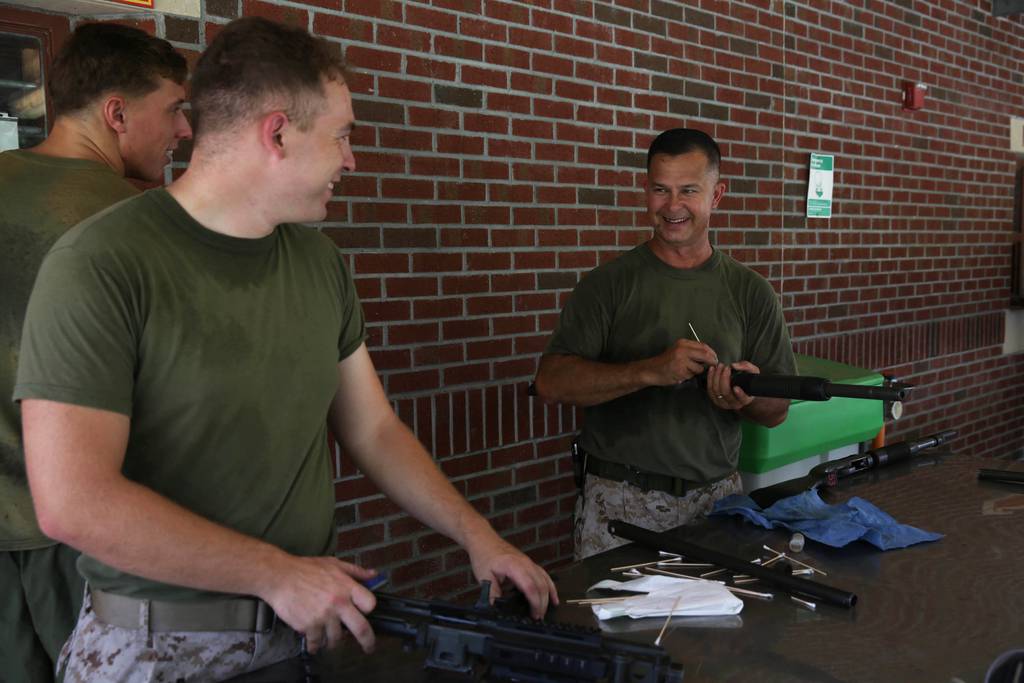
Troops cleaning up their weapons.
Even Marines who keep their issued cleaning kits will find them lacking and may supplement them with tools to speed up the chore. This includes Q-tips and baby wipes. I’m guilty of this, as was every infantry Marine I knew. However, Q-tips and baby wipes come with their own problems.
Q-tips break easily and can break off or deposit little bits of cotton in areas that can disable the weapon. They can get stuck in all manner of areas in rifles, but especially in machine guns. However, Q-tips do make weapon maintenance faster, and they can reach into the spots that fingers and AP brushes can’t.
Baby wipes provided the quickest means to remove dirt, dust, and carbon. The problem with baby wipes is their low concentration of alcohol and very high concentration of water which creates rust and oxidation. In time, this gathers in small cracks and pits and eventually causes rust. Rust creates more little places for water and alcohol to gather and rust. The use of baby wipes creates a vicious cycle that will wear the weapon down sooner, creating a need for more weapon maintenance.
Finally, Marines will often turn in their weapons completely dry causing them to rust in the armory. A light coat of CLP prevents rust but can also be the reason a Marine fails inspection as CLP is slightly brown, so the weapon appears dirty when an inspector uses their finger, glove, or white patch.
WHY IS WEAPON MAINTENANCE A PROBLEM?
Everything must be cleaned!
First, the Marine Corps culture demands perfection. If something can be cleaned, be it a humvee, a weapon, or a barracks room, it must be cleaned. This creates strict requirements for cleanliness. A weapon must be inspection-ready at all times. You never know when the commandant himself might bust into the armory and inspect the weapons.
To tap into that, lance corporals and PFCs can be lazy. Without the demand for perfection, things might be really slack. Give ’em an inch, and they’ll take ten clicks.
There is also a lack of education and clear objectives regarding weapon maintenance. You learn a little in boot camp, but it’s often sidelined in favor of drills, classes, and other training. Those cleaning methods are not retained in the feet, especially when the weapons go from rifles to machine guns, heavy machine guns, shotguns, pistols, missile launchers, and more.
HOW TO FIX IT?
Soldiers from the 414th Civil Affairs Battalion clean and perform preventive maintenance on their weapons at the Robert L. Poxon Army Reserve Center in Southfield, Michigan, Oct 19, 2019. Equipment maintenance is an essential task performed by Soldiers to ensure the Army Reserve maintains a high level of combat-readiness. (U.S. Army photo by Sgt. Robert Torres)
The Marine Corps needs to revamp and re-evaluate its weapon maintenance program, tactics, and techniques. It needs to provide modern equipment and do so in bulk. Cleaning kits are cheap, guns are not, and neither is losing a firefight due to a broken weapon.
The Marine Corps should consult with the firearms industry on the most effective means to maintain weapons. They should also ensure that the troops and command are educated on what’s important in weapon maintenance and how to achieve proper weapon maintenance. No one ever told me not to use baby wipes, steel bore brushes, or Q-tips. I learned it from higher-ups.
Ultimately, the Marine Corps needs to accept that parade-ready weapons should be reserved for parades. Additionally, Marines need to accept responsibility for the tools of their trade and treat them as such. It’s a problem that starts at both the bottom and top of the branch and should be fixed before we worry about adopting new weapons.
Desolate and remote, the Falkland Islands have been held by the British since the early nineteenth century.
8,000 miles South of the UK and 400 miles east of Argentina lie the Falklands Islands. The UK has held possession of the Falklands since 1833, and the islands are liberally populated with British subjects, some three thousand or so by 2006.
The Falkland Islands should be a fairly cold but idyllic place. However, folks have been squabbling over these barren rocks for centuries.
Starting with British Captain John Strong in 1690, various despots, regents, and tin pot administrators alternately claimed, occupied, or stole this desolate piece of dirt. At 4,700 square miles, the Falklands enjoyed a fair amount of space. However, its brutal Southern latitude made it an inhospitable sort of place. One of the first commercial endeavors back in the early 19th century actually involved the exploitation of feral cattle.
Margaret Thatcher wasn’t called the Iron Lady for nothing.
Now fast forward to 1982, and the nearby Argentines had their sights set on the windswept rocks of the Falkland Islands. The British had long since passed the apogee of their remarkable empire. Perhaps they wouldn’t notice if Argentina’s military junta government dispatched a few thousand troops to snatch up the Falklands. Sadly, Argentina’s Leopoldo Galtieri woefully underestimated the Iron Lady’s resolve. British Prime Minister Margaret Thatcher was having none of that.
Buildup for War
The British Harrier jump jet was a capable and effective air superiority fighter when deployed against 1980’s-era Argentinian air assets. However, they still needed all the help they could get.
With 8,000 miles of open ocean across which to stage a proper response, the Brits knew that air superiority during the upcoming amphibious counter-invasion was going to be critical. British Sea Harriers would bear the brunt of the air-to-air responsibilities. However, every Argentine airplane that could be neutralized was one less that the Harrier drivers would have to burn out of the sky.
The Argentine-manufactured IA 58 Pucara was a twin-turboprop Close Air Support aircraft.The Beechcraft T-34 Turbo Mentor was an armed version of a two-seat military training plane.
On the Northern aspect of the western Falklands chain lies Pebble Island. This forsaken spit of dirt was home to some twenty-five English subjects and another 2,500 very English sheep. Since the Argentine invasion, the Pebble Island Aerodromo Auxiliar Calderon airfield also housed six FMA IA 58 Pucara twin-engine turboprop ground attack aircraft, four T-34 Turbo Mentor counterinsurgency attack planes, and a single Coast Guard Skyvan transport. Servicing, supporting, and defending these eleven aircraft were about 150 Argentine Marines and aviation personnel.
The Plan
22 SAS laid the basis for modern Special Operations back during World War 2. LTC Stirling is shown here alongside some of his boys in North Africa.
22 Special Air Service Regiment was the foundation of the world’s modern Special Operations units. 22 SAS hearkens back to the Second World War and its first flamboyant commander, LTC Archibald David Stirling. Stirling’s mob of misfits tormented the Nazis from North Africa across Italy and occupied France. Subsequent generations of SAS men were shooting and scooting back when special operating wasn’t cool. In 1982 D Squadron 22 SAS Regiment stood ready to visit their own unique brand of chaos upon the Argentines.
The Klepper canoe is a non-metallic collapsible boat that breaks down into two man-portable components.
The plan was audacious. After an eyes-on recce conducted by Boat Troop of D Squadron 22 SAS via Klepper canoe, it was determined that there were severe headwinds near the target area. This would ultimately limit the amount of time the commandos could spend on the objective. The operational objectives were therefore reduced from the destruction of the garrison to simply neutralization of the aviation assets.
The Mission
The Westland Sea King HC4 was used for combat assault operations.
On the night of 14 May 1982, forty-five SAS D Squadron operators inserted via two Westland Sea King HC4 helicopters under cover of darkness. A single HC4 has the capacity to lift up to 28 combat-equipped troops. Members of the aforementioned Boat Troop provided approach navigation.
The SAS always had a fondness for the M203 grenade launcher as shown here in the hands of this modern-day re-enactor.
The SAS strike force landed six clicks from the airfield and unloaded some one hundred L16 81mm mortar bombs, demo charges, and a buttload of L1A1 66mm LAWs (Light Anti-tank Weapons). The SAS operators carried American-made M16 rifles along with a disproportionate number of M203 grenade launchers.
The capacity to march extreme distances while carrying ridiculously heavy loads is the bread and butter of the British SAS.
SAS operators are notorious for their simply breathtaking capacity to tab. Tab is short for Tactical Advance to Battle. This is British slang for a forced march across hostile terrain. The SAS assault force successfully infiltrated the airfield, avoiding the Argentine sentries on duty. They eventually set charges on seven of the Argentine aircraft without being detected.
The 22 SAS operators destroyed or disabled all of the combat aircraft on the airfield.
On cue, the SAS operators blew the charges and opened up on the parked aircraft with small arms and LAW rockets. At the same time, naval gunfire from the British destroyer HMS Glamorgan joined in targeting the nearby fuel stores and ammo dump. The preponderance of their ordnance expended, the SAS raiders exfilled to the PZ (Pickup Zone) where they were extracted by the waiting Sea Kings to the HMS Hermes.
The Weapons
The L1A1 Self-Loading Rifle was the standard Infantry weapon of the UK Armed Forces during the Falklands war.
The standard British Army rifle at the time of the Falklands War was the L1A1 SLR (Self-Loading Rifle). This Anglicized FN FAL was used across Her Majesty’s armed forces. However, the SAS opted for the US M16 for its lightweight and high-capacity magazines. Today’s SAS operators wield Canadian-made versions of the M4 Carbine made by Diemaco.
The British SAS appreciated the modest weight and superb maneuverability of the US M16 rifle.
The M16 has served in sundry guises for more than half a century in the US military and should be established dogma to anybody frequenting GunsAmerica. The M203 was the only component of the US Army’s long-running 1960’s-era Special Purpose Individual Weapon (SPIW) program to see adoption. Pronounced “Spew,” the SPIW had to have the coolest acronym in modern military history.
The under-barrel M203 grenade launcher adds a significant indirect fire capability to the individual trooper.
First adopted in 1969, the M203 fired the same 40x46mm grenade as did the standalone M79 break-open grenade launcher. The M203 mounted underneath a standard M16 and allowed the grenadier ready access to an automatic rifle in addition to the single-shot grenade launcher.
The M433 HEDP (High Explosive Dual-Purpose) round fired by the M203 has an effective casualty radius of five meters and will penetrate two inches of rolled homogenous steel armor.
The 40mm grenades fired by these weapons operate on the High-Low Propulsion System first developed by the Germans during World War 2. The Germans referred to this concept as the “Hoch-und-Niederdruck System,” and it allows a relatively-heavy, low-velocity round to be safely fired via a handheld weapon.
The disposable L1A1 LAW is a relatively lightweight anti-armor weapon that is also useful against fixed fortifications and material.
The L1A1 LAW is a single-shot disposable 66mm unguided antitank weapon. Originally an American contrivance, the US designation was the M72. The solid rocket motor was developed in 1959 at Redstone Arsenal, and the M72 first saw service in 1963. The M72 replaced both the M31 HEAT (High Explosive Antitank) rifle grenade and the cumbersome M20A1 Super Bazooka.
The aluminum inner tube of the L1A1 LAW telescopes into the fiberglass outer shell.
The L1A1 LAW consists of a telescoping aluminum tube within an external fiberglass cylinder with pop-up front and rear sights. When collapsed and sealed the LAW is waterproof. A percussion cap firing mechanism ignites the rocket, and a mechanical setback safety built into the warhead does not arm the piezoelectric detonator until the rocket has accelerated out of the tube.
The spring-loaded cover drops away when the rear cap is pivoted open.The spring-loaded sights deploy when the LAW is extended for use. The black rubber device in the middle is the trigger bar. The manual firing mechanism on the far right is pulled forward to arm the rocket.
To fire the L1A1 LAW you pull the safety pin and remove the spring-loaded back cover. This allows the front cover to drop away as well, while the rear cover pivots down to serve as a shoulder brace. Grip the front and back of the weapon and extend it briskly. This movement releases the spring-loaded front and rear sights to deploy. Put the weapon on your shoulder, pull the striker handle forward to arm the mechanism, point the thing at something you dislike, and squeeze the trigger bar.
There is a great deal of violence inherent in firing a LAW rocket. This thing veritably explodes off your shoulder.Care must be exercised to avoid the backblast area upon firing.
Firing the LAW is nothing like the movies. The entirety of the solid rocket motor is consumed prior to the rocket’s leaving the launch tube, and the open back of the tube makes the LAW essentially recoilless. The backblast, however, is subsequently ferocious.
The fins remain folded until the rocket leaves the launch tube.
Once the weapon is fired, six folding fins deploy to stabilize the rocket in flight. Muzzle velocity is 475 feet per second, and the thing makes a simply incredible racket.
The LAW is a proven and effective weapon system.
Max effective range is 200 meters, and later versions of the standard HEAT warhead will burn through about 12 inches of rolled homogenous steel armor. The LAW rockets used in the Pebble Island raid weighed about 8 pounds and cost about $750 apiece. Though augmented in US service in 1987 by the Swedish AT-4, the LAW remains in use around the world today.
The Rest of the Story
Subsequent aerial reconnaissance verified the destruction of all Argentine aircraft on the airfield.
As a result of intense shelling by the HMS Glamorgan the defending Argentines remained under cover for the most part throughout the raid. Presuming the attack to be the opening salvoes in a general invasion, the Argentine commander ordered the runway destroyed. The Argentines detonated prepositioned area denial charges underneath the runway and cratered it. Shrapnel from these charges injured one of the SAS operators. The Argentinian commander was subsequently killed by British small arms fire during the attack.
The tactical aircraft on Pebble Island were all rendered unusable for the duration of the Falklands War.
The original plan had the assault force redirecting their fire on the Argentinian garrison after ensuring the destruction of the attack aircraft. However, after exfilling the wounded man the ground force commander made the decision to return to the Hermes. This on-the-spot decision no doubt ultimately saved a great many lives.
The Pebble Island raid accomplished its primary objective without loss of life among the British attackers.
The Pebble Island raid accounted for all eleven aircraft as well as the ammo and fuel dump and was considered a rousing success. Considering that destroying airfields full of Axis aircraft during WW2 was considered a bit of an SAS specialty, the Pebble Island raid seemed fitting.
CPT Gavin John Hamilton commanded the ground element during the Pebble Island raid. Killed in action less than a month later, he was 29 years old.
Sadly, CPT Gavin John Hamilton, the ground force commander, was killed three weeks later while on a covert reconnaissance mission some forty miles behind Argentine lines. Colonel Juan Ramon Mabragana, the commander of the Argentine Commando unit that killed CPT Hamilton, later described him as “the most courageous man I have ever seen.”
The British SAS is justifiably viewed as one of the world’s premiere Special Operations units.
Who Dares Wins.
Brutally selected and exquisitely well-trained, 22 SAS is the tip of the spear.