Categories
Category: Allies
Categories
2nd Marine Division on Guadalcanal
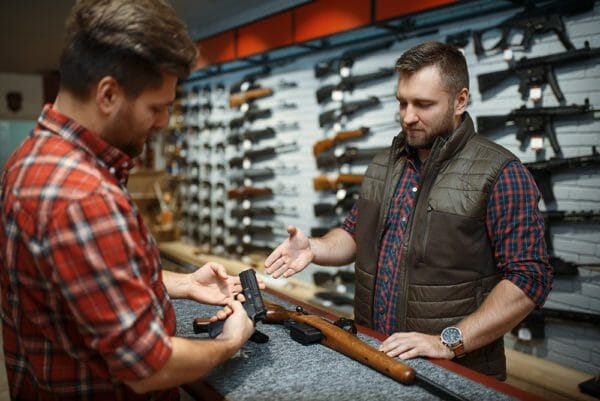
U.S.A. –-(AmmoLand.com)- More people own guns today than ever before. That growth continues a long-term trend that goes back several decades. In addition to that gradual increase, we’ve also seen extraordinary growth in new gun buyers in the last two years. We had to rewrite who owns guns and why they own them.
Today, about four-out-of-ten families have a firearm in their home. Despite the astounding changes in gun ownership, the way some politicians talk about guns and gun owners is out of date. New gun owners are subjected to a crash course in being misperceived and misrepresented by politicians and the mainstream news media.
What is real, and what is fantasy?
Sitting President, Joe Biden, echoed old myths about gun owners at a fundraising event in June. He said, “More people get killed with their own gun in their home trying to stop a burglar than, in fact, any other cause.. Think about that. Because it’s hard to do. It’s a hard thing to do.”
Mayor John Fetterman, the Democrat candidate for the US Senate from Pennsylvania, also felt the need to comment on guns and gun ownership. He said, “I have seen with my own eyes at the scenes in my community what a military-grade round does to the human body.” He said that rifles, particularly modern rifles, should be outlawed.
New York Governor Kathy Hochul said, “This whole concept that a good guy with a gun will stop the bad guys with a gun, it doesn’t hold up. And the data bears this out, so that theory is over.”
Those statements don’t fit what we know. We know a lot about new gun owners because we talked with them. Gun stores asked new gun owners why they wanted a gun so the gun shop employee could direct the customer to the appropriate products. The industry trade group representing firearms manufacturers and distributors collected those answers.
The stereotypical gun owner used to be an old white man who bought a gun to go hunting. Several years ago, personal safety replaced hunting as the major reason new gun owners buy firearms. Today, gun owners are from every demographic group; male and female, rich and poor, urban and rural. Gun owners represent every ethnic and racial group. About one-out-of-four African-American adults own a firearm. It seems strange that the mainstream media and politicians have deliberately ignored that change.
We saw firearms ownership increase for many reasons. Concealed carry of a personal firearm is now common in all but a handful of states. Not only are tens of millions licensed to carry a personal firearm in public, but we also exercise those permits daily.
Today, about one-out-of-a-dozen adults carry a firearm in public when and where it is legally permissible to do so. We also stop most attempted mass murders when the government allows us to carry our firearms. Good men and women, ordinary civilians, use firearms to protect themselves and their families more than four thousand times a day. Excluding some politicians, more and more of us have concluded that armed defense works.
Another reason for increased gun ownership is the unusual increase in crime we’ve seen in the last few years. Our judicial system stopped removing repeat criminals from society during the Covid lockdowns. The resulting increase in crime touched our families and friends. Many of us discovered that the police will not be there to protect us. Millions of us responded by buying a firearm and protecting ourselves.
We should probably add a third factor that increased the rate of firearms ownership. The Covid lockdowns reduced the time we could spend with friends and extended family. We spent more time looking at our computers and our phones. During the lockdowns, the news media had a larger influence on our perception of what is happening in the world around us.
To deliver viewers to their declining list of advertisers, the news media fed us a concentrated diet of sensationalized crime reports. Crime indeed increased in the last few years, but the tiny screens brought crime to where we live as never before. In combination, factors like these significantly increased both the number and diversity of legal firearms owners.
We defend ourselves with a firearm between 1.7 and 2.5 million times a year. 44 percent of black gun owners reported using firearms to defend themselves or their families. Many of us know someone who used a firearm in self-defense. In contrast, I never heard the mainstream media correct President Biden’s statement that our guns kill more of us than they save. That leaves our personal experience in direct contradiction with the President’s claim and the media’s twisted narrative about gun owners.
Mayor Fetterman’s claim sounds strange to me as well. Looking at our history, even the ubiquitous 9mm handgun cartridge was first carried as a military round. Today, the 9mm is the most common handgun cartridge carried by both law enforcement and civilians.
When a policeman is carrying it, the modern rifle is called a “personal defense weapon” or a “patrol rifle.” The same gun made out of metal and plastic is relabeled by anti-gun politicians as an “assault rifle” and a “military-grade weapon” when our neighbors own one. The modern rifle is called a “weapon of war,” even though no modern military branch would field the semi-automatic rifles that US civilians are allowed to own today. Today’s military rifles are capable of automatic fire, and ours are not.
Fetterman’s gun-confiscation proposal might make some sense if we only looked at one side of the argument. Fetterman deliberately ignored the hundred thousand times a year that long guns were used in armed defense. We have about 25 million modern rifles in civilian hands here in the US. If these gun owners were a problem to society, then we would surely know it. Modern rifles save many more lives than they cost, but that isn’t what we see on television.
The news media sells sensationalized stories and leaves out the additional facts that put violence into perspective. About four times as many people are killed with knives than are killed with rifles each year. Drowning kills ten times more people each year than die from “assault weapons.” According to FBI homicide statistics, more people were killed with hands and feet than were killed with a long gun of any kind.
We agree that violent crime is shocking, but the mainstream news media never called out the distortions of these anti-gun politicians. The media often reports when a criminal uses a firearm. In contrast, the media seldom reports when our neighbors use their legally owned firearms to stop a crime.
Each time that a major US media outlet mentions an armed citizen using a legally owned firearm to save lives, the media runs hundreds of stories where criminals used a gun. That media bias turns the world upside down. In fact, armed defense is several times more common than a criminal using a firearm during the commission of a crime. This deliberate editorial policy misrepresents the news of armed defense by a factor of over a thousand to one. That is why we think that mass murder is common and that armed defense is rare.
If you only know what you’re told by the mainstream press, then you might believe the gun-control politicians too. One hint is that many Democrat politicians own guns even as they vote for ever more gun-control laws to disarm the rest of us.
The stereotype of gun owners is a lie. The media calls us male-pale-and-stale, and who cares if old white men are disarmed anyway. In fact, gun owners now look like a cross-section of the USA. Minority urban women are the fastest-growing segment of new gun owners. I think Democrat politicians are afraid that more women and minorities will decide to become gun owners. These new gun owners might enter the culture of armed America and protect themselves.
That fear keeps Democrat politicians up at night.
About Rob Morse
The original article, with references, is posted here. Rob Morse writes about gun rights at Ammoland, Clash Daily, Second Call Defense, and his SlowFacts blog. He hosts the Self Defense Gun Stories Podcast and co-hosts the Polite Society Podcast. Rob was an NRA pistol instructor and combat handgun competitor.

Operation Overlord. In the overall pantheon of cool military names, Overlord flirts with perfection. The term projects the sort of gravitas demanded of the event.

June 6, 1944, was a Tuesday. From the comfortable vantage of my favorite writing chair, it is tough to comprehend the truly timeless significance of D-Day. Comprising the largest amphibious invasion in human history, on that fateful morning, some 156,000 Allied ground troops supported by another 195,700 sailors seized a foothold on mainland Europe. Never before had there been such a single seminal moment that so starkly reflected the struggle between the forces of good and evil.

Europe was engulfed in darkness. For four long years, mainland Europe had endured under the heel of the Nazi jackboot. In 1940 Hitler’s thugs had waltzed across France and the Low Countries like they owned the place. As D-Day approached Dwight David Eisenhower’s boys now stood poised to give the Germans a healthy dose of perspective.

It cost the Allies more than 10,000 casualties to acquire title to that precious beachfront property in Normandy, all in that single day. Of those thousands of casualties, some 4,414 were confirmed dead. We lost 185 Sherman tanks. Casualties on the German side ran somewhere between 4,000 and 9,000. So many of them were buried underneath untold tons of rubble that the final tally was known only to God.

Around 15,000 Frenchmen died in the pre-invasion bombardment. Roughly the same number perished in the crossfire during the invasion. In aggregate that’s more folks than live in my thriving little Southern town. The French equivalent of every man, woman, and child in Oxford, Mississippi, died to evict the Germans from Western France. Through the lens of history, it is easy to overlook such extraordinary stuff as that.
Drilling Down

Those numbers are the purview of the Generals, politicians, and historians. The few men I have known well who were there gave a very different perspective. Their world was much, much smaller. One gentleman, a member of the 5th Ranger Battalion who landed in the first wave, described events as utter chaos. They cared little for strategy. Life is distilled down to resisting death whenever possible and killing the enemy. It was here on that blood-soaked beach that General Norman Cota coined the epic phrase, “Rangers, lead the way!”

In times of such unimaginable madness, a man’s true nature bubbles forth. Many self-described brave men turn out cowards, while some of the more quiet sort show unimaginable resolve. Such combat is the ultimate crucible. It burns away the dross and leaves a man’s core character exposed for all to see.

Of the 83,115 British troops who landed as part of Operation Overlord only one man earned the Victoria Cross. Abbreviated VC, the Victoria Cross is England’s highest award for valor in the face of the enemy. It is the British equivalent of our own Medal of Honor, and it is not easily acquired.
British Backbone

Stanley Hollis was born in Middlesbrough, North Riding of Yorkshire, England, in 1912, six years before the end of the First War to End All Wars. As a child, he worked in his parents’ shop selling fish and chips. At age 17 he apprenticed as a ship’s navigator, making regular voyages to the western coast of Africa. He contracted blackwater fever, a particularly vile malarial variant, and was forced to quit the merchant marine.

Hollis came home, married, and started a family. In 1930 he enlisted in the Territorial Army, the British counterpart to our Army National Guard. With the outbreak of WW2, he deployed to Europe with the British Expeditionary Force. He narrowly escaped during Operation Dynamo, the evacuation of Dunkirk. Dynamo may be the second coolest military operation name ever contrived.

Hollis fought at El Alamein with Montgomery’s Eighth Army and was subsequently wounded during the invasion of Sicily in 1943. This was but one of multiple combat wounds Hollis received during the war. He was shot or hit with shrapnel so many times his men came to think him unkillable.

On June 6, 1944, Hollis had recovered sufficiently to join the 6th Green Howards as they stormed Gold Beach. Serving as a Company Sergeant Major Hollis moved forward with his troops. In their rush to get off the beach, the British inadvertently overlooked a pair of German fortifications.

Realizing that these active emplacements now threatened the flank of the British invasion force, CSM Hollis charged the first, his Sten gun blazing. Once he reached the pillbox under heavy fire he shoved the muzzle of his Sten through the embrasure and emptied his magazine. Leaping atop the fortification he swapped magazines, threw a Mills bomb through the back door, and emptied his second magazine behind it. In the process, he killed two of the German defenders and captured the rest.

Hollis immediately indexed to a nearby slit trench and supporting fighting position, singlehandedly taking another 26 prisoners. Later that day Hollis led an assault on a heavily fortified position that included a field piece and several MG42 machineguns. Seizing a PIAT gun, Hollis fired upon the German cannon from a range of 50 meters. This attack was ultimately repulsed, but two of his men were pinned down in the aftermath.

Hollis then rushed back into the enemy fire, this time with a Bren gun. He distracted the German defenders long enough for his men to escape. In the process, he threw a Mills bomb but forgot to prime it. The German defenders, however, did not appreciate this. As they scattered in the face of the inert grenade Hollis charged their position and cut them down with his Bren.
The Weapons

The Sten gun was a desperation weapon developed by Reginald Shepherd and Harold Turpin while working at the Enfield Small Arms Factory. The name Sten is a portmanteau combining elements of all three names. Designed in 1940 specifically to be inexpensive and easy to produce, the Sten was intended to help stave off the expected seaborne invasion by the Germans. More than 4 million copies were produced, making the Sten the second most-produced SMG of the war after the Soviet PPSh.

The Sten was manufactured in five different marks during the war. The Mk IIS and the Mk VS were the world’s first operational sound suppressed SMGs. The Sten fed on a ghastly side-mounted double-column, single-feed magazine and cycled at a sedate 500 rounds per minute. At a time when an American M1928A1 Thompson cost $200, the Sten ran about $11. That’s roughly $200 today.

The PIAT (Projector, Infantry, Anti-Tank) was technically a spigot mortar. Designed to replace the obsolete Boys antitank rifle, the PIAT was a 32-pound beast of a thing. While the published maximum effective range was 115 yards, in reality, the weapon was only reliable out to about half that. However, it did launch a shaped charge warhead that, when it detonated properly, was quite effective at penetrating German armored vehicles.

The PIAT benefitted from not having any backblast upon firing, but the recoil was said to be murderous. The gun itself contained a massive spring that kicked the 2.5-pound round out. The recoil force from firing would theoretically re-cock the heavy action. 115,000 copies were built.

The Mills bomb was the standard British hand grenade from 1915 into the 1980s. More than 75 million were produced. The Mills bomb was named after William Mills and produced at the Mills Munitions Factory in Birmingham. This patented design was based upon a previous Belgian grenade contrived by a Captain Leon Roland. There actually resulted in a most acrimonious row over patent rights.

The Mills bomb evolved over time. It was eventually configured such that it could be fired from a rifle equipped with a grenade discharger cup. The serrations in the grenade body were included to make the bomb easier to grip, not to enhance fragmentation.

The Mills bomb was a defensive grenade. This means that it produced a large volume of lethal fragments. By contrast, the German stick grenade was an offensive grenade that produced a great deal of blast but not so many fragments. A competent British Tommy was expected to throw a Mills bomb between 15 and 27 meters. The effective range of the grenade’s fragments was on the order of 90 meters.

The Bren gun was developed from the Czech ZB vz.26 light machinegun in the mid-1930s. Chambered for the British standard .303 cartridge and cycling at around 500 rpm, the Bren was one of the most reliable and effective light machineguns of the war. After WW2 the British rechambered the Bren for 7.62x51mm and redesignated it the L4A4. In this configuration modernized Bren guns served all the way through the First Gulf War.
The Rest of the Story

Three months after the D-Day invasion CSM Hollis was wounded once more, this time in the leg. He was subsequently evacuated back to England. He received his Victoria Cross a month later from the hand of King George VI himself. After the war ended, like so many of those great old heroes, Stanley Hollis simply wanted to have a life.

Hollis worked as a sandblaster at a local iron works before opening a motor repair business. He spent five years as a ship’s engineer from 1950 until 1955. Apparently earning your nation’s ultimate award for gallantry in combat trumps a little malaria.

The man needed some stability. Stanley Hollis took over the operation of the “Albion” public house in Market Square, North Ormesby. Under his management, the name of the pub was changed to “The Green Howard” after his wartime combat unit.

Stanley Hollis never fully recovered from his wartime injuries. His children later reported that he carried ample German shrapnel as well as a couple of bullets around in his body for the rest of his life. If he stood too long at the pub his leg and foot wounds would purportedly begin to bleed spontaneously. On February 8, 1972, CSM Stanley Hollis, VC, died. He was fifty-nine years old.

A commemorative plaque followed, as did a bronze statue of Hollis with his Sten gun. A Middlesbrough school was renamed Hollis Academy in his honor in 2016. Stanley Hollis’ Victoria Cross is on display in the Green Howards Museum in Richmond, North Yorkshire, today. We just don’t seem to make guys like that anymore.

Categories
FM AA52 – La nana
Categories
Back when we would win Wars
United States – -(AmmoLand.com)- Elon Musk completing the purchase of Twitter is a massive boon for Second Amendment supporters in our efforts to protect our freedoms – and our enemies know it.
Musk’s purchase of Twitter deals Silicon Valley censorship a very serious blow, one that is going to be difficult for it to recover from outside some very drastic intervention. We’ll get to that later, but for now, Second Amendment supporters now have a reasonably fair playing field thanks to the Tesla/SpaceX CEO.
In one sense, Second Amendment supporters now have the chance to show up and reach out on this site without interference from a cubicle somewhere in Silicon Valley. In another sense, they have to be careful – because Musk isn’t going to save us from our own mistakes or if we botch the fundamentals.
We’ve seen what just showing up does in some other contexts – Fox News gets better ratings than CNN and MSNBC simply by giving us a reasonably fair shake. We also can look at the lessons from the successful campaign of Glenn Youngkin in Virginia for a similar lesson.
Show up and reach out, but remember what I’ve said before and will say again: How we come across to our fellow Americans matters. The approach we take when we are making our case matters. Making sure we have our facts straight will matter because it goes to credibility. In anything, Second Amendment supporters must emphasize the fundamentals even more.
Elon Musk may be ridding Twitter of censorship, but a lot of media double standards will still be around. Those who fail in these, even if it’s an honest mistake, will make things harder, not easier, for those trying to defend the Second Amendment and could do far more damage than if they had just sat out.
That said, there is an elephant in the room – well, more accurately, Brussels – that Second Amendment supporters may have to deal with. The European Union could very well make Musk’s effort to restore Twitter to free speech a lot more difficult, to say the least, with fines for so-called “hate speech” and “misinformation” – and we have no real control over who in the EU will make those calls. Similarly, we do have the worry of companies who are told that advertising on Musk’s version of Twitter could impact so-called ESG scores.
Despite the potential threats from the EU and corporations, Second Amendment supporters have a lot to celebrate about Elon Musk’s purchase of Twitter. A fair fight on Twitter will, on balance, help Second Amendment supporters defeat anti-Second Amendment extremists via the ballot box at the federal, state, and local levels.
About Harold Hutchison
Writer Harold Hutchison has more than a dozen years of experience covering military affairs, international events, U.S. politics and Second Amendment issues. Harold was consulting senior editor at Soldier of Fortune magazine and is the author of the novel Strike Group Reagan. He has also written for the Daily Caller, National Review, Patriot Post, Strategypage.com, and other national websites.

James Montgomery Doohan was born on March 3, 1920, in Vancouver, British Columbia. His father was a veterinarian, pharmacist, and dentist who developed an early form of high-octane gasoline. Starting in 1946 Doohan took on roles as a voice actor for radio, developing a reputation for his broad range of accents and dialects. Over the next decade, he performed in more than 4,000 radio programs.


In the mid-1950s, James Doohan played forest ranger Timber Tom in the Canadian version of Howdy Doody. Oddly, at the same time, William Shatner was playing Ranger Bill in the American version of the show. Both men later appeared together on the Canadian TV series Space Command.

Over the years Doohan played a wide range of roles on screens both large and small. However, the one part for which he is best remembered is that of Montgomery Scott, the chief engineer on Star Trek‘s starship Enterprise. Though he was neither Scottish nor an engineer, James Doohan’s depiction of the longsuffering Starfleet officer created a cinematic icon.

While auditioning for the part before Gene Roddenberry, the creator and producer of Star Trek, Doohan suggested that all the best engineers were Scottish. He personally chose the first name of Montgomery to honor his grandfather. The resulting beloved character became a fixture across three years’ worth of live-action television, an animated series, and seven major films.

Doohan’s vocal range was indeed remarkable. He voiced a variety of entities on the TV series to include Sargon in “Return of Tomorrow,” the M-5 in “The Ultimate Computer,” the Mission Control Voice in “Assignment: Earth,” and the Oracle in “For the World is Hollow and I have Touched the Sky.” He voiced a total of fifty different characters during the animated series to include as many as seven in a single episode. He also contributed heavily to the development of both the Vulcan and Klingon languages for the films.

The Trekkie truly committed to his craft might appreciate, however, that throughout the run of both the TV shows and movies, Doohan takes care with how he positions his hands. However, in “The Trouble with Tribbles” we do get a quick glance. James Doohan was missing his right middle finger. The tale of how he lost that digit is indeed fascinating.
A Young Man Goes to War

Doohan’s father was an alcoholic who made life miserable for Jimmy and his three older siblings. At age nineteen, Doohan enlisted in the Royal Canadian Artillery and was assigned to the 14th (Midland) Field Battery of the 2d Canadian Infantry Division. He was later commissioned a Second Lieutenant and assigned to the 14th Field Artillery Regiment of the 3d Canadian Infantry Division. In 1940 he was deployed to England. By 1944 he was ready to go to war.

LT Doohan landed on Juno Beach on June 6, 1944, alongside 14,000 other Canadian troops. Juno was one of five invasion beaches designated as part of Operation Overlord, the Allied invasion of Normandy. Opposing the invading Canadians were two battalions of the German 716th Infantry Division with elements of the 21st Panzer in reserve near Caen. The initial landing was a fairly bitter thing. One in every eighteen Canadian assault troops became casualties that first day.

LT Doohan led his men across the beach strewn with antitank mines and personally killed a pair of German snipers. Doohan was ultimately in combat less than 24 hours. At around 2300 that first evening the young Canadian officer was making his way between a pair of Allied positions when an inexperienced Bren gunner fired at the noise. Doohan caught a total of six not-so-friendly .303 rounds.

Doohan took four rounds to his left knee and leg and one to the chest. The sixth round blew off the middle finger on his right hand. The chest wound would have undoubtedly been fatal had it not struck a glancing blow that deflected off of a cigarette case Doohan kept in his left breast pocket. The case had been a gift from his brother. Doohan joked later in life that he was one of the few people for whom smoking had actually saved his life.
The Guns

LT James Doohan’s No 4 Lee-Enfield rifle was an evolutionary development of the Short Magazine Lee-Enfield (SMLE) with which Commonwealth forces fought the First World War. These Tommies called their SMLE rifles “Smellies.” The SMLE was itself a development of the previous Lee-Metford.

The No 4 Lee-Enfield was cheaper and faster to produce than the WW1-era weapon. Fed from either a detachable ten-round box magazine or top-fed stripper clips, the No 4 also cocked on closing and had an abbreviated 60-degree bolt throw. These attributes made the Lee-Enfield arguably the fastest bolt-action military rifle ever produced. In 1914 a British musketry instructor named SGT Snoxall put 38 rounds inside a 12-inch target at 300 yards in 60 seconds, a record that purportedly stands even today.

The Bren gun was a license-produced development of the Czech ZGB-33 light machinegun. The name “Bren” is a portmanteau combining Brno, the Czech city where the gun was first designed, and Enfield, the location of the British Royal Small Arms Factory. The ZGB-33 was itself developed from the previous Zb vz.26 designed by Czech designer Vaclev Holek.

Originally adopted in 1935, the Bren fired the rimmed .303 British cartridge and weighed about 23 pounds. The gun’s sedate 500 rpm rate of fire, its superb reliability, and its quick-change barrel made it an efficient and effective support weapon. The Bren fed from the top via a sharply curved 30-round box or a 100-round pan magazine. However, the latter was a bit ungainly in action. All members of the rifle squad would typically pack spare magazines for the Bren.

In the 1950’s the British re-barrelled the Bren gun to fire the NATO-standard 7.62x51mm round and designated it the L4A4 LMG. This variant served through the war in the Falklands. Final production of the Bren by the Indian Ordnance Factories continued until 2012.

Though expensive and fairly heavy, the Bren has been described as the best light machinegun of its era. Filling roughly the same tactical space as did the American BAR, the Bren benefitted from its quick-change barrel and increased magazine capacity. The L4A4 version used a magazine that was interchangeable with those of the L1A1 SLR rifles employed by British forces at the time.
The Rest of the Story

LT Doohan obviously recovered from the wounds he incurred on D-Day. Afterward, he was selected for pilot training and graduated from Air Observation Course 40 alongside eleven other Canadian artillery officers. Doohan trained to fly the Taylorcraft Auster Mark V observation aircraft. He was assigned to the 666 Air Observation Post Squadron RCAF at Andover, England, in support of the 1st Army Group Royal Canadian Artillery.

Captain Doohan soon developed a reputation for his daring at the controls of his nimble little spotter plane. Once in the late spring of 1945 while flying a Mark IV Auster on the Salisbury Plain north of Andover he came across a series of telegraph poles. Doohan then slalomed his little plane back and forth around the poles, in his words later, “to prove it could be done.” He was strongly reprimanded for this stunt. He left the Canadian Army shortly after the end of the war.

Many of the Star Trek cast, particularly Leonard Nimoy, resented being type-cast in those roles. James Doohan did also strive for a time to shake off the inevitable baggage that came with playing such a popular character. However, he eventually came to embrace his Scotty persona and was a popular fixture at conventions for decades. Most of his film and TV roles after Star Trek included some reference or parody to his most famous part.

William Shatner who played Captain Kirk was notoriously difficult. The strained relationship between Shatner and the rest of the cast is beautifully parodied in the simply spectacular spoof Galaxy Quest. If you have any interest in classic science fiction at all and haven’t yet seen Quest then stop what you’re doing immediately and go watch it. You’ll thank me later.

Doohan once said of Shatner, “I like Captain Kirk, but I sure don’t like Bill.” Of the original cast, Doohan was the only one who refused to be interviewed for Shatner’s Star Trek: Memories books about the show and subsequent films. I’m not too proud to admit to having read and enjoyed both tomes. By their final convention appearance together in 2004 Doohan and Shatner seemed to have mended their relationship.

Jimmy Doohan was married three times and had seven children. Like most Hollywood personalities, his personal life was tumultuous. However, it was of his contributions in the Real World that Doohan was most proud. Doohan once corresponded with a young fan who was contemplating suicide. After subsequently meeting at a Star Trek convention Doohan’s encouragement and support not only got the young woman through her emotional slump but inspired her to complete engineering school. At James Doohan’s final stage appearance before his death in 2005 at age 85 Astronaut Neil Armstrong told him, “From one old engineer to another, thanks, mate.”

 A native of the Mississippi Delta, Will is a mechanical engineer who flew UH1H, OH58A/C, CH47D, and AH1S aircraft as an Army Aviator. He has parachuted out of perfectly good airplanes at 3 o’clock in the morning and summited Mount McKinley, Alaska, six times…always at the controls of an Army helicopter, which is the only way sensible folk climb mountains. Major Dabbs eventually resigned his commission in favor of medical school where he delivered 60 babies and occasionally wrung human blood out of his socks. Will works in his own urgent care clinic, shares a business build-ing precision rifles and sound suppressors, and has written for the gun press since 1989. He is married to his high school sweetheart, has three awesome adult children, and teaches Sunday School. Turn-ons include vintage German machineguns, flying his sexy-cool RV6A airplane, Count Chocula cereal, and the movie “Aliens.”