
Categories
How Harry met Spike.
When the ten ton 7.2” howitzer fired, the recoil drove it out of the gunpit and over the cliff, nearly hitting Harry’s radio truck. A few moments later, Spike ran up and said “Has anyone seen a gun?” Harry replied “What colour?”.
7.2” howitzer
If you don’t get the joke, or you’ve never heard of the Goons, you might find our humour difficult.
British humour has always carried a strong element of satire at the absurdity of life. Common themes include sarcasm, irony, understatement, self-deprecation, the mocking of authority and puns. Often delivered deadpan rather than telegraphed as funny, which can sometimes make it confusing for non-Britishers (excluding Aussies and Kiwis).
Whilst it would be wrong to suggest that there was not an element of propaganda in these portrayals, there was also a strong underlying current of truth or they would not have rung true with contemporary audiences.
Irony and black humour in conflict are a valuable aid to morale, allowing the discussion of topics that are no laughing matter and providing a safety valve that helps soldiers to bond and endure in dire conditions.
I should say that black humour is found in all armies and, for instance, Bill Mauldin’s US Army cartoons are very much direct descendents of Bruce Bairnsfather.
Bill Mauldin
However, black humour is absolutely foundational in the British forces. After all, today’s British Army Rumour Service is called ARRSE (ass for the Yanks).
Genuine, front-line, non-propaganda, humour was to be found everywhere but WW1 humour is preserved in publications such as the Wipers (Ypres) Times and remains very similar to this day. Some examples:

Notice the mocking of authority.
The joke is in the officer’s offensive dress sense (his socks). Mocking authority again
Bruce Bairnsfather’s cartoons were a great morale booster.
The use of understatement and irony.
Similar humour alive and well in WW2 – Pilot Officer Prune.

In the early 1960s, a tidy little war broke out along the border between Indonesia and East Malaysia on the island of Borneo. European colonialism had subdivided the planet into a bewildering amalgam of fiefdoms and protectorates, and the sundry peoples involved yearned to define themselves in the aftermath of the Second World War. On August 29, 1964, this tidy little war got quite messy.

Lance Corporal Amarjit Pun was the second-in-command for the point section of 10 Platoon, C Company, 2d Gurkha Rifles, on a company-strength patrol along the border south of Kumpang Langir. A company-sized element can be unwieldy on a protracted combat patrol, and all involved were looking forward to getting back to base for some rack time. However, as the patrol headed for home, they unwittingly walked into a kill zone.

The ambush was of the classic sort. Indonesian infantry well concealed in the jungle underbrush allowed the Gurkhas to walk deep into their killing ground before initiating the ambush with a murderous rain of small arms fire. In the first salvo, Lance Corporal Amarjit’s section commander was grievously wounded, while one of his NCOs was killed outright. The light machinegun team was also taken out of action. The Number 1 gunner was killed and his Number 2 badly hurt. Another rifleman was hit as well. The situation for LCPL Amarjit’s Gurkhas looked grave.

It is the most basic tenet of Infantry training to instinctively assault through an ambush. This goes against every natural urge a man might have in combat. When faced with murderous fire from an unexpected quarter, the natural response is to drop or hide. However, hesitating inside a kill zone equals violent gory death.

A friend who landed on Omaha Beach on June 6, 1944, once told me that stagnation meant dying. He said the fire coming from the German pillboxes was indeed overwhelming, but that combat leaders on the ground pushed their men forward into the chaos. He explained that he charged across the beach to cover, but that every member of his small unit that hesitated on that beach died.

Infantry soldiers are therefore trained on immediate action drills in response to an ambush. They are expected to react instinctively without a great deal of conscious thought. Sometimes that works, and sometimes it doesn’t. In the case of LCPL Amarjit Pun, this compact little man seized the initiative and took charge.

LCPL Amarjit charged forward and retrieved the fallen L4 Bren gun intending on using the discarded weapon on the attackers to help break the ambush. As he hefted the heavy gun another burst of fire raked over him, striking the Bren and putting it out of action. A lesser man might at this point have run or broken. LCPL Amarjit, however, was a Gurkha.

Amarjit Pun stood his ground in the center of the worn jungle track and unlimbered his British-issue L2A3 Sterling submachinegun. Fire poured in from Indonesian troops concealed a mere ten yards away. LCPL Amarjit thumbed his selector to full auto and squeezed the trigger, raking the jungle with 9mm rounds.

Amarjit emptied his Sterling at its cyclic rate and dropped the empty magazine. All the while he shouted encouragement to his comrades. He fished out a second 34-round mag, shoved it into the gun, jacked the bolt back, and emptied it at the nearby Indonesians as well. Throughout it all, heavy fire from the ambushing soldiers ripped the jungle and tore Amarjit’s patrol to ribbons. LCPL Amarjit burned through magazines as fast as he could cycle the gun.

While the Bren light machinegun has become irrevocably associated with British and Commonwealth troops fighting everywhere from North Africa in World War 2 to the Falklands, the gun was actually a Czech design. A license-produced version of the Czech ZGB 33 light machinegun, the ZGB 33 was itself a modified variant of the ZB vz. 26. Vaclav Holek was the primary designer. The name Bren is a portmanteau derived from Brno, the Czech city in Moravia where the gun was designed, and Enfield, the site of the Royal Small Arms Factory.

The earliest Bren gun weighed about 25 pounds and fed from a sharply curved magazine located atop the weapon to accommodate the rimmed .303 British round. The L4A4 Bren used by LCPL Amarjit’s men was the later version rechambered to accept the rimless 7.62x51mm cartridge. This variant can be identified at a glance by its straighter magazine. This 30-round box magazine was intentionally designed such that it would be interchangeable with that of the L1A1 SLR FAL rifles used by British forces at the time.

The Bren is indeed heavy in action, but its sedate 500-rpm rate of fire renders it thoroughly controllable. The Bren served in a similar role as the American BAR. Unlike the BAR, the Bren enjoyed a quick change barrel capability. The reliable tilting bolt, gas-operated action rendered splendid service in dirty environments. Additionally, while the gun was limited by its magazine feed system, the top-mounted design made mag changes fast. Each man in a British Infantry squad typically carried spare magazines for the Bren.

The Sterling submachine gun was an evolutionary improvement on the Sten that helped the British win World War 2. Developed in 1944, the Sterling was the brainchild of George William Patchett, the principal designer at the Sterling Armaments Company of Dagenham. Trial versions of the Sterling actually saw limited action in the closing months of World War 2, specifically with British Commando forces and at Arnhem with the British 1st Parachute Division during Operation Market Garden.

The Sterling generally favored the Sten that inspired it but represented an improvement across the board. The pistol grip was set at the rough center of balance of the gun, and the weapon fed from a superb side-mounted 34-round curved magazine. The Sterling was designed from the outset to feed from either Sterling or Sten magazines.

The Sterling is built around a drawn steel tube milled out and perforated as needed. It is finished out in a peculiar bake-on crinkle finish. This finish seems strangely similar to pickup truck bed liner. While early Sterlings featured a charging handle slot milled in line with the ejection port, production models were moved slightly higher.

One curious aspect of the Sterling design as it relates to American shooters is that the gun can be legally constructed from a registered transferable Sten tube. The BATF has allowed enterprising gunsmiths to adapt Sten tubes to accept demilled Sterling parts kits. The final product is referred to as a Stenling in the vernacular. As the Sterling is a markedly more pleasant and effective weapon than the Sten, this is a popular conversion.

The Sterling’s delightful balance and sedate 550-rpm rate of fire make it unusually controllable. The gun fires from the open bolt and is selective fire via a thumb-operated selector level oriented above the trigger. The collapsible stock on the Sterling is a bit complex but remains nonetheless rigid and effective.

The Sterling is one of the most controllable open-bolt subguns I have ever run. The telescoping recoil system of the German MP40 is perhaps incrementally smoother, but the Sterling still runs like a champ. The Sterling is also unusually compact and handy. This makes it the ideal weapon for combat leaders and second-line support troops who might need their hands free for other tasks.

LCPL Amarjit stood his ground on that tiny jungle trail, dumping magazine after magazine of full auto 9mm fire into the Indonesian troops. His furious close-range assault broke the back of the ambush and bought enough time for the rest of the company to maneuver in place and displace the enemy. The Indonesians subsequently retreated into the jungle. Amarjit’s Gurkhas gathered up their casualties and returned to their base camp.

LCPL Amarjit was unhurt during the chaotic exchange. However, his uniform and equipment had been pierced by Indonesian bullets in three different places. The combination of LCPL Amarjit’s unswerving bravery in the face of the withering enemy attack and the heavy volume of automatic fire from his Sterling submachine gun broke the Indonesian ambush and prevented further casualties to his Gurkha unit.

LCPL Amarjit Pun earned the Military Medal for his actions on that jungle trail back in 1964. The Military Medal was established in 1918 and was used to recognize acts of valor among other ranks such as NCOs and Warrant Officers. Recipients were granted a modest stipend and entitled to include the post-nominal letters “MM” after their names in official correspondence. Though the award was discontinued in 1993 in favor of the Military Cross which is granted to all ranks, the Military Medal still recognizes exceptional bravery in combat.

Wars are fought for territory, greed, and all manner of lofty nationalistic motivations. However, men invariably fight for their buddies. When the incoming fire seemed overwhelming and his comrades were falling LCPL Amarjit Pun unlimbered his Sterling submachine gun and won the day. Sometimes big things do indeed come in small packages.


Britain Stands Alone
Between May 26 and June 4, 1940, more than 330,000 British, French, Belgian, Dutch, and Polish troops were evacuated from the beaches at Dunkirk. By June 25th, another 190,000 troops (more than 140,000 of them British) were evacuated to England from French ports. Unfortunately for the British Expeditionary Force, they left their heavy weapons and vehicles behind. Most of the troops who made it to England arrived with just the uniforms on their backs, their rifles and machine guns having been abandoned in France.
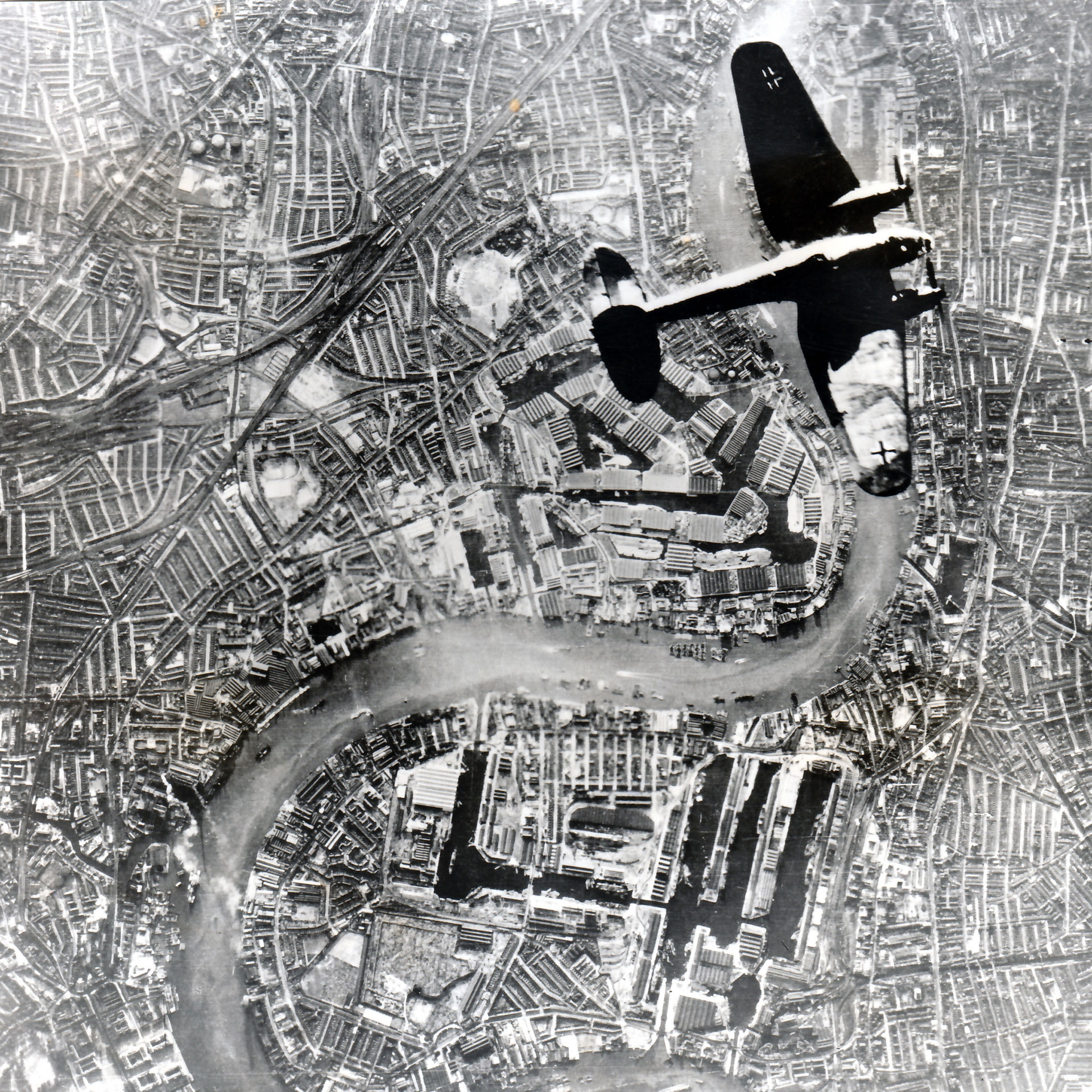
With France conquered, the Germans began bombing England in earnest by the middle of July. Initial attacks were on merchant shipping in the Channel, followed by ever increasing raids on British radar installations and RAF fighter fields across southeastern England. As more and more German aircraft appeared over the British Isles, the prospect of a Nazi invasion seemed more likely every day, particularly an aerial assault by German paratroops. By the end of the first week in September, hundreds of German bombers were attacking London by day and night. England was in grave danger.
Help From America
While RAF fighters struggled to defend their airspace, the British Home Guard did their best to mobilize a legitimate militia to help defend against a German invasion. Small arms were particularly scarce. There was no lack of volunteers, but unarmed free men would do little to stop well-armed Nazi wolves at the door. America, though still neutral, was quick to help. By the autumn of 1940, the American Committee for the Defense of British Homes was formed (with key organizational assistance from many NRA members).
Appeals were presented to American citizens in many publications (including, of course, American Rifleman magazine) to help the British defend themselves. Pistols, rifles, shotguns, and binoculars were collected from generous Americans and shipped to England. In December 1940, President Roosevelt described the concept of turning America into The Arsenal of Democracy. On March 11, 1941, the critical Lend-Lease Act was signed into law, and arms began to flow from America to England. Winston Churchill later wrote: “By the end of July 1941, we were an armed nation.”
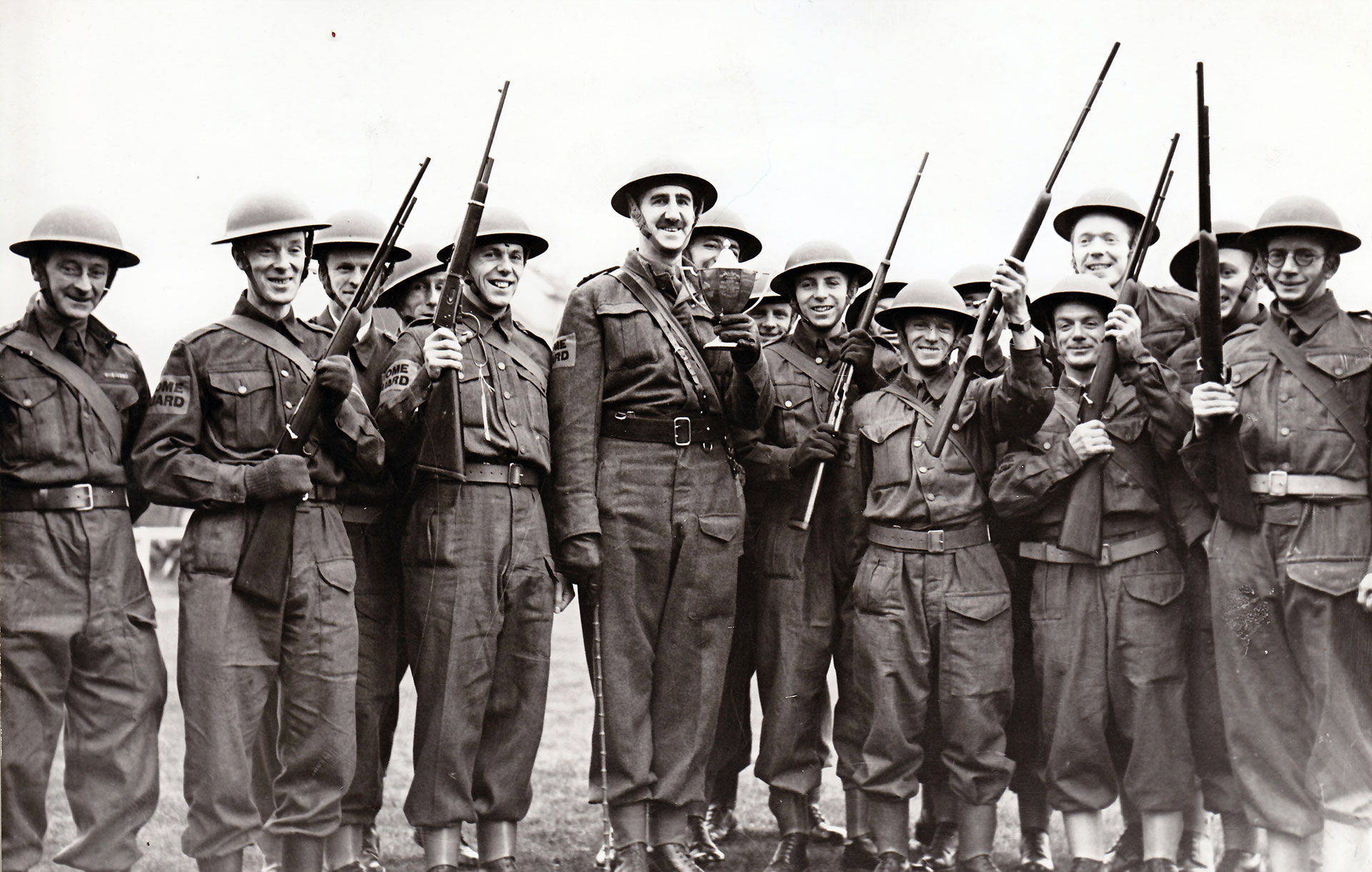
A wide range of US military firearms were sent to England, predominately for use with the Home Guard. The biggest challenge for the British was that most of these arms were chambered in .30-’06 Sprg., or in .45 ACP.
The M1917 .45-cal. Revolver: The British Army had adopted the M1917 revolver during World War I, and many remained in British stocks. More came over in Lend-Lease, and these were used by the Home Guard and also by the Royal Navy.
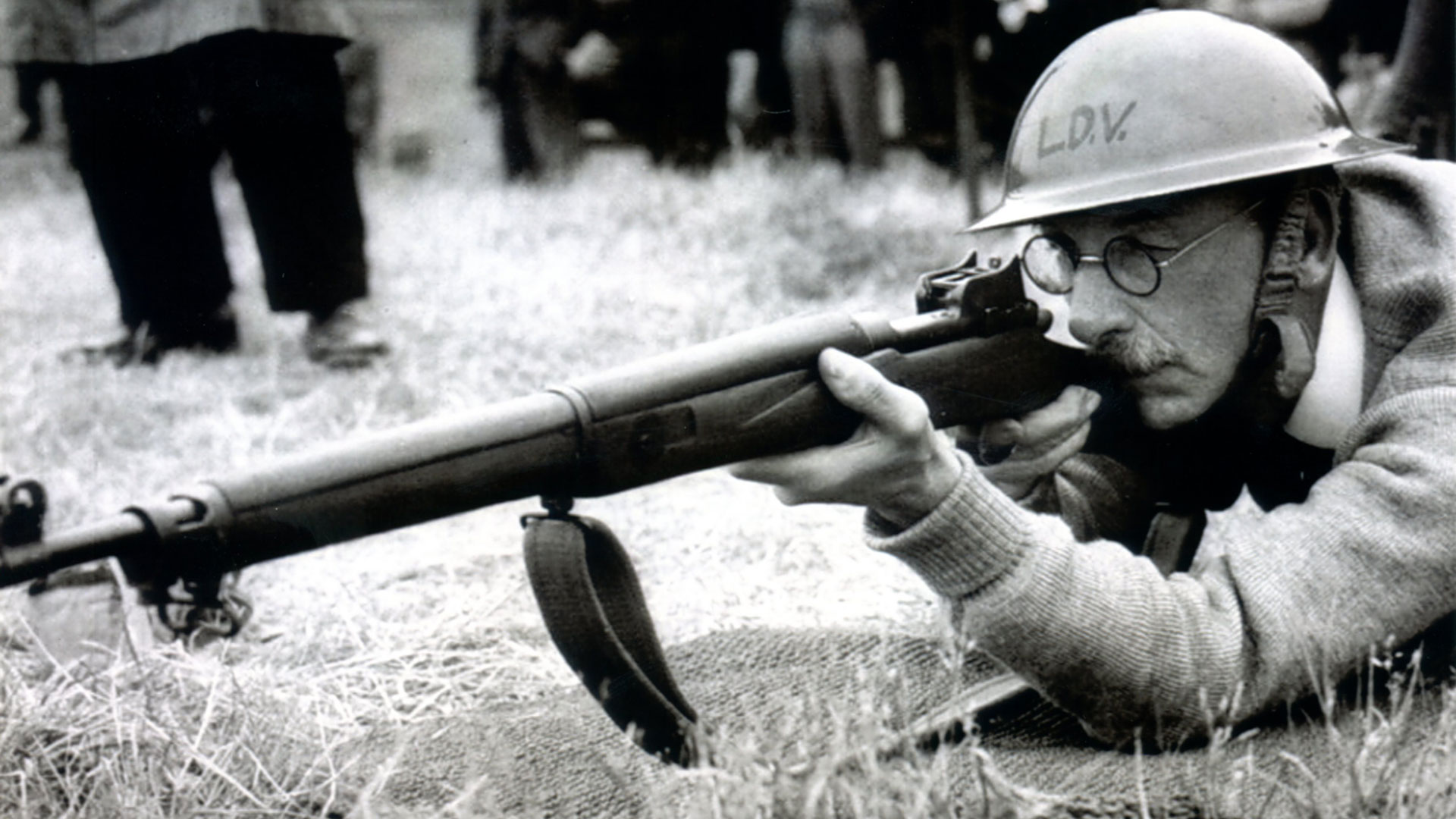
The M1917 & P14 Rifles: During 1940-1941, the British acquired 734,000 of the “United States Rifle, Caliber .30, Model of 1917“. These were marked with a highly visible red stripe painted on the fore-end of the stock to distinguish between the American M1917 and the British P14 chambered in .303 Brit.
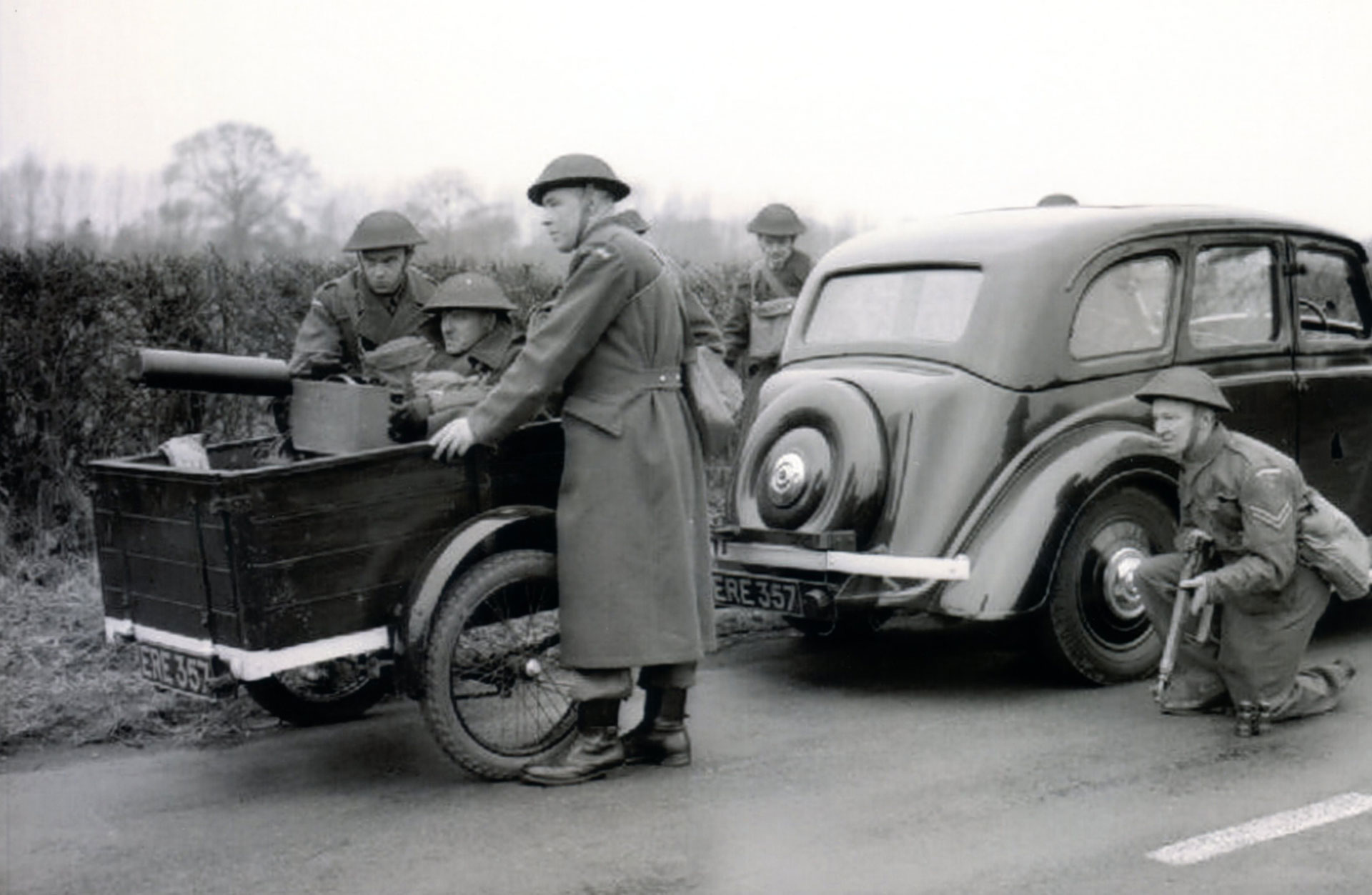
The Browning M1917 Machine Gun & The Colt-Vickers M1915 Machine Gun: The Browning M1917 .30-cal. water-cooled machine gun was supplied to England during the early days of Lend-Lease, with about 650 guns going directly to the Home Guard. The US Colt-Vickers M1915 was of more value to the Home Guard, as it differed only in caliber from the standard British heavy machine gun. Approximately 7,000 M1915 MGs were provided to the Home Guard and served until they were destroyed post-war.
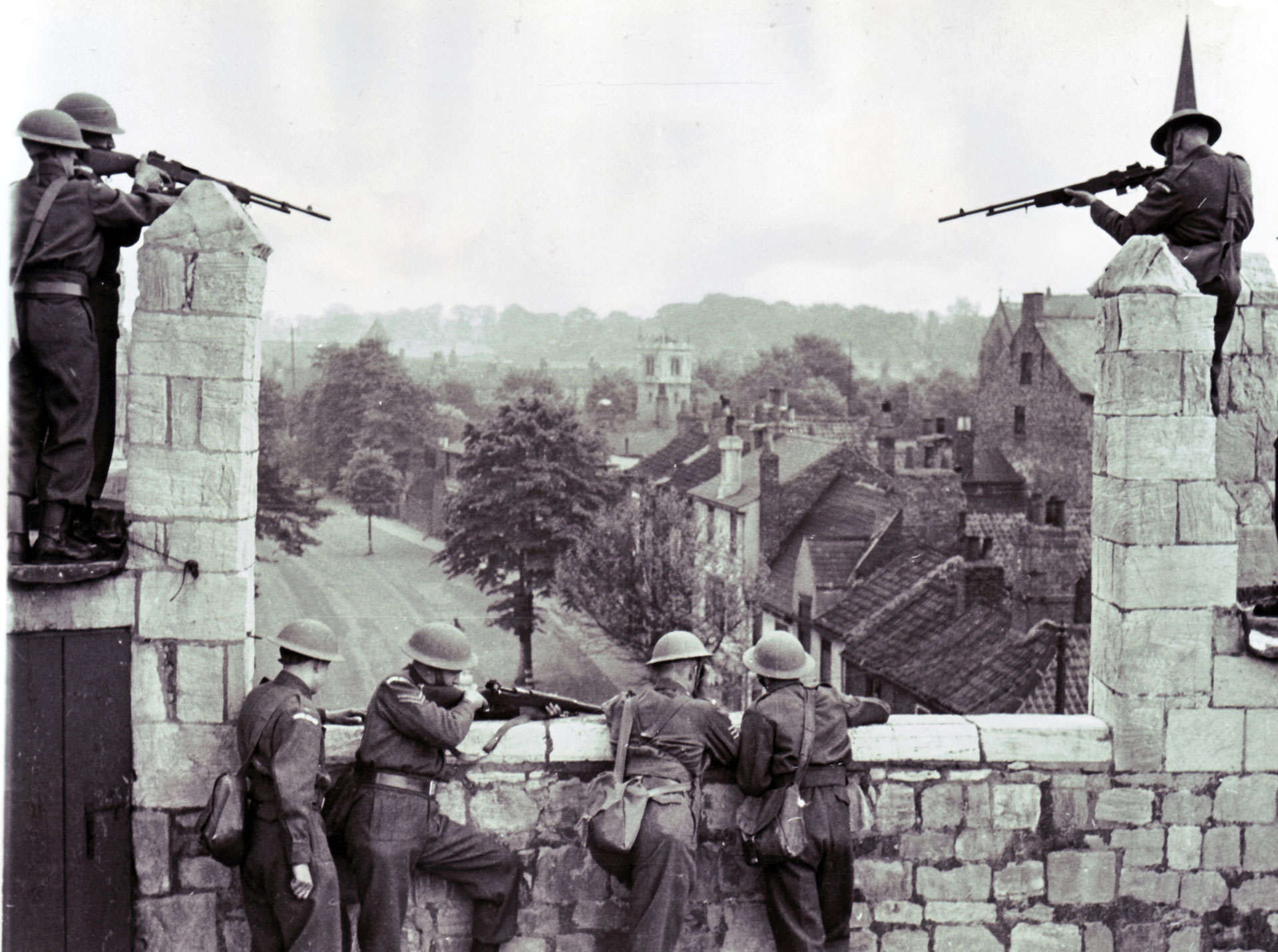
The Browning Automatic Rifle: The British were quite impressed with the BAR, and they strongly considered the weapon (in .303) until 1930, when they decided to move forward with the Bren Gun design. After the BEF abandoned most of their heavy weapons in France during late May 1940, there were only about 3,000 Bren Guns left in England (almost 27,000 having been lost in France). To compensate, the British acquired about 25,000 BARs, and these served the Home Guard until the end of the war. There was much concern in England about Home Guard BAR gunners “wasting ammunition” by using the weapon set for full-auto fire. After 1943, the Home Guard was instructed to use the BAR strictly in the semi-automatic mode.
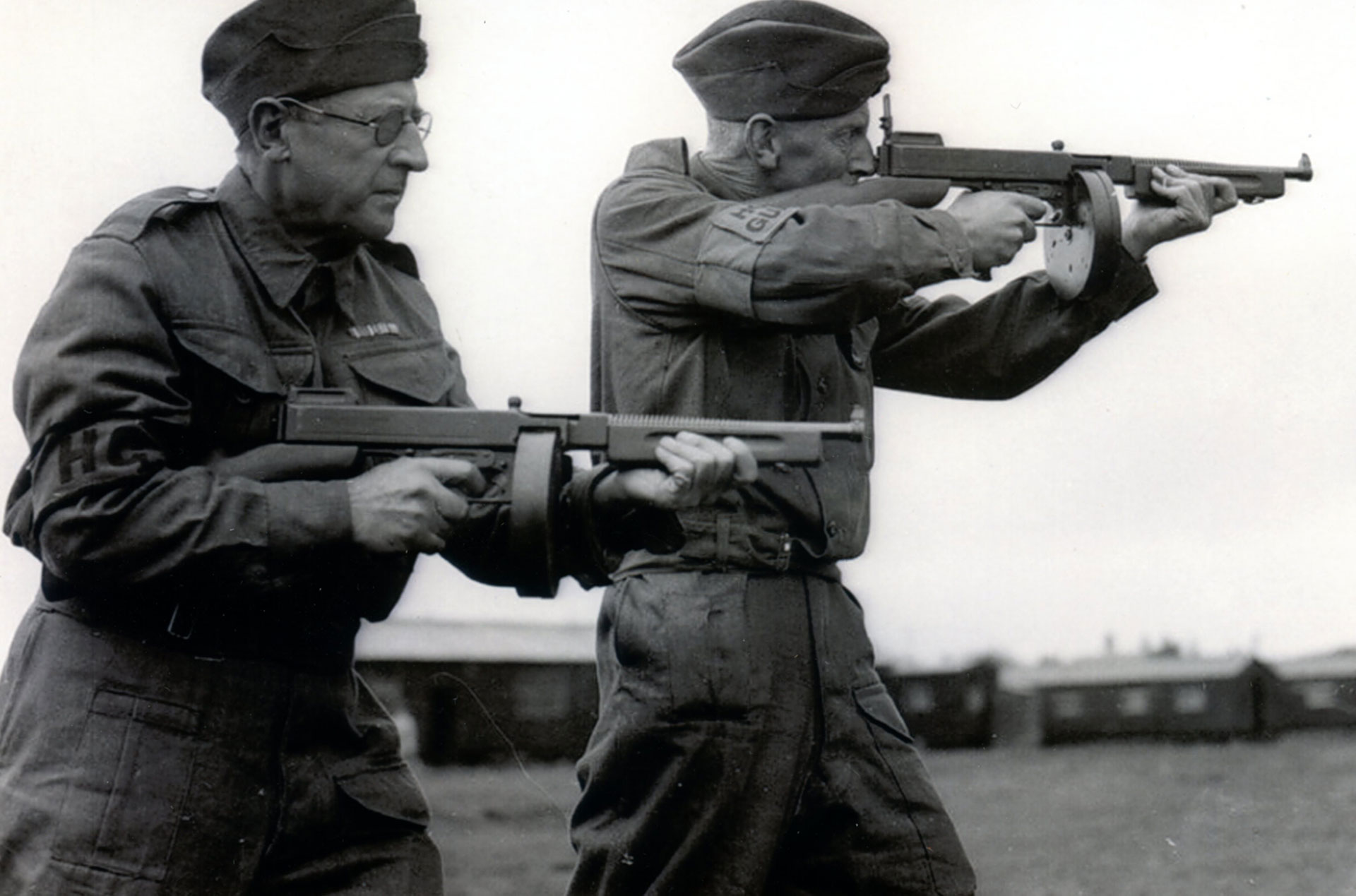
The Thompson Submachine Gun: The Thompson submachine gun was the most numerous American-made firearm supplied to the Home Guard, and ultimately to British forces throughout the war. The “Tommy Gun” made a huge impression on the British, from Prime Minister Winston Churchill to the man on the street and boys in the schoolyard. Even before Lend Lease in March 1941, the British had purchased 108,000 M1928 Thompson Guns from Auto Ordnance. By the end of the war, America sent a little more than 650,000 Thompson Guns (of all models) to England.
The Home Guard Remembered
It is difficult for us to understand now the precarious situation in Britain was in then. As a researcher, I can work to uncover the details about firearms sent and used. I can write about strategy and tactics. But I wasn’t there, and I don’t know how it felt. In that light, I was fortunate to have a friend who lived through the Battle of Britain as a pre-teen boy. I asked Gerry Marsh if he would share his memories of those days and his observations of the Home Guard in his community.
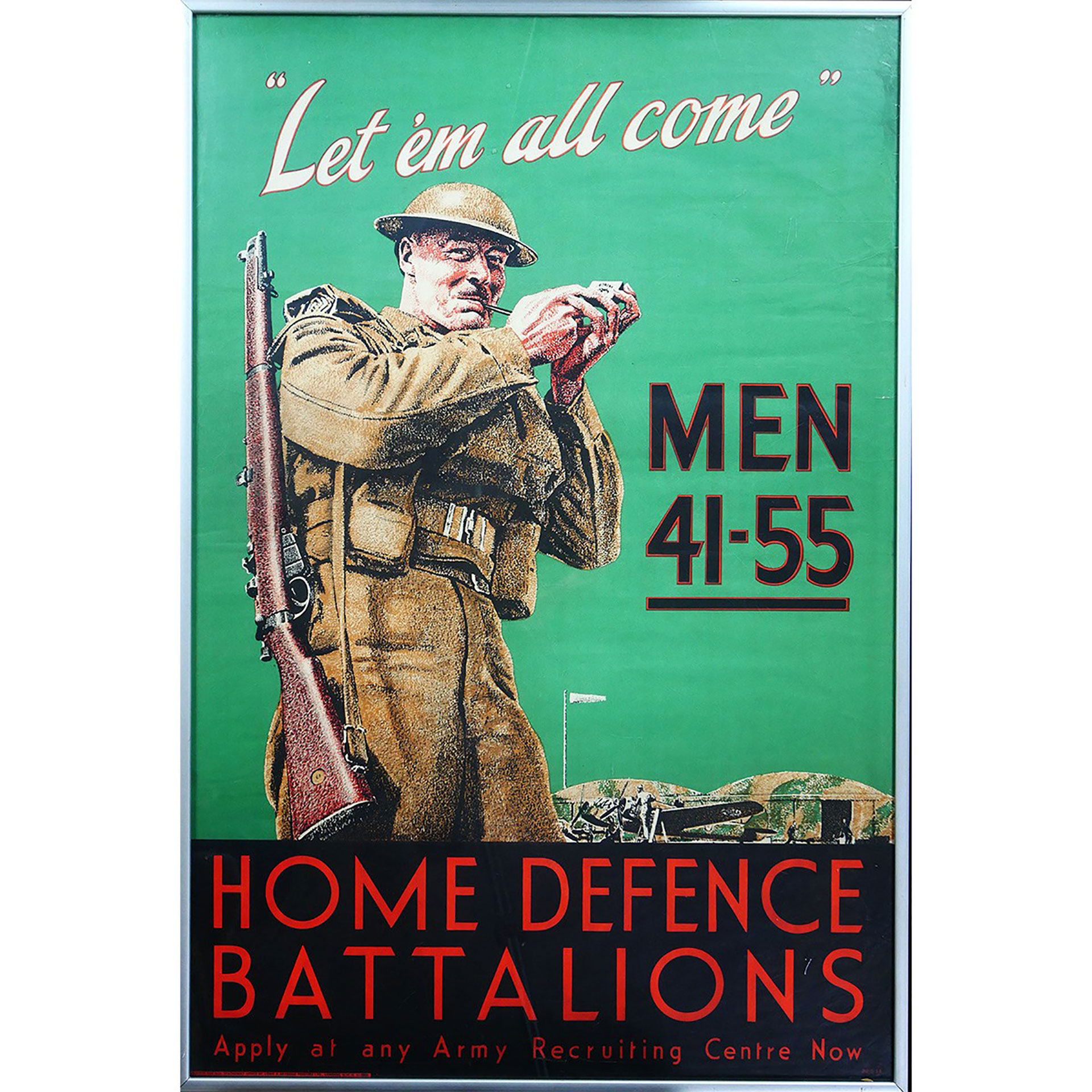
I recall listening to a radio broadcast encouraging those able to join a defense group to do so, to report to their local police station and sign up for duty. I recall, too, for the figures are lodged in my head with pride, the government fully expected half a million men and women to sign up. In fact, 1.7 million volunteered. What did they get for that? Eventually they received a uniform, even later a rifle, along with hours of arduous duty without pay, and the undying gratitude of a whole nation for men and women torn from their placid lives and pressed into service in a national emergency.
The group I watched was one of the many that sprang up quickly and spontaneously, inspired by other patriotic groups that had gathered themselves in anticipation of invasion. They would morph into the Home Guard when that body was approved by, and subject to the rules of, the Home Secretary. The group I saw was all male, for women did not join them until the Home Guard was approved and regulated by Whitehall’s Home Office.
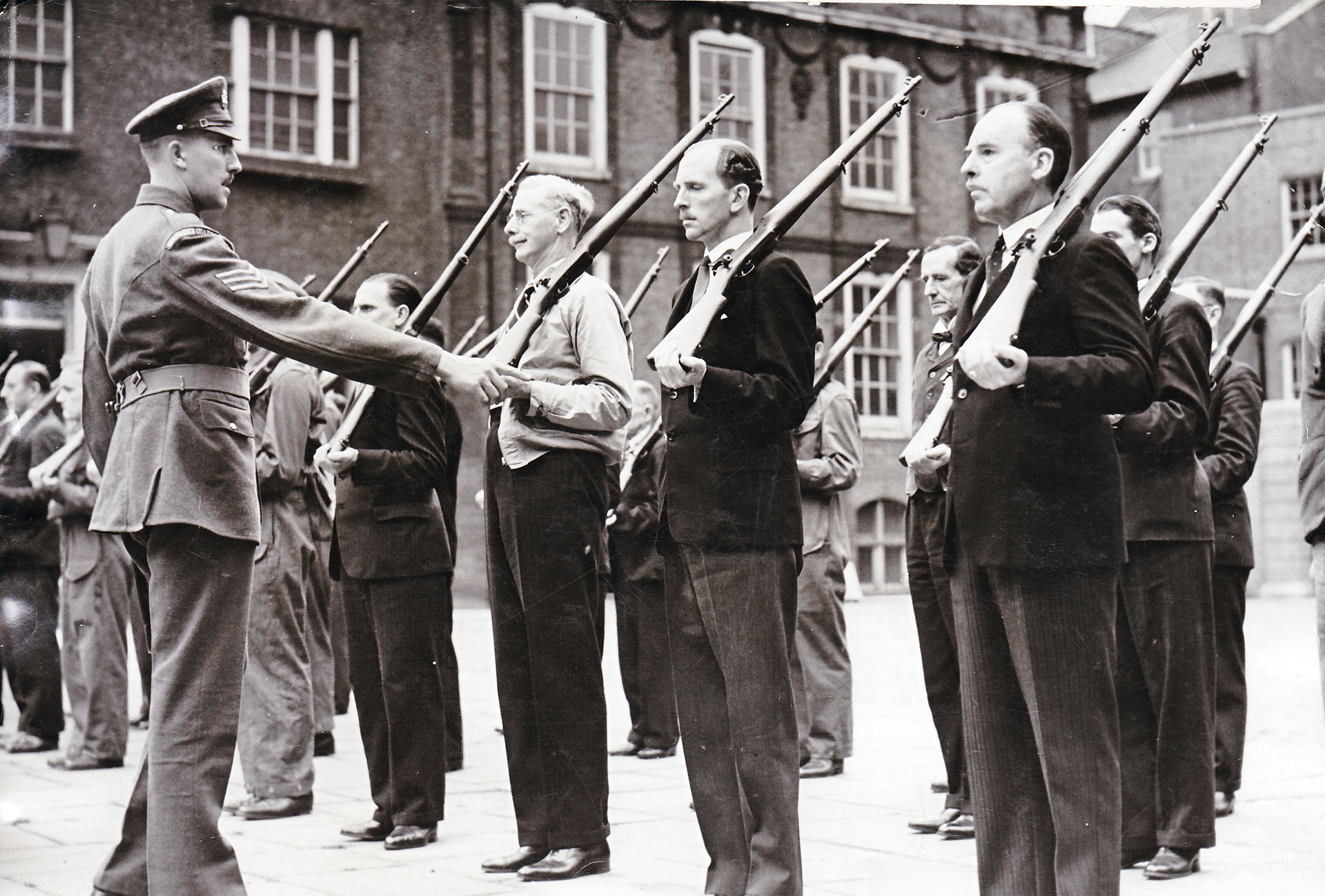
Many of the volunteers in my group, particularly the older ones, must have wearied at the thought of new danger, a renewal of a hell they thought was over. World War One had ended only twenty-nine years before, in 1918. It was still fresh in their minds and in the minds of my parents and grandparents. I thought then, and I think now, that World War I and World War II were for all practical purposes one war with a short tea break.
The playground, or the Bullring as we called it, was solidly edged with subsidized housing, or what we called council houses, built close together, surrounding the playground unbroken, save for three narrow entrances. On the playground was a roundabout and a quadruple set of swings. The paint on them had worn off years ago. The ground was hard packed and stony and bearing occasional stretches of determined grass. It was on one of these patches that the Home Guard assembled for training.
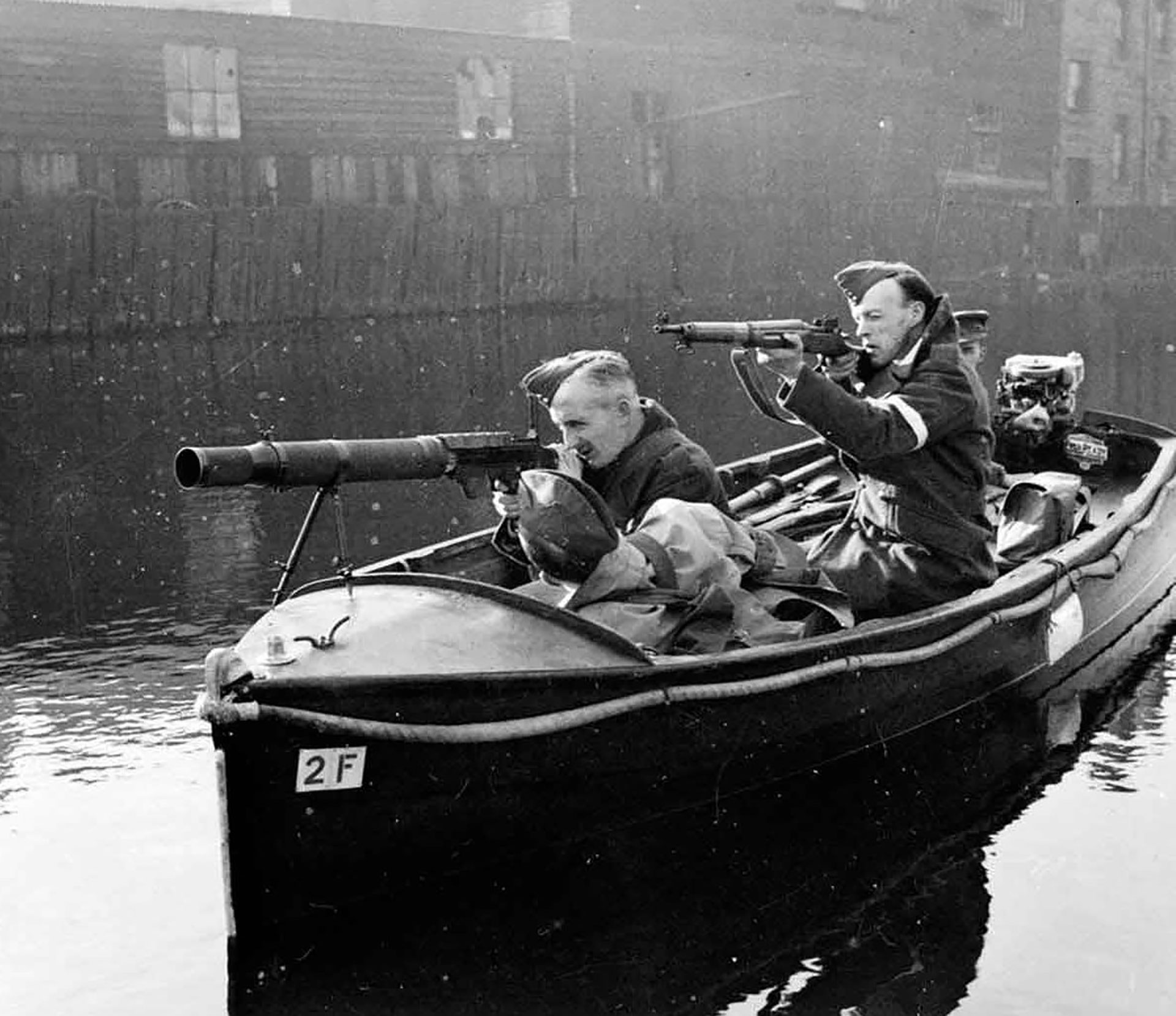
The men wore ordinary clothes. A few were in the suits they wore to their offices in town, others wore work clothes suitable for their jobs in a butcher’s shop or the barber’s, while many of those who worked on the land wore rough linen shirts without collars, heavy muddy Wellington boots and baggy pants of a hard wearing material, none-too-clean, tied up just above the knee with a bit of frayed string. There was a little laughter, but not much; this was a serious business. Any time, today, tomorrow, or who knows when, German Junkers Ju-52s could fill the skies and drop heavily armed parachutists in our midst.
These men, who should have been at home before a coal fire, reading the Daily Mail and looking forward to dinner were instead out on this cold night, ready to defend their country. They were in a serious mood, occasionally jocular in the British manner, but they were there to learn. There was no telling when they might need the deadly skills they were taught.
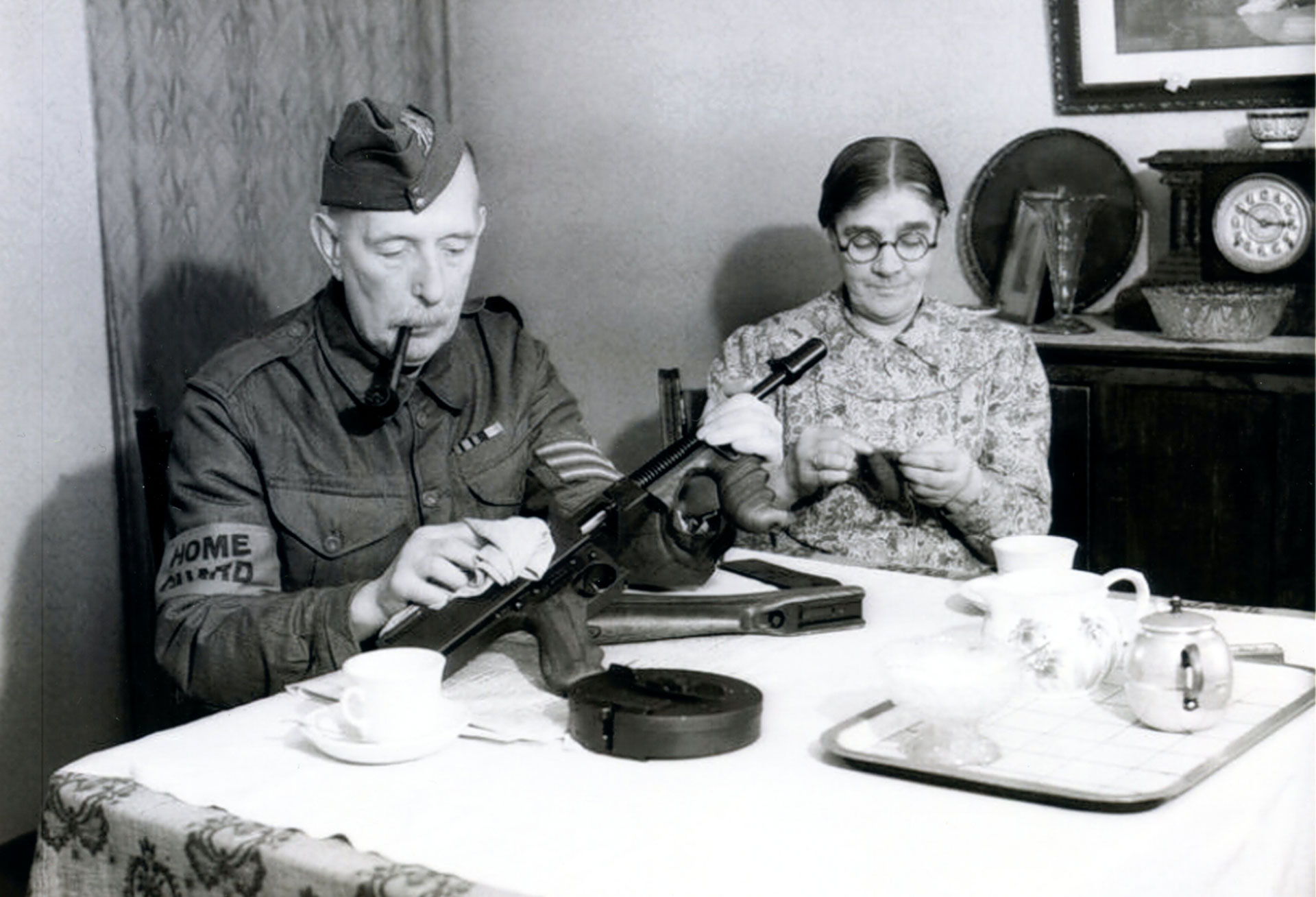
Several of the men, farmers from around Chester, had shotguns. Three or four of the men had Enfield bolt-action rifles left over from WWI. Three or four had ancient pistols, guns they were apparently allowed to keep when World War I ended. An unfortunate few had only broomhandles sawn down to shotgun size. They all wore armbands, brown bits of cloth on the left upper arm bearing black letters. The early groups called themselves different things, “D.F.” for Defense Force, “P.A.” for People’s Army, and similar names until the government set about organizing them. The man in charge had sewn on just above just below his armband, a design of three V-stripes denoting his rank as Sergeant.
I cannot remember exactly what the Sergeant said; I recall only that he stressed upon them the importance of what they were doing and told them he had every hope that the government would be able to furnish them all with uniforms and guns in the future. Rifles were slow in coming. I remember that later, to compensate for the paucity of guns and ammo, they were taught how to make improvised hand grenades and Molotov cocktails.
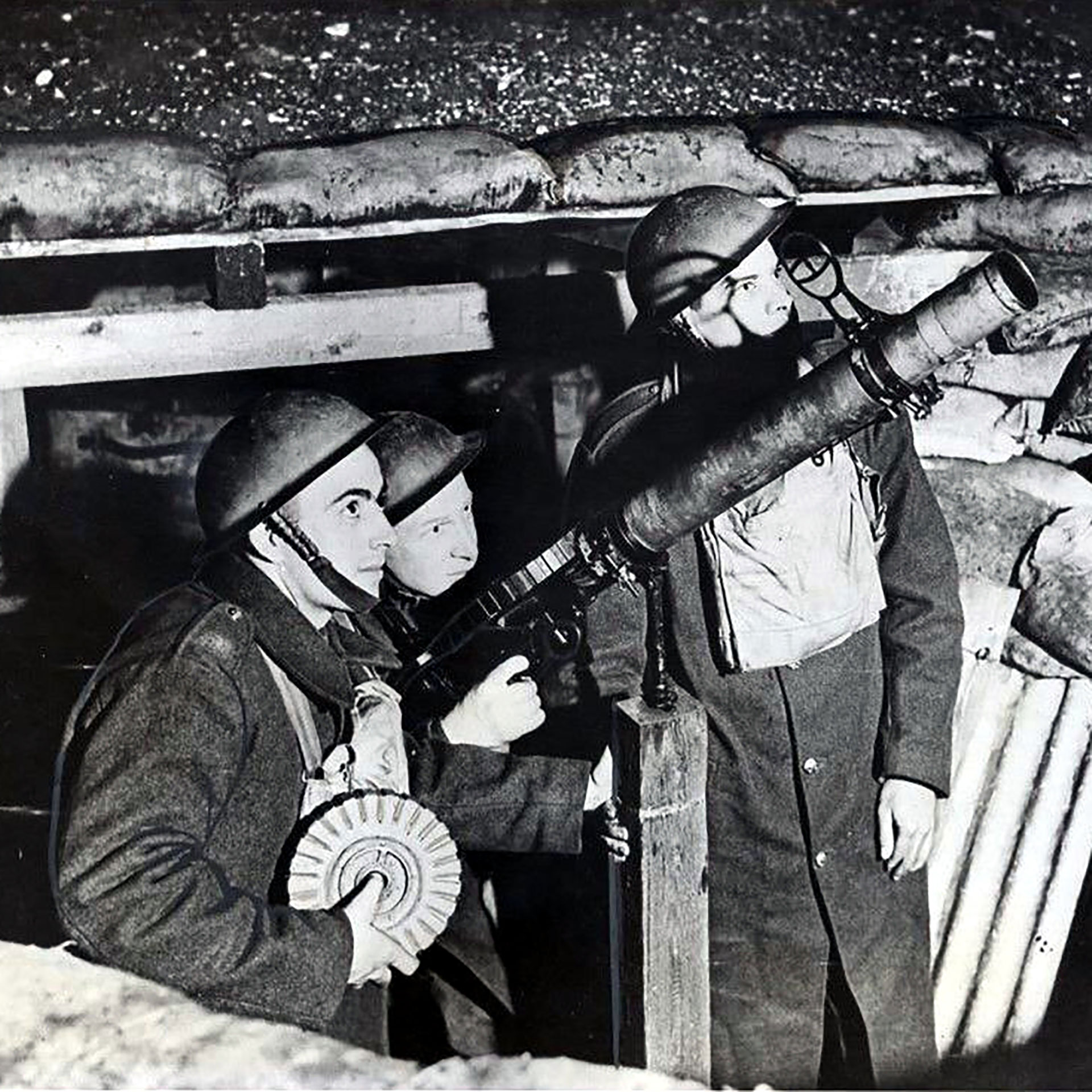
I think that they trained four nights a week. It was not their only chore. Later in the evening, when it was dark, I would see some of those same men, in pairs, patrolling the streets, doing double duty, this time wearing a different band on their sleeve, “A.R.P.” or Air Raid Precautions. Their job was to make sure all lights were hidden by drawn blackout curtains. People walking in the street were told to put out cigarettes with the unlikely warning that Luftwaffe pilots could see the end of a lighted cigarette from six thousand feet up.
If there was a raid, the HG or ARP men were to douse incendiary bombs if possible, as they were likely to be on the spot more quickly than the fire brigade. On occasion, they would run to the site of a downed enemy plane, rescue the pilot if they could, strip him of weapons and tun him over to the police. Or perhaps kill him.
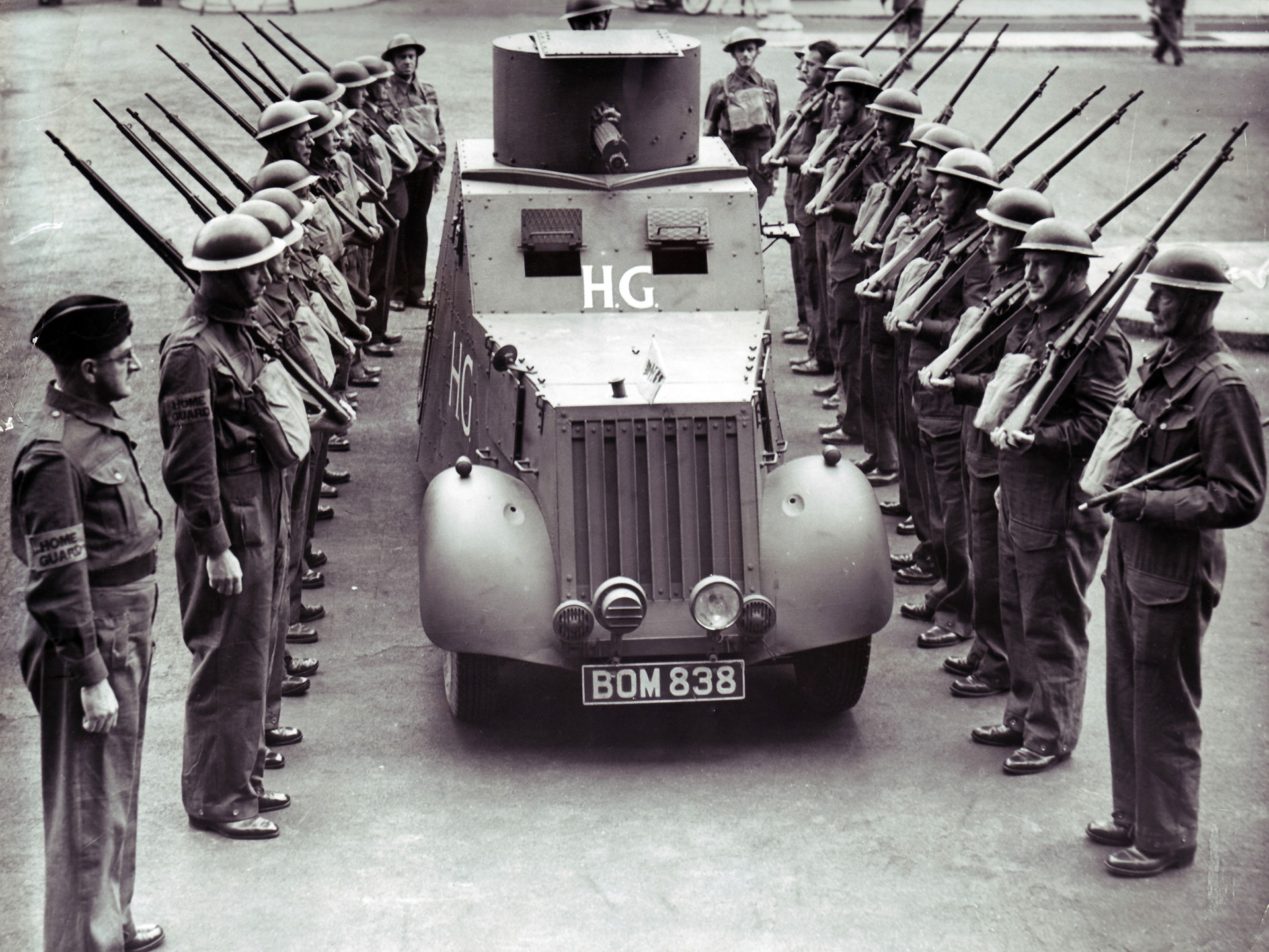
The End Of The Beginning
The Luftwaffe Blitz on British cities lasted from Sept. 7, 1940 until May 11, 1941. More than 40,000 British civilians were killed, and approximately 2 million homes were destroyed. London was devastated, but England survived. Winston Churchill had commented “We can take it”, and indeed the British could. Grit and sacrifice had seen them through the darkest days. Fears of a German invasion started to fade, and after America entered the war in December 1941, a “friendly invasion” of American troops began soon after.

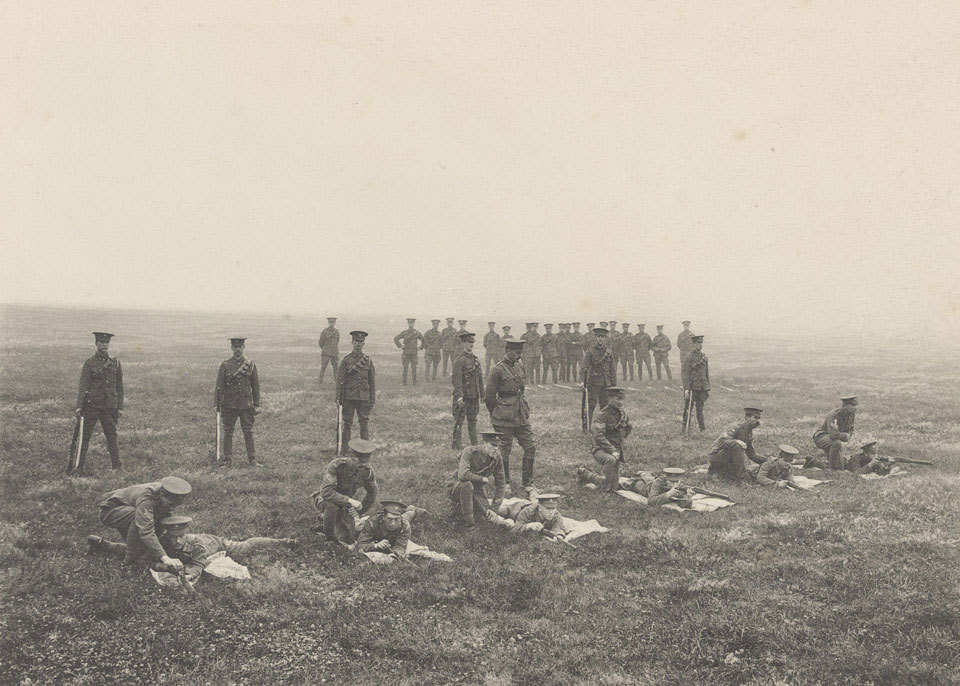

Marksmanship training in the British Army involved an exercise known as the ‘Mad Minute’ in which a soldier was expected to fire at, and hit, a Second Class figure target 300 yards out at least 15 times. A trained rifleman could hit the target 30+ times with his Short Magazine Lee-Enfield Rifle. At the turn of the century the British Army was the most professional in the world with each soldier trained to be an expert marksman. The Mad Minute itself is arguably a myth surrounded by myth, its proper name was Serial 22, Table B of the Musketry Regulations classification course of fire. Which instructed a soldier to fire rapidly into a distant target with 15 rounds being a target.
However, this was not a requirement as the rifleman’s scores were calculated by aggregate with the other stages of the classification. The exercise of firing as many rounds as possible was probably a challenge set for fun to encourage pride in marksmanship and to see just how many rounds it was possible to fire in a minute. During the musketry classifications shoots of recruits and again shot each year by all infantrymen, engineers and cavalrymen to gauge how good of a shot they were.
The classification shoot was shot in several stages shot out to 600 yards, the various stages or serials were laid out in Table B, Appendix II in the Musketry Regulations Pt.1, these included grouping with 5 rounds at 100 yards, snap shooting with 5 rounds out at 200 yards, two 5 round stages fired slowly with the first at 400 yards from the prone position and another at 300 yards from kneeling. Then came the so called ‘Mad Minute’ stage fired from prone at a target 300 yards out.
This was to be fired with 5 rounds loaded – 1 in the chamber and 4 in the magazine, the rifleman would then reload with 5-round chargers firing until 60 seconds had elapsed. The target used for this stage was the Second Class figure target which was a 4 foot screen with a 12 inch high figure silhouette at the centre surrounded by two rings, a 23 inch inner ring and a 36 inch outer ring. This stage was then followed by three final stages fired from prone out to 500 and 600 yards.
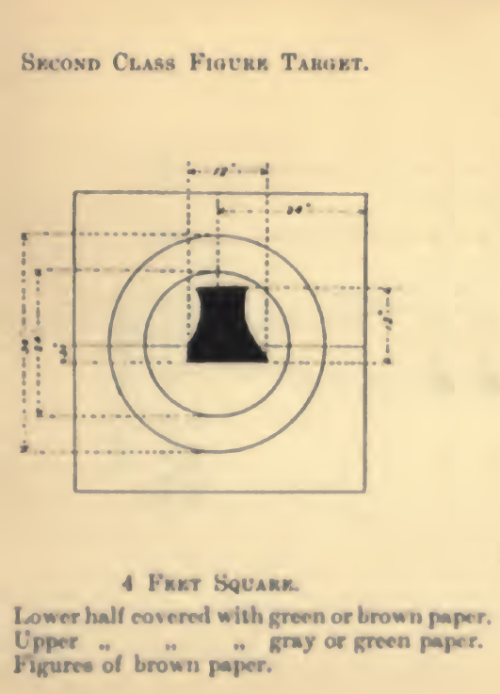
The Second Class figure target as shown in the 1910 Musketry Regulations
If the classification was completed with a high enough score the soldier would be classified as a Marksman and given a crossed rifles badge and a 6 pence a day increase in pay – so it paid to be a good shot. The rapid fire of the ‘Mad Minute’ was accomplished by used a ‘palming’ method where the rifleman used the palm of his hand to work the belt, and not his thumb and fore finger. Each man to shoot the classification course was allotted points for where each round hit – 4 points for a ‘bull’ figure hit, 3 for a hit in the inner ring and 2 points for an outer ring hit.
Troops could be classified as follows: Marksman (with at least 130 points out of 200 across the classification), 1st Class (105-130 points), 2nd Class and 3rd Class (sub-standard). The majority of British troops, even cavalry, were excellent marksman with 50% of troops in some battalions scored as Marksman with the rest being 1st and 2nd class shots.
As such when the First World War began the average British rifleman could out shoot his German and French counterparts. At the Battle of Mons it was well documented that German infantry believed they were facing British battalions heavily equipped with machine guns rather than riflemen.
The first and confirmed record for the most hits on target during a ’Mad Minute’ was set by Sgt-Major Jesse Wallingford – 36 hits at 300 yards in 1 minute in 1908. However, this was allegedly bettered in 1914, by Sergeant-Instructor Alfred Snoxall with 38 hits within the 24 inch inner ring in 60 seconds. It has not been beaten since although there is little documentary evidence of the feat readily available. Hitting the target 38 times would require him to fire his first 5 rounds pre-loaded in the SMLE’s magazine and then reload 7 times with 5 round chargers.
Add onto this that the rifle was a single shot, bolt action rifle which required the user to push up and retract the bolt and then return it forward pushing a new round into the chamber, then aiming and fire. All while maintaining his cheek weld and line of sight. This means Snoxall must have averaged around 1.5 seconds per shot to hit the target 38 times in a minute. Quite a feat.
Here is a short video of a SMLE owner attempting a very fast ’Mad Minute’, he managed to fire 10 rounds in under 10 seconds. It certainly gives you some idea of what Snoxall and other professionals could achieve.
Sources:
Image One Source – British Infantry firing at targets at 500 yards
Image Two Source – Recruits of the 5th (Royal Irish) Lancers at musketry training at Aldershot, August 1907
Image Three Source – Troops training on a miniature range at the School of Musketry c.1915
‘Mad Minute’, bbc.co.uk (source)
Tommy, R. Holmes (2004)
British Army Musketry Regulations pt.1 1909/1914
Thank you to Rob from Britishmuzzleloaders for his invaluable help
:max_bytes(150000):strip_icc():format(webp)/Theodore-Roosevelt-NYPD-3032-3x2gty-56a48a223df78cf77282df37.jpg)