It’s one of those prolific points of discussion when it comes to guns, one that can be very touchy with some folks, and it seems that everybody who fools with guns has an example. The ones that got away. My own cases in this unfortunate study are disheartening, and I generally attempt to avoid serious thought of them as the grieving can be embarrassing. But now and again something will trigger thoughts of a fugitive firearm that I slipped up and let go, and the pining starts, regardless.
The most recent episode involved a visit with one of my brush-beating compadres, midwestern land baron, NRA Board Member, and wildfowl conservationist Lance Olson. A renowned collector and expert in firearms, Olson frequents the Southwest and other areas of the country in search of various collectibles, occasionally permitting me to catch a glimpse–or even handle–some of his acquisitions.
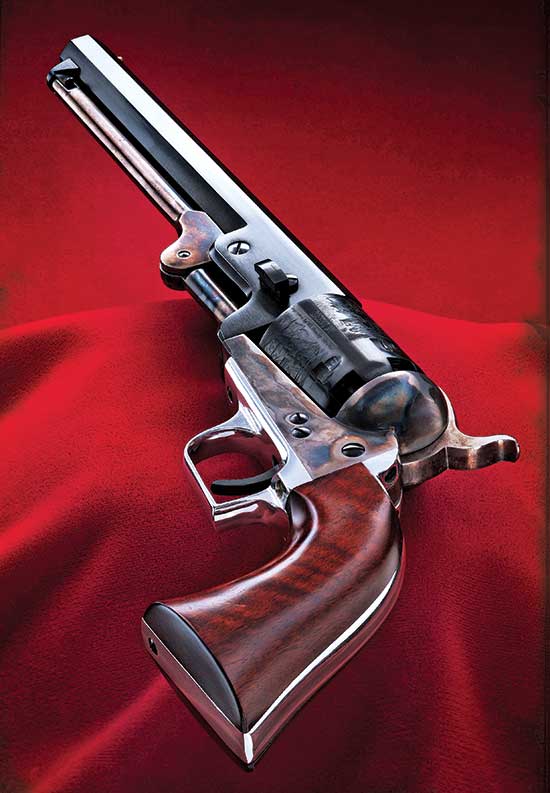
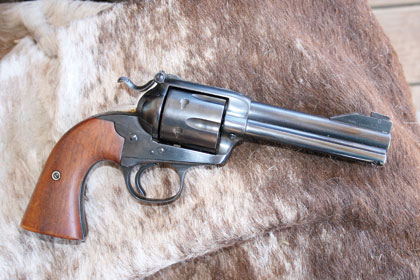
During his latest sortie, I discovered Olson had landed a fine Colt Single Action Army in one of my all-time favorite calibers, .44 Special. A 1st Generation Colt, the revolver had been highly customized. Upon closer examination, it was clear the gun had been modified by late gunsmithing legend Dean King. I generally cringe at the sight of a good 1st Generation single action that’s been modified–such behavior is villainous in my book–but I do find modifications by King to be much less offensive.
Olson’s revolver was a 4¾-inch single action with original Colt hard rubber grips featuring the famous eagle. The finish was of bright blue, no casecolors. The barrel had been fitted with a ventilated rib, which ran from the front of the gun’s frame to the end of the barrel, one of King’s signatures.
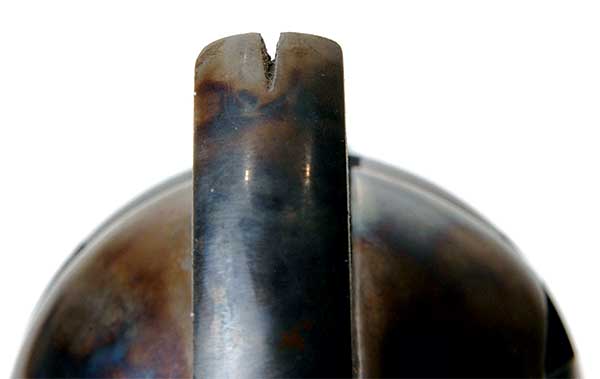
The revolver’s sights were another King touch. Gunsmith King invented the famous mirror front sight, which was basically a ramped sight with the blade set high. The ramp featured a small, round mirror that had been inset into the top of the ramp in front of the sight blade at an angle. This permitted available light to be reflected directly upon the front sight for maximum clarity. The rear sight was fully adjustable and looked similar to a Smith & Wesson rear sight.
It was after World War I when Mr. King began his famous gunsmithing work. Back then nobody really thought twice about wrecking the value of a Colt Single Action Army, heck they were still in production. King’s modifications were executed tastefully and really enhanced the shootability of a handgun. While most of these modifications were done on Colts, Mr. King experimented with other firearms as well.
As I looked over Monsieur Olson’s King Colt, it brought back memories of a couple of guns that I’d let get away from me, including one of my dad’s personal favorite revolvers. Dad had a respectable compilation of firearms, though he never considered himself a real collector.
He had a number of favorites that remained constant; otherwise he never felt much emotion about trading anything off. One of the main handguns always by his bedside was a Colt SAA 1st Generation in .45 Colt. The revolver had been customized to his personal specifications and was a finely timed piece of work. The action was silky smooth, and the trigger pull was one of the lightest I’d ever felt on a revolver.
While the Colt had no ventilated rib, it was fitted with a King mirror front sight, and the rear sight was what I always thought was a Smith & Wesson adjustable but could have likely been a King as well, though I never thought to ask. The revolver’s backstrap had the bluing polished away to natural steel and was finished off with a beautiful set of Herrett’s French Walnut grips. In all, it was a fine sixgun–one I should have figured out how to have kept after my dad’s untimely passing.
As luck would have it, I was contacted by an old friend of our family’s a few years back, one Mrs. Bennie Dean. Her late husband, Tom, had been a dear friend of my dad’s; they had worked together as U.S. Customs Investigators in South Texas in the late 1960s. Tom was a shooter and gun enthusiast, and he had told my dad that he had always wanted a Colt Bisley. He, too, admired King’s stuff and was fond of Dad’s single action .45. The old man scrounged up a Bisley–they weren’t too hard to come by back then at a decent price–and went to work on a custom sixgun for Tom.
Upon getting in touch with me, Mrs. Dean advised that she had something of Tom’s that I needed. This gracious lady and I struck a deal, and I walked away with that Bisley. The old shooter was marked Colt Single Action Army .45 Colt, yet it had been converted to shoot .45 ACP. The front sight was a ramped and mirrored King with the adjustable rear sight. I’ve always been fond of the Bisley, and I found the gun to be a real prize. Shortly after acquiring the old beauty, I entered in a cowboy action shoot down in the Texas Big Bend and placed decently using the old hogleg. It is definitely one revolver that I’ll not let get away, and while it’s not my dad’s old .45, it’s almost as good.
My gun-trading skills have always been mediocre at best, and Lance Olson knows it, which is likely why he allows me to peruse his trappings. During his last raid, not only was he in possession of the Colt single action, he also produced a fine little Colt Pre-Woodsman .22. Upon examining it, I noticed the adjustable sights were made by King. The front sight wasn’t the mirrored variety; it was the shadow model, which is almost as good. This sight was slightly undercut towards the muzzle, again to maximize the clarity of the sight blade.
Incredibly, that little Colt is now resting in my gun safe, where I intend for it to stay, along with the King Bisley. Next time you happen across an old revolver that’s been modified a bit, be sure to give it a once-over. If it has a King marking, it’s liable to be a keeper.