
Categories


After years in the making, the National Museum of the United States Army opened its doors on Veterans Day 2020. Located in Ft. Belvoir, Va., off Liberty Drive, the museum spans 185,000 square feet and represents the effort of more than 30 different organizations led by the U.S. Army and the Army Historical Foundation.
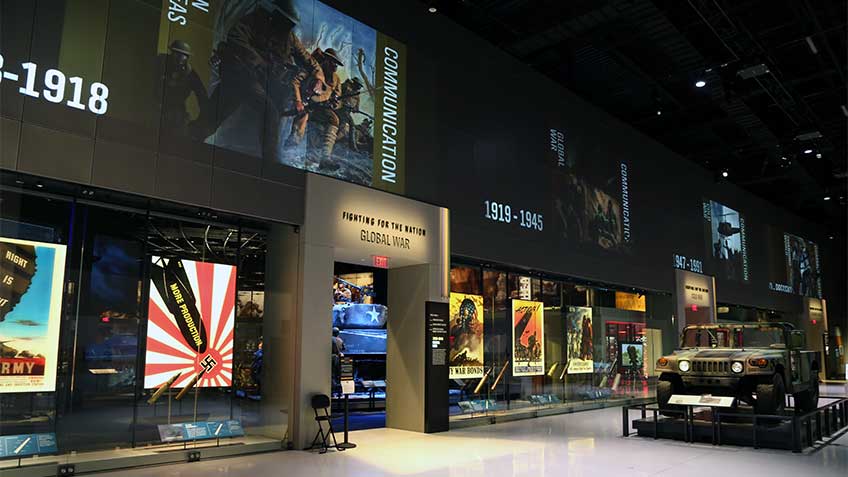
The five-story structure sits on 84 acres of ground and contains nearly 1,400 artifacts spread across 11 galleries that tell the story of the U.S. Army from its founding to its position in the modern world. The heart of the museum and where most artifacts are found lie in seven large galleries that span the history of the Army and highlight key roles it played in the development of the United States.
American Rifleman staff had a chance to view the museum during a media event a week prior to the museum opening its doors. Here are five amazing artifacts you can see when you come down to the National Museum of the United States Army:
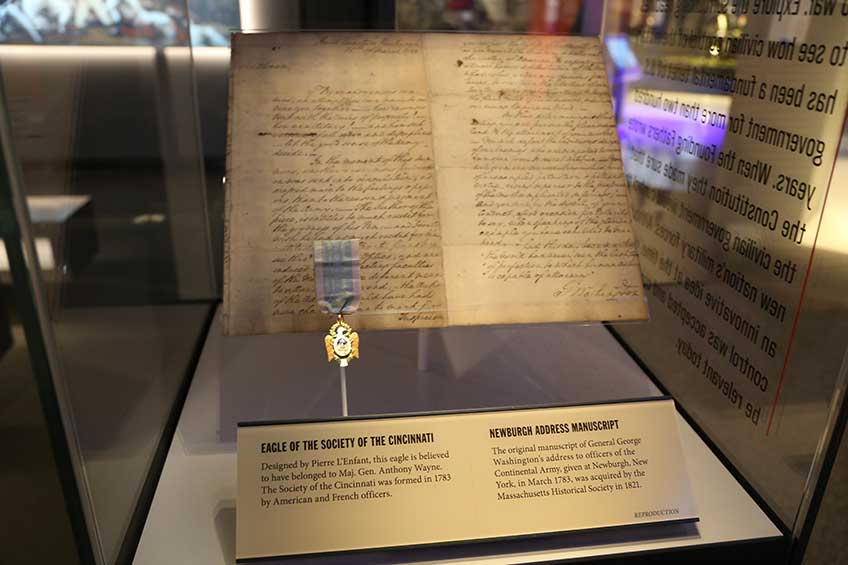
George Washington’s Newburgh Address
In March 1783, the fledgling United States faced a moment of crisis that almost ended the American experiment before it began. While the nation engaged in peace talks with Great Britain, the soldiers and officers of the Continental Army were reaching a breaking point. They hadn’t been paid in more than a year, and the promise of a lifetime pension for the officers still had no source of funding. An anonymous letter circulated the army camp in Newburgh, NY, which stirred talk of rebellion and a possible military coup against the Continental Congress.
When George Washington heard these rumblings, he knew immediate action was required. What followed on March 15 was one of Washington’s finest hours and a defining moment in the early history of the nation. Washington told his men to be patient, saying that doing so would prove their “unexampled patriotism…rising superior to the pressure of the most complicated sufferings.” After the address, Washington stirred the emotions of his men as he struggled to read a letter from Congress. After faltering, he paused and said, “Gentlemen, you will permit me to put on my spectacles, for I have not only grown gray but almost blind in the service of my country.”
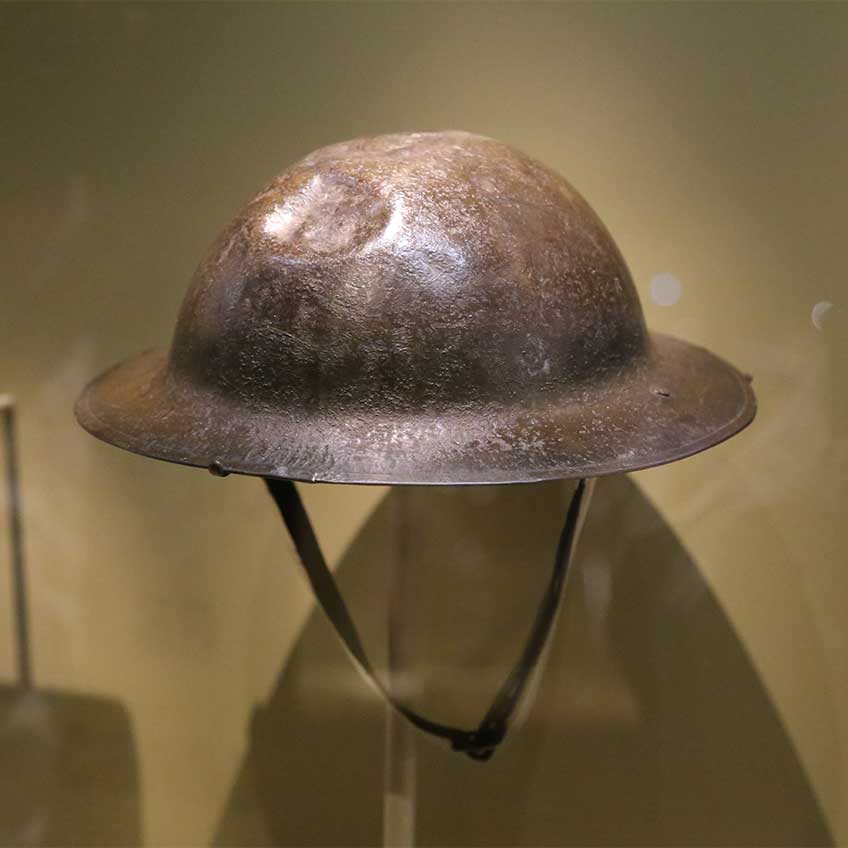
Sgt. Alvin York’s Helmet
In October 1918, then-Corporal Alvin York of the 82nd Division of the U.S. Army joined a group of American soldiers with a mission to take out a machine-gun position in the German lines during the Meuse-Argonne Offensive. While wearing the helmet pictured above, York and his men suddenly came under fire from a German machine gun while dealing with a group of captured German soldiers. To deal with this threat, York embarked on a series of incredible actions that would see him awarded the Medal of Honor.
Likely armed with an M1903 Springfield rifle, York lowered himself and began “touching off” the German machine gunners as quickly as he could. Then, six German soldiers with bayonets fixed charged York, who had expended all the rounds in his rifle. York then drew his M1911 pistol and shot each German soldier, from back to front. Ultimately, through his individual actions, York silenced all the machine-gun positions in the area and captured 132 German soldiers. French Marshal Ferdinand Foch remarked that it “was the greatest thing accomplished by any soldier in all the armies of Europe.”
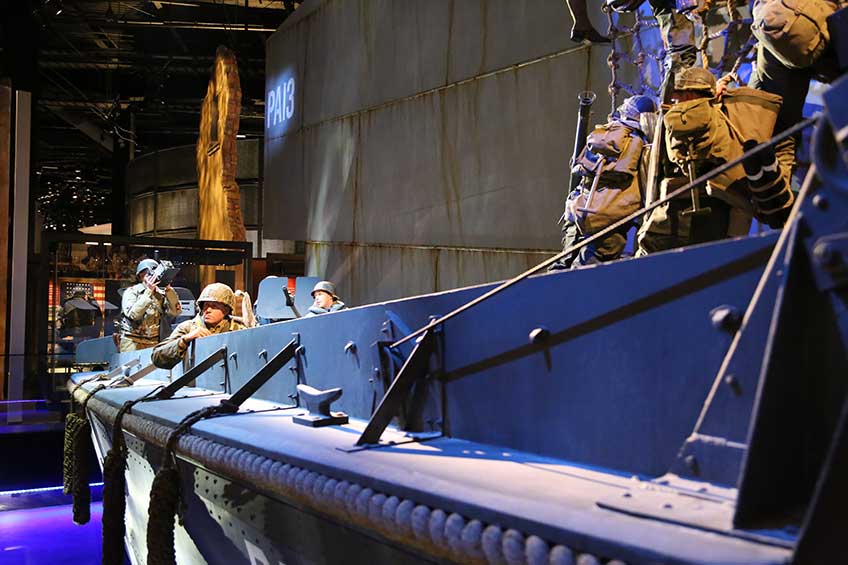
D-Day LCVP
As part of Operation Overlord, the beach landings in Normandy on June 6, 1944, represented one of the largest seaborne invasions in human history. More than 150,000 soldiers supported by nearly 200,000 naval personnel aligned themselves off the northern Channel coast with the aim of cracking Hitler’s Atlantic Wall and establishing a beachhead. The Allied invasion assembled the largest fleet of ships ever gathered.
Nearly 7,000 vessels from eight different navies made up the fleet, and 4,126 landing craft were the largest part of the assemblage, all designed to ferry fighting men from the ships to the five invasion beaches. Of these landing craft, one of the most famous is the “Landing Craft, Vehicle, Personnel” (LCVP), more popularly known as the “Higgins boat” after its designer, Andrew Higgins. More than 23,000 Higgins boats were produced during the war for use in the Atlantic and Pacific theaters. Few survive today, and even fewer are known to have been used in the Normandy landings. The Higgins boat at the National Museum of the U.S. Army is one of six known survivors from D-Day.
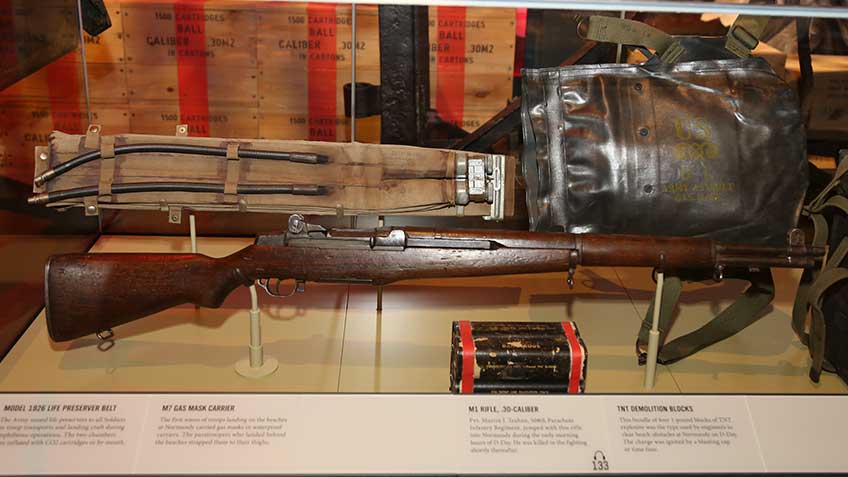
Pvt. Martin J. Teahan’s M1 Garand
At 2:15 a.m. on June 6, 1944, the 508th Parachute Infantry Regiment (PIR) of the 82nd Airborne took part in the opening phase of Operation Overlord, jumping behind German lines. The 508th PIR’s objectives were to capture the French town of Sainte-Mère-Église, secure Merderet River crossings and establish defensive positions in preparation for the Normandy landings. Among those who jumped from the skies that morning was 21-year-old Pvt. Martin J. Teahan.
He joined his comrades in the heavy fighting on D-Day, and while scouting near Picauville, France, Pvt. Teahan was shot in the leg, captured and later killed by a German soldier. Several days after the landing, a French farmer found an M1 Garand engraved with the name “M. Teahan” and held onto it for 72 years until its discovery in 2016. Pvt. Teahan is one of 9,388 American soldiers who lie in the Normandy American cemetery near Colleville-sur-Mer, France, but the rifle he fought with has an honored place in the U.S. Army’s National Museum.
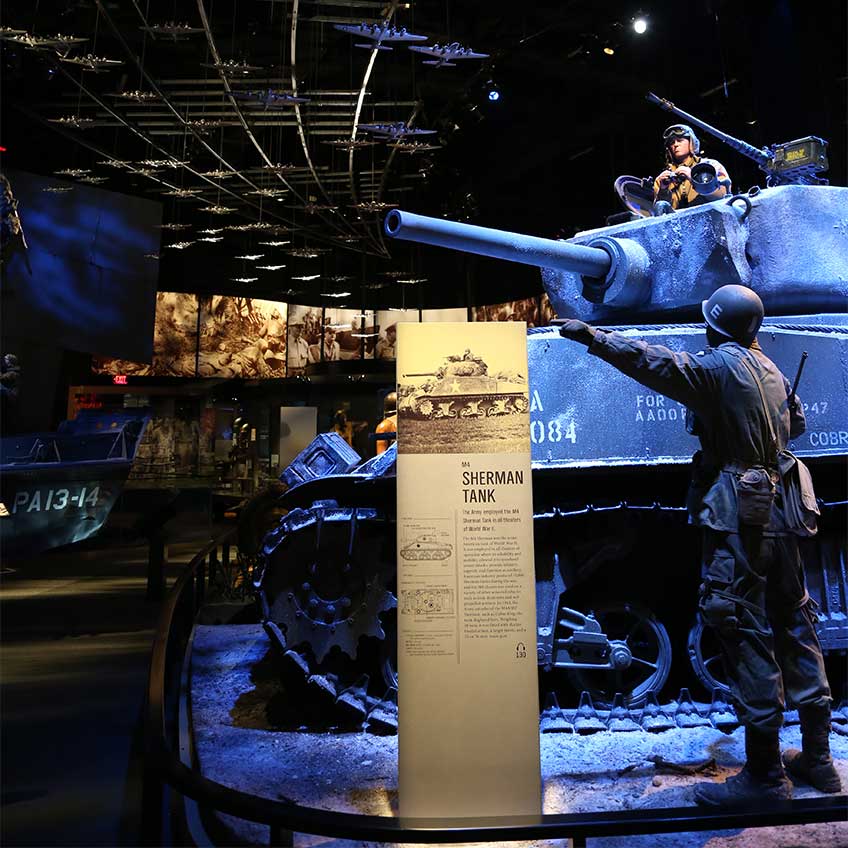
M4A3E2 Sherman “Cobra King”
During the winter of 1944, Allied armies were making significant progress against the Nazi war machine. The combined forces of the British and Americans on the Western Front of World War II had brought them nearly to the border of Germany itself. Hitler and his command staff had only enough men and materiel to mount one last offensive. Known today as the “Battle of the Bulge,” the German blow pushed through the Ardennes Forest with the aim of splitting the Allied lines. The Germans hoped this would destroy the Allied armies in northwestern France and prevent the use of the Antwerp port, forcing them into a surrender settlement.
While the German advance accomplished none of its aims, the assaulting force managed to surround the 101st Airborne in the Belgian town of Bastogne. With heavy cloud cover preventing any reliable means of air support or resupply, the men of the 101st Airborne held out against the odds during five days of heavy fighting. On Dec. 26, 1944, lead elements of the 37th Tank Battalion of the 4th Armored Division broke through German lines, effectively ending the siege of Bastogne. At the head of the column was “Cobra King,” an M4A3E2 Sherman tank that held the honor of being the first unit through the lines.
These are just five of the nearly 1,400 artifacts visitors can see in the National Museum of the U.S. Army, and there are many more priceless artifacts that tell the story of the nation through the eyes of its soldiers. From the rifles of the American Revolution to an engine recovered from one of the helicopters immortalized in “Blackhawk Down,” there’s something for everyone to see.
Museum entry is free, but timed-entry tickets are required and can be reserved on the museum’s website. The museum is open from 9 a.m. to 5 p.m. and is closed Christmas Day. Parking is free, and the museum is located 25 minutes from Ronald Reagan Washington National Airport. For more information, visit thenmusa.org.

It’s one of those prolific points of discussion when it comes to guns, one that can be very touchy with some folks, and it seems that everybody who fools with guns has an example. The ones that got away. My own cases in this unfortunate study are disheartening, and I generally attempt to avoid serious thought of them as the grieving can be embarrassing. But now and again something will trigger thoughts of a fugitive firearm that I slipped up and let go, and the pining starts, regardless.
The most recent episode involved a visit with one of my brush-beating compadres, midwestern land baron, NRA Board Member, and wildfowl conservationist Lance Olson. A renowned collector and expert in firearms, Olson frequents the Southwest and other areas of the country in search of various collectibles, occasionally permitting me to catch a glimpse–or even handle–some of his acquisitions.
During his latest sortie, I discovered Olson had landed a fine Colt Single Action Army in one of my all-time favorite calibers, .44 Special. A 1st Generation Colt, the revolver had been highly customized. Upon closer examination, it was clear the gun had been modified by late gunsmithing legend Dean King. I generally cringe at the sight of a good 1st Generation single action that’s been modified–such behavior is villainous in my book–but I do find modifications by King to be much less offensive.
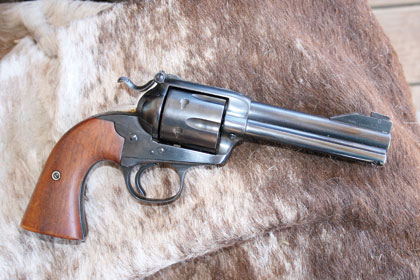
Olson’s revolver was a 4¾-inch single action with original Colt hard rubber grips featuring the famous eagle. The finish was of bright blue, no casecolors. The barrel had been fitted with a ventilated rib, which ran from the front of the gun’s frame to the end of the barrel, one of King’s signatures.
The revolver’s sights were another King touch. Gunsmith King invented the famous mirror front sight, which was basically a ramped sight with the blade set high. The ramp featured a small, round mirror that had been inset into the top of the ramp in front of the sight blade at an angle. This permitted available light to be reflected directly upon the front sight for maximum clarity. The rear sight was fully adjustable and looked similar to a Smith & Wesson rear sight.
It was after World War I when Mr. King began his famous gunsmithing work. Back then nobody really thought twice about wrecking the value of a Colt Single Action Army, heck they were still in production. King’s modifications were executed tastefully and really enhanced the shootability of a handgun. While most of these modifications were done on Colts, Mr. King experimented with other firearms as well.
As I looked over Monsieur Olson’s King Colt, it brought back memories of a couple of guns that I’d let get away from me, including one of my dad’s personal favorite revolvers. Dad had a respectable compilation of firearms, though he never considered himself a real collector.
He had a number of favorites that remained constant; otherwise he never felt much emotion about trading anything off. One of the main handguns always by his bedside was a Colt SAA 1st Generation in .45 Colt. The revolver had been customized to his personal specifications and was a finely timed piece of work. The action was silky smooth, and the trigger pull was one of the lightest I’d ever felt on a revolver.
While the Colt had no ventilated rib, it was fitted with a King mirror front sight, and the rear sight was what I always thought was a Smith & Wesson adjustable but could have likely been a King as well, though I never thought to ask. The revolver’s backstrap had the bluing polished away to natural steel and was finished off with a beautiful set of Herrett’s French Walnut grips. In all, it was a fine sixgun–one I should have figured out how to have kept after my dad’s untimely passing.
As luck would have it, I was contacted by an old friend of our family’s a few years back, one Mrs. Bennie Dean. Her late husband, Tom, had been a dear friend of my dad’s; they had worked together as U.S. Customs Investigators in South Texas in the late 1960s. Tom was a shooter and gun enthusiast, and he had told my dad that he had always wanted a Colt Bisley. He, too, admired King’s stuff and was fond of Dad’s single action .45. The old man scrounged up a Bisley–they weren’t too hard to come by back then at a decent price–and went to work on a custom sixgun for Tom.
Upon getting in touch with me, Mrs. Dean advised that she had something of Tom’s that I needed. This gracious lady and I struck a deal, and I walked away with that Bisley. The old shooter was marked Colt Single Action Army .45 Colt, yet it had been converted to shoot .45 ACP. The front sight was a ramped and mirrored King with the adjustable rear sight. I’ve always been fond of the Bisley, and I found the gun to be a real prize. Shortly after acquiring the old beauty, I entered in a cowboy action shoot down in the Texas Big Bend and placed decently using the old hogleg. It is definitely one revolver that I’ll not let get away, and while it’s not my dad’s old .45, it’s almost as good.
My gun-trading skills have always been mediocre at best, and Lance Olson knows it, which is likely why he allows me to peruse his trappings. During his last raid, not only was he in possession of the Colt single action, he also produced a fine little Colt Pre-Woodsman .22. Upon examining it, I noticed the adjustable sights were made by King. The front sight wasn’t the mirrored variety; it was the shadow model, which is almost as good. This sight was slightly undercut towards the muzzle, again to maximize the clarity of the sight blade.
Incredibly, that little Colt is now resting in my gun safe, where I intend for it to stay, along with the King Bisley. Next time you happen across an old revolver that’s been modified a bit, be sure to give it a once-over. If it has a King marking, it’s liable to be a keeper.