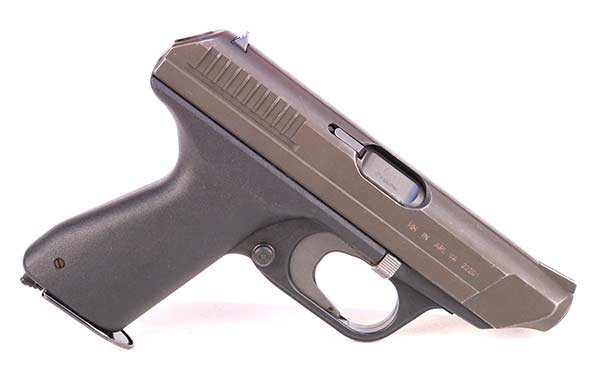
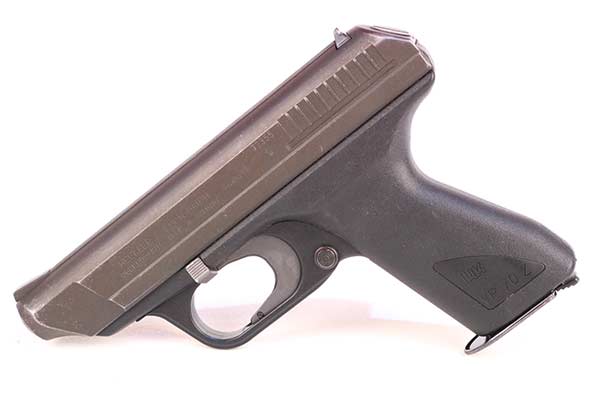
The HK VP70 was used as the standard sidearm for the U.S.
Colonial Marines in the epic 1986 James Cameron movie Aliens.
In 1986, visionary filmmaker James Cameron came out with what was, in my opinion at least, his masterwork. Aliens was the ultimate combat science fiction movie. Alongside Terminator 2, it was also one of the two best sequels ever made. Created at the very end of the analog era before digital special effects transformed the film industry, Aliens is simply cinematic perfection.
The original Ridley Scott Alien was a horror movie and a stupendous one at that. The narrative had the small crew of space freighter respond to a distress beacon that ultimately allowed a single most horrific alien monster onboard. The rest of the film was a series of creepy scenes, ample gore and jump scares. It also served to introduce us to Sigourney Weaver’s iconic character, Ellen Ripley.
When James Cameron was pitching the idea of a sequel to the execs at 20th Century Fox, he purportedly took a big whiteboard, wrote the word “ALIEN” in giant letters, and then put a dollar sign behind it. The resulting ALIEN$ pitch green-lit the project.
The narrative has Ripley narrowly escaping the rampaging monster and being lost in space for 57 years. She awakens to find that, in the interim, there has been a colony established on LV-426, the small planet where they first found the alien creature. Coincidentally, contact with the colony has been mysteriously lost. Ripley reluctantly agrees to return to LV-426, this time in the company of a squad of heavily armed U.S. Colonial Marines.
There results 137 minutes of gunslinging mayhem as the Marines discover hundreds of alien monsters, a single child survivor and peril aplenty. I’ll spare you the details. You need to see the movie yourself if you haven’t already. You’ll thank me later.
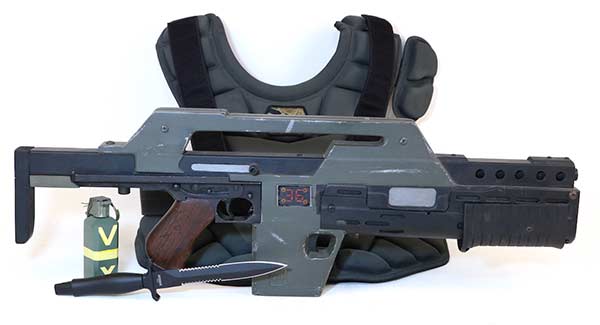
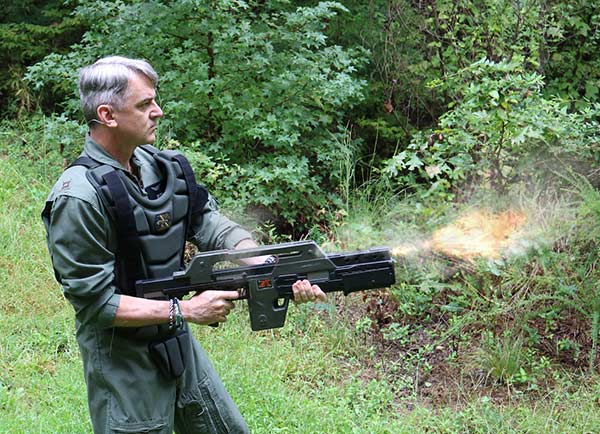
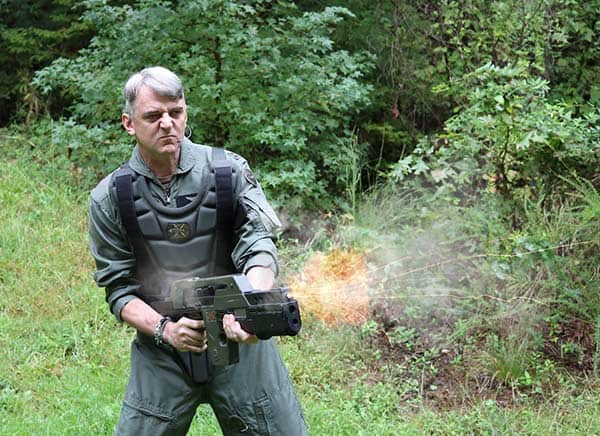
The M41 Pulse Rifle used in the movie Aliens was a bodged-together
amalgam of several real-world guns. The end result was cinematic gold.
The Weapons of “Aliens”
Arguably the coolest aspect of this homogenously cool movie for the gun nerd committed to his craft was the weapons. Developed under the guidance of Cameron himself by Bapty Limited in London, the same gun-bodging wizards who made the weapons for Star Wars, the weapons of Aliens made the film. Unlike later iterations that might include digital muzzle flashes and artificially enhanced action effects, these guns were the real deal. All the cool-guy stuff had to be created by special effects specialists in the real world.
There were two handguns featured in the movie. The machinegunner Vasquez packs a stock S&W Model 39 with white/ivory grips. The rest of the team uses HK VP70 9mm pistols.
The VP70s used in the film are otherwise unmodified VP70M selective-fire versions of the gun. In the real world, attaching a VP70M to a separate buttstock allows semiauto and 3-round burst functions. The same gun in semi auto only was imported and sold in the U.S. as the VP70Z. The VP70Z has a smooth grip, while that of the VP70M is ridged. One of the VP70M pistols used in the movie and demilled to UK standards sold for $12,700 at auction in 2022.
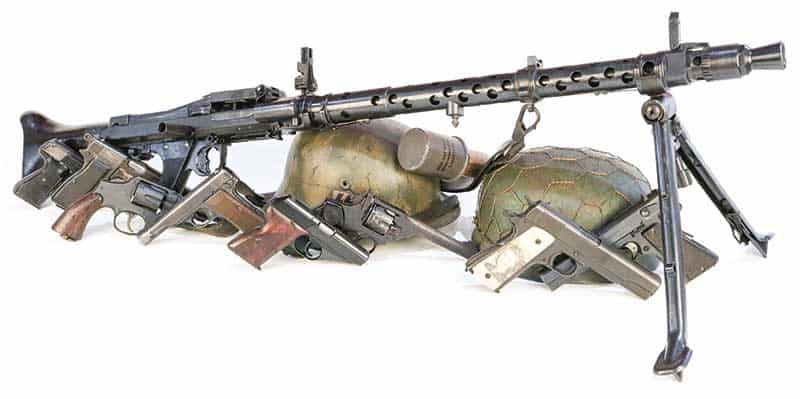
The M56 Smart Gun was created by mounting a WWII-vintage MG42 belt-fed machinegun onto a gyro-stabilized Cinema Products Model III Steadicam harness. This gave the big gun a most sinister gliding effect when used in the movie. When Vasquez shouted, “Let’s rock!” and opened up with her M56 that first time in the theater it was a near-religious experience for me. One of the two guns used in the movie was demilled and sold for $150,000 at auction in the U.S. in 2022.
I’ll never be able to afford a real screen-used weapon from the movie Alien. However, I remain nevertheless prepared for my next proper bug hunt.
The M41 Pulse Rifles used by the rank-and-file Marines were created from three different real-world weapons. The basic chassis was an M1A1 Thompson submachine gun. The 30mm pump-action grenade launcher was a radically shortened Remington 870 shotgun. The window dressing on the outside came from a Franchi SPAS-12 12-gauge.
The original plan had the M41 built around a 9mm HK MP5, but the muzzle flash was inadequate for Cameron’s needs. The .45ACP version from the Thompson was much more satisfying. Only one of the prop guns built for the movie had a functioning shotgun/grenade launcher. At the same 2022 auction, a demilled but screen-used Pulse Rifle went for $142,787.
Michael Biehn’s character CPL Duane Hicks also carried a curious cut-down Ithaca Model 37 shotgun. This gun had the pistol grip from a German MP40 grafted on. The same gun was used in the TV shows The Professionals and Dempsey and Makepeace. This gun was also demilled and sold for $63,481 at the same 2022 auction.
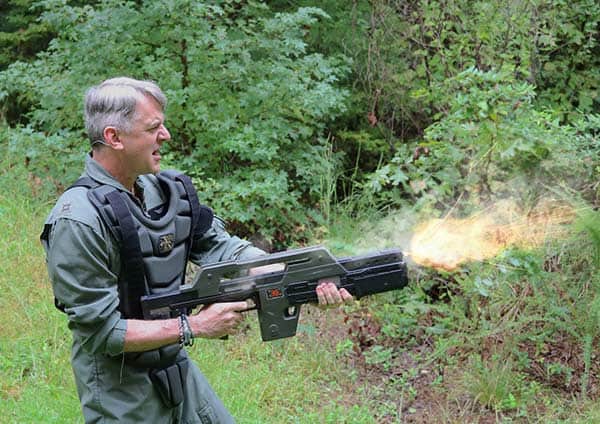
I’ll never be able to afford an original Aliens weapon, but my kids and I did build a decent facsimile as a homeschool project many years ago. The receiver is a piece of 1-inch square steel tube, the chassis is cut from pine lumber, and the fire control group was harvested from an original M1A1 Thompson parts kit.
The SPAS-12 bits came from a cheap airsoft version of the shotgun. The end result isn’t quite screen-perfect, yet I remain prepared for my next serious bug hunt nonetheless.
Maybe it never got closer to the action than guard duty at an ammo dump. Or perhaps some poor dogface clutched the thing desperately close in the frozen wastes around Bastogne or the fetid jungles of Peleliu. Regardless, a soldier’s individual weapon is his most intimate tool. To heft such an artifact is to physically connect across the decades to an era of unimaginable significance.
Vintage bring-back firearms from World War II drive home the reality of the war better
than anything else. Examples are available at a variety of price points.
Worlds Apart But Shrinking
We have a tough time comprehending the breadth of the Second World War today. During the course of the horrible conflict the world’s governments produced enough bullets to shoot everybody on the planet 40 times. We laid one landmine for every three humans. We built enough rifles to arm one-seventh of the world’s population. While the majority of those who actually served have passed on, many of their weapons remain to this day.
The Internet has revolutionized everything about our world. Previously folks with quirky hobbies might have thought themselves alone. Nowadays, however, a few mouse clicks can connect you with somebody on the other side of the world who shares your particular curious interests.
Fake animal noise competitions, conjuring art from magnetic VCR tape, extreme ironing wherein the participant irons clothes in exotic settings, and Hikaru Dorodango (compulsive dirt polishing) are all real things more than a couple of folks apparently do. As it relates to collectible firearms, sites like gunbroker.com and gunsamerica.com are like nationwide gun shows running 24/7. The treasures they offer are like little history batteries.
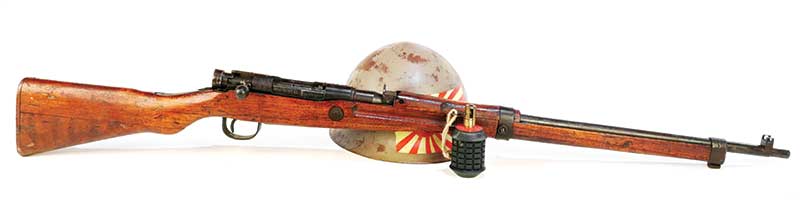
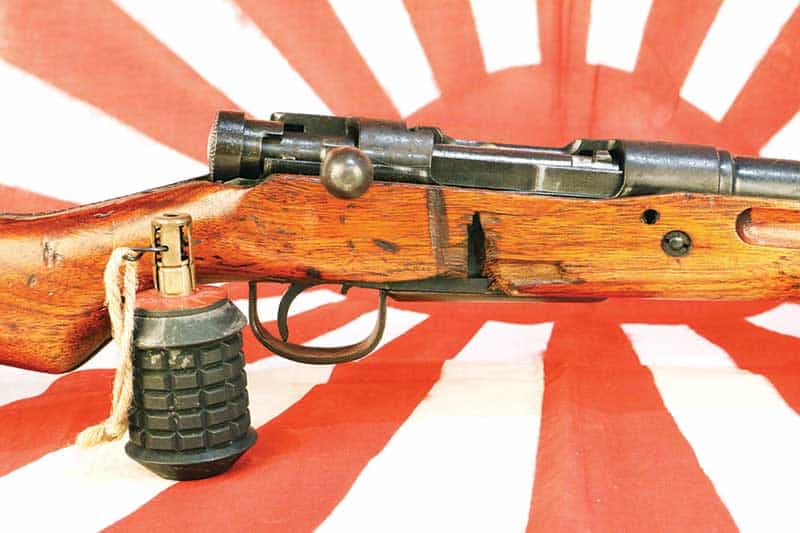
A beater Arisaka Type 99 rifle can still be had for a couple hundred bucks. Such an artifact will lend insight into the desperation of Japan at the end of WWII.
Arisaka Type 99 Rifles
Tests conducted by the NRA after the war showed the Arisaka action was stronger than any other bolt-action rifle fielded by a major combatant. Early Type 99 rifles were things of beauty, sporting such niceties as folding monopods, anti-aircraft sights and checkered safety knobs. Late-war last-ditch guns were horribly bodged-together affairs with wooden buttplates held in place by nails. The catalyst driving this sordid transformation was countless waves of B29 bombers.
Beater guns with ground-off mums can still be found for a couple hundred bucks. A Type 2 Paratrooper takedown version with matching numbers will set you back as much as a used car. However, a guy of modest means can still get into a genuine Japanese-surplus combat rifle for beans if he is patient and stalks his prey.
Sometimes you can happen upon a true gem. This high-mileage Type 99 sports a pair of .30-caliber bullet scars.
The Civilian Marksmanship Program
The CMP is a throwback to a previous era. Back when America was indeed a nation of riflemen, the government began this program to sell military surplus Infantry rifles and ammunition directly to the public. Back in the 1980s a really nice M1 Garand cost $165 through the CMP.
Like everything the government does, there is an onerous paperwork requirement. The details are available online. As I was pulling this article together much of the CMP inventory was depleted but they still had rifles starting at around $650. CMP guns do not have import marks and just drip with personality. Mine is fairly high mileage but sports an armorer’s repair to the upper handguard giving it special character. It also shoots like a dream.
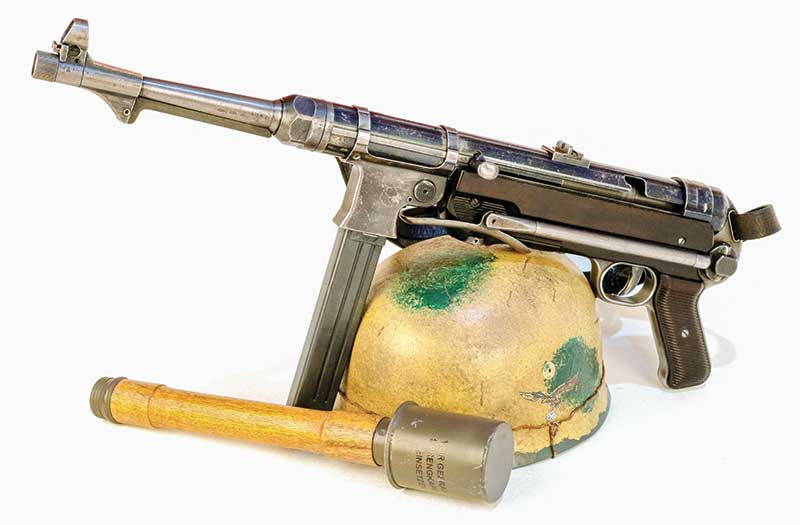
If your checkbook can bear it, vintage subguns like this 1940-production Steyr MP40
are still available. This particular example was an online find years ago.
The Big Leagues
If you have really deep pockets there are yet available some of the most tantalizing WWII-era German machineguns. I acquired my own modest collection over a long period of time using the proceeds from my writing gig. I am blessed with a day job which feeds my family so I can fold my writing cash into guns.
The MP40 submachine gun is a personal favorite. Long, front-heavy, and fairly ungainly, this iconic German subgun nonetheless cycles at a sedate 500 rpm and is eminently controllable. I got mine years ago when it was just plain expensive. Now they are ludicrously thus. However, it’s not like they’re making any more. Classic machineguns are reliably good investments.
Not unlike a supermodel, my MG34 belt-fed machinegun is both beautiful and finicky. The MG34 was the world’s first true General Purpose Machinegun and the workmanship and complexity of the design must be seen to be appreciated. A recoil-operated gun wherein the fire selector is built into the trigger, the MG34 is a complicated beast indeed.
Spare parts and accessories are still available, as is a .308 conversion kit. Serious collectors can drop a fortune on period accessories for classic guns and the MG34 is worse than most in this regard. However, it all melts away when you settle in behind the monster and launch 50 of those finger-sized rounds downrange at 900 rpm.
Denouement
It has been said “The Germans fought for Hitler, the Japanese fought for the emperor, the British fought for their king, and the Americans fought for souvenirs.” Once the new wore off, many of these old bring-back guns were sold off to pay for diapers and baby formula. Lugers, Walthers, 1911s, Nambus, Enfields, Nagants, Thompsons and Stens are all still floating around out there waiting to be collected and revered. Be patient, save your pennies, and strike when the opportunity arises. Quite literally anything is available, at a price.
The M67 flamethrower tank is one of the iconic American weapon systems from the Vietnam War. Nicknamed the “Zippo,” these flame tanks gave soldiers and Marines a tactical advantage against fortified enemy units.
A U.S. Marine Corps flame thrower tank in action during January 1966. Image: NARA
Since March 7, 1994, the United States Department of Defense has prohibited smoking worldwide in all workplaces and vehicles owned by the Pentagon. Moreover, smoking is even prohibited during basic training. Yet, there was a time when smoking and the U.S. military went hand in hand. During the Second World War, Zippo ceased production of lighters for the consumer market and dedicated all production to the U.S. military. Even today, Zippo produces a line of military-themed commemorative lighters.
However, the lighters aren’t the only connection between Zippo and the U.S. military.
A pair of U.S.M.C. M67 flamethrower tanks engage targets in a Department of Defense training film. Image: NARA
One of the most effective flamethrower tanks in the U.S. military’s arsenal was the “Flame Thrower Tank M67” — more commonly known as the M67 “Zippo.” It saw service with the United States Army, and later by the United States Marine Corps during the war in Vietnam. Though it was the last flamethrower tank used by the U.S. military, it wasn’t actually the first.
A Brief Service History of Flamethrower Tanks
Modern flamethrowers saw their horrific entrance on the battlefield during World War I. German flammenwerfer units experienced moderate successes, prompting the other powers to explore the use of the weapons also. World War I also introduced the tank to the battlefield.
A German assault team trains how to attack enemy trenches with flamethrowers and grenades.
It isn’t any significant surprise to find that the world’s armed forces might want to combine the two. The Soviet Union experimented with flamethrower tanks in the interwar era and adopted several models, including the KhT-27 and the KhT-26 among others.
During the Second World War, the Axis nations of Germany, Italy, and Japan also produced a number of tanks that could shoot flames to varying degrees of success.
The first U.S. flamethrower tank was actually the ominously-named “Satan,” a modified conversion of the M3 Stuart light tank. In place of its main gun, it was fitted with a “Ronson” flamethrower. The M3 Satan was used alongside M4 Sherman tanks that were also fitted with bow-mounted E4-5 flamethrowers to great effect against the heavily entrenched Japanese forces in the Pacific.
A Marine M3 Satan flamethrowing tank turns on the heat to wipe out a Japanese pillbox on Saipan. Image: Cpl. Clifford G. Jolly/U.S.M.C.
United States Marines experienced firsthand the capabilities of flame tanks in the Pacific, as it primarily used tanks in a close infantry support role due to the fact that the type of island hopping campaigns meant there were no significant tank battles — at least not on the scale of those in the European Theater.
A Marine flamethrower tank based on the M4 Sherman lays down a stream in heavy fighting near Naha, Okinawa. Image: Cpl. Robert Cusack/U.S.M.C.
During the Korean War, the U.S.M.C. sought a more effective platform to replace the aging M4 Sherman. That led to a request to the development of a M67, which was based on the M48 Patton with its 90mm gun.
Enter the M67
Production of the M67 began in 1952 and continued until 1954. The tank was, however, too late for the war in Korea. Nevertheless, the Marine Corps leadership apparently liked what they saw in the newly designed flame tank. A total of 109 were produced, and while the Army also adopted it briefly, only the Marines actually headed into combat with the flame thrower tank.
A U.S. Marine M67 flame tank of the 1st Marine Division burns out a Viet Cong position on July 7, 1967. Image: U.S.M.C.
What is also notable is that there were actually three versions produced including an M67 on the M48A1 chassis, the M67A1 on the M48A2 chassis, and the M67A2 on the M48A3 chassis. The only difference was in said chassis, as the flamethrower was identical on all models. Each tank weighed around 48 metric tons, a bit heavier than the M48 Patton — due to the flamethrower system and internal fuel tank.
The M67 “Zippo” tank was fitted with a lookalike 90mm main gun. The iconic muzzle brake was not needed to launch a stream of fire.
The M67 was fitted with a flame tube that was actually disguised to resemble a 90mm main gun, albeit the shroud was noticeably wider in diameter and a bit shorter. In hindsight, it was actually somewhat ironic that efforts were made to conceal the flamethrower as it proved to be a terrifying weapon, and one genuinely feared. However, the mock-up gun was fitted to the M67 to disguise it while on the move.
A Marine tank fires flame into some brush north of Camp Carroll where Viet Cong occupied tunnels. Image: J.L. Blick/U.S.M.C.
The flame tube was also heavier than the 90mm T54 gun, and though it shared many of the elevation and traverse components that were employed on the M48, the M6 Flame Gun required a complicated shroud, which made the muzzle heavy. This required that a hydraulic equilibrator device be introduced so as to balance the weapon.
Instead of a crew of four that was employed on the M48 Patton, the M67 actually had a crew of three — as it required no loader. Instead, a huge fuel tank was placed in the loader’s position within the turret. This meant that the gunner was charged with operating both the flame gun as well as the coaxial .30 caliber Browning M1919 air-cooled machine gun. It wasn’t an ideal setup, but there weren’t really any other options available.
All tanks can be described as cramped, and the M67 even more so.
A M67 flame tank from C Co. 1st Tank Bn. fires its deadly flame into an enemy position 10 mines south of DaNang in May 1967. Image: Cpl. R. P. Curry/U.S.M.C.
Within the turret was a large 398-gallon central “tank,” which held “thickened gasoline,” more commonly known as napalm, which was put under pressure, and ignited by a 24,000-volt electric spark. The total burn time in operation was around a minute, depending on the size of the nozzle employed. Nozzles of 19 mm (.75-inches) and 22 mm (.88-inches) were the most common. The flame tube had an approximate range of 280 yards (256 meters).
Due to the fact that the M67 didn’t need to carry standard ordnance, the ammunition racks for the 90mm ammunition to the left and right of the driver were removed and replaced by stowage bays. This allowed for tools, spare parts for the equipment, and ammunition for the machine gun to be stored.
Baby, Won’t You Light My Fire
In what can only be described as perhaps one of the most bizarre coincidences in modern military history, in January 1967 the American rock band The Doors released their hit single “Light My Fire.” The song would go on to spend three weeks at number one on the Billboard Hot 100 Chart later that same year, and while not as potent of an anti-war song as the group’s “The Unknown Soldier,” it has come to be associated with the Vietnam War.
Flame tanks of the 1st Tank Battalion engage Viet Cong combatants during Operation Doser near Binh Son in the Quang Ngai Province. Image: NARA
It was, of course, in that conflict where the M67 Zippo saw its only actions.
Details are sparse on how many of the flamethrower tanks were actually sent to Southeast Asia, but it was first employed in combat in August 1965 during Operation Starlite, the Battle of Van Tuong. It was the U.S. military’s first major action in the war, and during the battle, a number of M67s were ambushed and destroyed.
It wasn’t an ominous baptism of fire, yet the M67 did prove to be well-suited to the guerilla nature of the Vietnam War, and it was often employed to incinerate patches of jungle that may have concealed an enemy position. Such attacks took on the name “Rods of Flame,” and the Zippo was widely feared by the Viet Cong forces.
Urban Combat with the Zippo
It wasn’t just in the jungles where the M67 saw success.
During Operation Dozer, and the Battle of Hue, a pair of M67 Zippos accompanied by a number of M48 Patton tanks led the armored strike into the ancient Vietnamese city. The M67 proved even better suited to the urban combat in Hue than it did in the jungles. However, throughout its service, the M67 needed to be accompanied by a pair of 2 1/2 ton trucks that carried the equipment and supplies for the flamethrower. In most cases, one truck would carry the Napalm supply, while another would be employed to recharge the compressed air system. The need for such support restricted the type of operations where the tank could be used, while it also meant that efforts needed to be made to protect those trucks.
These Marines demonstrate the power of the M67 in a 1970 U.S. Navy training video. Image: NARA
Another issue that limited the success of the M67 was that the flamethrower was noisy — even by tank standards. When the flamethrower was in use, the level of the internal noise within the vehicle was so loud that the commander and gunner would barely hear each other over the intercom. There are reports of tank commanders putting their heads out of the turret so as to direct the gunner. In a firefight that was also far from ideal.
Legacy of the M67
The M67 wasn’t actually the only armored flamethrower to see service in the war. The other was the Self-Propelled Flame Thrower M132, a modified M113 armored personnel carrier (APC), which was fitted with much of the same equipment. It was employed in a limited role by the United States Army. However, the Army never had the same faith or success with the M132 as the Marines did with the M67.
Based on the success of the M67, the American armed forces looked to incorporate flamethrowers in other contexts. Here a U.S. Navy patrol boat tests a Zippo in January 1969. Image: NARA
Soon after the U.S. withdrew its forces from Southeast Asia, the Zippo was essentially snuffed out. The M67 was officially retired from service in 1974 without a replacement. It was the last flamethrower tank to be employed by the U.S. military.
Of the 109 that were produced, it is an actual mystery as to how many actually survive. According to Tanks-Encyclopedia.com, one was on display at the now-closed U.S. Army Ordnance Museum at the Aberdeen Proving Grounds in Maryland. All of the vehicles have been relocated to Fort Benning, Georgia — but as of press time, the M67 Zippo isn’t believed to be on display. Another can now be found outside the Engineering School at Fort Leonard Wood, Missouri.
These serve as the final reminders of the M67 Zippo.