Category: All About Guns
During the German “Spring Offensive” of 1918, the British Expeditionary Force took on part of the brunt of the German onslaught in fierce fighting that nearly pushed them back against the English Channel. The British desperately wanted U.S. troops of the American Expeditionary Force incorporated into their lines as reinforcements and met resistance from American General John Pershing.
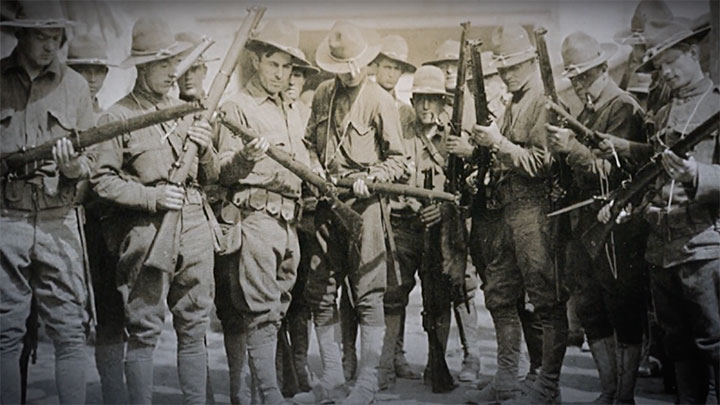
U.S. soldiers inspecting British Short Magazine Lee Enfield rifles.
At the beginning of the Spring Offensive, U.S. soldiers of the AEF were not available to help the allies against the German push, as they were still in training camps. This changed by summer 1918, when the first units of the AEF started trickling into France. General Pershing answered the British request for American reinforcements by sending elements of the 27th and 30th Infantry Regiments to join the British lines under British command.
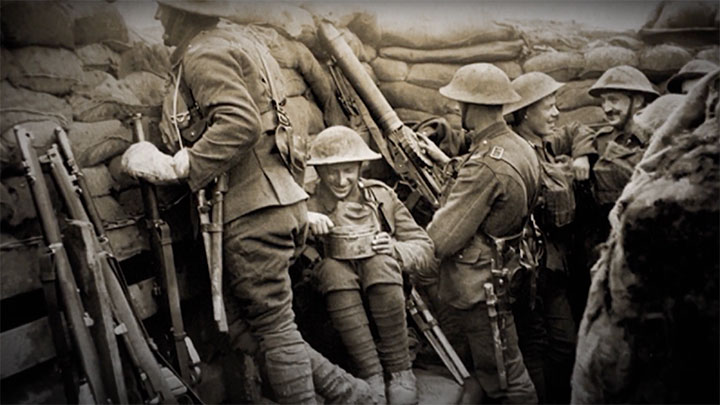
Soldiers packed into a trench on the Western Front surrounded by SMLE rifles and with a Lewis Light Machine Gun.
The U.S. soldiers of the 27th and 30th Infantry Regiments trained with elements of the Australian and New Zealand ANZAC corps to prepare for combat in the trenches. On July 4, 1918, these American troops joined British and Commonwealth forces in the Battle of Hamel, under the command of the Australian General John Monash. During the fighting, the joined AEF and ANZAC forces contributed to a new form of combat in the Western Front, with a combined and coordinated effort of infantry pushes, air cover, artillery and intelligence that would ultimately change the nature of trench warfare.
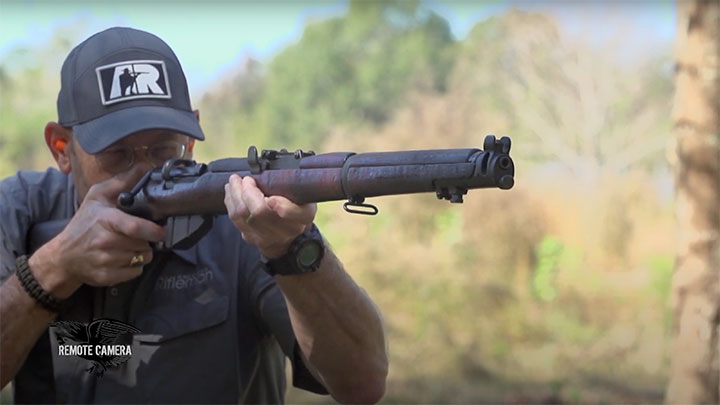
Shooting a British No.1 MKIII* SMLE rifle.
Unlike other AEF troops on the Western Front, the men of the 27th and 30th Infantry Regiments did not use standard American arms like the M1903 Springfield and M1917 Enfield rifles. Instead, they were issued British arms and gear as they fought under British command. These arms included the Short Magazine Lee Enfield, Lewis Light Machine Gun and Vickers Heavy Machine Gun, all chambered for the rimmed .303 British cartridge.
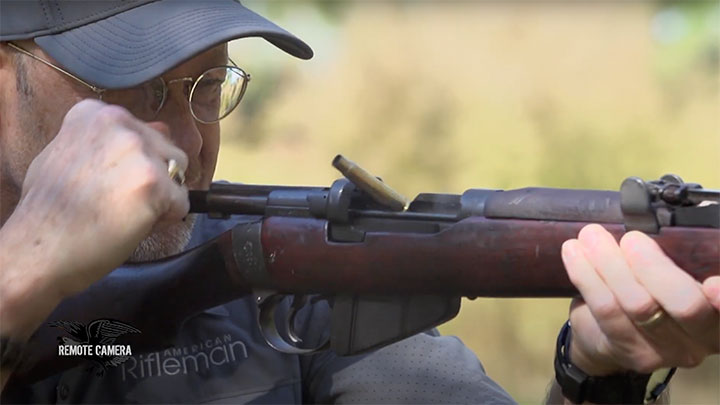
A view of the action of the No.1 MKIII* SMLE ejecting a spent .303 British casing.
The bolt-action Short Magazine Lee Enfield, or SMLE, rifle used by British and Commonwealth forces was one of the best service rifles used during World War I. While the standard-issue SMLE did not have the same long-range accuracy potential compared to the M1903, M1917 and German Gewehr 98, there were several features that made it better suited for the realities of fighting in trenches. The first of these notable features is its magazine capacity of 10 rounds, double the capacity of the other service rifles in use.
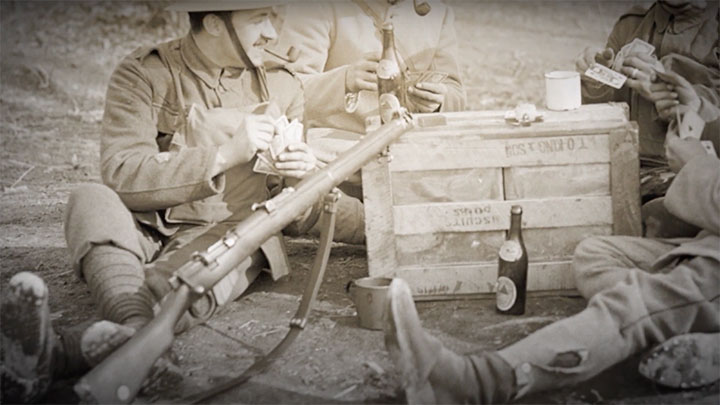
Soldiers sitting around a crate with a No.1 MkIII* SMLE in the foreground.
The SMLE was also slightly shorter than both the M1903 and M1917 rifles in use with other AEF troops, making it easier to maneuver within the tight confines of trench warfare. The cock-on-close action, in addition to the magazine capacity, of the SMLE also meant that trained soldiers could manipulate the action faster and put out a greater rate of fire compared to other bolt-action service rifles in use at the time. The SMLE uses a tangent rear sight and front sight post surrounded by large guard ears, protecting the sights from drops or falls.
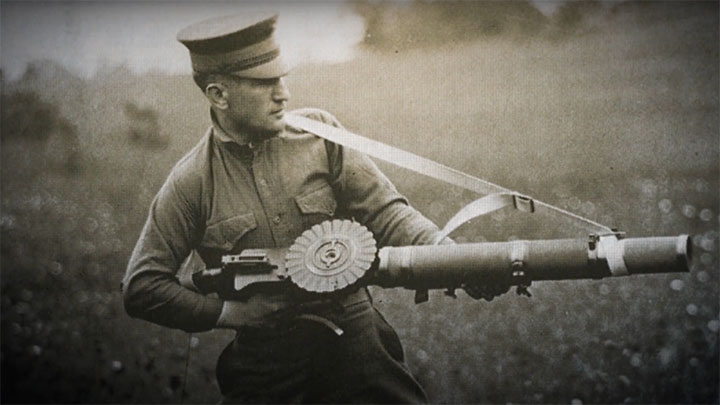
A Marine demonstrating use of the Lewis Light Machine Gun from the hip using a sling.
Another British weapon system used by the soldiers of the 27th and 30th Infantry Regiments under British command was the Lewis Light Machine Gun, designed by a U.S. Ordnance Officer, Isaac Newton Lewis. Lewis based his design off of an earlier machine gun prototype, the McClean, which used a drum feed and gas-operated action. The Lewis Gun fed from a top-mounted rotating drum magazine containing 47 rounds, and was light enough that a single man could carry and operate it versus the more cumbersome and stationary Vickers Heavy Machine Gun.
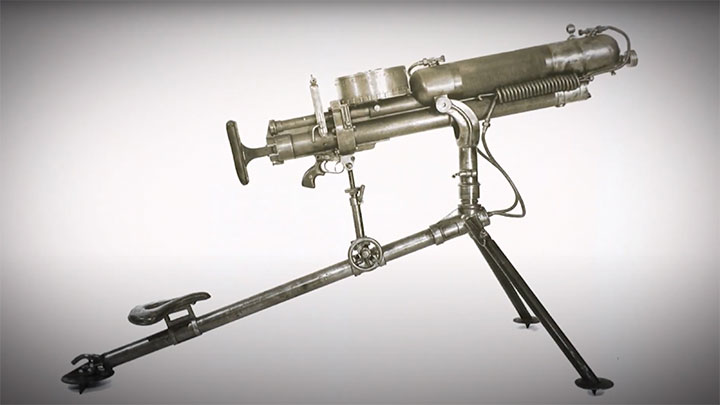
One of the McClean prototype machine guns, off which Issac Newton Lewis borrowed design features for his own machine gun.
One of the most notable features of the Lewis Gun was its finned barrel contained within a hollow shroud. Using a concept called the “Venturi” system, the barrel of the Lewis Gun ended before the opening of the shroud and the muzzle blast pushed air forward through the front while brining in cooler air through opening slits at the back of the shroud near the receiver. It was thought that this method of using flowing air and heat dissipating fins around the barrel would keep it cool during sustained fire while keeping the overall weight down in comparison to a water-cooled jacket.
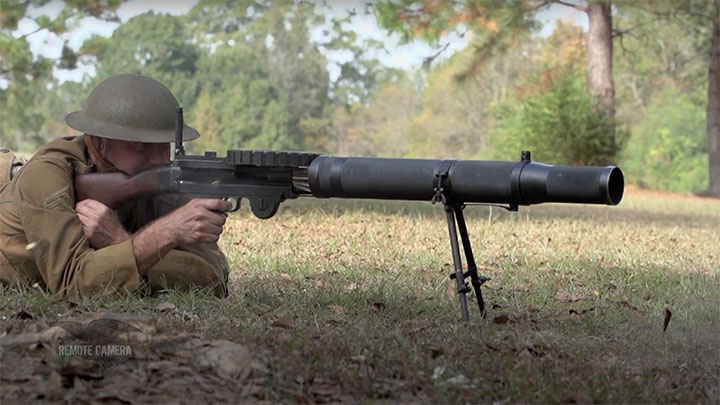
Shooting the Lewis Light Machine Gun.
The Lewis Gun also featured adjustments for the gas regulator and action spring, allowing it to be tuned as fouling built up within the system in order to keep the gun running. The demand for Lewis Guns was high throughout the war as its light weight, magazine capacity and ability to sustain fire made it a valuable asset for British soldiers fighting in the trenches. The number of Lewis Guns in use by British forces constantly grew throughout the war.
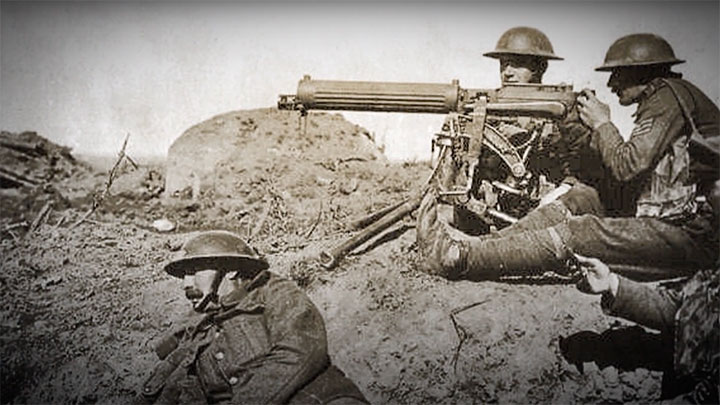
Soldiers crew a Vickers Heavy Machine Gun on the Western Front.
The Heavy Machine Gun Battalions of the 27th and 30th Infantry Regiments were issued the water-cooled, belt-fed British Vickers Heavy Machine Gun. The Vickers was essentially the same design as the American Maxim Gun, albeit a slightly lighter and improved version with the toggle lock turned upside-down. The Vickers uses a recoil-action operating system in which the barrel recoils backwards slightly within the water-jacket to unlock and operate the toggle action. The Vickers proved to be a reliable heavy machine gun on the Western Front, and a trained crew with plenty on ammunition, spare parts and water could fire it continuously.
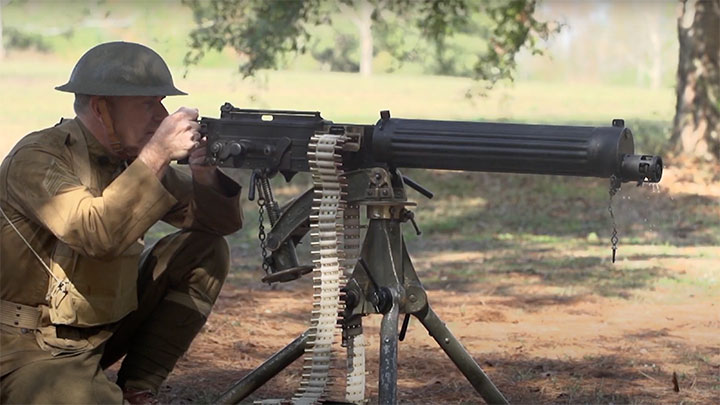
Shooting the British Vickers Heavy Machine Gun.
By mid-1918, the tactics used by the British had improved since the disastrous first Battle of the Somme two years earlier, in which they suffered more than 60,000 casualties on the first day. The British has started off with one Vickers per battalion at the beginning of the war, which increased to several machine guns per company to support the infantry.
The number of Lewis Guns increased to two guns per platoon, or at least one per section. The British also incorporated the use of rifle grenades fired off the front of SMLE rifles as well as “bomber” troops, which were soldiers tasked with hurling multiple grenades at the enemy.
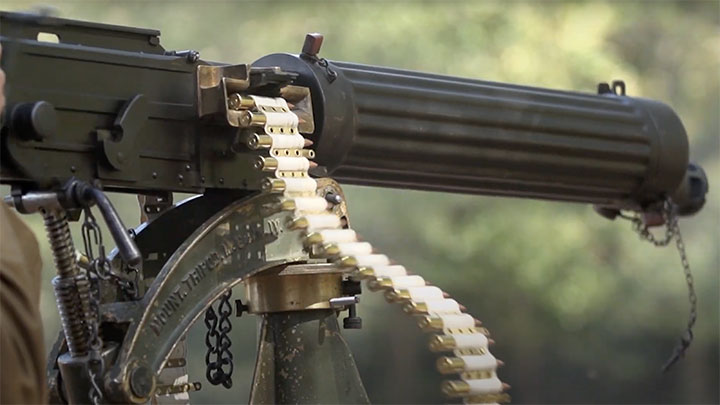
Another view of the Vickers Heavy Machine Gun in action.
The combination of better arms and tactics being used by the British by 1918 allowed for an increased degree of fluidity to be brought back into the fighting which had previously been a near constant stalemate. This was the environment that the U.S. soldiers of the 27th and 30th Infantry Regiments under British command participated in on the old Somme battlefield in 1918. General Monash, who commanded the two American regiments, went on to say that there were “no finer troops” in regards to the U.S. soldiers fighting with the British and ANZAC forces.
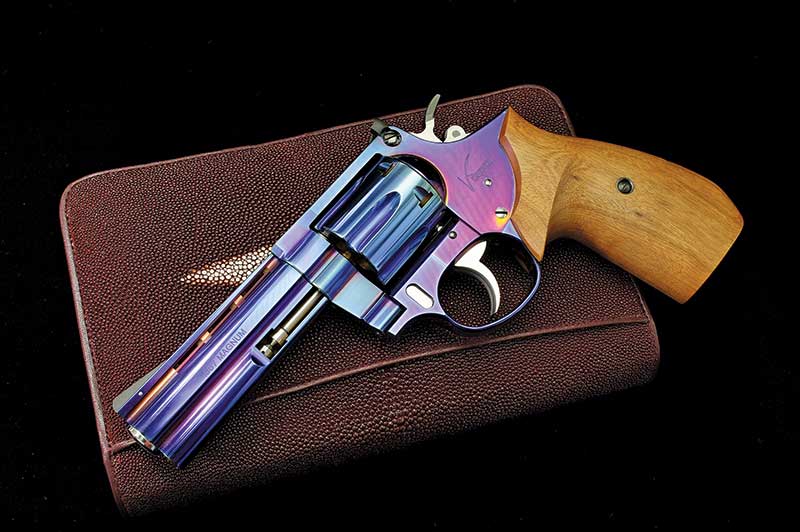
Who says “stock” can’t be stunning? This is a vintage Korth showcased
by a rayskin portfolio. Let your expectations grow beyond the safe full of
high-cap auto pistols you might have now.
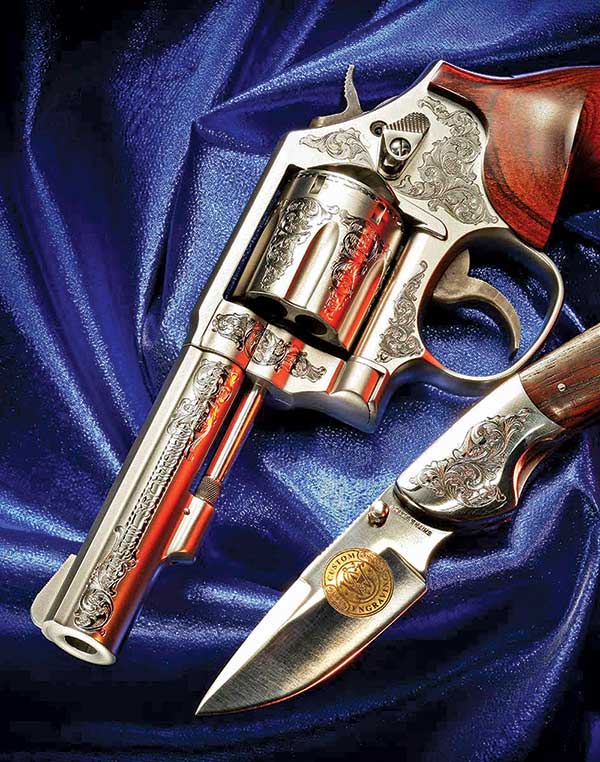
Roy’s wife, Suzi, owns this stunner of a Model 65. She shoots it
and simply enjoys it each and every time she does.
When I learned to SCUBA dive in the middle ’80s, my first “real” dive was in a training pool. Before we went in, the instructor said, “Okay, so once you get over the fact you’re actually breathing underwater, start to think about what’s happening, what you’re doing, how to handle emergencies and actually look around you and appreciate what you see.”
Sure enough, the first five minutes, all I could think about was, “Holy cow, I’m breathing underwater! Hey, look at me, I’m breathing underwater! Look at all those bubbles! Gosh!”
But as time passed, the novelty wore off, and I began to really learn about being a diver. The skills I learned paid off to help me get a slot in our agency’s Harbor Unit, where I became one of our department divers. But the ability to get past that initial astonishment was important.
So why does this matter to us? A shooter’s life journey usually goes along similarly. They shoot a gun for the first time, or buy a first gun, shoot it, then can’t help thinking, “Heck, this is great! What fun! I can’t believe I’m shooting a real gun! This is more fun than I thought. I want to shoot it a whole lot more too!” Remember?
Now comes the important part of the process though. Many people stop there. They have one gun, they shoot it, they repeat, “Gosh, I’m shooting a gun!” but don’t really ever get past that. It’s the same experience simply repeated over and over again. The key is to look down the road and figure out where it might lead. Learn to get better, to reload, learn history, to question ideas and simply to be interested beyond making empty brass.
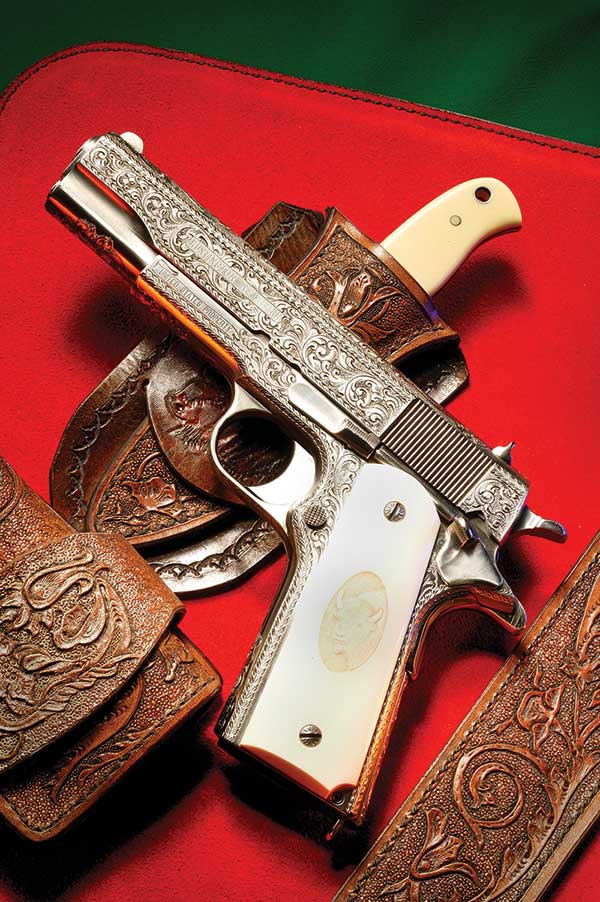
Get past the polymer and go for it, like this engraved 1911. Even a modest —
but still personal gun — helps you to push the envelope on your taste,
skills and the sheer fun of shooting.
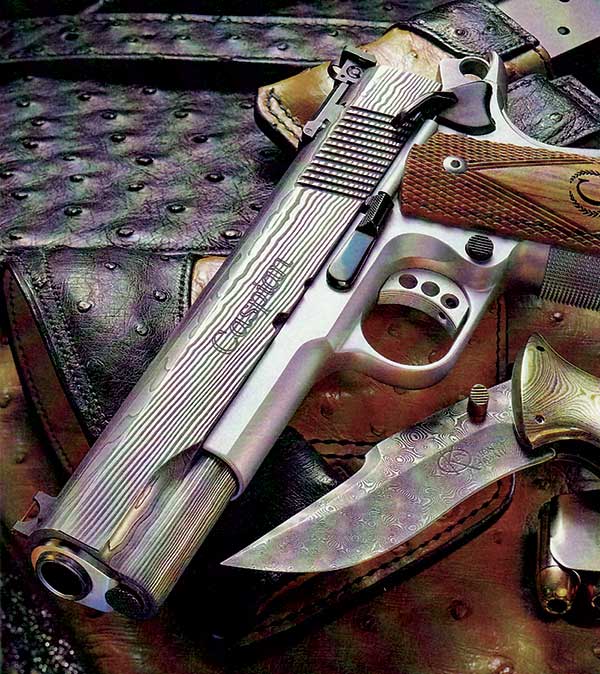
This is the first Damascus slide 1911 ever built, created by Tussey Custom for
Roy in 1998. It was the March cover gun that year for GUNS Magazine. Keep pushing
yourself to grow, learn and participate in outside-of-the-box thinking. It’s often surprisingly
affordable and always satisfying.
Messing With Boats
The term comes from The Wind in the Willows by Kenneth Grahame. They’re a great line of books for adults, sneakily masquerading as children’s books. If you keep your mind open, there are life lessons galore. If you don’t know the books, they are about small animals in the woods, but these animals talk and are as sophisticated as anyone you’ll ever meet. Maybe more.
In one part, Mole and Rat are rowing up a river in Rat’s boat. They are chatting about things in general and nautical things in particular, prompting Rat to say:
“Believe me, my young friend, there is nothing — absolutely nothing — half so much worth doing as simply messing around in boats. Simply messing … about in boats — or with boats. In or out of ’em, it doesn’t matter. Nothing seems really to matter, that’s the charm of it. Whether you get away, or whether you don’t; whether you arrive at your destination or whether you reach somewhere else, or whether you never get anywhere at all, you’re always busy, and you never do anything in particular; and when you’ve done it there’s always something else to do, and you can do it if you like, but you’d much better not.”
To me, Mr. Rat is talking about shooting too. Once you get your feet real and truly wet shooting and decide it’s going to be part of your life, you’ll soon find “messing about” with shooting to be satisfying, enjoyable, sociable and rewarding. The freedom to putter, guess, explore, find limits, discover no limits and learn to hone your tastes can be some of the most gratifying experiences you might have.
The key here, at least to me, is once you’re past the “I’m breathing underwater” stage, is to grow, learn and discover the hidden secrets behind the guns and gear we all love. When you find yourself wishing beyond that first polymer pistol, you’ll know the real journey is beginning. As your tastes broaden, become more sophisticated, and your yearning for knowledge grows, the bars for your expectations will rise accordingly. If you’re always on your tip-toes reaching for the next bar, you’ll find your enthusiasm for all things guns to continue to remain fresh, undeniable and fulfilling.
Just don’t stop at that first single-shot .22 — or plastic pistol. Enjoy them, yes, learn from them, indeed, but never think it stops there — because it doesn’t. When you find yourself eyeing the Bowen Classic Arms website, passing a surprising amount of time clicking on gun photos on the Turnbull Restorations site, or when you find yourself far down the rabbit hole of looking at “Just one more picture of engraved guns” — you’ll know you’re headed in the right direction.
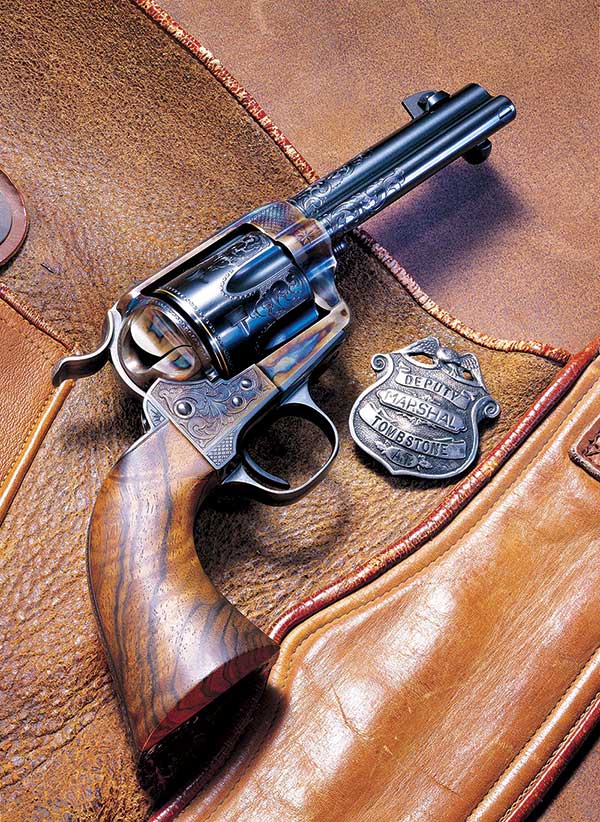
“Working” guns are one thing, but the sublime satisfaction of owning something
like this single action from Bowen Classic Arms ramps the game up!
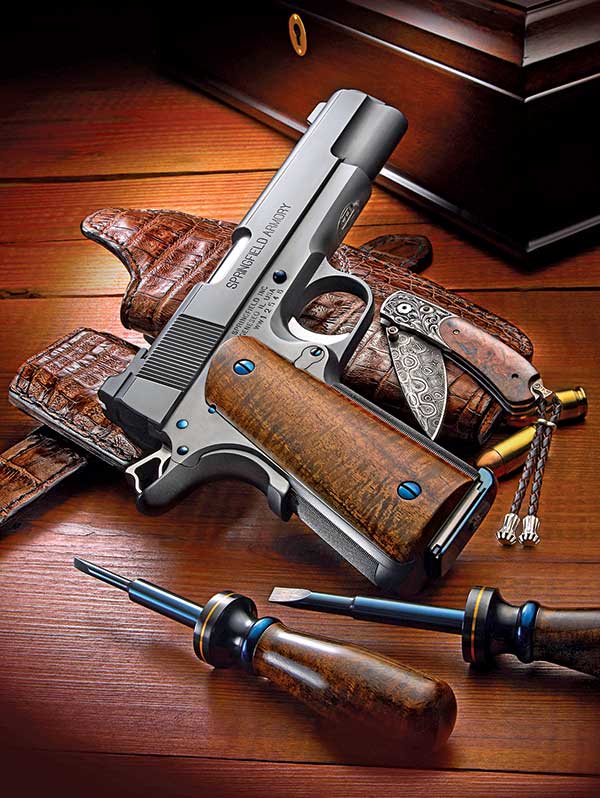
There comes a time for an all-out swing for the fence project and this
Ted Yost boxed set of gun and tools epitomizes it. Don’t lower your
expectations — strive toward them.
What Is Too Much?
I haven’t found it quite yet. It seems with every custom gun project (“No, really, this is the last one, I promise …”) I find new doors opening, new ideas flooding my dreams. When a satisfying group appears as if by magic on my target, it makes me wonder the how’s and why’s behind it — and if it can be better. That leads me to further exploration with reloading ideas, calls to fellows who know more than I do, talks with barrel makers, wondering why one rifle stock shoots better than another.
The key here is to “keep messing about with boats.” And always — always — continue to aim high with your dreams. Never accept adequate as the final word. And by all means, enjoy!
Categories
Part of Ridley Scotts Napoleon
Categories
A HK45C: U.S. NAVY SEAL in 45 ACP
 I am in lust and green with envy at the same time!

Smith & Wesson is currently marketing a semi-automatic pistol as a Military and Police (M&P) model, but the name is taken from the double action (DA) revolver that made it famous. Later, the same revolver was assigned the model number “10,” when S&W stopped naming their handguns and gave them numbers, instead.To this day, shooters over 30 associate the M&P name primarily with the forged steel Model 10 revolver that is still going strong and was the mainstay of the S&W police (and civilian) handgun line for decades, not the more recent plastic-framed semi-auto.The S&W .38 Hand Ejector, fixed sight service revolver has, in one form or another, been a best seller in the S&W revolver line since 1899. The Military and Police tag was added immediately after the gun’s introduction, as a result of an 1899 order from the U.S. military for thousands of Smith & Wesson’s new revolvers in the then U.S. service standard .38 Long Colt caliber.In addition, in 1899 S&W introduced a new caliber in the M&P, the .38 Special. (The actual bullet diameter is .357″). This was an enlarged and more powerful cartridge designed to address the stopping power deficiencies of the .38 Long Colt service cartridge. The M&P revolver and the .38 Special cartridge have been associated ever since.As a historical note, the S&W Military and Police was engaged in an intense competition with Colt’s best selling Police Positive Special service revolver for both the civilian and police markets during the first half of the 20th Century. Ultimately, S&W finally achieved market dominance due to their ability to undersell Colt.M&P revolvers have been periodically updated. The first major change came in 1902, when the lock-work was simplified and an ejector rod locking lug was added beneath the barrel, latching the cylinder into the frame at front and back.Starting in 1904, customers had a choice of square or rounded grip frames. In 1915 the mechanism was again improved by the addition of an automatic hammer block that rendered the revolver completely safe with all six chambers loaded. The fixed sights were also improved at the same time.S&W began heat treating cylinders in 1919. M&P revolvers produced between 1942 and 1944 had a “V” prefix added to their serial numbers and were known as “Victory” models. Incidentally, the S&W Magna grips were introduced after the end of World War II and, at some point, the hammer block actuation was changed from a spring to a cam.The Model 10 designation was introduced in 1957/1958, so the revolver became known as the “.38 Military & Police Model 10,” the designation used by the Gun Digest, the Shooter’s Bible and practically everyone else until 2010. Whatever it is called, this .38 Special, fixed sight revolver is the most popular in history, with over 6,000,000 sold and production continuing today.Model 10’s made at various times between 1958 and 2010 were available with 2″, 3″, 4″, 5″ and 6″ barrels. There were also limited production “distributor special” versions with 2.5″ barrels.However, the 4″ and 6″ barrel lengths have always been the most popular. These were elegantly tapered barrels, without a top rib and only a small bottom lug (about ½” long) to serve as a latch for the tip of the ejector rod. There was also an otherwise identical 4″ heavy barrel (no taper) M&P version.Prior to 1981, the barrel was threaded into the frame and pinned in place, while current Model 10 barrels are simply threaded into the frame sans pin. The gun reviewed here has a 6″ barrel, my favorite length for .38 revolvers.The caliber is marked on the right side of the test gun’s barrel, reading “38 S&W Special Ctg.” while “Smith & Wesson” is stamped on the left side. The serial number is stamped on the bottom of the grip frame.Our test gun’s serial number indicates that it was probably made in 1977, before the 10-7 engineering change took place (later in 1977). The model number is stamped inside the frame behind the cylinder crane; thus, the cylinder must be swung open to see the model number. In the case of the test revolver, it reads “Mod. 10-5.” That stands for Model 10, 5th engineering revision. The fifth engineering revision (-5) was a change from a 1/10″ wide “half moon” front sight blade to a 1/8″ wide ramp style front sight blade; this was instituted in 1962. Our test gun was therefore part of the Model 10-5 production run, manufactured between 1962 and 1977.Between 1958 and 2012 there were a total of 14 engineering revisions made to the Model 10. The lockwork has remained the same after the -4 revision, in which the earlier leaf spring powered trigger return mechanism was replaced by a more durable coil spring powered slider.The Model 10 was temporarily discontinued in 2010, only to be immediately reintroduced in the current 4″ heavy barrel version without the historic M&P tag. The blued steel Model 10 revolver is offered today in pretty much its original form, but only with a 4″ heavy barrel and a rounded butt. All Model 10’s from 1958 to the present are suitable for use with .38 Special +P ammunition, as well as all standard pressure .38 Special loads.The M&P is built on Smith’s medium size “K” frame, which is an appropriate size for a six-shot, .38 Special revolver. The small “J” frame was designed for .32 caliber cartridges (such as the .32 S&W) and the big “N” frame for .44/.45 caliber cartridges.None of these S&W frame sizes were originally intended for use with Magnum cartridges. Thus it was that when the .357 Magnum cartridge was introduced in 1935, it was chambered in a big N frame gun, which was unnecessarily large for the caliber.Later, the .357 was adapted to K frame guns, but it tended to shake them apart and the recoil is ferocious. It wasn’t until much later, when S&W copied the Colt Python size frame, calling it the “L” frame, that they finally had a frame appropriate for the .357 Magnum.The sights on the M&P are fixed (non-adjustable). The front sight is the angled (quick draw) front blade introduced with the -5 series and the rear sight is the traditional square notch machined into the top of the frame. This is a durable, but limiting, sighting system that was basically regulated for use with the traditional 158 grain LRN “police service” factory load. Good revolver sights should be user adjustable for windage and elevation, since otherwise the sights can be properly regulated at the factory for only one load at one distance.The K38 Masterpiece (Model 14) is S&W’s K-frame, adjustable sight .38 revolver. It is generally similar to the M&P, but supplied with a fully adjustable rear sight and undercut target type front blade that allows accurate use of the wide range of .38 Special loads on the market.Most Model 10’s came with a high polish, luster blued overall finish with a color case hardened hammer and trigger, although nickel finish was also available for most of the gun’s life. The nickel plated finish was discontinued in 1991, well after the satin stainless steel Model 64 M&P had been introduced, which effectively replaced the nickel finish. The stainless Model 64 is otherwise the same as the Model 10. (S&W pads their model list by using different model numbers for otherwise identical stainless and blued finish guns.)Previously supplied with a either a round or square butt and checkered wood grips, current production Model 10’s come with a round butt (only) and wood grip panels, while Model 64 revolvers are supplied with Uncle Mike’s combat style rubber grips. The test gun has a square grip frame with S&W Magna walnut grip panels; it is in completely stock form.The Model 10 Heavy Barrel. Illustration courtesy of Smith & Wesson.2016 Model 10 Heavy Barrel Specifications
Smith & Wesson Model 10-5. Photo by Chuck Hawks.1962-1977 Model 10-5 Specifications (as tested)
Like all S&W revolvers with swing out cylinders, the cylinder rotates counter clockwise, or out of the frame, because the hand that rotates the cylinder is on the right side of the frame and the cylinder swings out to the left. This is why S&W revolvers have two cylinder locks, one in the form of a spring loaded pin at the front of the ejector rod and the second a hole in the recoil shield at the rear of the frame window for the spring-loaded cylinder pin. The hand trying to rotate the cylinder out of the frame is also why S&W revolver cylinders are not quite as tight, with the trigger pulled back, as equivalent Colt revolver models.The firing pin is pinned into the hammer using a roll pin. There is rebounding hammer with an internal hammer block that positively prevents the firing pin from hitting the primer of a chambered cartridge until the trigger is pulled back, thus rendering the gun safe to carry with the cylinder fully loaded. The main (hammer) spring is a leaf spring inside the grip frame, secured by a screw in the lower front of the grip frame.The trigger pull of the test gun measured a clean four pounds, per my RCBS pull scale. Like all S&W revolvers G&S Online has reviewed, the DA pull exceeded the eight pound max reading of my scale. It is probably on the order of 12 to 14 pounds, so heavy that when dry firing I could not keep the sights correctly aligned, no matter how slowly and carefully I tried to pull the trigger.This revolver’s DA trigger function is adequate for use at contact range and not much else. If you want to hit what you are shooting at, cock the hammer manually for a SA trigger pull.It is no secret that S&W has turned out a lot of poorly machined and fitted revolvers, especially during the 1970’s and 1980’s. However, this test gun has a tight and uniform cylinder gap, tight cylinder crane to frame fit and a uniformly machined cylinder star. The frame is straight and the barrel is correctly aligned in the frame. The side plate fits the frame perfectly, with a nearly invisible line where the two meet. The hand ejector rod is straight, the action is tight and there is very little cylinder play. The locking bolt does not drag between the cylinder locking notches and the cylinder indexes correctly during rapid DA fire. The grip panels correctly match the shape of the frame and are a tight fit. It is one of the good ones!For the shooting part of this review I had .38 Special standard pressure Remington/UMC 130 grain Metal Case (MV 790 fps) and Winchester/USA 125 grain JSP (MV 850 fps) factory loads. To represent .38 Special +P loads I used the Winchester/USA 125 grain JHP Personal Protection factory load (MV 945 fps). Groups were five shots at 25 yards at slow fire pistol (bulls eye) targets, fired from a sturdy shooting bench using a Pistol Perch rest.Guns and Shooting Online staffers Gordon Landers, Rocky Hays and Jim Fleck helped me with the shooting chores. We did our test shooting at the Izaak Walton outdoor shooting range south of Eugene Oregon. Overcast skies with a high temperature in the upper 50’s F during our day at the range with the Model 10 were typical of Western Oregon weather in mid-March. The maximum wind velocity was 10-15 MPH. At least it did not rain.Shooting results
AVERAGE GROUP SIZE FOR ALL LOADS: 2.0″This time out Jim shot the smallest individual group. Note that none of our test loads were the 158 grain LRN factory loads (MV approx. 800 fps) for which the Model 10’s fixed sights were presumably regulated. I detest plain lead bullets and almost never shoot such ammo in my revolvers, so I don’t keep it on hand. Unfortunately, none was available for sale locally, due to the Obama ammo shortage.The sights, although fixed, present a decent, Patridge type sight picture in daylight conditions. Point of impact with a two hand hold, for me, was 1.5″ low and 1″ to the left at 25 yards with the 125-130 grain standard pressure ammo. The Winchester 125 grain +P loads grouped about 1.25″ low and approximately centered in windage.Shooting a bit low with these 125-130 grain loads was not surprising, as I figured the gun was intended for use with 158 grain police loads. If only the Model 10 had an adjustable rear sight it would be easy to zero this revolver to hit dead on at 25 yards with 125 grain +P JHP ammo.The SA trigger pull releases the hammer crisply, without any take-up and very little over-travel. All shooters appreciated the clean trigger. At a measured four pounds, the pull weight is about 1.5 pounds heavier than I would like, but it is so crisp it feels lighter.The wide trigger has a comfortably gentle curve and a grooved face. I prefer a smooth trigger surface. Never in my life can I remember my trigger finger slipping on a smooth trigger!As with all S&W revolvers, the checkering on top of the hammer spur is too sharp and tends to abrade the skin of the shooter’s thumb pad after a lot of single action shooting. All of our test firing for our recorded groups was done single action, of course, to maximize accuracy. I have never understood the gun manufacturers’ fascination with sharp edges on handguns.S&W’s two-piece Magna grips have to be among the most uncomfortable ever designed from the standpoint of handling recoil and they provide no fill between the front of the grip frame and the back of the trigger guard. (Well, okay, they are better than the earlier S&W wood grips–faint praise, indeed.) However, the Magna grips served satisfactorily on the relatively heavy for caliber Model 10 with both standard pressure and +P .38 Special loads. The revolver’s 6″ barrel and good balance helped minimize recoil and muzzle jump.My only real complaint was that the S&W cylinder latch (slide forward to swing open the cylinder) was too tight and a bit difficult to operate. It tended to hesitate or stick about half way when pressed forward, the only rough machine work we found on this gun.Despite its age, this revolver showed signs of having being shot very little prior to this review, with no signs of wear due to use, or even from being carried in a holster. I doubt it had fired a full box of ammo (50 rounds) in its entire life. It had been purchased by G&S Online Technical Assistant Nathan Rauzon’s Grandfather for home defense and spent virtually its entire life in a gun case. Thus, we had the pleasure of shooting what was functionally a new Model 10-5 revolver.The S&W Military and Police Model 10 is a good choice for police service and home defense, just as advertised. It is the right size for the .38 Special cartridge, which particularly in +P hollow point form, is an excellent choice for both purposes.Like any revolver, it can be left fully loaded with all springs relaxed for years and still be ready for immediate action at a moments notice, without any preparation. Just cock the hammer and squeeze the trigger to fire accurate SA shots, or simply pull the trigger for very short range DA use in an extreme emergency.For home defense, nothing is safer, more accurate, more reliable or more ambidextrous than a revolver. A good S&W Military and Police Model 10 is more than adequate for the job. |
Categories