Category: All About Guns

For years, deer hunters across parts of the Midwest had to study cartridge case dimensions before heading into the woods. Straight-wall cartridges like the .350 Legend and .450 Bushmaster grew popular in no small part because they gave rifle hunters legal alternatives in states that heavily restricted traditional bottleneck cartridges.

That landscape keeps changing.
Michigan, Indiana, and Iowa now give hunters considerably more flexibility than their old regulations allowed — though the rules, and when they changed, differ in each state.
Michigan Drops the Limited Firearms Deer Zone
Michigan made the biggest change for the 2026 season.
The Michigan Natural Resources Commission eliminated the Limited Firearms Deer Zone in the Lower Peninsula. Beginning September 12, 2026, hunters can use all legal firearms across the Lower Peninsula — including bottleneck-chambered rifles.
Michigan defines a legal rifle during applicable firearm deer seasons as one firing any caliber larger than .22 rimfire.
For hunters who spent years selecting cartridges specifically for the zone, that’s significant. Straight-wall cartridges are still legal; they’re just no longer required simply because you’re hunting the southern Lower Peninsula.
One capacity restriction is worth remembering for AR-platform and other semi-auto hunters: a semi-automatic rifle or shotgun can’t hold more than six shells in the barrel and magazine combined.
(Michigan DNR 2026 deer regulations: https://www.michigan.gov/dnr/managing-resources/laws/regulations/deer)
Indiana Standardizes Rifle Rules
Indiana took a different approach.
The state now permits centerfire rifles firing a bullet at least .219 inch, or 5.56mm, in diameter on both public and private land.
That public-versus-private distinction matters because Indiana previously maintained different rifle-cartridge restrictions depending on where you hunted. Senate Enrolled Act 280, passed in 2025, eliminated that distinction.
The state still prohibits full-metal-jacket bullets for deer and limits hunters to carrying no more than 10 cartridges for each such rifle while hunting deer.
In practical terms, Indiana hunters now follow a much simpler standard: centerfire, .219-inch bullet diameter or larger, with an appropriate hunting projectile. Meet the diameter and it’s a legal rifle — which puts a common AR-15 in 5.56 or .223 on the table, loaded with expanding bullets.
Iowa Is Still Different
Then there’s Iowa.
Iowa allows both straight-wall and necked-down cartridges during its youth/disabled and first and second shotgun seasons — but that doesn’t mean you can grab your .308 or 6.5 Creedmoor and head for the stand.
The cartridge must fire an expanding bullet measuring from .350 through .500 inch and generate at least 500 foot-pounds of muzzle energy.
That makes cartridges such as the .35 Whelen, .350 Legend, .358 Winchester, .450 Bushmaster and .45-70 Government legal options.

It excludes common smaller-diameter bottleneck cartridges — the .308 Winchester, .30-06 Springfield, .270 Winchester and 6.5 Creedmoor — from those seasons. Note the reason: Iowa cares about bullet diameter and energy, not case shape. A bottleneck round that clears .350 (the .35 Whelen, for instance) is fine; a .308 isn’t, because it’s too small.
There’s another important distinction: this isn’t a new Iowa rule for 2026.
The framework allowing these rifles dates to legislation passed in 2020 and administrative rules effective in June 2021. Hunters may be hearing more about expanded Midwestern rifle options this year because of Michigan’s change, but Iowa has operated under its current rules for several seasons.
(Iowa DNR deer hunting page: https://www.iowadnr.gov/things-do/hunting-trapping/types-hunting-trapping/deer-hunting)
Straight-Wall Isn’t Dead
None of this means the Midwest’s straight-wall boom is over.
The .350 Legend, .450 Bushmaster, .45-70 and their kin still make plenty of sense for whitetail, particularly in timber and where shots are short. Plenty of hunters already own rifles chambered for them, know their holds, and shoot ammunition that performs.
The difference is that regulations increasingly give hunters more choice. Michigan effectively removed case geometry from the equation in the Lower Peninsula. Indiana uses a minimum bullet diameter requirement rather than restricting hunters to straight-walled cartridges. Iowa allows necked-down cartridges, but only inside a fairly specific caliber, projectile and energy envelope.
Three Midwestern states, three different sets of rules.
As always, check current state regulations before heading into the field. The fact that your deer rifle is legal on one side of a state line doesn’t mean it’s legal on the other.
Scott Witner
Categories
Rare Guns you’ve never heard of
Categories
3 shots at 2km’s (300win mag)
Categories
Smith & Wesson 58 .41 magnum
Categories
Gun? What Gun!?!


A single-action .22 is about as basic as a gun gets, but it might be one of the most fun. The old model Ruger Single-Six has stood the test of time and is one of the more sought after and revered .22s in existence. While Ruger still produces the Single-Six today, many enthusiasts consider the three-screw, four-click originals to be the high-water mark of the model.
Quick Summary: Styled after the “gun that won the west,” the old model Ruger Single-Six is of the finest rimfire revolvers ever built, combining the classic Single Action Army design with Ruger’s reputation for durability. Plus, it’s affordable to buy and shoot.
Table of Contents
Brief History
Initial Thoughts
Specs
Range Review
Pros & Cons
Parting Shots
Brief History
Bill Ruger introduced the first Single-Six in 1953 in the aftermath of World War II and the Western Boom. John Wayne reached his peak during this period, and there was great demand for Single Action Army-type revolvers. Colt had ceased production of the legendary Single Action Army during the second world war and had no intentions of bringing it back.
Ruger decided to fill the void, first with the Single-Six, and a few years later with the Blackhawk.

While these looked the part, the hallmark for Ruger revolvers has always been durability. The Single-Six looks more like the Colt than any of the revolvers that came after and even features the classic three screws in the frame and four clicks from the hammer. This mechanism was tried and true, resulting in a smooth trigger pull and distinct audible cues. Ruger used coil springs that were much more durable than Colt’s delicate leaf springs.


Early versions had notable differences, but in a pinch looked the part for TV and movies. The first versions had a flatter loading gate that was later rounded to more closely match the Colt aesthetic.
About 10 years into production, Ruger offered the convertible package that included both a .22 LR cylinder and .22 Magnum, like the model I have in for review. The convertible package became one of the Single-Six’s most attractive features and helped cement Ruger’s reputation for practical value.


Ruger introduced the transfer bar system in 1973 to prevent accidental discharges if the revolver were dropped. Earlier models relied on the traditional practice of carrying the hammer over an empty chamber, making the revolver effectively a five-shooter when carried safely.
Initial Thoughts
I’m familiar with the Ruger lineups, having owned several of my own over the years. I’ve always felt the brand delivers incredible value for your money, though some of the offerings can feel second fiddle to the original – like Ruger single actions compared to the Colt standard.

What I found upon opening the box was an old model Ruger Single-Six. Based on the serial number, it’s from 1970. For a gun that is 56 years old, it’s aged amazingly well. The gun has a classic even blue, with some wear and a turn line from what was likely years of use. I did notice some softer edges around the fixed rear sights and typical spots from a holster. Overall, the gun is in great shape.


Before I dug into some of the research, I had been doing my own recon for my next single action. I was deep into the clones as a shootable version of the Colt Single Action I already own. The first thing I did with this model was slowly pull back the hammer. I can tell you that these days prioritizing safety is a good thing, but it’s hard to explain the satisfaction the four-click noise brings. It just feels more legit.
While I won’t be keeping this one, I did consider it. The gun is slightly smaller dimensionally than the big-bore guns, much like the 7/8-scale New Frontier is to the Colt lineup. This makes more sense, as it is a smaller caliber and can easily be carried afield for the day when plinking or small game might present itself. Despite its smaller size, it has quite the heft to it and nearly deletes all the recoil when at the range.

Range Review
I brought a decent selection of CCI Quiet, Federal 36-grain box ammo and some CCI .22 Magnum rounds for some range testing. Though I was only loading six at a time, I emptied the 50-round cases rather quickly and shot who-knows-how-many rounds from the box ammo. Single-action shooting can be a tiresome, but overall it’s an absolute blast.


The fixed sights are entirely serviceable, though they are harder to pick up in low light and demand more concentration at longer distances than modern adjustable sights. I kept most of the shooting to 10 yards and in, though I did put a few cylinders through at 15 yards. Throughout testing, I experienced no malfunctions and no stuck cases. The gun has essentially no recoil, which added to the fun.


The magnums heat up a little faster due to the pressures involved, so the ejector was a little sticky after a few rounds. What was fun, though, was doing some modified Bill Drills where I was shooting as fast as I could and then unloading and reloading while imagining myself behind a barrel for cover at the OK Corral.
Pulling the trigger to the second click notch, opening the loading gate and hearing the audible click as you rotate to each new open chamber is cathartic these days, but must have been incredibly chaotic in the past. It is apparent as you load and unload just how good we have it nowadays for actual defense and combat. I can’t fully imagine what this would have been like while in real peril, but suffice to say, those who got good at this likely won the gunfights.


The Single-Six proved capable of respectable accuracy, though I couldn’t produce groups as tight as those I’ve shot with more modern revolvers such as Colt’s King Cobra. The fixed sights appeared to favor more of a traditional 6 o’clock hold than the point-of-aim/point-of-impact setup I typically prefer, which may have contributed to some of the vertical dispersion in my groups.

Parting Shots
More than 50 years after it left the factory, the old model Ruger Single-Six remains one of the finest rimfire revolvers ever built. It combines classic Single Action Army styling with Ruger’s reputation for durability, all while delivering an affordable and enjoyable shooting experience.

Every click of the action, every case ejected from the cylinder, and every group fired downrange feels connected to the Wild West era. The fact that this 1970 revolver still functions as well as it does today speaks volumes about Ruger’s craftsmanship. While I won’t be keeping this one, it certainly reinforced my desire to add a classic .22 single action to my own collection.
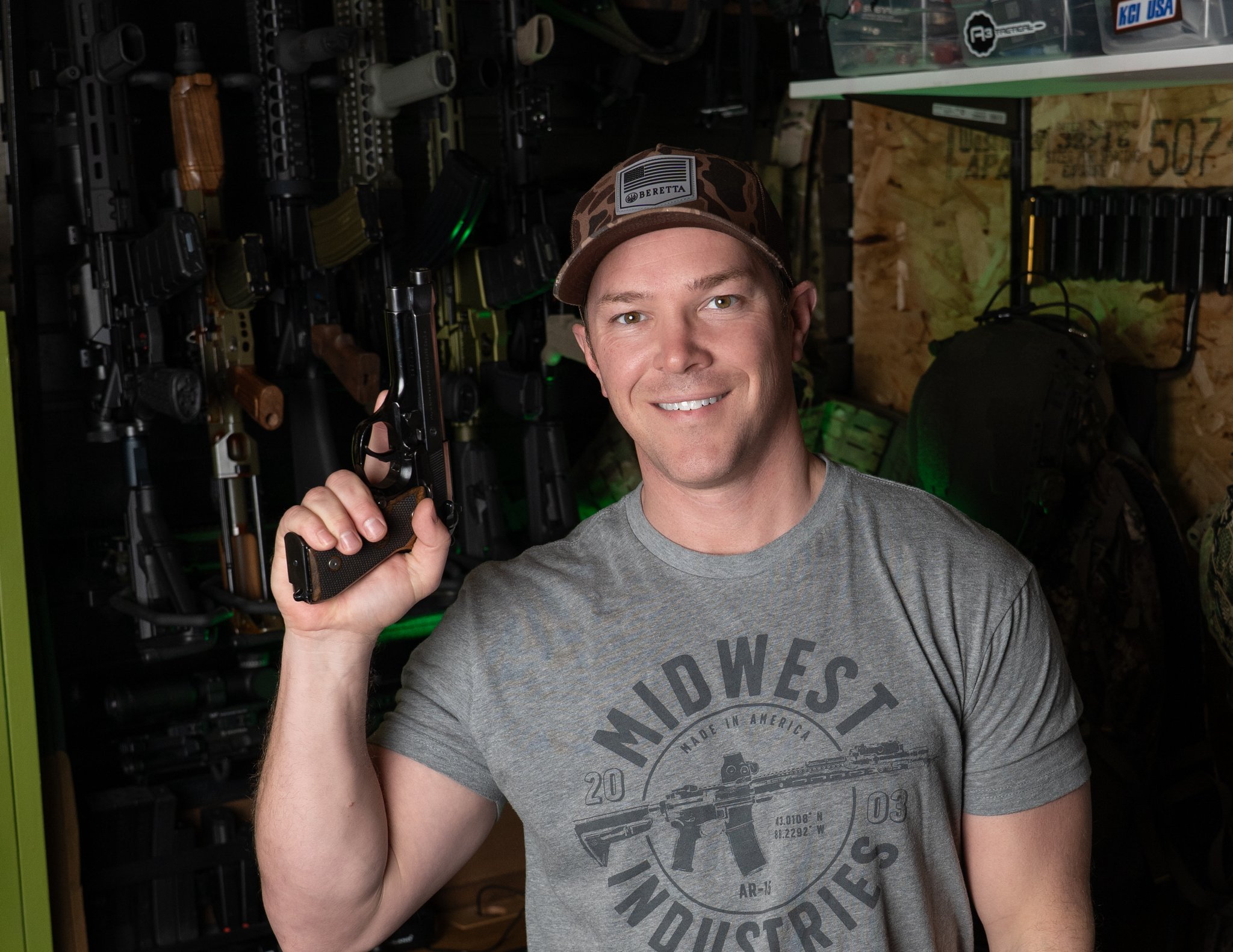

Andy Budnik
Andy is a self-taught photographer obsessed with creating stunning EDC and lifestyle imagery. As a creator, he focuses on highlighting a product’s best features through engaging visual storytelling. While he has a relentless drive to evolve his craft, his personal passion lies with pistols, specifically the Beretta 92.