Persian legends speak of the Manticore, a mysterious beast with the head of a human, the body of a lion and the tail of a scorpion. Although this mythological creature’s individual features were recognizable, they came together to form something uniquely different from its constituent parts.
With this in mind, TandemKross (TK) dubbed one of the latest additions to its extensive catalog of Ruger 10/22-compatible components and upgrades, the Manticore X. Simply stated, there is nothing else quite like it on the market. It’s different enough that it took me a minute to get my head around it, even with the photos and descriptions the company provided to writers just ahead of its launch.
But once I got it, I had to test-drive it for myself. The most straightforward way to do that was to build a 10/22-pattern rifle, in .22 LR, using the Manticore X as the starting point. TK offers the rest of the top-notch, in-house components required to flesh out the platform with the exception of two major components, the serial-numbered receiver and the barrel. In this case, I reached out to the good folks at Fletcher Rifle Works to request an innovative OpenTop 11/22 receiver and Summit Precision for one of the company’s sleek carbon-fiber wrapped barrels to complete the parts set. Here’s how this unique at-home rimfire rifle build came together:
TK Manticore X Lower Assembly
A typical 10/22-type trigger housing, from front to back, contains the magazine release mechanism, the external safety, the fire control group, the trigger guard and trigger. This polymer or aluminum assembly is secured to the rifle’s receiver using two pins. These pins are, in turn, held in place by the shoulder stock, which is secured to the receiver via a stock screw.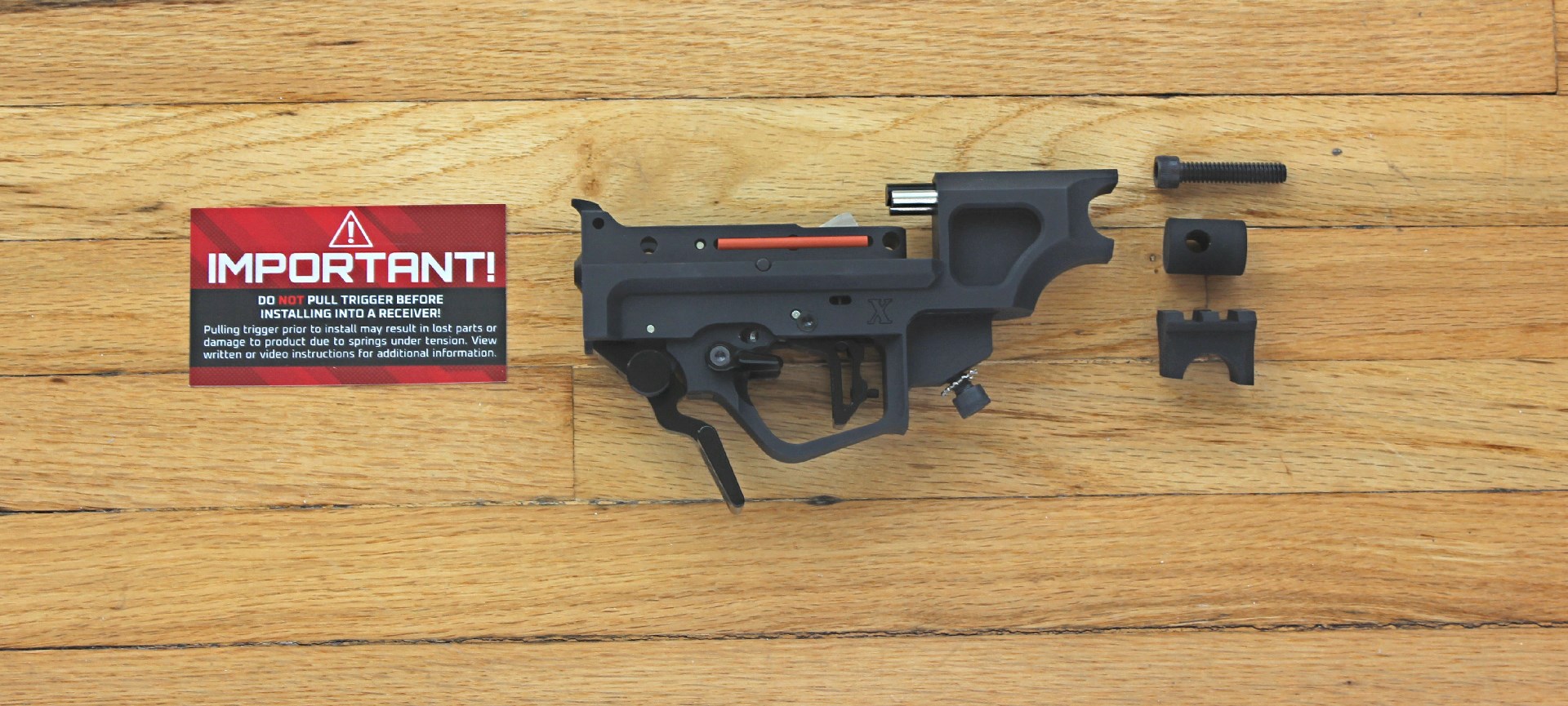
The Manticore X arrives ready to use with a set of receiver pins, buffer, grip screw and stock mounting parts.
The primary goal of the Manticore X design is to serve as a lower receiver, which eliminates the need for a stock or chassis system. Its CNC-machined aluminum housing serves the same role as a traditional 10/22 trigger housing. However, it has been extended at key points to support the magazine, the 10/22 upper receiver, an AR-15-type pistol grip and a Picatinny rail that serves as a shoulder-stock mounting point. The receiver’s cross pins, provided in the Manticore X, kit are fitted with ball detents to secure them in place.
The Manticore X is compatible with a wide variety of Ruger-brand and aftermarket fixed-barrel and takedown-type receivers. If you already own a factory-assembled gun, remove it from the stock, slip out the trigger housing and install the Manticore X to give your favorite rimfire a set of competition-grade controls, an adjustable trigger, pistol grip and a folding stock all in one step.
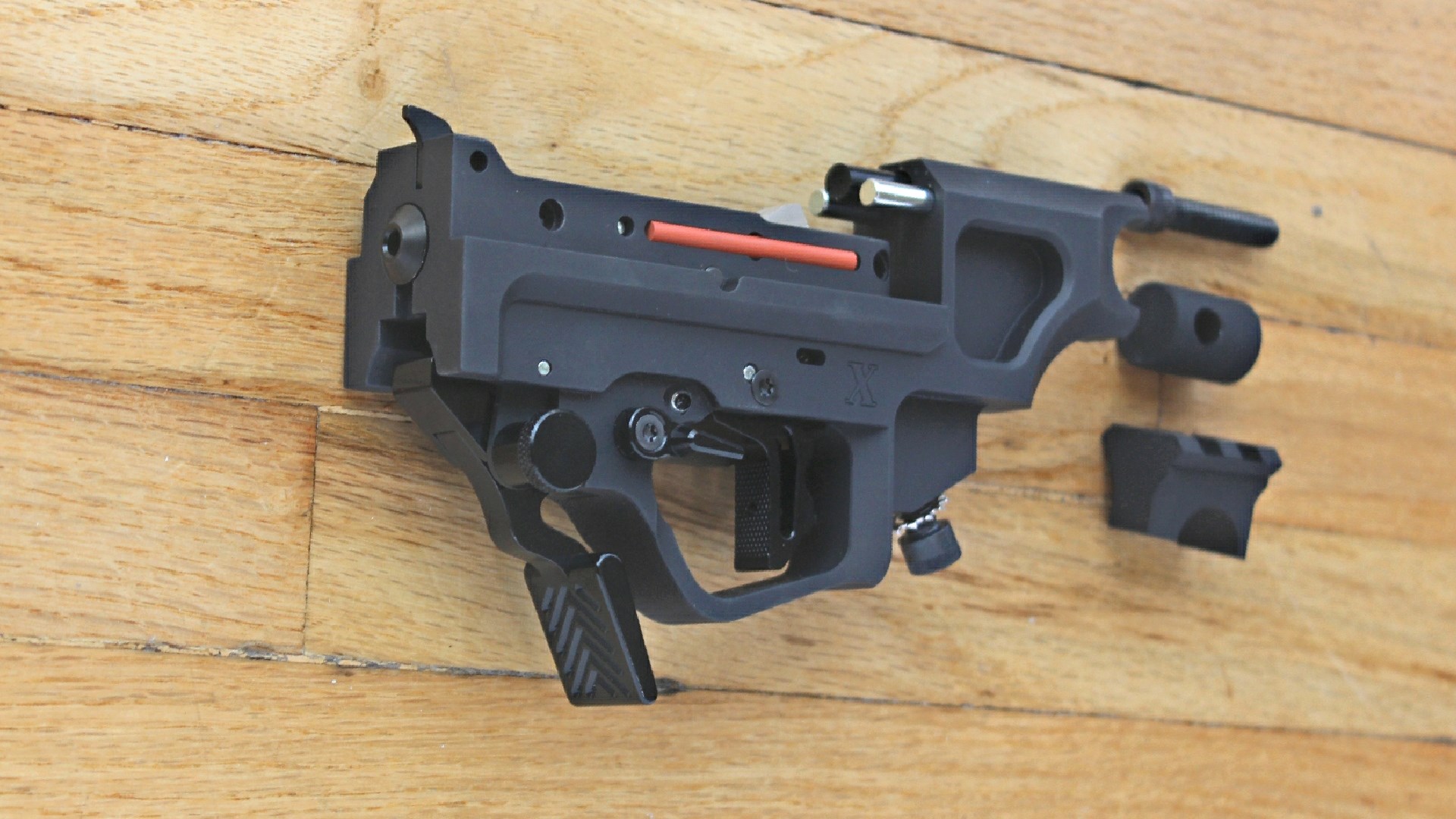 The controls and internals have been upgraded with TK competition components.
The Manticore X arrives ready to use and loaded with TK’s competition upgrades. Bright orange rubber strips are set along either side where it meets the upper receiver to guarantee a snug fit. The textured paddle Fireswitch magazine release is bi-directional, meaning it can be pushed forward or pulled back to drop the magazine.
The Bolt Keeper bolt hold-open lever, which rests to the left of the over sized integral trigger guard, is fitted with an extended knob for easy operation. The ambidextrous Cornerstone Rotary safety selector levers are set into the front of the trigger guard where they can be quickly moved up into the Safe position, or down into the Fire position using the tip of the trigger finger.
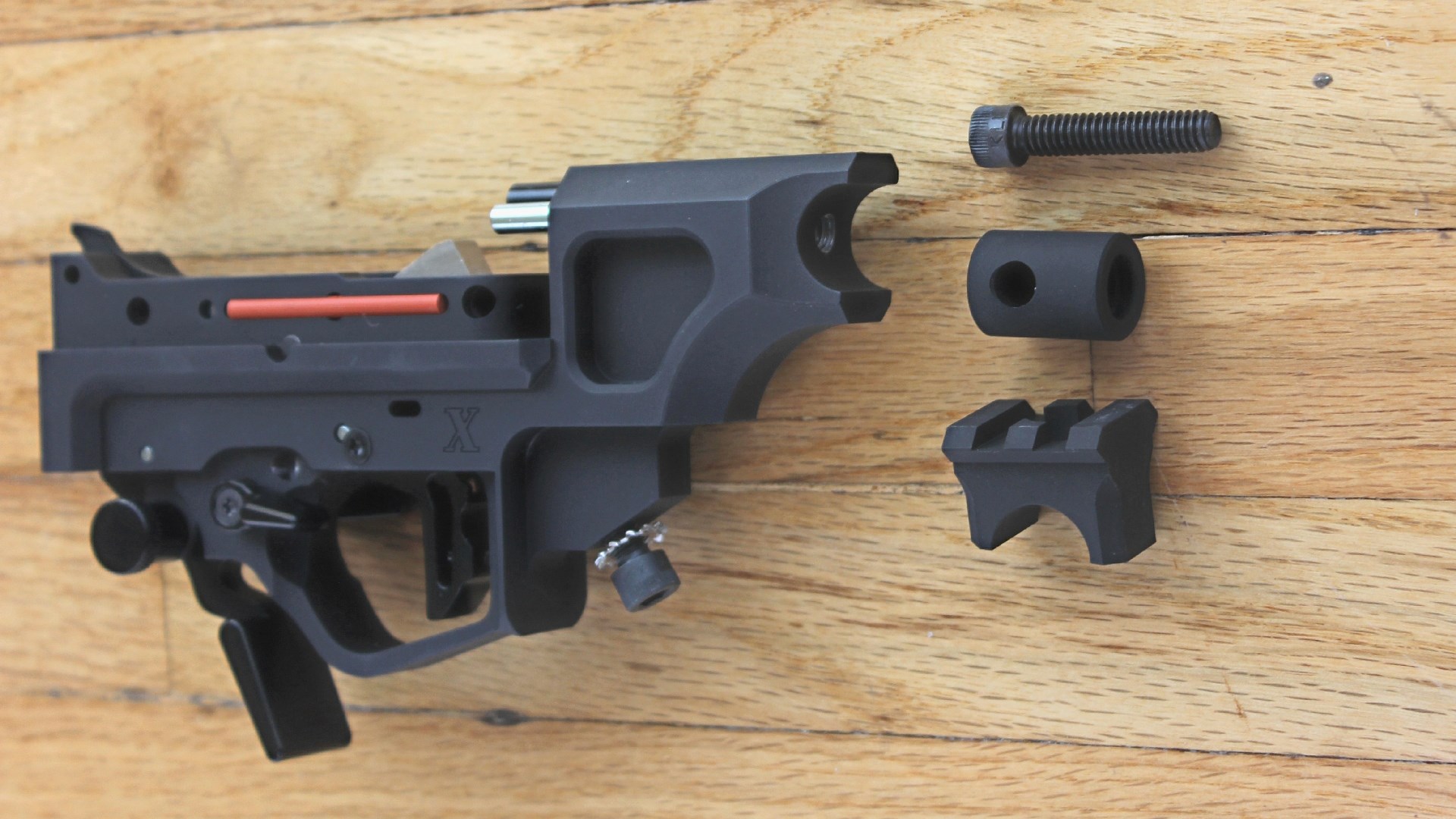 The stock rail can be configured for a straight stock or a 12-degree downward cant.
The Manticore X ships with TK’s Ultimate Trigger Kit. This includes a textured, flat-faced Victory trigger shoe, which is adjustable for overtravel. The single-stage trigger’s pull weight can be adjusted between 2.5 lbs. to over 5 lbs. It was set at 3 lbs., 8 ozs. for this evaluation and exhibited a short arc of travel with a smooth, clean feel.
The inside edge of the stock extension features three ports that are used to store the two upgraded receiver KrossPins and the rubber Shock Block Bolt Buffer, which are provided in the kit. The grip’s mounting point will accommodate a variety of AR-15-pattern pistol grips, with or without beavertail extensions.
The stock mounting rail’s base features an angled cut and a rounded connector. This allows the two-slot aluminum rail to be rotated for either a straight configuration or a 12 degree downward cant, depending on the height of the optic used. The rounded connector is also a quick-disconnect (QD) sling-mounting socket, which can be faced towards the right or left side of the receiver.
TK Pro Bundle for Manticore X
With the Manticore X lower in hand, folks are free to outfit it with the accessories they prefer, including those from TK or other manufacturers. But to simplify the process of building out the lower, TK offers the Pro Bundle kit of which includes the company’s M-Lok fore-end, hiveGrip and a Rim/Edge-brand folding shoulder stock. This bundle costs about $40 less than purchasing each of these components separately, so you essentially get the grip for free.
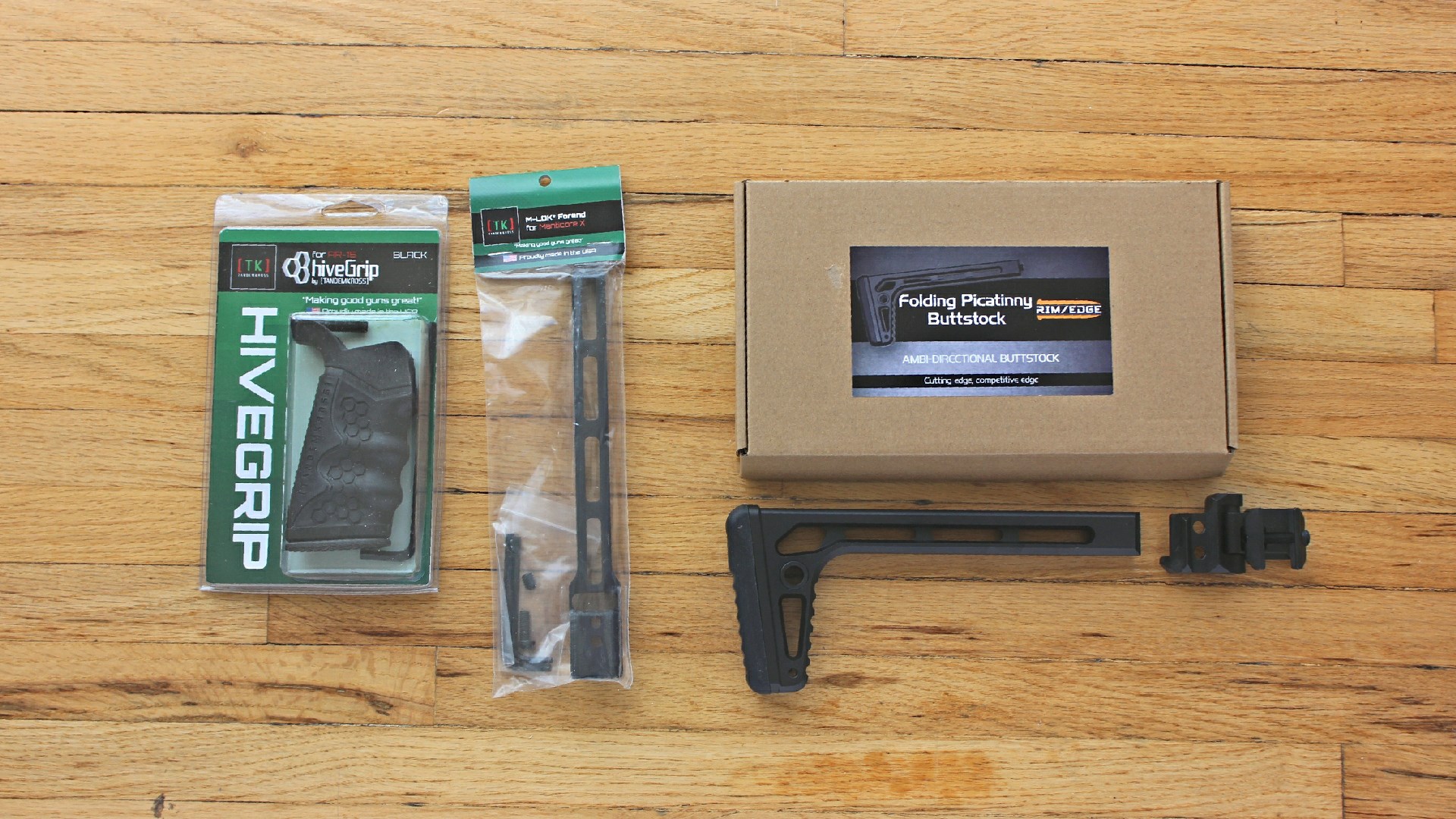 The Pro Bundle set costs less than buying these three components separately.
The American-made M-Lok fore-end for Manticore X is a minimalist’s delight. Only 8″ long, this lightweight CNC-machined aluminum rail free-floats the barrel and is just wide enough for three M-Lok accessory slots on the left and right sides with four along the bottom edge. It’s mounted to the upper receiver’s stock screw port using a single support screw, along with three tension screws that allow it to be adjusted for various factory and aftermarket receivers. It’s a suitable fit for bench rests, sand bags and bipods, but not all that comfortable to hold when shooting from the off-hand position. It would benefit from a set of rubber M-Lok rail covers to provide added purchase for the support hand.
I test drove the AR-15 hiveGrip for the first time with the Tippmann M4-22 Redline and found it to be a great fit for target shooting rimfires like this one. It has a hand-filling, finger-grooved and textured rubber surface that comfortably hugs the shooting hand. It also has a removable base plate with a water-resistant seal so that the grip’s hollow can be used as a storage compartment.
The skeletonized aluminum Rim/Edge folding shoulder stock features a Picatinny-mount hinging assembly, a QD socket and textured-rubber butt pad. The hinge and stock can be configured to fold to the left or right side of the rifle. It has two ports for the stock arm’s support screw, which allows for half an inch of height adjustment.
Additional TK Components & DoubleKross Magazines
Because this was a from-scratch build using a stripped 11/22 receiver, a few more TK parts were required. The hardened-steel KrossFire bolt assembly ships with the company’s Eagle’s Talon Extractor, a Fire Starter Titanium Firing Pin and a durable black PVD coating. The Spartan Skeletonized Charging Handle assembly features an oversized and skeletonized aluminum extension that is available in black (shown), red or silver finishes. The in-house bright-red Barrel Retaining V-Block was secured with a set of black Rim/Edge V-Block screws.
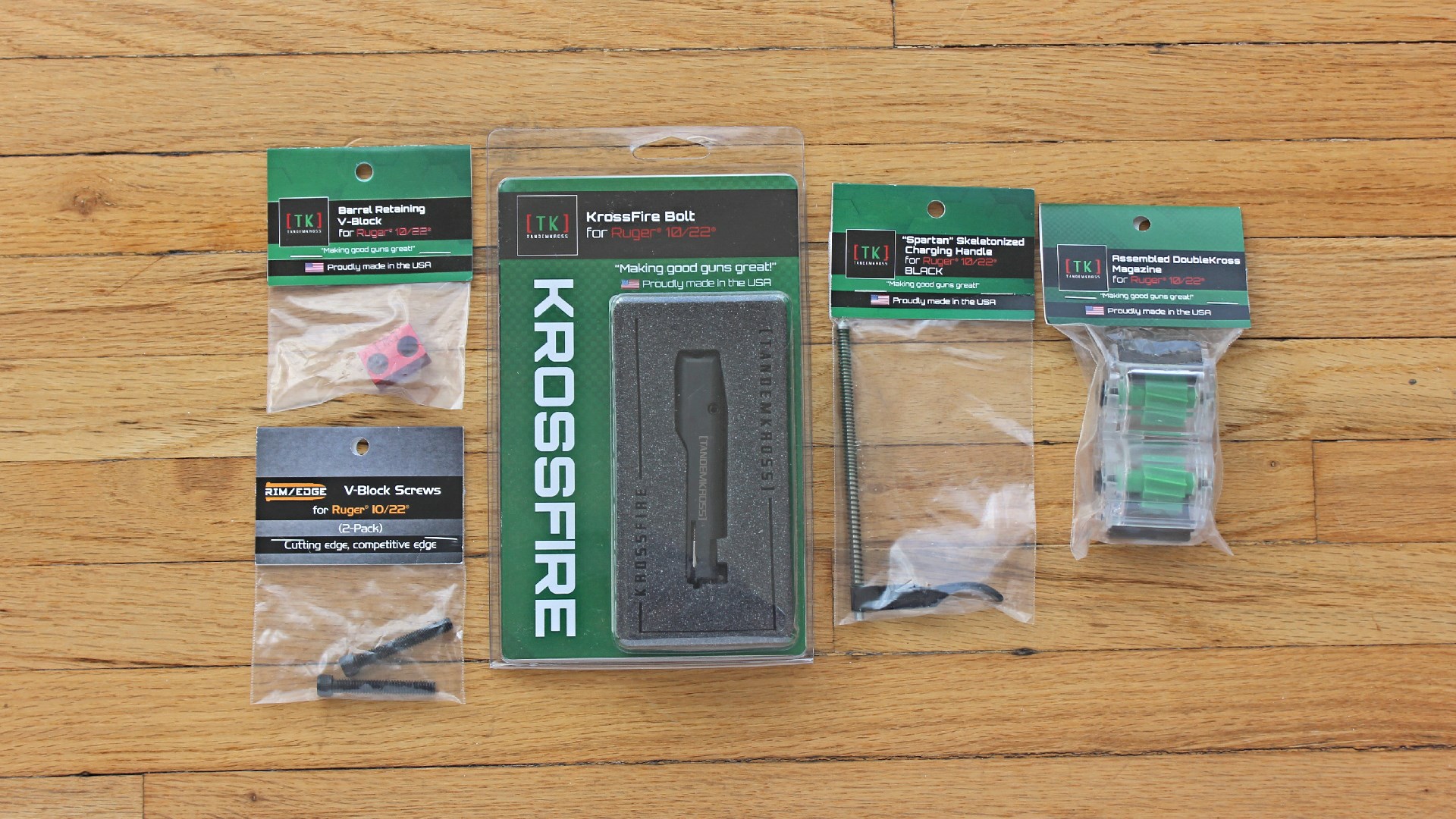 Tandemkross currently offers all of the parts needed to build a custom 10/22 rifle except for barrels or serial-numbered receivers.
One of the more recent additions to the TK catalog is the fully assembled, ready-to-use DoubleKross 20-round magazine (in the past, only the housings were available). Instead of the more common banana-like profile of aftermarket 15- and 25-round magazines, the translucent DoubleKross is essentially two BX-10 rotary magazines fused together at their bases. This configuration is robust, easy to use and quite compact. Two DoubleKross magazines stacked end-to-end are only about 0.25″ longer than one 15-round BX-15 magazine. That’s 25 more rounds in the same range bag or backpack pocket space.
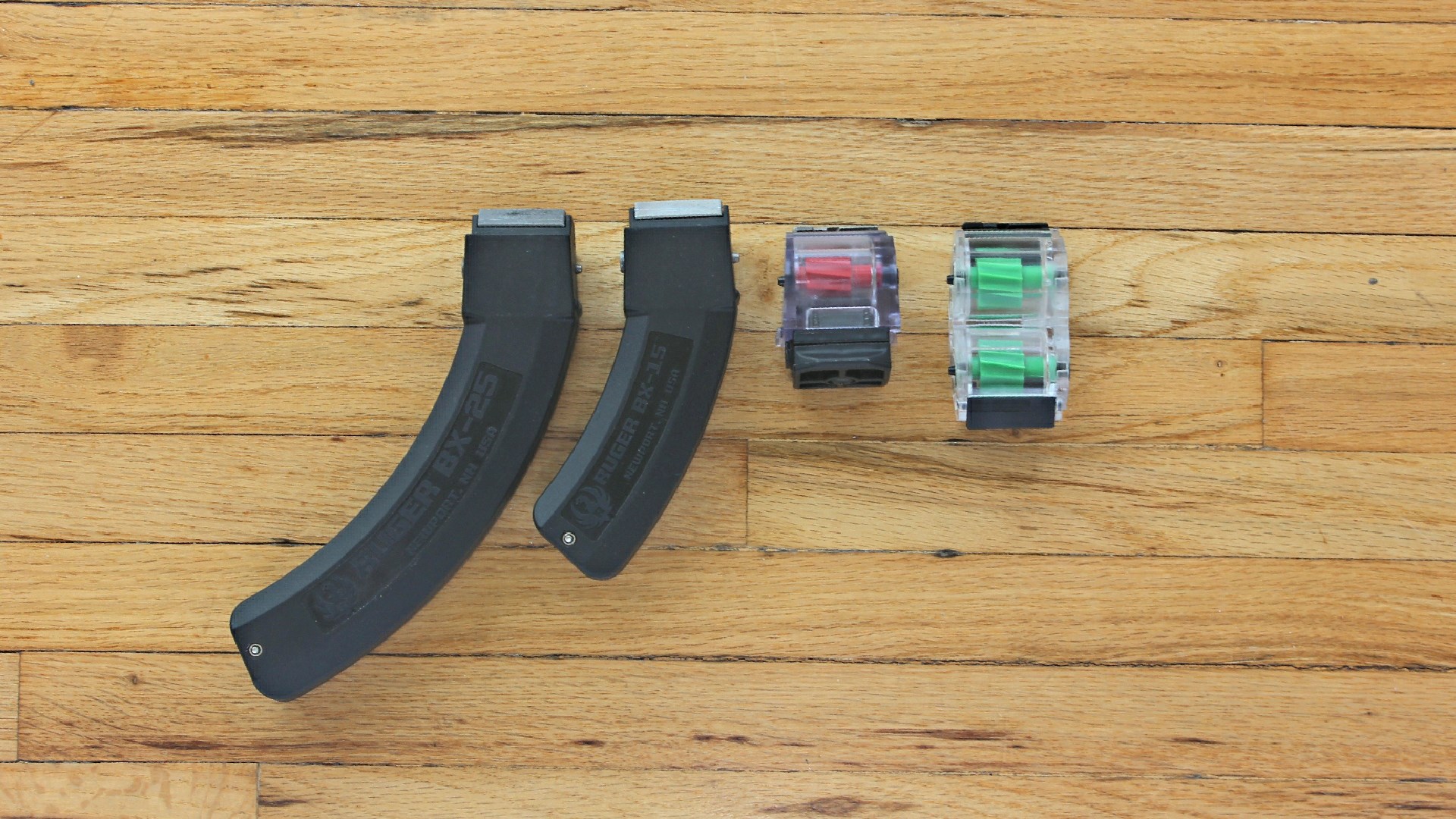 The 20-round DoubleKross magazine is more compact that BX 15-round magazines.
The Fletcher Rifle Works 11/22 OpenTop Upper
For this build, it seemed only fitting to find a receiver as innovative as the the Manticore X lower, which is why I went with the OpenTop 11/22. It was originally developed near Vienna, Austria by Sebastian Unger in his uncle’s garage. After the design was turned down by Ruger, he took it to the U.S.-based Fletcher Rifle Works team to bring it to market.
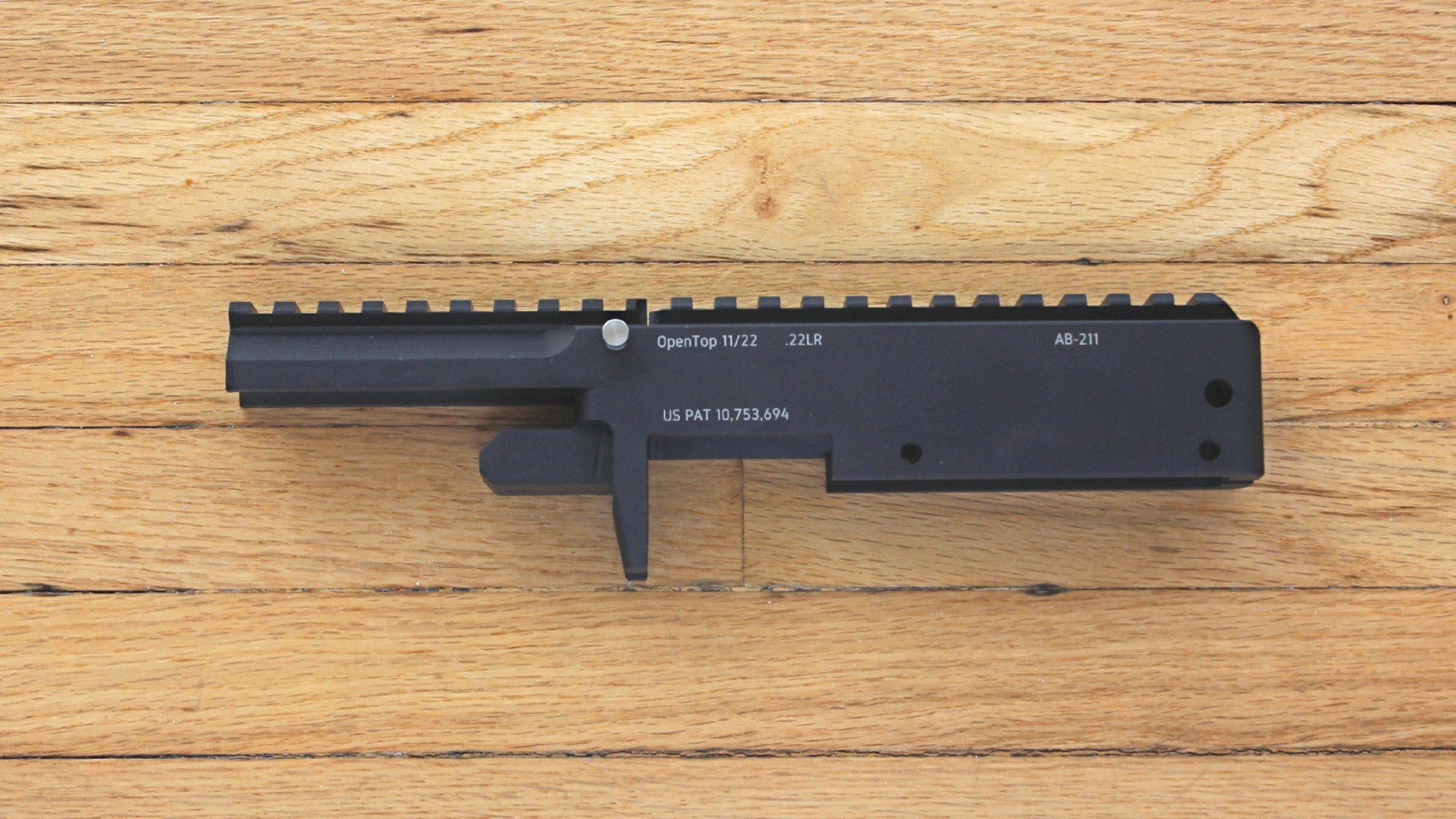 The Fletcher OpenTop 11/22 is available with either a railed (shown) or smooth cover plate.
CNC-machined from an aluminum billet and outfitted with stainless steel detents, pins and springs, the OpenTop 11/22 features a sliding top plate that provides access to the bolt assembly without disassembling the rifle. The plate is secured by a captured pin with a small handle located on the left side of the receiver. Just pull the pin out most of the way and then press the plate back towards the shoulder stock to access and remove the bolt assembly. At the front of the receiver is an integral 3.75″ optics rail ideally positioned for use with red-dot optics. The OpenTop 11/22 is available with either a smooth top plate or a plate that extends the optics rail to 9″ for longer magnified rimfire riflescopes.
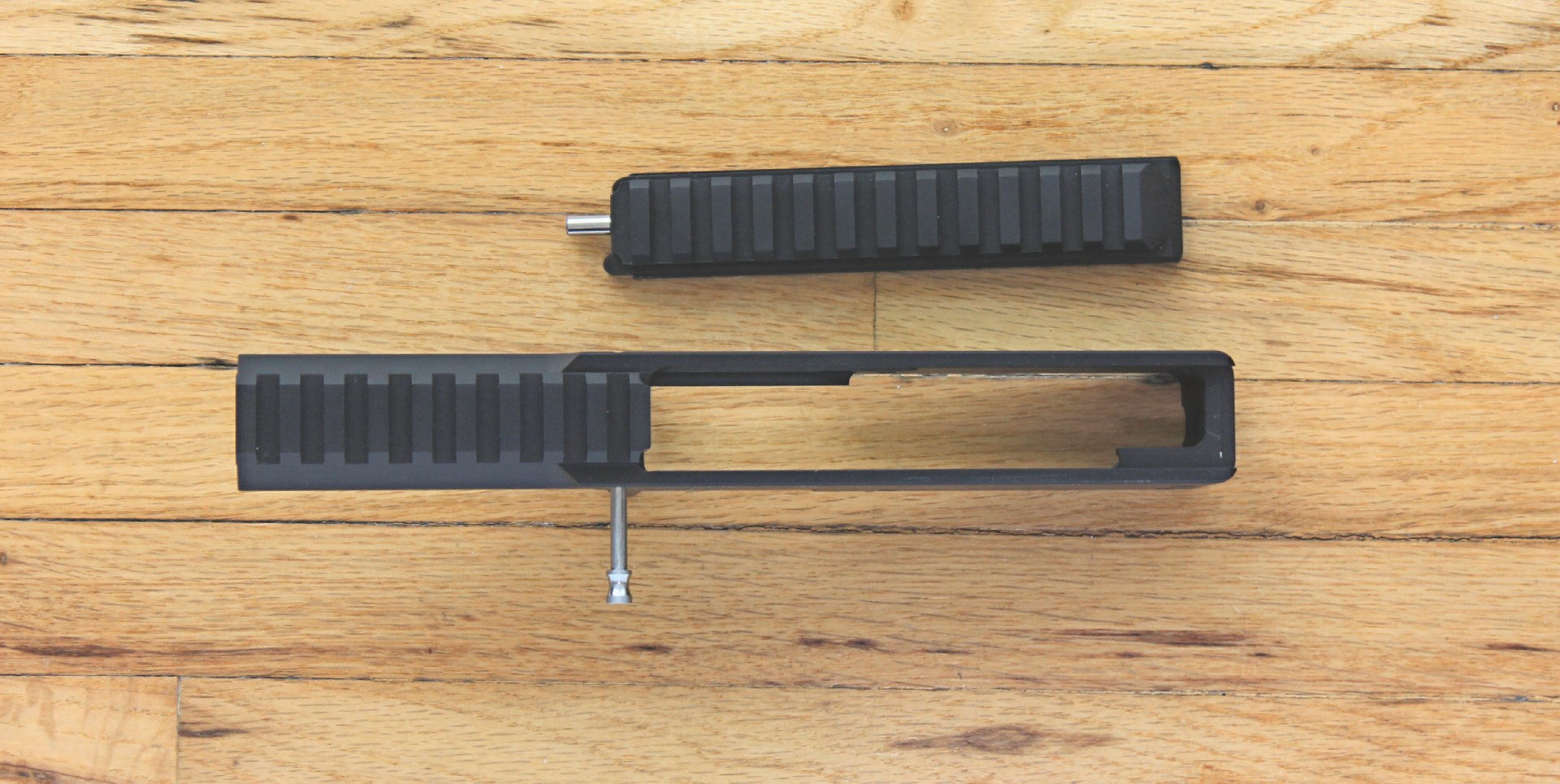 Pulling the OpenTop 11/22 left-side release pin allows the cover plate to be partially or completely removed from the receiver.
This sliding plate is primarily intended for cleaning purposes, but it’s also quite handy for dealing with the relatively frequent jams associated with rimfire ammunition. Remove the magazine, lock open the bolt, release the top plate, and you have wide open access to the barrel’s chamber for removing stubbornly stuck spent cartridge cases.
Summit Precision Barrel & Compensator
Thicker profile bull barrels (0.920″ diameter) have been a preferred feature for precision-shooting 10/22 carbines for quite some time. This is because the increased diameter reduces barrel flex under recoil, which contributes to better accuracy. However, all-steel barrels are relatively heavy, which is fine for bench work but not so much for shooting in the field.
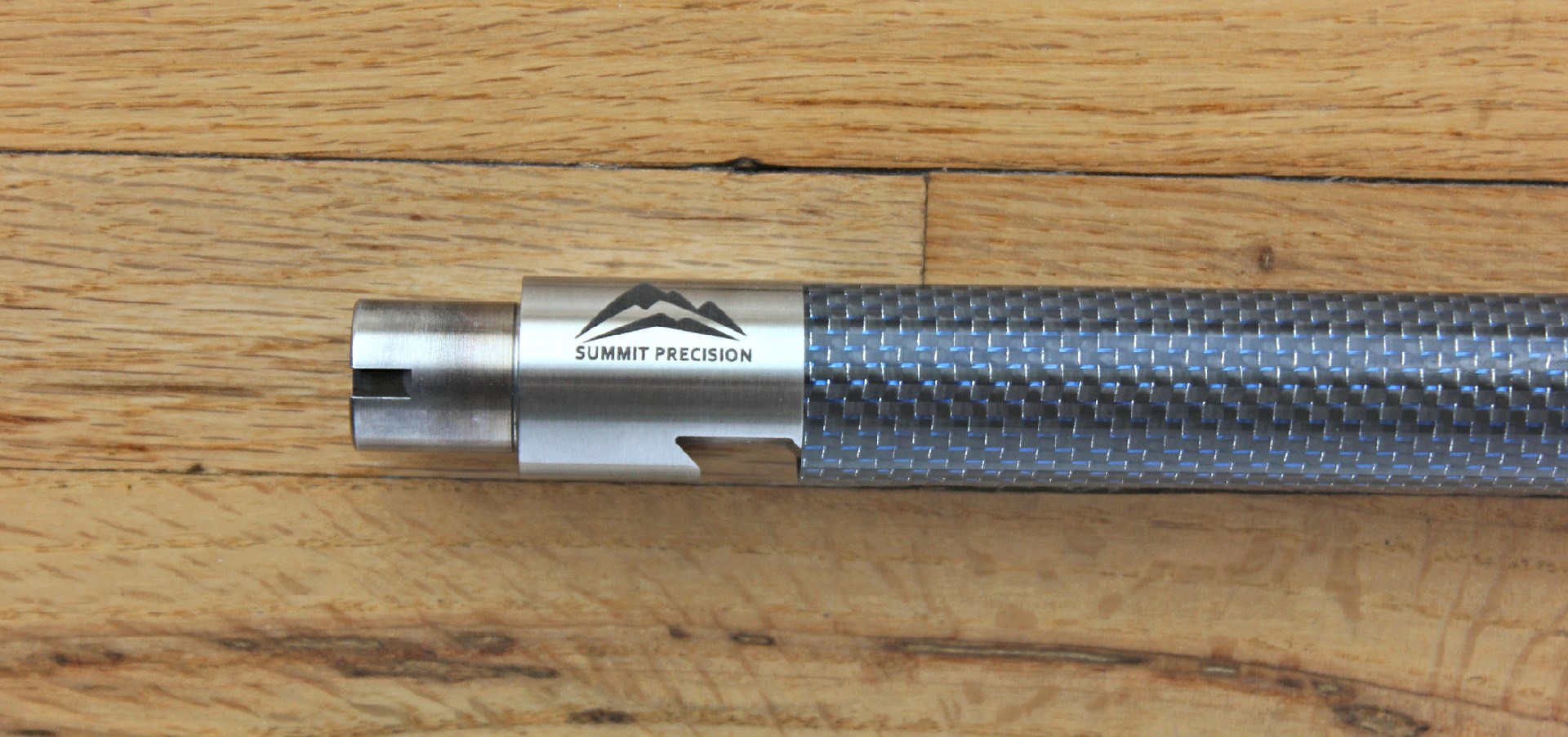 Summit Precision specializes in precision bull barrels for 10/22 rifles at fair prices.
Summit Precision offers competition-grade barrels featuring a slim, post-tension barrel housed inside a 0.920″ carbon-fiber sleeve. Capped off with 416 stainless steel fittings at either end, it offers the desirable stiffness of a solid steel barrel but with less weight. The solid steel bull barrels can weigh upwards of 48 ozs., while Ruger factory 10/22 tapered carbine barrels hover around 30 ozs. Available in 20″, 18.5″ or 16.1″ lengths, the Summit 18.5″ barrel shown here weighs just 23.2 ozs. before adding on muzzle accessories.
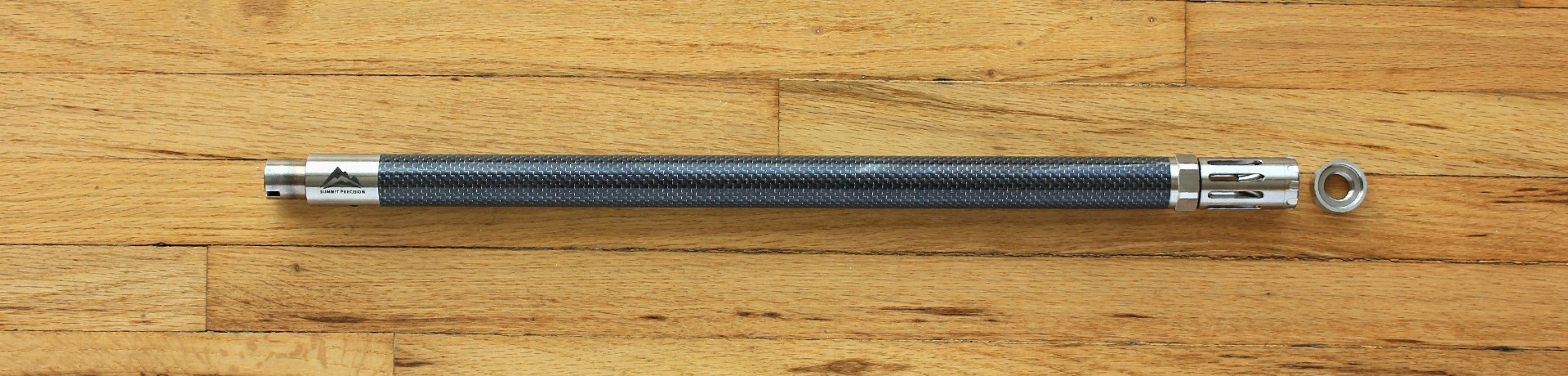 This post-tension, carbon-sleeve barrel is stiff like an all steel-barrel but significantly lighter.
This barrel features a .22 Bentz competition-style chamber with a bore that’s button-rifled at a 1:16″ twist rate. Folks can choose from fixed or takedown barrel configurations with either a natural stainless (shown) or matte black finish for the muzzle and chamber. The carbon fiber tubes are available in a variety of solid colors or mixed color weaves. The barrel shown here is black and gray with touches of silver and blue, which are subtly eye-catching in person, yet difficult to appreciate in photographs.
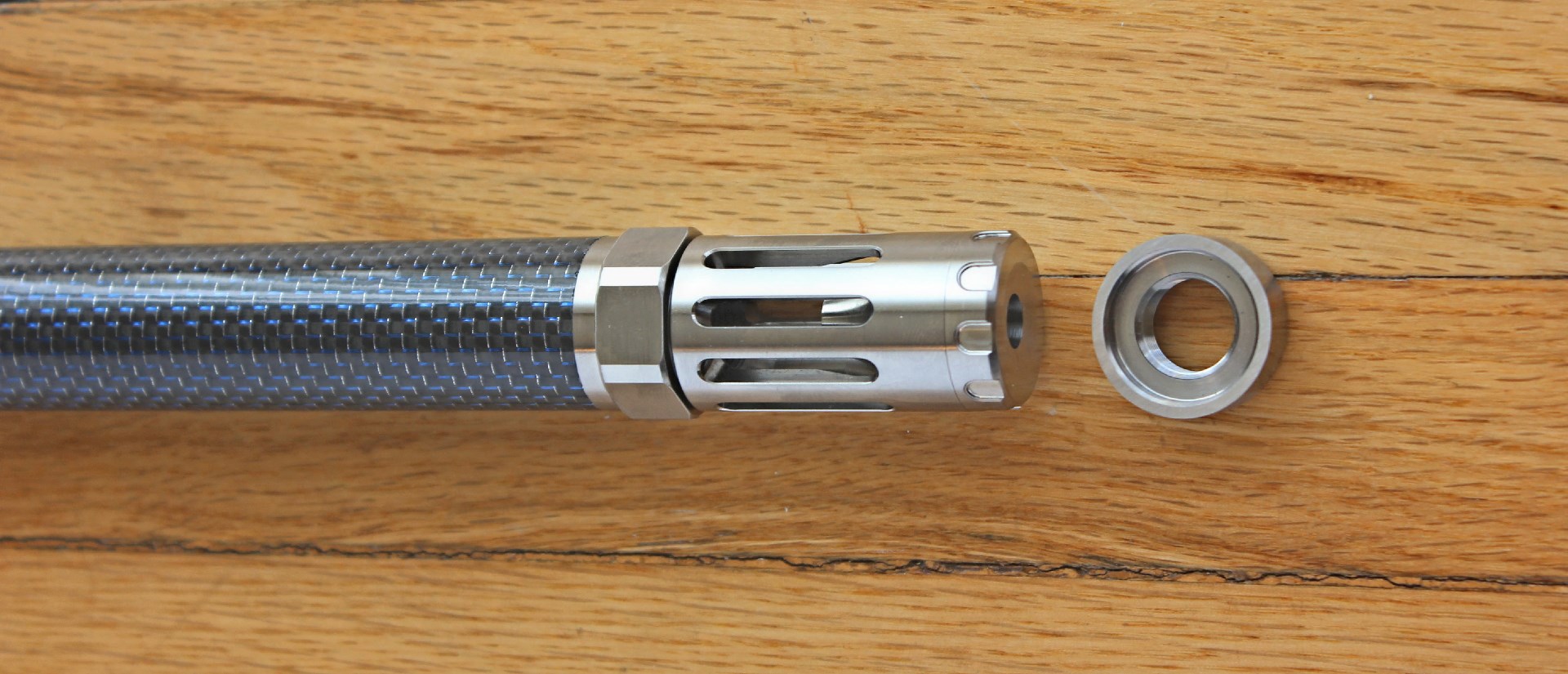 The slotted compensator shown here has a removable end cap for easier cleaning.
The muzzle is threaded at 1/2×28 TPI and ships with a smooth thread protector installed. For this evaluation, the barrel was fitted with Summit’s in-house 17-4 stainless steel slotted compensator. Ports are intentionally omitted at the 5- and 7-o’clock positions to avoid stirring up dust or debris when shooting from a prone position. The front cap is removable, for easier cleaning, and this compensator ships with a self-timing jam nut, which means that no crush washer or shims are required for a just-right fit.
Built Rifle Specifications
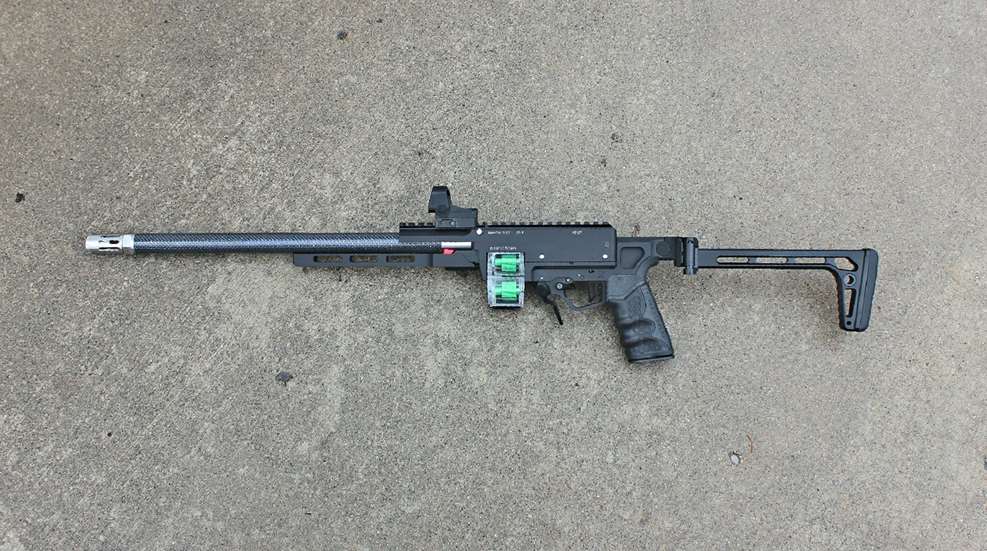
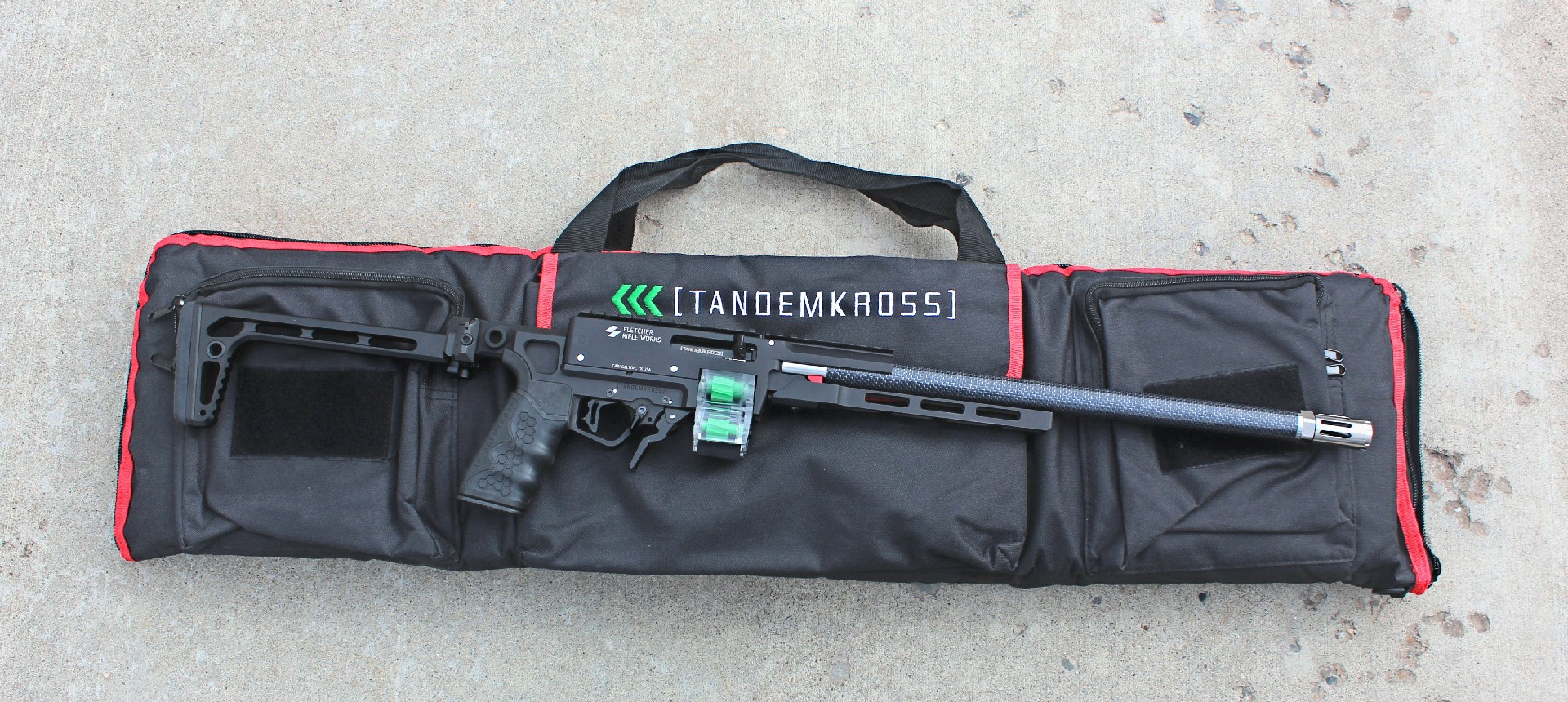
When fully assembled, this build was a sight to behold! The gun looks like the offspring of a rimfire race gun and tactical carbine, which works for me. With its mostly matte black finish, the stainless steel pins of the receiver tie in nicely with the stainless fittings and silver carbon-fiber flecks of the blue/black Summit barrel.
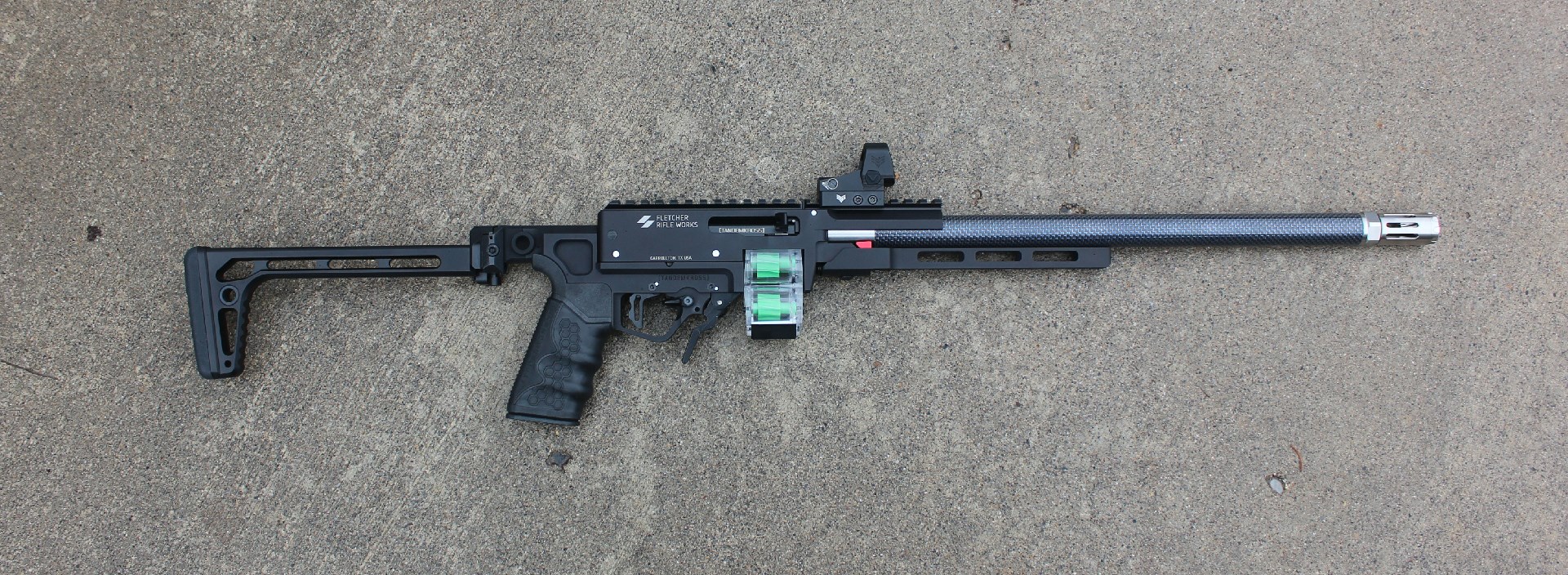 The completed Manticore X build weighs in at just 4 lbs., 7.3 ozs.
In the middle of it all is a splash of red from the partially visible TK V-Block. Altogether, the rifle’s profile and features draw attention without hollering for it, which is just what I wanted. For those who do want a bit more race-gun “zing,” the Manticore X lower is available with red appointments, and the Summit barrel is available with matching red carbon-fiber highlights.
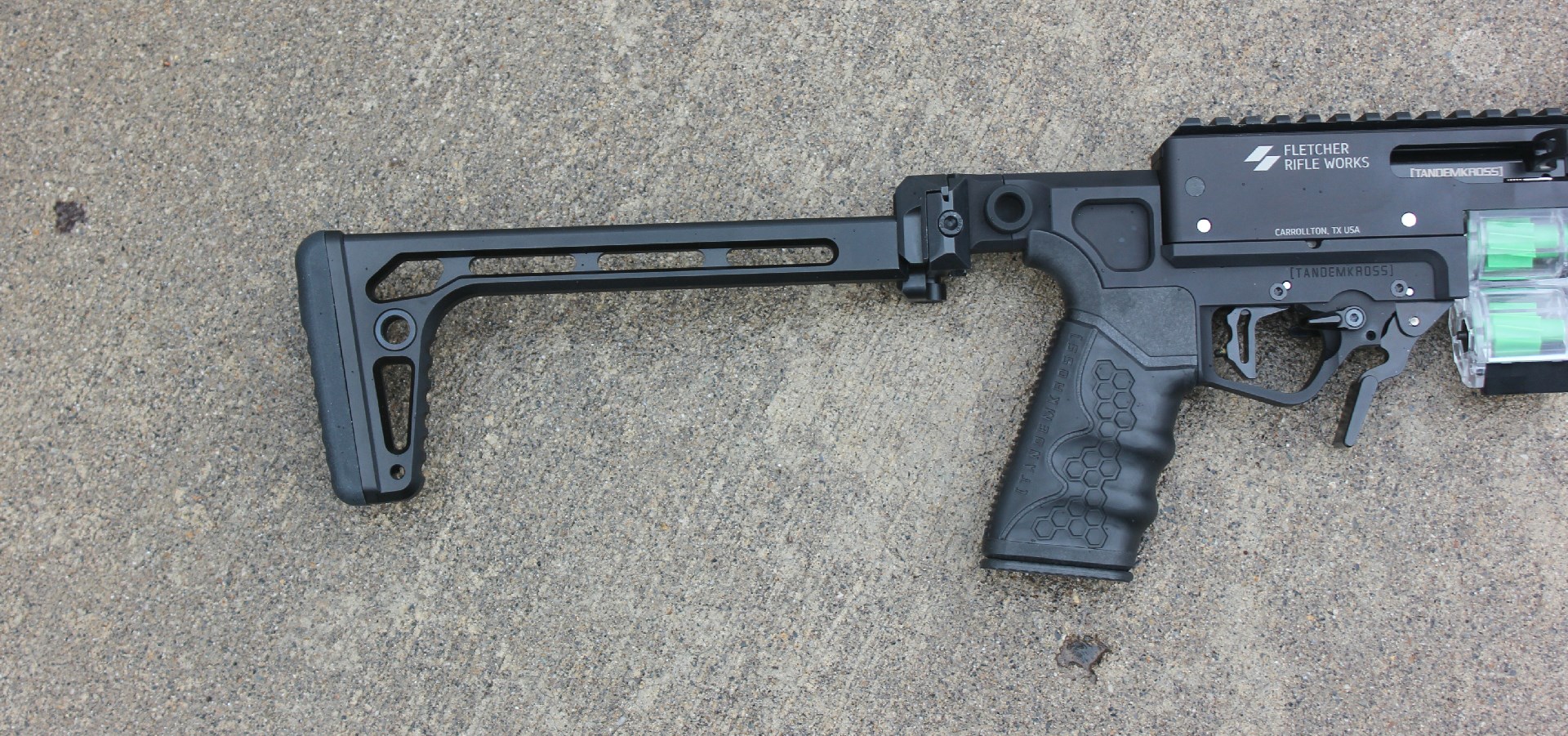 As configured, the stock assembly provides a 12.5” length of pull.
As configured, it tips the scales at 4 lbs., 7.3 ozs. without a magazine or an optic installed. It’s 34.63″ long with the Rim/Edge stock extended, 26.5″ with the stock folded and 6.13″ tall when measured from the top of the receiver’s rail to the base of the TK hiveGrip. I enjoyed trying out all of the various stock configurations.
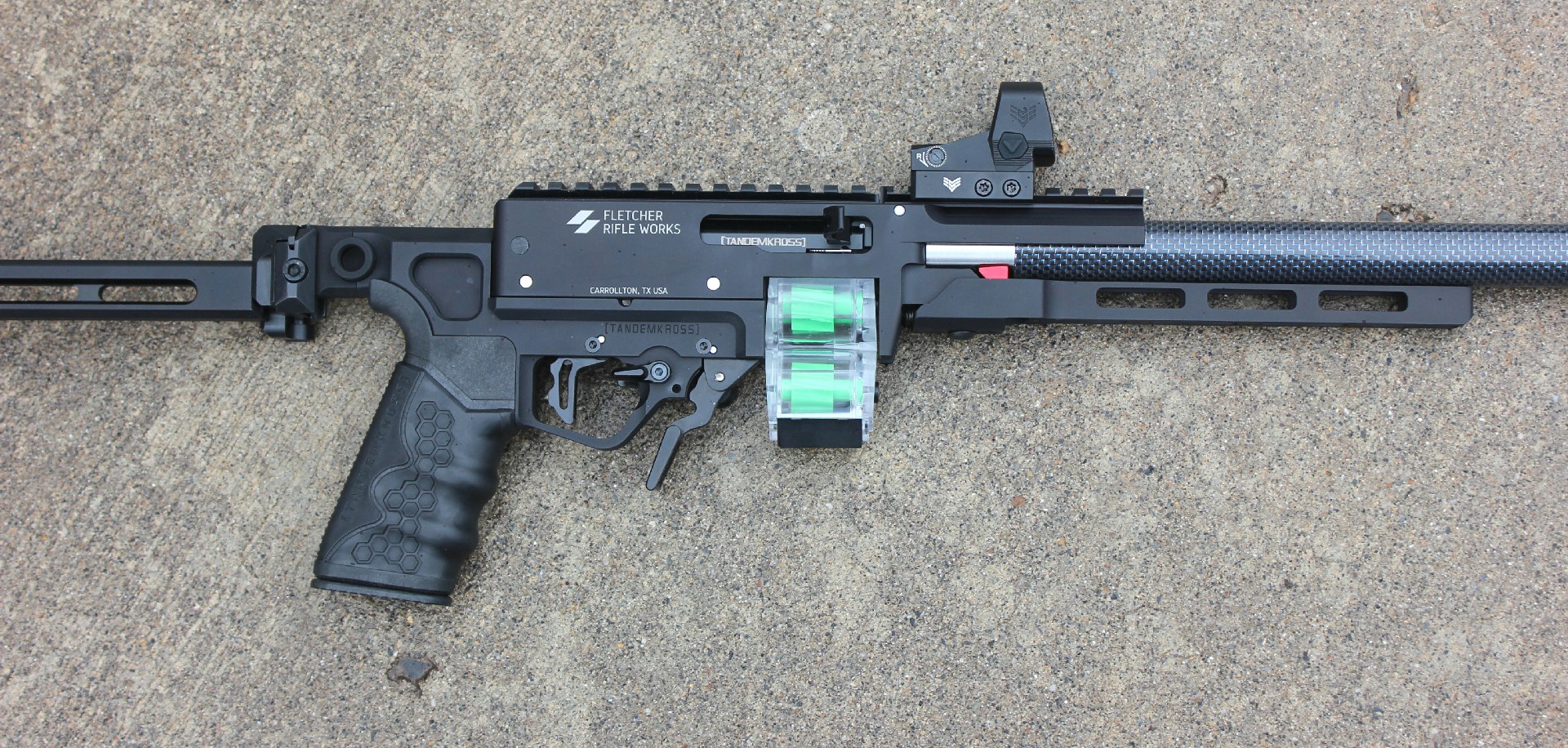 The Manticore X assembly gives this rifle a profile unlike any other currently available on the market.
What I settled on for the range test was a left-side folding, straight profile with the stock set to the bottom port of the hinge. Configured this way, it provides a 12.5″ length-of-pull, and it will comfortably accommodate a red-dot optic using a low-profile rail mount.
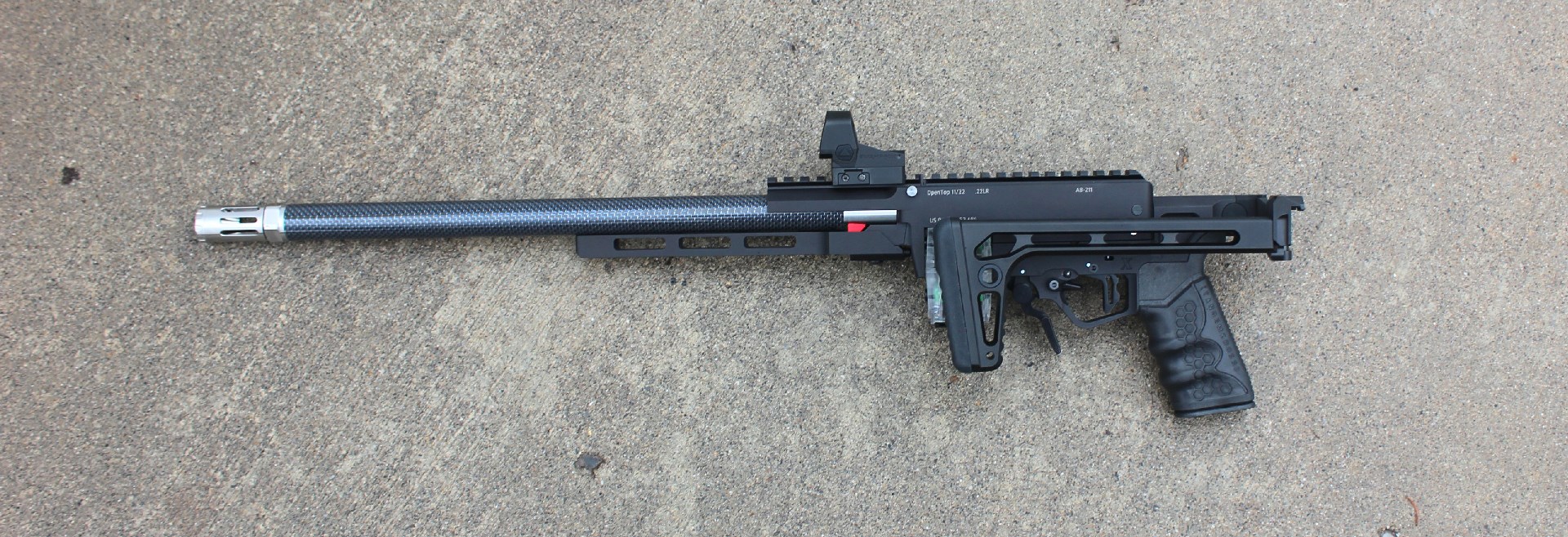 The skeletonized aluminum should stock folds easily to the left or right side of the carbine, depending on the orientation of the hinged mounting plate.
Swamp Fox Justice II
Swamp Fox Optics recently released its RMR footprint Justice II micro red-dot optic, which is optimized for use with competition guns. The 7075-T6 aluminum housing and hood have been strengthened to better protect the internals. The generously sized, ruby-coated 30 mm lens proved to be an ideal fit when paired with this company’s low-mount 1913 Picatinny rail base. The 6-m.o.a. dot features 10 brightness settings with a Shake ‘N Wake automatic on/off function to conserve the CR1632 battery’s power. For those who prefer a taller, AR-style red-dot height, take a look at the Swamp Fox Rebel Riser mount.
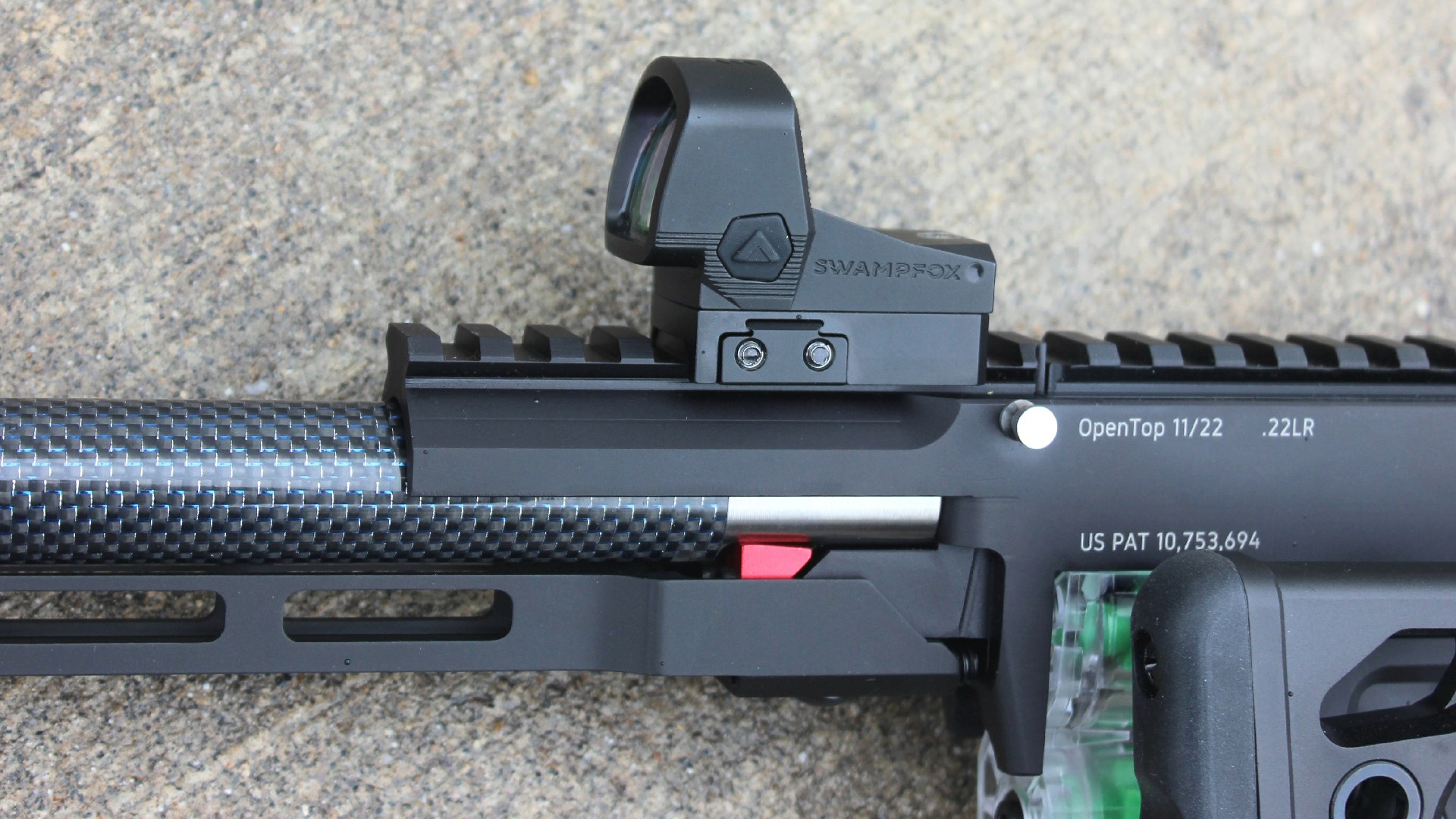 The Swamp Fox Justice II is an ideal red-dot optic for a multi-purpose rimfire like this one.
At The Range
This hybrid carbine was put through its paces at the shooting range using a mix of magazines, including a pair of the DoubleKross magazines from TK, Ruger factory BX magazines in 10-, 15- and 25-round capacities, along with a Black Dog Machine 25-rounder and a decades old Butler Creek Hot Lips 25-rounder, which was rolled into the set to keep things interesting.
In the course of firing hundreds of rounds, from practice-grade to premium hollow-point loads, there were three failed primers and one stuck case. This is pretty much par for the course when the ammo used includes budget-priced bulk-box loads. Otherwise, it was totally smooth sailing. All of the components, controls and magazines worked smoothly and properly for what proved to be an exceptionally enjoyable shooting session.
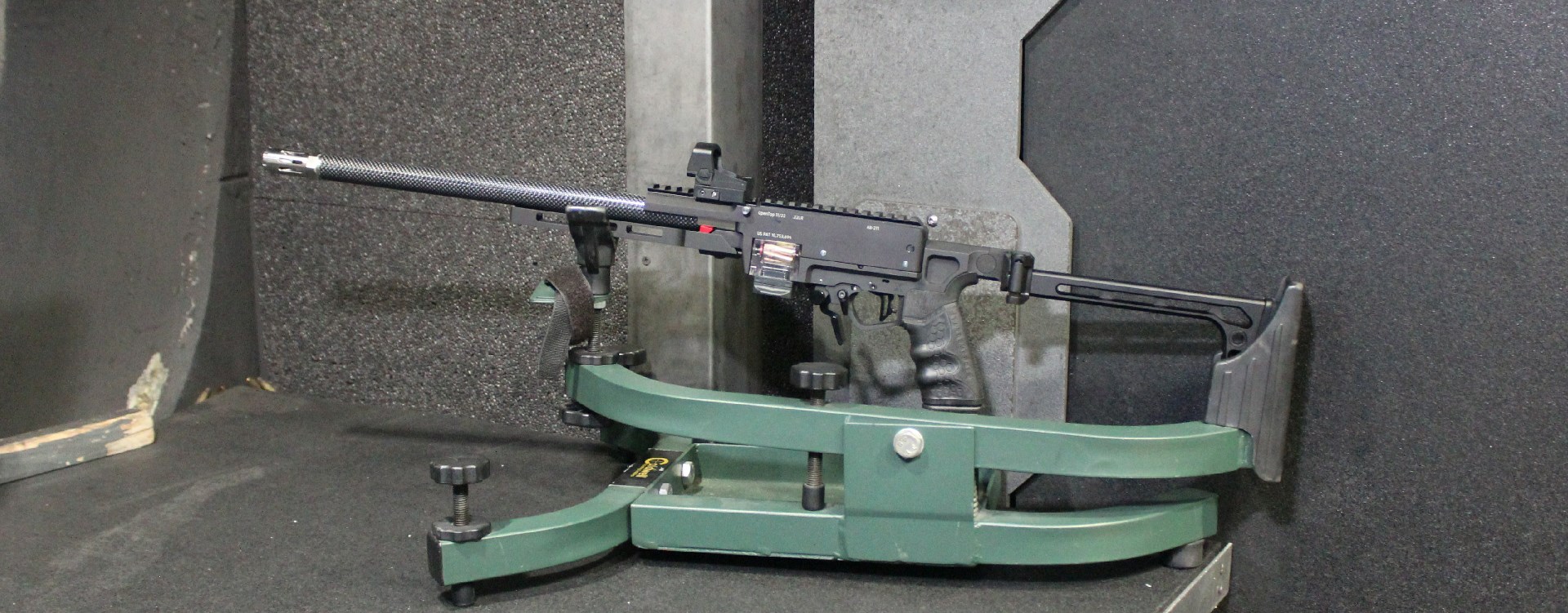 This build’s features make it a good fit for bench-rested shooting or for use in the field.
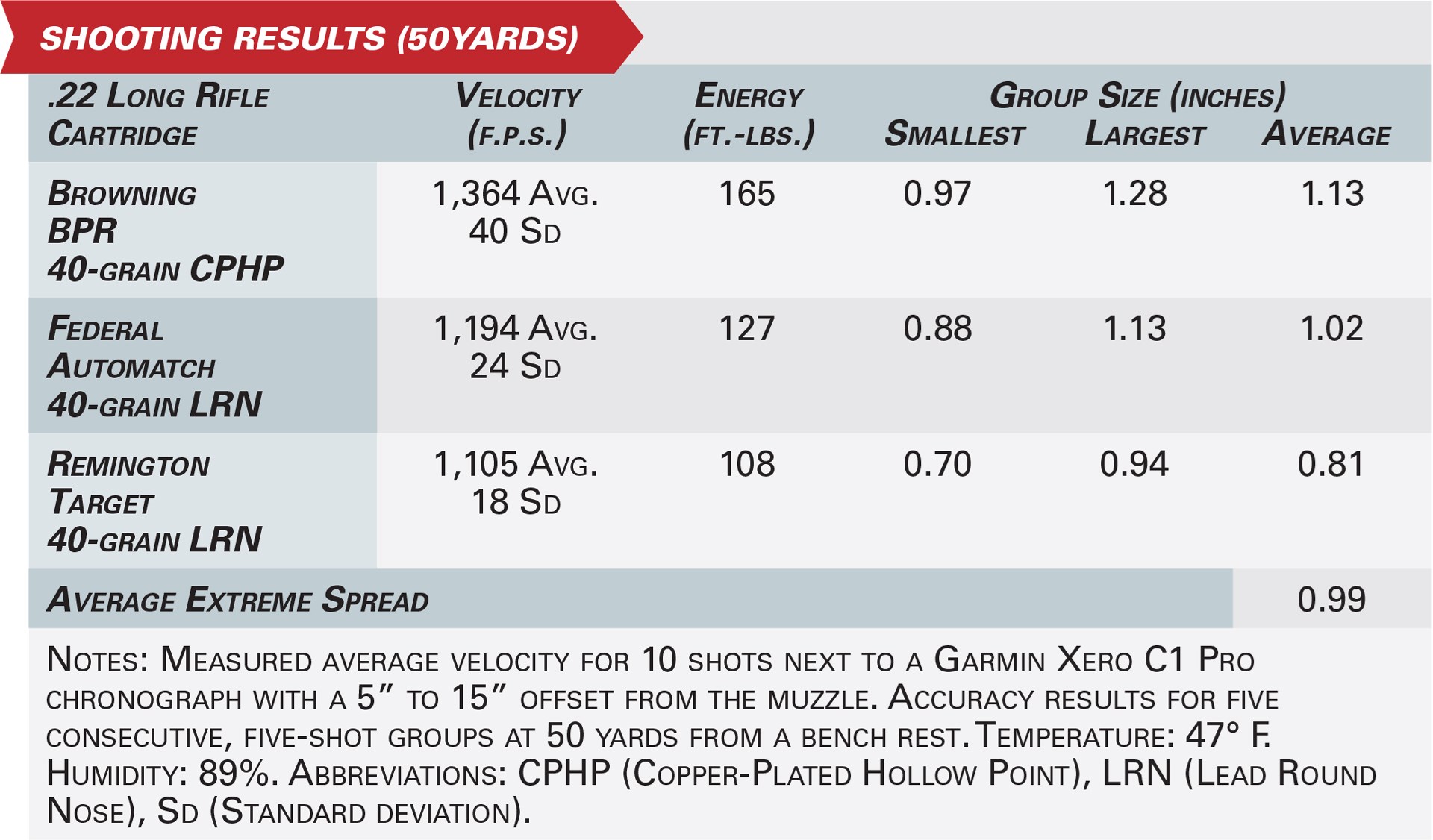
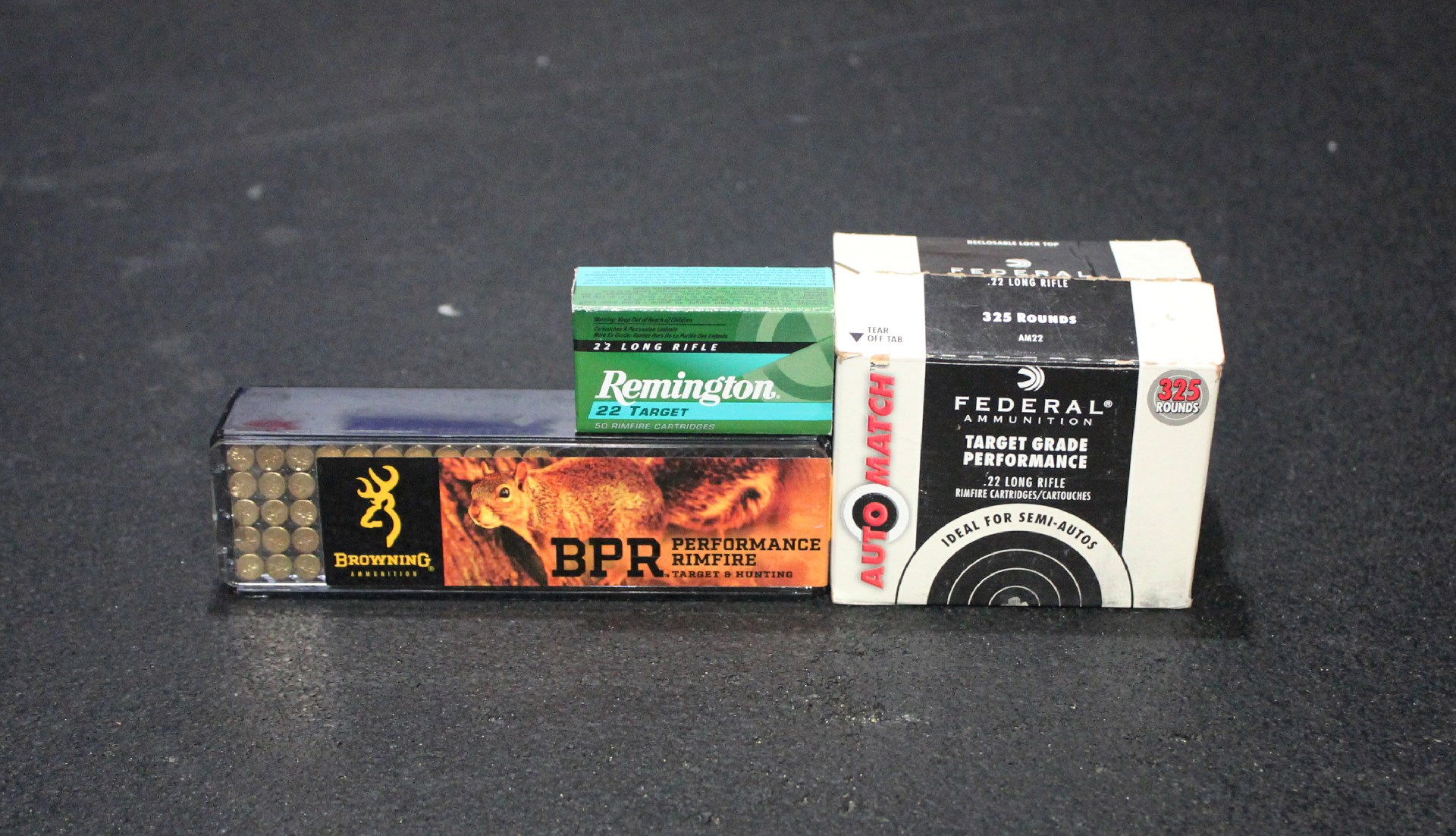
For the formal bench-rested accuracy testing conducted at 50 yards, I intentionally didn’t do this gun’s Bentz chamber any special favors in regards to ammunition selection. One point to keep in mind is that Summit Precision advises against the use of “hyper-velocity” ammunition in its .22 Bentz chamber. This is not to say that the Browning BPR, Federal Automatch or the Remington Target loads are bad choices for rimfire ammunition. On the contrary, I’ve used these loads extensively with positive results across several different platforms.
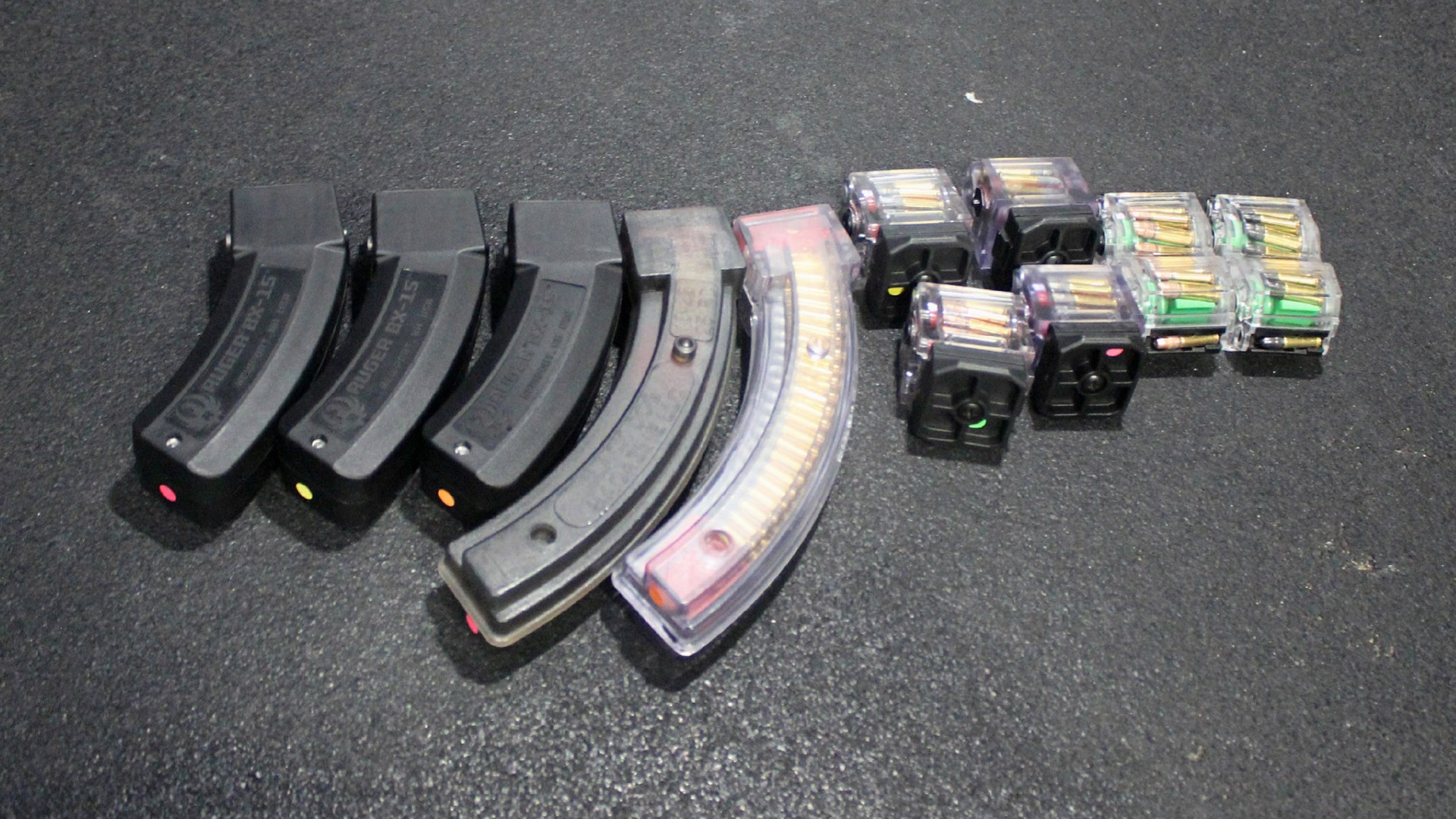 This semi-automatic operated reliably with a diverse mix of magazine brands and capacities.
However, they are more representative of what one finds in big box stores’ general use ammunition selection than the dedicated (and more expensive) high-grade target shooting loads preferred by rimfire competitors. This lightweight, folding-stock 10/22-pattern build is configured as a multi-purpose carbine, so it was wrung out with mostly multi-purpose ammo. But based on the following results, I’m looking forward to attaching a magnified riflescope and loading it up with competition-grade loads to see what it can really do:
Parting Shots
At the conclusion of this evaluation, it’s evident that the Tandemkross Manticore X lower assembly paired with the TK PRO Bundle parts succeeds in three ways. First, it strips away as much fat as possible for a lightweight 10/22-pattern rifle build. It’s lean, clean, and the minimalists in the crowd will love it. Secondly, the company set out to incorporate the best-of AR-15 design features including easily separated upper and lower receivers and modular grip and shoulder stock compatibility. Finally, TK serves up a generous helping of what they do best, namely, the upgraded components and controls that make race-gun enthusiasts smile with room in the mix for folks to pick out the barrel, receiver, grip and shoulder stock they prefer.
 Sub-1” groups were common with this rifle using readily available ammunition options.
Some folks are not going to care for the looks or features of this more tactical interpretation of the much beloved Ruger 10/22 carbine. And that’s just fine. Folks should own and shoot what they like. But for those of us who are into more cutting-edge design, this semi-automatic rimfire is enjoyable and simple to assemble along with being all kinds of good fun to shoot.
With the innovative Fletcher upper receiver and the precise Summit barrel, it can be a handy plinker, a lightweight backpack gun, a small game hunter and a bench-rested paper puncher. It can do it all and do so with a style all its own. For more information, see the manufacturer links shown below.
The Build Sheet
Fletcher Rifle Works OpenTop 11/22 Receiver; solid picatinny rail, black, $275
Summit Precision Carbon Fiber Barrel; blue/black, $250
Summit Precision Slotted Compensator; $100
Swampfox Justice II 1×30 Dot Sight; (JTC2130-6R), $259
Swampfox Picatinny (optic) Mount; (LJA-PBM-6061B), $20
TandemKross Components:
Maniticore X Lower Assembly; black (TK18N0511BLK1), $500
Manticore X PRO Bundle; (TK18N0533BLK1), $200
KrossFire Bolt Assembly, black; (TK18N0122BLK1), $140
Spartan Skeletonized Charging Handle, black; (TK18N0121BLK1), $28
Barrel Retaining V-Block; red (TK18N0449RED1), $20
Rim/Edge V-Block Screws 2-Pack; black (TK18N0453BLK1), $6
Assembeled DoubleKross Magazine; 20-round (TK18N0105CLRA), $50