Editor’s Note: The following is a post by Mark Kakkuri, a nationally published freelance writer who covers guns and gear, 2nd Amendment issues and the outdoors. His writing and photography have appeared in many firearms-related publications, including the USCCA’s Concealed Carry Magazine. You can follow him on Twitter @markkakkuri.
Read Mark’s previous articles in this “Top Five” series:

Jon Hodoway does gel testing on a Smith & Wesson .500 Magnum. Click here to read the article.
We love the Internet because it is chock full of useful information. But we also hate the Internet because it is chock full of misinformation.
As you know, information about firearms abounds on the Internet and while there are many very good websites with well-informed writers who do the gun community a great service, there are just as many who are not helpful at all. Whatever the reasons for myths about firearms starting and spreading, I hope to do my part to clear up some of that confusion even if just a little bit at a time. Today, I’m going to take a crack at some of the myths I’ve heard surrounding the use of a revolver. These aren’t the only myths, but they’re my top five.
1. Revolvers Never Jam
Well, using the word “never” might be the first clue that this statement is a myth. It would be more accurate to say revolvers rarely jam — as long as we are defining what is meant by “jam.” By design, a revolver’s operation is fairly simple, at least compared to an auto-loading, semi-automatic pistol. With a revolver, you squeeze the trigger, which rotates the cylinder, aligning a cartridge in front of the hammer and behind the barrel. And, just at the right time, bang. Usually, if a round doesn’t fire, you would just squeeze the trigger again, starting the whole operation over, in order to fire the next round. The typical “jam” that could happen with a revolver is that some sort of dirt or debris gets lodged between the cylinder and the frame, stopping the cylinder from rotating and therefore not allowing the trigger to go through its full cycle to fire. Again, no one should say this never happens. It has and it does. But it is very rare.
2. Revolvers Are Inaccurate
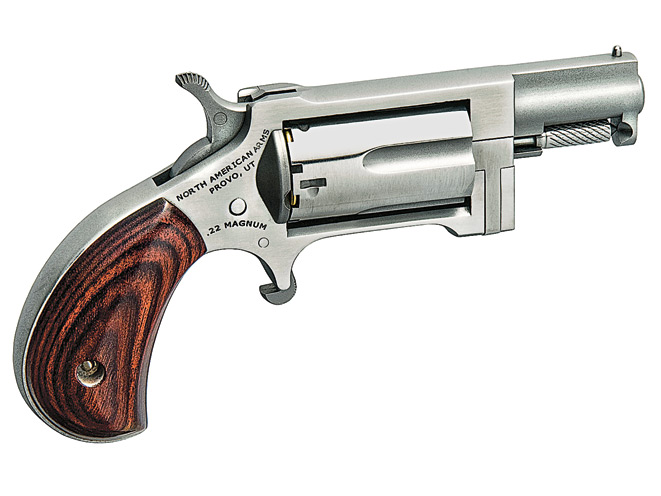
Usually, when people make this assertion, it is about a snub-nosed or shorter-barreled revolver. The logic goes like this: The shorter the barrel, the less accurate the gun. And while it is theoretically true that the more barrel you have interacting with a bullet, the more accurate you can be, it does not necessarily mean that a short-barreled gun is inaccurate. It might be less accurate than a longer barreled gun, but other factors that determine accuracy are at work, regardless of barrel length. The key to better accuracy is better muzzle control — keeping the muzzle pointed at your target while squeezing the trigger. If you want a good demonstration of this — following all the gun safety rules, please — put a laser aiming system on whatever gun you’re shooting and watch how much the laser jumps around your target as you’re pulling the trigger. Oh, and one more thing: Google “Jerry Miculek 200-yard snub-nosed revolver shot upside down.” Granted, he’s a pro, but shoot a revolver from a rest in order to eliminate as much muzzle movement as possible and you might be surprised at how accurate the gun actually is.
3. Revolvers Are Difficult to Shoot
Some revolvers, by design, require a bit more hand and finger strength in order to squeeze the trigger, which usually is a longer stroke than the one experienced on a semi-automatic pistol. That doesn’t mean revolvers are more difficult to shoot; in fact, after getting used to them, some say they’re easy to shoot. It just means that some guns, revolvers included, require hand strength and practice in order to master. Another factor that might contribute to revolvers seemingly being more difficult to shoot is that people might only experience small, lightweight revolvers shooting medium to big rounds. Here, basic physics works against them. Small guns shooting big rounds equals big recoil. And big recoil can be difficult and intimidating. And it can hurt. Again, practice and training are your friends. And, for the record, it is possible to train up to shooting .38 Special +p or .357 Magnum rounds out of a lightweight snub-nosed revolver and be able to do it well. And even enjoy it.
4. Revolvers Are Underpowered or Too Low-Capacity
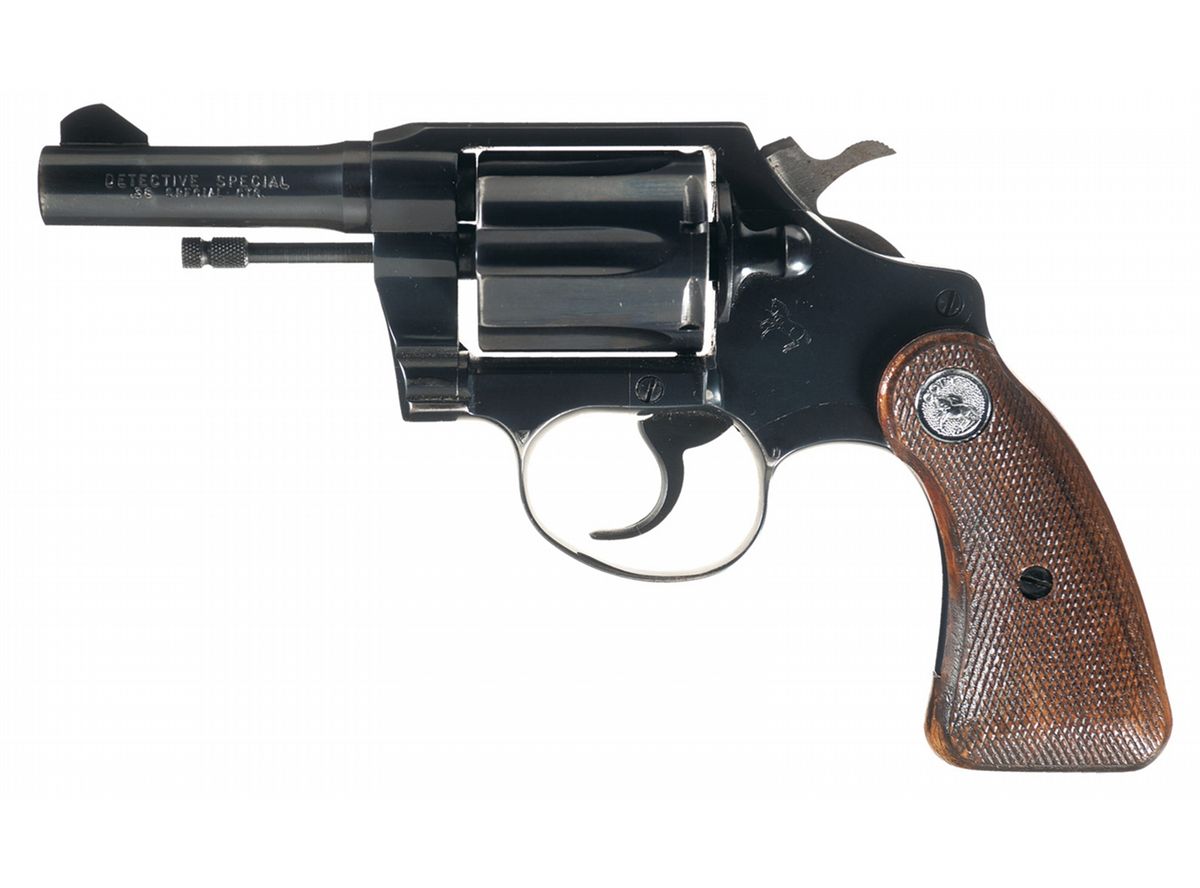
The typical self-defense revolver is a snub-nosed .38 Special with a capacity of five rounds. Some people scoff at the caliber; .38 Special is “the bottom of the effective self-defense cartridges,” they say. Some people scoff at the capacity — “five to stay alive” just isn’t enough, especially when you can easily carry twice or three times that amount in one magazine of another kind of gun. But the most effective self-defense handgun is the one you shoot well and will actually carry. If that’s a five-shot revolver, even a five-shot revolver chambered in .22 LR, then so be it. Better to have five rounds of .22 LR you can shoot well than 15 rounds of 9mm you leave at home. Regardless of what you carry, make sure you carry a reload. For revolvers, this means carrying a speed strip, a speedloader or moon clips — anything that will speed up replacing the empty cartridges with fresh ones.
5. Revolvers Are Outdated or Ineffective
Revolvers might have an old-school stigma: They’re the guns of old-time detectives and Old West shootouts. But there are many manufacturers making revolvers today and we keep seeing new models released each year, and that’s because people want them and buy them for concealed carry. So, revolvers might be a long-standing, long-history kind of gun, but to say they’re outdated is completely inaccurate. And just because there are hundreds of very good semiautomatic pistols available today — guns that are smaller, lighter and offer higher capacities than revolvers — doesn’t mean revolvers are ineffective. The key with any gun is practice, practice, practice. And remember, the “best” gun is the gun you shoot well and actually carry with you. Some people don’t shoot revolvers well or don’t like the trigger. Some do! Different strokes for different folks!
What other revolver myths have you heard? Let us know in the comments below!
Shop for your new revolver on GunsAmerica.
Discover how you can join more than 200,000 responsibly armed Americans who already rely on the USCCA to protect their families, futures and freedoms: USCCA.com/gunsamerica.