Categories
All About Guns Cops

ONE POLICEMAN’S CUSTOM REVOLVER WRITTEN BY MASSAD AYOOB


Wyatt Earp. The name resonates through American history, and not just among peace officers. Stuart Lake’s biography Wyatt Earp, Frontier Marshal established him as a national legend when it was published in 1931, a couple of years after Earp’s death in California. It was this book that first discussed Earp’s special Colt .45 revolver with extra-long barrel, the Buntline Special.

The story went that E.Z.C. Judson, a novelist and show promoter who specialized in Western Frontier themes and wrote under the nom de plume of Ned Buntline, presented these special Colts to five ace Dodge City lawmen: Charlie Basset, Neil Brown, Bill Tilghman, Bat Masterson and of course, Earp, in 1876.

According to Lake, Judson, “Sent to the Colt’s factory for five special forty-five caliber sixguns of regulation single-action style, but with barrels four inches longer than standard — a foot in length — making them eighteen inches over all. Each gun had a demountable walnut rifle stock, with a thumbscrew arrangement to fit the weapon for a shoulder-piece in longrange shooting.”

Lake wrote, “ ‘There was a lot of talk in Dodge about the specials slowing us on the draw,’Wyatt recalled. ‘Bat and Bill Tilghman cut off the barrels to make them standard length, but Bassett, Brown and I kept ours as they came. Mine was my favorite over any other gun.’”
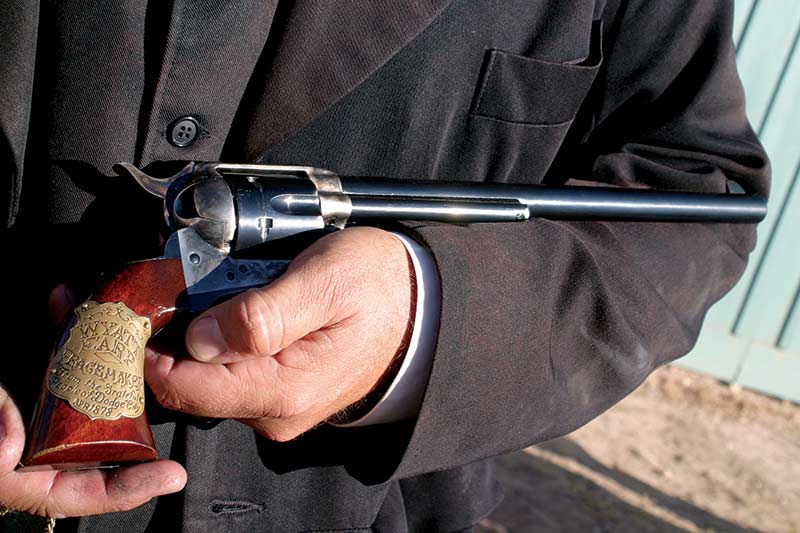
 

A reenactor in Tombstone plays the Earp part with this 12″
barrel Uberti clone of the fabled Buntline Special.

Legend Debunked?


By the 1950s, however, the legend of the Buntline Special was in question. The Colt factory, it was learned, had no records of having shipped five revolvers with foot-long barrels to anyone named Judson or Buntline. Earp claimed his Buntline had been lost in Alaska in the early 1900s, and there was no trace of the alleged Bassett and Brown specimens. Ironically, this was during the period in the 1950s when TV’s The Life and Legend of Wyatt Earp, with skilled single-action-man Hugh O’Brien in the title role, had helped to build both the legend of Earp and the legend of the Buntline. In 1957, Colt brought out a version of the SAA marked “Buntline Special,” complete with 12″ barrel.

However, with no proof available from Colt’s — and with many historians convinced Lake was more press agent than impartial biographer, and prone to exaggeration — it became the “in thing” among gun people to confidently dismiss the Buntline Special as myth, debunked and discredited.

Well, “debunked” and “discredited” are pretty strong words. More recently, evidence has emerged indicating Earp may have indeed received and used a special long-barrel SAA.


Historical Aspects


The great Colt authority James E. Serven wrote long ago that during the time of the Earp years, Colt would custom tailor longer barrels on order for a dollar an inch. Earp biographer Allen Barra noted in 1998 that long barrel SAAs had been on sale at the Centennial exposition in Philadelphia in 1876, where they could have been bought without shipping records showing it, and “Buntline” was a Philadelphian. Wyatt Earp’s wife Josie spoke of the extra longbarreled Colt in unpublished notes for her memoirs. Bat Masterson said of his close friend and colleague, “Wyatt would bend the long barrel of his Buntline Special around the gunman’s head and lug him to the calaboose.”

Judson/Buntline was also known to have visited the Colt plant in Hartford, Conn., in the 1870s, notes Lee Silva, the Western historian and antique gun expert who believes the Buntline Special did in fact exist, and that Earp did indeed use one. I met Silva in October ’06 at the 125th Anniversary Symposium on the “OK Corral Shooting,” conducted by another respected Earp historian, Michael Hickey. Silva explained several reasons why he didn’t think the Buntline revolvers were a myth.

“There’s little doubt,” Silva establishes, “that Buntline was on a firstname basis with the Colt factory, and the flamboyant Buntline, as well as Buffalo Bill, was a welcomed celebrity to be used by the Colt factory in obtaining publicity for its guns.” Silva is speaking of an 1873 visit to Hartford by Buntline, the promoter of Buffalo Bill Cody’s successful “Wild West” shows. Silva concludes, “And so, Buntline was also certainly in a position to walk in the back door of the Colt factory a few years later and make a deal on some of the unusual extra-long-barreled revolvers he had seen at the Philadelphia Centennial in the spring of 1876.”

Another noted shootist in Tombstone, Ariz., “Buckskin” Frank Leslie, was an acquaintance of Wyatt Earp who ordered a 12″ SAA from the Colt factory in January 1881. That transaction is recorded. Silva does not think this is a coincidence.


Pretty Large


Testifying at the inquest after the OK Corral incident, a butcher named Bauer described Wyatt Earp firing a revolver that was “pretty large, 14 or 16 inches long, it seems to me.” The latter measurement would be about right for a 10″ Buntline, the barrel length Silva believes these guns actually had. Witnesses are notorious for poor recollection of weapon size, but Silva told me, “Bauer was a butcher, who worked every day with 8″, 9″, 10″ knives. He had a trained eye and was the best possible witness as to the size of this particular object.” Good point.

Silva believes the real reason for the five-gun presentation was that in 1876, Buffalo Bill had abandoned “Ned Buntline” to go out and do his own Wild West show, and the promoter was looking for five new, genuine frontiersmen and former buffalo hunters for a new show. Earp and the others filled that bill on both counts. Silva hypothesizes that, seeing the unique long-barrel Colts at the Philadelphia exposition, it would have occurred to Judson/Buntline that they would be accurate, longrange guns prized by serious shooters and marksmen, as Earp and the other four were known to be.

Many more convincing arguments are in Lee Silva’s Wyatt Earp, A Biography of the Legend, Volume I, the Cowtown Years, which includes a large section on “The ‘Buntline Special’ Colt Controversy.” At 991 pages, seven pounds, and a retail price of $89.95, this superbly researched book is worth every penny, and can be ordered from Silva at P.O. Box 556, Sunset Beach, CA 90742.

Categories
All About Guns

From the Vault: Teddy Roosevelt’s Smith & Wesson No. 3

Categories
All About Guns

Ethiopian Oddities: Strange Smallbore Gewehr 71 Carbine

Categories
All About Guns Allies Gear & Stuff

Let’s Talk Tanks

Categories
All About Guns

ARTV: The Remington Model 700 Story

Categories
All About Guns

P53 Enfield Turkey Shoot

Categories
All About Guns

“AT HOME WITH GUNS”

Categories
All About Guns

MATURE MAN’S RIFLE

Categories
All About Guns

Colt Trooper, Trooper MK III, Trooper MK V, and Grips

Categories
All About Guns Hard Nosed Folks Both Good & Bad Paint me surprised by this Real men

Nicknamed for the Gatling Gun: Arthur L. “Gat” Howard By Kurt Allemeier

Arthur L. “Gat” Howard earned his reputation and nickname from behind a Gatling gun.

As slang for a gun, “gat” took hold in the early 20th century, but is clearly a play on Gatling gun, designed in 1862 and named after its inventor Richard J. Gatling.

Born in 1846, Howard served with the U.S. Cavalry for five years and fought in the Indian Wars on the western plains before going to work for Winchester Arms. Eventually he left Winchester and started his own cartridge manufacturing company and enjoyed some success before the factory burned down. Howard served in the Connecticut National Guard where he led the Gatling gun platoon, but it was in service of the Canadian government where Howard earned his nickname.

A Smith & Wesson New Model No. 3 single action revolver with pearl grips attributed to Howard is on offer in Rock Island Auction’s Feb. 14-17 Sporting & Collector Auction along with an unmarked black powder reproduction Model 1862 Gatling gun.

Gat-Howard-picAn American, Arthur L. “Gat” Howard earned his nickname working a Gatling gun in service of the Canadian military during the North-West Uprising of 1885. He stayed in Canada and also fought in the Second Boer War where he was killed in 1901.

Gatling Gun

Gatling, a doctor, invented his namesake weapon hoping to make a gun that would reduce the number of men in battle and lower the devastating losses seen early in the American Civil War. A precursor to the machine gun, Gatling’s multi-barrel, crank-operated weapon was patented in 1862 but not officially adopted by the U.S. military until 1866, after the end of the Civil War.

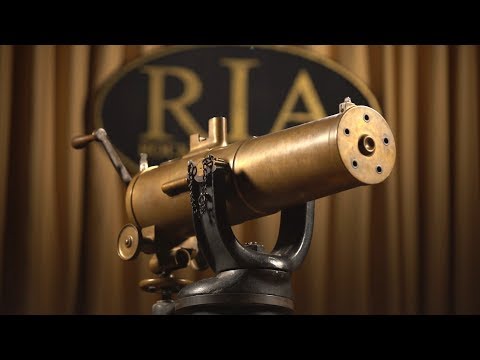
Gatling-gun-repro-2042This black powder reproduction of a Model 1862 Gatling gun is available in Rock Island Auction Company’s Feb. 14-17 Sporting & Collector Auction.

Colt produced all Gatling guns for the U.S. market from 1866 to 1903. The grandfather of the machine gun, the first Gatling gun could fire about 200 rounds per minute. Later models achieved the fire rate of as high as 1,500 rounds per minute. The 1883 Colt Gatling gun had a full brass housing and a fire rate of 800 rounds per minute.

The Gatling gun available in the February Sporting & Collector Auction is an unmarked black powder reproduction of the Model 1862 which did not use self-contained cartridges as we know them today. It utilized steel cartridge chambers which were individually loaded with paper cartridges in the front and primed with percussion caps at the rear.

Colt Gatling gun for sale with RIAC with original ammo caseA U.S. Government inspected Colt Model 1883 Gatling gun with an Accles drum magazine, full original carriage, and crate of vintage ammunition.

Rebellion in Canada

In 1885, rebellion was fomenting north of the border as indigenous people and mixed race settlers were unhappy about European settlers coming west, the Canadian government’s neglecting to recognize land titles in Saskatchewan and Alberta, and being under-represented in the Canadian parliament.

The Canadian government at the time had a small professional army and so enlisted militias to assist in quelling the uprising, amassing a military force of about 5,000 soldiers. Colt executives seeing a marketing opportunity, offered to loan a Gatling gun to the Canadian government.

The question was who would operate the Gatling gun? Colt and Gatling turned to Howard. He was not to be a representative of Colt, nor the Connecticut National Guard. Even Gatling stated that Howard didn’t represent him but was on the mission as “a friend of the gun.”

Gatling saw Howard, two of his guns, likely 10-barrel 1874 models, and 5,000 rounds of ammunition get on a train bound for Winnipeg. There was little time to train Canadian gunners.

In an early battle during the uprising, the Battle of Cut Knife Hill, the resistance gained the upper hand so it was up to a Gatling gun operated by a Canadian gunner to cover a retreat by government forces, preventing a possible massacre. Howard, as always wearing his blue army uniform, played a key part in stopping a charge in the decisive Battle of Batoche in May 1885 that ended the five month-long rebellion. Ultimately, it was the superior firepower of the government forces that led to the end of the resistance.

Batle-of-BatocheIn this lithograph depicting the Battle of Batoche, in May 1885, Howard and the Gatling gun can be seen in the lower right corner, though the gun would likely have been placed closer to the action during the battle.

Canada after the Rebellion

Howard earned $5,000 and received a medal for his role in quashing the rebellion. He never returned to Connecticut, instead taking up residence in Montreal where he became an investor in the Dominion Cartridge Factory. Along with the stipend and medal, Howard also got assistance from the Canadian government that allowed him to import materials for the cartridge factory duty free. The business made him a wealthy man.

His actions gained Howard enough fame that his purported death and survival in a storm off Nova Scotia was reported by The New York Times. He grew weary of the tedium of Montreal and as the Boer War began in South Africa, he offered to commission a battery of four machine guns at his expense but was refused. Instead, he was offered and accepted a position as machine gun officer in the 1st Canadian Mounted Rifles.

Smith---Wesson-New-Model-no.-3-closeupThis Smith & Wesson New Model No. 3 is attributed to Arthur L. “Gat” Howard, who gained fame and his nickname from operating a Gatling gun during Canada’s 1885 North-West Uprising. It is available in Rock Island Auction Company’s Feb. 14-17 Sporting & Collector Auction.

Second Boer War

Conflict between the descendants of South African Dutch settlers, called Boers or Afrikaners, and British colonists exploded into open warfare in 1899. The British took control of most of the territory as the Boers began fighting with guerilla tactics.

In South Africa, Howard commanded a Maxim and Colt machine gun. An aggressive and fearless leader willing to fight at close quarters, he didn’t return to Canada with his unit in December, 1900, choosing to stay in South Africa where he organized the Canadian Scouts, equipped with air-cooled Colt Model 1895 machine guns.

Spandau Maxim MG08 15 machine gunA Spandau Maxim MG08/15 machine gun.

Two months later, in February, 1901, Howard was killed at the age of 57. Reports of Howard’s death varied, with some saying he and his aide were killed in an ambush by Boers, or that they were captured and murdered. In a short article in The New York Times, he was described as “an intrepid and absolutely fearless fellow.”

The article also stated “He knew a machine gun perfectly and it was his skill in handling the gun of the Gatling make that earned for him his title during the Riel rebellion when he was in the Canadian Service.”

Murder-of-Gat-HowardA drawing from a news periodical of the time portrays Arthur L. “Gat” Howard’s death in 1901 during the Second Boer War. Accounts varied that he and his aide were killed in an ambush or that the men were captured by Boers and executed.

Machine Gun Hero

Arthur L. “Gat” Howard was a man of action who joined in the Canadian government’s effort to put down a western uprising, earned his reputation and nickname as a Gatling gunner. An American who remained in Canada, Howard fought in the Boer War where he met his death. A Smith & Wesson New Model No. 3 with pearl grips and attributed to Howard is on offer in the Feb. 14-17 Sporting & Collector Auction, as is a Gatling gun Model 1862 black powder reproduction of the weapon that ushered in the machine gun.

Smith---Wesson-New-Model-no.-3-full-shotThis Smith & Wesson New Model No. 3 attributed to Arthur L. “Gat” Howard is available in Rock Island Auction Company’s Feb. 14-17 Sporting & Collector Auction.

Sources:

The New York Times

The Canadian Encyclopedia

Canadian War Museum

“A Connecticut Yankee (and his Gatling) in Queen Victoria’s Canada,” by Terry Edwards,Small Arms Re