Category: All About Guns
Categories
The 1863 Sharps cavalry carbine




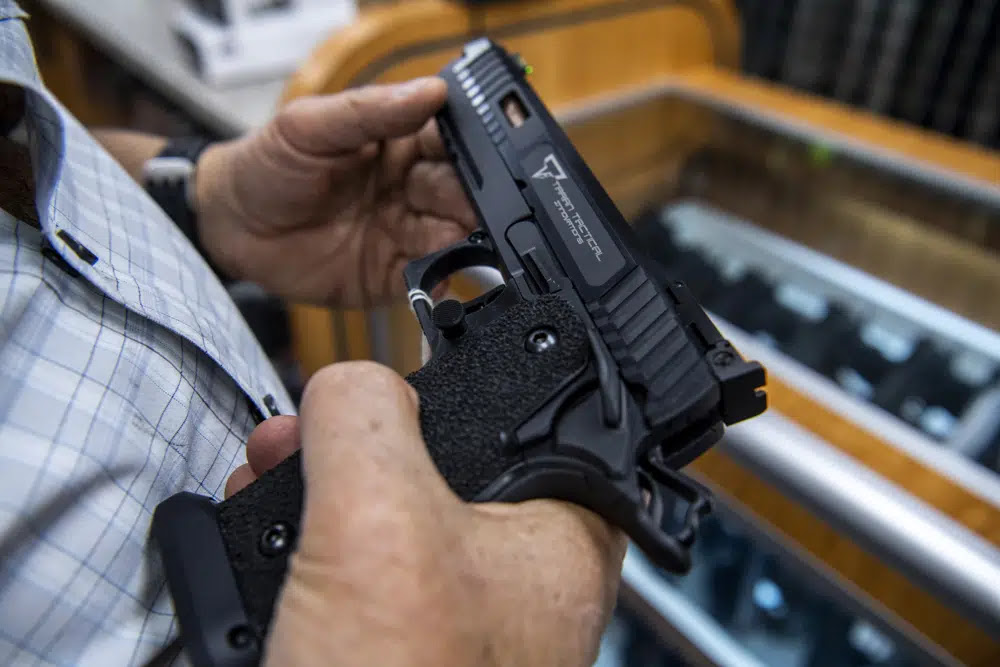
A customer checks out a hand gun that is for sale and on display at SP firearms on June 23, 2022, in Hempstead, New York. A landmark Supreme Court decision on the Second Amendment is dismantling gun law across the country, dividing judges and sowing confusion over what firearm restrictions can remain on the books. Experts say the high court’s ruling that outlined a new test for evaluating gun laws left open many questions, resulting in an increasing number of conflicting decisions as lower court judges struggle to figure out how to apply it. (AP Photo/Brittainy Newman, File)
WASHINGTON (AP) — A landmark U.S. Supreme Court decision on the Second Amendment is upending gun laws across the country, dividing judges and sowing confusion over what firearm restrictions can remain on the books.
The high court’s ruling that set new standards for evaluating gun laws left open many questions, experts say, resulting in an increasing number of conflicting decisions as lower court judges struggle to figure out how to apply it.
The Supreme Court’s so-called Bruen decision changed the test that lower courts had long used for evaluating challenges to firearm restrictions. Judges should no longer consider whether the law serves public interests like enhancing public safety, the justices said.
Under the Supreme Court’s new test, the government that wants to uphold a gun restriction must look back into history to show it is consistent with the country’s “historical tradition of firearm regulation.”
Courts in recent months have declared unconstitutional federal laws designed to keep guns out of the hands of domestic abusers,felony defendants and people who use marijuana. Judges have shot down a federal ban on possessing guns with serial numbers removed and gun restrictions for young adults in Texas and have blocked the enforcement of Delaware’s ban on the possession of homemade “ghost guns.”
In several instances, judges looking at the same laws have come down on opposite sides on whether they are constitutional in the wake of the conservative Supreme Court majority’s ruling. The legal turmoil caused by the first major gun ruling in a decade will likely force the Supreme Court to step in again soon to provide more guidance for judges.
“There’s confusion and disarray in the lower courts because not only are they not reaching the same conclusions, they’re just applying different methods or applying Bruen’s method differently,” said Jacob Charles, a professor at Pepperdine University’s law school who focuses on firearms law.
“What it means is that not only are new laws being struck down … but also laws that have been on the books for over 60 years, 40 years in some cases, those are being struck down — where prior to Bruen — courts were unanimous that those were constitutional,” he said.
The legal wrangling is playing out as mass shootings continue to plague the country awash in guns and as law enforcement officials across the U.S. work to combat an uptick in violent crime.
This week, six people were fatally shot at multiple locations in a small town in rural Mississippi and a gunman killed three students and critically wounded five others at Michigan State University before killing himself.
Dozens of people have died in mass shootings so far in 2023, including in California, where 11 people were killed as they welcomed the Lunar New Year at a dance hall popular with older Asian Americans. Last year, more than 600 mass shootings occurred in the U.S. in which at least four people were killed or wounded, according to the Gun Violence Archive.
The decision opened the door to a wave of legal challenges from gun-rights activists who saw an opportunity to undo laws on everything from age limits to AR-15-style semi-automatic weapons. For gun rights supporters, the Bruen decision was a welcome development that removed what they see as unconstitutional restraints on Second Amendment rights.
“It’s a true reading of what the Constitution and the Bill of Rights tells us,” said Mark Oliva, a spokesman for the National Shooting Sports Foundation. “It absolutely does provide clarity to the lower courts on how the constitution should be applied when it comes to our fundamental rights.”
Gun control groups are raising alarm after a federal appeals court this month said that under the Supreme Court’s new standards, the government can’t stop people who have domestic violence restraining orders against them from owning guns.
The New Orleans-based 5th U.S. Circuit Court of Appeals acknowledged that the law “embodies salutary policy goals meant to protect vulnerable people in our society.” But the judges concluded that the government failed to point to a precursor from early American history that is comparable enough to the modern law. Attorney General Merrick Garland has said the government will seek further review of that decision.
Gun control activists have decried the Supreme Court’s historical test, but say they remain confident that many gun restrictions will survive challenges. Since the decision, for example, judges have consistently upheld the federal ban on convicted felons from possessing guns.
The Supreme Court noted that cases dealing with “unprecedented societal concerns or dramatic technological changes may require a more nuanced approach.” And the justices clearly emphasized that the right to bear arms is limited to law-abiding citizens, said Shira Feldman, litigation counsel for Brady, the gun control group.
The Supreme Court’s test has raised questions about whether judges are suited to be poring over history and whether it makes sense to judge modern laws based on regulations — or a lack thereof— from the past.
“We are not experts in what white, wealthy, and male property owners thought about firearms regulation in 1791. Yet we are now expected to play historian in the name of constitutional adjudication,” wrote Mississippi U.S. District Judge Carlton Reeves, who was appointed by President Barack Obama.
Some judges are “really parsing the history very closely and saying ‘these laws aren’t analogous because the historical law worked in a slightly different fashion than the modern law’,” said Andrew Willinger, executive director of the Duke Center for Firearms Law.
Others, he said, “have done a much more flexible inquiry and are trying to say ‘look, what is the purpose of this historical law as best I can understand it?’”
Firearm rights and gun control groups are closely watching many pending cases, including several challenging state laws banning certain semi-automatic weapons and high-capacity magazines.
A federal judge in Chicago on Friday denied a bid to block an Illinois law that bans the sale of so-called assault weapons and high-capacity magazines, finding the law to be constitutional under the Supreme Court’s new test. A state court, however, already has partially blocked the law — allowing some gun dealers to continue selling the weapons — amid a separate legal challenge.
Already, some gun laws passed in the wake of the Supreme Court decision have been shot down. A judge declared multiple portions of New York’s new gun law unconstitutional, including rules that restrict carrying firearms in public parks and places of worship. An appeals court later put that ruling on hold while it considers the case. And the Supreme Court has allowed New York to enforce the law for now.
Some judges have upheld a law banning people under indictment for felonies from buying guns while others have declared it unconstitutional.
A federal judge issued an order barring Delaware from enforcing provisions of a new law outlawing the manufacture and possession of so-called “ghost guns” that don’t have serial numbers and can be nearly impossible for law enforcement officials to trace. But another judge rejected a challenge to California’s “ghost gun” regulations.
In the California case, U.S. District Judge George Wu, who was nominated by President George W. Bush, appeared to take a dig at how other judges are interpreting the Supreme Court’s guidance.
The company that brought the challenge —“and apparently certain other courts” — would like to treat the Supreme Court’s decision “as a ‘word salad,’ choosing an ingredient from one side of the ‘plate’ and an entirely-separate ingredient from the other, until there is nothing left whatsoever other than an entirely-bulletproof and unrestrained Second Amendment,” Wu wrote in his ruling.
____
Richer reported from Boston.
———————————————————————————– Nobody likes a sore loser! Oh well!!!!!!!!!!!! Grumpy
Categories
I am green with envy!

Discover Financial Services, a provider of credit cards, told Reuters it will allow its network to track purchases at gun retailers come April, making it the first among its peers to move ahead with the initiative aimed at helping authorities probe gun-related crimes.
The decision came after the International Organization for Standardization (ISO), which decides on the classification of merchant categories used by payment cards, approved in September the launch of a dedicated code for gun retailers.
Proponents of the move, including gun control activists and Democratic politicians, say it will allow financial institutions to better assist authorities in investigating crimes involving gun violence in the United States.
There has been uncertainty around the implementation, with Visa Inc, Mastercard Inc and American Express Co yet to disclose a timetable for adopting the change. Although the codes will not show specific items purchased, some Republican politicians have spoken out against the move, arguing it could violate the privacy of U.S. citizens lawfully buying guns.
Isn’t that nice? The ISO wants to know what you’re purchasing with your wealth. The ISO, an international organization – although I’m sure that U.S. banks were all too willing to comply and the ISO is just a straw man.
If you have a Discover Card, be aware that this change is coming and make appropriate arrangements.
At least Louisiana is fighting back in what I guess is the only way they can. Texas, I think, has similar laws now.