Assembly Bill 92 and Assembly Bill 301 ban citizens from delivering or taking possession of body armor, with exceptions for those in “eligible professions.” Existing federal and California state laws already prohibit violent felons from possessing body armor, with limited exceptions for employment. Law-abiding citizens own body armor for the same legitimate purposes as professional users: to protect themselves from violent criminals and for increased safety during various forms of firearm training.
Access to body armor, which is freely available from all over the world due to advances in materials science, is essential for Americans to exercise their Second Amendment right to self-defense. Bans only leave law-abiding citizens defenseless to criminals, who by definition, ignore the law.
Assembly Bill 97 increases penalties for violating California’s law on serializing home-built firearms and buying, disposing, possessing, etc., any firearm with the manufacturer name, model designation, or serial number altered or obliterated, from misdemeanors to felonies. The existing California law already goes above and beyond federal law in regulating markings on firearms. These penalties are for mere possession, which could cause otherwise law-abiding citizens, without any criminal intent, to permanently lose their Second Amendment rights.
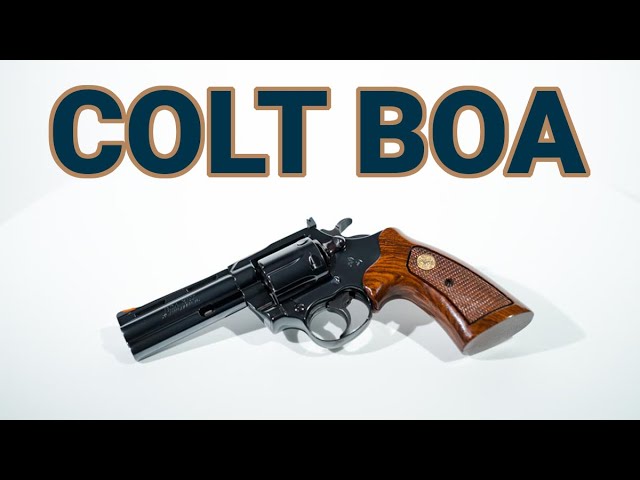
The Colt BOA was only made in limited numbers for a single year, then sold through a single distributor, making it probably the most elusive and desirable of the company’s double-action revolvers.
Between 1950 and 2003, Colt delivered to wheel gun aficionados a series of seven now-classic “snake” guns: Cobra, Python, Diamondback, Viper, BOA, King Cobra, and Anaconda. Some of these were more popular and widespread, such as the Diamondback, which was made in both .22 LR and .38 Special, while some were less frequently encountered, such as the Anaconda, which was made in .44 Mag and .45 Colt. For seekers of the seven serpents, however, a couple of these guns are almost impossible to find: the Viper, which was just a regular catalog item for Colt in 1977, and the BOA, which is even rarer.
Gun writer Jim Weller, who reviewed the BOA for American Handgunner in 1986, detailed that Colt had originally intended to produce the six-shot .357 Magnum double-action revolver to fall between the standard Mark V Trooper and the top-shelf hand-built Python, blending the features of both guns. The frame and action are that of a Trooper while the distinctive full-lug barrel is a Python trait. Call it a dressed-up Mark V or a budget Python, it was unique.
Eschewing adding it to their catalog, Colt elected to just deliver the entire factory run of some 1,200 of these crossover revolvers to distributor Lew Horton of Southborough, Massachusetts, in 1985, with limited edition consecutive serial numbers running from BOA1 to BOA1200. Of those, half of the revolvers used 4-inch barrels while the other half had 6-inch barrels. Horton also packaged one of each barrel length in 100 cased sets, meaning only 500 individual 4-inch and 500 corresponding 6-inch guns were sold.
Standard features on the BOA were the same Accro-style sights and Royal Blue finish of the Python, and a wide, target-style trigger with three grooves. Grips were checkered rosewood with a smooth backstrap and gold rampant Colt medallion inserts. The asking price from Horton at the time was $525, typically right at or just slightly under that of a new Python, making them attractive for buyers.
For the record, Weller took his T&E gun out to the range and was not disappointed by its accuracy, printing 125-grain JHP .357 pills in 2.5-inch groups at 25 yards “with disgusting regularity.” He did note that the lockup was not as tight as a Python and had a small amount of play in the cylinder, but in the end said of the BOA, “I don’t know whether or not those who buy one will actually shoot it, but it does make a good showing on the range.”
The BOA we have in the Guns.com Vault is in excellent condition, with the original Royal Blue finish only holding scattered light handling marks, and a light cylinder drag line. The grips are also excellent with sharp checkering.
It is serial number BOA0513, one of just 1,200 BOAs made and one of just 600 produced with a 4-inch barrel.
The gun was a hybrid, combining the barrel, sights, and finish of the Colt Python with the action and frame of the Colt Mark V Trooper.
The idea was to make a more affordable Python, but due to its rarity, the BOA today is worth far more than all but the most select Pythons.
Colt sold their entire run of BOAs to Lew Horton in 1985.
The thing is, once Horton was sold out of the BOA, that was it. Colt never revisited the concept. There weren’t any custom shop guns that were later turned out in small batches. No leftover parts were made up into new BOAs in the 1990s – such as what occurred with the Viper. Nada. Just 1,200 BOAs, and it’s a wrap.
If you think of vintage Colt snake guns as being Corvettes, the BOA is something akin to the Stingray L88 series. Sure, there are faster ‘Vettes (ZR1), examples that are more mechanically interesting (the ’57 Arkus-Duntov-era car with Ramjet injection), some that are arguably prettier (’63 split-window), and more comfortable – it didn’t even have an option for air conditioning or power steering – but the L88 is incredibly rare, with just 216 driving out of the factory over a three-year run. The odds of finding an L88 for sale in good condition are incredibly low. The same can be said of the BOA, now over 35 years out of production.
In short, BOAs, for Colt revolver fans especially, are the missing piece to many collections, which makes them, for many, the most charming of the snake guns.
Deer are the most popular game animal in the U.S., and there are many kinds of calibers and guns made for deer hunting. But any young hunters who think that they can just take their dad’s deer rifle out might be in for a painful surprise: recoil. Recoil is the effect that comes from the gun being fired, pushing the gun into the shooter’s shoulder, and it can be painful if you’re not prepared for it. It can cause problems like flinching, which can really cut into a shooter’s accuracy. In my experience, it’s best to start with a smaller caliber and build your way up to the bigger ones. You will need to start somewhere, but where?
Two deer-rifle calibers that are good for beginners are the .243 Winchester and .260 Remington. Developed respectively by two of the biggest and highest-quality gun and ammunition companies, these two calibers are perfect for newbie deer hunters. And they also fit into the legal limit for deer hunting calibers in many states. In most states, the required minimum caliber for hunting deer is a bullet with a diameter at least as wide as .24 inches—and the .243 and .260 fit that limit nicely.
In 1955, Winchester released the .243 to the public. It was made by the process of “necking down” the .308 caliber—which basically means the neck of the .308 Win. cartridge case was made smaller. Remington released the .260 in 1997. Interestingly enough, it was made through the same process of necking down the .308. Since the .243 Win. has been around for longer, it has had more time to gain popularity and is now one of the most popular calibers in America. The .260 Rem. hasn’t had as much time to gain popularity, but it’s showing a lot of promise.
Because of this difference in familiarity, there is also a difference in availability. Pretty much all ammo companies produce the .243, and .243 ammo and rifles chambered for it can be found at almost any gun store. The .260, however, is harder to find. Right now, only a few major ammunition manufacturers produce .260, and there are a limited number of rifles chambered for that caliber. Your best bet to find them would be to go to a larger store like Cabela’s, where they have room for a wide selection. You can also buy .260 ammo online from websites like MidwayUSA if you are over 18. Be forewarned: The .260 is rarer and larger than the .243, so that makes it a bit more expensive.
The .260 Rem. and the .243 Win. offer similar ballistic performances in most respects, except that the .260 retains energy longer than the .243. According to the NRA Firearms Sourcebook, it takes about 1,000 ft/lbs of terminal energy to reliably kill a deer. The .243 keeps its terminal energy above 1,000 ft/lbs out to about 300 yards, but after that its terminal energy drops below 1,000 ft/lbs. The .260, however, keeps its terminal energy above 1,000 ft/lbs out to 400 yards before falling below that standard. This means that a .260 can cleanly take a deer 100 yards further away than a .243 can. Depending on where you live, this may make a big difference…or almost none at all. In the Great Plains states, hunters will often have to make shots from long distances. For these hunters, a gun with a better downrange performance, like the .260, can mean the difference between a successful hunt and going home empty-handed. However, in the rest of the country, especially the East, people tend to hunt at closer distances in forested areas. For these hunters, that extra 100 yards won’t make much of a difference.
In my own experience, I’ve taken deer with both the .243 and the .260, and both have worked well for me. The recoil on these guns is very manageable, but they both still perform well and make good, clean kills. Any beginning deer hunter, and for that matter any beginning shooter, should be able to handle the .243 and the .260. My dad and I took my friend Ryan out to the range with me to shoot guns in both calibers. He had never shot anything bigger than a .22, and was not an experienced shooter. Still, Ryan was able to shoot these guns accurately and without a problem. He was nervous at first, but when we really got into shooting, he started to enjoy it. The kick on these guns didn’t make much of a difference to him. So for any beginning deer hunter, the .243 and .260 are the calibers for you. They can help you build up your resistance to the recoil of larger guns while helping you bag bucks and have a blast.