Category: All About Guns

While Hochul was trying to make the case that preventing responsible gun owners from being able to exercise their right to carry is beneficial to public safety, however, an incident in Largo, Florida that unfolded just a few hours before the debate in New York once again proved the value of the right to bear arms; not only for self-defense but for the defense of others as well.
A bystander drew his gun on a man accused of beating and stomping on his pregnant girlfriend outside a Publix super market, ending the “brutal” attack, Florida deputies say. The incident occurred around 5:15 p.m. Saturday, Oct. 22, in the parking lot of the Largo grocery store, according to an arrest affidavit.
The woman told Pinellas County deputies that her boyfriend, Cole Danisment, 27, got angry and punched her in the face repeatedly. She fell to the ground, and Danisment is then accused of stomping on her head and upper body.
The woman told deputies that Danisment knew she was 14 weeks pregnant with his unborn child. A man who witnessed the attack said he feared for the woman’s life, prompting him to intervene. Danisment didn’t stop brutalizing the woman until the witness pulled a gun on him, according to the affidavit.
According to police, Danisment had a no-contact order issued just last week after another domestic violence arrest that prohibited him from being anywhere near the woman he allegedly assaulted. That court order didn’t stop him from allegedly carrying out the brutal assault of his girlfriend, obviously. It took a stranger who was lawfully carrying concealed to bring the attack to a close without it escalating any further.
Under the concealed carry restrictions imposed by Kathy Hochul and her anti-gun allies in the New York legislature, that armed citizen would have been committing a felony offense if he’d saved that woman from being assaulted in a grocery store parking lot in Albany or Westchester County. Private property is considered a “gun-free zone” by default under New York’s new laws, and unless the grocery store had explicitly posted signage allowing concealed carry on the premises the armed citizen’s life-saving actions would likely have been “celebrated” with his arrest and prosecution.
The sad truth is that Kathy Hochul’s “public safety” measures have largely been aimed at restricting the public’s ability to protect themselves and others. Even now she and her buddies like Attorney General Letitia James are fighting in court to prevent responsible gun owners from exercising their right to carry, including pastors who were previously able to carry at church, arguing that by making it illegal to do so the law will somehow stop determined killers from invading the sanctuary and targeting the parishioners inside. In Hochul’s view, no one is really responsible enough to carry a firearm for self-defense, so their ability must be curtailed and criminalized as much as possible.
As we once again saw in Florida on Tuesday night, that kind of mentality puts good people at risk. Armed citizens save lives, and I hope that voters across the country reject the anti-gun ideology offered by Democrats like Hochul on Election Day.
The Guns of John Pedersen

So, do you know who the first gun collector was? I’m not sure myself but I do know that the Bible, in the first book of Genesis, speaks about the spoils of war and captured booty. No doubt amidst all the plundering mentioned in the Old Testament, some weapons of warfare were certainly earmarked as trophies. We do know that a few of our founding fathers were gun aficionados and were quite the collectors by 18th century standards with Washington and Jefferson being well known for their interest in acquiring fine arms.

Last week I had the privilege of touring the brand new Museum of the American Revolution in Philadelphia. There is quite the collection of swords, sabers, pikes, muskets and rifles on display in a most spacious and well appointed facility. A rare, and previously unknown to me, Ferguson rifle caught my eye from across the room which made the admission price worth every penny. On the way out of the museum, I was taken aback by a wall of photographs illustrating some of the last surviving participants in the revolution who passed unto their eternal reward just as photography was beginning to become a practical method of capturing an image. One of the images stopped me short in my tracks and caused me to do a double take.


It was a photo of Nicholas Veeder of Schenectady, N.Y. He had participated in the Battle of Oriskany (1777) when he was 15 years old. In 1862, at the age of 101, he was New York’s last surviving veteran of the revolution. He is pictured in front of his museum “Fort Veeder” with many muskets and the famous “Liberty” flag prominently displayed around him. While I doubt that musketman Veeder opened the first museum with a prominent gun collection on view, I am willing to guess that his was the first one ever photographed. Endeavoring to learn more about Veeder, I browsed online for him and found out that the photo displayed at the Museum in Philly was severely cropped and Veeder had a LOT more guns than I was lead to believe.
So while our own National Firearms Museum may be quite proud of our modest collection that soon turns 82 years old, we owe a debt of gratitude to veterans like Nicholas Veeder of Schenectady, who were not only eyewitnesses, but thoughtful enough to preserve their experiences, and their firearms, for future generations to appreciate.

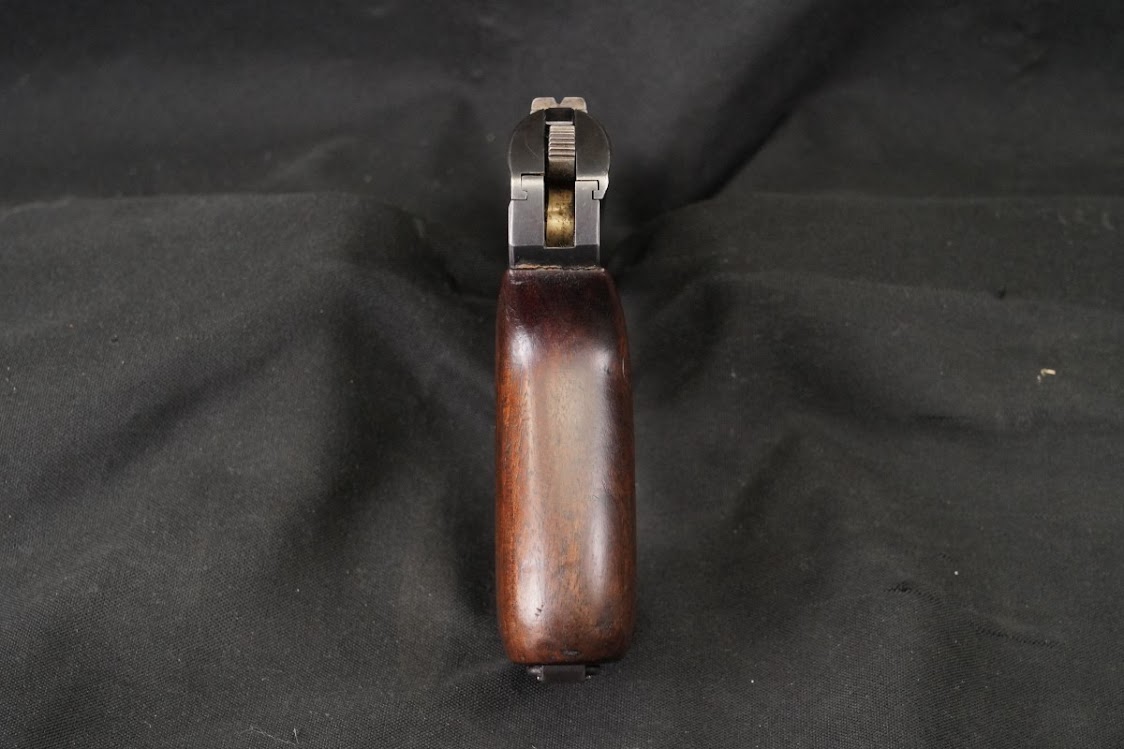
Q: My father was a private first class in the 17th Airborne Division and made the parachute jump into Germany where he acquired an unusual semi- automatic pistol from a surrendering German SS officer. The gun is marked “DUO” on its stocks.
A: You have a Czech DUO pistol. The most interesting thing is that German officers were not supposed to carry 6.35 mm (.25 ACP) pistols, only 7.65 mm Browning (.32 ACP), for their personal military use. But, last year, a French contributor to an Auto-Mag collector magazine published a photo of a soldbuch belonging to a German World War II soldier, and it states he was allowed to own and carry a DUO .25 ACP pistol.
The soldbuch served as a form of identification and record-keeping. It was the standard identity document in the German military, issued to every man. It allowed the owner to draw pay, prove he had permission for leave, recorded what equipment he had been issued and identified his current and former units.
—Michael F. Carrick, Contributing Editor

Riverside County Sheriff Chad Bianco recently sent out a notification to concealed carry holders in the county alerting them to a public records request from Viacom-CBS for “the names of all people with concealed carry permits.” Bianco says that after the request was received, the department reached out to attorneys to “determine if their were any valid exceptions the department could use” in order to prevent handing over those names to the media. According to Bianco, an “outside legal analysis” determined that the California Supreme Court ruled all the way back in 1986 that if media outlets request this information, “public agencies must disclose the full names of concealed weapons permit holders.”
Bianco says he had no choice but to release the names of all those Riverside County residents who possess a valid concealed carry license, and in his alert to permit holders told them that he doesn’t take this matter lightly. Still, the sheriff says that because of “court precedent and a lack of protections” within the state’s legal code he was forced to hand over the information, and encouraged those “seeking a change” to state law to contact their local legislators.
I’m actually somewhat torn here. If California were a true “shall issue” state, then I don’t think there is any compelling public interest in knowing the names of those who possess a concealed carry license. In “may issue” states, however, I think the argument can be made that the subjective and arbitrary issuance of carry license is deserving of public scrutiny. Look at what’s going on in Santa Clara County, California right now, where Sheriff Laurie Smith is currently on trial in civil court on charges of corruption after allegations that deep-pocketed donors to her re-election campaign were given rarely-issued concealed carry permits in exchange for their “support”. While the powerful and well-connected were handed permits, those who didn’t have that same special relationship with the sheriff’s office were often left twisting in the wind without even a formal denial.
A former manager for a Silicon Valley security business testified at a sheriff’s civil corruption trial that he and the company’s CEO agreed to provide political donations in exchange for concealed-weapons permits.
Martin Nielsen, who implicated a Santa Clara County sheriff’s captain and others in the alleged bribery scheme, testified publicly for the first time Monday at Sheriff Laurie Smith’s trial.
He detailed how he was tasked with finding a way to get concealed-carry permits for AS Solutions security agents who were assigned to high-profile clients, the Mercury News reported. The effort followed a 2018 shooting at the YouTube campus in San Bruno in which a woman wounded three people before killing herself.
The now-defunct security company’s high-profile clients included Meta CEO Mark Zuckerberg. Nielsen testified that he and AS Solution’s then-head Christian West agreed to financially support Smith’s 2018 reelection bid in exchange for the permits for security agents assigned to protect executives for the company then known as Facebook.
… Nielsen, testifying under a grant of immunity from criminal prosecution, said he and West arranged to donate a large sum to an independent expenditure committee backing Smith’s reelection.
“Did you come away with the understanding you would get 10 to 15 permits?” prosecutor Gabriel Markoff asked.
“Yes,” Nielsen replied.
… Nielson did not state the precise donation amount in his testimony because San Mateo County Superior Court Judge Nancy Fineman had limited what details Nielsen could give in front of the jury.
However, in past testimony, Nielsen said $90,000 was the agreed amount, though only $45,000 was ever donated. The other half was scuttled after the bribery and corruption probe got underway in 2019.
Nielsen also testified that he was unilaterally exempted by a sheriff’s captain from having to qualify under a legally required firearms proficiency test, and was instructed to obscure their association with the security company to avoid negative optics.
“They could not all be AS Solution,” he said. “Something about the fact it was a security company and it didn’t look good.”
If the powerful and well-connected are afforded access to their right of armed self-defense while the vast majority of applicants are denied, that’s a legitimate news story. Having said that, the scandal in the Santa Clara County Sheriff’s Department wasn’t uncovered by local media, but by the Santa Clara County D.A.’s office. While the publicly available information could have been used by news outlets to uncover the alleged shady situation in the sheriff’s office, it looks instead like it was campaign finance disclosures that actually raised suspicions of prosecutors, with the media only picking up on the scandalous allegations after a search warrant was served on the sheriff’s office.
While there’s a theoretical benefit to publicly disclosing the names of concealed carry holders in “may issue” states, in practice this leads to responsible gun owners being put at risk of burglary and theft, and may even help aid stalkers learn whether their potential victims are armed or not. Unfortunately, for now this policy is the law of the land in California, and concealed carry holders can be outed by their local media. Whether that law would withstand constitutional scrutiny in light of the test laid out by the Supreme Court in Bruen is another question entirely, however, and I hope that one or more of the 2A groups operating in the state will challenge that 1986 California court decision by using the Bruen test in the very near future.
Stunning Cartridge Colt Firearms
When Jack Dean patrolled the lonesome roads of west Texas in the 1960s, he didn’t know he’d cross paths with an infamous hitman with a famous son.
Dean joined the Texas Highway Patrol in 1960 after being laid off from an aircraft plant in Fort Worth. After 10 years, he was recruited to the Texas Rangers in 1970 where he rose to the rank of captain before he retired to become U.S. Marshal for the Western District of Texas in 1993. He is one of six Texas Rangers to serve as a U.S. Marshal.
When he joined the Rangers, there was no training.
“They gave you a pistol and a badge, and it was go to work,” Dean said in an interview with the Texas Rangers Hall of Fame and Museum. “They just turned you loose and you leaned on your fellow Rangers.”
A factory engraved Colt Single Action Army with carved steer handgrips that Dean carried while on duty is on offer in Rock Island Auction Company’s May 13-15 Premier Auction. The gun, with factory engraving, was sold to “E. Cosgrove” of Silver City, New Mexico Territory after it was shipped to Simmons Hardware Company in St. Louis, Mo., on Nov. 24, 1906. The right grip features a carved raised steer head.

Texas Panhandle
With the highway patrol, Dean was first assigned to Pecos in the Texas panhandle, a lonely, desolate place.
“I went two or three hours without seeing a car. Just a few jack rabbits, deer, and rattlesnakes, that’s about all,” he said in the interview. He was transferred a few years later to Tyler where he met some Texas Rangers who would become friends and recruit him to join them.
As a Ranger, Dean found himself first assigned to the Rio Grande Valley on the heels of the 1966-67 farm strikes that caused friction between migrant workers and law enforcement in the region. There he worked under a comparatively progressive new captain whose task was to rebuild relations with local residents and migrants, and train a new generation of Rangers on how to enforce the law in the post-Civil Rights movement era.

Harrelson – Not That One, but Close
Soon he would cross paths with Charles Harrelson, actor Woody Harrelson’s father and a hitman for hire. Dean described the senior Harrelson as someone with a “gambler’s personality.”
They first met in 1970 while Harrelson was in jail charged for a murder in McAllen, Texas, after a hung jury failed to convict him in a murder-for-hire case. The defense produced a nightclub singer as a surprise witness who offered questionable testimony claiming she was with Harrelson at the time of the murder. Dean spent four years gathering evidence, finding witnesses, and investigating Harrelson’s attempted jail breaks before a re-trial in Brownsville.
Prior to the the 1974 retrial, the Texas Rangers got a perjury arrest warrant for the nightclub singer who hot-footed to the Caribbean. Harrelson was convicted and received a 15-year sentence but served five.
Assassination
Judge John Howland Wood Jr., appointed to the bench in 1970, earned the nickname “Maximum John” for handing down long sentences on drug cases. He was fatally shot outside his San Antonio condominium in May 1979, the first of three federal judges assassinated in the 20th century and the first in more than a century.
No leads developed at the start of the case so the FBI called the Texas Rangers, and Dean, for assistance. At one point, Dean received an anonymous phone call stating that Harrelson was in San Antonio when Wood was killed.

Dean and investigators learned that a drug dealer, Jamiel Chagra, of El Paso, was to be in court in front of Wood the day of his death. They also had a recording of a meeting in jail between Chagra and his brother that implicated a murder for hire scheme involving Harrelson.
Dean shared everything he knew about Harrelson with the FBI and was sent on his way. Police arrested Harrelson on reports that he was randomly firing a gun at imaginary FBI agents while on a cocaine binge.
“He wasn’t a bad guy to talk to, he’d just kill you, you know, but he wouldn’t kill you unless somebody paid him to. He wasn’t cold-blooded, you know, go stab, kill everybody…,” Dean recalled of Harrelson. “(But) if you pay him a million dollars or $500k well he would take out anybody.”
Harrelson claimed at trial that he didn’t kill the judge but took credit for it to get a larger payment from Chagra. He was convicted and received two life terms. In 2003, Chagra recanted his testimony, saying it wasn’t Harrelson who shot the judge.
The recanted testimony spurred Woody Harrelson, now a famous actor, to try to free his father. By that time, the senior Harrelson, who had tried to escape prison in Georgia, was now confined at a super max prison in Colorado so Dean had to travel to Denver for hearings.
Dean, who always found his nemesis charming and personable, helped arrange for Harrelson to meet his grandchildren and recalled receiving a nice note from the senior Harrelson thanking him for the opportunity. Harrelson died in 2007 in prison.
“I don’t think we caught him for everything he ever did,” Dean said. “I think he slipped one or two around on us somewhere.”

Henry Lee Lucas
Jack Dean wasn’t part of the investigation of Henry Lee Lucas, a fabulist who confessed to 600 murders across the country, but knew of two cases in particular that he believed Lucas committed.
Lucas murdered his mother in 1960 and two others in 1983. While in prison in Texas his confessions of hundreds and hundreds of murders made him the most prolific serial killer in history. He was convicted of murdering 11 in Texas and condemned to death, but that notoriety came with an asterisk.
The Dallas Times-Herald investigated and showed that many of the murders Lucas confessed to were impossible for him to have committed. A follow-up investigation by the Texas Attorney General showed that he was an extraordinary liar who had nothing to lose by confessing. He recanted all of his confessions except for his mother’s murder. His death sentence was commuted to life in prison in 1988.
The Texas Rangers were criticized for offering inducements like nice meals and television time that gleaned confessions from prisoners like Lucas who figured out how to game the system for his benefit. Investigators also shared case files with Lucas to help refresh his memory.
Dean said in the interview for the Texas Rangers Hall of Fame and Museum that he thought Lucas committed a couple of murders but couldn’t get enough evidence to prove it.
Texas Ranger Duty Revolver
Jack Dean’s duty weapon was a Colt Single Action Army shipped in 1906 to a hardware store in St. Louis, Mo., and was purchased by E. Cosgrove of Silver City, New Mexico Territory. It features factory engraving and pearl grips with a carved steer head motif, according to the factory letter. The engraving has classic factory scroll, floral, and wavy lines from master engraver Cuno A. Helfricht, the head of Colt’s engraving shop from 1871 to 1921.

Eugene Cosgrove was a pioneer in the New Mexico territory and operated the E. Cosgrove Hardware Store in Silver City. The gun also has the name “Buck,” that appears as “Buch” on the backstrap. Buck Galbraith was a jailer, constable, deputy sheriff, and marshal in the town of Deming, near Silver City, in the late 19th and early 20th centuries before resigning in 1907. The gun with “Buck” engraved on the backstrap was given to Galbraith as a retirement gift, long before Dean acquired it.
The nickel-plated Colt SAA is a fine connection to the changing frontier of the late 19th and early 20th centuries in the New Mexico territory and, with its mild wear that comes with being at a lawman’s side for many years, an attractive representation of Texas law enforcement history as the everyday carry of only the sixth man to serve as a Texas Ranger and U.S. Marshal.