Sayago: police officer had ice cream with his son and repelled a shooting assault
Two men approached the ice cream parlor, the policeman identified himself and repelled them.
One of the criminals ended up injured.
Sayago: police officer had ice cream with his son and repelled a shooting assault
Two men approached the ice cream parlor, the policeman identified himself and repelled them.
One of the criminals ended up injured.

In 1968, Marvin Gaye and Tammi Terrell grooved their way across the American airwaves with the lyrics, “Ain’t nothing like the real thing, baby!” And when it comes to the guns serious collectors will pay real money for, they couldn’t have been more correct. Clones, near copies and models that borrow the features of popular guns sell well enough. But for some folks, only the genuine article will do.
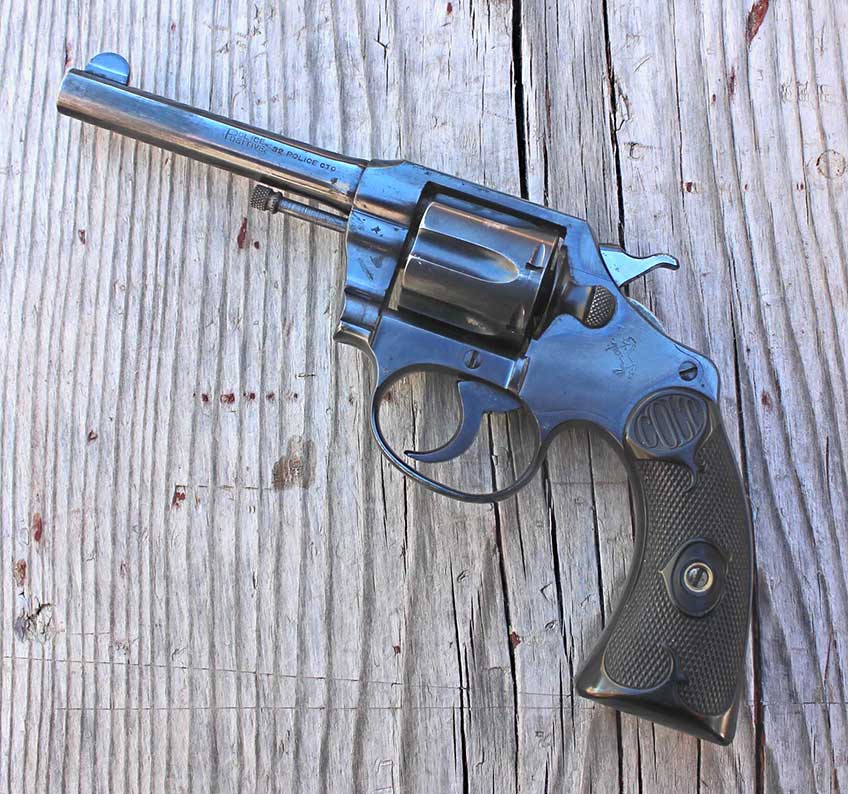
Just look at all of the enthusiasm surrounding the re-release of the Colt Python. Like many others, I spent years pining for an authentic Python to join my personal collection. But the two times I came across them in the wild, the price tags were far out of my reach. So I struggled on without a Colt to call my own until about a decade ago. That was when I found a Colt revolver that nobody really wants.
The revolver in question is a Police Positive, one of Colt’s small-frame double-action revolvers manufactured from 1907 to 1947. “Now hold up there, Gil!” you might say. “The Police Positive is a highly desirable collector’s item, with some models selling for as much as $1,200 these days. How can you say nobody wants it?”
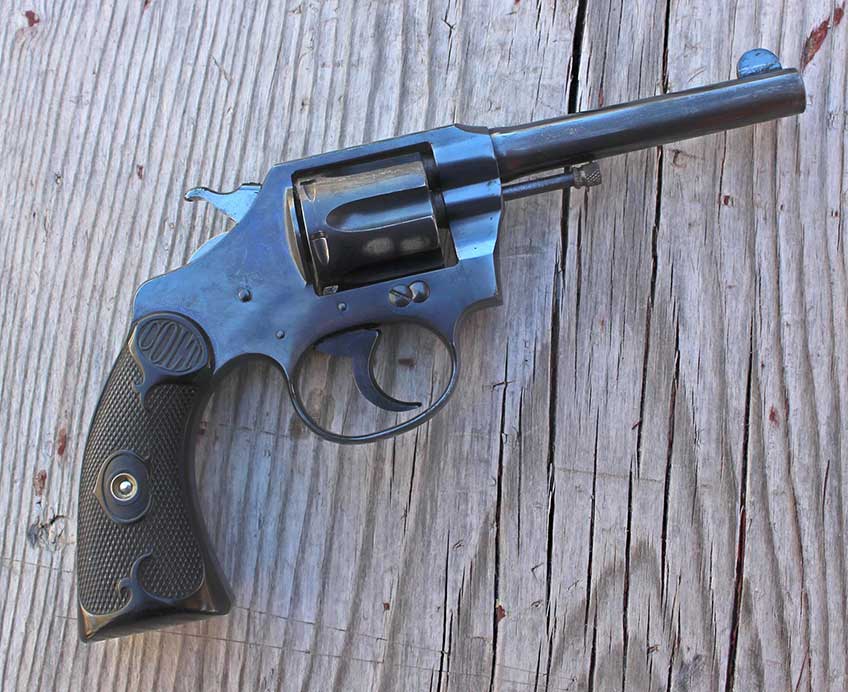
Well, not all of them command a high price from collectors. With a 40-year production history under its belt, the Police Positive was made in several variants. They were made with barrel lengths ranging from 2.5″ to 6″, with a polished blued or nickel finish along with wood or hard rubber grips. Caliber options included .22 LR, .32 Long Colt, .32-20 Winchester and .38 Special.
There are two additional caliber options you may bump into that are a bit confusing if you don’t know the history of these guns. Namely, the .32 Colt New Police and the .38 Colt New Police. The truth is they don’t exist. Colt executives didn’t want to provide any advertising for one of their top competitors. So they invented new names for the .32 S&W Long and .38 S&W cartridges so as to avoid stamping the Smith & Wesson logo on the barrels of their guns.
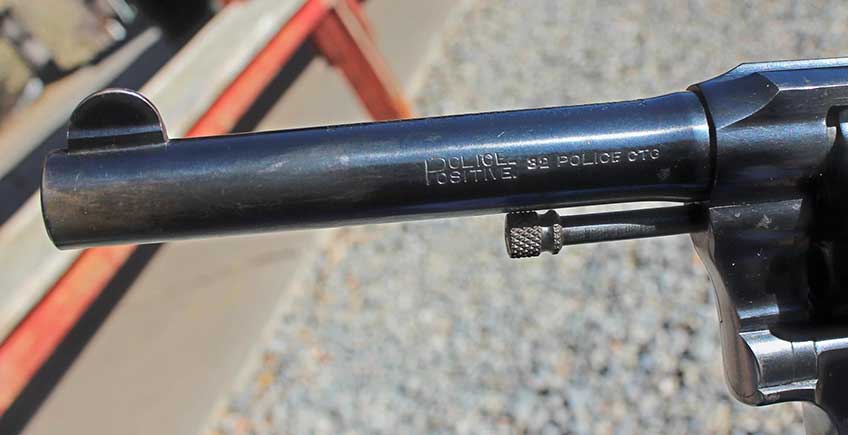
When I found the Police Positive you see here, it was one of two 4″ barrel blued models with rubber grips laying side-by-side in a pawn shop display case. It’s interesting just how much the caliber a vintage firearm is chambered in can be a determining factor in its value. The other one was chambered in .38 Special, it was in fair condition, and it had a price tag of $600, despite some pitting on the cylinder.
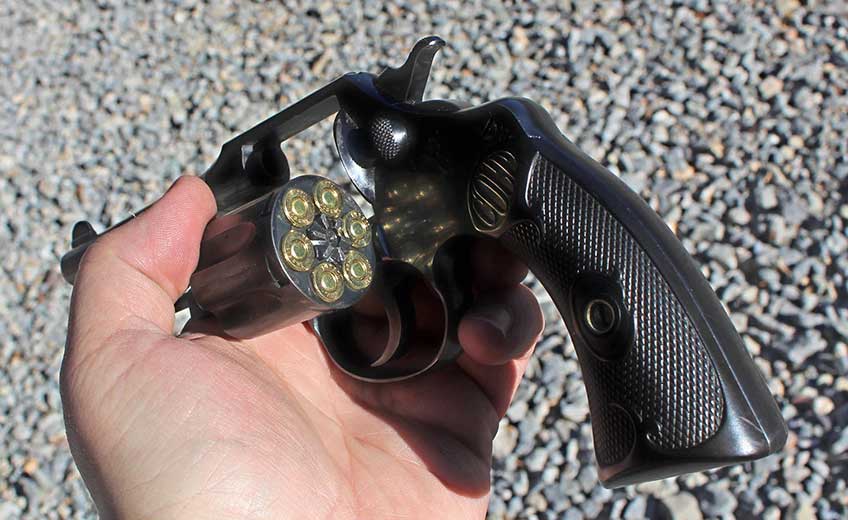
This one was in very good condition. It exhibited a buttery smooth, hand-tuned action that revolver enthusiasts long for. The grips were in great shape, the bore and chambers were clean and most of the bluing was intact with some visible holster wear at the muzzle and along the sides of the cylinder. The price tag was a whopping $129. Why? Because the barrel is stamped .32 Colt New Police, meaning that it shoots the now-obsolete .32 S&W Long.
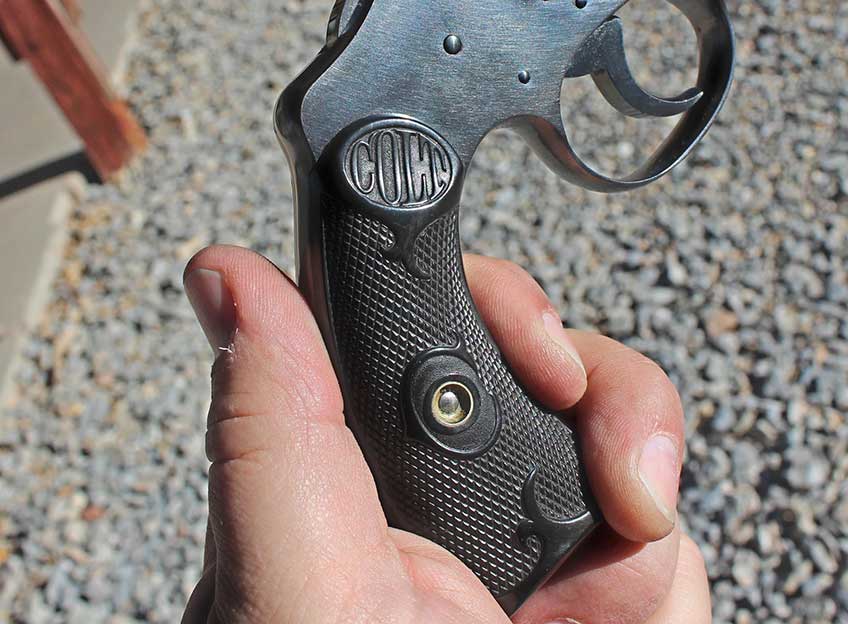
I fell in love with it on the spot. What was not to love? Here was a piece of shooting history that I could take home for less than a used .22-cal. rifle. It has such sleek, clean, classic lines and such intriguing little details like the checkering on the pull-back cylinder release, the small pony logo stamped on the left side of the receiver and all of the detail worked into the rubber of the grip. This particular model weighs in at 18.1 ozs. unloaded, making it feel feathery-light when pointed down.
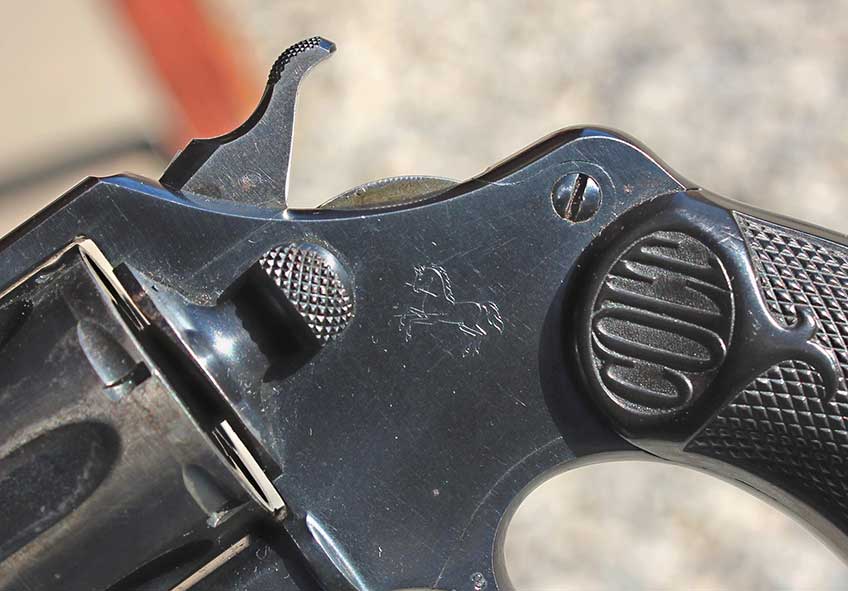
I was perfectly happy to contact Colt’s archives and pay the fee for a letter of authenticity. I learned that this particular wheel gun was made in 1924 as part of the first issue of the series, introduced in 1907, that ran until 1927. I carefully stripped down the revolver and found it to be mechanically sound inside and out.
There was a good deal of dusty, greasy build-up and oxidation under the grip panels, which may not have ever been removed since they were installed at the factory (remember, folks, to clean under your grips once in a while). I took it to a local gunsmith who knows his way around vintage firearms, and he also gave it the once-over and declared it safe to shoot.
I rooted around a few different shops until I found a single box of .32 S&W Long cartridges that had to be rescued from a nest of dusty bunnies. I shot this for the first time with my dad at one of our family’s annual Thanksgiving morning shooting sessions out behind my brother’s property. Its vintage looks, slim grip and mild recoil brought a smile to our faces. It was one of those wonderful days together that I’ll always treasure.
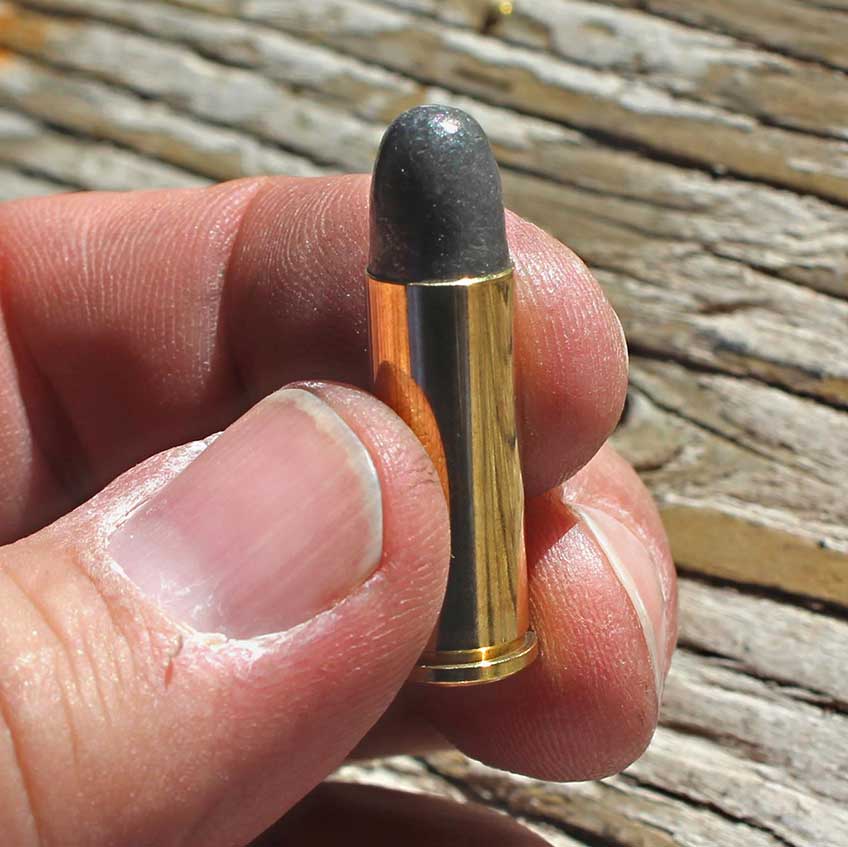
Finding .32 S&W Long ammunition is not any easier than it used to be. But I was able to wrangle up a couple of boxes of PPU (Prvi Partizan) Ammunition’s 98-gr. lead round nose loads from a local Cabela’s ahead of the latest nationwide ammunition shortage.
So what kind of performance can one expect from a .32-cal. Colt? The Police Positive was able to tap out a best group of 2.39″ with a five-group average of 2.77″ at 15 yards from a benchrest. According to a LabRadar chronograph, the average velocity for 10 rounds of the soft lead slugs was 683 f.p.s. for 102-ft-lbs. of energy at the muzzle.
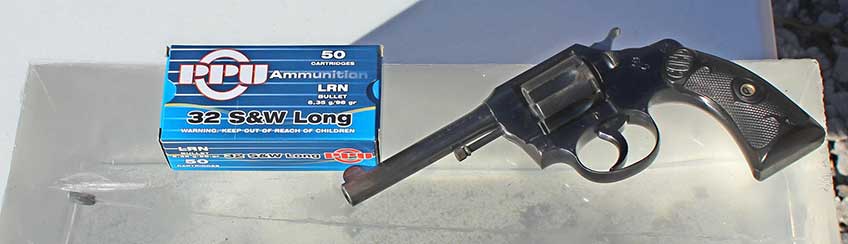
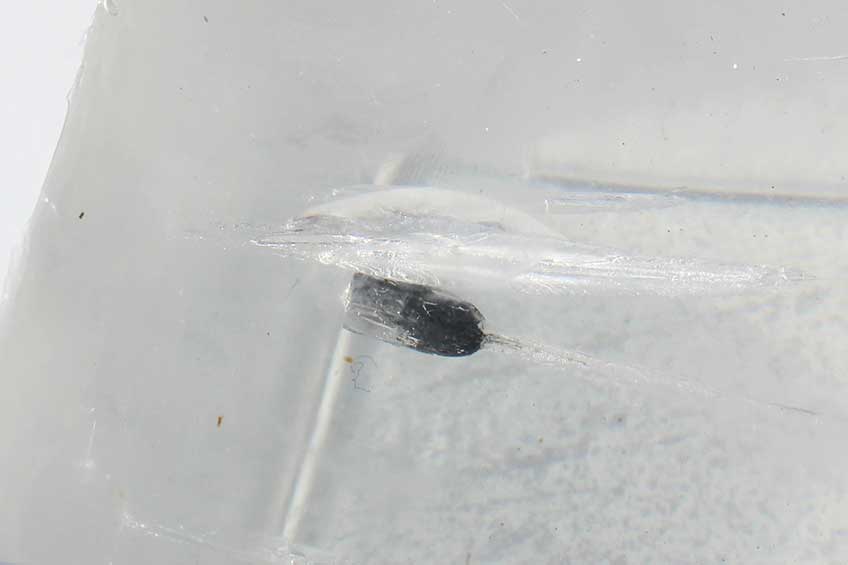
The day I was at the range with this gun, I had a few Clear Ballistics gel blocks on hand for some shotgun testing. I had an undamaged section in one block that had been used for a shotshell test and figured I should go ahead and see what this little gun could do. The round-nose bullet penetrated 14.75″ when fired from 10′ into the bare gelatin. It stopped facing backwards with no noticeable deformation. So is this gun and ammunition combination a defensive power house? Not exactly, especially when compared to today’s handgun standards. But it performed better than I expected it to.
I have to admit that I’m a bit in awe of this little Colt Police Positive revolver. Not because of what it can do, or the brand stamped on the grip, though I still take pride in owning an authentic vintage Colt. No, my respect for this piece is based on what it represents. When I look it over, I feel like I’m holding a little piece of history.
It was made without the aid of CNC machines, long before industrial computers aided drafting and without many of the manufacturing systems gun makers rely on today. This gun was built by skilled hands dedicated to hard work in factory conditions that would at the least be considered uncomfortable by today’s standards.
With its 100th birthday just around the corner, this Colt revolver not only still works, it has a smoother action than several of the modern guns I’ve shot. I’ll never know the story of this revolver’s history before it became a part of my collection.
Was it carried by a beat cop on his rounds, or was it kept close at hand for home defense? Did it help to preserve someone’s life, or did it just come out of the safe once in a while for a few pot shots at some tin cans? What I do know is that it’s now a part of my family’s history, and it didn’t cost a small fortune to enjoy it.
Specifications:
Manufacturer: Colt’s Manufacturing Co, LLC
Model: Police Positive
Action: Double-Action Revolver
Date of Manufacture: 1924
Chambering Stamp: .32 Police CTG.
Chambering: .32 S&W
Finish: Blued Carbon Steel
Grips: Checkered Hard Rubber
Sights: Fixed
Single–Action Trigger Pull: 5-lbs. 7-oz.
Barrel Length: 4″
Overall Length: 8″
Cylinder Width: 1.25″
Weight: 18.1-oz.
Capacity: 6 Rounds
Twist: 1:16 RH
Rifle Grooves: 6

It’s tough for the modern mind to comprehend the scope of the Second World War. During those six years, the combatant nations produced enough bullets to shoot every human being on the planet forty times. 12.2 million Americans served. 407,316 died.

The final planetary death toll was somewhere between 70 and 85 million people. That’s roughly 3% of the world’s population. Nearly one-fifth of the Soviet population perished.

WW2 touched almost everybody on earth. If you didn’t have a loved one serving you certainly knew someone who did. My friend enlisted in 1940.

He fought in North Africa before heading to Sicily for Operation Husky. He then landed at Salerno in September of 1943 as part of Operation Avalanche. Afterward, he fought past places like Rome and Monte Cassino. Nearly 70,000 Allied soldiers died in the Italian campaign.

By the mid-1940s warfare was a very dynamic thing. The advent of the tank and, more importantly, the military truck ensured that battle lines ebbed and flowed with the vagaries of fate, strategy, and logistics. The Italian campaign, however, lasted nearly two years. This gave the combatants time to get to know each other.

Italy was a grunt’s nightmare. Steep natural defiles impeded maneuver while minimizing the effectiveness of air power and artillery. When combined with cold, wet, miserable weather this all conspired to create a relatively static battlefield, particularly in wintertime. In 1944 with the offensive temporarily stalled my friend’s unit dug in and made itself at home.

Things then got a bit weird. In some areas, the German and American positions were within shouting range, sometimes for days on end. In my buddy’s unit, nobody spoke German. However, a few of the corresponding Germans did speak English. The two sides would pass the time by hurling insults at each other punctuated by the occasional hand grenade. My friend acquired a decent repertoire of German profanity.

In this particular area, the Americans held the ridgeline, while the Germans occupied the valley. Each side would sporadically exchange rifle and machinegun fire as necessity dictated. However, most grunts on both sides just wanted to live long enough to go home.


A modest road snaked through the valley at the base of my buddy’s ridge. Fairly frequently German troops would cruise down the road, sometimes in vehicles like trucks or Kubelwagens, occasionally on horseback, and often on foot. The road was at the limits of effective rifle range but oriented directly underneath the American positions.

My friend said neither side was in any real hurry to shoot at the other. Small arms fire invariably precipitated mortars or artillery in response. Nobody likes being on the receiving end of the field artillery. One frigid evening as my buddy sat shivering in his foxhole he had an epiphany.

The next afternoon late he and his pals took a bunch of Mk 2 hand grenades and packed snow tightly around them before pouring water over the whole frozen mess. The water froze in short order, locking the grenade spoons in place. The US troops then gently removed the safety pins from the grenades and gave these high explosive snowballs a gentle shove down the mountainside.

By the time these frosty bombs reached the bottom of the hill, they were thoroughly encased in ice and ample accumulated snow. The geography of the situation was such that each diabolical frozen snowball came to rest in the road below. Then they just waited.

The English word “grenade” dates back to the 1590s and is derived from the French word “pomegranate.” The hand grenade’s obvious similarity to this poly-seeded fruit was the overt inspiration. The concept of the hand grenade dates back much farther, however.


Simple incendiary grenades were used by the Byzantines as far back as the 8th century. Byzantine troops found that they could fashion glass and ceramic containers filled with Greek Fire and use them to visit chaos upon a nearby enemy. Greek Fire was some fascinating stuff indeed.

Even today nobody is completely sure what made up Greek Fire. The stuff was most typically expelled from a device similar to a modern-day flamethrower and was used in ship-to-ship naval battles. Greek Fire was rumored to continue burning once in contact with water. Some suggested components included quicklime, naphtha, pine resin, sulfur, niter, and calcium phosphide.

True explosive grenades as we appreciate them really arose in China about a thousand years ago. They were rather theatrically called Zhen Tian Lei or “Sky-Shaking Thunder.” These rudimentary devices consisted of gunpowder packed into metal or ceramic containers. Fuse-fired cast iron versions first saw service in Europe in the mid-1400s.

The Ketchum Grenade was fin-stabilized and featured a nose-mounted impact fuse. These weapons were first used by Union forces during the American Civil War. Confederate counterparts were simpler spherical things that weighed up to six pounds and used sensitive paper fuses.

In 1902 the British War Office declared hand grenades to be obsolete. However, nobody bothered telling the Germans so they started churning out stick grenades by the zillions in 1915. In that same year, the British saw the light and began producing the Mills Bomb, the world’s first truly modern fragmentation grenade.

The Mills Bomb was a product of the fertile imagination of one William Mills and was deeply serrated. In theory, this was supposed to create predictable fragmentation. In practice, these knobs made very little difference to exactly how the grenade burst. The typical British Tommy was expected to be able to throw a Mills Bomb at least thirty meters, though the danger zone was advertised as being closer to 100. By the end of WW1, the warring nations had produced about 75 million hand grenades.

The Mk 1 grenade was one of the world’s first time-fused grenades. However, deploying the Mk 1 was a fairly convoluted chore, and many were thrown without being properly lit. The Germans were frequently all too willing to light these things up and toss them back. This led to the definitive Mk 2.

The classic Mk2 Pineapple grenade was first introduced to US forces in 1918 just as the First World War was winding down. Despite orders for some 44 million copies very few of these handy little bombs saw service before the armistice. By the onset of WW2, however, the Mk 2 was ready for prime time.

The Mk 2 hand grenade featured a cast iron body with a grooved surface divided into forty prominent knobs in five rows of eight columns. Like the Mills Bomb, these knobs actually did very little for controlling fragmentation but did make the grenade easier to grip. The obvious similarity to the pineapple fruit forever associated the two terms.

The Mk 2 typically sported a time fuse with a 4 to 5-second delay. Fillers included TNT, Grenite, a 50/50 combination of amatol and nitrostarch, a proprietary explosive called Trojan comprised of ammonium nitrate, sodium nitrate, and nitrostarch, or smokeless EC powder.

EC powder was a 19th-century formulation of potassium nitrate, barium nitrate, and nitro-cotton gelatinized with ether alcohol. This same stuff was sometimes used as a propellant in shotgun shells. The Mk 2 weighed about 21 ounces depending upon the particular filler and was most unpleasant up close, particularly in enclosed spaces.

By late winter, the snow was thick on the ridgeline, but the temperature fluctuated from sunny and warm in the daytime to well below freezing at night. My friend and his buddies would liberally seed the German road below with frozen snowball grenades at night and then go about their business. The following day the sun would come up and gradually melt the ice-encased bombs.

The end result was a steady stream of random detonations along the German road throughout the day. My friend said he had a clear conscience as he was effectively harassing the enemy without exposing himself or his men to any incremental danger. After the first few days of random grenade explosions, the Germans lost their enthusiasm and stopped running couriers and supply vehicles within sight of American positions.

My pal told me that, as near as he could tell, they never killed anybody with their curious explosive snowballs. However, they did effectively deny the enemy use of a handy supply and communications route while suffering no casualties in the process. Eventually, the weather improved and Allied forces resumed pushing the Germans back up the Italian peninsula.

Like most heroes of his generation, my friend came home from the war ready to create and to build. He went decades without discussing his wartime experiences with anybody, preferring to focus on more pleasant stuff. I was blessed with this story sitting on a porch swing with him soon after I finished Airborne School back in the 1980s.

Our friendship blossomed, and I got to hear many such tales. Along the way, I also married his granddaughter. He was and remains one of my heroes.


